Introduction
The terrestrial invertebrate biodiversity of Antarctica is low compared to other polar systems and only a few higher taxa such as mites, springtails, nematodes, rotifers and tardigrades are represented here (Convey et al. Reference Convey, Gibson, Hillenbrand, Hodgson, Pugh, Smellie and Stevens2008). Of these, nematodes are among the phylogenetically highest taxa that occur in Antarctic soils and sediments (Wall & Virginia Reference Wall and Virginia1999). Nematodes are widely distributed throughout the Antarctic, but local species richness and abundances are low, even compared with other species-poor ecosystems (Wall & Virginia Reference Wall and Virginia1999). However, many of the nematode species occurring in Antarctica are endemics that are highly specialized and well adapted to the harsh conditions (Convey et al. Reference Convey, Gibson, Hillenbrand, Hodgson, Pugh, Smellie and Stevens2008). The high degree of endemism has been attributed to the physical barriers provided by the Southern Ocean and global weather patterns that limit successful colonization and environmental constraints (Convey et al. Reference Convey, Gibson, Hillenbrand, Hodgson, Pugh, Smellie and Stevens2008).
Although most of the Antarctic landscape is ice or snow covered, patches of exposed soil offer habitable areas for colonization. These patches are often spatially isolated at scales ranging from metres to kilometres, making it difficult for soil fauna to disperse and colonize successfully (Huiskes et al. Reference Huiskes, Convey and Bergström2006). This contributes to high spatial variability in the belowground communities at landscape scales. Furthermore, the spatial isolation of Antarctica as a whole, and the habitable areas within this large remote landmass, has made scientific exploration difficult. Consequently the nematode communities of large parts of Antarctica remain to be explored, and there is a gap in our knowledge of the factors that structure the communities in Antarctica. This is critical as nematodes often represent the highest level of the soil and sediment food webs in Antarctica (Wall & Virginia Reference Wall and Virginia1999), and subsequently have a particularly great impact on soil processes (Barrett et al. Reference Barrett, Virginia, Wall and Adams2008).
Within the Antarctic region nematode diversity (i.e. number of species) and community structure varies with habitat type, environmental and climatic conditions, and there is little to no species overlap between the climatic regions of Antarctica (Andrássy Reference Andrássy1998). The observed high degree of endemism and lack of overlap in species between climatic regions has led to the hypothesis that most species survived in local refugia during one or several glaciation events (e.g. Maslen & Convey Reference Maslen and Convey2006, Pugh & Convey Reference Pugh and Convey2008).
Three distinct Antarctic climatic regions are recognized. The maritime Antarctic, which will be the focus of this paper, is defined as the region of Antarctica where average monthly temperatures during summer reach 0–2°C and where monthly temperatures are above freezing for one to four months per year (Smith Reference Smith1984, Convey & Smith Reference Convey and Smith2006). By contrast, average monthly temperatures reach 5–10°C during summer in sub-Antarctica, while they remain below 0°C in continental Antarctica. The maritime Antarctic includes the islands of the Scotia Arc (South Shetland, South Orkney and South Sandwich islands) and part of the western side of the Antarctic Peninsula (Smith Reference Smith1984).
In comparison with continental Antarctica, the maritime Antarctic is more productive and hospitable, mainly due to higher summer temperatures, which lengthen the growing season and the availability of water. This is reflected in the species richness of nematodes with 42 and 14 taxa officially recognized in the maritime and continental Antarctic, respectively (Andrássy Reference Andrássy1998, Maslen & Convey Reference Maslen and Convey2006). It has been shown that nematode communities in the McMurdo Dry Valleys are structured mainly by abiotic factors (Moorhead et al. Reference Moorhead, Barrett, Virginia, Wall and Porazinska2003) with no strong evidence for any discernible influence of biotic interactions (Hogg et al. Reference Hogg, Cary, Convey, Newsham, O'Donnell, Adams, Aislabie, Frati, Stevens and Wall2006). Although little is known about the factors that structure the nematode communities in maritime Antarctica, it is probable that abiotic factors also play a major role here. However, a higher degree of biotic interactions could be expected in the maritime Antarctic compared with continental Antarctica because of the greater species richness found at local scales and more favourable environmental conditions in the former.
Byers Peninsula on Livingston Island is the largest ice-free area on the South Shetland Islands in maritime Antarctica (∼50 km2, Richard et al. Reference Richard, Convey and Block1994), and is designated as an Antarctic Specially Protected Area (ASPA No. 126) due to its palaeontological, geomorphological and biological features. The terrestrial invertebrate communities on Byers Peninsula are known to include at least 15 species of mites and six species of collembolans, and both of the two chironomid midges, Parochlus steinenii (Gercke) and Belgica antarctica Jabocs, native to Antarctica (Usher & Edwards Reference Usher and Edwards1986, Richard et al. Reference Richard, Convey and Block1994, Block & Stary Reference Block and Stary1996, Toro et al. Reference Toro, Camacho, Rochera, Rico, Bañón, Fernández-Valiente, Marco, Justel, Avendaño, Ariosa, Vincent and Quesada2007). The terrestrial communities of Byers Peninsula are therefore considered to be one the most species rich areas in Antarctica (Convey et al. Reference Convey, Greenslade, Richard and Block1996). However, there has been no thorough investigation of the nematode communities on Byers Peninsula.
Here we present data on the richness and composition of nematode communities in relation to soil properties (soil moisture, pH, electrical conductivity, %C and %N, and C:N ratio) and rotifer and tardigrade densities on Byers Peninsula, Livingston Island, to increase our knowledge of the distribution of nematodes within the maritime Antarctic, and to add some insight into the factors that underlie community composition at local scales.
Material and methods
Sampling area
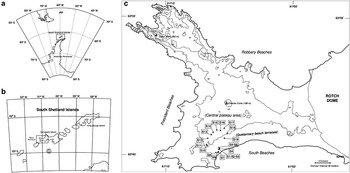
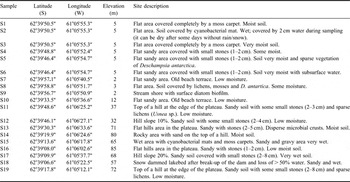
Soil samples were collected on Byers Peninsula, Livingston Island, in maritime Antarctica (62°39′S, 61°05′W) in two different areas (Fig. 1). Ten samples were collected in sampling area A (samples S1 to S10), which was a flat area located on a Quaternary beach terrace of gravels and alluvium. This area is home to an elephant seal colony, which provides extra nutrient inputs to the soils. Nine soil samples were collected in sampling area B (samples S11 to S19), which was an upland plateau with flat hills and very sparse or no vegetation. The mean annual temperature of Livingston Island is approximately -2°C at sea level and the annual precipitation is ∼800 mm (Navas et al. Reference Navas, López-Martínez, Casas, Machín, Durán, Serrano, Cuchi and Mink2008). The active layer was between 30 and 70 cm deep and was thawed from the end of November to March. Samples were collected on 15 and 16 December 2006 using a soil corer 8 cm diameter and 10 cm deep. The soil samples were shipped frozen (-20°C) to Colorado State University for chemical and biological analyses. Geographic coordinates and a brief description of the sampling points are presented in Table I.
a. Insert showing the location of South Shetland Islands in the maritime Antarctic. b. Insert showing the location of Byers Peninsula on Livingston Island, South Shetland Islands. c. Close-up of the sampling area on Byers Peninsula with the sampling points (S1–S19, see Table I for a description of sampling points).

Description of sampling points. Samples 1–10 were collected on a Quaternary beach terrace and samples 11–19 were collected on an upland plateau with sparse to no vegetation.

Soil properties
Upon arrival the soil samples were thawed by increasing the temperature to -14°C and then +4°C (24 hrs at each temperature). After the soils were thawed, the soils were mixed and sub-samples taken for analyses of soil fauna and soil properties. Soil fauna was extracted using a standard sugar centrifugation method (Freckman et al. Reference Freckman, Kaplan and van Gundy1977) and c. 50 g wet soil was used for extractions. Nematodes (dead and alive), and live rotifers and tardigrades were counted and densities calculated as number of individuals per kilogramme dry soil. Nematodes were assigned to trophic groups according to Yeates et al. (Reference Yeates, Bongers, De Goede, Freckman and Georgieva1993) and identified to genus level where possible.
Soil moisture was estimated by drying c. 50 g of soil at 105°C for 24 hr and calculated as the percentage of dry soil (i.e. % dry weight). pH was measured using a 2:1 water:soil dilution using a standard pH electrode (Fisher Scientific, Pittsburgh, PA, USA). 60 ml DI H2O was added to 30 g of soil, the mixture stirred well and left for 10 min. The solution was then stirred again and a reading was taken. Electrical conductivity (EC) was measured using a handheld YSI 30-10FT conductivity meter (YSI Inc, Yellow Springs, OH, USA) on a 5:1 DI water:soil dilution by weight. 120 ml DI H2O was added to 20 g of soil, the mixture was stirred well and left for 10 min. The solution was then stirred again after which a reading was taken. The readings expressed as μS cm-1 were calibrated by measuring the conductivity of a standard solution of 0.01 M KCl and corrected for the influence of solution temperature. Percentage total C and N was measured on a TruSpec (Leco, St Joseph, MI, USA) using c. 0.4 g soil, which was dried at 110°C for 48 hr and ground using a ball grinder.
Data analysis
A standard curve estimation procedure was used to explore the relationship between total nematode and trophic group abundance, and nematode richness (number of taxa), and environmental variables, whereas Pearson correlations (two-tailed) were used to explore relationships between total and group abundances of nematodes and abundances of rotifers and tardigrades. Correlations between nematode variables and environmental variables were always stronger when using the number of live and dead nematodes compared with live nematodes only. This suggests that some nematode species may have suffered from rapid freezing/thawing of samples, which should be avoided for future collection of samples. Canonical Correspondence Analysis (CCA; ter Braak Reference Ter Braak1986) was used to explore the relationship between nematode community composition and environmental variables. Species abundance data was log(x+1) transformed due to high variation in species abundances between samples. Curve estimations were performed using PASW v.18 (IBM, Chicago, IL, USA) and CCA was performed in R (R Development Core Team 2009) using the package vegan. Ordinations were created using manual stepwise forward selection of environmental variables using Monte Carlo permutations (1000), to find the most parsimonious set of variables. Only variables with a significance level of P < 0.05 were included in the final ordination. The final ordination model was validated using Monte Carlo permutations (1000) to ensure the model, and all included variables, explained a significant proportion of the variation in the data.
Results
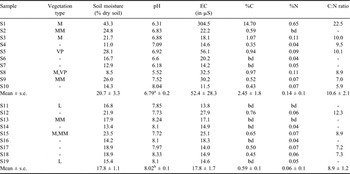
Soil properties displayed a high spatial variability within each of the two sampling areas and therefore only the pH-value was significantly different between the two sampling areas (Table II). However, several samples in both sampling areas, and in particular samples in areas with no or very sparse vegetation, showed C and N contents below the detection limit, indicating very nutrient poor soils.
Summary of soil properties and vegetation type for all samples collected.
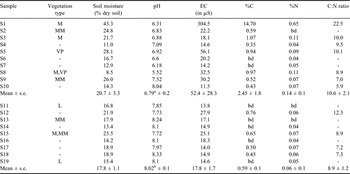
bd = concentrations below detection limits. For vegetation: M = moss, MM = microbial mat, VP = vascular plant, L = lichen. Superscript letters indicate significant differences between sampling areas (t-test, P < 0.05).
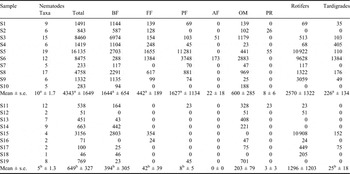
Our samples contained 37 different nematode taxa representing six trophic groups (Appendix A). However, the abundance and species richness of nematodes varied considerably between samples, with 46–16 135 individuals per kg dry soil and one to 19 taxa per sample, respectively (Table III). There were some differences between the two sampling areas. The richness was greater in the raised beach terrace than in the upland plateau. Furthermore, the total abundance of nematodes and tardigrades, and the abundance of bacterial feeders, fungal feeders and plant feeders, were also significantly greater in the raised beach terrace soils than in the upland plateau soils. The abundance of nematodes appeared to be greater in samples with a high cover of moss and/or vascular plants although we could not quantify this statistically.
Summary of the number of taxa of nematodes, and total (living and dead individuals per kg dry soil) for all nematodes and trophic groups, rotifers and tardigrades per sample.

BF = bacterial feeders, FF = fungal feeders, PF = plant feeders, AF = algal feeders, OM = omnivores, PR = predators. Superscript letters indicate significant differences between sampling areas (t-test, P < 0.05).
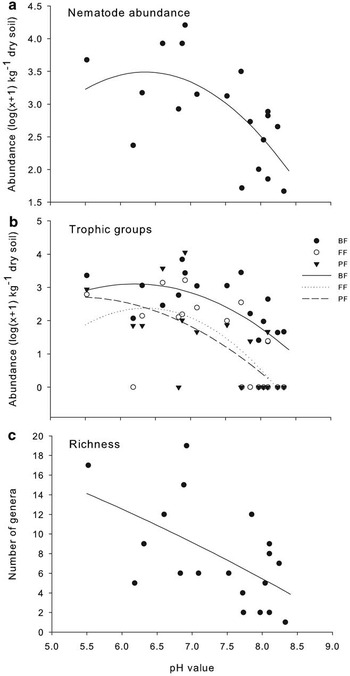
The total abundance (r 2 = 0.42, F2,16 = 5.75, P < 0.05) and the abundance of the bacterial feeders (r 2 = 0.35, F2,16 = 4.37, P < 0.05), fungal feeders (r 2 = 0.51, F2,16 = 8.36, P < 0.01), and plant feeders (r 2 = 0.50, F2,16 = 7.83, P < 0.01) were all best explained by a unimodal relationship with pH, while richness decreased with increasing pH (r 2 = 0.31, F1,17 = 7.76, P < 0.05) (Fig. 2). The abundance of the algal feeders, omnivores and predators showed no significant relationships with soil properties. However, the occurrence of both algal feeders and predators was very low, thus making it difficult to establish relationships with environmental factors.
a. Total, and b. trophic group abundance, and c. richness as a function of pH value. BF = bacterial feeders, FF = fungal feeders, PF = plant feeders. Symbols represent observed values and lines represent best-fitted models.

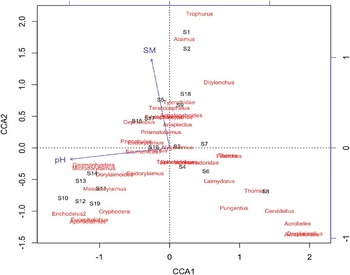
As both abundances and richness of nematodes were related to pH it was expected that there would also be a significant relationship between nematode community composition and pH, and this relationship was confirmed by the CCA analysis (Fig. 3). The best ordination model included pH and soil moisture as the only environmental factors with a significant relationship with nematode community composition. However, the CCA could only account for 19.2% of the total variation in community composition suggesting a great overlap in communities between samples and that other factors influence nematode community composition within Byers Peninsula.
Canonical Correspondence Analysis (CCA) of the relationship between nematode communities and environmental factors on Byers Peninsula. The CCA explains 19.2% of the variation in nematode community composition between samples. SM = soil moisture (% wet weight), pH = pH value, S1 through S19 denotes samples (see Fig. 1 and Table I for location and description of samples).

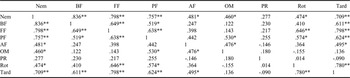
Pearson correlations showed that the abundances of most trophic groups are positively correlated, and we found no negative correlations between any two trophic groups (Table IV). Moreover, the bacterial feeders, fungal feeders, root associates and total nematode abundance are all positively correlated with the abundance of tardigrades and, to a lesser extent, with the abundance of rotifers (except bacterial feeders, Table IV).
Pearson correlation between abundances of nematode trophic groups, total number of nematodes, rotifers and tardigrades.

* = P < 0.05 and ** = P < 0.01. Nem = total abundance of nematodes, BF = bacterial feeders, FF = fungal feeders, PF = plant feeders, AF = algal feeders, OM = omnivores, PR = predators, Rot = rotifer abundance, Tard = tardigrade abundance.
Discussion
The richness of nematode taxa found at Byers Peninsula support the notion of Convey et al. (Reference Convey, Greenslade, Richard and Block1996) that this site is an Antarctic biodiversity hotspot for terrestrial fauna. Other maritime Antarctic hotspots include the Marguerite Bay area, Cierva Point (ASPA No. 134) and Mars Oasis on the Antarctic Peninsula. A total of 24 free-living microarthropod species and 13 species of nematodes have been recorded in the Marguerite Bay area (Convey & Smith Reference Convey and Smith1997, Maslen & Convey Reference Maslen and Convey2006), while 15 species of free-living microarthropods have been recorded at Cierva Point (Convey & Quintana Reference Convey and Quintana1997) and 25 species of nematodes have been recorded in Mars Oasis (Maslen & Convey Reference Maslen and Convey2006). Thus, with a total of 21 free-living microarthropods and two chironomids (Maslen & Convey Reference Maslen and Convey2006), and 37 nematode taxa (this study), the terrestrial invertebrate communities of Byers Peninsula are among the most diverse in maritime Antarctica.
We found 37 different nematode taxa and, as some of these taxa may have included multiple undiagnosed species, this value is probably an underestimate of the actual nematode species richness of Byers Peninsula. Compared with a total of 42 nematode species recorded throughout the whole of the maritime Antarctic (Andrássy Reference Andrássy1998, Maslen & Convey Reference Maslen and Convey2006) this site shows a surprisingly high diversity of nematodes and suggests that the true species richness of nematodes within the maritime Antarctic may be much greater than previously thought. The abundances of nematodes on Byers Peninsula also appeared fairly high compared with numbers recorded at other sites in the maritime Antarctic. For example, Bölter et al. (Reference Bölter, Blume, Schneider and Beyer1997) found 0.6–1.8 × 10⁴ individuals per m2 on King George Island, and Convey & Wynn-Williams (Reference Convey and Wynn-Williams2002) found around 1.5 × 10⁵ individuals per m2 in vegetated sandy soils of Mars Oasis on the Antarctic Peninsula. These values are not directly comparable with our data, but we can make some limited comparisons. For example, the average abundance of nematodes in this study is 2.5 × 10³ individuals per kg dry soil. If the nematodes were in the upper 10 cm soil only, and we assume a bulk density of 1.5 g cm-3, this would result in an estimated 3.75 × 10⁵ individuals per m2 average abundance of nematodes in our site, considerably more than the other sites and still probably an underestimate of the actual abundance on Byers Peninsula.
Of the soil properties measured, pH was the only variable that showed a significant relationship with nematode abundances and richness, and was the main factor related to nematode community composition. A second factor, soil moisture, could explain a small part of the variation in nematode community composition between samples. Both pH and soil moisture are factors known to influence nematode communities as well as population dynamics, in both Antarctica and elsewhere (e.g. Moorhead et al. Reference Moorhead, Barrett, Virginia, Wall and Porazinska2003, Mulder et al. Reference Mulder, De Zwart, van Wijnen, Schouten and Breure2003), so these results are not surprising. The influence of pH on the nematode community appeared to directly limit abundance at high and low pH values, and richness at high pH values. However, it is also probable that pH is related to other factors, both abiotic and biotic (i.e. resource quality and quantity), which may have had an indirect influence on the nematode communities. For instance, soil pH has a strong influence on phosphorus availability and in the McMurdo Dry Valleys, in continental Antarctica, low soil pH is generally associated with wetter soils high in organic matter (Bate et al. Reference Bate, Barrett, Poage and Virginia2008, Poage et al. Reference Poage, Barrett, Virginia and Wall2008). As soil moistures were generally rather high for all samples compared with some Antarctic soils (Fell et al. Reference Fell, Scorzetti, Connell and Craig2006) water availability was not expected to exert a strong direct influence on nematode abundances. However, the observed influence on the nematode community composition could be due to a direct effect on nematode species abundances through niche preferences (displayed by single species), changes in resource availability and/or quality, or any combination of the above (as described above). High abundances of nematodes, rotifers and tardigrades generally appeared to be associated with samples with a high cover of mosses and/or vascular plants, which supports this notion.
Our data did not allow us to include vegetation type, or lack thereof, in our analyses, but it seems probable that the presence/absence of specific species of mosses, lichens, algae influence the nematode communities and their abundances, which could explain the high degree of unexplained variation in the composition of nematode communities between samples. In support of this it does appear that high nematode abundances are associated with samples where mosses and vascular plants are present (Tables II & III). Moreover, even though the climatic conditions are less severe in maritime Antarctica compared with continental Antarctica, climate (temperature and limited precipitation) can be a major constraint to nematode communities as supported by in situ climate manipulations. For instance, it has been found that increasing soil temperatures (combined with less temperature variability due to the experimental design) and lower UV radiation have a strong positive influence on nematode abundance and caused a shift in the composition of nematode communities in Mars Oasis (Convey & Wynn-Williams Reference Convey and Wynn-Williams2002). Similarly, it has been shown that the nematode communities in the McMurdo Dry Valleys respond to natural variation in climate (Barrett et al. Reference Barrett, Virginia, Wall and Adams2008) and to climate manipulations (Simmons et al. Reference Simmons, Wall, Adams, Ayres, Barrett and Virginia2009). Therefore, local topographical and/or biological (such as moss carpets and algae mats etc.) features that ameliorate climate extremes might influence nematode community composition and have a positive influence on nematode densities overall. Finally, dispersal limitations between the spatially isolated areas with habitable soils and sediments on Byers Peninsula may also play a large part in the seemingly high degree of randomness in the nematode communities.
The abundance of most nematode trophic groups, and total abundances of nematodes, rotifers and tardigrades were generally positively correlated, and the abundance of predatory nematodes showed no significant negative or positive correlation with the abundance of any other biotic group. This indicates that abiotic factors may have a stronger influence on invertebrate communities than biotic interactions such as competition and predation, but it seems probable that biotic interactions play at least some role in structuring these communities. In particular the presence of known predators, such as the nematode genera Nygolaimus, suggests that there is some predation occurring. However, this genera is known to predate enchytraeids in other systems (Yeates Reference Yeates1968). This may also be the case here as several species have been found in nearby stream biofilms and sediments (Rodriguez & Rico Reference Rodriguez and Rico2008). Some tardigrades including species occurring in Antarctica (Milnesium antarcticum Tumanov; Nielsen, personal observation) are also known to feed on both nematodes and rotifers (Hallas & Yeates Reference Hallas and Yeates1972), but we have no evidence of this occurring here. Furthermore, bacterial grazing nematodes could limit bacterial dominance of the soil food web, thus favouring growth of fungi which could support fungal feeding nematodes or vice versa, and similar relationships could occur between any of the organisms found here. Finally, there are at least six different species of nematophagous fungi occurring in the soils and sediments of Byers Peninsula (Gray & Smith Reference Gray and Smith1984) and several species of predatory mites, which probably feed on nematodes and other prey items, have been recorded as well (Convey et al. Reference Convey, Greenslade, Richard and Block1996). Biotic interactions in a more fully developed soil food web are likely to occur at a larger scale here compared with the limited biodiversity and soil carbon availability in the McMurdo Dry Valleys, where it has been suggested that biotic interactions may have no influence on soil communities (Hogg et al. Reference Hogg, Cary, Convey, Newsham, O'Donnell, Adams, Aislabie, Frati, Stevens and Wall2006).
In conclusion, we have shown that the nematode communities of Byers Peninsula are surprisingly diverse and confirm that this maritime location should be considered as an Antarctic biodiversity hotspot. Our results indicate that nematode species richness in maritime Antarctica is probably greatly underestimated. Although local soil properties have some influence on the nematode communities of Byers Peninsula, we hypothesize that the observed high variation in abundance, biodiversity and community structure is linked to spatial variation in vegetation and topography. Finally, although no strong direct negative relationships between faunal groups were observed it seems probable that biotic interactions may be of greater importance at Byers Peninsula than in continental Antarctica and other maritime Antarctic sites due to the high abundance and diversity of soil fauna, and the known occurrence of several nematophagous fungi and predatory mites.
Acknowledgements
Samples were collected in the framework of the Spanish Project Limnopolar (CGL2005-06549-C02-01/02/ANT) funded by the Ministry of Science and Innovation, and the US National Science Foundation (DEB 0344834 and OPP 0229836) supported this work. We are grateful to C. Tomasel, E. Molina, and K. Ivanovich for help with measurements of pH, conductivity, and C and N concentrations. We also thank the two anonymous referees for helpful comments on an earlier version of the manuscript.
Appendix A
A list of the genera present in the samples and the trophic group to which they were assigned (trophic groups were assigned based on Yeates et al. Reference Yeates, Bongers, De Goede, Freckman and Georgieva1993)