



1 Introduction
In 1967, Furstenberg introduced the concept of disjointness in topological dynamics and ergodic theory in the seminal paper [Reference Furstenberg15], and characterized certain classes of systems by their disjointness relations. Two compact dynamical systems
$(X,T)$
 and
$(Y,S)$
 (continuous self-maps on compact metric spaces) are said to be disjoint if
$X\times Y$
 is the only closed
$T\times S$
 -invariant subset whose coordinate projections are surjective. It is easy to see that if two transitive compact dynamical systems
$(X,T)$
 and
$(Y,S)$
 are disjoint, then the product system
$(X\times Y,T\times S)$
 is transitive. Later in 1972, Peleg introduced the concept of weak disjointness in topological dynamics in [Reference Peleg26], which, as the name suggests, is a condition weaker than disjointness. Two compact dynamical systems
$(X,T)$
 and
$(Y,S)$
 are said to be weakly disjoint provided that the product system
$(X\times Y,T\times S)$
 is transitive.
In 2000, Weiss characterized in [Reference Weiss28] the compact dynamical systems that are weakly disjoint from all weakly mixing compact dynamical systems, as being exactly the syndetically transitive ones. Let
$\mathcal {F}$
 be a Furstenberg family (a hereditary upward collection of subsets of non-negative integers). A topological dynamical system
$(X,T)$
 is said to be
$\mathcal {F}$
 -transitive provided that
$N(U,V):=\{n\in \mathbb {N}_0: T^nU\cap V\neq \emptyset \}\in \mathcal {F}$
 for any non-empty open subsets
$U,V$
 of X; and
$\mathcal {F}$
 -mixing provided that the product system
$(X\times X,T\times T)$
 is
$\mathcal {F}$
 -transitive. In 2001, Akin and Glasner studied in [Reference Akin and Glasner2] the
$\mathcal {F}$
 -transitivity of compact dynamical systems and provided a method to characterize the compact dynamical systems that are weakly disjoint from a prescribed class of compact dynamical systems, generalizing Weiss’ result. The key ingredient is the realization of every set in a shift-invariant thick Furstenberg family
$\mathcal {F}$
 by the return time sets of
$\mathcal {F}$
 -transitive compact dynamical systems. The corresponding result of the characterization of compact dynamical systems is known as the Weiss–Akin–Glasner theorem, and the realization result is called the Weiss–Akin–Glasner lemma, see e.g. [Reference Huang and Ye24, Reference Huang and Ye25]. It turns out that the notion of weak disjointness plays a significant role in the classification of transitive compact dynamical systems, see e.g. [Reference Akin and Glasner2, Reference Glasner18, Reference Huang and Ye24].
Furstenberg showed in [Reference Furstenberg15] that the return time sets of any weakly mixing topological dynamical system form a filter base. By this result, it is easy to see that a topological dynamical system
$(X,T)$
 is weakly mixing if and only if
$N(U,V)$
 is thick for any non-empty open subsets U and V of X, and
$(X,T)$
 is
$\mathcal {F}$
 -mixing if and only if it is
$\mathcal {F}$
 -transitive and weakly mixing. This implies that for a thick family
$\mathcal {F}$
 , the
$\mathcal {F}$
 -transitivity is equivalent to the
$\mathcal {F}$
 -mixing. Then, the
$\mathcal {F}$
 -transitive system in the Weiss–Akin–Glasner lemma is in fact
$\mathcal {F}$
 -mixing. However, the family generated by the return time sets of a non-trivial
$\mathcal {F}$
 -mixing topological dynamical system must be a shift-invariant thick family. Therefore, the Weiss–Akin–Glasner lemma gives a characterization of subsets of non-negative integers that can be realized by the return time sets of
$\mathcal {F}$
 -mixing compact dynamical systems (see Lemma 2.12), and the Weiss–Akin–Glasner theorem characterizes the compact dynamical systems that are weakly disjoint from
$\mathcal {F}$
 -mixing compact dynamical systems (see Theorem 2.13).
Linear dynamics has become an active area of research in the last decades, see the monographs [Reference Bayart and Matheron6, Reference Grosse-Erdmann and Peris Manguillot22] for the introduction of dynamics of linear operators. In particular, the study of hypercyclic operators constitutes a subject of considerable interest. A linear dynamical system (a continuous linear operator on an infinite-dimensional Fréchet space over
$\mathbb {R}$
 or
$\mathbb {C}$
 ) is said to be hypercyclic provided that the orbit of some vector is dense. Although linear dynamical systems lack compactness compared with compact dynamical systems, by different methods and techniques, many conclusions in linear dynamical systems are parallel to those in compact dynamical systems.
As every linear dynamical system has a fixed point, two linear dynamical systems can never be disjoint in the sense of Furstenberg. In [Reference Bernal-González8, Reference Bès and Peris12], the authors introduced the notion of disjoint hypercyclicity, which is weaker than disjointness. In [Reference Bernal-González8, Reference Bès, Menet, Peris and Puig10, Reference Bès and Peris12, Reference Cardeccia13, Reference Salas27], the authors studied the hypercyclicity of direct sums, which is in fact the weak disjointness in linear dynamics. In 1992, Herrero asked in [Reference Herrero23] whether
$T\oplus T$
 is hypercyclic or not, provided that T is hypercyclic. In 1995, Salas gave an affirmative answer in [Reference Salas27] for the case where T is a weighted backward shift on
$\ell ^2(\mathbb {N}_0)$
 or
$\ell ^2(\mathbb {Z})$
 , and also provided two hypercyclic operators
$T,S$
 on
$\ell ^2(\mathbb {Z})$
 such that
$T\oplus S$
 is not hypercyclic. de la Rosa and Read [Reference de la Rosa and Read14] constructed a hypercyclic operator on a suitable Banach space such that the direct sum is not hypercyclic, while Bayart and Matheron [Reference Bayart and Matheron5] showed that operators of this type can be found on many classical Banach spaces like
$c_0(\mathbb {N}_0)$
 ,
$\ell ^p(\mathbb {N}_0)$
 ,
$1\leq p<\infty $
 , etc. To provide more hypercyclic operators without hypercyclic direct sums, it is natural to ask: which operators are weakly disjoint from a given class of hypercyclic operators?
In [Reference Bès, Menet, Peris and Puig10], Bès et al studied the
$\mathcal {F}$
 -transitivity of operators. They formulated a criterion for an operator to be
$\mathcal {F}$
 -transitive and characterized the
$\mathcal {F}$
 -transitivity of weighted backward shifts. In [Reference Cardeccia13], Cardeccia studied the hypercyclicity of the direct sum of an operator and its iterates. Cardeccia also proved that the operators that are weakly disjoint from all weakly mixing operators are exactly the syndetically transitive ones, and that the operators that are weakly disjoint from all syndetically transitive operators are exactly the piecewise syndetically transitive ones.
The aim of this paper is to study the weak disjointness of hypercyclic operators, advancing the classifications of hypercyclic operators. Motivated by the Weiss–Akin–Glasner theorem from topological dynamics and Cardeccia’s results for operators, we characterize the weak disjointness of more classes of operators. We first present some preliminaries in §2. In §3, we state some basic properties of weak disjointness in linear dynamics, and give sufficient conditions for
$\mathcal {F}$
 -mixing operators (Theorem 3.9) and mild mixing operators (Proposition 3.15). We also illustrate some examples to show that a weakly mixing operator may not be weakly disjoint from its iterates. In §4, as an analogue of the Weiss–Akin–Glasner theorem from topological dynamics, we formulate the corresponding result (Theorem 4.4) in linear dynamics, which gives a characterization of the weak disjointness of
$\mathcal {F}$
 -mixing operators. The key ingredient of the proof is an analogue of the Weiss–Akin–Glasner lemma from topological dynamics, see Lemma 4.1, which gives a characterization of subsets of non-negative integers that can be realized by the return time sets of
$\mathcal {F}$
 -mixing operators. We also provide several examples of operators with some prescribed properties. In §5, we characterize the
$\mathcal F$
 -mixing property of direct sums of backward shifts on Fréchet sequence spaces in terms of the F-norms of the basis.
2 Preliminaries
In this section, we recall some basic notions and results that will be used consistently throughout the paper.
2.1 Subsets of non-negative integers
By
$\mathbb {N}$
 ,
$\mathbb {N}_0$
 and
$\mathbb {Z}$
 , we denote respectively the set of positive integers, the set of non-negative integers and the set of integers.
Before proceeding further, we briefly recall the relevant notation concerning a Furstenberg family (detailed discussions can be found in [Reference Akin1, Reference Furstenberg16]). Let
$\mathcal {F}$
 be a collection of subsets of
$\mathbb {N}_0$
 . We say that
$\mathcal {F}$
 is a Furstenberg family (or family for short) provided that it is hereditary upward, that is, for any
$A\in \mathcal {F}$
 and
$B\subset \mathbb {N}_0$
 with
$A\subset B$
 , we have
$B\in \mathcal {F}$
 . Denote the family of all infinite subsets of
$\mathbb {N}_0$
 by
$\mathcal {F}_{\mathrm {inf}}$
 and the family of all cofinite subsets of
$\mathbb {N}_0$
 by
$\mathcal {F}_{\mathrm {cf}}$
 . For a family
$\mathcal {F}$
 , we say that a collection
$\mathcal {F}'$
 of subsets of
$\mathbb {N}_0$
 is a subfamily of
$\mathcal {F}$
 if
$\mathcal {F}'$
 is a family with
$\mathcal {F}'\subset \mathcal {F}$
 .
Throughout this paper, for each Furstenberg family
$\mathcal {F}$
 , we adopt the conventions that
$\emptyset \notin \mathcal {F}$
 and
$\mathcal {F}\neq \emptyset $
 .
For a subset F of
$\mathbb {Z}$
 and
$i\in \mathbb {Z}$
 , let
$F\pm i=\{m\pm i\colon m\in F\}$
 . We say that a family
$\mathcal {F}$
 is:
-
• shift $_+$
 -invariant if
$F+i\in \mathcal {F}$
for each
$i\in \mathbb {N}_0$
and
$ F\in \mathcal {F}$
;
-
• shift $_-$
-invariant if
$(F-i)\cap \mathbb {N}_0\in \mathcal {F}$
for each
$i\in \mathbb {N}_0$
and
$ F\in \mathcal {F}$
; -
• shift-invariant if $(F+i)\cap \mathbb {N}_0 \in \mathcal {F}$
for each
$i\in \mathbb {Z}$
and
$F\in \mathcal {F}$
.





Definition 2.1. Let
$\mathcal {F}$
 be a family. The dual family
$\mathcal {F}^*$
 is given by

We say that
$\mathcal {F}$
 is a full family if
$F\cap F'$
 is infinite for any
$F\in \mathcal {F}$
 and
$F'\in \mathcal {F}^*$
 ;
$\mathcal {F}$
 is a filter if
$F_1\cap F_2\in \mathcal {F}$
 for any
$F_1, F_2\in \mathcal {F}$
 .
Remark 2.2. The following statements can be checked easily.
-
(1) A family $\mathcal {F}$
is full if and only if
$F\cap F'\in \mathcal {F}$
for any
$F\in \mathcal {F}$
and
$F'\in \mathcal {F}_{\mathrm {cf}}$
. -
(2) Each shift-invariant family is full.
-
(3) For each full family $\mathcal {F}$
, we must have
$\mathcal {F}_{\mathrm {cf}}\subset \mathcal {F}$
. -
(4) A family $\mathcal {F}$
is full if and only if
$\mathcal {F}^*$
is full.


We recall some standard families.
-
• $\mathcal {F}_{\mathrm {t}}$
: the family of subsets of
$\mathbb {N}_0$
containing intervals of arbitrary length, which are said to be thick. -
• $\mathcal {F}_{\mathrm {s}}$
: the family of subsets of
$\mathbb {N}_0$
with bounded gaps, which are said to be syndetic. -
• $\mathcal {F}_{\mathrm {ps}}$
: the family of subsets of
$\mathbb {N}_0$
with the form
$F_1\cap F_2$
, where
$F_1\in \mathcal {F}_{\mathrm {s}}$
and
$F_2\in \mathcal {F}_{\mathrm {t}}$
, and these are said to be piecewise syndetic. -
• $\mathcal {F}_{\mathrm {ts}}$
: the family of subsets A of
$\mathbb {N}_0$
such that for each
$k\in \mathbb {N}_0$
, there exists
$F\in \mathcal {F}_{\mathrm {s}}$
with
$\bigcup _{i=0}^k (F+i)\subset A$
, and these are said to be thickly syndetic.



It is easy to see that
$\mathcal {F}_{\mathrm {s}}^*=\mathcal {F}_{\mathrm {t}}$
 and
$ \mathcal {F}_{\mathrm {ps}}^*=\mathcal {F}_{\mathrm {ts}}$
 .
We turn to a property of families (see [Reference Akin1, Reference Akin and Glasner2]) which plays a significant role in our later discussion.
Definition 2.3. Let
$\mathcal {F}$
 be a family. We say that
$\mathcal {F}$
 is a thick family if for any
$F\in \mathcal {F}$
 and
$k\in \mathbb {N}_0$
 ,

Remark 2.4. We have the following easy facts:
-
(1) each thick family is shift $_-$
-invariant; -
(2) each thick family is a subfamily of $\mathcal {F}_{\mathrm {t}}$
; -
(3) each shift-invariant filter is a thick family;
-
(4) a family $\mathcal {F}$
is a shift-invariant thick family if and only if for each
$F\in \mathcal {F}$
and any
$k_1, k_2\in \mathbb {N}_0$
, $$ \begin{align*} \{n\in\mathbb{N}_0: \{n-k_1,n-k_1+1,\ldots,n+k_2\}\subset F\}\in\mathcal{F}; \end{align*} $$
-
(5) both $\mathcal {F}_{\mathrm {t}}$
and
$\mathcal {F}_{\mathrm {ts}}$
are shift-invariant thick families.


Following [Reference Bès, Menet, Peris and Puig10], for a given family
$\mathcal {F}$
 , we denote

Then,
$\widetilde {\mathcal {F}}$
 is the maximal shift-invariant thick subfamily of
$\mathcal {F}$
 provided that it is not empty. Note that if
$\mathcal {F}$
 is full, then
$\mathcal {F}_{\mathrm {cf}}\subset \widetilde {\mathcal {F}}$
 .
2.2 Topological dynamics
For a topological dynamical system, we mean a pair
$(X,T)$
 , where X is a metric space and T is a continuous map of X into X. If in addition X is a compact metric space, then we say that
$(X,T)$
 is a compact dynamical system. See [Reference Furstenberg15, Reference Furstenberg16] for details of compact dynamics.
A topological dynamical system
$(X,T)$
 is said to be topologically transitive (or transitive for short) if for any pair
$U, V$
 of non-empty open subsets of X, the return time set

is non-empty. When the operator is fixed and there is no risk of ambiguity, we shall write
$N(U,V)$
 in place of
$N_T(U,V)$
 . A topological dynamical system
$(X,T)$
 is said to be weakly mixing if the product system
$(X\times X,T\times T)$
 is transitive, and strongly mixing if for any pair
$U, V$
 of non-empty open subsets of X,
$N(U,V)\in \mathcal {F}_{\mathrm {cf}}$
 .
Given a family
$\mathcal {F}$
 , we say that a topological dynamical system
$(X,T)$
 is:
-
• $\mathcal {F}$
-transitive if for any non-empty open subsets
$U,V$
of X,
$N(U,V)\in \mathcal {F}$
; -
• $\mathcal {F}$
-mixing if the product system
$(X\times X,T\times T)$
is
$\mathcal {F}$
-transitive.





For each family
$\mathcal {F}$
 , since
$\emptyset \notin \mathcal {F}$
 , the
$\mathcal {F}$
 -transitivity is stronger than topological transitivity. It can be verified that a topological dynamical system is transitive if and only if it is
$\mathcal {F}_{\mathrm {inf}}$
 -transitive. A topological dynamical system is said to be topologically ergodic if it is
$\mathcal {F}_{\mathrm {s}}$
 -transitive.
We have the following characterization of weak mixing of topological dynamical systems, which is essentially contained in the proof of [Reference Furstenberg15, Proposition II.3].
Proposition 2.5. Let
$(X,T)$
 be a topological dynamical system. Then,
$(X,T)$
 is weakly mixing if and only if it is
$\mathcal {F}_{\mathrm {t}}$
 -transitive, and if and only if

is a filter.
By Proposition 2.5, it is easy to see that a topological dynamical system
$(X,T)$
 is
$\mathcal {F}$
 -mixing if and only if it is
$\mathcal {F}$
 -transitive and weakly mixing. We have the following folklore result on the return time sets of
$\mathcal {F}$
 -mixing systems, see e.g. [Reference Bès, Menet, Peris and Puig10, Lemma 2.3] in the setting of linear dynamics.
Proposition 2.6. Let
$(X,T)$
 be a topological dynamical system, where X is not a singleton, and
$\mathcal {F}$
 be a family. Then,
$(X,T)$
 is
$\mathcal {F}$
 -mixing if and only if

is a shift-invariant thick subfamily of
$\mathcal {F}$
 .
Proof. On the one hand, suppose that T is
$\mathcal {F}$
 -mixing. It is clear that
$\mathcal {N}_T$
 is a subfamily of
$\mathcal {F}$
 . By Proposition 2.5,
$\mathcal {N}_T$
 is a filter. By Remark 2.4, it suffices to show that
$\mathcal {N}_T$
 is a shift-invariant family. Let U and V be non-empty open subsets of X and
$i\in \mathbb {N}_0$
 . Since T is transitive, it has a dense range, and then
$T^{-i}U\neq \emptyset $
 and
$T^{-i}V\neq \emptyset $
 . Since T is weakly mixing and X is not a singleton, we have that X has no isolated points. Then, there are non-empty open subsets
$W_1\subset T^{-i}U, W_2\subset V$
 with
$N(W_1,W_2)\subset [i,+\infty )$
 . Note that
$N(T^{-i}U,V)\cap [i,+\infty )\subset N(U,V)+i$
 . So, we have

and

By the fact that
$\mathcal {N}_T$
 is a filter,
$\mathcal {N}_T$
 is a shift-invariant thick family.
On the other hand, suppose that
$\mathcal {N}_T$
 is a shift-invariant thick subfamily of
$\mathcal {F}$
 . Then, we have
$\mathcal {N}_T\subset \mathcal {F}_{\mathrm {t}}$
 . By Proposition 2.5, T is weakly mixing. Since T is
$\mathcal {F}$
 -transitive, we have that T is
$\mathcal {F}$
 -mixing.
Remark 2.7. Let
$\mathcal {F}_1$
 and
$\mathcal {F}_2$
 be two families. If there exists an
$\mathcal {F}_1$
 -mixing
$(X,T)$
 that is not
$\mathcal {F}_2$
 -transitive, then by Proposition 2.6, there exists a shift-invariant thick subfamily
$\mathcal {F}_0$
 of
$\mathcal {F}_1$
 such that
$\mathcal {F}_0\setminus \mathcal {F}_2\neq \emptyset $
 .
Definition 2.8. Two topological dynamical systems
$(X,T)$
 and
$(Y,S)$
 are said to be weakly disjoint provided that their product
$(X\times Y,T\times S)$
 is topologically transitive.
In 2000, Weiss found in [Reference Weiss28] that the compact dynamical systems that are weakly disjoint from all weakly mixing compact dynamical systems are exactly the topologically ergodic ones. In 2001, Akin and Glasner generalized Weiss’ result to more classes of compact dynamical systems in [Reference Akin and Glasner2], and the generalized result is known as the Weiss–Akin–Glasner theorem, see e.g. [Reference Huang and Ye24, Reference Huang and Ye25]. In this theorem, they characterized the weak disjointness of
$\mathcal {F}$
 -transitive compact dynamical systems, where
$\mathcal {F}$
 is a shift-invariant thick family, and connected the study of topological dynamics and combinatorial number theory.
Theorem 2.9. (Weiss–Akin–Glasner theorem, [Reference Akin and Glasner2, Theorem 4.15])
Let
$(X,T)$
 be a compact dynamical system and
$\mathcal {F}$
 be a shift-invariant thick family. Then,
$(X,T)$
 is
$\mathcal {F}^*$
 -transitive if and only if
$(X,T)$
 is weakly disjoint from all
$\mathcal {F}$
 -transitive compact dynamical systems.
The key ingredient of the proof of the Weiss–Akin–Glasner theorem is the following lemma.
Lemma 2.10. (Weiss–Akin–Glasner lemma, [Reference Akin and Glasner2, Lemma 4.16])
Suppose that
$\mathcal {F}$
 is a shift-invariant thick family and
$F\in \mathcal {F}$
 . Then, there exists an
$\mathcal {F}$
 -transitive compact dynamical system
$(X,T)$
 and a non-empty open subset U of X such that

Remark 2.11. As
$\mathcal {F}$
 is a shift-invariant thick family, by Remark 2.4, the
$\mathcal {F}$
 -transitive compact dynamical system
$(X,T)$
 in the Weiss–Akin–Glasner lemma is in fact
$\mathcal {F}$
 -mixing.
By Proposition 2.6, the family generated by the return time sets of an
$\mathcal {F}$
 -mixing system whose underlying space is not a singleton must be a shift-invariant thick family. So, the condition that
$\mathcal {F}$
 is a shift-invariant thick family in the Weiss–Akin–Glasner lemma is necessary for all sets in
$\mathcal {F}$
 to be realized by the return time sets of
$\mathcal {F}$
 -mixing systems.
Recall that
$\widetilde {\mathcal {F}}$
 is the maximal shift-invariant thick subfamily of a full
$\mathcal {F}$
 . Then, we can restate the Weiss–Akin–Glasner lemma as follows.
Lemma 2.12. Suppose that
$\mathcal {F}$
 is a full family and
$F\subset \mathbb {N}_0$
 . Then,
$F\in \widetilde {\mathcal {F}}$
 if and only if there exists an
$\mathcal {F}$
 -mixing compact dynamical system
$(X,T)$
 and a non-empty open subset U of X such that

We also restate the Weiss–Akin–Glasner theorem as follows.
Theorem 2.13. Let
$(X,T)$
 be a compact dynamical system and
$\mathcal {F}$
 be a full family. Then,
$(X,T)$
 is
$(\widetilde {\mathcal {F}})^*$
 -transitive if and only if
$(X,T)$
 is weakly disjoint from all
$\mathcal {F}$
 -mixing compact dynamical systems.
The concept of mild mixing was originally introduced by Furstenberg and Weiss in the context of ergodic theory [Reference Furstenberg and Weiss17], and was later introduced independently in topological dynamics by Glasner [Reference Glasner18] and by Huang and Ye [Reference Huang and Ye25], inspired by its ergodic-theoretic counterpart.
Definition 2.14. A compact dynamical system
$(X,T)$
 is said to be mildly mixing if it is weakly disjoint from all transitive compact dynamical systems.
The return time sets of mild mixing systems are related to IP-sets. For a sequence
$(x_n)_{n\in \mathbb {N}}$
 in
$\mathbb {N}$
 , the finite sum set of
$(x_n)_{n\in \mathbb {N}}$
 is given by

A set
$A\subset \mathbb {N}_0$
 is called an IP-set if there is a sequence
$(x_n)_{n\in \mathbb {N}}$
 in
$\mathbb {N}_0$
 with infinitely many non-zero terms such that
$\mathrm {FS}((x_n)_{n\in \mathbb {N}})\subset A$
 . Denote by
$\mathcal {F}_{\mathrm {ip}}$
 the family of all IP-sets and by
$\Delta _{\mathrm {ip}}$
 the family of the sets of the form
$(F-F)\cap \mathbb {N}_0$
 , where
$F\in \mathcal {F}_{\mathrm {ip}}$
 and
$F-F=\{m-n:m\neq n\in F\}$
 . We denote the dual family of
$\Delta _{\mathrm {ip}}$
 by
$\Delta ^*_{\mathrm {ip}}$
 . For a topological dynamical system
$(X,T), x\in X$
 and a subset U of X, we denote

Recall that a point
$x\in X$
 is recurrent if for every neighbourhood U of x,
$N(x,U)$
 is infinite. In 1981, Furstenberg proved the following result for compact dynamical systems, which is in fact true for topological dynamical systems.
Theorem 2.15. [Reference Furstenberg16, Theorem 2.17]
Let
$(X, T)$
 be a topological dynamical system. If a point
$x\in X$
 is recurrent, then for any neighbourhood U of x, we have
$N(x, U)\in \mathcal {F}_{\mathrm {ip}}$
 .
The following characterization of mild mixing was obtained by Glasner [Reference Glasner18], and by Huang and Ye [Reference Huang and Ye25] independently.
Theorem 2.16. [Reference Glasner18, Theorem 10.7] or [Reference Huang and Ye25, Theorem 6.6]
A compact dynamical system is mildly mixing if and only if it is
$\Delta ^*_{\mathrm {ip}}$
 -transitive.
2.3 Linear dynamics
In recent years, there has been growing interest in the study of linear dynamical systems, see [Reference Bayart and Matheron6, Reference Grosse-Erdmann and Peris Manguillot22] for further information.
Let X be an infinite-dimensional separable Fréchet space over
$\mathbb {R}$
 or
$\mathbb {C}$
 . For an operator (i.e. a continuous linear self-map) T on X, the pair
$(X,T)$
 is called a linear dynamical system. Usually, we simply call the operator T or
$T\colon X\to X$
 a linear dynamical system. If, in addition, T is an invertible map such that
$T^{-1}$
 is also an operator on X, then we say that
$(X,T)$
 (or T for short) is invertible. In this paper, for a Fréchet space X, the symbol
$\|\cdot \|_X=\|\cdot \|$
 denotes an F-norm defining the topology of X. If, in particular, X is a Banach space, then the symbol
$\|\cdot \|_X=\|\cdot \|$
 denotes a norm defining the topology of X.
While infinite-dimensional Fréchet spaces are lacking of compactness, many results in linear dynamical systems remain similar to their counterparts from compact dynamical systems, despite being obtained by different methods.
Definition 2.17. An operator
$T\colon X\to X$
 is said to be hypercyclic provided that there is some
$x\in X$
 whose orbit under T is dense in X. Such an x is called a hypercyclic vector for T. We denote the set of hypercyclic vectors for T by
$HC(T)$
 .
Remark 2.18. By the Birkhoff transitivity theorem (see e.g. [Reference Grosse-Erdmann and Peris Manguillot22, Theorem 1.16]), we know that for a separable infinite-dimensional Fréchet space X, an operator T on X is hypercyclic if and only if it is topologically transitive, and if and only if
$HC(T)$
 is a dense
$G_\delta $
 subset of X.
A well-known result to imply the weak mixing of a given operator is the so-called hypercyclicity criterion.
Theorem 2.19. (Hypercyclicity criterion, see e.g. [Reference Grosse-Erdmann and Peris Manguillot22, Theorem 3.12])
Let
$T\colon X\to X$
 be an operator. If there exist dense subsets
$X_0$
 ,
$Y_0\subset X$
 , a sequence
$(n_k)_{k\in \mathbb {N}}$
 in
$\mathbb {N}$
 and a sequence of maps
$S_{n_k}\colon Y_0\to X$
 such that for any
$x_0\in X_0$
 ,
$y_0\in Y_0$
 :
-
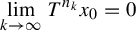
(1) $\displaystyle \lim _{k\to \infty }T^{n_k}x_0=0$
; -
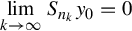
(2) $\displaystyle \lim _{k\to \infty }S_{n_k}y_0=0$
; -
(3) $\displaystyle \lim _{k\to \infty }T^{n_k}S_{n_k}y_0=y_0;$

then T is weakly mixing.
A remarkable feature of the hypercyclicity criterion is that it is actually equivalent to an operator being weakly mixing. In [Reference Bès and Peris11], Bès and Peris obtained this result using the notion of hereditarily hypercyclic operators.
Theorem 2.20. [Reference Bès and Peris11, Theorem 2.3]
Let
$T\colon X\to X$
 be an operator. Then, the following assertions are equivalent:
-
(1) T satisfies the hypercyclicity criterion;
-
(2) T is weakly mixing;
-
(3) T is hereditarily hypercyclic.
Unlike the case for compact dynamical systems, a tool for the study of linear dynamical systems is provided by the neighbourhoods of
$0$
 . We recall the blow up/collapse condition for weak mixing.
Theorem 2.21. [Reference Grosse-Erdmann and Peris Manguillot22, Theorem 2.47]
Let
$T\colon X\to X$
 be an operator. Then, T is weakly mixing if and only if for any non-empty open sets
$U, V\subset X$
 and any neighbourhood W of
$0$
 ,

Let
$X= c_0(\mathbb {N}_0)$
 or
$\ell ^p(\mathbb {N}_0)$
 ,
$1\leq p<\infty $
 , and let
$w=(w_i)_{i\in \mathbb {N}_0}$
 be a bounded sequence of positive real numbers. Define a map
$B_w\colon X\to X$
 by

The map
$B_w$
 is clearly an operator on X and is called a unilateral weighted backward shift. Similarly, one can define bilateral weighted backward shift on
$c_0(\mathbb {Z})$
 and
$\ell ^p(\mathbb {Z})$
 ,
${1\leq p<\infty }$
 . In [Reference Bès, Menet, Peris and Puig10], Bès et al characterized the
$\mathcal {F}$
 -transitivity of such operators and one of their results is restated here.
Proposition 2.22. [Reference Bès, Menet, Peris and Puig10, Proposition 3.1]
Let
$\mathcal {F}$
 be a family and
$B_w$
 be a bilateral weighted backward shift on
$X=c_0(\mathbb {Z})$
 or
$\ell ^p(\mathbb {Z})$
 ,
$1\leq p<\infty $
 . Then, the following assertions are equivalent:
-
(1) $B_w$
is
$\mathcal {F}$
-transitive; -
(2) $B_w$
is
$\mathcal {F}$
-mixing (that is,
$\mathcal {F}$
-transitive and weakly mixing); -
(3) for any $M>0$
and
$j\in \mathbb {N}$
, we have
$A_{M,j}\cap \overline {A}_{M,j}\in \mathcal {F}$
, where $$ \begin{align*} A_{M,j}&=\{n\in\mathbb{N}\colon w_{j+1}w_{j+2}\cdots w_{j+n}>M\}, \\ \overline{A}_{M,j}&=\bigg\{n\in\mathbb{N} \colon w_{j}w_{j-1}\cdots w_{j-n+1}<\frac{1}{M}\bigg\}. \end{align*} $$


We denote by
$\omega $
 the Fréchet space of all sequences in
$\mathbb {K}$
 , where
$\mathbb {K}$
 denotes either
$\mathbb {R}$
 or
$\mathbb {C}$
 , that is,

with the topology given by the seminorms:
$p_n(x)=\mathrm {sup}_{i\leq n}|x_i|, n\in \mathbb {N}_0$
 . The canonical basis of
$\omega $
 is denoted by
$e_n=(\delta _{i,n})_{i\in \mathbb {N}_0}$
 ,
$n\in \mathbb {N}_0$
 .
Let X be an infinite-dimensional separable Fréchet space. If X can be embedded continuously (by a linear map,
$\theta $
 say) into
$\omega $
 , then X is called a unilateral Fréchet sequence space. Roughly speaking, the convergence in a Fréchet sequence space implies the convergence of each coefficient in
$\mathbb {K}$
 . Since for each
$n\in \mathbb {N}_0$
 ,
$E_n=\theta ^{-1}e_n\in X$
 (if exists) must be unique, we denote it still by
$e_n$
 .
Let X be a unilateral Fréchet sequence space in which
$(e_n)_{n\in \mathbb {N}_0}$
 is a basis (i.e.
$\sum _{i=0}^{\infty }x_ie_i$
 converges for each
$x\in X$
 ). Define a linear map
$B\colon X\to \omega $
 by

where
$x=\sum _{i=0}^{\infty }x_ie_i\in X.$
 If B maps X into X, then it must be continuous and we say that B is the unilateral backward shift on X. Define a map
$F\colon \{x\in X\colon \text {there is } l\in \mathbb {N}_0\text { such that }x_i=0\text { for each }i\geq l\}\to X$
 by

The map F is called the unilateral forward shift for finite sequences of X. Bilateral backward (and forward) shifts on bilateral Fréchet sequence spaces are defined similarly. See [Reference Bès, Menet, Peris and Puig9, Reference Bès, Menet, Peris and Puig10, Reference Grosse-Erdmann and Peris Manguillot22, Reference Salas27] for more details of weighted backward shifts.
3 Weak disjointness in linear dynamics
In this section, we introduce the notion of weak disjointness of linear dynamical systems. We will give a criterion for
$\mathcal {F}$
 -mixing and a sufficient condition for mild mixing. In addition, we illustrate that a weakly mixing operator may not be weakly disjoint from its iterates.
Definition 3.1. Let
$T\colon X\to X$
 and
$S\colon Y\to Y$
 be two operators. We say that T and S are weakly disjoint provided that their direct sum
$T\oplus S$
 is hypercyclic.
Weak disjointness of finitely many operators is defined similarly. By Remark 2.18, two operators
$T\colon X\to X$
 and
$S\colon Y\to Y$
 are weakly disjoint if and only if for any non-empty open subsets
$U_1,U_2$
 of X and non-empty open subsets
$V_1,V_2$
 of Y,
$N_T(U_1,U_2)\cap N_S(V_1,V_2)\neq \emptyset $
 . We have the following observation, which is in fact true for topological dynamical systems. Recall that for a given family
$\mathcal {F}$
 , an operator
$T\colon X\to X$
 is
$\mathcal {F}$
 -transitive if
$N(U,V)\in \mathcal {F}$
 for any non-empty open subsets U and V of X.
Lemma 3.2. Suppose that
$\mathcal {F}$
 is a shift
$_+$
 -invariant family. Let
$T\colon X\to X$
 and
$S\colon Y\to Y$
 be two operators. If S is hypercyclic, then
$T\oplus S$
 is
$\mathcal {F}$
 -transitive if and only if for any non-empty open subsets
$U_1,U_2$
 of X and non-empty open subset V of Y, we have

Proof. The condition is obviously necessary.
Conversely, by the hypothesis, both T and S are hypercyclic. Fix non-empty open subsets
$U_1,U_2$
 of X and non-empty open subsets
$V_1,V_2$
 of Y. By the hypercyclicity of S, there must be
$m\in \mathbb {N}_0$
 such that
$V_1\cap S^{-m}V_2\neq \emptyset $
 . By the hypercyclicity of T,
$T^{-m}U_2\neq \emptyset $
 . Let
$V=V_1\cap S^{-m}V_2$
 . We then have
$N_S(V, V)+m\subset N_S(V_1, V_2)$
 and
$N_T(U_1, T^{-m}U_2)+m\subset N_T(U_1, U_2)$
 . Finally,

We are done since
$N_T(U_1, T^{-m}U_2)\cap N_S(V, V)\in \mathcal {F}$
 and
$\mathcal {F}$
 is shift
$_+$
 -invariant.
Since the family of non-empty subsets of
$\mathbb {N}_0$
 is shift
$_+$
 -invariant, by applying Lemma 3.2, we have the following version for weak disjointness.
Lemma 3.3. Let
$T\colon X\to X$
 and
$S\colon Y\to Y$
 be two operators. If S is hypercyclic, then T and S are weakly disjoint if and only if for any non-empty open subsets
$U_1,U_2$
 of X and non-empty open subset V of Y, we have

Given a hypercyclic operator T and
$k\in \mathbb {N}$
 , we consider the weak disjointness of T and
$T^k$
 . We will see in the following examples that T may not be weakly disjoint from
$T^k$
 , even if T is weakly mixing. We note that related constructions appear in [Reference Grivaux and Roginskaya20, Theorem 1.3] and [Reference Bès and Peris12, Example 4.5], although they are used there to address different questions. We give a self-contained proof below, formulated in a way that makes explicit the properties required for our subsequent analysis.
Example 3.4. Let
$X=c_0(\mathbb {N}_0)$
 or
$\ell ^p(\mathbb {N}_0)$
 ,
$1\leq p<\infty $
 . There exists a unilateral weighted backward shift
$B_w$
 on X such that
$B_w$
 is weakly mixing, but
$B_w\oplus B^2_w$
 is not hypercyclic.
Proof. For any
$n\in \mathbb {N}$
 , we define two finite blocks
$\mathcal {A}_n$
 and
$\mathcal {B}_n$
 by

Define a sequence
$(b_n)_{n\in \mathbb {N}}$
 of positive integers by

Let
$B_w$
 be the unilateral weighted backward shift on X defined by the weight w, where
$w=(w_i)_{i\in \mathbb {N}_0}$
 is given by

For a finite block u, denote the length of u by
$|u|$
 . For each
$n\in \mathbb {N}$
 , one has

For each
$n\in \mathbb {N}$
 , it is easy to see that for each
$k\in [b_n-1,2b_n]\cap \mathbb {N}_0$
 ,
$w_1w_2\cdots w_k=1$
 , and for each
$k\in [2b_n+1,2b_n+n+1]\cap \mathbb {N}_0$
 ,
$w_1w_2\cdots w_k=2^{k-2b_n}$
 . Then,
$\limsup _{k\to \infty }\, w_1w_2\cdots w_{k}=\infty $
 . By [Reference Grosse-Erdmann and Peris Manguillot22, Example 4.9],
$B_w$
 is weakly mixing.
For each
$k\in \mathbb {N}$
 with
$w_1w_2\cdots w_k\geq 2$
 , we have either
$k=1$
 or
$k\in [2b_n+1,2b_n+n+1]$
 for some
$n\in \mathbb {N}$
 . If
$k=1$
 , then
$w_1w_2\cdots w_{2k}=w_1w_2=1$
 . If
$k\in [2b_n+1,2b_n+n+1]$
 for some
$n\in \mathbb {N}$
 , since
$2k\in [4b_n+2, 4b_n+2n+2]\subset [b_{n+1}-1,2b_{n+1}]$
 , we have
$w_1w_2\cdots w_{2k}=1$
 . Consider the non-empty open set

Assume that there is
$m\in N_{B_w\oplus B_w^2}(W\oplus W, W\oplus W)\setminus \{0\}$
 . Then, there is a pair
$(x,y)\in W\oplus W$
 with
$(B_w\oplus B_w^2)^m (x,y)\in W\oplus W$
 . Since
$x,y\in W$
 and
$m\neq 0$
 , we have
$|x_m|<\frac 13$
 and
$|y_{2m}|<\frac 13$
 . Since
$B_w^m x\in W$
 , we have
$|w_1w_2\cdots w_m x_m-1|<\frac 13$
 and then
$w_1w_2\cdots w_m=({w_1w_2\cdots w_m|x_m|}/{|x_m|})>2$
 . Then,
$w_1w_2\cdots w_{2m}=1$
 by the above analysis. Since
$B_w^{2m} y\in W$
 , we have
$|w_1w_2\cdots w_{2m} y_{2m}-1|<\frac 13$
 and then again
$w_1w_2\cdots w_{2m}>2$
 , which is a contradiction. Then,
$N_{B_w\oplus B_w^2}(W\oplus W, W\oplus W)=\{0\}$
 , which implies that
$B_w\oplus B^2_w$
 is not hypercyclic.
Example 3.5. Let
$X=c_0(\mathbb {N}_0)$
 or
$\ell ^p(\mathbb {N}_0)$
 ,
$1\leq p<\infty $
 . There exists a unilateral weighted backward shift
$B_w$
 on X such that
$B_w\oplus B^2_w$
 is weakly mixing, but
$B_w\oplus B^3_w$
 is not hypercyclic.
Proof. Assume that
$X=c_0(\mathbb {N}_0)$
 ; the case
$X=\ell ^p(\mathbb {N}_0)$
 ,
$1\leq p<\infty $
 is similar. For any
$n, m\in \mathbb {N}$
 , we define three finite blocks
$\mathcal {A}_{n},\mathcal {B}_{n,m}$
 and
$\mathcal {C}_n$
 by

Let
$s_0=1,s_1=3$
 and
$s_{n+1}=2(3(s_n-1)+n+1)+n$
 for
$n\in \mathbb {N}$
 . Define two sequences
$(b_n)_{n\in \mathbb {N}}$
 and
$(c_n)_{n\in \mathbb {N}}$
 of positive integers by

Let
$B_w$
 be the unilateral weighted backward shift on X defined by the weight w, where
$w=(w_i)_{i\in \mathbb {N}_0}$
 is given by

Fix
$n\in \mathbb {N}$
 . One has
$w_{s_n}=2^{-n}$
 . If
$k\in [s_n,3(s_n-1)]\cap \mathbb {N}_0$
 , then
$w_1w_2\cdots w_k=1$
 . If
${k\in [3(s_n-1)+1,3(s_n-1)+n]\cap \mathbb {N}_0}$
 , then
$w_1w_2\cdots w_k=2^{k-3(s_n-1)}$
 . If
$k\in [3(s_n-1)\, +\,n+1,s_{n+1}-1]\cap \mathbb {N}_0$
 , then
$w_1w_2\cdots w_k=2^{n+1}$
 .
For each finite sequence
$x=(x_0,x_1,x_2,\ldots ,x_l,0, \ldots )\in X$
 , let

Denote
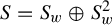
$T=B_w\oplus B_w^2$
 ,
$S=S_w\oplus S^2_w$
 and
$Y=X\oplus X$
 . Let
$X_0$
 be the set of finite sequences in X. Then,
$Y_0=X_0\oplus X_0$
 is a dense subset of Y. Put
$a_n=3(s_{n-1}-1)+n$
 for each
$n\in \mathbb {N}$
 . We shall show that T satisfies the hypercyclicity criterion (Theorem 2.19) with S,
$Y_0$
 and
$(a_n)_{n\in \mathbb {N}}$
 .
To see this, fix
$(u,v)\in Y_0$
 and
$\epsilon>0$
 . Write
$u=(u_0,u_1,\ldots , u_l,0,0, \ldots )$
 and
${v=(v_0,v_1,\ldots , v_l,0,0, \ldots )}$
 . Let
$M_1=\mathrm \max (\{|u_i|: i\in \mathbb {N}_0\}\cup \{|v_i|: i\in \mathbb {N}_0\})+1,\, M_2=\mathrm \max \{w_1w_2\cdots w_i: i\in \mathbb {N}_0, i\leq l\}$
 . Pick
$N_1\in \mathbb {N}$
 such that
$n>N_1$
 implies
${s_n-2n-7>l}$
 . For any
$n>N_1$
 , we have
$l+2a_n-a_n<s_{n}-1-(3(s_{n-1}-1)+n)$
 and then
${\{a_n,a_n+1,\ldots , 2a_n, \ldots ,l+2a_n\}\subset [3(s_{n-1}-1)+n,s_{n}-1]}$
 . By the above analysis, we have
$w_{1}\cdots w_{a_n}=w_{1}\cdots w_{a_n+1}=\cdots =w_{1}\cdots w_{l+2a_n}=2^n$
 . Pick
$N_2\in \mathbb {N}$
 such that
$n>N_2$
 implies
${1}/{2^n}<{\epsilon }/{M_1M_2}$
 . Put
$N=\mathrm \max \{N_1,N_2\}$
 . For any
$n>N$
 , one has

and

This gives that
$\displaystyle \lim _{n\to \infty }S^{a_n}(u,v)=0$
 , while it is clear that
$TS(u,v)=(u,v)$
 and
$\displaystyle \lim _{n\to \infty }T^{a_n}y_0=0$
 for each
$y_0\in Y_0$
 . So, T satisfies the hypercyclicity criterion (Theorem 2.19) and then it is weakly mixing.
However, whenever there is
$n\in \mathbb {N}$
 with
$w_1w_2\cdots w_n\geq 2$
 , we have either
$n\in \{1,2\}$
 or
$n\in [3(s_k-1)+1,s_{k+1}-1]$
 for some
$k\in \mathbb {N}$
 . If
$n\in \{1,2\}$
 , then
$w_1w_2\cdots w_{3n}=1$
 . If
$n\in [3(s_k-1)+1,s_{k+1}-1]$
 for some
$k\in \mathbb {N}$
 , since
$3n\in [9(s_k-1)+3,3(s_{k+1}-1)]\subset [s_{k+1},3(s_{k+1}-1)]$
 , we have
$w_1w_2\cdots w_{3n}=1$
 . Consider the non-empty open set

As in Example 3.4,
$N_{B_w\oplus B_w^3}(W\oplus W, W\oplus W)=\{0\}$
 and then
$B_w\oplus B_w^3$
 is not hypercyclic.
Remark 3.6. By a similar method, for any
$k\in \mathbb {N}$
 and
$X=c_0(\mathbb {N}_0)$
 or
$\ell ^p(\mathbb {N}_0)$
 ,
$1\leq p<\infty $
 , one can construct a unilateral weighted backward shift
$B_w$
 on X such that
$B_w\oplus B_w^2\oplus \cdots \oplus B^k_w$
 is weakly mixing but
$B_w\oplus B_w^{k+1}$
 is not hypercyclic.
3.1 The
$\mathcal {F}$
-mixing criterion

It is observed that an operator is weakly mixing if and only if it is weakly disjoint from itself. We investigate how a weakly mixing operator can be weakly disjoint from itself. In terms of Furstenberg families, we study the
$\mathcal {F}$
 -transitivity of the direct sum of an operator and itself when a family
$\mathcal {F}$
 is given.
Definition 3.7. Let
$\mathcal {F}$
 be a family. An operator
$T\colon X\to X$
 is said to be
$\mathcal {F}$
 -mixing provided that
$T\oplus T$
 is
$\mathcal {F}$
 -transitive.
Recall that the blow up/collapse condition characterizes the weak mixing of operators (see Theorem 2.21). We formulate here the blow up/collapse condition for
$\mathcal {F}$
 -mixing.
Lemma 3.8. Let
$\mathcal {F}$
 be a family. Then, an operator
$T\colon X\to X$
 is
$\mathcal {F}$
 -mixing if and only if for any non-empty open subsets
$U,V$
 of X and neighbourhood W of
$0$
 , we have

Proof. The condition is obviously necessary.
Conversely, let
$U,V$
 be a pair of non-empty open subsets of X. Pick non-empty open subsets
$U'\subset U,V'\subset V$
 and a neighbourhood W of
$0$
 such that
$U'+W\subset U, V'+ W\subset V$
 . The observation
$N(U',W)\cap N(W,V')\subset N(U,V)$
 gives that
$N(U,V)\in \mathcal {F}$
 and then T is
$\mathcal {F}$
 -transitive. Since
$\emptyset \notin \mathcal {F}$
 , by Theorem 2.21, T is weakly mixing. So, T is
$\mathcal {F}$
 -mixing.
Inspired by the hypercyclicity criterion (Theorem 2.19), we formulate a criterion for
$\mathcal {F}$
 -mixing in terms of limits, which is especially applicable to backward shifts (see §5). Before this, we need a notion, which requires the specific shape of the indices of convergent subsequences.
Suppose that X is a metric space and
$\mathcal {F}$
 is a family. Let
$(x_n)_{n\in \mathbb {N}_0}$
 be a sequence in X. We say that a point
$x\in X$
 is an
$\mathcal {F}$
 -limit of
$(x_n)_{n\in \mathbb {N}_0}$
 , denoted by
$\mathcal {F}$
 -
$\displaystyle \lim _{n\to \infty }x_n=x$
 , if for any neighbourhood U of x, we have

In [Reference Bès, Menet, Peris and Puig10], Bès et al gave a criterion [Reference Bès, Menet, Peris and Puig10, Theorem 2.4] for an operator to be
$\mathcal {F}$
 -mixing, requiring that
$\widetilde {\mathcal {F}}$
 is a filter. The following criterion has a strong requirement on the limits, but no requirement for the family.
Theorem 3.9. (
$\mathcal {F}$
-mixing criterion)

Let
$T\colon X\to X$
 be an operator and
$\mathcal {F}$
 be a family. If there exist dense subsets
$X_0$
 ,
$Y_0$
 of X and a sequence
$(S_n)_{n\in \mathbb {N}_0}$
 of maps of
$Y_0$
 into X such that for any
$x_0\in X_0$
 ,
$y_0\in Y_0$
 ,

then T is
$\mathcal {F}$
 -mixing.
Proof. Let
$U, V$
 be non-empty open subsets of X and let
$W\subset X$
 be a neighbourhood of
$0$
 . Pick
$x_0\in X_0\cap U$
 and
$y_0\in Y_0\cap V$
 . Then,

Since
$A\subset N(U, W)\cap N(W, V)$
 , we have
$N(U,W)\cap N(W,V)\in \mathcal {F}$
 . Then, T is
$\mathcal {F}$
 -mixing, by Lemma 3.8.
Remark 3.10. It is clear that an operator satisfying the hypercyclicity criterion (Theorem 2.19) must satisfy the
$\mathcal {F}_{\mathrm {inf}}$
 -mixing criterion. Once an operator satisfies the
$\mathcal {F}_{\mathrm {inf}}$
 -mixing criterion, it is weakly mixing and then by Theorem 2.20, it satisfies the hypercyclicity criterion (Theorem 2.19). The
$\mathcal {F}_{\mathrm {cf}}$
 -mixing criterion coincides with Kitai’s criterion [Reference Grosse-Erdmann and Peris Manguillot22, Theorem 3.4]. Generally, the
$\mathcal {F}$
 -mixing criterion does not characterize the
$\mathcal {F}$
 -mixing. For example, Grivaux has constructed a strongly mixing operator that does not satisfy Kitai’s criterion (see [Reference Grivaux19, Theorem 2.5]).
3.2 Mild mixing
It is natural to consider the property of operators that are weakly disjoint from a given class of operators. In 2024, Cardeccia characterized in [Reference Cardeccia13] the operators that are weakly disjoint from all weakly mixing operators and the operators that are weakly disjoint from all topologically ergodic operators. We restate these results, in the language of weak disjointness.
Theorem 3.11. [Reference Cardeccia13, Theorem 5.3]
Let
$T\colon X\to X$
 be an operator. The following assertions are equivalent:
-
(1) T is topologically ergodic;
-
(2) T is weakly disjoint from all weakly mixing operators;
-
(3) $T\oplus S$
is weakly mixing for each weakly mixing operator
$S\colon Y\to Y$
.


Theorem 3.12. [Reference Cardeccia13, Theorem 5.4]
An operator
$T\colon X\to X$
 is
$\mathcal {F}_{\mathrm {ps}}$
 -transitive if and only if T is weakly disjoint from all topologically ergodic operators.
It is clear that the operators that are weakly disjoint from all strongly mixing operators are exactly the hypercyclic ones. We wonder if there is a non-mixing operator that is weakly disjoint from all hypercyclic operators. We introduce the concept of mild mixing in the framework of linear dynamical systems, and show that the mild mixing of operators is a property that lies strictly between strong mixing and weak mixing.
Definition 3.13. An operator
$T\colon X\to X$
 is said to be mildly mixing provided that it is weakly disjoint from all hypercyclic operators.
Proposition 3.14. Let
$T\colon X\to X$
 and
$S\colon Y\to Y$
 be two operators. Then,
$T\oplus S$
 is mildly mixing if and only if both T and S are mildly mixing.
Proof. The condition is obviously necessary.
Conversely, fix a hypercyclic operator
$R\colon Z\to Z$
 . Since S is mildly mixing, we have that
$S\oplus R$
 is hypercyclic. Since T is mildly mixing, we have that
$T\oplus (S\oplus R)$
 is hypercyclic. This gives that
$(T\oplus S)\oplus R$
 is hypercyclic and then
$T\oplus S$
 is mildly mixing.
Next, we deduce a sufficient condition for an operator to be mildly mixing.
Proposition 3.15. Each
$\Delta ^*_{\mathrm {ip}}$
 -transitive operator is mildly mixing.
Proof. Suppose that
$T\colon X\to X$
 is a
$\Delta ^*_{\mathrm {ip}}$
 -transitive operator. Fix a hypercyclic operator
$S\colon Y\to Y$
 . Let
$U_1, U_2$
 be non-empty open subsets of X and let V be a non-empty open subset of Y. Let
$x\in V$
 be a hypercyclic vector for S. Since each hypercyclic vector is recurrent, by Theorem 2.15, we have
$N_S(x, V)\in \mathcal {F}_{\mathrm {ip}}$
 and
$N_S(V,V)=(N_S(x,V)-N_S(x, V))\cap \mathbb {N}_0$
 (i.e.
$N_S(V,V)\in \Delta _{\mathrm {ip}}$
 ). Since
$N_T(U_1, U_2)\in \Delta ^*_{\mathrm {ip}}$
 , we have that
$N_T(U_1, U_2)\cap N_S(V,V)\neq \emptyset $
 . By Lemma 3.3, T is weakly disjoint from S and then T is mildly mixing.
Recall from Theorem 2.16, we know that the mild mixing of compact dynamical systems is equivalent to the
$\Delta ^*_{\mathrm {ip}}$
 -transitivity. In Proposition 3.15, we have shown that each
$\Delta ^*_{\mathrm {ip}}$
 -transitive operator is mildly mixing, so we ask the following question.
Question 3.16. Is each mildly mixing operator
$\Delta ^*_{\mathrm {ip}}$
 -transitive?
Now, we deduce that for operators, strong mixing is not equivalent to mild mixing. Let
$\Delta =\{A\subset \mathbb {N}_0: \text {there is }F\in \mathcal {F}_{\mathrm {inf}}\text { with }(F-F)\cap \mathbb {N}_0\subset A\}$
 . Since
$\mathcal {F}_{\mathrm {ip}}\subset \mathcal {F}_{\mathrm {inf}}$
 , by Proposition 3.15, each
$\Delta ^*$
 -transitive operator is mildly mixing. Bès et al have constructed a
$\Delta ^*$
 -transitive weighted backward shift on
$c_0(\mathbb {N}_0)$
 or
$\ell ^p(\mathbb {N}_0), 1\leq p<\infty $
 that is not strongly mixing in [Reference Bès, Menet, Peris and Puig10, Proposition 5.5]. So, we have the following.
Proposition 3.17. There exists a mildly mixing operator that is not strongly mixing.
Remark 3.18. For an operator T on
$\ell ^2(\mathbb {Z})$
 , it is natural to consider the weak disjointness of T and its adjoint
$T^*$
 . However, it can be easily checked that this will never happen, see e.g. [Reference Grosse-Erdmann and Peris Manguillot22, Remark 4.17].
Salas constructed in [Reference Salas27, Corollary 2.6] two weakly mixing operators
$T,S$
 on
$\ell ^2(\mathbb {Z})$
 such that T and S are not weakly disjoint. He also constructed in [Reference Salas27, Corollary 2.3] an operator T on
$\ell ^2(\mathbb {Z})$
 such that both T and
$T^*$
 are weakly mixing, while T and
$T^*$
 can never be weakly disjoint by Remark 3.18. It is illustrated in Example 3.5 that there is a weakly mixing operator T on
$\ell ^1(\mathbb {N}_0)$
 such that T and
$T^2$
 are not weakly disjoint. The above examples show that mild mixing is not equivalent to weak mixing for operators.
Proposition 3.19. There exist some weakly mixing operators that are not mildly mixing.
It is observed that each strongly mixing operator is mildly mixing and each mildly mixing operator is weakly mixing. By Propositions 3.17 and 3.19, the mild mixing of operators lies strictly between strong mixing and weak mixing. In 1993, Ansari showed in [Reference Ansari3] that an operator is hypercyclic if and only if each of its iterates is hypercyclic.
Theorem 3.20. [Reference Ansari3, Theorem 1]
Let
$T\colon X\to X$
 be an operator and
$p\in \mathbb {N}$
 . Then,
$HC(T)=HC(T^p)$
 .
By Ansari’s result, we have the following two more sufficient conditions for mild mixing. Recall that an operator is said to be chaotic in the sense of Devaney (or chaotic for short) if it is hypercyclic and has a dense set of periodic points. In 2007, Badea and Grivaux constructed in [Reference Badea and Grivaux4, Corollary 4.7] a chaotic operator that is not strongly mixing, which shows that chaos does not imply strong mixing. However, we have that chaos does imply mild mixing. We also obtain that an operator is mildly mixing if some iterate of it is mildly mixing.
Proposition 3.21. Let
$T\colon X\to X$
 be an operator.
-
(1) If T is chaotic, then it is mildly mixing.
-
(2) If $T^p$
is mildly mixing for some
$p\in \mathbb {N}$
, then T is mildly mixing.


Proof. (1) Let
$S\colon Y\to Y$
 be a hypercyclic operator. Fix a non-empty open subset V of X and two non-empty open subsets
$U_1, U_2$
 of Y. Since T is chaotic, there is
$v\in V$
 and
$p\in \mathbb {N}$
 such that
$T^pv=v$
 . Since
$S^p$
 is hypercyclic by Theorem 3.20, there exists
$n\in \mathbb {N}$
 such that
$S^{pn}U_1\cap U_2\neq \emptyset $
 . Since
$T^{pn}v=v$
 , we have
$pn\in N_T(V,V)\cap N_S(U_1,U_2)$
 . By Lemma 3.3, T is weakly disjoint from S. Thus, T is mildly mixing.
(2) Let
$S\colon Y\to Y$
 be a hypercyclic operator. By Theorem 3.20,
$S^p$
 is also hypercyclic. Since
$T^p$
 is mildly mixing, we have that
$T^p$
 is weakly disjoint from
$S^p$
 . Then, T is weakly disjoint from S. This implies that T is mildly mixing.
It is natural to consider the following question.
Question 3.22. Let
$T\colon X\to X$
 be a mildly mixing operator. Is
$T^p$
 mildly mixing for all
$p\in \mathbb {N}$
 ?
4 The Weiss–Akin–Glasner theorem for operators and some applications
In this section, by showing an analogue of the Weiss–Akin–Glasner lemma, we formulate the counterpart of the Weiss–Akin–Glasner theorem within the framework of linear dynamical systems and provide some applications.
4.1 The Weiss–Akin–Glasner theorem for operators
We have the following characterization of subsets of non-negative integers that can be realized by the return time sets of
$\mathcal {F}$
 -mixing operators, which is an analogue of the Weiss–Akin–Glasner lemma (Lemma 2.12) from topological dynamics.
Lemma 4.1. Let
$\mathcal {F}$
 be a full family and
$F\subset \mathbb {N}_0$
 . Then,
$F\in \widetilde {\mathcal {F}}$
 if and only if there is an invertible
$\mathcal {F}$
 -mixing weighted backward shift
$B_w$
 on X, and a non-empty open subset W of X such that

where
$X=c_0(\mathbb {Z})$
 or
$ \ell ^p(\mathbb {Z})$
 ,
$1\leq p<\infty $
 .
Proof. If such an operator
$B_w\colon X\to X$
 exists, then by Proposition 2.6,
$\mathcal {N}_{B_w}$
 is a shift-invariant thick subfamily of
$\mathcal {F}$
 . Then,
$F\cup \{0\} \in \mathcal {N}_{B_w}\subset \widetilde {\mathcal {F}}$
 since
$\widetilde {\mathcal {F}}$
 is the maximal shift-invariant thick subfamily of
$\mathcal {F}$
 . Since
$\widetilde {\mathcal {F}}$
 is shift-invariant, it is full. Then,
${(F\cup \{0\})\cap \mathbb {N}\in \widetilde {\mathcal {F}}}$
 . It is observed that
$(F\cup \{0\})\cap \mathbb {N}\subset F$
 . So,
$F\in \widetilde {\mathcal {F}}$
 .
Conversely, suppose that
$F\in \widetilde {\mathcal {F}}$
 . Since
$\widetilde {\mathcal {F}}$
 is hereditary upward,
$F\cup \{0\}\in \widetilde {\mathcal {F}}$
 . As the desired return time set is
$F\cup \{0\}$
 , replacing F by
$F\cup \{0\}$
 if necessary, we may assume that
$0\in F$
 . We divide the construction of the weighted backward shift into two cases.
Case A:
$F\in \mathcal {F}_{\mathrm {cf}}$
 . Write
$F=I_1\cup I_2\cup \cdots \cup I_t\cup ([L,\infty )\cap \mathbb N_0)$
 with
$t,L\geq 0$
 such that
$\{I_k\}_{k=1}^t$
 are disjoint maximal finite integer intervals. Write
$\mathbb {N}_0\setminus F=J_1\cup J_2\cup \cdots \cup J_t$
 such that
$\{J_k\}_{k=1}^t$
 are disjoint maximal finite integer intervals. Without loss of generality, we assume that
$\min I_1<\min I_2<\cdots <\min I_t$
 and
$\min J_1<\min J_2<\cdots <\min J_t$
 . If
$F=\mathbb {N}_0$
 , then there is no such
$I_k$
 and
$J_k$
 . For each
$k\in \{1,2,\ldots , t\}$
 , let

and

with
$|\mathcal {J}_{k}|=|J_k|$
 . We consider the weighted backward shift
$B_w\colon X\to X$
 defined by the weight

Since both
$(w_i)_{i\in \mathbb {Z}}$
 and
$({1}/{w_{i+1}})_{i\in \mathbb {Z}}$
 are bounded,
$B_w$
 is an invertible operator on X. Clearly,
$B_w$
 is strongly mixing (see [Reference Grosse-Erdmann and Peris Manguillot22, Example 4.15]) and, thus,
$\mathcal F$
 -mixing.
Case B:
$F\in \widetilde {\mathcal {F}}\setminus \mathcal {F}_{\mathrm {cf}}$
 . Write F as the disjoint union of a sequence
$(I_k)_{k\in \mathbb {N}}$
 of maximal finite integer intervals and write
$\mathbb {N}_0\setminus F$
 as the disjoint union of a sequence
$(J_k)_{k\in \mathbb {N}}$
 of maximal finite integer intervals. Without loss of generality, we assume that the sequences
$(\min I_k)_{k\in \mathbb {N}}$
 and
$(\min J_k)_{k\in \mathbb {N}}$
 are increasing. Note that
$0\in I_1$
 . For each
$k\in \mathbb {N}$
 , let
$\mathcal {I}_k$
 and
$\mathcal {J}_{k}$
 be defined by the same formulae as in Case A. Let
$B_w$
 be the bilateral weighted backward shift on X defined by the weight

Since both
$(w_i)_{i\in \mathbb {Z}}$
 and
$({1}/{w_{i+1}})_{i\in \mathbb {Z}}$
 are bounded,
$B_w$
 is an invertible operator on X. We first prove the following claim.
Claim 4.2. If
$m\in \mathbb {N}_0$
 satisfies
$\{m-r-1,m-r,\ldots ,m+r+1\}\subset F$
 for some
$r\in \mathbb {N}_0$
 with
$r>|I_1|$
 , then
$w_0w_1\cdots w_m\geq 2^r$
 .
Proof of the claim.
Denote
$\varphi (j)=w_0w_1\cdots w_j$
 for
$j\in \mathbb {N}_0$
 . Since
$(I_k)_{k\in \mathbb {N}}$
 are disjoint, there is a unique
$k\in \mathbb {N}$
 such that
$\{m-r-1,m-r,\ldots ,m+r+1\}\subset I_k$
 . Denote
${a=\min I_k}$
 and
$b=\max I_k$
 . Since
$|I_k|\geq 2r+3>|I_1|$
 , we have
$k\geq 2$
 and
$|I_k|\geq 3$
 . If
$|I_k|=2s$
 for some
$s\in \mathbb {N}$
 , then

If
$|I_k|=2s+1$
 for some
$s\in \mathbb {N}$
 , then

As
$a+r+1\leq m \leq b-r-1$
 , it is clear that
$\varphi (m)\geq 2^r$
 .
To show that
$B_w$
 is
$\mathcal {F}$
 -mixing, by Proposition 2.22, it suffices to show that for any
$M>0$
 and
$j\in \mathbb {N}$
 ,
$A_{M,j}\cap \overline {A}_{M,j}\in \mathcal {F}$
 , where

Now, fix
$M>0$
 and
$j\in \mathbb {N}$
 . There is
$q\in \mathbb {N}_0$
 with
$q>|I_1|$
 and
$2^q>Mw_0w_1w_2\cdots w_j$
 . Consider the set

Recall that
$\widetilde {\mathcal {F}}$
 is the maximal shift-invariant thick subfamily of
$\mathcal {F}$
 and
$F\in \widetilde {\mathcal {F}}$
 , by Remark 2.4,
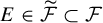
$E\in \widetilde {\mathcal F}\subset \mathcal {F}$
 . Fix
$n\in E$
 . We have
$\{(j+n)-q-1,(j+n)-q,\ldots , (j+n)+ q+1\}\subset F$
 . By the claim,

This implies that

It is obvious that
$n\geq q+j+1$
 . Then,

So,
$n\in A_{M,j}\cap \overline {A}_{M,j}$
 and then
$E\subset A_{M,j}\cap \overline {A}_{M,j}$
 . This gives that
$A_{M,j}\cap \overline {A}_{M,j}\in \mathcal {F}$
 . Hence,
$B_w$
 is
$\mathcal {F}$
 -mixing, by Proposition 2.22.
So, in both cases, we have constructed an
$\mathcal {F}$
 -mixing bilateral weighted backward shift
$B_w$
 on X and for each
$n\in \mathbb N_0$
 , one has:
-
(1) $w_0w_1w_2\cdots w_n =\frac {1}{2}$
if and only if
$n\notin F$
; -
(2) $w_0w_1w_2\cdots w_n \geq 1$
if and only if
$n\in F$
.


For each
$x=\sum _{i\in \mathbb Z}x_ie_i\in X$
 , let

The function
$\|\cdot \|_+$
 is clearly a continuous seminorm on X. Consider the following neighbourhood W of
$e_0$
 :

Now, we verify that
$N_{B_w}(W,W)=F$
 . On the one hand, fix
$m\in N_{B_w}(W,W)\setminus \{0\}$
 . Then, there is a vector
$x=\sum _{i\in \mathbb Z}x_ie_i\in W$
 such that
$B_w^mx\in W$
 , which gives that
$|x_m|<\frac 45$
 and
$|w_1w_2\cdots w_mx_m-1|<\frac 45$
 . Then, we have
$w_1w_2\cdots w_m|x_m|>\frac {1}{5}$
 and

which gives that
$m\in F$
 . On the other hand, fix
$m\in F\setminus \{0\}$
 . Let
$x=e_0+ ({3}/{10w_1w_2\cdots w_m})e_m$
 . Then,

and, hence,
$x\in W$
 . Moreover,

So,
$B_w^mx\in W$
 . Therefore,
$m\in N_{B_w}(W,W)$
 .
Remark 4.3. Given a full family
$\mathcal {F}$
 and
$F\in \widetilde {\mathcal {F}}$
 , by a strategy similar to that used in the proof of Lemma 4.1, one can find an
$\mathcal {F}$
 -mixing unilateral weighted backward shift
$B_w$
 on X, and a non-empty open subset W of X such that
$N_{B_w}(W,W)= F\cup \{0\}$
 , where
$X=c_0(\mathbb {N}_0)$
 or
$ \ell ^p(\mathbb {N}_0)$
 ,
$1\leq p<\infty $
 .
By Lemma 4.1, for a given full family
$\mathcal {F}$
 , we characterize the operators that are weakly disjoint from all
$\mathcal {F}$
 -mixing operators, which is an analogue of the Weiss–Akin–Glasner theorem (Theorem 2.13) from topological dynamics.
Theorem 4.4. Let
$T\colon X\to X$
 be an operator and let
$\mathcal {F}$
 be a full family. Then, the following assertions are equivalent:
-
(1) T is $(\widetilde {\mathcal {F}})^*$
-transitive; -
(2) T is weakly disjoint from all $\mathcal {F}$
-mixing operators; -
(3) T is weakly disjoint from all invertible $\mathcal {F}$
-mixing bilateral weighted backward shifts on Y, where
$Y=c_0(\mathbb {Z})$
or
$\ell ^p(\mathbb {Z}),1\leq p<\infty $
.


Proof. The implications (1)
$\Rightarrow $
 (2)
$\Rightarrow $
 (3) are clear.
(3)
$\Rightarrow $
 (1). Let
$U, V$
 be a pair of non-empty open subsets of X. Our goal is to show that
$N_T(U,V)$
 intersects each member in
$\widetilde {\mathcal {F}}$
 . Fix
$F\in \widetilde {\mathcal {F}}$
 . By Lemma 4.1, there exists an invertible
$\mathcal {F}$
 -mixing bilateral weighted backward shift S on Y and a non-empty open subset W of Y such that
$N_S(W,W)= F\cup \{0\}$
 . Since
$T\oplus S$
 is hypercyclic,
${N_T(U,V)\cap N_S(W,W)}$
 is an infinite set, while
$N_T(U,V)\cap N_S(W,W)= N_T(U,V)\cap (F\cup \{0\})=(N_T(U,V)\cap F)\cup (N_T(U,V)\cap \{0\})$
 . Consequently,
$N_T(U,V)\cap F$
 is an infinite set and then
$N_T(U,V)\in (\widetilde {\mathcal {F}})^*$
 . Hence, T is
$(\widetilde {\mathcal {F}})^*$
 -transitive.
For a shift-invariant thick family
$\mathcal {F}$
 , if every
$\mathcal {F}^*$
 -transitive operator is weakly mixing, then the characterization of the weak disjointness of
$\mathcal {F}$
 -transitive operators can be strengthened as follows.
Proposition 4.5. Let
$T\colon X\to X$
 be an operator and let
$\mathcal {F}$
 be a shift-invariant thick family. If every
$\mathcal {F}^*$
 -transitive operator is weakly mixing, then the following assertions are equivalent:
-
(1) T is $\mathcal {F}^*$
-transitive; -
(2) for any $\mathcal {F}$
-transitive operator
$S\colon Y\to Y$
,
$T\oplus S$
is weakly mixing; -
(3) for any invertible $\mathcal {F}$
-transitive bilateral weighted backward shift S on Y, where
${Y=c_0(\mathbb {Z})}$
, or
$\ell ^p(\mathbb {Z})$
,
$1\leq p<\infty $
,
$T\oplus S$
is weakly mixing.


Proof. The implication (2)
$\Rightarrow $
 (3) is clear. (3)
$\Rightarrow $
 (1) follows from Theorem 4.4.
(1)
$\Rightarrow $
 (2). Let
$S\colon Y\to Y$
 be an
$\mathcal {F}$
 -transitive operator. Fix non-empty open subsets
$U_1, V_1$
 of X and
$U_2, V_2$
 of Y. Let
$k\in \mathbb {N}_0$
 . By the hypothesis, T is weakly mixing and
$\mathcal {F}^*$
 -transitive. So, T is
$\mathcal {F}^*$
 -mixing. Then,
$A=\{n\in \mathbb {N}_0: \{n,n+1,\ldots ,n+k\}\subset N_T(U_1, V_1)\}\in \mathcal {F}^*$
 . By the
$\mathcal {F}$
 -transitivity of S and the thickness of
$\mathcal {F}$
 , we have
$B=\{n\in \mathbb {N}_0: \{n,n+1,\ldots ,n+k\}\subset N_S(U_2, V_2)\}\in \mathcal {F}$
 . Now,
$\emptyset \neq A\cap B\subset \{n\in \mathbb {N}_0: \{n,n+1,\ldots ,n+k\}\subset N_T(U_1,V_1)\cap N_S(U_2, V_2)\}$
 and then
$N_T(U_1,V_1)\cap N_S(U_2, V_2)\in \mathcal {F}_{\mathrm {t}}$
 . By Proposition 2.5,
$T\oplus S$
 is weakly mixing.
Since
$\mathcal {F}_{\mathrm {ts}}$
 and
$\mathcal {F}_{\mathrm {t}}$
 are shift-invariant thick families, and topologically ergodic operators are weakly mixing, by Theorem 4.4 and Proposition 4.5, we can strengthen Cardeccia’s results (Theorems 3.11 and 3.12) as follows.
Corollary 4.6. Let
$T\colon X\to X$
 be an operator. Then, the following assertions are equivalent:
-
(1) T is topologically ergodic;
-
(2) T is weakly disjoint from all weakly mixing operators;
-
(3) T is weakly disjoint from all invertible weakly mixing bilateral weighted backward shifts on Y, where $Y=c_0(\mathbb {Z})$
or
$\ell ^p(\mathbb {Z}),1\leq p<\infty $
; -
(4) for any invertible weakly mixing bilateral weighted backward shift S on Y, $T\oplus S$
is weakly mixing, where
$Y=c_0(\mathbb {Z})$
or
$\ell ^p(\mathbb {Z}),1\leq p<\infty $
; -
(5) for any weakly mixing operator $S\colon Y\to Y$
,
$T\oplus S$
is weakly mixing, where
$Y=c_0(\mathbb {Z})$
or
$\ell ^p(\mathbb {Z}),1\leq p<\infty $
.





Corollary 4.7. Let
$T\colon X\to X$
 be an operator. Then, the following assertions are equivalent:
-
(1) T is $\mathcal {F}_{\mathrm {ps}}$
-transitive; -
(2) T is weakly disjoint from all topologically ergodic operators;
-
(3) T is weakly disjoint from all invertible topologically ergodic bilateral weighted backward shifts on Y, where $Y=c_0(\mathbb {Z})$
or
$\ell ^p(\mathbb {Z}),1\leq p<\infty $
.


As we can see, if each member of a family
$\mathcal {F}$
 contains a return time set of an
$\mathcal {F}$
 -transitive operator, then the
$\mathcal {F}^*$
 -transitivity of an operator is equivalent to the weak disjointness from all
$\mathcal {F}$
 -transitive operators. By Lemma 4.1, every member of a shift-invariant thick family contains a return time set of an
$\mathcal {F}$
 -mixing operator. However, one can construct a family
$\mathcal {F}$
 , where every member contains a return time set of an
$\mathcal {F}$
 -transitive operator but is not thick, using the following result.
Theorem 4.8. ([Reference de la Rosa and Read14, Theorem 4.1] or [Reference Bayart and Matheron7, Theorem 1.2])
There is a hypercyclic operator that is not weakly mixing.
Let
$T\colon X\to X$
 be a hypercyclic operator that is not weakly mixing and let
${\mathcal {N}_T=\{A\subset \mathbb {N}_0\colon N(U,V)\subset A\text { for some non-empty open subsets }U,V\text { of }X\}}$
 . It is easy to check that an operator
$S\colon Y\to Y$
 is
$\mathcal {N}_T^*$
 -transitive if and only if it is weakly disjoint from all
$\mathcal {N}_T$
 -transitive operators if and only if it is weakly disjoint from T. However, since T is not weakly mixing, we have
$N(U_0,V_0)\not \in \mathcal {F}_{\mathrm {t}}$
 for some non-empty open subsets
$U_0,V_0$
 of X and then
$\mathcal {N}_T$
 is not a thick family. Lemma 4.1 gives a characterization of subsets of non-negative integers that can be realized by the return time sets of
$\mathcal {F}$
 -mixing operators. However, the characterization of return time sets remains open for hypercyclic operators that are not weakly mixing. This raises the following question.
Question 4.9. In addition to shift-invariant thick families, what kind of family
$\mathcal {F}$
 has the property that every member of
$\mathcal {F}$
 contains a return time set of an
$\mathcal {F}$
 -transitive operator?
By the Weiss–Akin–Glasner theorem (Theorem 2.9), there is no family
$\mathcal {F}$
 such that the
$\mathcal {F}$
 -transitivity of compact dynamical systems is equivalent to the weak disjointness from all
$\mathcal {F}$
 -transitive compact dynamical systems, since there exists a topologically ergodic compact dynamical system that is not weakly mixing. However, things change under the framework of linear dynamical systems, since each topologically ergodic operator must be
$\mathcal {F}_{\mathrm {ts}}$
 -transitive, thus weakly mixing, so we ask the following question.
Question 4.10. Is there a family
$\mathcal {F}$
 such that an operator is
$\mathcal {F}$
 -transitive if and only if it is weakly disjoint from all
$\mathcal {F}$
 -transitive operators?
Remark 4.11. It is clear that every weakly mixing operator is
$\mathcal {F}_{\mathrm {ps}}$
 -transitive. A natural question is whether these two classes of operators are distinct, see [Reference Cardeccia13, Question on p. 1328]. We note that by Corollaries 4.6 and 4.7, an operator is weakly disjoint from all weakly mixing operators if and only if it is weakly disjoint from all
$\mathcal {F}_{\mathrm {ps}}$
 -transitive operators.
In 1995, Salas provided in [Reference Salas27, Corollary 2.3] a hypercyclic operator T on
$\ell ^2(\mathbb {Z})$
 such that
$T^*$
 is also hypercyclic. In Lemma 4.1, if we restrict the underlying space X to be
$\ell ^2(\mathbb {Z})$
 , require that
$\mathbb {N}_0\setminus F$
 is large enough and modify our construction slightly, then the operator we obtain possesses a hypercyclic adjoint.
Proposition 4.12. Let
$\mathcal {F}_1$
 and
$\mathcal {F}_2$
 be shift-invariant thick families. If there are
${F_1\in \mathcal {F}_1,F_2\in \mathcal {F}_2}$
 with
$F_1\cap F_2=\emptyset $
 , then there is an invertible operator T on
$\ell ^2(\mathbb {Z})$
 such that T is
$\mathcal {F}_1$
 -transitive and
$T^*$
 is
$\mathcal {F}_2$
 -transitive.
Proof. Let
$F=F_1$
 . It is clear that both F and
$\mathbb {N}_0\setminus F$
 are not cofinite. Write F as the disjoint union of a sequence
$(I_k)_{k\in \mathbb {N}}$
 of maximal finite integer intervals. Since
${\{ n\in \mathbb {N}_0\colon \{n-2,n-1,n\}\subset F\}\in \mathcal {F}_1}$
 , without loss of generality, we require that
$0\notin F,1\notin F$
 and
$|I_k|\geq 3$
 for each
$k\in \mathbb {N}$
 . In addition, we assume that the sequence
$(\mathrm \min I_k)_{k\in \mathbb {N}}$
 is increasing. Let
$J_1=[1,\mathrm \min I_1-1]\cap \mathbb {N}_0$
 . For each
$k\in \mathbb {N}$
 , let
${J_{k+1}=[\mathrm \max I_{k}+1,\mathrm \min I_{k+1}-1]\cap \mathbb {N}_0}$
 . For
$n\in \mathbb {N}$
 , let

and

In addition, let

and

Let
$B_w$
 be the bilateral weighted backward shift on X defined by the weight w, where
$w=(w_i)_{i\in \mathbb {Z}}$
 is given by

For each
$i\in -\mathbb {N}$
 , we have
$w_i={1}/{w_{-i}}$
 . Since both
$(w_i)_{i\in \mathbb {Z}}$
 and
$({1}/{w_{i+1}})_{i\in \mathbb {Z}}$
 are bounded,
$B_w$
 is an invertible operator on
$\ell ^2(\mathbb {Z})$
 . Let
$v=(w_{1-i})_{i\in \mathbb {N}_0}$
 and
$T=B_w$
 . It is easy to see that
$T^*$
 is conjugate to
$B_v$
 . It remains to show that
$B_w$
 is
$\mathcal {F}_1$
 -transitive and
$B_v$
 is
$\mathcal {F}_2$
 -transitive.
By the same argument as the one in Case B of the proof of Lemma 4.1, we have the following facts:
-
• if $m\in \mathbb {N}_0$
satisfies
$\{m-r,m-r+1,\ldots ,m+r+1\}\subset F$
for some
$r\in \mathbb {N}_0$
, then
$w_1\cdots w_m\geq 2^r$
; -
• if $m\in \mathbb {N}_0$
satisfies
$\{m-r,m-r+1,\ldots ,m+r+1\}\subset \mathbb {N}\setminus F$
for some
$r\in \mathbb {N}_0$
, then
$w_1\cdots w_m\leq {1}/{2^r}$
.







To show that
$B_w$
 is
$\mathcal {F}_1$
 -transitive, by Proposition 2.22, it suffices to show that for any
$M>0$
 and
$j\in \mathbb {N}$
 ,
$A_{M,j}(w)\cap \overline {A}_{M,j}(w)\in \mathcal {F}_1$
 , where

Fix
$j\in \mathbb {N}$
 and
$M>0$
 . There is
$q_1\in \mathbb {N}$
 with
$2^{q_1}>Mw_1\cdots w_j$
 . Consider the set

Since
$\mathcal {F}_1$
 is a shift-invariant thick family and
$F\in \mathcal {F}_1$
 , by Remark 2.4,
$E_1\in \mathcal {F}_1$
 . Fix
$n\in E_1$
 , we have
$\{(n+j)-q_1, (n+j)-q_1+1,\ldots ,(n+j)+q_1+1\}\subset F$
 and
$\{(n-j-1)-q_1, (n-j-1)-q_1+1,\ldots ,(n-j-1)+q_1+1\}\subset F$
 . Then,
$w_1w_2\cdots w_{j+n}\geq 2^{q_1}$
 and
$w_1w_2\cdots w_{n-j-1}\geq 2^{q_1}$
 . We have

and

This gives that
$n\in A_{M,j}(w)\cap \overline {A}_{M,j}(w)$
 and then
$E_1\subset A_{M,j}(w)\cap \overline {A}_{M,j}(w)$
 . Then,
$A_{M,j}(w)\cap \overline {A}_{M,j}(w)\in \mathcal {F}_1$
 and
$B_w$
 is
$\mathcal {F}_1$
 -transitive by Proposition 2.22.
To show that
$B_v$
 is
$\mathcal {F}_2$
 -transitive, by Proposition 2.22, it suffices to show that for any
$M>0$
 and
$j\in \mathbb {N}$
 ,
$A_{M,j}(v)\cap \overline {A}_{M,j}(v)\in \mathcal {F}_2$
 , where

Fix
$j\in \mathbb {N}$
 and
$M>0$
 . There is
$q_2\in \mathbb {N}$
 with
$2^{q_2}>M\mathrm \max \{w_0w_{-1}\cdots w_{-j+1},\, v_jv_{j-1} \cdots v_2\}$
 . Consider the set

Since
$\mathbb {N}_0\setminus F\in \mathcal {F}_2$
 and
$\mathcal {F}_2$
 is full, we have
$\mathbb {N}\setminus F\in \mathcal {F}_2$
 . Since
$\mathcal {F}_2$
 is a shift-invariant thick family, by Remark 2.4,
$E_2\in \mathcal {F}_2$
 . Fix
$n\in E_2$
 . We have
$\{(n+j)-q_2,(n+j)-q_2+1,\ldots , (n+j)+q_2+1\}\subset \mathbb {N}\setminus F$
 and
$\{(n-j)-q_2,(n-j)-q_2+1,\ldots , (n-~j)+q_2+1\}\subset \mathbb {N}\setminus F$
 . By the above analysis, we have
$w_1w_2\cdots w_{j+n-1}\leq {1}/{2^{q_2}}$
 and
${w_1w_2\cdots w_{n-j}\leq {1}/{2^{q_2}}}$
 . Note that

We have

and

This gives that
$n\in A_{M,j}(v)\cap \overline {A}_{M,j}(v)$
 and then
$E_2\subset A_{M,j}(v)\cap \overline {A}_{M,j}(v)$
 . Then,
$A_{M,j}(v)\cap \overline {A}_{M,j}(v)\in \mathcal {F}_2$
 and
$B_v$
 is
$\mathcal {F}_2$
 -transitive by Proposition 2.22.
4.2 Some examples
Applying Lemma 4.1, we can provide a large number of operators with some prescribed properties. We first give two general results and then provide certain examples.
Proposition 4.13. Let
$\mathcal {F}_1$
 be a shift-invariant thick family and
$\mathcal {F}_2$
 be a family. Then, there exists an invertible
$\mathcal {F}_1$
 -transitive operator on X that is not
$\mathcal {F}_2$
 -transitive if and only if
$\mathcal {F}_1\setminus \mathcal {F}_2\neq \emptyset $
 , where
$X=c_0(\mathbb {Z})$
 or
$\ell ^p(\mathbb {Z})$
 ,
$1\leq p<\infty $
 .
Proof. On the one hand, let
$T\colon X\to X$
 be an invertible
$\mathcal {F}_1$
 -transitive operator that is not
$\mathcal {F}_2$
 -transitive. Then, there are non-empty open subsets
$U,V$
 of X with
$N(U,V)\notin \mathcal {F}_2$
 . We are done since
$N(U,V)\in \mathcal {F}_1$
 .
Conversely, fix
$F\in \mathcal {F}_1\setminus \mathcal {F}_2$
 . By Lemma 4.1, there exist an invertible
$\mathcal {F}_1$
 -transitive operator
$T\colon X\to X$
 and a non-empty open subset W of X such that

where
$X=c_0(\mathbb {Z})$
 or
$\ell ^p(\mathbb {Z})$
 ,
$1\leq p<\infty $
 . Since X has no isolated points, there are non-empty open sets
$W', W"\subset W$
 with
$N(W', W")\subset [1,+\infty )$
 . Finally, we have
$N(W', W")\subset F$
 . Since
$F\notin \mathcal F_2$
 , we have that
$N(W', W")\notin \mathcal F_2$
 . Hence, T is not
$\mathcal {F}_2$
 -transitive.
Proposition 4.14. Let
$\mathcal {F}_1$
 and
$\mathcal {F}_2$
 be shift-invariant thick families. Then, there exists an invertible
$\mathcal {F}_1$
 -transitive operator
$T\colon X\to X$
 and an invertible
$\mathcal {F}_2$
 -transitive operator
$S\colon Y\to Y$
 such that T is not weakly disjoint from S if and only if there are
$F_1\in \mathcal {F}_1$
 and
$F_2\in \mathcal {F}_2$
 such that
$F_1\cap F_2=\emptyset $
 .
Proof. On the one hand, let
$T\colon X\to X$
 be an invertible
$\mathcal {F}_1$
 -transitive operator and
$S\colon Y\to Y$
 be an invertible
$\mathcal {F}_2$
 -transitive operator such that T is not weakly disjoint from S. Then, there are non-empty open subsets
$U_1,V_1$
 of X and
$U_2,V_2$
 of Y with
$N_T(U_1,V_1)\cap N_S(U_2,V_2)=\emptyset $
 . We are done since
$N_T(U_1,V_1)\in \mathcal {F}_1$
 and
$N_S(U_2,V_2)\in \mathcal {F}_2$
 .
Conversely, by the hypothesis,
$F_1\in \mathcal {F}_1\setminus \mathcal {F}^*_2$
 . By Proposition 4.13, there exists an invertible
$\mathcal {F}_1$
 -transitive operator that is not
$\mathcal {F}^*_2$
 -transitive. Since
$\mathcal {F}_2$
 is a shift-invariant thick family, by Theorem 4.4, there exists an invertible
$\mathcal {F}_2$
 -transitive operator
$S\colon Y\to Y$
 such that T is not weakly disjoint from S.
In 2019, Bès et al constructed several operators to distinguish transitivity with respect to different families [Reference Bès, Menet, Peris and Puig10]. We provide here more invertible operators of this kind. We recall the definitions of density and Banach density of a subset of
$\mathbb {N}_0$
 .
Definition 4.15. Let
$A\subset \mathbb {N}_0$
 .
-
• The upper and lower density of A are given by
$$ \begin{align*} \overline{\mathrm{D}}(A)=\limsup_{n\to \infty} \frac{|\{j\in A: j\leq n-1\}|}{n},\quad \underline{\operatorname{D}}(A)=\liminf_{n\to \infty} \frac{|\{j\in A: j\leq n-1\}|}{n}. \end{align*} $$
-
• The upper and lower Banach density of A are given by
$$ \begin{align*} \overline{\mathrm{BD}}(A)&=\limsup_{n-m\to \infty} \frac{|\{j\in A: m\leq j\leq n-1\}|}{n-m}, \\ \ \underline{\mathrm{BD}}(A)&=\liminf_{n-m\to \infty} \frac{|\{j\in A: m\leq j\leq n-1\}|}{n-m}. \end{align*} $$


It is observed that for any
$A\subset \mathbb {N}_0$
 , we have
$\underline {\mathrm {BD}}(A)\leq \underline {\mathrm {D}}(A)\leq \overline {\mathrm {D}}(A)\leq \overline {\mathrm {BD}}(A)$
 . We denote:
-
• $\mathcal {F}_{\mathrm {pud}}=\{A\subset \mathbb {N}_0: \overline {\mathrm {D}}(A)>0\}$
;
$\mathcal {F}_{\mathrm {pld}}=\{A\subset \mathbb {N}_0: \underline {\mathrm {D}}(A)>0\}$
; -
• $\mathcal {F}_{\mathrm {ud1}}=\{A\subset \mathbb {N}_0: \overline {\mathrm {D}}(A)=1\}$
;
$\mathcal {F}_{\mathrm {ld1}}=\{A\subset \mathbb {N}_0: \underline {\mathrm {D}}(A)=1\}$
; -
• $\mathcal {F}_{\mathrm {pubd}}=\{A\subset \mathbb {N}_0: \overline {\mathrm {BD}}(A)>0\}$
;
$\mathcal {F}_{\mathrm {lbd1}}=\{A\subset \mathbb {N}_0: \underline {\mathrm {BD}}(A)=1\}$
.






It can be checked that the above six families are shift-invariant and
$\mathcal {F}_{\mathrm {ld1}}, \mathcal {F}_{\mathrm {lbd1}}$
 are filters. By Remark 2.4(5), both
$\mathcal {F}_{\mathrm {ld1}}$
 and
$\mathcal {F}_{\mathrm {lbd1}}$
 are shift-invariant thick families. In addition, we have
$\mathcal {F}^*_{\mathrm {ld1}}=\mathcal {F}_{\mathrm {pud}}$
 and
$\mathcal {F}^*_{\mathrm {lbd1}}=\mathcal {F}_{\mathrm {pubd}}$
 . By Proposition 4.13, once we have found a subset of
$\mathbb {N}_0$
 with some prescribed properties, we will obtain an operator to distinguish certain classes of hypercyclic operators.
Proposition 4.16. Let
$X=c_0(\mathbb {Z})$
 or
$\ell ^p(\mathbb {Z})$
 ,
$1\leq p<\infty $
 .
-
(1) There exists an invertible weakly mixing operator on X that is not $\mathcal {F}_{\mathrm {pud}}$
-transitive. -
(2) There exists an invertible topologically ergodic operator on X that is not $\mathcal {F}^*_{\mathrm {ip}}$
-transitive. -
(3) There exists an invertible topologically ergodic operator on X that is not $\mathcal {F}_{\mathrm {ud1}}$
-transitive. -
(4) There exists an invertible $\mathcal {F}_{\mathrm {ld1}}$
-transitive operator on X that is not topologically ergodic. -
(5) There exists an invertible $\mathcal {F}_{\mathrm {lbd1}}$
-transitive operator on X that is not strongly mixing. -
(6) There exists an invertible $\mathcal {F}^*_{\mathrm {ip}}$
-transitive operator on X that is not
$\Delta ^*$
-transitive. -
(7) There exists an invertible $\Delta ^*_{\mathrm {ip}}$
-transitive operator on X that is not
$\mathcal {F}^*_{\mathrm {ip}}$
-transitive.


Proof. (1) Let
$F=\bigcup _{n\in \mathbb {N}} \{2^n,2^n+1,\ldots ,2^n+n\}$
 . It is clear that
$F\in \mathcal {F}_{\mathrm {t}}\setminus \mathcal {F}_{\mathrm {pud}}$
 . Since
$\mathcal {F}_{\mathrm {t}}$
 is a shift-invariant thick family, the result follows from Proposition 4.13.
(2) Let
$F=\mathbb {N}_0\setminus \mathrm {FS}((10^{n})_{n\in \mathbb {N}})$
 . It can be verified that
$F\in \mathcal {F}_{\mathrm {ts}}\setminus \mathcal {F}^*_{\mathrm {ip}}$
 . Since
$\mathcal {F}_{\mathrm {ts}}$
 is a shift-invariant thick family, the result follows from Proposition 4.13.
(3) For each
$n\in \mathbb {N}_0$
 , let
$F_n = \{(n 3^n)k+i\colon k\in \mathbb {N}, i\in \{0,1,\ldots ,n-1\}\}$
 . Then, for each
$n\in \mathbb {N}$
 ,
$F_n$
 is syndetic and
$\overline {\mathrm {D}}(F_n)=\underline {\mathrm {D}}(F_n)={1}/{3^n}$
 . Then,
$F: =\bigcup _{n=1}^\infty F_n$
 is thickly syndetic and
$\overline {\mathrm {D}}(F)\leq \sum _{n=1}^\infty \overline {\mathrm {D}}(F_n)=\frac 23$
 . This shows that
$F\in \mathcal {F}_{\mathrm {ts}}\setminus \mathcal {F}_{\mathrm {ud1}}$
 . Since
$\mathcal {F}_{\mathrm {ts}}$
 is a shift-invariant thick family, the result follows from Proposition 4.13.
(4) Let
$F=\mathbb {N}_0\setminus \bigcup _{n\in \mathbb {N}} \{2^n,2^n+1,\ldots ,2^n+n\}$
 . By the proof of (1),
$F\in \mathcal {F}_{\mathrm {ld1}}\setminus \mathcal {F}_{\mathrm {s}}$
 . Since
$\mathcal {F}_{\mathrm {ld1}}$
 is a shift-invariant thick family, the result follows from Proposition 4.13.
(5) Let
$F=\mathbb {N}_0\setminus \{2^n\colon n\in \mathbb {N}\}$
 . It is clear that
$F\in \mathcal {F}_{\mathrm {lbd1}}\setminus \mathcal {F}_{\mathrm {cf}}$
 . Since
$\mathcal {F}_{\mathrm {lbd1}}$
 is a shift-invariant thick family, the result follows from Proposition 4.13.
(6) Let
$(s_n)_{n\in \mathbb {N}}$
 be a sequence of positive integers such that
$s_{n+1}>4(\sum _{i=1}^n s_i+n)$
 for each
$n\in \mathbb {N}$
 . Put
$S=\{s_n\colon n\in \mathbb {N}\}$
 and
$A=\mathbb {N}_0\setminus (S-S)$
 . The family

is a shift-invariant thick subfamily of
$\mathcal {F}^*_{\mathrm {ip}}$
 (see [Reference Huang and Ye25, Example B]). Now, we have
$A\in \mathcal {F}_A\setminus \Delta ^*$
 . Then, the result follows from Proposition 4.13.
(7) Let
$(s_n)_{n\in \mathbb {N}}$
 be the same sequence as the one in the proof of part (6). Put
${A=\mathbb {N}_0\setminus \mathrm {FS}((s_n)_{n\in \mathbb {N}})}$
 . For each
$k\in \mathbb {N}$
 , let
$A_k=\bigcap _{i=-k}^k (A+i)$
 . The family

is a shift-invariant thick subfamily of
$\Delta ^*_{\mathrm {ip}}$
 (see [Reference Huang and Ye25, Example C]). Now, we have
${A\in \mathcal {F}_A\setminus \mathcal {F}^*_{\mathrm {ip}}}$
 . Then, the result follows from Proposition 4.13.
We provide examples of weakly mixing operators without hypercyclic direct sums.
Corollary 4.17. There exist an invertible weakly mixing operator T and an invertible
$\mathcal {F}_{\mathrm {ld1}}$
 -transitive operator S such that T is not weakly disjoint from S.
Proof. Since there are
$F_1\in \mathcal {F}_{\mathrm {t}}$
 and
$F_2\in \mathcal {F}_{\mathrm {ld1}}$
 with
$F_1\cap F_2=\emptyset $
 (see the proof of Proposition 4.16(4)), the result follows from Proposition 4.14.
In §3, we have demonstrated that the mild mixing of operators lies strictly between strong mixing and weak mixing. By Proposition 4.16 and Corollary 4.17, we immediately obtain that the mild mixing of invertible operators lies strictly between strong mixing and weak mixing.
Corollary 4.18.
-
(1) There exists an invertible $\mathcal {F}_{\mathrm {ld1}}$
-transitive operator that is not mildly mixing. -
(2) There exists an invertible mildly mixing operator T that is not strongly mixing.

Proof. (1) The
$\mathcal {F}_{\mathrm {ld1}}$
 -transitive operator
$S\colon Y\to Y$
 in Corollary 4.17 is not mildly mixing since it is not weakly disjoint from some weakly mixing operator.
(2) By Proposition 4.16(7), there exists an invertible
$\Delta ^*_{\mathrm {ip}}$
 -transitive operator
$T\colon X\to X$
 that is not
$\mathcal {F}^*_{\mathrm {ip}}$
 -transitive. By Proposition 3.15, T is mildly mixing. It is clear that T is not strongly mixing.
We provide a further example of a weakly mixing operator with a weakly mixing adjoint. By Remark 3.18, this is also an example of a weakly mixing operator
$T\colon X\to X$
 such that neither T nor
$T^*$
 is mildly mixing.
Corollary 4.19. There exists an invertible
$\mathcal {F}_{\mathrm {ld1}}$
 -transitive operator T on
$\ell ^2(\mathbb {Z})$
 such that
$T^*$
 is weakly mixing.


5 Direct sums of backward shifts
In this section, we investigate the
$\mathcal F$
 -transitivity of the direct sums of finitely many (bilateral and unilateral) backward shifts on Fréchet sequence spaces and show that the
$\mathcal {F}$
 -transitivity of such operators is equivalent to the
$\mathcal {F}$
 -mixing criterion.
Recall that in 1995, Salas gave in [Reference Salas27] a characterization of the weak disjointness of weighted backward shifts on
$\ell ^2(\mathbb {Z})$
 and
$\ell ^2(\mathbb {N}_0)$
 . Indeed, the weak disjointness of weighted backward shifts on
$c_0(\mathbb {Z})$
 and
$\ell ^p(\mathbb {Z}), 1\leq p<\infty $
 (or
$c_0(\mathbb {N}_0)$
 and
$\ell ^p(\mathbb {N}_0), 1\leq p<\infty $
 ) is already characterized by Salas in [Reference Salas27], although he only gave a proof for
$\ell ^2(\mathbb {Z})$
 and
$\ell ^2(\mathbb {N}_0)$
 . We restate these results in the language of weak disjointness.
Theorem 5.1. [Reference Salas27, Theorem 2.5]
Two weighted backward shifts
$B_w, B_v$
 on
$\ell ^2(\mathbb {Z})$
 are weakly disjoint if and only if for any
$\epsilon>0$
 and
$q\in \mathbb {N}_0$
 , there exists
$n\in \mathbb {N}$
 such that for any
$|j|\leq q$
 ,

and

Theorem 5.2. [Reference Salas27, Theorem 2.8]
Two weighted backward shifts
$B_w$
 and
$B_v$
 on
$\ell ^2(\mathbb {N}_0)$
 are weakly disjoint if and only if

In [Reference Grosse-Erdmann21], Grosse-Erdmann gave a characterization of weak disjointness of finitely many (unilateral and bilateral) backward shifts on F-sequence spaces with OP basis, by the limits of the basis, see [Reference Grosse-Erdmann21, Theorems 6 and 7].
Let X be a bilateral Fréchet sequence space in which
$\{\ldots , e_{-2},e_{-1}, e_0, e_1, e_2, \ldots \}$
 is a basis. Given a bilateral weighted backward shift
$B_w$
 on X, it is not hard to see that
$B_w$
 is conjugate to a (non-weighted) backward shift B on a Fréchet sequence space
$X_w$
 with the basis
$\{\ldots ,w_{-1}w_0e_2,w_0e_{-1},e_0, ({e_1}/{w_1}), ({e_2}/{w_1w_2}), \ldots \}$
 . This strategy also works for unilateral weighted backward shifts. Since the weak disjointness and the
$\mathcal {F}$
 -transitivity of operators are preserved under conjugacy, in what follows, we consider the direct sums of backward shifts, which can be transferred into the form of weighted backward shifts.
Theorem 5.3. Let
$X_1, X_2, \ldots , X_k$
 be bilateral Fréchet sequence spaces in which
$(e_n)_{n\in \mathbb {Z}}$
 is a basis and
$B_1, B_2, \ldots , B_k$
 be the backward shifts on
$X_1, X_2, \ldots , X_k$
 , respectively. Let
$\mathcal {F}$
 be a family. Then, the following assertions are equivalent:
-
(1) $\bigoplus _{i=1}^kB_i$
is
$\mathcal {F}$
-transitive; -
(2) $\bigoplus _{i=1}^kB_i$
is
$\mathcal {F}$
-mixing; -
(3) $\bigoplus _{i=1}^kB_i$
satisfies the
$\mathcal {F}$
-mixing criterion; -
(4) for each $\epsilon>0$
and
$N\in \mathbb {N}$
,
$\bigcap _{j=-N}^N\bigcap _{i=1}^k(C^+_{\epsilon , j}(X_i)\cap C^-_{\epsilon , j}(X_i))\in \mathcal {F}$
, where for
$j\in \mathbb {Z}$
and
$i\in \{1,2,\ldots , k\}$
, $$ \begin{align*} C^+_{\epsilon, j}(X_i)=\{n\in\mathbb{N}_0: \|e_{j+n}\|_{X_i}<\epsilon\}, C^-_{\epsilon, j}(X_i)=\{n\in\mathbb{N}_0: \|e_{j-n}\|_{X_i}<\epsilon\}. \end{align*} $$


Proof. The implications (3)
$\Rightarrow $
 (2)
$\Rightarrow $
 (1) are clear.
(1)
$\Rightarrow $
 (4). Fix
$\epsilon>0$
 and
$N\in \mathbb {N}$
 . For each
$i\in \{1,2,\ldots ,k\}$
 , since
$(e_n)_{n\in \mathbb {Z}}$
 is a basis of
$X_i$
 , we have that
$\{h_ne_n\colon n\in \mathbb {Z}\}$
 is bounded for each
$h=(h_n)_{n\in \mathbb {Z}}\in X_i$
 . By the Banach–Steinhaus theorem [Reference Grosse-Erdmann and Peris Manguillot22, Theorem A.10], for each
$i\in \{1,2,\ldots ,k\}$
 , there exists
$\delta _i>0$
 such that for any
$x^{(i)}\in X_i$
 with
$\|x^{(i)}\|_{X_i}<\delta _i$
 , we have that

and

Let
$\delta =\mathrm \min \{\delta _i\colon i=1,2, \ldots k\}$
 and
$u=\sum _{i=-N}^Ne_i$
 . For each
$i\in \{1,2,\ldots ,k\}$
 , denote
$U_i=\{y\in X_i\colon \|y-u\|_{X_i}<\delta \}$
 . Since
$\bigoplus _{i=1}^k B_i$
 is hypercyclic, we have

Fix
$n\in Q$
 . There is a vector
$(x^{(1)}, x^{(2)},\ldots x^{(k)})\in U_1\oplus U_2\oplus \cdots \oplus U_k$
 such that

That is, we have
$|j-n|>N, j+n>N$
 for
$|j|\leq N$
 and for each
$i\in \{1,2,\ldots ,k\}$
 , we have the following:
-
(i) $|x^{(i)}_j-1|\leq \frac {1}{3}$
for
$|j|\leq N$
; -
(ii) $|x^{(i)}_k|\leq \frac {1}{3}$
for
$|k|>N$
; -
(iii) $\|(x^{(i)}_j-1)e_j\|_{X_i}< {\epsilon }/{2}$
for
$|j|\leq N$
; -
(iv) $\|x^{(i)}_ke_k\|_{X_i}< {\epsilon }/{2}$
for
$|k|>N$
; -
(v) $|x^{(i)}_{n+j}-1|\leq \frac {1}{3}$
for
$|j|\leq N$
; -
(vi) $|x^{(i)}_{n+k}|\leq \frac {1}{3}$
for
$|k|>N$
; -
(vii) $\|(x^{(i)}_{n+j}-1)e_j\|_{X_i}< {\epsilon }/{2}$
for
$|j|\leq N$
; -
(viii) $\|x^{(i)}_{n+k}e_k\|_{X_i}< {\epsilon }/{2}$
for
$|k|>N$
.


Fix
$i\in \{1,2, \ldots k\}$
 . By item (viii), we have that
$\|x^{(i)}_je_{j-n}\|_{X_i}<{\epsilon }/{2}$
 for
$|j|\leq N$
 . Then by item (ii), we have that for
$|j|\leq N$
 ,

By item (iv), we have that
$\|x^{(i)}_{j+n}e_{j+n}\|_{X_i}<{\epsilon }/{2}$
 for
$|j|\leq N$
 . Then, by item (v), we have that for
${|j|\leq N}$
 ,

Hence, we have that

Since
$\bigoplus _{i=1}^kX_i$
 has no isolated points, for each
$i\in \{1,2,\ldots ,k\}$
 , there are non-empty open subsets
$W_i$
 and
$V_i$
 of
$U_i$
 such that

Then,

We are done since the hypothesis gives that
$\bigcap _{i=1}^k N_{B_i}(W_i, V_i)\in \mathcal {F}$
 .
(4)
$\Rightarrow $
 (3). Let
$a=(a^{(1)}, a^{(2)}, \ldots ,a^{(k)})$
 and
$b=(b^{(1)},b^{(2)}, \ldots ,b^{(k)})$
 be two k-tuples of finite sequences in
$\bigoplus _{i=1}^k X_i$
 . For each
$i\in \{1,2,\ldots , k\}$
 , write

Let
$F_1,F_2\ldots , F_k$
 be the forward shifts for finite sequences of
$X_1,X_2\ldots , X_k$
 , respectively. Denote
$T=\bigoplus _{i=1}^k B_i$
 and
$S=\bigoplus _{i=1}^k F_i$
 . Fix
$\delta>0$
 . For each
$i\in \{1,2,\ldots ,k\}$
 , there exists
$\epsilon _i>0$
 such that for any
$z^{(i)}\in X_i$
 with
$\|z^{(i)}\|_{X_i}<\epsilon _i$
 , we have for
$|j|\leq l$
 ,

Let
$\epsilon =\mathrm \min \{\epsilon _i\colon i=1,2,\ldots ,k\}$
 . Fix
$n\in \bigcap _{j=-l}^l\bigcap _{i=1}^k(C^+_{\epsilon , j}(X_i)\cap C^-_{\epsilon , j}(X_i))$
 and
${i\in \{1,2,\ldots ,k\}}$
 . We have

and

Then, we obtain

Hence, T satisfies the
$\mathcal {F}$
 -mixing criterion.
We now turn to unilateral backward shifts. The corresponding result is stated below. Since its proof closely parallels that of Theorem 5.3 in the bilateral setting, we omit the details.
Theorem 5.4. Let
$X_1, X_2, \ldots , X_k$
 be unilateral Fréchet sequence spaces in which
$(e_n)_{n\in \mathbb {N}_0}$
 is a basis and
$B_1, B_2, \ldots , B_k$
 be the backward shifts on
$X_1, X_2, \ldots , X_k$
 , respectively. Let
$\mathcal {F}$
 be a family. Then, the following assertions are equivalent:
-
(1) $\bigoplus _{i=1}^kB_i$
is
$\mathcal {F}$
-transitive; -
(2) $\bigoplus _{i=1}^kB_i$
is
$\mathcal {F}$
-mixing; -
(3) $\bigoplus _{i=1}^kB_i$
satisfies the
$\mathcal {F}$
-mixing criterion; -
(4) for each $\epsilon>0$
and
$N\in \mathbb {N}$
,
$\bigcap _{j=0}^N\bigcap _{i=1}^kC_{\epsilon , j}(X_i)\in \mathcal {F}$
, where for
$j\in \mathbb {N}_0$
and
${i\in \{1,2,\ldots ,k\}}$
, $$ \begin{align*} C_{\epsilon, j}(X_i)=\{n\in\mathbb{N}_0: \|e_{n+j}\|_{X_i}<\epsilon\}. \end{align*} $$


Acknowledgements
The authors would like to thank the referee for their valuable comments, which have helped to improve the presentation of this paper.
Funding
The authors were partially supported by the National Key R&D Program of China (2024YFA1013601), NSF of China (12222110, 12171298) and a grant from the Guangdong Provincial Department of Education (2025KCXTD013).



