Studies have shown that task interdependence and task autonomy are crucial to employees who work in teams because they shape the extent to which team members must rely on fellow coworkers for resources or the extent to which team members feel free to act on their own accord (e.g., Campion, Medsker, & Higgs, Reference Campion, Medsker and Higgs1993; Cohen & Bailey, Reference Cohen and Bailey1997; Kiggundu, Reference Kiggundu1983; Langfred, Reference Langfred2005; Stewart & Barrick, Reference Stewart and Barrick2000). Team members are considered task interdependent when they require resources, such as materials, information, and/or advice, from one or more co-workers to complete their work successfully (e.g., Johnson & Johnson, Reference Johnson and Johnson1989; Van der Vegt, Emans, & Van de Vliert, Reference Van der Vegt, Emans, Van de Vliert, Schriesheim and Neider2005; Wageman, Reference Wageman1995). In addition, team members’ task autonomy can be defined as the degree to which they have the discretion and freedom to determine how to carry out assigned tasks (e.g., Langfred, Reference Langfred2000; Molleman, Nauta, & Jehn, Reference Molleman, Nauta and Jehn2004; Stewart & Barrick, Reference Stewart and Barrick2000). Several recent studies have demonstrated that task interdependence and task autonomy are distinct constructs and that the interaction between them relates to team effectiveness (Langfred, Reference Langfred2000), team creativity (Gilson & Shalley, Reference Gilson and Shalley2004), and team performance (Langfred, Reference Langfred2005).
However, to date only a limited amount of research has been performed and studies have been restricted solely to the team level of analysis (e.g., Cordery, Morrison, Wright, & Wall, Reference Cordery, Morrison, Wright and Wall2010; Langfred, Reference Langfred2000, Reference Langfred2005; Rasmussen & Jeppesen, Reference Rasmussen and Jeppesen2006). Molleman (2009, cf. p. 263) noted that important questions have therefore remained unanswered, such as, if—and if so, how—the interaction between task interdependence and task autonomy exerts an influence on the individual level of analysis, in particular in relation to individual performance. More insight into this is important for several reasons. For example, if the interaction is not found at the individual level, interventionists can be more assured that they do not have to balance for each individual in the team the extent to which he or she must rely on co-workers for resources and the extent he/she is autonomous. Interventions could then be more confident that they can just deal with these job and work design issues on the team level. Yet, if the interaction does exist at the individual level, interventionists would have evidence that a more detailed look might be worth their efforts. More importantly, besides knowing if the individual level of analysis matters for this topic, our study aims to provide more insight into why and how this interaction affects individual-level employees. The advantages for practitioners and researchers alike of a deeper theoretical understanding is that it helps to guide interventions and future studies, for instance, by indicating what other variables would fit to our new theoretical framework and might thus also be of importance. Investigating this topic is, however, challenging given the current state of knowledge. Because not only is empirical evidence scarce, but there has also been a limited amount of theoretical development on this interaction (e.g., Langfred, Reference Langfred2005; Langfred & Moye, Reference Langfred and Moye2004). Consequently, although several studies have shown that the interaction between these two constructs is important, empirical evidence is scarce, studies have only looked at the team level of analysis, and theoretical development has been limited.
To address all these three gaps simultaneously, this study will develop, and test, an alternative point of view focused at the individual level of analysis. To develop a firm foundation for our research, we will draw on established theories, namely interdependence theory (Thibaut & Kelley, Reference Thibaut and Kelley1959; Kelley & Thibaut, Reference Kelley and Thibaut1978) and Emerson’s (Reference Emerson1962) power-dependence theory to argue that individuals’ dependence on others makes them relatively powerless. In contrast, individuals who have others who depend on them (but who do not depend on those others in return) are relatively powerful. Although several other views related to power can be found in the literature (e.g., Raven, Reference Raven, Lee-Chai and Bargh2001), a number of recent reviews of the power literature (e.g., Fiske & Berdahl, Reference Fiske, Berdahl, Kruglanski and Higgins2007; Keltner, Gruenfeld, & Anderson, Reference Keltner, Gruenfeld and Anderson2003) have reaffirmed that Emerson’s theory on power and dependence very appropriately describes power differences that occur between team members (for additional reviews of the power literature, see also Guinote, Reference Guinote2007; Keltner, Van Kleef, Chen, & Kraus, Reference Keltner, Van Kleef, Chen and Kraus2008; Sell, Lovaglia, Mannix, Samuelson, & Wilson, Reference Sell, Lovaglia, Mannix, Samuelson and Wilson2004). The value of adopting a power-dependence perspective involves a frequently overlooked, but crucial, point of interdependence theory. This point is that two aspects determine individual task members’ levels of task interdependence: (a) the amount of resources received from other team members and (b) the amount of resources given to others (see also Morgenson & Humphrey, Reference Morgeson and Humphrey2006).
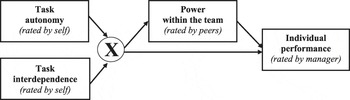
The majority of previous studies that focused on task interdependence (e.g., Johnson & Johnson, Reference Johnson and Johnson1989; Van der Vegt et al., Reference Van der Vegt, Emans, Van de Vliert, Schriesheim and Neider2005; Wageman, Reference Wageman1995, Reference Wageman and Turner1999), as well as the few studies on the interaction between task interdependence and task autonomy, did not explicitly acknowledge the two above-noted aspects. Rather, they assumed that similar task-interdependent individuals have equal power. However, we will argue, based on the above-mentioned two theories, as well as on other research on power and dependence (e.g., Brass, Reference Brass1981; Cook & Emerson, Reference Cook and Emerson1978; Giebels, De Dreu, & Van de Vliert, Reference Giebels, De Dreu and Van de Vliert2000), that this is not necessarily the case. In short, we theorize that individuals who report both high task interdependence and high task autonomy indicate that they give more resources to their colleagues than they receive resources from their colleagues in return. In contrast, we argue that similar high task interdependent individuals who report less task autonomy will need more resources from co-workers than their co-workers will require from them. We test this logic by investigating if interdependent individuals who report less task autonomy are more asymmetrically task dependent, and, thus, less powerful, than individuals who report more task autonomy. Ultimately, we will extend this theorizing by an additional step by arguing that, if the above line of reasoning is valid, then highly task interdependent and highly task autonomous individuals should also be in better positions to successfully complete their tasks than their less powerful colleagues who are also highly task interdependent, but perceive lower task autonomy. Hence, our core expectations are that the interaction between task interdependence and task autonomy will be related to individuals’ power and performance. Figure 1 depicts all of the expected individual level relationships between these four variables.
Research Model of How the Interaction Between Task Autonomy and Task Interdependence Relates to Power and Individual Performance at the Individual Level of Analysis. (Sources of Measurement appear in Italics)

Consequently, the main goal of this study is to increase currently limited insights into the interaction between task interdependence and task autonomy (e.g., Langfred, Reference Langfred2005; Molleman, Reference Molleman2009; Rasmussen & Jeppesen, Reference Rasmussen and Jeppesen2006). We will expand contemporary knowledge on this topic by developing a new theoretical lens based on interdependence theory (Thibaut & Kelley, Reference Thibaut and Kelley1959) and power-dependence theory (Emerson, Reference Emerson1962) and by investigating whether this interaction is related to power differences and individual performance. By studying this, this study will also contribute to future research related to “power due to asymmetries in task dependence” (De Jong, Van der Vegt, & Molleman, 2007; Van der Vegt, De Jong, Bunderson, & Molleman, 2010).
Definitions and Foundations
Before we develop our theory and hypotheses we will first discuss the definitions and theoretical foundations for our key variables. In our characterization of task autonomy, we remain close to the definition provided by Hackman and Oldham (Reference Hackman and Oldham1975) who described task autonomy as the amount of freedom and independence individuals possess in relation to their abilities to complete their work assignments. Task autonomy is an important aspect of work teams because it has been demonstrated to have a strong relationship with individuals’ well-being (Van Mierlo, Rutte, Kompier, & Seinen, Reference Van Mierlo, Rutte, Kompier and Seinen2001), team cohesiveness (Man & Lam, Reference Man and Lam2003), and team performance (Cohen & Bailey, Reference Cohen and Bailey1997). According to a recent study conducted by Molleman (Reference Molleman2009) “the focus [of task autonomy research] has always been on task autonomy as perceived by the jobholder because it is assumed that it is primarily these perceptions that affect psychological phenomena such as attitudes and behavior” (p. 245). Therefore this study will focus on team members’ individual perceptions of the amounts of task autonomy they possess within their teams.
The second key variable of interest is task interdependence. Prior studies conceptualized and measured task interdependence at both the team and individual levels of analysis (see, e.g., Johnson & Johnson, Reference Johnson and Johnson1989; Van der Vegt et al., Reference Van der Vegt, Emans, Van de Vliert, Schriesheim and Neider2005; Wageman, Reference Wageman1995). Studies that adopted team level approaches focused primarily on the differences between teams with respect to the extent of average task interdependence that occurred among all team members (e.g., Johnson & Johnson, Reference Johnson and Johnson1989; Wageman, Reference Wageman1995). In contrast, studies conducted at the individual level of analysis focused primarily on the degree to which specific individual team members were task interdependent with other members of their teams. Based on the goals of this study, we adopted the latter perspective and define task interdependence “as the degree to which the design of an individual team member’s tasks and job requires that he or she coordinates activities and exchanges materials and information with other members of the team for being able to carry out the job” (Van der Vegt & Van de Vliert, Reference Van der Vegt and Van de Vliert2005, p. 75).
The perspective on task interdependence described above holds an implicit assumption that has been applied by most studies focused on interdependence theory, namely that relationships are symmetrical. Contemporary research has shown that this assumption is not always valid because differences, or asymmetries, in task dependence occur in real life teams. These differences or asymmetries can exert importance effects on work relations (De Jong et al., 2007), as well as on intra-team processes (Van der Vegt et al., 2010). Based on Emerson’s (Reference Emerson1962) power-dependence theory, we expect that asymmetries in task dependence might be very important because they may result in situations in which asymmetrically less task-dependent team members maintain power over asymmetrically more task-dependent co-workers. By building on this theory of power offered by Emerson (Reference Emerson1962), as well as by drawing upon recent insights (e.g., De Jong et al., 2007; Fiske & Berdahl, Reference Fiske, Berdahl, Kruglanski and Higgins2007; Van der Vegt et al., Reference Van der Vegt, De Jong, Bunderson and Molleman2010), we conceptualized that team members’ power relates to imbalances in the resource exchange relationships between those team members and their peer team members Footnote 1 .
The Interaction between Task Interdependence and Task Autonomy
Before going into detail on the interaction between task interdependence and task autonomy we will briefly discuss the two main theories from which we will draw, namely interdependence theory (Thibaut & Kelley, Reference Thibaut and Kelley1959) and power-dependence theory (Emerson, Reference Emerson1962). While they have some similarities, each of them also provides crucial and unique insights into the topic of this study. Interdependence theory describes what occurs when team members need each other to fulfill their tasks. In short, this theory states that when team members have high need of each other (i.e. are highly task interdependent) they tend to collaborate more, whilst coworkers tend to work more individually when they do not need others to fulfill their tasks (i.e., are lowly task interdependent). Yet, as mentioned earlier, research on interdependency theory has often failed to investigate what happens when one individual needs coworkers more than vice versa (cf. De Jong et al., 2007). It is here where power-dependency theory (Emerson, Reference Emerson1962), and subsequent research on power, comes into play as it indicates that such differences in task interdependence mean that some workers have more power than others and that the powerful have many benefits. One of these benefits is that they can choose to withhold support or exit relationships at lower costs than less powerful team members (e.g., Cook & Emerson, Reference Cook and Emerson1978; Giebels, De Dreu, & Van de Vliert, Reference Giebels, De Dreu and Van de Vliert2000). Another is that they have more transaction alternatives (e.g., Brass, Reference Brass1981) and therefore have more potential partners to exchange resources with.
The application of these two theories to the interaction between task interdependence and task autonomy (Langfred, Reference Langfred2000, Reference Langfred2005) suggests that individuals who are highly task-interdependent and highly task-autonomous are likely to be the most powerful members in teams. Our argument is that a) the high task-interdependence of these individuals indicates that they exchange many resources within their teams and b) that this reveals, when viewed in conjunction with their perceptions of high task autonomy, that these individuals need fewer resources from others than others need from them. Hence, based on power-dependence theory (Emerson, Reference Emerson1962), interdependence theory (Thibaut & Kelley, Reference Thibaut and Kelley1959), and recent studies on power-dependence asymmetries (De Jong et al., Reference Van Dijke and Poppe2007; Van der Vegt et al., Reference Van der Vegt, De Jong, Bunderson and Molleman2010), we expect that these highly task interdependent and highly task autonomous individuals will be relatively powerful within their teams.
In contrast, we reason that highly task-interdependent individuals who reported lower task autonomy will be relatively powerless compared to the above mentioned colleagues who are also highly task-interdependent but experience more task autonomy. Once again, drawing from interdependence theory it can be expected that their high task-interdependence indicates that they exchange many resources within their team. However, drawing on power-dependence theory it can be argued that their perceptions of low task autonomy reveals that they are rather powerless because low autonomy indicates that they are more dependent upon their colleagues for resources to complete their tasks than colleagues are upon them.
As an illustration, imagine individuals who need to exchange many resources with their coworkers yet cannot autonomously decide how to use these resources or cannot freely decide how to schedule their tasks (cf. Morgeson & Humphrey, Reference Morgeson and Humphrey2006). We expect that these individuals are likely to have little power as the resources they need are apparently under the control of more powerful team members. Similarly, we argue that equally highly task interdependent individuals who report that they can freely decide on such matters are more likely to be powerful. Research on autonomy and power supports this notion, as research has indicated that more autonomous individuals indeed perceive themselves to be more powerful (Seppälä, Lipponen, Pirttila-Backman, & Lipsanen, Reference Seppälä, Lipponen, Pirttila-Backman and Lipsanen2011). Thus, at the individual level of analysis, we expect that the interaction between task interdependence and task autonomy relates to which individuals are powerful within their teams and which not.
Hypothesis 1: The interaction between task interdependence and task autonomy is positively related to individual team members’ power. Specifically, highly task-interdependent team members who perceive that they possess high task autonomy will be more powerful in comparison with equally highly task-interdependent team members who perceive that they possess lower levels of task autonomy.
Task Interdependence, Task Autonomy, and Individual Performance
The limited number of studies (e.g., Gilson & Shalley, Reference Gilson and Shalley2004; Langfred, Reference Langfred2000, Reference Langfred2005) that investigated the interaction between task interdependence and task autonomy focused solely on the team level of analysis. Therefore, if—and how—individual level processes and outcome are affected by this interaction remains unexplored (cf. Molleman, Reference Molleman2009). Based on recent studies focused on power that results from asymmetries in task dependence (De Jong et al., 2007; Van der Vegt et al., Reference Van der Vegt, De Jong, Bunderson and Molleman2010), as well as on literature related to power-dependence theory (e.g., Emerson, Reference Emerson1962; Fiske & Berdahl, Reference Fiske, Berdahl, Kruglanski and Higgins2007; Keltner et al., Reference Keltner, Gruenfeld and Anderson2003), we argued above that the interaction of task interdependence and task autonomy is related to the power of individual team members. Below, we will argue that, if this is indeed a valid line of reasoning, this interaction should also be related to individual performance because more powerful team members should be in better positions to successfully complete their tasks than their less powerful colleagues. Although teams often aspire to attain team goals, the reality in many teams is that individuals have conflicting goals (e.g., Locke, Smith, Erez, Chah, & Schaffer, Reference Locke, Smith, Erez, Chah and Schaffer1994) as they vie for bonuses, promotions, salary increases and compete for getting more resources or better projects.
Before extrapolating our power-dependence argumentation underlying hypothesis 1 to individual performance, it should be noted that research on the separate effects of task interdependence and task autonomy also suggests that these variables should affect individual performance. For example, the key works of Thompson (Reference Thompson1967) and Steiner (Reference Steiner1972) indicate that workers who are less dependent, and thus need few resources from co-workers, have a better chance of getting a high individual performance as they experience less so called ‘processes losses’ which can interfere with their work and outputs. Processes losses can be many things, such as conflicts over resources or goals, communication problems, misunderstandings, cooperation issues, or unproductive waiting times. Based on these works, it can be expected that when workers have the autonomy to decide how to work and have the resources to do their work, such process losses are less likely to distract, or hinder, them from setting a good performance. Additional support for an effect of our key variables on individual performance can be found in research which has shown that employees work harder on freely chosen tasks than on assigned tasks (e.g., Patall, Cooper, & Robinson, Reference Patall, Cooper and Robinson2008). Why this is, is described by self-determination theory, in which choice is argued to increase one’s sense of autonomy and it is this sense of autonomy which enhances one’s effort and motivation (e.g., Deci & Ryan, Reference Deci and Ryan1987; Ryan, Koestner, & Deci, Reference Ryan, Koestner and Deci1991). Hence, although studies on the interaction of task interdependence and task autonomy are scarce on the individual level, prior research into the separate effects of these variables already hints towards an impact on individual performance.
To capture these findings in one clear theoretical framework we will now continue on our previous theorizing from a power-dependence theory perspective (Emerson, Reference Emerson1962). Doing so, reveals that there are several theoretical reasons why a positive relationship between team members’ power and individuals’ performance can be expected, including the fact that more powerful team members are not easily hindered by other team members because they already possess the majority of the resources they require to complete their tasks (for reviews of the power literature see, e.g., Fiske & Berdahl, Reference Fiske, Berdahl, Kruglanski and Higgins2007; Guinote, Reference Guinote2007; Keltner et al., Reference Keltner, Gruenfeld and Anderson2003, Reference Keltner, Van Kleef, Chen and Kraus2008). Therefore, even if other team members might attempt to influence powerful members in negative ways, they cannot easily affect them. In addition, these attempts would involve great risks since powerful team members might choose to punish powerless team members at a later date by withholding critical resources (e.g., Cook & Emerson, Reference Cook and Emerson1978; Giebels et al., Reference Giebels, De Dreu and Van de Vliert2000). Consequently, powerful individual can perform better than the powerless as they are less easily affected by others.
Second, powerful team members can more easily recruit support by offering to provide materials, means, and/or information they control in exchange for assistance. Thus, the powerful are in better positions to employ direct influence tactics to persuade reluctant team members to share their resources. Even if one team member refuses to cooperate, the powerful remain in good positions to complete their tasks because they have more transaction alternatives that allow them to exchange resources with other team members (cf. Brass, Reference Brass1981). Other research supports this notion by showing that different types of power can affect job performance by affecting the bargaining and problem-solving style of individuals (e.g., Rahim, Antonioni, & Psenicka, Reference Rahim, Antonioni and Psenicka2001). Hence, powerful individuals are likely to perform better than the powerless as they have more options to influence others.
Third, powerful individuals might require less time to acquire their resources and can thus spend more time on actual task performance. In other words, powerful members might have lower ‘process losses’ than powerless members (cf. Steiner, Reference Steiner1972). Process losses not only refer to the losses individuals encounter when they try to search for the needed resource (e.g, by asking co-workers), but also refer to many other types of losses as well, such as conflicts, distractions, or unproductive thoughts and emotions. As an example of such other process losses, research by Keltner, Gruenfeld, and Anderson (Reference Keltner, Gruenfeld and Anderson2003) argues that ”status, class, or power related connotations may direct the attention of individuals of low-power groups away from the substance … thus worsening performance” (p. 272). We argue that since the powerful have less of these process losses and distractions, they are more able to focus on the tasks at hand and thus should be better able to perform.
Hence, based on power-dependence theory (Emerson, Reference Emerson1962), reviews of the power literature (e.g., Fiske & Berdahl, Reference Fiske, Berdahl, Kruglanski and Higgins2007; Keltner et al., Reference Keltner, Gruenfeld and Anderson2003), and recent empirical studies focused on power that results from asymmetries in task dependence (De Jong et al., 2007; Van der Vegt et al., Reference Van der Vegt, De Jong, Bunderson and Molleman2010), we expect that the interaction between task interdependence and task autonomy is related to the performance of individual team members. We put forward three key reasons for this, namely a) powerful individuals already possess the majority of resources required to complete their own tasks and cannot be easily affected by others (Giebels et al., Reference Giebels, De Dreu and Van de Vliert2000), b) powerful individuals possess valuable resources they can exchange with others so they can use more influence and problem-solving strategies (Rahim et al., Reference Rahim, Antonioni and Psenicka2001), and c) powerful individuals have fewer process losses and less distractions (Keltner et al., Reference Keltner, Gruenfeld and Anderson2003). As described in the theory that led to the development of Hypothesis 1, task-interdependent individuals who consider the task autonomy within their teams to be more limited are likely to be relatively powerless because they are more dependent on powerful team members to provide resources. Therefore, we propose the following hypotheses:
Hypothesis 2: The interaction between task interdependence and task autonomy is positively related to a team member’s individual performance. Specifically, a highly task-interdependent team member who reports he/she has high task autonomy is expected to have higher individual performance levels in comparison to an equally highly task-interdependent team member who reports he/she has lower task autonomy.
Hypothesis 3: An individual’s power within his/her team mediates the relationship between the interaction of task interdependence and task autonomy on the one hand and individual’s performance on the other.
Method
Procedure
As part of a larger research project we gathered data from teams who worked in companies throughout the Netherlands by contacting their managers. These teams worked in a variety of different organizational settings. The top three sectors where the financial sector (16.7%), the government sector (12.5%), and the consultancy sector (12.5%). The other teams had various backgrounds, namely consumer goods, education, ICT, medical, technology, construction, law, real estate, and travel sectors. We selected these teams because we expected there would be differences between team members in the degrees of specialization, backgrounds, tenure, and so on and that these intra-team differences would allow us to observe power-dependence asymmetries within these teams. To increase the likelihood that these differences were present, we focused on teams that included four or more members. This approach resulted in a dataset that contained 37 teams comprised of 224 individuals. Of that total, 182 individuals (81%) returned usable questionnaires. The average response rate within teams was 85 percent (SD = 20). The average team size was 6.05 team members (SD = 3.70).
To connect and analyze the self-, peer-, and manager-ratings, we asked supervisors to provide the names of all team members. After this we sent out the questionnaires. Our questionnaires contained questions related to respondents’ demographic backgrounds and task autonomy, as well as relational level items that aimed to assess the extent of power that resulted from asymmetries in task dependence between the specific respondent and each of his/her fellow team members. A short introductory text explicitly guaranteed confidentiality and we explicitly mentioned that only group-level results would be reported back and that individual team members where thus not recognizable. The manager provided data on the performance of each team member as they would normally also do for performance evaluations or end of year talks. On average managers were 41.43 years old (SD = 8.47) and had been 59.79 months in their function (SD = 70.21), 24 percent of the managers were women. Managers were not included in the analyses because our attention was focused on peer-relationships (see Footnote 1). In our sample, 110 of the 182 respondents were female (60%), the average age was 35.36 years (SD = 9.85), and the average number of years in the organization was 7.42 years (SD = 7.41).
Measures
Task interdependence
This variable was measured using team members’ responses to three items adapted from past research (Van der Vegt, Van de Vliert, & Oosterhof, 2003, p. 719; see also Van der Vegt & Van de Vliert, 2005). These items were adapted to be consistent with our other measures and as such we used a 7-point scale (1 = totally disagree, 7 = totally agree) instead of the original 5-point scale. An example item is: ‘I have to work closely with my colleagues to do my work properly’. Cronbach’s alpha was .76. An ANOVA revealed that some differences occurred between the groups, F(36 ,145) = 1.65, p < .05. The subsequently calculated ICC1 demonstrated that only 8 percent of the variance occurred at the team level (ICC1 = .08). These results showed that we needed to include a random intercept in our multi-level analysis to control for possible differences that might occur between teams (e.g., Krull & MacKinnon, Reference Krull and MacKinnon2001).
Task autonomy
This variable was measured by the use of respondents’ responses to five 7-point items adapted from Molleman et al. (Reference Molleman, Nauta and Jehn2004) which we obtained by contacting the main author. The original items were rated on a 5-point scale. An example item is: ‘As a team we are free to choose our work methods’. Cronbach’s alpha was .72. Although the ANOVA revealed that some differences occurred between groups, F(36 ,145) = 1.85, p < .01 the subsequently calculated ICC1 demonstrated that 10 percent of the variance occurred at the team level (ICC1 = .10) and according to Lebreton and Senter (2008, p. 838) this can be considered as a medium effect. This reaffirmed the need to use multilevel analyses and include a random intercept to account for possible group-level effects.
Power
This variable was measured by the use of a peer-rating approach. Consistent with the conceptualization that power is based on resource dependencies (Emerson, Reference Emerson1962; Fiske & Berdahl, Reference Fiske, Berdahl, Kruglanski and Higgins2007), we used the same two items reported in De Jong et al. (2007) and Van der Vegt et al. (2010) to measure the effects of asymmetries in the task dependence of team member (A) on another team member (B): “How dependent are you on X for materials, means, information, and so on, so you can complete your work adequately?” and “How dependent is X on you for materials, means, information, and so on, so he/she can complete his/her work adequately?” (1 = not dependent, 7 = completely dependent). X was replaced by the name of a specific fellow team member for all items.
Given that task interdependence and task autonomy had already been measured by self-report items, we decided to calculate each team member’s power within a dyad by calculating the differences that occurred between the two questions answered by each co-worker in order to diminish concerns related to common source biases (Podsakoff, MacKenzie, Lee, & Podsakoff, Reference Podsakoff, MacKenzie, Lee and Podsakoff2003). More specifically, we subtracted the first item mentioned above (i.e., …you on X…) from the second mentioned item (i.e., …X on you…) in order to arrive at a measure of power in which higher scores indicate more power for the target individual as viewed by his or her colleague. We then averaged the dyadic power scores to the individual level by calculating the mean, and thus followed an additive composition model strategy (Chan, Reference Chan1998), as consensus is not required on these items. The resulting individual-level measure reflected the average power of an individual, with higher scores indicating that colleagues viewed this individual as more powerful. The procedure we performed was highly similar as the procedure reported in Van der Vegt et al. (2010, p. 352) with two key exceptions, namely a) we focused on peer ratings to circumvent issues related to mono-source biases and b) we did not aggregate our individual level measures to the team level given that our theory resides at the individual level Footnote 2 . An ANOVA revealed that no significant differences occurred between teams F(36 ,145) = 1.20, n.s.
Individual performance
Each manager who normally rated each employee’s performance (e.g., during performance evaluations or end of year talks) provided information on each team member by proving responses to three questions from Wayne, Shore, and Liden (1997, p. 98). We used a 7-point scale instead of the original 5-point scale to be consistent with the other measures. As we asked the manager to rate all of his followers we shortened the original scale to include only the three items which had the highest factor loading. Cronbach’s alpha was .86. An ANOVA revealed that no significant differences occurred between teams F(36 ,145) = 1.44, n.s.
Control variables
To account for the possible confounding effects of team size, we controlled for this variable in our analyses. Additionally, since employees with more experience in life or more experience in the organization might be better able to perform well, we controlled for the age of each team member as well as for the time each team member had worked in the organization. These variables were also added to control for colleagues’ and managers’ possession of possible stereotypes and biases related to these variables that might affect individual team members’ power (e.g., Fiske & Berdahl, Reference Fiske, Berdahl, Kruglanski and Higgins2007; Guinote, Reference Guinote2007; Keltner et al., Reference Keltner, Gruenfeld and Anderson2003; Keltner et al., Reference Keltner, Van Kleef, Chen and Kraus2008; Raven, Reference Raven, Lee-Chai and Bargh2001).
Discriminant and Convergent Validity
We performed a confirmatory factor analysis to assess the discriminant and convergent validity of our scales. We computed parameter estimates by the use of the maximum likelihood method provided in the AMOS 18 computer package. First, we tested a model in which the three task interdependence items, the five task autonomy items, the three individual performance items, and the aggregated power measure were loaded onto four corresponding latent constructs. For the power measure, we followed Richardson and Van den Berg (2005) and assumed a conservative reliability of .70. The overall fit of the four-factor model to the data was satisfactory, χ2(49, 182) = 73.94, p < .05, SRMSR = .06, GFI = .94, CFI = .96.
To further evaluate the discriminant validity of our scales, we computed an alternative three-factor model in which the eight self-perception items related to task interdependence and task autonomy were loaded on one dimension and the three supervisor-rated individual performance items were loaded on another dimension. The peer-rated power measure was loaded on its own dimension. The fit of this three-factor model, ∆χ2(4) = 171.10, p < .001, SRMSR = .13, GFI = .82, CFI = .72 was significantly worse than the fit of the four-factor model. Additionally, we calculated a one-factor model in which all twelve items were loaded onto one latent construct. The fit of the one-factor model, ∆χ2(6) = 501.20, p < .001, SRMSR = .21, GFI = .63, CFI = .24 was also significantly worse than the fit of the four-factor model. Therefore, we concluded that our hypothesized four-factor measurement model was the most appropriate for the situation under consideration. Hence, task interdependence, task autonomy, asymmetries in task dependence, and individual performance were both theoretically and empirically distinct from one another.
Statistical Analyses
Our model focused on the individual level of analysis. However, because we investigated our model by studying real life teams, we were required to consider the nested structure of the data because team members were nested within work teams. If we had neglected this, we might have developed erroneous conclusions as interfering group effects might have been overlooked (e.g., Hox, Reference Hox2007). Our mediation model was a “1–1–1”-model. As Krull and MacKinnon (Reference Krull and MacKinnon2001) observed, when “all three variables [are] measured at the same level, it is only the clustered nature of the data that requires multilevel modeling” (p. 253). Therefore, we conducted multilevel analyses by using the MIXED MODEL procedures in SPSS 20. We included a random intercept and used fixed terms for all other variables (see p. 701 of Zhang, Zyphur, & Preacher (Reference Zhang, Zyphur and Preacher2009) for the multilevel equations for 1–1–1 models). We began with model-0 which did not include any predictor variables to establish a baseline condition. Next, we recalculated by including the control variables and then we added the main effects. Subsequently, we added the two-way interaction. The mediation term was added in the fourth model. We tested for a decrease in log-likelihood between each of the models by performing a chi-square difference test. In line with the recommendations of Aiken and West (Reference Aiken and West1991), all independent variables were first standardized and the interaction term was calculated from the products of the standardized variables. We used the bootstrapping techniques of Preacher and Hayes (Reference Preacher and Hayes2008) by utilizing their SPSS macro’s to test for the indirect effect hypothesized in hypothesis 3.
Results
Descriptive Statistics
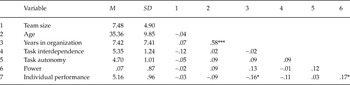
The means, standard deviations, and Pearson zero-order correlations between variables are presented in Table 1. The table shows that individual performance was positively and significantly related to power (r = .17, p < .05). This result indicates that, in line with our theorizing, team members who possessed more power also tended to demonstrate better performance.
Descriptive Statistics and Pearson Zero-Order Correlations among Study Variables at the Individual Level (n = 182)

* p < .05
*** p < .001.
Hypotheses Tests
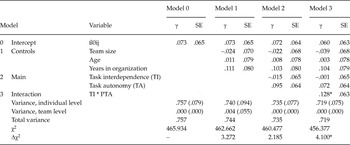
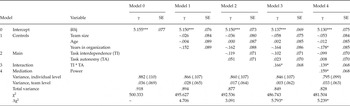
Hypothesis 1 predicted an interaction effect between task autonomy and task interdependence on a team member’s power. As shown in Table 2, the first model, which included the control variables, did not have significantly more predictive power, ∆χ2(3) = 3.272, n.s. than model 0 that solely contained the random intercept. The second model also did not have more predictive power than the first model, ∆χ2(2) = 2.185, n.s. However, as expected, the interaction between task interdependence and task autonomy added in Model 3 did significantly improve the model, ∆χ2 = 4.100, df = 1, p < .05. The interaction coefficient (γ = .128, p < .05) had the expected positive sign.
Results of Multi-level Analyses of Power

Note:
n = 182 at the individual level and n = 37 at the team level.
* p < .05.
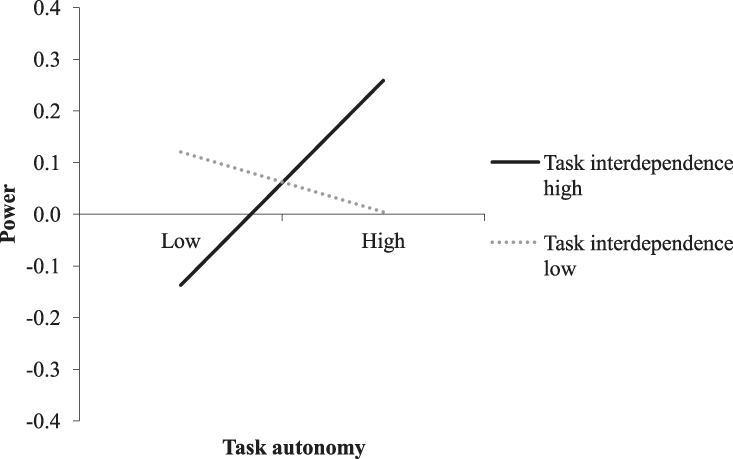
Figure 2 illustrates the significant two-way interaction between task interdependence and task autonomy for power. To create the figure, we followed procedures suggested by Aiken and West (Reference Aiken and West1991). We plotted the low conditions at –1 SD and the high conditions at +1 SD. As expected, when task interdependence was high, higher levels of task autonomy were related to higher levels of power (simple slope: γ =. 200, se = .082, p < .05). No significant relationship was detected between task autonomy and power when task interdependence was low (γ = –.053, se = .097, n.s.). Hence, team members who reported high levels of task interdependence and low levels of task autonomy were considered relatively powerless by their peers. In contrast, team members who reported high levels of task interdependence, and who reported high levels of task autonomy were considered relatively powerful by their peers. These results fully support Hypothesis 1.
The Interaction Between Task Autonomy and Task Interdependence and Its Relationship to Power.

Hypothesis 2 predicted that the interaction effect between task autonomy and task interdependence would affect the individual performance of team members. As shown in Table 3, the first model did not have significantly more predictive power, ∆χ2(3) = 4.706, n.s. than model 0 and model 2 did not significantly improve on model 1, ∆χ2 = (2) = 3.091, n.s. However, as was hypothesized, adding the interaction between task interdependence and task autonomy in model 3 did significantly improve the model, ∆χ2(1) = 5.793, p < .05 The interaction coefficient (γ = .166, p < .05) had the expected positive sign.
Results of Multi-level Analyses of Individual Performance.

Note:
n = 182 at the individual level and n = 37 at the team level.
* p < .05
*** p < .001.
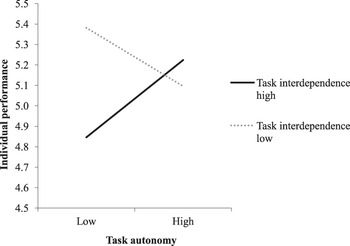
Figure 3 illustrates the significant two-way interaction between task interdependence and task autonomy for individual performance. As expected, when task interdependence was high, higher levels of task autonomy were related to higher levels of individual performance (γ = .189, se = .089, p < .05). No significant relationship was detected between task autonomy and performance when task interdependence was low (γ = –.139, se = .105, n.s.). Hence, Hypothesis 2 was fully supported.
The Interaction between Task Autonomy and Task Interdependence and its Relationship to Individual Performance.

Hypothesis 3 predicted that power would mediate between the interaction of task interdependence and task autonomy on the one hand and individual performance on the other. As shown in Table 3 (Model 4), the addition of the mediation term significantly improved the model, ∆χ2(1) = 5.239, p < .05. The coefficient for power was in the expected positive direction and was significant (γ = .159, p < .05). The interaction coefficient dropped (from γ = .166, p < .05 to γ = .139, p < .05). Given that both of these coefficients were positive and significant our mediation can be classified as a ‘complementary mediation’ (Zhao, Lynch, & Chen, Reference Zhao, Lynch and Chen2010). To test if mediation indeed occurred we used the bootstrapping procedures of Preacher and Hayes (Reference Preacher and Hayes2008). The results showed that the bootstrapped estimate for the indirect effect was .0234 and that the values of the 95% BC confidence interval (CI) were positive and did not include zero (lower 95% BCCI = .0038; higher 95% BCCI = .0686). Thus, we concluded that our third hypothesis was, indeed, supported by the data Footnote 3 .
Discussion
In this study, we focused on a rarely researched interaction that exerts an important impact on employees who work in teams: the interaction between task interdependence and task autonomy (e.g., Campion et al., Reference Campion, Medsker and Higgs1993; Cohen & Bailey, Reference Cohen and Bailey1997; Kiggundu, Reference Kiggundu1983; Langfred, Reference Langfred2005; Stewart & Barrick, Reference Stewart and Barrick2000). Although a few prior studies demonstrated that this interaction is important at the team level (e.g., Gilson & Shalley, Reference Gilson and Shalley2004; Langfred, Reference Langfred2000, Reference Langfred2005), we decided to perform a more detailed investigation of this interaction at the individual level of analysis. The primary reason why we chose to perform this investigation was because previously scholars had observed that scientific progress on this topic had been hindered by a lack of theoretical development (e.g., Langfred, Reference Langfred2005; Langfred & Moye, Reference Langfred and Moye2004). We based our new perspective on recent developments in power-dependence theory and interdependence theory. Thus, we attempted to provide more than a simple response to scholars’ calls for more research on this topic (e.g., Langfred, Reference Langfred2005; Molleman, Reference Molleman2009; Rasmussen & Jeppesen, Reference Rasmussen and Jeppesen2006) by also providing an alternative theoretical perspective that can be used to gain a better understanding of this interaction at a new level of analysis.
Our alternative perspective is based on power-dependence theory (Emerson, Reference Emerson1962), interdependence theory (Thibaut & Kelley, Reference Thibaut and Kelley1959), recent reviews of the power literature (e.g., Fiske & Berdahl, Reference Fiske, Berdahl, Kruglanski and Higgins2007), and recent studies on power that focused on asymmetries in task dependence (De Jong et al., 2007; Van der Vegt et al., Reference Van der Vegt, De Jong, Bunderson and Molleman2010). Based on these theories and studies, we hypothesized, and subsequently demonstrated, that team members who report they are highly task-interdependent and highly task autonomous are considered relatively powerful by their peers. They are also considered to be high performers by their supervisors. Additionally, our results demonstrated that team members who report high task-interdependence, but who perceive little task autonomy, are considered relatively powerless by their peers, as well as lower performers by their supervisors. Furthermore, our theorizing was supported by the fact that we found support for a mediating effect of power between the interaction between task interdependence and task autonomy on the one hand and individual performance on the other. Consequently, the results indicated that the power-dependence perspective (Emerson, Reference Emerson1962) can be used to understand the interaction between task interdependence and task autonomy and its relationship with individual power and performance.
In the next section, we will discuss the theoretical implications of this study. Then, we will reflect on the main strengths and limitations of this study and discuss possible implications for future research. Finally, we will present our practical recommendations.
In our opinion, this study makes at least two main theoretical contributions to (a) the limited amount of literature which focused on the interaction between task interdependence and task autonomy (e.g., Molleman, Reference Molleman2009; Langfred, Reference Langfred2005); and (b) the power-dependence perspective on power (Emerson, Reference Emerson1962; Fiske & Berdhal, Reference Fiske, Berdahl, Kruglanski and Higgins2007; Keltner et al., Reference Keltner, Gruenfeld and Anderson2003) and the related up-and-coming area that focuses on “power due to asymmetries in task dependence” research (e.g., De Jong et al., 2007; Van der Vegt et al., Reference Van der Vegt, De Jong, Bunderson and Molleman2010).
As our first main contribution, we increased the currently limited theoretical insight into a particular interaction that can profoundly influence team members (e.g., Langfred, Reference Langfred2005; Rasmussen & Jeppesen, Reference Rasmussen and Jeppesen2006). While scholars had previously noticed that the study of Langfred (Reference Langfred2005) demanded more theoretical insights, researchers had, until now, only investigated the team level of analysis (e.g., Cordery et al., Reference Cordery, Morrison, Wright and Wall2010). By adopting a power-dependence perspective on the individual level of analysis, we provided an alternative viewpoint, on a new level of analysis that can be used to understand the interaction between task interdependence and task autonomy. Our study also response to the call of Grant and Parker (Reference Grant and Parker2009) to investigate in more depth the relational perspectives on job and task design. Our results do so by demonstrating that the interaction between task interdependence and task autonomy can be understood at the individual level by observing individuals’ power within their teams, based on the differences in their relational task dependencies with co-workers. Hence, we contribute to scholarly understanding of job and task design by bringing to this field the core reasoning that underlies power-dependence theory (e.g., Emerson, Reference Emerson1962; Fiske & Berdahl, Reference Fiske, Berdahl, Kruglanski and Higgins2007), interdependence theory (Thibaut & Kelley, Reference Thibaut and Kelley1959), and the reasoning from recent studies on power and asymmetries in task dependence (e.g., De Jong et al., 2007; Van der Vegt et al., Reference Van der Vegt, De Jong, Bunderson and Molleman2010).
Second, our research contributes to power-dependence theory (Emerson, Reference Emerson1962) and interdependence theory (Thibaut & Kelley, Reference Thibaut and Kelley1959) because it uses a measure that is directly related to the core of each of these theories: Power resulting from asymmetries in task dependence (e.g., Fiske & Berdahl, Reference Fiske, Berdahl, Kruglanski and Higgins2007; Keltner et al., Reference Keltner, Gruenfeld and Anderson2003). By showing an effect on individual performance, our results extend the results of prior studies by testing their key, but often implicit, assumption that power that results from asymmetries in task dependence are indeed beneficial to the powerful (e.g., De Jong et al., Reference Van Dijke and Poppe2007). Additionally, no study to date has investigated where these asymmetries in task dependence come from. Prior studies solely examined consequences that included interpersonal processes and team processes and outcomes (e.g., Van der Vegt et al., Reference Van der Vegt, De Jong, Bunderson and Molleman2010). The results of our study indicated that asymmetries in task dependence (as rated by peers) can be related to each team member’s specific position within their teams (i.e., a team member’s perception of his or her task interdependence and task autonomy). Thus, our study not only contributes to research focused on the interaction between task interdependence and task autonomy, it also contributes to the emerging area of research that focuses on power that results from asymmetries in task dependence, because it demonstrates that power resulting from asymmetries in task dependence (a) has effects on the individual level, (b) has task interdependence and task autonomy as key antecedents, and (c) has a positive relationship with individual performance.
Similar to any scientific study, the present research has some strengths and limitations. A first potential limitation might involve the study’s use of single items in its assessment of the dyadic-level differences in power. However, our items were drawn from existing scales used in previous research whose value has been demonstrated (e.g., De Jong et al., Reference Van Dijke and Poppe2007; Van der Vegt et al., Reference Van der Vegt, De Jong, Bunderson and Molleman2010). Moreover, we constructed individual level measures from several dyadic level items. This procedure was directly derived from power-dependence theory of Emerson (Reference Emerson1962), interdependence theory (Thibaut & Kelley, Reference Thibaut and Kelley1959), and the recent characterization of power provided by Fiske and Berdahl (Reference Fiske, Berdahl, Kruglanski and Higgins2007). Consequently, the method used in this study, which measures power resulting from asymmetries in task dependence, directly assesses the resource-based power differences as described by power-dependence theory (Emerson, Reference Emerson1962).
Another potential limitation might involve the use of cross-sectional data, because this prevented us from determining the causality in our model. Therefore, the possibility remains that power actually determines the interaction between task interdependence and task autonomy. Hence, even though our results fall in line with our theorizing, future studies should test causality by taking measurements at more than one point in time or by conducting laboratory experiments. Moreover, future studies should also study in more detail the broader context of our new perspective, for example by investigating boundary conditions or cross-level relationships (cf. Diez-Roux, Reference Diez-Roux1998). We think that one of the key contributions of this study lies in the fact that these future studies can now actually draw from our theorizing about the importance of the power-dependence perspective and are now in a better position to develop scholarly understanding of this interaction.
Although our research design did not allow us to test causality, it did allow us to perform rigorous tests on our hypotheses because we used three different sources of data and we used dyadic—and individual—level measures. Scholars in the field have demanded that researchers employ multi-source and multi-method datasets in their research (e.g., Molleman, Reference Molleman2009, p. 262) because the employment of these datasets can greatly diminish alternative explanations for findings, such as common source and common method biases (e.g., Podsakoff et al., Reference Podsakoff, MacKenzie, Lee and Podsakoff2003). Given that we investigated a diversity of teams, ranging from the financial sector to the government sector, our results appear to be generalizable to various sectors and industries. However, only further research can determine if this is indeed so.
Future studies could conduct in-depth investigations of the interaction between task interdependence and task autonomy. As shown in Figure 2, differences in task autonomy are not associated with differences in power in situations of low task-interdependence. It is possible that low task-interdependence facilitates high individual performance because team members then have access to all resources required to complete their tasks. If low task-interdependence is coupled with high autonomy, tasks are likely to require only limited interactions with other team members. Moreover, individuals should then be more likely to clearly understand what must be done to complete their tasks. As such, these situations can be expected to have low levels of role ambiguity (Kahn, Wolfe, Quinn, Snoek, & Rosenthal, Reference Kahn, Wolfe, Quinn, Snoek and Rosenthal1964) or high goal and process clarity (e.g., Sawyer, Reference Sawyer1992). Because these would be relatively simple and clearly defined tasks, team members can easily complete them. Although the simple slope is not significant, our results provide some support to the arguments stated above because they indicate that low task-interdependence is associated with high individual performance when task autonomy is low (see Figure 3). Hence, our theory and results indicate possible ways to further improve our understanding of this interaction and indicate that theories and research related to role ambiguity (e.g., Kahn et al., Reference Kahn, Wolfe, Quinn, Snoek and Rosenthal1964) or goal and process clarity (e.g., Sawyer, Reference Sawyer1992) might be useful. Alternatively, future research could also explore other mechanisms which might drive this effect as we found that power is a significant, yet complementary, mediator (Zhao et al., Reference Zhao, Lynch and Chen2010). Variables which are related to process losses (e.g., Steiner, Reference Steiner1972; Thompson, Reference Thompson1967), such as lowered trust (Langfred, Reference Langfred2005), increased communication needs (Puranam, Raveendran, & Knudsen, Reference Puranam, Raveendran and Knudsen2012), or heightened interpersonal conflict (Jehn, Reference Jehn1995) might be able to shed more light on this interaction. Thus, future research could validate our results that the power-dependence perspective can explain the interaction between task autonomy and task interdependence and separately, or simultaneously, investigate new mechanisms such as described above.
In addition, future research might explore power that results from asymmetries in the power-dependence perspective in more depth by combining our results with results drawn from other recent field studies (e.g., De Jong et al., 2007; Van der Vegt et al., Reference Van der Vegt, De Jong, Bunderson and Molleman2010) and/or from broader literature focused on power. For instance, one avenue for these types of future endeavors can be derived from Fiske and Berdahl’s (2007, p. 687) observation that power = person × position × situation. In our study, we primarily focused on the position aspect (i.e., the interaction between task interdependence and the task autonomy). However, Van der Vegt et al. (Reference Van der Vegt, De Jong, Bunderson and Molleman2010) focused more on the situation (i.e., the amount and type of feedback provided to the team). Yet, no study to date has investigated if, and how, personality can shape perception or use of power that result from asymmetries in task dependence. Researchers who hope to explore this topic in more depth might choose to focus on the influence of personality differences, such as self-efficacy beliefs (Bandura, Reference Bandura1997) or goal orientation (Elliott & Dweck, Reference Elliott and Dweck1988). We think that these personality differences might serve as interesting moderators because they might shape how individuals perceive their positions and power within teams and/or how individuals might actually be tempted to use these advantages. There is some support for this notion as studies have shown that personality can be related to individuals’ preferred influence strategies (e.g., Koslowsky & Schwarzwald, Reference Koslowsky, Schwarzwald, Lee-Chai and Bargh2001). Thus, future studies might investigate whether individual-level power that results from asymmetries in task dependence can be influenced by situational factors (e.g., types and amounts of feedback, low levels of role ambiguity, or high levels of goal clarity). Yet, we believe that an even more novel approach would be to investigate the moderating effects of personality differences.
The practical implications of the present study derive from our findings that task interdependence, task autonomy, and power are related to individual team members’ performance. Our results indicate that interventions that attempt to increase team members’ performance must consider structural and relational mechanisms that might prevent team members from achieving high performance (cf. Grant & Parker, Reference Grant and Parker2009). Thus, managers who want to ensure that all team members have equal chances to perform well might consider that team members who must give more resources will be in better positions than team members who must receive resources from their colleagues. Consequently, motivating, inspiring, or rewarding underperforming team members might not work if the structural causes for low performance (i.e., those team members’ asymmetrical task dependence on other team members) have not been removed or at least addressed. It is important to consider this factor during team design, as well as during normal team operations, because prior research has demonstrated that individuals tend to strive to obtain superior power over their peers (Van Dijke & Poppe, Reference Van Dijke and Poppe2007). Therefore, managers should be aware that some individuals might attempt to change the asymmetries in task dependence within their teams and make the conditions more favorable for themselves, possibly, at the expense of others.
Moreover, our results indicate that resolutions of these structural causes by simply matching amounts of task autonomy with equal amounts of task interdependence might be less appropriate than prior studies have sometimes suggested (e.g., Molleman, Reference Molleman2009, p. 264). The logic underlying the power-dependence perspective (e.g., Emerson, Reference Emerson1962) clarifies that attempts to redesign tasks to increase some team members’ power (e.g., decreasing their asymmetrical task dependence) could, simultaneously, decrease other team members’ power (e.g., increase their asymmetrical task dependence). Consequently, if not well thought through, interventions might simply result in exchanges of certain team members’ low performance for other team members’ low performance. Although additional research is required to examine this issue, we currently suggest that practitioners balance their interventions when they address task interdependence and task autonomy by considering the asymmetries in power and task dependence that might occur between team members.