Introduction
According to numerous scientific reports, the food produced in line with the lawful principles of organic farming [Council Regulation (EC) 834/2007 and Commission Regulation (EC) 889/2008] is characterized by more favorable health properties, which generally arise from higher concentrations of phytochemicals from the group of antioxidant and anti-inflammatory polyphenols as well as those with anticancer activity, and definitely lower pollution levels compared to the food from conventional farmingReference Manach, Scalbert, Morand, Remesy and Jimenez1, Reference Heaton2. According to BenbrookReference Benbrook3, up to 85% of studies, carried out previously, have shown that organic farming methods result in a rise of the antioxidant level in raw materials by approx. 30%. This is achieved by a number of basic practices used in organic production, such as the use of compost, intercrops and slow nitrogen release to the soil, which can increase the content of bioactive compounds, as compared to conventional practices allowing the use of chemical fertilizers and pesticides. The plants grown under organic farming principles are capable of increased synthesis of these compounds and, thanks to them, fight diseases and pests single-handedly. Thus, the compounds with antioxidant properties are defined as natural pesticidesReference Brandt and Mølgaard4. However, apart from agricultural practices, the content of bioactive compounds is affected by a huge number of factors, including: soil quality, weather conditions, plant genetics, harvest and maturity season, storage, processing and preparation of raw materials. This may be shown by the fact that in numerous studies some agricultural crops have presented positive effects of organic farming on the antioxidant content, whereas others were indifferent to these practices. Although the results of the studies are not entirely unambiguous, most of them indicate discrepancies in the content of these substances in favor of organic raw materialsReference Brandt, Leifert, Sanderson and Seal5. That is an important step to prove that organic food consumption brings health benefits through an increased daily intake of antioxidants without a concomitant risk of increased levels of caloriesReference Brandt and Mølgaard4.
Recently, there has been growing the interest in organic food in Europe and worldwide. It results from consumers' belief that organic materials are healthier than analogous conventional materials, because in their production no pesticides and fertilizers are appliedReference Worthington6, Reference Bourne and Prescott7. Tea is one of the most popular beverages in the world, dating back several thousand years before our eraReference Cichoń and Wierciak8. Green tea leaves (Camelia sinensis) are rich in biologically active substances having a large impact on human body. Their composition includes soluble and insoluble tannic compounds, and purine alkaloids, most important of which is caffeine; they also contain lecithin, coumarins, numerous flavonoid glycosides, vitamins (B1, B2, B5, C, E and K) and micronutrients (magnesium, sodium, manganese, iron, calcium, phosphorus, fluorine, silicon and iodine). Essential oils present in a small quantity give a characteristic flavor of tea, while dyes, such as chlorophyll, carotene, theaflavin, xanthophyll and arubigin, are responsible for the colorReference Hojden9. Health-promoting effects of green tea are mainly attributed to antioxidant properties of its components. Numerous studies have shown a wide range of anti-cancer mechanisms of green tea componentsReference Alberts, Bray, Johnson, Lewis, Raff, Roberts and Walter10, Reference Muzolf and Tyrakowska11.
This paper presents the results of an experiment involving determination and comparison of antioxidant properties and the content of active compounds found in green tea infusions from organic and non-organic production; the aim was to assess the impact of organic farming methods on the quality of the products tested.
Material and Methods
Materials
For the experiment, green teabags and leaf green teas from two different production systems were chosen. Organic teas were bought in a shop with certified organic food, whereas the non-organic ones—in a typical grocery store in Warsaw (Poland). We purchased four packs of 20 bags of each teabag examined, and four packs of 100 g of each leaf tea tested. We used the following brands of organic green teas: Sonnentor, Tè verde (teabags) and Sonnentor, Terrasana (leaf teas). Of the non-organic teas we used other brands and they were: Teekanne, Dilmah (teabags) and Lipton, Yunnan (leaf teas).
Polyphenol analysis
Preparation of green tea infusions
For analyses there were prepared 1% infusions of eight teas under examination. Tea samples (weight 1 g) were made with hot but not boiling water (80 °C), according to the instructions on the tea packaging, and were infused for 5 min. Having brought the samples of tea to room temperature (20 °C), the infusions were filtered through a filter paper, and the liquid was collected for analysis.
Phenolic acids
Phenolic acids were determined by spectrophotometric method using Arnova reagent. This method allows the calculation of total phenolic acids, which were calculated according to the standard curve determined for gallic acid (GA). The principle of the method consists in the extraction of phenolic acids with water and colorimetric assay. The reagents used included hydrochloric acid (HCl), sodium hydroxide (NaOH) and Arnova reagent. The apparatus was a spectrophotometer. A tea infusion was weighed out to a 250-ml conical flask. The flasks were allowed to stand for 60 min on a stirrer for accurate extraction of polyphenolic acids. Into 10-ml calibration tubes, water, tea infusion, HCl, Arnova reagent and NaOH were successively added, and they were made up to the mark. The absorbance was measured immediately after adding the last reagent at a wavelength of 490 nm and thickness of 1 cm. There was also taken a blank sample with reagents without the tea infusionReference Strzelecka, Kamińska, Kowalski and Wawelska12.
Flavonols
Flavonols were determined by spectrophotometric method. The tested tea infusion was weighed into a round-bottomed flask, then acetone, HCl and hexamine were added. The solution was heated in a heating mantle under reflux until the sample boiled. The hydrolysate obtained was filtered and boiled again for 10 min once it reached the sample boiling point, adding acetone as previously. This procedure was repeated two times. The extract obtained was filled up with acetone. A part of the solution was collected, then ethyl acetate and water were added, and it was subjected to shaking in a separatory funnel. After separation of the layers, the lower layer was drained and transferred into a clean separatory funnel for further leaching of flavonoids. Ethyl acetate was added again and it was shaken. The procedure was repeated three times, each time pouring the upper layer to a second separatory funnel in order to collect all the organic phase. After three shaking procedures, the content of the third separatory funnel was washed with water. The content of separatory funnels was filtered into a flask and filled to the mark with ethyl acetate. A mixture was collected into the flask, AgCl3 solution was added and it was filled up to the mark with a mixture of acetic acid and methanol. After 45 min the absorbance of the sample was measured at a wavelength of 425 nm, and the result was read out from a standard curve of quercetin content (in mg of quercetin/ml of solution collected)Reference Strzelecka, Kamińska, Kowalski and Wawelska12.
Total polyphenolic compounds
The content of total polyphenolic compounds in infusions was determined by spectrophotometric method using Folin–Ciocalteu reagent, according to Singleton and RossiReference Singelton and Rossi13. The results are expressed as the gallic acid equivalent (GAE), i.e., as the number of mg of GA per 1 g of the product examined, i.e., the amount contained in 100 ml infusion.
Tannin analysis
Preparation of green tea extracts
Finely crumbled material (1 g of tea) was poured in a beaker with 100 ml of water and heated to boiling, and then cooled. The content of the beaker was filtered into a 200-ml flask through a swab. The material was poured with 50 ml of water and boiled for 10 min once it reached boiling point, and then it was decanted into a 200-ml flask. The content of the flask was filtered through a filter.
Analysis by the titration method
The filtrate prepared was collected, and then 0.1 M copper acetate was added. Copper tannins precipitated from the sediment after 12 h were filtered on a precisely weighed and dried filter paper. The filter with precipitate was dried at 105 °C to constant weight. Twenty-five milliliters of the clear filtrate containing unbound copper ion were collected in a conical flask, and H2SO4 and 40% potassium iodide added; then the sample was shaken, starch solution was added and the titration process with 0.1 M sodium thiosulfate began until the change of color from brown and blue to white. A blank sample was made without any raw materialReference Strzelecka, Kamińska, Kowalski and Wawelska12.
Caffeine and catechin analysis
High-performance liquid chromatography (HPLC) analysis
For analysis 1% infusions of the eight examined teas were used, which were prepared similarly as described previously under the analysis of polyphenols.Five milliliters of infusion were collected in a plastic tube and centrifuged for 15 min at 6000 rpm. Then the infusion was put into an HPLC vial and the caffeine content was measured. Measurement conditions: C18 column, mobile phases—acetonitrile and deionized water (55 and 10%) using a modification of the mobile phase flow. Caffeine detection range: 254–270 nm. Detection time: 36 min. Crystalline caffeine was used as a marker (EC number: 200-362-1) with 99.00% HPLC purity (Fluka Company, Poland), dissolved in methanol, and gallic acid (GA) and catechins with 99.9% HPLC purity (Sigma-Aldrich Company, Poland)Reference Frankowski, Kowalski, Ociepa, Siepak and Niedzielski14.
Antioxidant activity
Spectrophotometric analysis
For analysis 1% infusions of the eight examined teas were used, which were prepared as described previously under the analysis of polyphenols. The antioxidant activity of infusions was determined according to Re et al.Reference Re, Pellegrini, Proteggente, Pannala, Yang and Rice-Evans15. The results were expressed as Trolox equivalent antioxidant capacity (TEAC), i.e., as the amount of μmoles of Trolox per 1 g of the product examined. Calculations were made for the solutions having the activity of ‘scavenging’ 2,2′-azino-bis(3-ethylbenzothiazoline-6-sulfonic acid) (ABTS)•+ cation radicals in the range 20–80%, based on the equation of the calibration curve.
Statistical analysis
For the calculations, two-way analysis of variance was applied (for the form of tea and production system) using the Tukey's test at the significance level α=0.05. Each measurement was performed with six replicates. In addition, standard deviations (SD) were determined for the sample tested and mean values. All results for the content of the examined compounds are specified in dry matter (d.m.) of teas.
Results and Discussion
Phenolic acids and flavonols
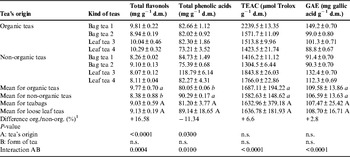
The content of phenolic acids and flavonols in the teas examined is presented in Table 1. Statistically more phenolic acids were found in a non-organic tea (90.29 mg g−1 d.m.) compared to the organic one (80.05 mg g−1 d.m.). Leaf teas in relation to teabags contained similar amount of phenolic acids (89.14 and 81.20 mg g−1 d.m., respectively). Among the studies on the content of phenolic acids in organic and non-organic products there has not been found any research on green teas. The results obtained are opposite to most of the results of papers concerning other raw materials, which show a higher content of phenolic acids in organic raw materials. Studies have demonstrated that a higher content of phenolic acids was typical for organic beetsReference Sikora, Klonowska, Hallmann, Rembiałkowska and Rembiałkowska16, organic tomato fruits and in the juice made from these raw materialsReference Hallman and Rembiałkowska17. However, the studies by Caris-Veryat et al.Reference Caris-Veyrat, Amiot, Tyssandier, Grasselly, Buret, Mikolajczak, Guilland, Bouteloup-Demange and Borel18 on tomatoes have indicated more chlorogenic acid in the fruits from conventional production.
Total flavonols, phenolic acids, total polyphenol content (GAE) and antioxidant activity (TEAC) in selected green teas from organic and non-organic productions (±SD).

1 Calculated from formula: [(org.−non-org.)/non-org.)×100%].
Means in a column followed by the same letter are not significantly different at the 5% level of probability (α=0.05); small letters indicate differences between tea production systems, capital letters indicate differences between form of teas.
n.s., not significant statistically.
The most common flavonols present in tea are quercetin, kaempferol and myricetin. In the present study, flavonols are determined based on quercetin, and their significantly higher content was reported in organic tea (9.77 mg g−1 d.m.) compared to the non-organic one (8.38 mg g−1 d.m.). There were no significant differences between leaf teas and teabags regarding the content of flavonols. Among the numerous tea studies, no research was found comparing the content of flavonols in organic and non-organic teas. The studies by Wierzejska and JaroszReference Wierzejska and Jarosz19 have ascertained that the flavonol content in a conventional green tea infusion was 5.2 mg g−1 of the product, whereas in a black tea infusion it was 3.0 mg g−1. Numerous studies conducted on other raw materials confirm that higher contents of flavonols are typical for organic crops, such as black currant fruitsReference Kazimierczak, Hallmann, Rembiałkowska and Zbytek20, fresh and marinated pepper, tomato fruits and tomato juiceReference Rembiałkowska and Hallmann21, apple mousses made from organic fruitsReference Rembiałkowska, Hallmann and Rusaczonek22 and onionReference Hallman and Rembiałkowska23.
Total polyphenols and antioxidant activity
Organic and non-organic teas did not differ significantly in terms of antioxidant activity (1687.11 and 1582.63 μmol Trolox g−1 d.m., respectively) and total polyphenol content, expressed as GAE (109.58 and 106.59 mg g−1 d.m., respectively) (Table 1). This result probably stems from the occurrence of other antioxidants in teas, including carotenoids, tocopherols, ascorbic acid (vitamin C) and minerals, such as Cr, Mn, Se and Zn, which can increase the antioxidant capacityReference Cabrera, Artacho and Giménez24. There was no effect of the tea form on the infusion antioxidant activity and total polyphenol content. The leaf teas contained 108.70 and teabags 107.47 mg GA g−1 d.m., whereas the antioxidant activity of leaf teas was 1636.78 and of teabags 1632.96 μmol Trolox g−1 d.m. (Table 1). Although studies on the content of bioactive substances in plant food of organic and non-organic origin have been conducted by many researchers, only a few publications concern antioxidant properties and the content of total polyphenols in teas from organic and non-organic production systems. According to Hallmann et al.Reference Hallmann, Rusaczonek and Rembiałkowska25, organic teas contained more total polyphenols (GAE) compared to the conventional ones. The authors of the studies on polyphenol content in plant raw materials draw attention to the relationship between nitrogen absorption by plants and the concentration of these compounds. The differences in the types of fertilizers used in organic and non-organic farming have led to creating the two theories to justify a diverse composition of organic and non-organic raw materials, namely the theory of carbon/nitrogen balance (C/N)Reference Bryant, Chapin and Klein26, Reference Coley, Bryant and Chapin27 and the growth differentiation balance hypothesis (GDBH)Reference Lorio28, Reference Herms and Mattson29. According to the C/N theory, in the environment poor in easily-assimilable nitrogen, i.e., in organic production systems, plants initially produce compounds that contain no nitrogen, such as simple and complex sugars (glucose, fructose, starch and cellulose) and secondary metabolites (terpenoids, phenol compounds, some pigments and vitamins). However, in the environment rich in easily-assimilable nitrogen, i.e., in conventional production systems, plant metabolism changes toward intensive production of nitrogen-containing compounds, such as free amino acids, proteins and alkaloids. According to the GDBH theory, plants—in each situation—are able to estimate the available mineral resources and optimize their own metabolism toward the processes that lead to the increase in organic matter content or differentiation of tissues and plant materials. The term ‘differentiation’ includes, among other things, the increase in the production of defensive compounds (secondary metabolites) by plants. A higher total polyphenol content in organic products has been recorded in the apple mousses, both before and after the pasteurization processReference Rembiałkowska, Hallmann and Rusaczonek22, in applesReference Benbrook3, in black raspberries and cornReference Asami, Hong, Barrett and Mitchell30 and in peachesReference Carbonaro, Mattera, Nicoli, Bergamo and Cappelloni31.
The existing results of the research on the antioxidant activity of agricultural crops from organic and conventional production systems indicate that organic materials are usually characterized by a higher antioxidant activity. This is confirmed by the previously mentioned tea studies by Hallmann et al.Reference Hallmann, Rusaczonek and Rembiałkowska25. And similarly, the other studies conducted on apple moussesReference Rembiałkowska, Hallmann and Rusaczonek22, fresh apple juice as well as apple juice subjected to the pasteurization process and after 6 months of storageReference Rembiałkowska, Hallmann, Adamczyk, Lipowski, Jasińska and Owczarek32. The studies by Fik and ZawiślakReference Fik and Zawiślak33 on conventional green tea have shown antioxidant activity of 53.6–60.9%.
Tannins, caffeine and catechins
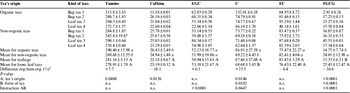
A significantly higher content of tannins was found in organic tea (290.40 mg g−1 d.m.) compared to the non-organic one (269.68 mg g−1 d.m.), while the caffeine content was higher in non-organic tea (24.94 mg g−1 d.m.) compared to the organic one (20.43 mg g−1 d.m.). Taking into account the form of tea, there was no difference in tannins and caffeine content between leaf teas and teabags. The leaf teas contained 278.91 and 23.19 mg g−1 d.m. of tannins and caffeine, whereas the teabags contained 281.16 and 22.18 mg g−1 d.m., respectively (Table 2). Organic tea had higher content of catechin (C) (86.91 mg g−1 d.m.) than in non-organic tea (69.22 mg g−1 d.m.), but at the same time non-organic tea had more epigallocatechin 3-gallate (EGCG) (24.01 mg g−1 d.m.) in comparison to the organic one (14.75 mg g−1 d.m.). Epigallocatechin (ECG) and epicatechin (EC) were not found to be different between the two groups of tea. C was found to be significantly higher in teabags, whereas EGCG was higher in leaf teas. The reason for this may be the oxidation of teabags that have a greater surface exposed. There was no appreciable effect of the form of tea on the content of EGC and EC in the tea infusions examined (Table 2). Stańczyk et al.Reference Stańczyk, Skolimowska and Wędzisz34 studied the tannin content in green and black teas from conventional production. According to the results obtained, the tannin content in green tea ranged from 140 to 310 mg g−1 d.m. It can be assumed that similar tannin contents were found in the present study, because their mean contents for organic and non-organic teas are 290.40 and 269 mg g−1 d.m., respectively.
Tannin, caffeine and catechin content (mg g−1 d.m.) in selected green teas from organic and non-organic production (±SD).

1 Calculated from formula: [(org.−non-org.)/non-org.)×100%].
Means in a column followed by the same letter are not significantly different at the 5% level of probability (α=0.05); small letters indicate differences between tea production systems, capital letters indicate differences between form of teas.
n.s., not significant statistically.
C, catechin; EC, epicatechin; EGC, epigallocatechin; EGCG, epigallocatechin 3-gallate.
Kłódka et al.Reference Kłódka, Bońkowski and Telesiński35 examined different types of conventional teas in order to determine their caffeine content depending on brewing time of infusions. In all green teas tested, the greatest caffeine content was recorded after 6 min of brewing. According to Hicks et al.Reference Hicks, Hsieh and Bell36 the mean caffeine content found in green conventional tea was 36.6 mg g−1 d.m., which—comparing to the present results—represents a higher value (compared with the teas from both cultivation systems). However, the studies by Waszkiewicz-RobakReference Waszkiewicz-Robak37 as well as Iso et al.Reference Iso, Date, Wakai, Fukui and Tamakoshi38 have pointed out that conventional green tea contained about 15 mg of caffeine per 1 g of dried tea. Some studies have indicated that green tea contains considerable amounts of catechins, such as EGCG, EGC, epicatechin gallate (ECG), C and ECReference Wang, Tsai, Lin and Ou39, Reference Dufresne and Farnworth40. The present study showed that the examined teas contained highest amounts of C, EC and EGC.
Conclusions
The green teas having a certificate of organic production contained significantly more flavonols, tannins and catechin compared to the non-organic teas. On the other hand, the non-organic green teas contained more phenolic acids, caffeine and EGCG compared to the organic ones. No significant effect of tea production system on the content of total polyphenols (GAE) and antioxidant activity was found in the teas tested. The form of the teas examined—leaf tea or teabag—had no significant effect on antioxidant activity of infusions. Similarly, no differences were observed in the contents of total polyphenols, flavonols, phenolic acids, tannins, caffeine, EGC and EC between leaf teas and teabags. The leaf teas used in the experiment were characterized only by a significantly higher content of EGCG compared to the teabags.