Introduction
In an April 1955 petition to the British Vice Consul and Labor Officer at Calabar, Esien Ekong of Calabar, a migrant laborer employed at the Mariano Cugigal Estate in Santa Isabel, Fernando Po, requested that his Calabar resident wife, “Miss Ukpong Ikah,” who had “failed” to accompany him to Fernando Po, should be “officially sent to [him].”Footnote 1 Ikah had in fact, refused to travel to Fernando Po with Ekong. A month after Ekong’s appeal, Sampson Udoka, contract laborer “G230,” employee of the “Luterma Francaise-ABINE” in Libreville, Gabon, similarly petitioned the District Officer of Calabar Province to send his wife, “Miss Akon James,” because “I see no reason why she should stay up to till now, while others’ women are coming to Gabon.”Footnote 2 Udoka’s parents-in-law had disregarded his letters requesting for his wife, but he believed that the British District Officer, the Calabar County Council, and the Native Court could compel his wife to join him in Gabon, or retrieve his dowry. The British Vice Consul in Gabon and the District Officer in Calabar supported Udoka’s petition. They viewed placating male migrants as essential to sustaining a colonial labor system.Footnote 3 The Anglo-Spanish Employment Agency (ASEA) commissioner reported that, when their messenger went to retrieve Udoka’s wife, her family stated that she “had a rather sick child belonging to another man [and therefore] left for her home in Ibibio land.”Footnote 4 Miss James subsequently appeared at the Calabar ASEA office to avow, “she would be unable to travel owing to a recent death in the family.”Footnote 5 To avoid being sent to her husband – and evade colonial surveillance and control – James mobilized kinship: supported by her parents, she used motherhood to justify her refusal to join her husband.
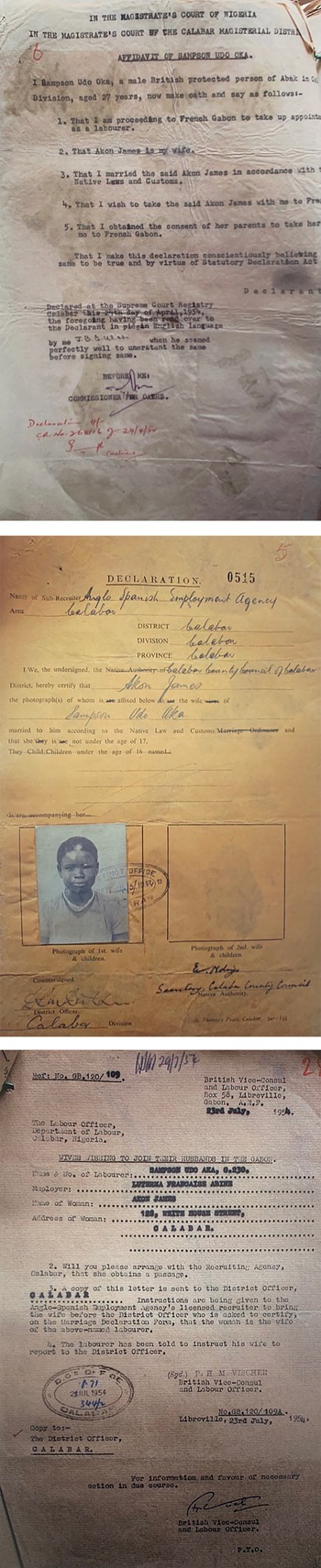
Meanwhile, Udoka, who was emotionally and financially invested in bringing his wife to Gabon, mobilized state bureaucracy. In asserting his claim over his wife, Udoka used various colonial documents (see Figure 1). The first was an “Affidavit” he had sworn in the Calabar magistrate’s court one year prior, which read,
I Sampson Udo Oka, a male British protected person of Abak in Calabar Division, aged 27 years, now make oath and say as follows: 1. That I am proceeding to French Gabon to take up appointment as a labourer. 2. That Akon James is my wife. 3. That I married the said Akon James in accordance with the Native Laws and Customs. 4. That I wish to take the said Akon James with me to French Gabon. 5. That I obtained the consent of her parents to take her with me to French Gabon. That I make this declaration conscientiously believing the same to be true and by virtue of Statutory Declaration Act of 1835.Footnote 6
Affidavit, Marriage Declaration Certificate, and Consulate “Wife” Requisition Letter.

The second document was a marriage “Declaration” certificate. This provided the name of the labor “recruiter” for Sampson Udoka, namely the Anglo-Spanish Employment Agency, and the “Native Authority,” Calabar County Council, certifying that Akon James was the wife of Sampson Udoka and was not under the age of 17. It also contained a stamped passport photograph of Akon James and signatures of the Native Authority and District Officer.Footnote 7 Third, Udoka required a formulaic letter from P. H. M. Vischer, the British Vice-Consul and Labor Officer at Libreville Gabon, requesting the Labor Officer at Calabar Nigeria to “arrange with the Recruiting Agency” in order to transport Udoka’s wife to Gabon. This letter was entitled, “Wives Wishing to Join Their Husbands in the Gabon,” and listed the “Name & No. of Labourer,” “Employer,” “Name of Woman,” and “Address of Woman.” The letter required “the Anglo-Spanish Employment Agency’s licensed recruiter to bring the wife before the District Officer who is asked to certify, on the Marriage Declaration Form, that the woman is the wife of the above-named labourer.”Footnote 8
What historical contingencies enabled southeastern Nigerian men like Ekong and Udoka to enlist British colonial personnel in asserting possessive claims over their wives? How did European bureaucrats mobilize “archival government” to codify African marriages and facilitate transfers of African wives across colonial boundaries? How did southeastern Nigerian women such as Ikah and James, glossed in archives as “wives” of migrant men, contingently exploit wifehood as an instrumental forgery, enabling them to negotiate new European and African patriarchies, emerging from a masculinist migrant wage labor economy? I examine the proliferation of labor migrants’ marital contracts, petitions, declarations, certifications, and photographic documentation as African participation in what Florence Bernault astutely calls a colonial “bureaucracy of paper.”Footnote 9 Because colonial documentation made contract labor, migration, property, and marriages legible and legitimate, men and women brought gendered political logic to their transformation, manufacturing, and uses of colonial documents. Such legibility practices in turn shaped notions of legitimate marriage, conjugal rights, wives as property, gendered wage-based breadwinner status, and legal transcolonial mobility. Legibility was a complex colonial praxis. It signified a colonial endeavor to rationalize, order, and control African mobility economies, which generated loopholes within colonial monopolies and plantation labor systems. At once intrusive, “pervasive and impotent,” colonial marriage documentation was much like fingerprinting and other modes of “archival government” developed to control migrant workers.Footnote 10 I argue that, whereas European administrators used marriage documentation to rigidly “gender” African subjects as either waged male laborers and migrant husbands or domestic and dependent wives, Nigerian women built economic and political autonomy by exploiting marriage declarations and certifications, photography, and testimonials as gendered colonial legibility forgeries. Women understood colonial bureaucracy sufficiently to manipulate the production and uses of travel documents by generating photographs, mobilizing kinship, producing testaments, and bribing court officials. Their agencies enabled them to navigate and shape the masculinist colonial migration system, subvert colonial bureaucracy, and use the status of “wife” to make demands on the colonial state. Simultaneously, men mobilized these documents to define themselves as breadwinners and household heads and to articulate ineffable desires of unprecedented claims over women’s bodies. Colonial state policies, women’s agencies, and men’s desires constituted social forgeries, because they each sought to manufacture hitherto non-existent gender relations and identities.
Historical Background
Southeastern Nigerian men and women responded to opportunities presented by labor shortages in Gabon and Fernando Po during the first half of the twentieth century. Gabon came under “devastating” European influence beginning in the 1850s.Footnote 11 By the 1860s, predominantly British, German, and a few French commercialists, led by John Holt and Hatton & Cookson, had established lumbering and trading factories in Gabon, displacing local institutions and intermediaries. By the twentieth century, French military troops had occupied the land and imposed forced labor and taxation. Between 1905 and the 1930s, colonial forced labor, regrouping of villages, destruction of religious cults and objects, and diseases and famines deracinated Gabon’s population. Meanwhile, French administrators expected timber-rich Gabon to support the poorer territories of Congo and Chad. The result was an enormous demand for manpower. Thus, Gabon continually imported African administrative staff and laborers from Senegal, Dahomey, Togo, Cameroun, and Nigeria.Footnote 12 From the 1920s, men from throughout Gabon and elsewhere migrated to work in timber camps and relied on women for growing the food that fed the critical mass of wage laborers. As African immigration to Gabon peaked after 1945, the anxieties of African men and the colonial state over “the marriage crisis” heightened and manifested in public debates over “male and female spaces” and “sexual respectability.” The crisis included concerns about spiraling bridewealth that made marriage increasingly unattainable for young men, as well as rising rates of prostitution that afforded women economic independence and enabled them to refuse marriage. The colony’s demographic imbalance accentuated this marriage crisis. From 1942, men outnumbered women by 34 percent, comprising the dominant population in neighborhoods of newly arrived migrants. The majority of these migrants were young men, single or unaccompanied by wives.Footnote 13 This context is critical to understanding Nigerian male migrants’ urgent petitions, such as Udoka’s, for their wives to join them in Gabon.
Spanish Fernando Po, the “economic heartland of Equatorial Guinea,” responsible for “over 90 percent of the colony’s exports,” faced a similar “chronic shortage of labor.”Footnote 14 Unable to recruit sufficient labor from among the indigenous Bubi of the island, the Fang peoples of the mainland, and Liberia and Cameroon between 1860 and 1930, Fernando Po’s cacao planters turned to southeastern Nigeria. They relied on recruiters, who inveigled Igbo and Ibibio laborers and smuggled them in canoe convoys from the Nigerian ports of Oron, Eket, Opobo, Andoni, and Calabar.Footnote 15 Consequently, during the Francoist period (1936–1968), “the majority of contract laborers in Spanish Guinea, up to three hundred thousand of them, were Nigerian.”Footnote 16 These men, mostly 20–25 years of age, went to Fernando Po because they lacked employment and farming land and sought money to pay for marriage dowries and onerous taxes.Footnote 17 According to Bernard Bourdillon, governor of Nigeria, “Under the provisions of the Labor Ordinance No. 1 of 1929, both the recruitment and emigration of labourers for service in Fernando Po” were “illegal,” but measures to prohibit this labor emigration proved “ineffective.”Footnote 18 In 1934, the British government required migrants to present a police-issued permit authorizing travel to Fernando Po before leaving Nigerian ports, but migrants evaded the permits by booking travel to ports other than Fernando Po, and disembarked on the island nevertheless.Footnote 19 Recruiters created “forged permit forms” by duplicating permits and authenticating them with police stamps.Footnote 20 The prevalent deceitful recruitments and smuggling of Nigerian laborers, abusive labor conditions, and exploitative contract and remuneration practices upheld by a network of recruiters or “touts,” planters, the curaduria (government labor office), and government police are well documented.Footnote 21 Nigerian migrants found themselves in a vulnerable position, where European planters controlled major resources and used coercive policing, especially as the Franco regime expanded cacao plantations and started timber estates in Rio Muni after the Spanish Civil War (1936–1941).Footnote 22
British officials recognized Nigerian laborers as “British protected persons” only to the extent that they sought to ensure that recruited laborers did not exceed one year of service, as required by the International Labor Conference at Geneva.Footnote 23 Since they could not control Nigerian labor recruitment, they focused on managing laborers’ welfare after they made it to Fernando Po. Thus, in order to prevent the “selling of boys by recruiters” on Fernando Po, the British vice consul arranged for the curaduria to take charge of housing for arriving Nigerian laborers and facilitating their employment. But the curaduria compound was under the control of the police, “a very undisciplined and venal lot,” who took charge of the laborers.Footnote 24 As such, both the modes of labor recruitment and conditions of employment during the 1930s thrived on brutal exploitation and sheer abuse.Footnote 25 Although most touts were men, a few women worked as recruiters. A migrant’s petition to the British Resident at Calabar in 1936 stated that “one lady in Henshaw-Square at Calabar named Ne Edak” had developed “a great craftiness” in recruiting men, whom she sold to an abusive planter in Santa Isabel. In March 1936, Na Edek sold thirteen men, who became entrapped in two-year contracts. These men had been told that they were being taken to “Tico or Victoria” to work in large British and German plantations in British Cameroon but ended up on Fernando Po instead.Footnote 26 Emphasizing the centrality of “deception” to the recruitment of Nigerian laborers from Ibibio and Annang villages for Fernando Po, David Pratten highlights the kidnapping of young girls sold into prostitution on Fernando Po. Some of the girls were inveigled by “woman-husbands” or “elderly madams” seeking to stock a brothel.Footnote 27
To legalize and control Nigerian labor migration to “the Spanish Territories of the Gulf of Guinea,” which in practice included Fernando Po, Rio Muni, and French Gabon, the British colonial government signed a treaty with Spain in 1942.Footnote 28 This treaty defined the legitimate waged laborer as axiomatically male, stipulated that each male laborer could bring “wives not to exceed two” and “children under the age of 16 years” as dependents and companions (article 6). It further prescribed a contract form and consent attestation (articles 14–17), containing migrants’ “particulars” including names, “tribe,” place of birth, fingerprints, and photograph, in addition to an “Identity Card” (article 11). All recruits were to be screened at Calabar to ensure they were not under the age of 16 years, were in good health, and had paid tax – and to swear an affidavit of consent in the magistrate court. The Spanish Chamber of Commerce contracted the British John Holt Company to oversee the recruitment of Nigerian laborers, while a British vice consul was appointed in Santa Isabel to inspect plantations and ensure “civilized” labor conditions. However, Nkparom Ejituwu explains that persistent ill treatment of laborers and continued reliance on smugglers resulted in John Holt relinquishing its recruitment role, enabling ASEA, which sought to foster “a better condition of labor,” to replace it.Footnote 29 By 1943, Fernando Po’s population consisted of 1,000 Spaniards, 500 Portuguese, 4 Germans, 2,000 Cameroonians, 2,500 Bubis, and 17,000 Nigerians.Footnote 30 The ASEA brought 103,881 recruits through the treaty in the first twenty years of its operation (1943–1962). A majority of these male laborers worked on cacao and coffee plantations on Fernando Po, and in timber forests in Rio Muni and French Gabon. Fewer worked as household servants, chauffeurs, carpenters, and stewards. Although “wives” and “children” were not “obliged” to work, many worked as baby nurses, cooks, household servants, seasonal plantation laborers, traders, bankers, and sex workers.
Methodologies and Theories
The few studies that have noted migrant women’s agencies emphasize their informal, rebellious, and illicit economies. Ejituwu argues that many of the “wives” that male migrants took with them were rather “prostitutes” and “free women” who, “once in the new territory, almost invariably, separated from their supposed ‘husbands’ and established their independent existence.”Footnote 31 Martino writes, “Several thousand Nigerian and Cameroonian women ran and staffed the market stalls, brothels and bar that populated Nu Billi (New Village) or Campo Yaounde – the migrant slum of Santa Isabel.” These women acted as so-called “money-keepers” who banked the “informal dash money” that Nigerian laborers earned. Because the peseta lost its value “fourfold” in relation to the West African pound between 1936 and 1952, it made sense to quickly convert the dash into fixed assets such as bottles of liquor that could eventually be smuggled back and easily sold in Nigeria – a conversion usually arranged by women. In addition to this marginal economy, women, working as prostitutes, “tempted [laborers] to fritter away” their earnings on “wine, women, and tobacco.”Footnote 32 As Nigerian women became important to the emotional and economic strategies of migrant male laborers, what was the scope of women’s agencies in the preliminary processes of migration? Robin Chapdelaine’s recent article reaffirms that southeastern Nigerian women, especially residents of Owerri, Onitsha, Ogoja, and Calabar provinces, acting as “legitimate and fictitious wives, traders, and prostitutes” on Spanish Fernando Po, exploited the male-centered migrant labor system to improve their autonomy and money-earning capacities. Women used “marriage certificates and declarations” to gain access to economic and social mobility. “As a consequence of Spanish authorities wanting married migrants to bring their wives and children with them,” women secured “temporary” and illegitimate marriages with male migrants, engaged in itinerant prostitution, and trafficked children in order to “benefit from men’s wages.” They “strategized their way out of male-dominated domestic spheres wherein they were subordinates.”Footnote 33 The Spanish government was responsible for an extensive and officially organized prostitution trade by furnishing Nigerian women with a passport called a “walker card,” which cost two pesetas, valid for a month, and allowed them to visit relatives in different districts unsupervised.Footnote 34 But whereas Ejituwu, Martino, and Chapdelaine highlight how southeastern Nigerian women exploited the male-centered labor migration to Fernando Po specifically to develop a prostitution economy, I focus on southeastern Nigerian women’s marriages with migrant laborers as manifestations of “colonial forgery,” which leveraged surveillant colonial photography and documentation of customary marital customs.
The literature on women’s prostitution suggests that migrant men’s petitions for their wives to join them in Fernando Po and Gabon must be understood within a broader context of colonial reckoning with African women’s sexuality, as well as women’s leveraging of both the colonial state and African men’s reliance on their sexuality. According to Saheed Aderinto, for example, Nigerian women’s sexuality threatened the British state, and debates over prostitution shaped colonial policies and Nigerian contestatory politics, underpinning colonialist conceptions of male able-bodies capable of wage labor and female domesticated bodies best suited for social and biological reproduction.Footnote 35 When Isaac Pepple wrote in 1953 that Nigerian women were “shanghaied and kept in Fernando Po against their will,” he captured how smugglers married women, took them to Fernando Po and sold them for labor, including prostitution, as well as colonial complicity in sending wives to husbands, as the cases of Ukpon Ikah and Akon James reveal. British officials did not stop “the traffic in women,” and Spanish colonial police consistently violated women.Footnote 36 Furthermore, poor labor conditions pushed husbands into abusive reliance on women’s bodies. Anthony Oham interviewed a former Nigerian migrant named Loise, who reported that some laborers sent their wives into prostitution because they did not have access to adequate wages.Footnote 37 Moreover, the colonial policy that required women to travel as dependent wives engendered illicit mobilities. Women invaded the Calabar labor office in the 1940s, “holding on to men,” forming long lines akin to a “human tug of war,” withstanding trampling and the stripping of their garments, in order to obtain a marriage declaration that would permit them to travel to Fernando Po and Gabon.Footnote 38 Women advanced diverse arguments in order to obtain a travel permit. Madam Idang Umo petitioned the District Officer in Calabar in 1957, complaining that her daughter, Edem Anwan Efiom Okon Nyong was “taken to Fernando Poo about 10 years ago by an unknown Calabar woman,” and “expresse[d] a great desire to see her daughter,” who was then “nursing a baby.”Footnote 39 Apart from alluding to the fact that women trafficked children, Umo cited a mother’s desire to be reunited with her daughter as a basis to petition for a travel permit. Whether women used forged declarations to obtain permits, married migrants to gain access to their wages while refusing to join them in Fernando Po and Gabon, or used declarations to claim and traffic other people’s children, they interfaced with the colonial state in ways that left testimonial and contestatory archival traces, in which they articulated subjective ideas of wifehood and motherhood, sexuality, and their own imaginations of mobility.
Emily Burrill has argued that colonial states used the codification of African marriages as a powerful instrument of “state-making”; marriage “played a central role in how empires defined their colonial subjects as gendered persons with particular rights and privileges,” and marriage was central to African social and political struggles and contested notions of “gender justice.”Footnote 40 Burrill defines the French colonial “marriage legibility project” as part of the codification of justice in West Africa, which enabled other more forceful interventions but did not prevent Africans from engaging in “state legibility projects in forging marriages.”Footnote 41 I am interested in how Nigerian women partook in this type of forgery within migrant economies. Rachel Jean-Baptiste opens her book with a reminder that the first group of French-resettled Africans in Libreville expressed their sense of freedom through a militant demand for “wives” because “marriage conferred dignity and the capacity to articulate social, legal, and economic rights to shape one’s personhood and status in society.”Footnote 42 How did wives invest in marriages to acquire dignity and rights within what Jean-Baptiste calls “sexual economies” or transactions that defined gender identities and sexual relationships? Especially in the Nigerian case, where the “migrant economies” and “sexual economies” overlapped, how did women mobilize colonial documentation to forge autonomous means of social reproduction, given that the literature across East, West, and Southern Africa shows that women declined in economic, social, and legal status from the 1930s, and European colonial officials and African men strove to limit women’s economic autonomy and ability to determine their marital lives and sexuality?Footnote 43 How did women’s colonial legibility practices catalyze and exploit the fissures of colonial rule, enabling women to create autonomous spaces of sexuality, mobility, and economic opportunity?
Two major truths evident in existing scholarship are imperative to answering these questions: First, an excess of commercialized labor mobilization as well as African fantasies of migration – both of which neither planters nor colonial states effectively controlled – shaped Nigerian labor migration to Fernando Po and Gabon. Second, colonial states resorted to “archival government” or “bureaucracy of paper” to “control and regulate,” as well as profit from the migrant labor system, while Nigerians developed new tactics of leveraging these colonial documents, including the Pre-Treaty “forged permit form” and Post-Treaty contracts, “identity Cards,” “walker cards,” affidavits, declarations, certificates and attestatory photographs. I develop the concept of “forgery” to demonstrate how colonial legibility protocols and African manipulations of these official documentations constituted gendering practices. Forgery refers to both the manufacture of legal documents through deceitful and adaptative agencies, as well as the deployment of opportunistic and often illicit praxis aimed at countering or repurposing colonial hegemonic ordering of access to resources and socio-economic opportunities. In the latter sense specifically, both colonial impositions of contracts that rendered customary transactions (often based on oral and gift idioms) legible, and African gendered reconfigurations of the original purposes of colonial legal practices, constituted forgeries. Therefore, I propose three concepts of forgery: mobilization of extra-legal evidence resulting in the manufacturing of legal documents, irrespective of proximity to documentary manipulation or literacy; impositions of colonial legibility practices that produced social identity forgeries (such as those of waged male laborers, wife-owning husbands, fake and temporary wives, etc.), which Africans embodied; and African-gendered repurposing of colonial hegemonic and patriarchal processes and institutions, especially in ways that were self-advancing and rebellious.
Methodologically, forgery underpins my approach to the colonial archives in ways that draw out the implicit goals of the British colonial bureaucracy in mobilizing Nigerian laborers, the discursive fantasies and sexual desires of Nigerian men and women who were labor migrants, and, most importantly, the rebellious and illicit agencies of Nigerian wives and mothers. My methodology insists that migrant men’s complaints, articulated colonial anxieties, and abundant women- and child-focused photography constituted evidence of women’s agencies and centrality to the emergent illicit economies that significantly shaped the migrant labor system. I employ Gaurav Desai’s idea of African retortive performativity, that is, how Africans’ “critical awareness” of the colonial uses of tropes – and, in this case, of surveillant legibility – engendered resistance or “critique.” Legibility embodied “undercurrents of [colonial] ambivalence and anxiety” and became subject to “the potential of critique.” Such African critiques – in this case, the discrepant legibility practices of African women especially – constituted the “motor of colonial growth” and defined the “trajectory of [colonialism’s] functioning;” and these African critiques are especially evident “in the colonial archive” as “central rather than marginal” texts.Footnote 44 Desai thus offers a perspective that reimagines the colonial archive “as a space of contestation,” where African resistance, collaboration, and accommodation became “constitutive” of colonial relations.Footnote 45 In this light, the colonial masculinization of migrant labor functioned as a polymorphous incitement to discourse,Footnote 46 more so, because Africans contested “meanings and expectations of marriage.”Footnote 47 When men mobilized colonial documents to claim wives, or wives assembled quasi-kinship to generate colonial documents that leveraged marriage with migrant men, they responded to a colonial incitement to discourse about their status as “husbands” and “wives.” Thus, Nigerian men and women used colonial documentation to forge new meanings of what it meant to be husband and wife within a colonial migrant labor economy. And the evidence consists of their petitions, declarations, certificates, affidavits, and photographs.
Forgery captures the extensive transformative and rebellious agencies of Nigerian women’s engagement with the colonial state and encapsulates the broad range of gendered maneuvering that women enacted to accomplish not only the deceptive production of documents but also deceptive uses of documents. From a feminist intersectional analysis standpoint, colonial legibility was a forgery because it sought to invent and legitimize men as waged breadwinners and women as dependent domestic wives, thereby amounting to a deception. We cannot assume that the colonial state was ipso facto legitimate because of its ability to wield violence and surveillance, just as we cannot assume that African contestations and alternative imaginations of access and right to geographies of economic advancement were illicit. To do so is to a priori assuage the colonial state with legitimacy while marginalizing African rebellious visions as illegal. Because all sides of the colonial encounter advanced different types of forgery, the colonial state and Nigerian men and women articulated alternate notions of legitimate marriage.
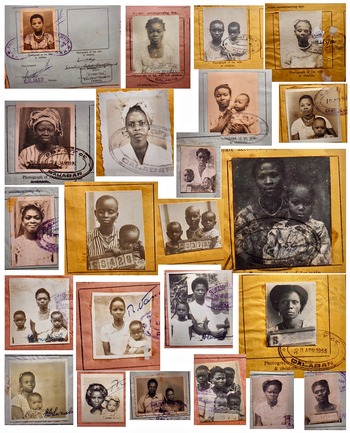
Photography is critical to understanding women’s agencies within the contexts of labor migration. The photographs of women and children examined in this article reflect a particular type of photograph, produced by local studios in Nigeria between the 1930s and 1950s that consisted mainly of half-length and quarter-length portrait photographs.Footnote 48 These portraits became popularized and standardized through the production of identity cards that served as modes of government surveillance and modernization. Because of their insertion into legal structures as a source of evidence and mimetic truth, portrait photographs have been central to the rise of modern collective and individual identities in Africa.Footnote 49 And Africans invested colonial photographic aesthetics with self-fashioning, which had been part of the urban colonial public sphere in Nigeria since the nineteenth century, enabling representations of local identities.Footnote 50 In order to enunciate women’s lived experiences of colonial legibility and capture their otherwise marginalized voices and non-linguistic representations, I employ collage portraiture, an arts-based research (ABR) method, sifting through several hundreds of pages of archival files and sorting declarations and marriage petitions to decipher the diversity in migrant wives’ origins, motivations, tactics of forgery, kinship networks, and strategic mobilization of motherhood.
The women’s photographs I examine (see Figure 2) reflect “individuality,” as opposed to “types” or “anonymity” characteristic of early colonial and missionary photo-ethnography.Footnote 51 They are embedded within documents that provide personal information about the women, including name, relative age, and family relations. From a “visual media” perspective, they constitute feminine individualization processes that contested colonial hegemony and gender hierarchies and articulated women’s desire for greater autonomy.Footnote 52 In his study of the role of photography in the process of modern social regulation, John Tagg shows that portrait photography “is both the description of an individual and the inscription of social identity,” and, in some cases, “it is also a commodity, a luxury, an adornment, ownership of which itself confers status.”Footnote 54 When women sat for their photos, did they experience a sense of individuality, autonomy, and a fantasy of access to new economic opportunities that a travel permit promised? Women dressed up for portraits, styled their hair, and wore fashionable jewelry. This suggests that they saw portraiture as a process of self-fashioning. Although bounded within colonial surveillant documents, tagged with mugshot numbers, and stamped with validating colonial signatures and dates, women’s portraits in the marriage declarations convey individual traits, ranging from a posture, fashion, and a frown to an evident maternal instinct to protect and provide for a child.
An Overview of Women’s Marriage Declaration Portraits. Footnote 53

Terence Ranger has defined Africans “turning photography to their own use” as a “democratic seizure of photography by colonized” peoples.Footnote 55 He describes as “a process of democratization” the spread of photography culture from elites to ordinary peoples who leveraged access to cheaper studio and street photographers in aspiring towards modern “consumption.” I argue that women participated in this process, which transformed photography from a brutal, unequal, undemocratic, unidirectional, and purely colonial gaze at the exotic into a “popular mass technology.”Footnote 56 Between the 1930s and 1950s, as Africans everywhere began to “colonize the colonizing camera,” colonial bureaucracies sought to subject Africans to “close-up” and “cropped image” head and shoulder portraits, which facilitated colonial administrative and police surveillance.Footnote 57 Little attention has been paid to how African women were critical subjects of this colonial surveillance or how they managed “the whole burden of representing modernity and expressing desires,” which fell “on the[ir] bodies” and “especially on their clothes.”Footnote 58 Despite the prevalence of imperial “othering” and “enumeration” of subjects through the camera, photographs still expressed colonized subjects’ earned social status, pride, aspirations, and persistent reappropriation of the colonial gaze.Footnote 59
Although analyzing the agencies and emotive humanity of women who were photo-documented in colonial archives advances a form of decolonization, it arouses problems of the interpretive gaze. How does one capture what is conveyed in a frown, smile, hair styling, necklace, or posing with a child without dislocating historical actors or constructing narratives “outside of the text” of subjects’ experiences?Footnote 60 How do we historicize the “social lives of images” accounting for the “milieus of image making,” the work that generated those images, as well as their meanings and functions?Footnote 61 I suggest that the knowledge and agency espoused by women, who sat for photographs, paid for them, brought those portraits to magistrate courts and native administrations to secure declarations and travel permits, summoned real and fictive kin to testify to their customary marriages, and articulated arguments for traveling to Fernando Po and Gabon constitute the appropriate context and scope for theorizing women’s embodied aspirations in the portraits.Footnote 62 This is a perspective that sees photography as a history of makers and images in which women were both (co-)producers and subjects of photographic images – such women made histories.Footnote 63 Such a perspective foregrounds the fantasy (needs and desires) of photograph creation and the subjectivity of photographed women. As subjects of photographs, these women were “looking past” the temporality of colonial enumeration and surveillance that catalyzed their photographic subjection.Footnote 64 From a photovoice perspective and within the “field of mobile power relations” that characterized gendered wage labor, women’s photographic images constitute “silent talkers,” challenging a colonial regime that employed photographs to “displace, rather than represent the [emotive] individual,” and codified the person “in relation to other frames of reference and other hierarchies of significance.”Footnote 65 Nigerian women’s photographs in the colonial archives evidence self-representation, self-story-telling, and self-advocacy from socially marginalized persons. They are evidence of women’s lived experiences of colonial legibility protocols. This methodology assumes that local appropriations and uses of photographs were the “true motor of photography” as a global genre of identity politics, self-fashioning, and historical consciousness; such methodology is wary of sexual “discrimination” within photography narratives.Footnote 66 Unlike the women, migrant men were not required to provide their photographs in colonial courts. Paying attention to why and how women became special subjects of colonial surveillance reveals something disturbing about trans-colonial forced labor: everybody, including African men, European colonial officials, and colonial planters and firms needed African women but denied them integrity. Hence, women appear in the colonial archives as either dependents or criminals. Yet their photographs and forgeries assert that they were active subjects seeking to improve their own lives.
The Forgery of Labor and Kinship into Legible Colonial Transactions: Of Wife-Owning Husbands, Temporary/Abandoned Husbands, and Fake Wives and Mothers
In a March 1956 petition to the Calabar District Officer, one Mr. A. E. Ugoiji, a native councilor from Eziama Ntigha, inquired about an original complaint that he had submitted in October 1949, which alleged that three recruiters from Calabar named Edward, Silas, and Daniel Ogbuti “have been seizing girls of nine years of age and taking them to Fernando Poo.” More disturbing to Mr. Ugoiji was that the men “have convinced my wife by name Rose Wada Wachukwu, now promising her of marriage and taking her to Fernando Poo without first paying me finish. I have reported the matter to the district officer Aba. Kindly hint this report to the Police before they arrive at Calabar.”Footnote 67 The labor officer at Calabar, F. O. Thomas replied that he would only investigate the matter further “if” Ugoiji could “supply the addresses in Fernando Po of Edward, Silas, and Daniel Ogbuti or the addresses of their employers.”Footnote 68 Resident in the eastern Nigerian hinterland, Ugoiji could not possibly provide those addresses. Therefore, the labor officer’s response was tantamount to a dismissal. Ugoiji’s complaint highlights three salient features of Nigeria’s colonial migrant labor system. First, it was propelled by the illicit recruitment practices of touts and smugglers, who combined “very substantial [financial gift] inducement to braceros (Nigerian migrants under peonage contract)” that served to create re-engancos (or “re-hooked” bonded laborers), with deceitful promises of better economic opportunities and outright kidnapping.Footnote 69 The role of women in this process of forgery, kidnapping, and smuggling has received little attention. Second, it highlights women and children as vulnerable categories of migrants and captures the latent fantasy of economic opportunities that induced some wives to abandon or marry some husbands. Lastly, it represents what was a recurrent strategy: in calling out women to colonial officials as immoral, unfaithful, and engaging in criminal behavior, men, including those who had been complicit in their wives’ illicit economies or profited from them, sought to assert claims over women.
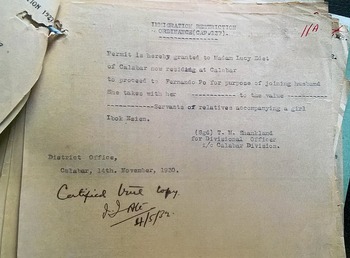
In 1932, Samuel W. Johnson alerted the British district officer at Calabar about “the character and prostitute living” of his wife, Lucy Ekanem Edet (alias Ekanem Ndiyo), a “British subject native of Calabar,” who had been “permitted” to travel to Fernando Po “under my responsibility,” and “under my name” but turned out not to be “bona-fide” as “she is carrying on [a] slave trade” (see Figure 3).Footnote 70 Johnson continued, “There is a group of this type of woman who practice the habit of kidnapping under false pretense illiterate children especially girls, declared as servants [at Calabar] in order to obtain a permit, and given out for a reasonable sum [on Fernando Po] amidst the semi-cultured class of Spanish Europeans.” He specified that one such girl Mary Etim Nkoyo Okokon had recently been rescued by the British vice consul, and that “a good realization of finance is developed in this traffic and the result is always detrimental to the health of young and healthy children. There are several cases which have passed through the hands of the British representative at the [Calabar] end … There are some children craving for freedom.”Footnote 71 Johnson concluded, “The attached permit declares ‘Traveling to Fernando Poo for purpose of joining husband;’ as the husband, I am soliciting your aid that the above lady having no lawful contract of marriage in proof to any statement, and the way in which good children are bartered combined with her prostitute living, urge me to request that such measures be brought into force that she be not permitted any more to travel in my name and be prevented to travel over with children.”Footnote 72
Lucy Edet Ekanem’s Travel Permit.

Colonial documentation had gendered labor migration in such a way that Johnson asserted a “responsibility” over Edet, who had obtained a travel permit in his name; whereas Edet exploited her dependent position to access Fernando Po and pursue child trafficking. Johnson readily mobilized a copy of Edet’s marriage declaration to legitimize his claims. Notably, although women worked to generate marriage declarations, they did not receive a copy, whereas their husbands did. Rather, women received a travel permit.Footnote 73 Both Johnson and Edet were engaged in forgeries. In Johnson’s view, Edet belonged to him, by virtue of her travel permit, otherwise, she was not a “bona fide” migrant. Effectively, Johnson sought to forge the identity of a wife-owning husband. As the Calabar police commissioner later reported, “Sam Johnson and Lucy Edet were once living together as husband and wife for a period of about three years, after which a quarrel broke off their relationship. It is now alleged by the woman that the quarrel was the cause of the report, and this has been confirmed by a Mr. Oliver. Apparently, the woman has been carrying on this illegal practice for a long time to the knowledge of Sam Johnson who was an accessory after the fact.”Footnote 74 Thus, it was not “responsibility” that motivated Johnson’s report but, rather, loss of claim to Edet’s body. There are similar cases of men bringing allegations of slave trafficking to colonial officials in order to assert patriarchal rights over girls and women.Footnote 75 On her part, Edet embodied the forgery of a fake wife. The evidence shows that Edet had married Johnson temporarily, used that marriage to gain access to Fernando Po, and carried on child trafficking in the guise of traveling with her children. The commissioner later reported that some months earlier, Edet’s father had informed the Calabar police that Edet had sent home a letter stating that a girl she had taken to Fernando Po, Ibok Esien, had been lost.Footnote 76 Although, Edet denied the allegations of child trafficking, stating, “The girl Ibok Esien that my father reported missing was a mistake. He misunderstood my letter … I have since brought her back to Calabar.” Edet only admitted, “I know Sam Johnson very well. He was my lover. I lived with him for about three years … He reported me because I left him.”Footnote 77
In contrast to Ukpong Kiah and Akon James who refused to join their husbands, as referenced in the introduction, most archived women sought to travel to Fernando Po and Gabon, and a significant number of women traveled with children. For example, Theresa Peter Inyang claimed to have married Fernando Po laborer Patrick Chuku Okpani in 1950, lived with her husband on Fernando Po for some years, returned to Calabar where she had a child, and in 1954, sought to take the child identified as “Benais Chuku” to her husband on Fernando Po. In her marriage declaration, Inyang presented a male acquaintance and “Native Herbalist,” Effiom Asibong of Calabar, as witness.Footnote 78 Arit Bassey summoned her brother-in-law, tailor, and councilor of Calabar Urban District, Etim Akpan, as her marriage declaration witness, which enabled her to travel with her eight-month old daughter, Alice Essien to Fernando Po in 1954.Footnote 79 Efioanwan Etim relied on her half-brother Asuquo Okon as a witness in order to take her daughter Edet Effiom to her husband Bassey Ekpeyong in Gabon in 1954.Footnote 80 Some women such as Mary Udo and Iyeme Eleng relied on testimonial letters from the Calabar Social Welfare Officer, Belcher, in order to take their children (nine-month-old Sunday Omini, three-year-old Sampson Bernard, and one-year-old Bebe Bernard) to their husbands Omini Ekpata and Bernard Agbo in Fernando Po.Footnote 81 In rarer instances, prominent women sought fellow women as witnesses. Thus, Afiong Etim secured Grace Henshaw, eldest daughter of late Ekpo Efiom Ekpo, and “head and successor in that family,” as a witness to enable her to join her husband Okon Abasi in Fernando Po.Footnote 82 Similarly, Iquo Okon Ufokimaha relied on her mother, Atim Etim Efiom, who testified that she received “£5:5/- complimentary fees, mother’s fees and twelve bottles of unidentified drinks (nkpo Eka Eyen ye imunkpo)” from Bassey Hogan of Creek Town as dowry for her daughter, and was giving her consent for her daughter to accompany Bassey to Fernando Po.Footnote 83 The diversity of witnesses shows that women sought various avenues to travel with their children.
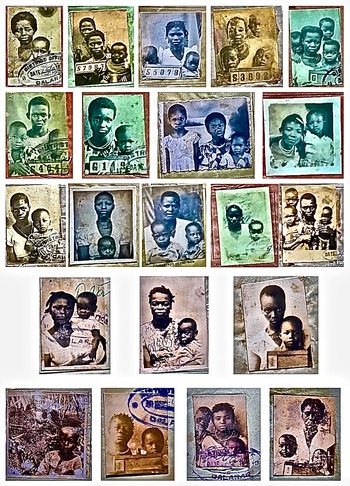
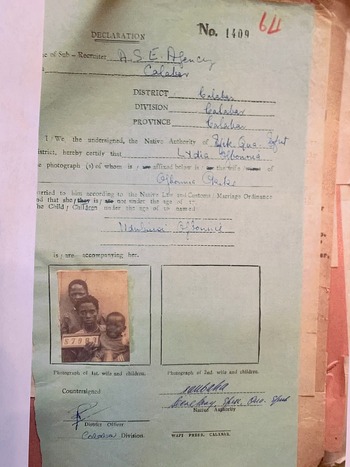
The existence of several cases alleging that women trafficked children corresponds with the significant number of marriage declaration applicant-women photographed with children (see Figure 4). Their cases are different from those of men, who claimed girls as wives to disguise slavery.Footnote 84 They also differ from cases of slave dealing involving women already resident in Fernando Po.Footnote 85 In the cases of women who used declaration certificates to document and traffic children, they specifically claimed maternity over children, who did not belong to them. In 1952, “Treaty Laborer” Ogbonnia Okike could not return to Fernando Po and required “a new marriage Declaration form” because his second wife, Lydia Ogbonnia, had forged in her marriage declaration form that she was mother to their two-year-old son Ndubuisi, as well as to twelve-year-old girl, Rebecca, whom she had brought from Afikpo (see Figure 5). When it “was subsequently found to be incorrect” that “Lydia was the mother of both children” on Fernando Po, Lydia Ogbonnia and Rebecca were repatriated. It is not clear that Ogbonnia forged maternity over Rebecca with the aim of trading her, but it is likely that Ogbonnia wanted to bring Rebecca along as a house servant.Footnote 88 In the accompanying photograph, Ogbonnia held Ndubuisi in her arms and placed Rebecca behind her. Although Rebecca’s positioning was practical, it reflected her marginality within the family.
Wives and their Children.Footnote 86

Lydia Ogbonnia’s Marriage Declaration in which she Forged Motherhood. Footnote 87

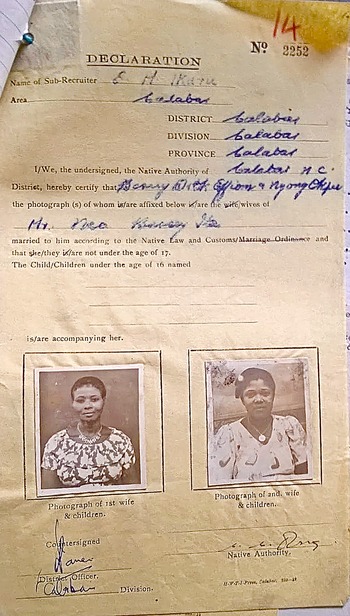
Although the declaration forms allowed for polygamously married men to bring up to two wives and any number of children, there were instances where different women used different declaration forms to claim marriage to the same male migrant laborer. For example, a woman named Bassey Harry Ebong, passport photo “20701” (see Figure 6), was recorded to have been married to a man named Nsa Etim Edet in “Declaration No. 2713.”Footnote 89 Miss Bassey’s father, Harry Ebong testified that Mr. Nsa Etim Edet had paid him £12 dowry and £5 complimentary fees to legalize his marriage to Miss Bassey, with the “intention of going to Fernando Poo together,” and the couple had lived together for seven months.Footnote 90 The same day, or a day later (see fn. 91), another woman named Ibok Etim Nyong, mother of two-year-old Augustus Nsa, was recorded to have been married to the same Mr. Nsa in “Declaration No. 2714.”Footnote 91 An “Uncle of Ibok Etim Nyong” testified that Miss Nyong had been married to Mr. Nsa according to Efik law and custom for “the past six years” and was now ready to travel to Fernando Po.Footnote 92 Miss Bassey and Mrs. Nyong applied independently of each other and their husband – instead of their husband filing for them and putting them both on the same declaration form. Therefore, the application of the two wives of Nsa using two different declaration forms suggests that they were less interested in recording, and thus legitimizing, their status as wives belonging to Mr. Nsa and more interested in securing what was essentially a travel permit to Fernando Po. In both declarations, orchestrated by the wives and their witnesses, the husband’s voice is conspicuously absent. Women’s transformation of the colonial marriage declaration into travel permits constituted a unique form of forgery – that of repurposing colonial legal instruments.
One of a Few Marriage Declaration Forms Showing Two Wives, Mrs. Bassey Efiom, and Mrs. Nyong Okpu, Married to Mr. Nsa Bassey. Footnote 93

The declaration documented and made legible otherwise oral and performative customary marital traditions, which husbands and wives had to subsequently negotiate. In this regard, it differed from private marriage contracts. For example, William E. Ndo, identified as “paternal guardian,” and Ekpenyon Nsa Ekpo, identified as “maternal guardian,” signed a “marriage contract” stating, “We the undersigned both paternal and maternal guardians of Miss Esien Anwan Efiong have given her for marriage to Mr. Efiong Noah, and received from him the sum of £17- 5/- (seventeen pounds and five shillings) being the bride price according to Efik custom, and it is our consent that he the said Mr. Efiong Noah can take her with him to any Station he might be.”Footnote 94 Mr. Noah, a Western-educated schoolteacher and merchant sought a carte blanche contract specifying his right to take his wife wherever he pleased. In another example of an actual marriage declaration, Efiom Okong of Calabar attested in 1956: “I am the father of [the woman named] Ekpe Anwan Efiom Okon … [Mr.] Emmanuel Harry to legalize his marriage with my said daughter … paid to me:- (a) £6. 15. 6d in cash & 8 bottles assorted drinkable – Complimentary drinks, (b) £12. 0. 3d full dowry.”Footnote 95 In this declaration, Okong merely stated that Harry “desired” that his daughter Anwan should accompany him to Fernando Po as a wife and that he made the declaration “in order to obtain Traveling Permit for Ekpe Anwan Edem Efiom [as Harry’s] lawful wife.”Footnote 96 Thus, the declaration differed from a “marriage contract” that specified spousal rights, as in the case of Mr. Noah. Upon Okong’s testimony and paternal consent and the endorsement of the Secretary of the Calabar County Council, Anwan joined her husband, Harry, an employee of Agencia Fortuny Ltd., at Santa Isabel, Fernando Po. Subsequently, however, beyond the purview of the Native Authorities, husband and wife could interpret the marriage declaration as they saw fit. The point is that although patriarchal hegemony characterized the institutions of colonial marriage declarations, women strategically wielded the securing of “consent” or expression of “refusal” to join husbands, as well as the opportunities that a “traveling permit,” secured through a marriage declaration, afforded them. Therefore, husbands’ proliferated complaints about wives’ (mis-)behavior are best understood as part of a broader process of colonial marriage forgeries, that is, concerted transformative praxis evident in diverse mobilizations and deceitful expansion of opportunities. From this perspective, in recording the monetary value of gifts provided to a woman’s family in the course of marriage rites, declarations reduced marriages into economic transactions, which reinforced husbands’ claims, but it also armed wives with a legal document that enabled mobility and forgery.
Marriages with migrant men were conducive to forgeries because colonial officials supported and facilitated husbands’ demands for wives to join them, went looking for wives at various local addresses to “know the woman’s mind,” and encouraged wives to travel.Footnote 97 James Nwuzo, contract laborer G68 of Consortium-Macoc-Libreville requested the Calabar District Council to expedite their signing of his marriage declaration “without delay” to enable his wife Theresa James to join him in Gabon.Footnote 98 Nwuzo cited his employer’s support, as well as Vice Consul Vischer’s “Wives Wishing to Join their Husbands in Gabon” letter to the Labor Officer at Calabar, requesting the ASEA recruiter to bring his wife.Footnote 99 Indeed, there are examples where women could not be traced or located at the address their husband had given to the consulate and labor office, which suggests that such wives may have refused travel, like Ukpong Ikah and Akon James.Footnote 100
But migrant men continually deluged British officials with appeals to bring their wives, offering various arguments. Thus, Edet Usuah wrote to the Calabar district officer, identifying himself as “a John Holt boy at Fernando Poo” in the first year of his contract, and begged the DO to “help” and “try all you can to send me my wife very urgently. I am tired of cooking alone, while I have got a wife & children at home. My wife & children have no one to care for them, as I do care for them when they are with me.”Footnote 101 Usuah reiterated, “I have full courage that being a John Holt my wife can be sent to me at my demand at any time. When I [say] Govt. or John Holt, it is you that I mean … I need my wife and children because I have no well trusted person that can care for them until I shall finish the 3½ years course” of employment.Footnote 102 Rather than reference a marriage declaration entitling him to his wife, Usuah chose to appeal to the sentiment of the British official, mobilizing a mutually cognizant ideology of colonial paternalism. The DO advised Usuah to “apply to the vice consul and labour officer at Fernando Po in the usual way.”Footnote 103 The volume of men’s direct applications to British officials at Calabar had risen, testing the patience of officials. To another petitioner-husband, Okon Obot, who requested, “kindly send my wife,” the DO replied, “I am not a matrimonial agent. You should write to your friends or relatives to arrange to send your wife to you.”Footnote 104 Lastly, Mr. Efiom Nyong complained that he paid dowry and fulfilled all customary obligations to marry Asari Okon Ewa and further received her parents’ consent to take her to Fernando Po; however, as they readied to board the Anglo-Spanish Employment Agency boat at Calabar, his wife disappeared. On landing on Fernando Po, Mr. Eyong lodged a complaint with the British vice consul, who required him to petition the DO at Calabar.Footnote 105 “On the subject of the desertion of your wife,” replied the DO, “return to Calabar and look for her or instruct your relatives to help you to do so.”Footnote 106
Why did some married women refuse to travel to Gabon and Fernando Po to join their husbands?Footnote 107 Another letter from Sampson Udoka suggests that some women may have valued collecting dowries, gifts, and long-term fiscal support from absentee husbands because they afforded women greater freedom. Upon learning of his wife’s refusal to join him in Gabon, Udoka petitioned the Calabar district officer to “despatch [sic] her to me as sooner as possible” within five weeks, or retrieve his dowry. He argued that he married Akon James to be “as a wife of [an] orphan but not of a rich man as the woman wants to be.”Footnote 108 In addition to financial motives, Akon had become pregnant with a child belonging to another man, during the absence of Udoka, which suggests that she engaged in other generative extramarital relationships. And her decision to flee Calabar for her Ibibio homeland suggests that she may have wanted to further distance herself from Udoka, ASEA agents, and British officials at Calabar.
Moreover, Udoka did not know his wife well. He met Akon James briefly during a visit to Calabar in 1954, paid her dowry, and returned to Gabon. The second time that ASEA sent a messenger, Luke Animeka, to interview James and her mother in December 1955, the labor officer mistakenly reported the wife’s name in parenthesis as “Ukpon Ikah,” who was in fact, the wife of Esien Ekong.Footnote 109 During that interview, James and her mother were “very much opposed to the woman joining the man in [Gabon] and the woman herself who has a child refuses to travel to join the man, having complained that there has been no assistance from the man at all.”Footnote 110 Upon receiving this information,Footnote 111 Udoka asked the Calabar district officer and the native authorities “to take serious view in this matter, since my wife (Ukpon Ika) has refused to join me here in Gabon (F.E.A) following her parents’ advice, I have no middle course to regret if the District Officer will agree with me and either imprison the woman (Ukpon Ikah) or receive my money paid on her behalf as dowry if she refuses to join me here in Gabon.”Footnote 112 Udoka put his wife’s name in parenthesis either because he sought consistency with the district officer’s letter, which he did not bother to correct, or because he was not sure of the woman’s identity.
Furthermore, Udoka had come to view his wife as a fraud and a prostitute. He argued, “whereas I had fulfilled all necessary conditions on behalf of this woman (Ukpong Ikah) according to our system of marriage, there is no reasonable excuse why she should not join me here in Gabon, except she wants to increase the number of harlots in Calabar and Nigeria as a whole. I am of the opinion that there is no other cause of numerous harlots in Nigeria than the question of accepting false excuses from a woman who does not like to join her husband.”Footnote 113 Udoka argued that his “lack of financial assistance” to the woman was a result of the fact that “we are making use of the French money” and “it will not be possible for any Nigerian worker in Gabon to send any amount of money to anybody in Nigeria.” Lastly, he alluded to another documentary evidence, “a written bond which was made on the very day I married the said woman, the written agreement now in possession of my brother.”Footnote 114 The British officer could not “do anything in the matter” and advised Udoka to seek “remedies” in the court of law.Footnote 115
The recurrence of petitions in which husbands were calling their wives out as prostitutes to British officials suggests that the female prostitution discourse, which is replete in the archives and reinforced in published literature on Nigerian labor migration to Fernando Po and Gabon, requires closer scrutiny. As the examples of Samuel Johnson vs. Lucy Edet, and Sampson Udoka vs. Akon James show, men denounced wives as “harlots” and “prostitutes” to own them. Yet women did not appear to have been swayed by the anxieties of men and the colonial state.
By September 1955, African forgeries of marriage declarations had grown so considerably that the colonial department of labor initiated a review “towards the eradication of the unpleasantness hitherto experienced in the matter of marriage declarations.”Footnote 116 The Calabar labor officer cited a “series of complaints from fathers who alleged that their daughters had been taken away by or sent to husbands who had not paid full dowry, and from husbands who alleged that their wives had been seduced by recruited labourers.”Footnote 117 In this examination, contracted male migrants, ambitious wives seeking better economic opportunities, corrupt native councilors accepting bribes, and recruiters “signing marriage declaration forms [while posing] as a Native Authority” were the culprits and forgers. The disagreement between the Eastern Region Labor Commission and Labor Officers in Calabar and Gabon over the appropriate “Native Authority” to sign the declarations (whether the County Council or the Native Court) further befuddled the declaration certification procedures, undermined accountability, and enabled contract laborers, “wives,” and recruiters to exploit loopholes to their advantages. In fact, cases of women traveling with children and “husbands” presenting themselves as declarant witnesses for their “wives” multiplied.Footnote 118 A labor report on Fernando Po suggests that some of these were fake husbands.Footnote 119
To curtail women’s forgery of marriage declarations through the mobilization of a diverse range of “witnesses,” the British Resident Officer in Calabar recommended to the district officers of Abak, Calabar, Eket, Ikot Ekpene, Itu, Uyo, Opobo, and Arochukwu, “it would be far better if the parties with the parents of the wife appeared before the Native Court within whose jurisdiction the marriage was contracted,” rather than in Calabar, “and swear on oath that the marriage has been made according to native law and custom.”Footnote 120 He suggested that each Nigerian wife wishing to join a husband should be required to submit a petition for a declaration that she is the wife of X [male migrant] according to Native law and custom, pay the necessary fee [for filing the declaration] and appear before the court in full session in the usual way accompanied by her parents or guardian. The matter can be recorded in the Judgment Book, and the declaration can then be signed by a court member, and countersigned by the clerk.Footnote 121
The Calabar district officer replied that there was already a practice of district officers signing across the photographs on marriage declaration certificates “to deter substitution” and observed that the Colonial Resident’s proposal was impractical because, most times, a husband was already in Fernando Po or Gabon and could not, as such, appear in court in Nigeria; further, the procedure would be expensive, and, lastly, such a judicial process would transform the marriage declarations into actual “legal marriage certificates,” which would then “require amendment or cancelation in the event of divorce or refund of dowry.”Footnote 122 In effect, it would make British colonial bureaucracy accountable and deter more wives from joining migrant husbands. Ultimately, labor authorities required that marriage certificates must be issued in women’s natal villages and witnessed by parents or relatives, which did not curb fake applications at Calabar.Footnote 123 The documentation of witnesses for declarations became more elaborate and started including the collective signatures of parents of the wife, the husband, and parents of the husband.Footnote 124
Conclusion
This article has sought to develop a theory of Nigerian women’s documentary agencies and engagements with the British colonial state between the 1930s and 1950s. Although a majority of the women were likely not literate, they evinced a cosmopolitan habitus that reflected both their fantasies of autonomous social reproduction and their knowledge of labor migration dynamics, the protocols of colonial legibility, and practical mobilization of kinship. 1950s Calabar was a cosmopolitan environment, not only because Old Calabar had been a major node of the trans-Atlantic slave trade and post-abolition legitimate trade in palm produce especially but because, at the turn of the twentieth century, Calabar became the major center for the mobilization of Nigerian laborers to Spanish Fernando Po and French Gabon. Calabar was host to a diverse ethnic demography of African and European peoples. Women of various origins including Igbo, Ibibio, Efik, Hausa, Yoruba, and French and British Cameroons, among many others, fulfilled marriage declarations to obtain travel permits in Calabar during the 1950s.Footnote 125 In this article, I have tried to tell the stories of such women who are glossed within the colonial archives as “wives.” Women’s motivations to travel certainly included the desire to join their husbands and, for women traveling with their children, to reunite their families. The family photos of women with their children certainly convey this idea.
But in requiring customary marriages to be made legible as a condition of trans-colonial mobility, the colonial state opened an avenue for women identifying as wives of migrant men and mothers to migrant men’s children to populate the colonial archives with their photographs, ambitions, forgeries, and fantasies of what could be accomplished in new environments where no formalized system of wage employment existed for women, in contrast to men’s experiences. My approach has been to elicit women’s strategies and imaginations from gendered imperial archives and reveal the diverse manifestations of women’s agencies and ambitions. The mobilizations of Africans for trans-colonial labor migration required gendering forgeries, in which the colonial state, and Nigerian women and men participated. All three categories of historical actors invested heavily in colonial forgery, contrivance, or imaginative invention through intentional participation in the colonial “bureaucracy of paper”: the state pursued a surveillant strategy of “archival government;” African men used colonial documentation to assert claims over the bodies of women, especially as “wives;” and African women transformed documentary colonial marriage declarations into “travel permits” that allowed them to deploy forgeries of motherhood and temporary wifehood, traffic children, and define the spatial, durational, and transactional terms of their conjugal relationships with husbands. Although women may not have directly manipulated colonial documents themselves, they generated the requisite evidence, both real and fictive, to facilitate the deceptive production of legal documents. Women’s strategies, mobility fantasies, and mobilization work, including their ingenuity in producing witnesses and photographs, enabled them to develop autonomous spaces of social reproduction – that is, modes of economic survival and social identity formation beyond the control of colonial surveillance and the nascent patriarchy of androcentric wage labor. The article has examined intra-African migration in terms of the intersectional politics of gendering, kinship, and dissident mobilities. From the perspectives of “Wives Wishing [or Refusing] to Join Their Husbands” on Spanish colonial Fernando Po and in French colonial Gabon, gendered forgeries facilitated and enabled the evasion of colonial, monopolistic, and forced labor systems.
Acknowledgments
Research for this article was funded by the American Council of Learned Societies (ACLS) and the State University of New York at Buffalo’s Humanities Institute and Baldy Center Centre for Law and Social Policy.