
I. INTRODUCTION
Increasing worldwide concern over plastic waste disposal problems has prompted much interest in using bio-based materials instead of petroleum-based materials. Polylactic acid (PLA) derived from biomass has become one of the most interesting biodegradable thermoplastic polymers. PLA shows the good performance in many industrial divisions, for example, biomedical, automotive, and packaging. Reference Yu, Dean and Li1,Reference Lim, Auras and Rubino2 PLA is stiff and brittle which limit its potential application. For example, the tough PLA in packaging industry can be molded in a complex shape but the stiff one cannot. Many approaches have been explored to overcome PLA stiffness, such as plasticization, Reference Djellali, Haddaoui, Sadoun, Bergeret and Grohens3 copolymerization, Reference Yasuniwa, Tsubakihara, Iura, Ono, Dan and Takahashi4,Reference Likittanaprasong, Seadan and Suttiruengwong5 toughening with rigid particles, Reference Meng, Tao, Deng, Wu and Yang6 and blending with a flexible polymer. Reference Zhang, Man, Pan, Wang, Jiang and Dan7,Reference Jaratrotkamjorn, Khaokong and Tanrattanakul8 Rubber has been widely utilized to toughen brittle thermoplastics. Rubber particles act like stress concentrators improving the fracture energy absorption of brittle materials and enhance toughness of the materials. There are many criteria to impart toughness to polymers such as (i) the interfacial adhesion between the dispersed rubber and the polymer matrix must be good, (ii) rubber must be distributed as small quantity of particles with appropriate size in the polymer matrix, and (iii) rubber must be stable in the temperatures of the polymer processing. Reference Bitinis, Verdejo, Cassagnau and Lopez-Manchado9 Natural rubber (NR), derived from a renewable resource, shows unique combination properties of flexibility, toughness, biocompatibility, and biodegradability with its low cost. All of these make it be an excellent alternative to enhance the properties of PLA. Reference Bitinis, Verdejo, Cassagnau and Lopez-Manchado9,Reference Nagarajan, Mohanty and Misra10 Considering the difference of chemical structure and polarity, PLA and NR are immiscible, so that it is necessary to improve compatibility of this system to achieve good properties. Juntuek et al. Reference Juntuek, Ruksakulpiwat, Chumsamrong and Ruksakulpiwat11 studied the mechanical and thermal properties of 90 wt% PLA and 10 wt% of NR and glycidyl methacrylate-grafted NR (NR-g-GMA) blends. They found that NR-g-GMA improved compatibility between PLA and NR, which led to an increase in impact strength, elongation at break, and thermal stability.
Admicellar polymerization is a technique to modify surface and can enhance surface interaction without using a compatibilizer. This technique is introduced to improve the compatibility between different polar polymers by forming a thin layer of one polymer on the other polymer/substrate surface. In a previous work, we have successfully prepared admicelled poly(methyl methacrylate) on NR (PMMA-ad-NR) using the 100:1 monomer to initiator ratio. Reference Pongpilaipruet and Magaraphan12 We found that the vulcanized PMMA-ad-NR exhibited better thermal stability, mechanical properties, and ozone resistance than the vulcanized NR. Although polarities of PMMA and NR were different, the admicelled PMMA effectively enhanced NR properties due to the good interfacial adhesion. In other words, PMMA-ad-NR has potential to improve compatibility between hydrophobic NR and other polar polymers and can be used as a core–shell toughening agent. The PMMA layer could play a role in providing the compatibility to other brittle polar polymers, e.g., PLA. Several studies showed that PLA blended with PMMA could be a miscible blend. Reference Hao, Kaschta, Liu, Pan and Schubert13–Reference Imre, Renner and Pukanszky17 In addition, it was reported that the compatibility between PLA and PMMA depends on the molecular weight of PMMA. Reference Anakabe, Zaldua Huici, Eceiza and Arbelaiz15,Reference Samuel, Raquez and Dubois16 The blends of PLA with a small amount of low-molecular weight polyester can improve compatibility and retention of degradability. Reference El-Hadi18,Reference Odelius, Ohlson, Höglund and Albertsson19 El-Hadi Reference El-Hadi18 used 10 wt% poly(vinyl acetate), a third polymer, to improve interaction and miscibility between PLA and poly(propylene carbonate). Odelius et al. Reference Odelius, Ohlson, Höglund and Albertsson19 studied the PLA blends with 5–25% of low-molecular weight polyester. The results showed that adding low-molecular weight of polyester to PLA matrix enhanced the thermal stability and mechanical properties without any deterioration in other material properties. Particularly, the molecular weight of synthesized polymer can be simply controlled by increasing the amount of initiator relative to monomer, e.g., more radicals from the initiator lead to shorter polymeric chain. The monomer to initiator ratios are typically in a range of 500–1000 in emulsion polymerization, whereas the low proportions were required in admicellar polymerization, Reference Cheah, Bhikha, Haver and Smith20 which is known as the surface analog of emulsion polymerization. In other words, a strong effort by adding more initiator content is needed for admicellar polymerization. This is commonly found as a result of the striving of the initiator to reach polymerization sites that confine only on the surface of the substrates.
This study aimed to improve the toughness and thermal stability of PLA. The approach adopted to increase compatibility of PLA and NR by using admicellar polymerization technique to synthesize PMMA-ad-NR. The effects of PMMA molecular weight and contents of admicelled rubber on mechanical and thermal properties were studied. This research was emphasized on the molecular weight of PMMA by varying the molar ratio of methyl methacrylate (MMA) monomer to initiator (25:1, 50:1, and 100:1). The effect of PMMA-ad-NR content (5, 10, and 15 wt%) on the properties of the PLA/PMMA-ad-NR blends in comparison to PLA/NR blends was also evaluated.
II. EXPERIMENTAL SECTION
A. Materials
NR latex used in this work was supplied from Thai Rubber Latex Co. (Samutprakarn Thailand). Potassium peroxodisulfate (KPS) was obtained from Fluka (Steinheim, Germany). MMA monomer and hexadecyltrimethyl ammonium bromide (CTAB) were manufactured by Merck (Darmstadt, Germany), and PLA (grade 3051D, D-content 4%, MFI 10–25 g/10 min at 210 °C with a 2.16 kg load) was supplied by NatureWorks LLC (Minnetonka, Minnesota).
B. Preparation of the PMMA-ad-NR
The PMMA-ad-NR was prepared as described by Pongpilaipruet et al. Reference Pongpilaipruet and Magaraphan12 The 5-wt% centrifuged NR latex was dispersed in distilled water at pH8. CTAB using as a surfactant was added into this mixture and the concentration was adjusted below critical micelle concentration to avoid the emulsion polymerization. The MMA concentration was fixed at 100 mM, which corresponded to 16.7 wt% of MMA in PMMA-ad-NR. In this study, the molar ratios of monomer to initiator were 25:1, 50:1, and 100:1 by varying the KPS initiator. The reaction was carried out for 4 h. The PMMA-ad-NR was rinsed with distilled water to remove the excess CTAB surfactant. After drying in a vacuum oven at 70 °C, the dried PMMA-ad-NR was then obtained to be characterized in Fourier transform infrared (FT-IR) observation and determination of conversion. The neat PMMA was synthesized by using the soap-free emulsion polymerization method Reference Chen and Sajjadi21 for using in the FTIR experiment.
C. Preparation of the PLA blends
The PLA/rubber blends, prepared by varied NR and PMMA-ad-NR contents to be 5, 10, and 15 wt%, were achieved via a co-rotating twin screw extruder (Labtech type LHFS1-271822) with a screw diameter of 20 mm, L/D ratio of 40/1, and a screw speed of 30 rpm. The temperature profile was at 160 °C in the feed zone and at 190 °C in the die zone. The blends were extruded with 1-mm-diameter circular die, cooled down in a water bath, and cut into pellets. The obtained pellets were formed by injection molding (Battenfeld BA 250 CDC) for mechanical testing, with temperature set in a range from 160 °C to 180 °C along the direction from hopper to the injection nozzle.
D. Characterization techniques
1. FT-IR observation
The functional groups of the admicelled rubber were recorded on a Nicolet iS5 spectrometer (Thermo Fisher Scientific, Waltham, Massachusetts) operating in the attenuated total reflectance mode with a diamond crystal having a refractive index of 2.4, at an incident angle θ of 45° with 64 scans at a resolution of 4 cm−1, and a frequency range of 4000–650 cm−1.
2. Determination of conversion
The monomer concentration in the reaction was analyzed from spectra of a Shimadzu UV 1800 UV-visible spectrometer (Shimadzu Corp., Kyoto, Japan). The MMA conversion (%C) in PMMA-ad-NR was computed based on the quantity of monomers left in the reaction. The calibration curves of the MMA monomers were resulted from maximum absorption of the carbonyl group in the MMA monomer at 207 nm at various concentrations of the MMA monomer. The absorbance of the samples at this particular wave length was measured, resulting in %C. The PMMA-ad-NR after removing excess surfactant was weighed and calculated the wt% and %yield according to the following equations:
 $$\% C = {{{{\left[ {{\rm{MMA}}\;{\rm{monomer}}} \right]}_{t = 0}} - {{\left[ {{\rm{MMA}}\;{\rm{monomer}}} \right]}_{t = t}}} \over {{{\left[ {{\rm{MMA}}\;{\rm{monomer}}} \right]}_{t = 0}}}} \times 100\quad ,$$
 $${\rm{wt}}\% \;{\rm{PMMA}}\;{\rm{in}}\;{\rm{PMMA ‐ }}ad{\rm{ ‐ NR}} = {{{\rm{PMMA ‐ }}ad{\rm{ ‐ NR}}\;{\rm{dried}}\;{\rm{weight}} - {\rm{NR}}\;{\rm{dried}}\;{\rm{weight}}} \over {{\rm{PMMA ‐ }}ad{\rm{ ‐ NR}}\;{\rm{dried}}\;{\rm{weight}}}} \times 100\quad ,$$
 $$\% {\rm{yield}} = {{{\rm{PMMA ‐ }}ad{\rm{ ‐ NR}}\;{\rm{dried}}\;{\rm{weight}}} \over {{\rm{NR}}\;{\rm{dried}}\;{\rm{weight}} + {\rm{weight}}\;{\rm{of}}\;{\rm{MMA}}\;{\rm{monomer}}}} \times 100\quad ,$$
where [MMA monomer] t=0 is the initial MMA concentration and [MMA monomer] t=t is the final MMA concentration.
3. Molecular weight measurement
To measure the weight-average molecular weights (M w), number-average molecular weights (M n), and polydispersity index of the admicelled PMMA polymer, a Shimadzu GPC-RID10A with styragel®HR5E columns (WAT044228; Shimadzu Corp., Kyoto, Japan), refractive index detector, and tetrahydrofuran (THF) solvent were used. A narrow molecular weight distribution polystyrene standard was utilized for the calibration curve. The operating condition was controlled at 40 °C with a flow rate 1.0 mL/min. The dried PMMA-ad-NR was extracted by soxhlet extraction with acetonitrile and extracted PMMA was evaporated and redissolved in THF, an eluent, and then the solutions were injected with a volume of 20 µL.
4. Thermal stability measurement
Weight loss and degradation temperature (T d) were assessed using thermogravimetric analysis Netzsch STA 449 F3 (Netzsch Group, Selb, Germany) under N2 atmosphere with a N2 flow rate of 20 mL/min and a heating rate of 10 °C/min. The temperature program was set from 30 to 800 °C. The temperature at the maximum rate of weight loss taken from the TG-DTA thermograms was indicated as the peak decomposition temperature.
5. Thermal analysis
The glass transition (T g), cold crystallization (T cc), and crystalline melting (T m) temperature of pure PLA and the blends were analyzed by a differential scanning calorimeter (DSC) Mettler Toledo 822e (Mettler-Toledo, LLC., Columbus, Ohio). For eliminating the thermal history, the specimens were heated at 25 °C and increased to 180 °C with a heating rate of 10 °C/min, and later on they were cooled from 180 to 25 °C. For the last run, the specimens which were back at 25 °C were heated up to 180 °C with a heating rate of 10 °C/min under a N2 gas flow rate of 20 mL/min. The degree of crystallinity (χc) was determined as seen in Eq. (4):
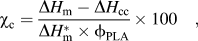 $${\chi _{\rm{c}}} = {{\Delta {H_{\rm{m}}} - \Delta {H_{{\rm{cc}}}}} \over {\Delta H_{\rm{m}}^ * \times {\phi _{{\rm{PLA}}}}}} \times 100\quad ,$$
where ΔH
m is the heat of fusion, ΔH
cc is the heat of crystallization of PLA,
 $\Delta H_{\rm{m}}^ *$
is the 100% crystalline for PLLA (93.1 J/g),
Reference Lim, Auras and Rubino2
and ϕ
PLA is the weight fraction of PLA component in the blends.
6. Static mechanical tests
a. Tensile test
The tensile testing of specimens was performed utilizing a universal testing machine, Instron 133R 4206 (Instron Corporation, Norwood, Massachusetts), with a crosshead load cell of 25 kN and a speed at 10 mm/min. The test was carried out using the procedure outline in ASTM D638. The specimens were molded in an injection molding machine to dumbbell shape samples. The dimensions of the specimens were 165 mm length × 13 mm width × 3 mm thickness. At least ten samples of each specimen were tested. Tensile toughness, the resistance to fracture of the materials when stressed, was calculated by integrating area underneath the stress–strain curve in unit of Joule per cubic meter (J/m3).
b. Impact test
The Izod impact test was performed using a Zwick 5113 Pendulum tester (The Zwick Roell Group, Ulm, Germany) with a 21.6 J hammer according to ASTM D256. The specimens were obtained from an injection molding machine. At least ten samples of each specimen were tested.
c. Flexural test
The flexural testing of samples was performed using an Instron 133R 4206 (Instron Corporation, Norwood, Massachusetts) with a crosshead load cell of 5 kN and a speed at 2 mm/min, and the support span length was 80 mm. The test was carried out according to procedure outline by ASTM D790. The specimens were prepared by using an injection machine. The size of test samples was 127 mm length × 12.7 mm width × 3.2 mm thickness. At least ten samples of each specimen were tested.
7. Morphological characterization
The core–shell morphologies of samples were studied by using a transmission electron microscope (TEM) JEOL, JEM-2100 (JEOL USA, Inc., Peabody, Massachusetts) with an acceleration voltage of 100 kV. The well-dispersed samples in distilled water were deposited on 200 mesh copper grid and left to dry overnight before testing. The particle sizes of NR and PMMA-ad-NR were calculated by averaging size of 20 particles from TEM micrographs utilizing a digital image processing and an analysis program called SemAfore version 5.2 developed by the Rimppi Inc., Ojakkala, Finland.
The phase morphologies of the freeze-fractured surface of extrudates and fractured surface from tensile and impact tests of PLA/NR and PLA/PMMA-ad-NR were carried out utilizing a field emission scanning electron microscope (FE-SEM) HITACHI S-4800 (Hitachi High-Technologies Corporation, Tokyo, Japan). The samples were prepared by dipping the dry specimens into liquid nitrogen and were broken in it. The cross-section area was coated with platinum under vacuum and observed by using the FE-SEM. All images were acquired with a magnification of 1000 times at 2 kV.
III. RESULTS AND DISCUSSION
A. Properties of PMMA-ad-NR
1. FT-IR observation
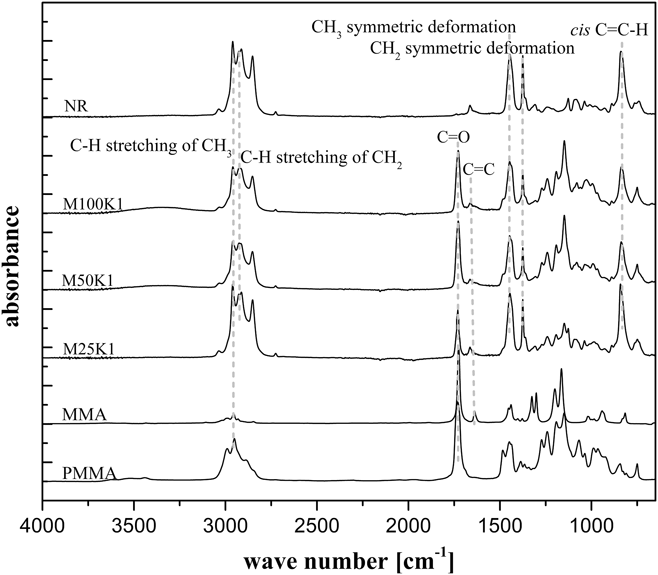
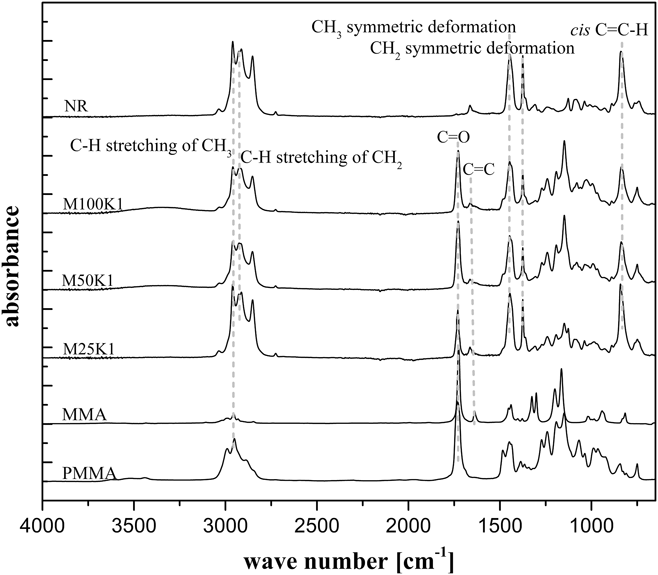
In the study, the molar ratio of monomer to initiator used to synthesize PMMA-ad-NR was varied as 25:1, 50:1, and 100:1, which were named as M25K1, M50K1, and M100K1, respectively. Figure 1 shows spectra of PMMA-ad-NR at different molar ratios of monomer to initiator. The spectra of NR observed at 2960, 2916, and 2851 cm−1 were corresponded to C–H stretching. In addition, the strong absorption band at 1447 cm−1 was assigned to C–H deformation of –CH2– and those at 1375 and 835 cm−1 were corresponded to C–H deformation of –CH3 and C–H deformation of cis C=C–H, respectively. Reference Anancharungsuk, Tanpantree, Sruanganurak and Tangboriboonrat22 The peaks of synthesized PMMA using emulsion polymerization at 2951, 1732, 841, and 750 cm−1 were assigned to C–H symmetric stretching, C=O asymmetric stretching, C–O–C stretching, and CH2 rocking, respectively. Reference Wei, Bai and Shao23,Reference Gebreyesus, Purushotham and Kumar24 Compared to synthesized PMMA, the characteristic absorption peak at 1730 cm−1 was clearly observed in all monomer to initiator molar ratios of PMMA-ad-NR samples corresponding to C=O stretching of MMA, which was consistent with the previous work. Reference Pongpilaipruet and Magaraphan12 The FT-IR results indicated that the PMMA had been successfully formed on the NR surface via admicellar polymerization.
FT-IR spectra of the samples.
2. Conversion and molecular weight measurement
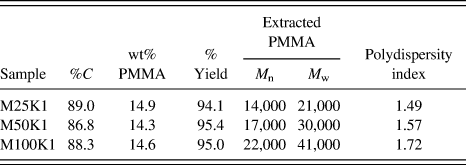
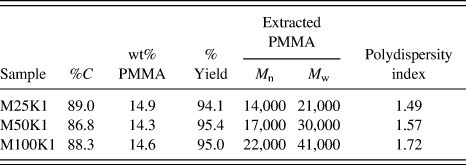
The %C and wt% PMMA in PMMA-ad-NR and %yield were calculated using Eqs. (1)–(3) and then listed in Table I. The %C changed little with the increase in molar ratio of monomer to initiator. The molecular weight of admicelled PMMA increased with increasing monomer to initiator molar ratio because more monomers reacted with the initiator led to longer polymeric chains. Reference Mohamad Sadeghi, Morshedian and Barikani25 Moreover, the polydispersity index of PMMA-ad-NR was found to be slightly increased with the increasing monomer to initiator molar ratio. This trend was opposite to polydispersity index usually found in the conventional emulsion polymerization Reference Tanrisever, Okay and Sönmezoğlu26 and free radical polymerization. Reference Ng, di Lena and Chai27 Although molar ratio of monomer to initiator was increased by 4, the increase in PMMA molecular weight was less than 4-fold. The change in ratio of monomer to initiator causes the change in molecular weight in linear relationship or direct variation as shown in Fig. S1. Then the M25K1, M50K1, and M100K1 were renamed to M20000, M30000, and M40000, respectively.
Characteristics of PMMA-ad-NR.
3. Core-shell morphology
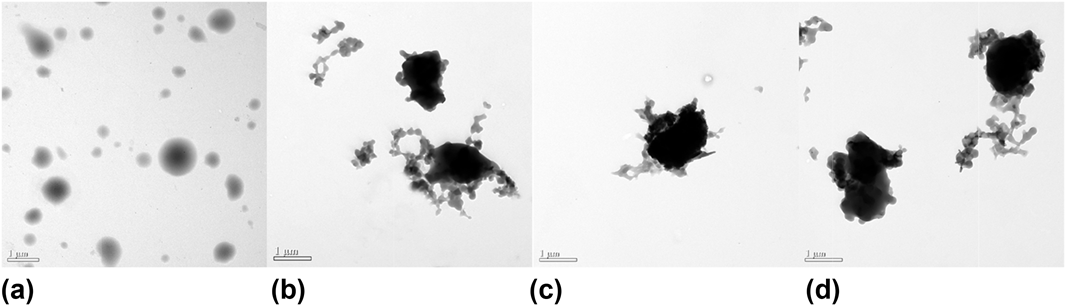
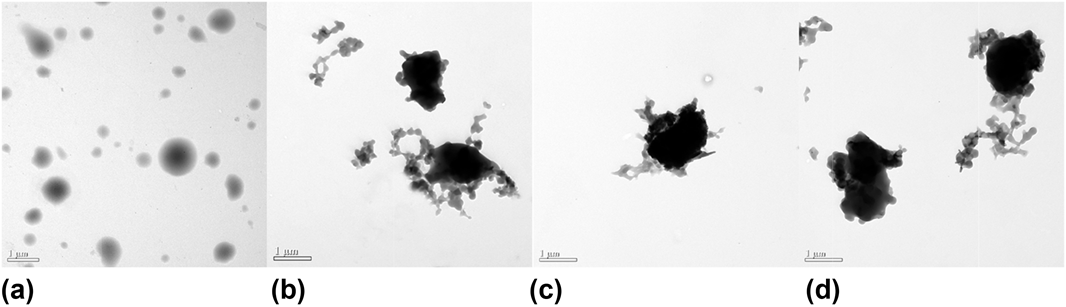
Figure 2(a) shows that the neat NR particle was almost round in shape with a diameter around 0.8 µm, whereas the PMMA-ad-NR particle exhibited the core–shell structure. The NR core parts showed as the dark inner phase and admicelled PMMA exhibited as the light outer layer or shell. With the presence of PMMA shell, the PMMA-ad-NR particles were slightly distorted morphology from typical spherical NR morphology but the PMMA layer was fully covered on NR particles. The size of PMMA-ad-NR particles as shown in Figs. 2(b)–2(d) was about 1.8 µm, larger than the size of neat NR particles. This was attributed to the admicelled PMMA shell formation on NR. These results were corresponding to our previous study. Reference Pongpilaipruet and Magaraphan12 The particle size of PMMA-ad-NR had changed little when compared with the increase in the monomer to initiator ratios or molecular weight of PMMA due to the monomer concentration was fixed in this study. A similar observation was found in the emulsifier-free emulsion polymerization of MMA when KPS concentrations were varied as suggested by Tanrisever et al. Reference Tanrisever, Okay and Sönmezoğlu26 Their results showed that the particle size did not change much with the initiator concentration and increased slightly with increasing monomer concentration.
Morphologies of (a) NR, PMMA-ad-NR, (b) M20000, (c) M30000, and (d) M40000.
B. Properties of PLA blends
1. FE-SEM morphology
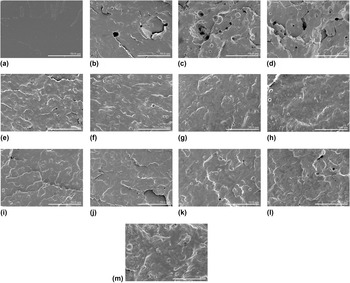
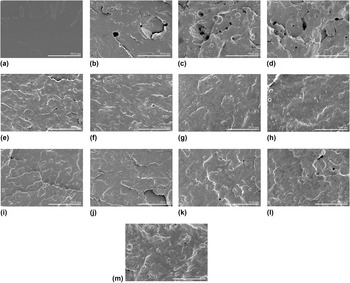
Figure 3 shows SEM micrographs of the freeze-fractured surfaces of extrudates of PLA, PLA/NR, and PLA/PMMA-ad-NR blends at 5, 10, and 15 wt%. PLA shows a brittle-fractured surface, as can be seen in Fig. 3(a), whereas the blends of PLA/NR show nonuniform distribution of large aggregate domains in Figs. 3(b)–3(d). The particle size of NR particles was in a range of 0.5–10 µm. High incompatibility induces coalescence of the NR dispersed phase since phase separation is preferred in the blend. Reference Chumeka, Tanrattanakul, Pilard and Pasetto28 The distinct particle interfaces between PLA matrix and NR particles demonstrated poor interfacial adhesion due to phase separation, as in the study of Zhan et al. Reference Zhang, Man, Pan, Wang, Jiang and Dan7 By contrast, a good interfacial adhesion was observed between PLA matrix and spherical-particle-dispersed PMMA-ad-NR particles in all PLA/PMMA-ad-NR blends. Moreover, PMMA-ad-NR particles showed smaller in size and better uniform distribution compared to PLA/NR blends. The average sizes of dispersed PMMA-ad-NR phases showed little change with increasing molecular weights. The average sizes of 5, 10, and 15 wt% PMMA-ad-NR domains were 2.0, 3.0, and 3.5 µm, respectively. The increase in rubber contents, dispersed phase, led to larger size of rubber particles. Reference Thongpin, Klatsuwan, Borkchaiyapoom and Thongkamwong29,Reference Bhatia, Gupta, Bhattacharya and Choi30 PLA/NR blends showed that the NR phases were larger aggregate than those of PMMA-ad-NR in all proportions. Theoretically, smaller and more uniform domain size and its distribution as well as a stable phase morphology indicate higher compatibility. Reference Pongtanayut, Thongpin and Santawitee31 This can be implied that the PMMA-ad-NR gave better compatibility in the PLA matrix than neat NR.
SEM micrographs of (a) PLA, (b) 5 wt% NR, (c) 10 wt% NR, (d) 15 wt% NR, (e) 5 wt% M20000, (f) 10 wt% M20000, (g) 15 wt% M20000, (h) 5 wt% M30000, (i) 10 wt% M30000, (j) 15 wt% M30000, (k) 5 wt% M40000, (l) 10 wt% M40000, and (m) 15 wt% M40000.
2. Thermal stability
Table SI shows the thermal stabilities of PLA and its blends. The T d onset of PLA was at a temperature of 331 °C and the maximum mass loss (T d at peak) was 364 °C. The thermal decomposition of PLA includes loss of ester group from the main chain and inter- or intra-molecular transesterification, forming oligomers or cyclic oligomers. Reference Li, Yuan, Yu, Yuan and Ren32,Reference Teoh, Mariatti and Chow33 The PLA thermal degradation was completed at 384 °C, leaving no residue at the end of the test. The thermal degradation of PLA/NR and PLA/PMMA-ad-NR blends ended at around 410 and 435 °C, respectively. Although the PLA/NR and PLA/PMMA-ad-NR blends exhibited lower T d onset and T 10 than PLA, all the blends displayed higher endpoint of T d than PLA. The increased thermal stability of PLA/NR blends was ascribed to the better thermal stability of NR compared with that of PLA, which agreed well with previous studies. Reference Juntuek, Ruksakulpiwat, Chumsamrong and Ruksakulpiwat11,Reference Ayutthaya and Poompradub34 In addition, the PLA/PMMA-ad-NR blends showed higher endpoint of T d more than PLA/NR blends in all proportions. This demonstrated that the existence of PMMA did not enhance thermal stability of PLA at low temperature; however, it had delayed the thermal degradation at high temperature. In other words, PMMA had increased the range of PLA thermal decomposition temperature. Reference Teoh, Mariatti and Chow33 The endpoint of T d of PLA/M20000 blends was lower than that of M30000 and M40000. These results implied that the longer molecular chain of admicelled PMMA resulted in the higher T d of PLA blends. The increase in thermal stability of PLA blends when utilizing PMMA-ad-NR indicated the higher interaction and better dispersion of rubber in the PLA matrix. An increase in thermal stability of PLA owing to the good interaction between the blend components was also found in other PLA blends. Ayutthaya et al. reported that the thermal stability of PLA was increased by the introduction of ENR and PMMA to the PLA matrix. Reference Ayutthaya and Poompradub34 Moreover, Juntuek et al. described that the thermal stability of PLA blends, using NR-g-GMA, was increased when the interaction and dispersion of the components were enhanced. Reference Juntuek, Ruksakulpiwat, Chumsamrong and Ruksakulpiwat11 This can be implied that the PMMA-ad-NR gave better compatibility in the PLA matrix and enhanced thermal decomposition of PLA blends than neat NR.
3. Thermal properties
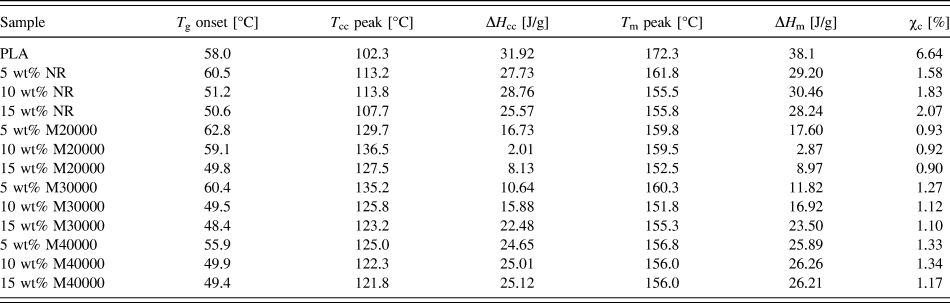
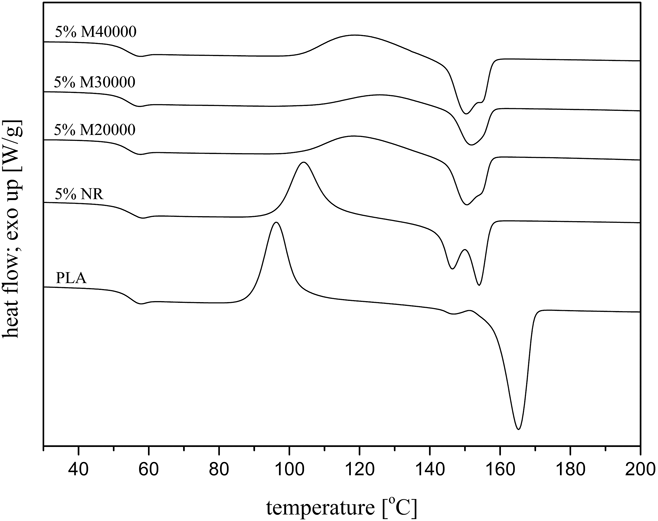
From second heating DSC results in Table II, The T g of PLA and the blends in both 5 wt% NR and 5 wt% PMMA-ad-NR in all molecular weights were found at the same temperature of 58 ± 2 °C except T g of 5 wt% M20000 which was observed at 62 °C and shifted to higher temperature than that of other PLA/rubber blends. Compared to all PLA/PMMA-ad-NR blends, the T g of PLA/M20000 was higher than that of PLA/M30000 and PLA/M40000. These shifts of T g to higher temperature (T g of PMMA at around 105 °C Reference Lin, Kuo, Huang and Chang35 ) suggested good compatibility between PLA and PMMA phases. Increasing rubber content made T g decrease in all blends owing to the addition of the rubber amorphous phase into the PLA crystal phase, Reference Zhang, Wang, Huang, Pan, Jiang, Dan, Luo and Peng36 leading to increasing the flexibility and mobility to PLA chains. Reference Ayutthaya and Poompradub34 The T g of PLA/NR blends changed insignificantly when the NR content was higher than 10 wt%, implying that the introduction of NR did not have obvious effect on the T g behavior of PLA. These results confirmed a characteristic of an immiscible blend of PLA/NR blends. The DSC studies of PLA/NR blends by Jaratrotkamjorn et al. Reference Jaratrotkamjorn, Khaokong and Tanrattanakul8 and Bitinis et al. Reference Bitinis, Verdejo, Cassagnau and Lopez-Manchado9 also found similar thermal behavior of the blends and little change in T g. On the other hand, the T g of PLA/PMMA-ad-NR blends in all molecular weights decreased with increasing PMMA-ad-NR contents. For an immiscible blend having partial compatibility, the T g value of each component phase ought to be influenced by each other, and they ought to be shifted toward one another. Such behavior is owing to some degree of molecular mix at the interface between the two polymeric phases. Reference Zhang, Zhang, Wang and Shen37 This implied that PMMA-ad-NR had partial compatibility with PLA which made T g of PLA blends decrease and its compatibility was better than that of PLA/NR blends.
Thermal properties of PLA and its blends.
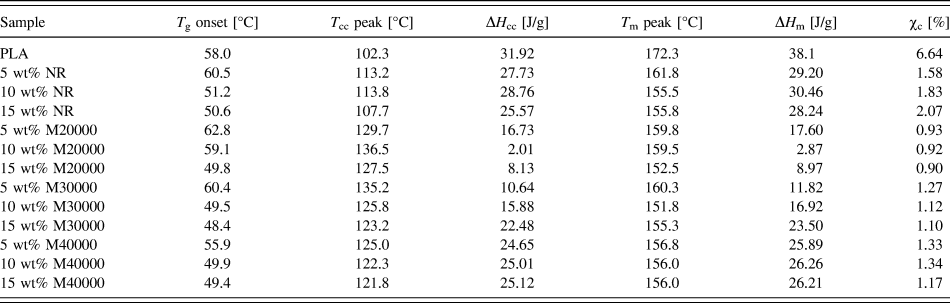
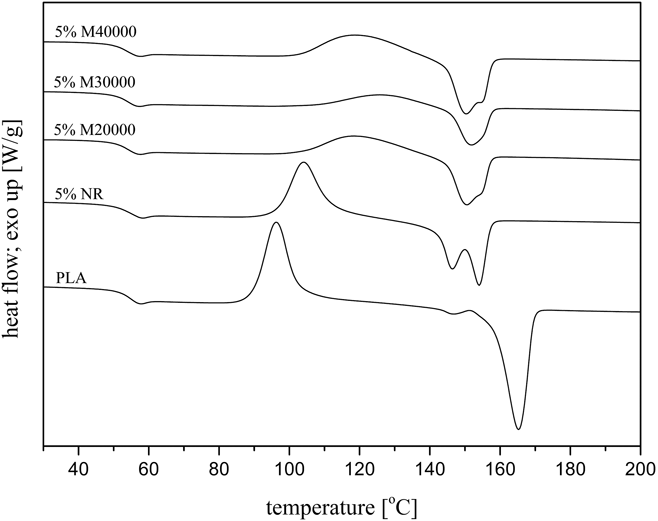
Figure 4 shows the second heating DSC thermograms of PLA and PLA blends with 5 wt% rubbers. No crystalline of PLA appeared on cooling but it recrystallized on heating. PLA exhibited only one melting peak at about 172 °C. The PLA/NR blends showed double melting peaks which were more obvious than those of PLA/PMMA-ad-NR blends. The higher melting peak of PLA/NR blends was observed at 155 °C and the lower melting peak was observed at 150 °C. The following two melting peaks arose from melting of different crystal forms: the pseudo-orthorhombic crystalline (α-form) melting at high temperature and the orthorhombic crystalline (β-form) melting at low temperature. Reference Yasuniwa, Tsubakihara, Iura, Ono, Dan and Takahashi4 The double melting peaks of PLA relate to the reorganized crystal after melting, and the crystalline generated at high cold crystallization temperature having a high tendency to rearrange into more ordered forms when melted at high temperature. Reference Fukushima, Tabuani and Camino38 The χc of PLA blends both with NR and with PMMA-ad-NR was lower than that of PLA. The χc decreased due to the increase in the amorphous phase of NR which hindered PLA crystals formation. Reference Zhang, Wang, Huang, Pan, Jiang, Dan, Luo and Peng36 The χc slightly increased with increasing NR phase which attributed to the nucleating effect of NR over PLA. Similar observations were found in PLA/NR blends Reference Bitinis, Verdejo, Cassagnau and Lopez-Manchado9 and in PLA/other thermoplastic blends. Reference Yokohara and Yamaguchi39
Thermal properties of PLA and its blends with 5 wt% rubbers.
In case of PLA/PMMA-ad-NR blends, MMA converted to PMMA at about 15%. PLA blend with 5, 10, and 15 wt% of PMMA-ad-NR in all molecular weights had PMMA of approximately 0.75, 1.50, and 2.25 wt%. This can imply that the percentage of PMMA increased with an increasing percentage of PMMA-ad-NR. The decrease of χc with the increase of PMMA-ad-NR content indicated that the crystalline kinetics of PLA was highly restricted by amorphous PMMA; this is a typical example of a miscible blend in the amorphous state with a T g higher than that of semicrystallization components. Reference Zhang, Zhang, Wang and Shen37 Particularly, the χc of PLA decreases with an increase of PMMA as shown in studies of Hao et al. Reference Hao, Kaschta, Liu, Pan and Schubert13 and Zhang et al. Reference Zhang, Zhang, Wang and Shen37 Compared to all PLA/PMMA-ad-NR blends, the χc of PLA/M20000 blends was lower than that of PLA/M30000 and PLA/M40000. This suggested the lower molecular weight of PMMA gave better compatibility between PLA and NR phases.
4. Mechanical properties
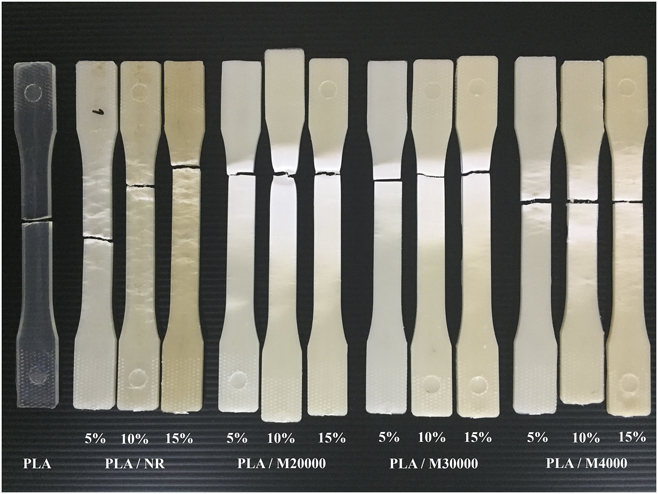
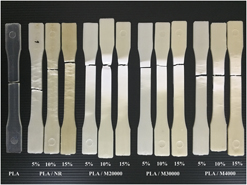
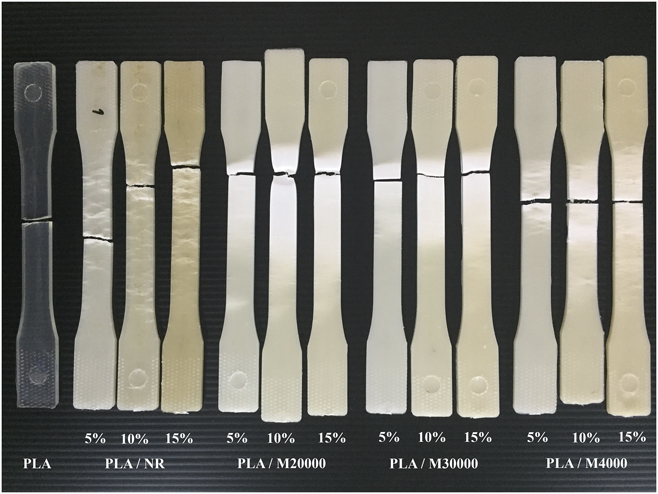
The appearance of the samples after tensile test is shown in Fig. 5. All the PLA blends exhibited the stress whitening when compared to neat PLA. After the yield point, the material undergoes the stress whitening in the necked zone, which reflects a fine-scale cavitation process. The integration of micromechanisms such as microcracks, microvoids, and stretched fibrils resulted in this occurrence. The degrees of stress whitening in the PLA/NR blends were less intensive than those of PLA/PMMA-ad-NR blends. All blends of PLA/PMMA-ad-NR demonstrated the greatest result in the PLA/10 wt% M20000 blend in which the behavior of high elongation with long stress whitening was exhibited.
Tensile specimens after testing of PLA and its blends.
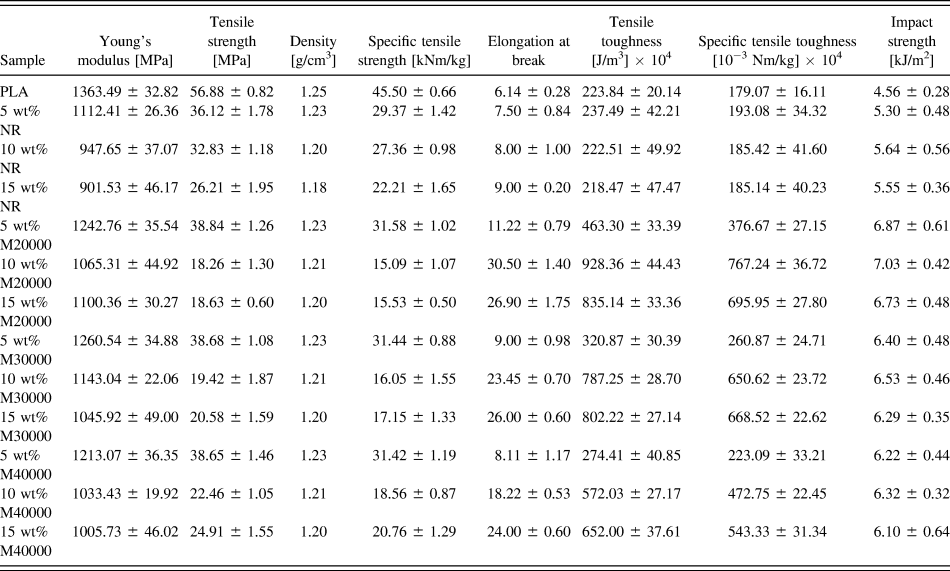
The tensile properties of PLA and its blends are demonstrated in Table III. PLA was brittle and rigid polymer with low elongation at the break of approximately 6%. Mechanical properties of the polymer blends are related to the compatibility of all components, the size of dispersed phase, and interfacial adhesion between the phases. All the blends displayed lower tensile strength at break and Young’s modulus but higher the elongation at break compared with PLA. Increasing the rubber contents decreased Young’s modulus and tensile strength at break of the PLA blends. Generally, the introduction of a soft segment of rubber into a hard segment of PLA results in deterioration in the strength and modulus of the blends but enhances the elasticity of the blends. Reference Jaratrotkamjorn, Khaokong and Tanrattanakul8 The modulus of the PLA/PMMA-ad-NR blends was higher than that of the PLA/NR blends due to the presence of rigid PMMA which acted as a stiffening agent. As compared with 5 wt% of PMMA-ad-NR and NR, the tensile results of the PLA/PMMA-ad-NR blends were better than those of the PLA/NR blends. This suggested the effect of good interfacial adhesion to achieve high modulus, tensile strength/specific tensile strength, and elongation at break. This good interfacial adhesion resulted in preserving high elongation at break and toughness as well as modulus which could not be obtained from the simple PLA/NR blends. Reference Ayutthaya and Poompradub34 Moreover, the effect of interfacial adhesion on mechanical properties was dominant in PLA/M20000 blends. As compared with the same rubber content of PLA/PMMA-ad-NR blends, lower molecular weight of PMMA gave higher modulus with higher elongation at break than those of higher molecular weight of PMMA. This implied that lower molecular weight of PMMA gave better compatibility in the PLA matrix.
Mechanical properties of PLA and PLA blends.
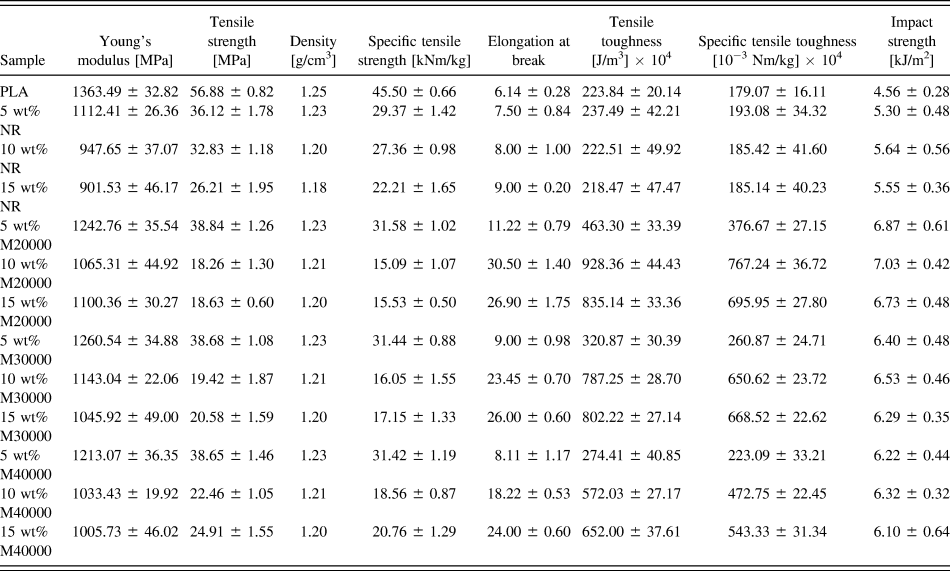
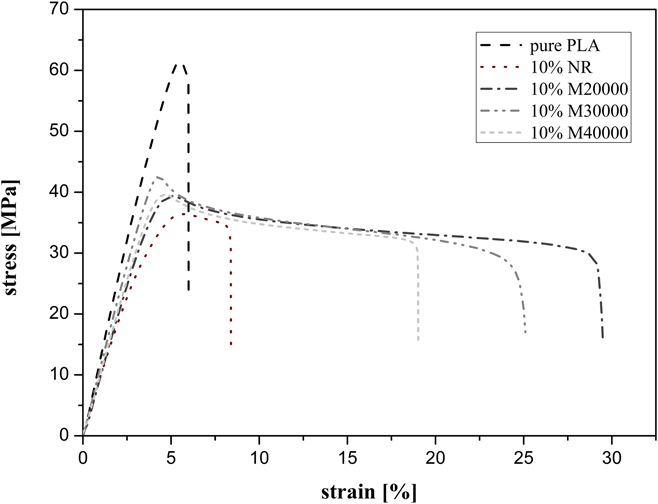
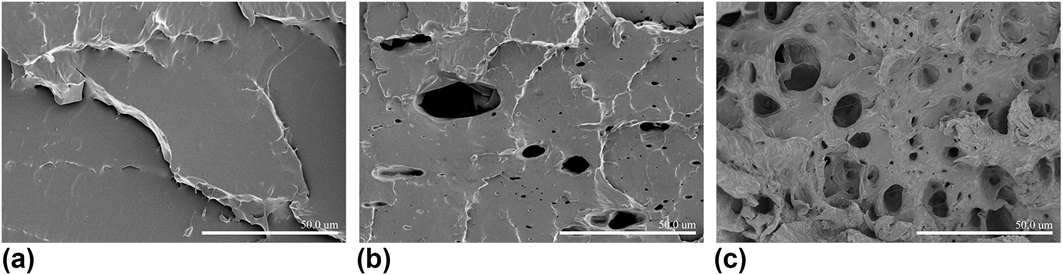
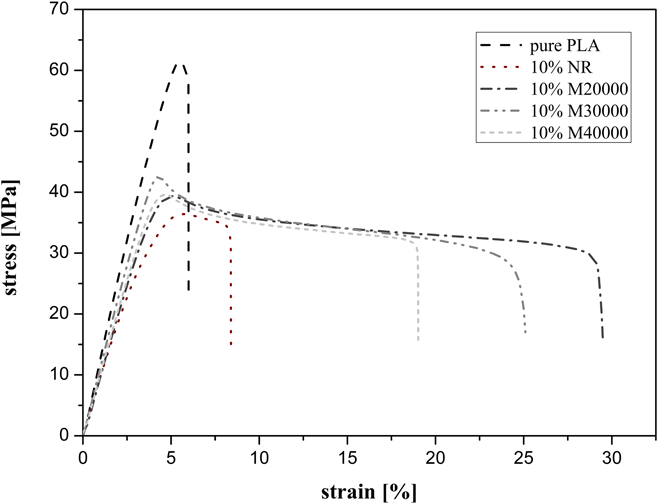
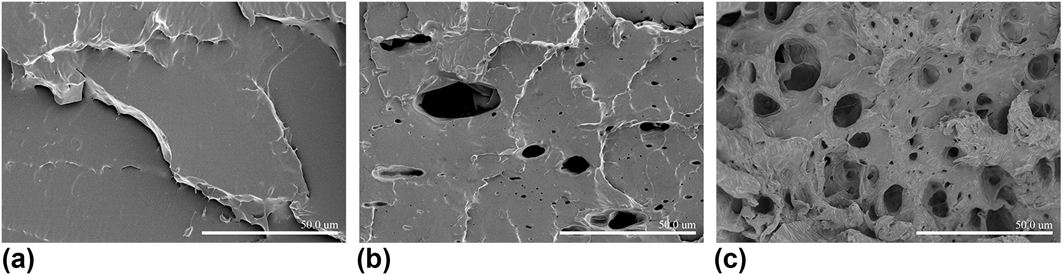
Figure 6 shows stress–strain curves of PLA and its blends and Fig. 7 shows the fracture surfaces after tensile test of PLA, PLA/10 wt% NR, and PLA/10 wt% M20000 blends. PLA showed behavior of brittle materials with the absence of any necking owing to less plastic deformation; therefore, the strain hardening was not observed. The PLA fractured surface also showed the smooth surface of brittle fracture resulting from the formation of crazes which was consistent with low elongation at break. The yield stress of PLA blends decreased with the introduction of NR and PMMA-ad-NR part. These results indicated that the NR and PMMA-ad-NR acted as a stress concentrator, and crazing was not the major deformation process of PLA/rubber blends compared with that of PLA. There are two other traditionally proposed deformation mechanisms for PLA/elastomer blends, cavitation, and debonding, depending on the adhesion and phase morphology. Reference Bitinis, Sanz, Nogales, Verdejo, Lopez-Manchado and Ezquerra40 Due to the poor interfacial adhesion between PLA and NR, debonding prevailed as the principal deformation mechanism occurring at the particle–matrix interface as observed in Fig. 7(b). For PLA/PMMA-ad-NR blends upon the yield point, a typical neck begins to form and then extends in a cold drawing process driven by the local heating of the sample because of energy released during deformation. Reference Bitinis, Verdejo, Cassagnau and Lopez-Manchado9 The introduction of PMMA-ad-NR into the PLA matrix changed the PLA properties from brittle to ductile failure, and the fractured surface also changed to be the rough surface. Owing to the good compatibility of PLA and PMMA-ad-NR, the internal cavitation of PMMA-ad-NR particles had a major role in the toughening effect which brought about release of triaxial stresses surrounding cavitated particles. Then the energy was dissipated resulting in more shear yielding. The PLA/10 wt% M20000 blend showed maximum elongation at break (31%) and tensile toughness (928 × 104 J/m3). The increases in elongation at break and tensile toughness/specific tensile toughness were achieved to four times comparing to PLA. In comparison to studying the blend of Jaratrotkamjorn et al., Reference Jaratrotkamjorn, Khaokong and Tanrattanakul8 the PLA/10 wt% PMMA-ad-NR blends showed the tensile strength and modulus similar to their PLA/ENR25, PLA/ENR50, PLA/5% grafted PMMA (G5), and PLA/35% grafted PMMA (G35) blends at the same 10 wt% rubber component. The elongation at break of their blends was in a range of 2.3–4.6%, Reference Jaratrotkamjorn, Khaokong and Tanrattanakul8 whereas the elongation at break of PLA/10 wt% M20000, M30000, and M40000 blends in this study was 30.5%, 23.5%, and 18.2%, respectively, which were more than 4-fold. These results informed that the admicelled PMMA gave good compatibility which contributed to not only high modulus but also high elongation at break. Longer molecular chain resulted in higher tensile strength/specific tensile strength not elongation. PLA/PMMA-ad-NR blends especially with M20000 in all proportions showed highest elongation at break and tensile toughness/specific tensile toughness. This also confirmed strong compatibility between low molecular weight of PMMA in PMMA-ad-NR and PLA matrix.
Stress–strain curves of PLA and PLA blends 10 wt% rubbers.
SEM micrographs of the fractured surface after tensile testing (a) PLA, (b) PLA/10 wt% NR, and (c) PLA/10 wt% M20000.
The impact strength values of PLA and its blends are also presented in Table III. The impact strength of PLA was 4.6 kJ/m2. The impact strengths of PLA/NR and PLA/PMMA-ad-NR blends were higher than that of PLA. Generally, the spherical particles of the rubber phase act as stress-concentrators which are responsible for the improved fracture energy absorption. Reference Zhang, Man, Pan, Wang, Jiang and Dan7 Moreover, the PLA/PMMA-ad-NR blends showed higher impact strength values than PLA/NR blends in all proportions. The effective interfacial adhesion and distribution of the fine PMMA-ad-NR particles contributed to improve the PLA impact strength, despite the thin PMMA layer content was around 14 wt%. A similar observation was found in the PLA/poly(butyl acrylate)-grafted NR (NR-g-PBA) blend, as described by Zhang et al. Reference Zhang, Man, Pan, Wang, Jiang and Dan7 They found that the impact strength increased from below 6.0 to 6.5 kJ/m2 when NR-g-PBA contents in the PLA matrix increased from 10 to 20 wt%. Nevertheless PMMA is more rigid than PBA, it was surprised that the impact strength of all PLA/PMMA-ad-NR blends was higher than 6.0 kJ/m2. In addition, the impact strength of the blends could reach up to 7.0 kJ/m2 with addition of only 10 wt% M20000, which was about 17% higher than the results of Zhang et al. Reference Zhang, Man, Pan, Wang, Jiang and Dan7 These results also implied that the admicelled PMMA provided good compatibility between PLA and rubber phases which was attributed to high impact strength. When molecular weight of admicelled PMMA decreased, the impact strength increased. These results confirmed that good compatibility between PMMA-ad-NR and PLA took place at lower molecular weight of admicelled PMMA and led to higher mechanical properties of PLA blends.
As a result, the impact strengths of PLA/rubber blends increased with increasing NR and PMMA-ad-NR contents up to the maximum in the PLA/10 wt% rubber blends. At low PMMA-ad-NR content, the PMMA-ad-NR particles were small while their bulk modulus was rather high and required high energy to cavitate rubber particles. At high PMMA-ad-NR contents, the rubber particles became larger and easier to cavitate. The size of PMMA-ad-NR particles increased up to 3.5 µm in PLA/15 wt% PMMA-ad-NR blends which was responsible for local stress concentration in more extensive area than other PLA/PMMA-ad-NR blends. Consequently, this led to fast fracture progress, and then the impact strength became lower than that of the PLA/10 wt% PMMA-ad-NR blend. It was corresponding to the study of Chumeka et al., Reference Chumeka, Tanrattanakul, Pilard and Pasetto28 which indicated that the coalescence of rubber particles which formulated relatively larger sized particles in PLA/NR blends contributed to lower tensile properties and impact strength. When a rubber diameter was larger than 2.1 µm, it resulted in low mechanical properties. Reference Chumeka, Tanrattanakul, Pilard and Pasetto28 The mechanical properties such as yield stress and modulus of the blends have been less intense due to the increase of rubber content. When the blends possessed a low yield stress and low modulus, the stress lost the capacity to be transferred far from the crack. This demonstrated the tangible correspondence to the crack propagation without a large deformation of the matrix. In contrast to this study, the particle size had reached 3.0 µm in PLA/10 wt% PMMA-ad-NR blends but it still showed better mechanical properties than that of 2.0 µm in PLA/5 wt% PMMA-ad-NR blends. This expressed that it was not only the compatibilization but also the appropriate rubber particle diameter that controlled the impact resistance of the PLA/PMMA-ad-NR blends.
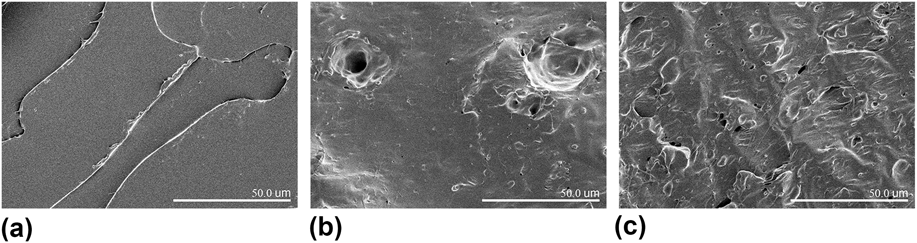
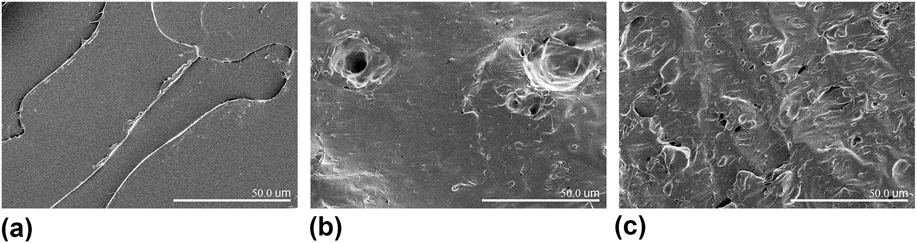
Figure 8 shows the fractured surface after impact test of PLA, PLA/10 wt% NR, and PLA/10 wt% M20000. The fractured surface of PLA was smooth. The deformation mechanism of unmodified PLA is known to be crazing. The PLA/NR fractured surface was rougher than that of PLA. The failure mechanism of PLA/10 wt% NR blend was altered to debonding of the large NR domains with some introduced yielding but none of fibrillation; in other words, crack propagating without large deformation of the PLA matrix. Reference Trapper and Volokh41 The introduction of PMMA-ad-NR allowed rubber cavitation with intensive matrix yielding to form fibrils. Therefore, the fibrillation absorbed fracture energy and obstructed the crack propagation. Then, the deformation process resulting in extensive energy dissipation was the most striking in the PLA/10 wt% M20000 blend, where the maximum impact strength was accomplished. The interfacial adhesion was normally more potent than the matrix yield stress when cavitation of M20000 was introduced. The released triaxial stress led to the induced shear yielding of the matrix. Reference Zhao, Ding, Yang, Ning and Fu42 The fibrillation took place around the rubber particles derived the large deformation related with high energy absorption.
SEM micrographs of the fractured surface after impact testing (a) PLA, (b) PLA/10 wt% NR, and (c) PLA/10 wt% M20000.
Flexural properties of PLA and its blends are shown in Table SII. The PLA sample was broken entirely while other samples were not broken completely under the same test condition. This suggested that the brittle PLA became more ductile with the addition of NR and PMMA-ad-NR. As from the study of Jaratrotkamjorn et al., Reference Jaratrotkamjorn, Khaokong and Tanrattanakul8 the PLA blends with ENR25, ENR50, G5, and G35 were broken. In contrast to the results reported in this work, the PLA/NR and PLA/PMMA-ad-NR in all molecular weight values were not broken. Since the addition of NR and PMMA-ad-NR increased the flexibility of PLA. The completely unbroken behavior suggested good interfacial adhesion between PLA and either NR or PMMA-ad-NR. The flexural modulus, the flexural strength at 5% strain, and flexural strength at yield of PLA were higher than those of the PLA/NR blends and the PLA/PMMA-ad-NR blends in all proportions. Although PLA/NR blends showed unbroken behavior in flexural test, PLA/PMMA-ad-NR blends had better compatibility and better mechanical properties than PLA/NR blends. The impact strength increased from 4.6 to 5.6 kJ/m2 when adding 10 wt% NR to PLA matrix while it reached to 7.0 kJ/m2 with the addition of 10 wt% M20000. In other words, the impact strength of PLA changed from 24 to 54% increase when changed from 10 wt% NR to 10 wt% M20000. These results also confirmed that better compatibility between PLA and PMMA-ad-NR took place especially with lower molecular weight of admicelled PMMA, compared to the PLA/NR blend which led to higher mechanical properties of PLA blends.
IV. CONCLUSION
Admicellear polymerization of PMMA on NR particles was carried out successfully as evidenced by FTIR and TEM results. The FTIR confirmed the carbonyl stretching of PMMA at 1730 cm−1. TEM images revealed clearly PMMA-ad-NR core–shell particles (having PMMA shell and NR core) suggesting the successful surface-modification of NR. UV absorption was used to determine the conversion of MMA under admicellar polymerization with various monomer to initiator ratios. It was found that all conditions gave comparable conversion about 86–89% and yield content of 94–95%. The GPC results revealed that the PMMA molecular weight increased with monomer to initiator ratio; i.e., 21,000, 30,000, and 41,000 g/mole for 25:1, 50:1, and 100:1, respectively. The morphology from FE-SEM micrographs exhibited uniform distribution of PMMA-ad-NR domains in the PLA matrix with good interfacial adhesion. By increasing rubber contents in the PLA blends, the morphology still showed the smooth interfacial adhesion between PLA and PMMA-ad-NR resulting in good distribution of the PMMA-ad-NR particles (of larger size). Moreover, the increase in thermal stability of PLA/PMMA-ad-NR blends indicated the higher interaction and better dispersion of rubber in the PLA matrix than that of simple PLA/NR blends. This clearly demonstrated that the admicellar polymerization is an efficient method to ultimately enhance interfacial adhesion between hydrophobic NR particles (in PMMA-ad-NR) and polar polymer matrix (PLA) at any compositions. The tensile and impact results showed that it was not only the compatibilization but also the appropriate rubber particle diameter that controlled the mechanical properties of the PLA/PMMA-ad-NR blends. The highest impact strength (7.0 kJ/m2) and elongation at break (30%) were obtained in the PLA/10 wt% M20000 blend. This suggests that the lower molar ratio of monomer to initiator produced the lower PMMA molecular weight in PMMA-ad-NR giving the better compatibility with the PLA matrix and better mechanical properties (especially specific tensile toughness).
Supplementary Material
To view supplementary material for this article, please visit https://doi.org/10.1557/jmr.2018.34.
ACKNOWLEDGMENTS
The authors would like to gratefully thank the Thailand Research Fund scholarship through the Royal Golden Jubilee Ph.D. Program (PHD/0243/2552), the Center of Excellence on Petrochemical and Materials Technology, and Special task force for activating research (STAR, GSTAR 58-003-23-002).