




No CrossRef data available.
Article contents
- Abstract
- WHAT WAS THE CHARITY ORGANIZATION MOVEMENT?
- THE INDIANAPOLIS EXPERIMENT
- FRIENDLY VISITING WOULD MEND THE “BROKEN”
- THE ECONOMETRIC EVIDENCE IS NOT ENCOURAGING: HAZARD REGRESSIONS
- Evidence from Simple Hazards
- Evidence at Exit on Earnings, Marriage, and Inebriation
- Exits for “Other” Reasons
- Weibull Regressions
- Robustness
- THE TEXTUAL EVIDENCE IS NOT ENCOURAGING: CASEWORKER NARRATIVES AND THE DIARY OF A FRIENDLY VISITOR
- References
Self-Reliance Before the Welfare State: Evidence from the Charity Organization Movement in the United States
Published online by Cambridge University Press: 10 June 2004
Article contents
- Abstract
- WHAT WAS THE CHARITY ORGANIZATION MOVEMENT?
- THE INDIANAPOLIS EXPERIMENT
- FRIENDLY VISITING WOULD MEND THE “BROKEN”
- THE ECONOMETRIC EVIDENCE IS NOT ENCOURAGING: HAZARD REGRESSIONS
- Evidence from Simple Hazards
- Evidence at Exit on Earnings, Marriage, and Inebriation
- Exits for “Other” Reasons
- Weibull Regressions
- Robustness
- THE TEXTUAL EVIDENCE IS NOT ENCOURAGING: CASEWORKER NARRATIVES AND THE DIARY OF A FRIENDLY VISITOR
- References
Abstract
If replacing welfare with private charity has increased the self-reliance of the poor, the benefits would be observed in the charity organization movement of the late nineteenth century. Inebriation would subside, the heart would be cheered, earnings would rise, the “broken” would be “complete,” dependence would wither, and the classes would converge. If the benefits were large, they would have been large in Indianapolis—the beacon of charity in a Coasean landscape. The hypotheses are tested in hazard models using a sample from 25 years of household-level caseworker manuscripts. The evidence is not suggestive in the direction of hope.
Information
- Type
- ARTICLES
- Information
- Copyright
- © 2004 The Economic History Association
If charity could hurry the self-reliance of America's able-bodied “worthy” poor it would likely have happened in Indianapolis at the height of the charity organization movement.
Mary MacKinnon examined a movement in Britain to shrink the systems of “public outdoor relief”—the tax-financed benefits in cash and in-kind that had been assisting the poor since the first Elizabeth. MacKinnon asked in particular if poor law unions, under the influence of charity organization societies, stood to gain in the 1860s by endorsing the substitution of outdoor relief with an expanded workhouse system. Likewise, in a book-length study, Robert Humphreys emphasized the finance and administration of organized charity rather more than the relief and labor-market experiences of the poor who took it. Still, Humphreys argued from aggregated, municipal-level evidence that organized charity “failed miserably” in its main concern: to build the self-reliance of the poor.1
MacKinnon, “English Poor Law”; and Humphreys, Sin, p. 13.
The Webbs lamented their ignorance of the length of time the poor spent on relief in history. In Volume 2 of English Poor Law History they regret that “no one has traced the life-histories of recipients of Outdoor Relief” and that “we [lack] any detailed studies of pauper pedigrees” (English Local Government, pp. 1051–52). Ironically, the charity the Webbs would famously oppose in the Minority Report of the Poor Law Commission had been the supplier of the very life-histories they desired.
WHAT WAS THE CHARITY ORGANIZATION MOVEMENT?
The charity organization movement began auspiciously in 1869 when the Society for Organizing Charitable Relief and Repressing Mendicity was established in London.3
Watson, Charity Organization, p. 53; Mowat, Charity Organisation; Katz, Shadow, chap. 3; Himmelfarb, Poverty, pp. 185–86; Humphreys, Sin, p. 1, chap. 4; and Jones, Outcast.
Hill, Homes.
Ruskin, Stones, pp. 166–67, 228–29; Hill, Letters, pp. 114–32, 256–62; Watson, p. 57; Humphreys, p. 60; and McCloskey, Rhetoric, p. 98. This is not to say that the range was Chekhovian. It is true, as historians have alleged, that the COS employed as weapons an unfortunate army of metaphors and metonymies. See, for example, McCulloch, “Tribe of Ishmael.” But historians have confused what is essentially a rhetoric of pamphleteering against “unworthy” poor and their patrons with the COS's literal treatment of the poor—whom, worthy or unworthy, it seems plausible to say, did not themselves read COS documents. Case records get closer to the literal treatments and ideals.
Robert Gross suggests but in no sense secures the idea that “charity” and “philanthropy” in history have been differently motivated and practiced. Gross, “Giving,” pp. 30–31, and throughout.
Watson, pp. 145–46; Lowell, Public, pp. 91–92; Himmelfarb, Poverty, p. 7; Humphreys, Sin, p. 1; Ziliak, “End of Welfare”; and McCloskey, “Bourgeois,” p. 301
Leading figures were attracted to London's COS—including Cardinal Newman, William Gladstone, Beatrice Webb, Henry Sidgwick, William Beveridge, and Helen and Bernard Bosanquet. With prestige, word spread quickly and the COS gained adherents in France, Germany, and Russia. But the United States—specifically, the cities of the Middle Atlantic and Middle West—were most receptive of all. S. H. Gurteen was studying at Cambridge University when he eagerly joined the movement in London. Gurteen (a minister in the Anglican Church) would later move to Buffalo, New York, where he started in 1877 the nation's first COS. His example attracted instant imitators. By 1893 there was a COS in some one hundred cities of the nation.8
Report of the Committee on [the] History of Charity Organization, “Charities Organization,” pp. 52–93 and appendix A and B, in Proceedings, National Conference on Charities and Correction; Gurteen, “What is?”; Watson, Charity Organization Movement, pp. 179–86; Katz, In the Shadow, pp. 72–80; and Boyer, Urban Masses, p. 146.
The “objects” of the COS were multiple and seem to have varied little from city to city. Indianapolis, like many other cities, simply borrowed the Constitution that Gurteen had crafted for Buffalo.9
Minutes of the Indianapolis Charity Organization Society [hereafter COS Minutes], BV1700, December 1879.
COS Minutes, December 1879, p. 6.
Annual Report of the Indianapolis Charity Organization Society [hereafter Annual Report], 1884/85, Boxes 1, 4, and 5
Ziliak and Hannon, “Public Assistance.”
Private charity, however, when distributed “scientifically” and with “the personal touch,” was something else. Much has been written about a cruelty the COS would lavish upon the “undeserving” poor.13
See, for example, Addams, Democracy, pp. 1–70; Katz, In the Shadow, chap. 3; Mink, “Lady,” pp. 92–114; Nelson, “Origin,” pp. 137–45; and Montgomery, Citizen Worker, pp. 2–6, 21–22, 65–104
The seminal statement in America is in Gurteen, “What is Charity?,” Family Service Association Collection M102 [hereafter FSA M102]. A British saying is “C.O.S.”—“Cringe or Starve” (the saying has been attributed to Dickens).
Lowell, Public Relief, pp. 4–5; and Katz, In the Shadow, p. 70.
Lowell, Public Relief, pp. 4–5.
COS Minutes, December 1879, p. 4, and 2 February 1880, p. 109.
THE INDIANAPOLIS EXPERIMENT
If the replacement was beneficial to the poor then the effects would be observed in Indianapolis between 1878, when Oscar McCulloch re-organized the 50 year-old Benevolent Society on COS principles and commenced to control public outdoor relief, and the mid-1890s, when the local governmental response to the Depression was public spending for public works.18
Almy, “Relation”; Dunn, Greater Indianapolis, pp. 342–59; Devine, “Public Outdoor”; Watson, Charity Organization Movement, p. 203; Kershner, “Country Town”; Weeks, Oscar Carleton McCulloch, pp. 187–215; and Katz, In the Shadow, p. 82.
Almy, “Relation”; Devine, “Public Outdoor Relief,” pp. 186–99; Mohl, “Abolition,” pp. 35–50.
Johnson, “Oscar C. McCulloch”; Annual Report, 1884/85; Warner, American Charities; Devine, Principles; Watson, Charity Organization Movement, pp. 202–03; Katz, In the Shadow, p. 82; and Ziliak, “End of Welfare.”
The Reverend Oscar C. McCulloch established the Indianapolis Charity Organization Society in December 1879.21
COS Minutes, pp. 1–4; and Weeks, Oscar Carleton McCulloch, 81–114.
Taylor et al., eds. Indiana, p. 384; U.S. Bureau of the Census, Tenth U.S. Census of Population, table 26, p. 454; Weeks, Oscar Carleton McCulloch, chap. 5.
Dunn, Greater Indianapolis, pp. 342–59; Kershner, “From Country Town,” pp. 327–38; Phillips, Indiana; and U.S. Bureau of the Census, Tenth Census of Manufactures, table 6, pp. 405–06.
U.S. Bureau of the Census, Eleventh U.S. Census of Population, V. 15, table 23; and Kershner, “From Country Town,” pp. 336–37.
Smith King was the Center Township Trustee, the overseer of the city's relief policy. The trustee was by popular election the administrator of public outdoor relief. Although the local tax on property for the relief of the poor was fixed by the Board of County Commissioners, in practice the trustee determined how much to spend and for whom. 25
Shaffer, Keefer, and Breckenridge, Indiana Poor Law, pp. 33-57.
COS Minutes 1879, pp. 12–13; Weeks, Oscar Carleton McCulloch, pp. 165–218.
McCulloch took King everywhere the COS went, or tried to. At fund-raisers King was thanked early and often for his “cooperation” with the COS. McCulloch apparently introduced King to Gurteen (whom McCulloch had invited to Indianapolis) so that Gurteen could speak about his COS in Buffalo. The philanthropic meetings were not the “coffee and sponge cake” variety, mocked by Veblen. Instead, King and McCulloch spoke earnestly about paupers and the charities with reform-minded business leaders such as Eli Lilly and future President Benjamin Harrison, whom McCulloch had also recruited. After one large gathering Lilly and Harrison agreed to “subscribe” to the COS, pledging monetary donations. Harrison went further. Inspired by McCulloch, Harrison donated space in the offices of his law firm to create a COS headquarters; and years later he stepped into McCulloch's role as executive director. Like the text of a Coasean play about a lighthouse, or a user's manual on the logic of collective action, Oscar McCulloch replaced public outdoor relief with the Charity Organization Society.
The city did not abolish public outdoor relief but it bequeathed much power to McCulloch's organization. The trustee gave McCulloch the histories of 6,000 families receiving public relief in Indianapolis.27
The trustee's books are lost. Some data were transcribed by McCulloch and his caseworkers into caseworker record books but not sufficient to build individual or family-level case histories prior to 1879.
COS Minutes 1879, p. 63.
Weeks, Oscar Carleton McCulloch, pp. 177–80.
Annual Reports, boxes 1, 4, and 5.
Indianapolis Charity Organization Society Yearbook of Charities [hereafter Yearbook] 1886, Box 5, Folder 3.

REAL EXPENDITURES IN INDIANAPOLIS ON OUTDOOR RELIEF: PUBLIC AND PRIVATE “SCIENTIFIC”

At the same time, McCulloch rebuilt the Indianapolis Benevolent Society (IBS). The IBS was the city's oldest benevolent society but it had fallen on hard times in the late 1870s; when McCulloch moved from Sheboygan to Indianapolis in 1877 the IBS was, in fact, penniless. Organizers everywhere believed that material relief could be wise and that private charity given “scientifically” was—outside the family—preferred. In 1880 McCulloch merged the IBS with the COS.32
Indianapolis Benevolent Society Minutes [hereafter IBS Minutes], BV1178, December 1879.
As the COS took shape a dozen other charities—such as the Alpha Home for Aged Colored Women—had emerged, and a dozen more charities were already functioning. In the expanding “Circle of Charities” the COS exercised its influence in varying degrees. The data here represent organized, scientific charity only; the size and scope of charitable activity was of course larger and so, therefore, the degree of institutional replacement. Compare Steinberg, “Does Government Spending”; Ziliak, “End of Welfare”; and Ziliak and Hannon, “Public Assistance.”
Figure 1 suggests that by the mid-1880s total expenditures on public outdoor relief were again larger than expenditures on scientific charity. Anecdotal evidence suggests that scientific charity surpassed public relief after the Depression of the 1890s. This see-saw of private and public need not cloud observations on the main hypothesis. The objective is to discover whether charity organization, in its purest expression, had increased the self-reliance of the able-bodied worthy poor.
FRIENDLY VISITING WOULD MEND THE “BROKEN”
Monetary gifts were necessary but not sufficient. “The greatest benefit to the poor is gained by friendly intercourse and personal influence,” wrote one organizer in Indianapolis. “Sympathy, encouragement[,] and hopefulness are their more important wants. The Society aims to supply these, [and] the friendly visitor is the agent.”34
Yearbook, 1893/94, p. 10.
McCulloch, “On the Spirit.”
The COS did not theorize the origin of human character.36
Social scientists have had little to say about the origins of character. John Stuart Mill, few historians have noticed, struggled throughout his life to theorize the relationship between character structure and economic organization. Carlisle, John Stuart Mill. Mill's failure to develop an economic theory of character continues to pose a serious challenge to contemporary economic theory.
Lowell, Public Relief, pp. 91–92.
Richmond was quoting from George Eliot's Daniel Deronda.
Richmond, Friendly Visiting, p. 34
Ibid., p. 34.
Noble, Handbook, pp. 6–7.
Ibid., pp. 6–7.
Every COS practiced friendly visiting. In Indianapolis a Society of Friendly Visitors was organized in 1879.43
Minutes of the Indianapolis Society for Friendly Visitors [hereafter SFV Minutes] 1882, p. 1.
The project seemed coherent. It integrated price theory with the street-smarts of urban reformers and the social possibilities of private charity. Case work would reveal the cause of destitution. And visitors would mend the bent and the broken. In the absence of a dole, organized charity promised that the able-bodied worthy poor would have a better chance to become self-reliant.
THE ECONOMETRIC EVIDENCE IS NOT ENCOURAGING: HAZARD REGRESSIONS
To make their metaphor econometric, organized charity invites the study of hazard regressions, an econometric analysis of the probability of exit. Compared to other welfare schemes, a higher percentage of exits from COS rolls should occur because earnings rose, because inebriation subsided, and because sympathy and the personal touch put the “broken” back together again. Hazard functions estimated with COS data should exhibit higher rates of exit at each moment of survival. And a truly successful relief program would be revealed in a hazard function that rises in probability of exit as time spent with the COS accumulated. The hypotheses can be tested with an econometric analysis of household-level duration data.44
Kiefer, “Economic Duration Data”; and Lancaster, Econometric Analysis.
The Duration Data
Using a method similar to that of Rebecca Blank in her study of the Aid to Families with Dependent Children program, I drew a sample from the flow of new entrants to relief rolls from the hand-written caseworker manuscripts of the Indianapolis Charity Organization Society, January 1881–February 1883.45
Blank, “Analyzing the Length,” pp. 245–73.
Worthiness was determined by the COS not in a mechanical way but with methodical steps. A case began typically when a caseworker visited the home of a family that had come to the attention of the Society. She would look around the place, taking note of dress, cleanliness, literacy, room size, race, ethnicity, and furnishing. She would ask about the make-up of the family, and inquire into the moral, economic, medical, and criminal history of each member of the family. (Until the turn of the century “inebriation” was high on the list of probable causes for pauperism.46
Compared to Chicago, New York, and Boston, Indianapolis was much less concerned with immigration and citizenship. In Indianapolis a large share of worthy recipients were Irish or English or German born, both Protestant and Catholic, and the pattern seems little different in the trustee's accounts. Pauperism, the condition of receiving public outdoor or indoor relief, disenfranchised the pauper in at least 13 states: see Ziliak, “Pauper Fiction,” p. 170.
In Indianapolis three districts triangulated the city North, West, and East about the vertices of Meridian and Washington Streets. At the district office the caseworker checked the family's story against existing COS records to ascertain the truth of their account and of the change of circumstance. If the family were new to the COS she would check their story against any facts contained in the “Social Service Exchange.” The exchange was an information clearinghouse, a kind of credit bureau, created by the bequest of the trustee's records to McCulloch. It linked (allegedly) most penal and relief institutions of the city.47
Watson, Charity Organization Movement, pp. 125–28, 409–10.
COS Minutes, pp. 6–13, 79, 100.
Ziliak, “Pauper Fiction”; and Hannon, “Poor Relief.”
Each household in the sample was followed through the end of a spell or until it was censored. A “censored” observation occurs when one cannot discern whether the observed exit was truly an exit. The length of spells is measured in months. If the case appeared at least once in the month then the case was recorded as having received relief for the month. For example, new entrants on 30 March 1881 that were on 8 April 1881 denied aid are said to have a spell equal to one month. Gaps between active months were treated as active if the interviews did not indicate a change in worthiness. The collection rule is more conservative than one finds in contemporary data sets. The March-to-April example would be coded as “two months” or even “one year.”50
Blank, “Analyzing the Length,” pp. 255–57; and Bane and Ellwood, Welfare Realities, p. 168.
See Bane and Ellwood, Welfare Realities.
The sample contains 220 observations in total, including 60 censored observations. Half the spells were completed in four months. About two-thirds of all spells lasted less than a year. The average duration of a completed spell was 9.4 months and the average duration of all spells was 12 months.52
An earlier study put the average duration of a completed spell at about eight months. The figure came from a sample which was smaller by more than half and in which the spells of relief were concentrated in the winter months. Ziliak, “End of Welfare,” p. 63.
Evidence from Simple Hazards
Table 2 reports the unconditional distribution of spells on outdoor relief for all households and by gender. The hazard rates—the probabilities of exit from the rolls—are of particular interest. The probability of exit was about 19 percent for households receiving relief for up to two months. The probability of exit fell to 10 percent for households receiving relief between two and six months, and then dropped sharply to 3.5 percent between the sixth and twelfth month, flattening out to very low rates as time on the rolls increased. The pattern is similar by gender (see Table 2).

Duration data do not exist for the systems of relief immediately preceding the COS. Difference-in-difference estimates are desirable. But unconditional hazard rates for female headed households can be compared with evidence from another “indiscriminate” program: single mothers receiving AFDC in Seattle and Denver, 1971–1976 (the so-called SIME/DIME experiment).53
Seattle-Denver Income Maintenance Experiment.
Blank, “Analyzing the Length,” p. 256, table 1.
Fitzgerald, “Welfare Durations,” p. 550.
Evidence at Exit on Earnings, Marriage, and Inebriation
What is the evidence when personal and household characteristics are controlled for? Table 3 reports selected characteristics of households at entry and exit (replicating as much as possible Blank's 1989 work). Twenty-nine percent of all households had a head of household (usually the father) with earnings at the beginning of a spell. Spouses and children brought earnings to the beginning of a spell in 37 percent of all households. Illness burdened 56 percent of all heads of households and 19 percent of all spouses. The main breadwinner in 14 percent of all households drank alcohol with the “occasional spree.”56
How could a drinker be “worthy” of relief? In practice the COS employed a fluid standard of worthiness, something like an Aristotelian Mean of All Virtues: the supplicant could err in one virtue (temperance, say) and yet on average be considered virtuous (because industrious and honest and provident).

The second panel of Table 3 shows in percentage values the reasons for exit. By these measures, it seems, little “uplift” occurred. Temperance, a reduction in alcohol consumption, was not a reason for exit or uplift; it was already the norm. Eleven percent left the rolls when the head of household recovered from an illness. Only a few households—1 percent—left because they married “up” (or anyway, married off). Thirty-four percent left with higher earnings than they had fetched while receiving relief. Was 34 percent large? Evidence in the twentieth century suggests the rate was not unusual. The charity-to-higher earnings transition was no higher in the 1880s than the welfare-to-higher earnings transitions were in the AFDC program, 1968–1991 (32–40 percent), or in the state of Michigan's economy following the 1991 abolition of general assistance (36.5 percent), or in the 1970s when poor mothers left welfare rolls during the Negative Income Tax experiment (31 percent).57
Bane and Ellwood, Welfare Realities, pp. 57, 152; Blank, “Analyzing the Length,” p. 258; Danziger and Kossoudji, “When Welfare Ends”; and Ziliak, “Some Tendencies.”
Exits for “Other” Reasons
Forty percent of the cases ended for reasons that are difficult or impossible to determine. In 40 percent of the completed spells, in other words, there is no indication that the head of household got a job, a clean bill of health, or a ticket for a train out of town. To the extent that “other” represents success, organized charity shall be vindicated. The COS tried to “make work the basis of relief” and they spent considerable rhetorical energy showing the public the successes of their mission.58
See, for example, Boyer, Urban Masses, pp. 152, 158; Katz, In the Shadow, p. 80; Himmelfarb, Poverty, pp. 185–88; and Humphreys, Sin, pp. 6–7.
Hirschman, Propensity, chap. 1. “Exit,” Hirschman observed after the collapse of the Berlin wall, can ironically strengthen “voice” (p. 39). Poor people's aversion to organized charity may have strengthened their voice in Catholic and in public charities. The effect of exit-as-resistance on settlement house philosophy seems evident anyway in 1890s Chicago (Addams, Democracy). See also Montgomery, Citizen Worker, p. 11.
Weibull Regressions
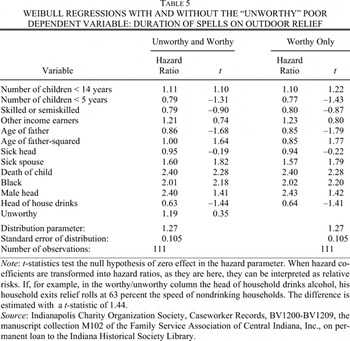
The relationship between time and reason for exit can be further tested with Weibull regressions. The Weibull regressions control for heterogeneity arising out of character difference more than have previous studies, which take “character” to be unobservable or unmeasured.60
Bane and Ellwood, Welfare Realities; Blank, “Analyzing the Length”; Tienda, “Welfare”; Fitzgerald, “Welfare Durations”; Hoynes and MaCurdy, “Has the Decline”; and Borjas and Hilton, “Immigration.”
Blank, “Analyzing the Length,” p. 250.
Heckman, “Identifying the Hand,” pp. 75–79.

Evidence of rising self-reliance over time might be suggested in Weibull regressions if the estimated DISTRIBUTION PARAMETER (σ) is substantially less than 1.0. A distribution parameter less than 1.0 would yield evidence of a positively-sloped hazard, showing that the probability of exit from the rolls increased as time spent with the COS increased. This, anyway, is the “strong” promise of friendly visiting articulated by Hill and Lowell and Richmond and McCulloch (Figure 2). Likewise, a distribution parameter larger than 1.0 would suggest a negatively sloped hazard, showing that the probability of exit decreased as time went by. Some historians believe the COS aimed primarily to rid the rolls of shiftless and vicious poor, a policy that would shift the hazard function upward and to the right but not necessarily reverse its slope from negative to positive (Figure 2). The “weak” promise of the COS—to reduce caseloads—may be plausible in the minds of historians but this merely negative role of charity organization is not, as we have seen, evident in COS writings. One need not look any further than to Gurteen's original Constitution of the Buffalo Charity Organization Society.63
A copy of the Constitution can be found in COS Minutes, BV1700, December 1879.
Himmelfarb, p. 180.

THE THEORETICAL HAZARD FUNCTIONS OF THE CHARITY ORGANIZATION SOCIETY
The estimated Weibull DISTRIBUTION PARAMETER for the whole sample—with no discrimination by type of exit—is not less than 1.0. It is about 1.3 (s.e. = 0.105, N = 111). The negative result is more pronounced than is the result reported by Blank (Blank's p parameter is my 1/p, or Stata's σ, equal 1.09).65
Blank, “Analyzing the Length,” p. 261.

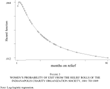
In separate Weibull regressions for women the DISTRIBUTION PARAMETER is higher than one finds in the other samples: about 1.5 (s.e. = 0.14, N = 89), controlling for the UNWORTHY. Though other functional forms were fit to test robustness, a larger distribution parameter in women-only data is probably not surprising. All the able-bodied women in the sample were self-employed or partly employed as washers or knitters or cleaners. In the 1880s a poor woman's dependence on any form of charity would not have come from a deterioration of specific human capital; her capital was low to begin with. Most spells of relief were too short for a visitor to have a perceptible effect, for good or for ill, on anyone. More than 95 percent of all female heads of household had passed the character test of the District Committee. Therefore, the decline in a woman's probability of exit, indicated by the larger distribution parameter, suggests obstacles to self-reliance beyond the personal habits assumed to be at fault.66
Compare Mink, “Lady,” pp. 96–102.
Yet the leading reformer Josephine Shaw Lowell—a widow and single mother—held the conventional view on women's work. She believed “what [a married woman] earns can not compensate for the loss occasioned by her absence.”67
Lowell, Public Relief, p. 109.
Annual Report 1890; and Mink, pp. 96–102.
Watson, Charity Organization Movement, p. 181.
Robustness
The robustness of the Weibull models was tested against exponential and log-logistic regressions, excluding and including outliers. The exponential is mildly better than the Weibull in fit overall but it is in any case a functional form that imposes the interpretation of a flat or constant hazard. Blank's estimates from the SIME/DIME experiment showed that the Weibull fit well but that the log-logistic fit somewhat better.70
Blank, “Analyzing the Length,” figure 2, pp. 261–64.
Ibid., p. 261.

WOMEN'S PROBABILITY OF EXIT FROM THE RELIEF ROLLS OF THE INDIANAPOLIS CHARITY ORGANIZATION SOCIETY, 1881 TO 1889
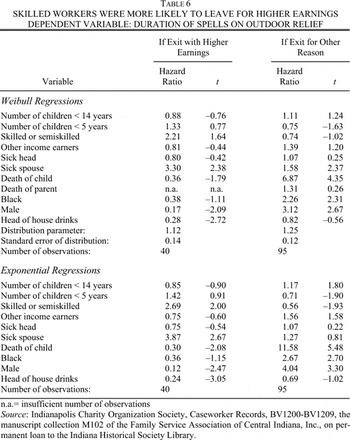
The probability of exit will likely differ by reason of exit. As Blank observed, families with fewer and older children, and with young, healthy, skilled, and physically capable heads of household are of course likely to have the shorter spells. Weibull and exponential regressions were estimated for households leaving the rolls with higher earnings and for households leaving for all other reasons. The findings reported in Table 6 are not surprising, though some of the coefficients (such as health) are estimated with little statistical power. Coefficients are measured in hazard ratios, that is, in relative risks: a coefficient of 1.2, for instance, says that, other things equal, the variable contributes a 20 percent advantage of speed toward exit. The regressions suggest that the death of a child dampened the family's likelihood of leaving for higher earnings. On the other hand, a skilled or semi-skilled head of household—a blacksmith, for example, or a carpenter—was much more likely to leave for higher earnings.72
The occupational data were gathered by reading the caseworker interviews and employing the occupational classifications used by Stephan Thernstrom in his study of social mobility, Poverty, pp. 90–104.

Alcohol did have a dulling effect. If you were an occasional binge drinker, the probability of leaving charity for higher earnings was 24–28 percent that of temperate folk. In this regard the COS may be vindicated, though the charge that inebriation was a major cause of poverty is hardly proven.
THE TEXTUAL EVIDENCE IS NOT ENCOURAGING: CASEWORKER NARRATIVES AND THE DIARY OF A FRIENDLY VISITOR
Exits by increased earnings were encouraged not, it seems, by organized charity but by improvements in health and by characteristics such as skill-level, which workers had acquired before their contact with the society. If character-building commenced one would certainly observe it in the caseworker narratives, or in a visitor's diary.
Home visiting was not as friendly as Hill had dreamed. I randomly selected ten entries from a diary written by one visitor in Indianapolis between 1893 and 1896.73
Caseworker's Day Book [hereafter Diary], 1893/94, BV1174. The Indiana Historical Society Library attributed the Diary to an anonymous “caseworker.” The entries do not support the attribution.
Played “hide and go seek” with the Jackson family this morning. Saw the boy and chased him around the square two or three times and finally lost him … Celia in back yard and called to see why she was not in school. Said mother was sick and she must do the work. Told her to take me to her mother … Think the mother was drunk but claimed to be sick and scolded C. for not being in school … Gave them a short lecture on being found in bed at such an hour in the morning and the children not in school. Was invited to leave the house but stayed till Celia dressed and I took her to school. After leaving school house [I] saw the boy I had been chasing with father hurrying home … Called to them and father was very angry at first and I had to talk him into a good humor before telling him what I wanted to … Told him yes I had taken the children twice from begging tours north … Said his children did not beg that a baker had told him to send [the children] and he would give them rolls every day … I asked the boy to go home as I did not want to say what I was going to before the child.74
Diary, 1 October 1893. Surnames have been changed by the author.
The entry does not suggest the visitor and the family were, in COS terms, friends. “Tender” and “cheer” did not walk into the bedroom. The visitor spoke frankly with the worthy family and the dialogue seems to be typical. On 8 October 1893 the visitor wrote: “I grew very much discouraged … I could not get names of boys from 10 yrs. to 16 yrs. who I found in different sheds as I drove through some alleys. It seems to me these boys could be taken for vagrancy. The corner of Mississippi and Henry Sts. is a great place for these boys to congregate and spend their time in worse than idleness.” “Sympathy” was not congregating in the alley. “Gentle” was driving in zigzags.
Resistance from mothers was not uncommon though scarcely was it welcome. The mother of one boy crossed the street and said “she worked for her boy” and “he may loaf on any corner he pleased.”75
Diary, 8 October 1893.
If the visits with the poor in their bedrooms and alley-ways had lessened the possibility for social uplift the caseworker ethos made uplift impossible. The physical and rhetorical characteristics of the poor—not least, their race and ethnicity—were formed into an other-worldly spectacle.76
Cmiel, Democratic Eloquence, chaps. 6, 7.
Indianapolis Charity Organization Society Application Book, Ledger 9, Record number 1793, BV1200-09.
The diary is an inscription by one visitor and may not reflect the norm. But the norm would have to be very good indeed—good enough to heal the conflict caused by foot-chases around the square. Still, the Society of Friendly Visitors retained a few members only and they were never organized for success. During the close of 1882 and the first half of 1883—the height of their re-organizational efforts—so few participated that meetings adjourned awkwardly, there being no new cases to assign or old cases to celebrate.78
SFV Minutes, 22 November 1882–29 May 1883.
Ibid., p. 4.
SELF-RELIANCE AND THE COS
In the United States the charity organization movement had some of the markings of a great movement. It invented the profession of social work. It institutionalized house-to-house visitation and the systematic collection and analysis of quantitative and qualitative data for the alleviation of poverty. It founded the journals that became Survey, a premier journal for the study of poverty. It unified disparate institutions of public welfare: for example, the leaders of charity organization co-founded and staffed many of the state Boards of Charities and Correction and Health and Lunacy, and they created the National Conference on Charities and Correction which, under different names, became the state welfare and national social work agencies of the twentieth century.80
In Indiana, for example: Shaffer, Keefer, and Breckenridge, Indiana, pp. 44–46; a chronology of the emergence of state welfare agencies can be found in Report of [the] Committee, “History of State Boards,” pp. 33–51, in Proceedings, National Conference on Charities and Correction (1893).
Tice, Tales.
Charity organization seems to have been more successful than welfare at moving people rapidly off of relief. But the antiseptic and even hostile relationships between charity workers and worthy poor, the steep and negatively sloped hazard functions, the miscalculation and apparent misapprehension of intemperance, the failure of—or aversion toward—re-marriage, the lack of upward occupational mobility and any public or private investment therein, the ideology of separate spheres, and the merely typical rates of transition from relief to employment-with-higher earnings suggest that the COS still fell well short of its goal of moving a high percentage of able-bodied poor into economies of self-support.
The idea that a welfare scheme could exhibit a monotonically upward-sloping hazard function is foreign to neoclassical economists in the twenty-first century and it is surely possible to drum up multiple criticisms of the very metric. In the nineteenth century, however, early and late, some transcendentalists and a few social economists were the architects of a different idea, an idea some may consider to be an unhappy contradiction, true perhaps for family and kin but not for states or strangers: it is the notion that charitable donations can build the virtue of self-support. The COS believed its “thousandfold Relief Societies” (as Emerson disparagingly called them) were of course necessary for the attainment of self-support. And, as parents will say of themselves to their children, nothing less would be sufficient.
If the evolution of literary theme can follow a Fibonacci sequence the early history of this article is its boundary condition. The debts I owe are now too numerous to mention. For their charity I would like to thank Rebecca Blank, Stanley Engerman, Price Fishback, Dawn Greeley, Joan Hannon, Santhi Hejeebu, Gary Libecap, Robert Margo, Deirdre McCloskey, Richard Steinberg, Gavin Wright, James Ziliak, three anonymous referees, and audiences at the Center on Philanthropy, Emory University, Georgia Institute of Technology, Indiana University, Roosevelt University, University of Michigan, and University of the South. The Family Service Association of Central Indiana, Inc. and the Indiana Historical Society Library kindly provided access to collection M102.
References
Manuscript Collections
1. The Holliday Collection, Indiana Room, Indiana State Library:
Butler Amos W.
1916
“A Century of Progress: A Study of Public Charities and Correction, 1790–1915”Google Scholar
2. Family Service Association of Central Indiana, Inc., M102, the Indiana Historical Society Library (FSA M102):
Gurteen S. Humphreys.
1881
What is Charity Organization?
Buffalo:
Bigelow Brothers,
Indiana Board of State Charities,
“Annual Report of the Board of State Charities to the Legislature of Indiana.”
In Documentary Journal
(Indianapolis, Wm. B. Burford, Contractor for State Printing and Binding), 1897–1900, Indiana State Archives.
Indianapolis Benevolent Society: Minutes (includes notes, news clippings, memos, fund-raising pamphlets, the financial and administrative records of the Friendly Inn and Wood Yard, and ephemera), BV1178, 1879–1918; Application book (the caseworker records on applications for relief, prior to the assumption of that task in 1880 by the Charity Organization Society), 1878–1880; Annual Reports (Boxes 1, 4 and 5, in the form of pamphlets and in the Yearbook of Charities), 1884–1903 (incomplete set).
Indianapolis Charity Organization Society: Minutes (includes notes, news clippings, memos, fund-raising pamphlets, the financial and administrative records of the Friendly Inn and Wood Yard, and ephemera), BV1700, 1879–1916; Caseworker records of applications for relief, BV1200–1209, 1880–1907; Annual Reports (mainly found in Boxes 1, 4 and 5, in the form of pamphlets and in the Yearbook of Charities), 1884–1903 (incomplete set).
Indianapolis Charity Organization Society.
1901
Facts.
Indianapolis:
Charity Organization Society,
McCulloch Oscar C.
“The Tribe of Ishmael: A Study in Social Degradation.”
(Indianapolis, Carlon and Hollenbeck, 1888). Read at the National Conference on Charities and Correction, 5–11 July 1888, and re-printed in the annual Proceedings,
pp. 154
59.
McCulloch Oscar C.
Handbill [“On the Spirit of Charity Organization”], 18 May 1891, Minutes of the ICOS, BV1700.
Noble Harriet.
1903
The Indianapolis Friendly Visitor.
Indianapolis:
Charity Organization Society,
Society for Friendly Visitors [a sub-committee of the Charity Organization Society]: Minutes, BV1182, 1896-1901; Secretary's book, BV1183, 1882-1916;
Society for Friendly Visitors. Caseworker's Day Book [a diary of a friendly visitor], BV1174, 1893–1896.
Published Materials
Addams Jane.
1902 [1907].
Democracy and Social Ethics.
Cambridge:
Belknap Press,
Almy Frederic.
1899–1900
“The Relation Between Private and Public Outdoor Relief-1.”
The Charities Review
9
(March-February):
22–
33.Google Scholar
Bane Mary Jo, and
David T. Ellwood.
1994
Welfare Realities: From Rhetoric to Reform.
Cambridge, MA:
Harvard University Press,
Blank Rebecca M.
1989
“Analyzing the Length of Welfare Spells.”
Journal of Public Economics
39,
no. 3
245–
73.Google Scholar
Blank Rebecca, and
Ron Haskins, eds.
2001
The New World of Welfare.
Washington, DC:
Brookings Institution Press,
Borjas George, and
Lynette Hilton.
“Immigration and the Welfare State: Immigrant Participation in Means-Tested Entitlement Programs.”
Quarterly Journal of Economics
111,
no. 2
(May 1996):
575–
604.
Boskin Michael J., and
Frederick C. Nold,
1975
“A Markov Model of Turnover in Aid to Families with Dependent Children.”
The Journal of Human Resources
10,
no. 4
467–
81.Google Scholar
Boyer Paul.
1978
Urban Masses and Moral Order in America, 1820–1920.
Cambridge, MA:
Harvard University Press,
Carlisle Janice.
1991
John Stuart Mill and the Writing of Character.
Athens:
University of Georgia,
Cmiel Kenneth J.
1990
Democratic Eloquence: The Fight Over Popular Speech in Nineteenth-Century America.
New York:
William Morrow,
Danziger S. K., and
S. A. Kossoudji.
1995
“When Welfare Ends: Subsistence Strategies of Former GA Recipients.”
Final Report of the General Assistance Project.
University of Michigan School of Social Work, Michigan Department of Social Services, and the Ford Foundation,Google Scholar
Devine Edward T.
1898–1899
“Public Outdoor Relief. II.”
The Charities Review
8:
186–
99.Google Scholar
Devine Edward T.
1914
Principles of Relief.
New York:
MacMillan,
Dunn Jacob P.
1910
Greater Indianapolis: The History, the Industries, and the People of a City of Houses.
Volumes 1 and 2. Chicago: no press denoted,
Fitzgerald John.
1991
“Welfare Durations and the Marriage Market: Evidence from the Survey of Income and Program Participation.”
The Journal of Human Resources
26,
no. 3
545–
61.Google Scholar
Friedman Lawrence E. and
Mark D. McGarvie, eds.
2003
Charity, Philanthropy, and Civility American History.
New York:
Cambridge University Press,
Gordon Linda, ed.
1990
Women, the State, and Welfare.
Madison:
The University of Wisconsin Press,
Gordon Linda, ed.
1994
Pitied But Not Entitled: Single Mothers and the History of Welfare.
New York:
The Free Press,
Gross Robert A.
2003
“Giving in America: From Charity to Philanthropy.”
In Charity, Philanthropy, and Civility in American History,
edited by Lawrence E. Friedman and
Mark D. McGarvie,
29–
48.
New York:
Cambridge University Press,
Hannon Joan Underhill.
1985
“Poor Relief Policy in Antebellum New York State: The Rise and Decline of the Poorhouse.”
Explorations in Economic History
22,
no. 3
233–
56.Google Scholar
Heckman James J.
1991
“Identifying the Hand of the Past: Distinguishing State Dependence from Heterogeneity.”
American Economic Review
81
(May):
75–
79.Google Scholar
Hill Octavia.
1970
Homes of the London Poor.
London:
MacMillan,
1883, reprinted with Andrew Mearns's The Bitter Cry of Outcast London. London: Frank Cass and Co.,
Hill Octavia.
1914
Edited by C. Edmund Maurice.
The Life of Octavia Hill as Told in her Letters.
London:
MacMillan,
Himmelfarb Gertrude.
1992
Poverty and Compassion: The Moral Imagination of the Late Victorians.
New York:
Vintage,
Himmelfarb Gertrude.
1995
The De-Moralization of Society: From Victorian Virtues to Modern Values.
New York:
Alfred P. Knopf,
Hirschman Albert O.
1995
A Propensity to Self-Subversion.
Cambridge, MA:
Harvard University Press,
Hofstadter Richard.
1944 [1955]
Social Darwinism in American Thought.
Boston:
Beacon Press,
Hoynes Hilary, and
Thomas MaCurdy.
1994
“Has the Decline in Benefits Shortened Welfare Spells?”
American Economic Review
84,
no. 2 (May):
43–
53.Google Scholar
Humphreys Robert.
1995
Sin, Organized Charity, and the Poor in Victorian England.
New York:
St. Martin's Press,
Jones Gareth Stedman.
1971
Outcast London.
Oxford:
Oxford University Press,
Katz Michael B.
1986
In the Shadow of the Poorhouse.
New York:
Basic,
Keller Albert G., and
Maurice R. Davie, eds.
1934
Essays of William Graham Sumner.
New Haven, CT:
Yale University Press,
Kershner Frederick D.
1949
“From Country Town to Industrial City: The Urban Pattern in Indianapolis.”
Indiana Magazine of History
45
(4 December):
327–
38.Google Scholar
Kiefer Nicholas M.
1988
“Economic Duration Data and Hazard Functions.”
Journal of Economic Literature
26
(June):
646–
79.Google Scholar
Lancaster Tony.
1992
The Econometric Analysis of Transition Data.
Cambridge:
Cambridge University Press,
Lowell Josephine Shaw.
1884 [1971]
Public Relief and Private Charity.
New York:
Arno Press and The New York Times,
McCloskey Deirdre N.
[1998a]
The Rhetoric of Economics.
Madison:
University of Wisconsin Press,
McCloskey Deirdre N.
1998
“Bourgeois Virtue and the History of P and S.”
This JOURNAL
58,
no. 2
297–
317.Google Scholar
MacKinnon Mary.
1987
“English Poor Law Policy and the Crusade Against Outrelief.”
This JOURNAL
47,
no. 3
603–
25.Google Scholar
Mink Gwendolyn.
1990
“The Lady and the Tramp: Gender, Race, and the Origins of the American Welfare State.”
In Women, the State, and Welfare,
edited by Linda Gordon,
92–
122.
Madison:
University of Wisconsin Press,
Moffitt Robert.
1992
“Incentive Effects of the U.S. Welfare System: A Review.”
Journal of Economic Literature
30
(March):
1–
61.Google Scholar
Mohl Raymond A.
1983
“The Abolition of Public Outdoor Relief, 1870–1900.”
In Social Welfare or Social Control?
Edited by Walter I. Trattner,
35–
50.
Knoxville:
University of Tennessee Press,
Montgomery David.
1993
Citizen Worker: The Experience of Workers in the United States with Democracy and the Free Market during the Nineteenth-Century.
Cambridge:
Cambridge University Press,
Mowat Charles Loch.
1961
The Charity Organisation Society, 1869–1913.
London:
Methuen,
National Conference on Charities and Correction.
1893
Proceedings.
Boston:
Geo. H. Ellis,
Nelson Barbara.
1990
“The Origins of the Two-Channel Welfare State: Workman's Compensation and Mothers' Aid.”
in Women, the State, and Welfare,
edited by Linda Gordon,
123–
52.
City ???:
publisher ???,
O'Neill June A.,
Laurie J. Bassi, and
Douglas A. Wolf.
1987
“The Duration of Welfare Spells.”
The Review of Economics and Statistics
69
(May):
241–
48.Google Scholar
Phillips Clifton J.
1968
Indiana in Transition: The Emergence of an Industrial Commonwealth, 1880–1920.
Indianapolis:
Indiana Historical Bureau and Indiana Historical Society,
Plotnick Robert.
1983
“Turnover in the AFDC Population: An Event History Analysis.”
The Journal of Human Resources
18,
no. 1
65–
81.Google Scholar
Rezneck Samuel.
1953
“Unemployment, Unrest, and Relief in the United States During the Depression of 1893-97.”
Journal of Political Economy
61,
no. 4
(August):
324–
45.Google Scholar
Richmond Mary E.
1899
Friendly Visiting Among the Poor: A Handbook for Charity Workers.
New York:
MacMillan,
Shaffer Alice
Mary Wysor Keefer, and
Sophonisba P. Breckenridge.
1936
The Indiana Poor Law.
Chicago:
The University of Chicago Press,
Steinberg Richard.
1991
“Does Government Spending Crowd-Out Donations? Interpreting the Evidence.”
Annals of Public and Cooperative Economics
62,
no. 4
591–
617.Google Scholar
Sumner William Graham.
1887
“The Abolition of Poverty”
In Essays
edited by Keller and
Davie,
107–
11.
New Haven, CT:
Yale University Press,
1934.
Taylor Robert,
Errol W. Stevens, and
Mary Ann Ponder, eds.
1989
Indiana: A New Historical Guide.
Indianapolis:
Indiana Historical Society,
Thernstrom Stephan.
1964 [1974]
Poverty and Progress: Social Mobility in a Nineteenth-Century City.
New York:
Atheneum,
Tice Karen W.
1998
Tales of Wayward Girls and Immoral Women: Case Records and the Professionalization of Social Work.
Urbana:
University of Illinois Press,
Tienda Marta.
1990
“Welfare and Work in Chicago's Inner City.”
American Economic Review
80,
no. 2
372–
76.Google Scholar
Trattner Walter I.
1983
“Introduction.”
In Social Welfare or Social Control?
Edited by Walter I. Trattner,
3–
14.
Knoxville:
The University of Tennessee Press,
Trattner Walter I., ed.
1983
Social Welfare or Social Control? Some Reflections on Regulating the Poor.
Knoxville:
The University of Tennessee Press,
U.S. Bureau of the Census.
1883
Tenth Census of Manufactures of the United States, 1880, Volume 2
Washington, DC:
GPO,
U.S. Bureau of the Census.
1883
Compendium of the Tenth Census of Population of the United States, 1880, Part I.
Washington, DC:
GPO,
U.S. Bureau of the Census.
1895
Compendium of the Eleventh Census of Population of the United States, 1890, Volume 15.
Washington, DC:
GPO,
Warner Amos G.
1891
“Some Experiments on Behalf of the Unemployed.”
Quarterly Journal of Economics
5
1–
23.Google Scholar
Warner Amos G.
1894
American Charities: A Study in Philanthropy and Economics.
New York:
Thomas Y. Crowell and Company,
Watson Frank Dekker.
1922
The Charity Organization Movement in the United States.
New York:
MacMillan,
Webb Sidney, and
Beatrice Webb.
1929
English Local Government: English Poor Law History, Part II: The Last Hundred Years.
London:
Longmans-Green,
Weeks Genevieve.
1976
Oscar Carleton McCulloch, 1843-1891: Preacher and Practitioner of Applied Christianity.
Indianapolis:
Indiana Historical Society,
Ziliak Stephen T.
1996
“The End of Welfare and the Contradiction of Compassion.”
The Independent Review
1,
no. 1
55–
73.Google Scholar
Ziliak Stephen T.
2002
“Some Tendencies of Social Welfare and the Problem of Interpretation.”
Cato Journal
21,
no. 3
499–
513.Google Scholar
Ziliak Stephen T.
2002
“Pauper Fiction in Economic Science: ‘Paupers in Almshouses’ and the Odd Fit of Oliver Twist.”
Review of Social Economy
60,
no. 2
159–
81.Google Scholar
Ziliak Stephen T.
(with Joan Underhill Hannon).
“Public Assistance: Colonial Times to the 1920s.”
In Historical Statistics of the United States: Colonial Times to the Present,
edited by Susan Carter, et al.
New York:
Cambridge University Press and U.S. Bureau of the Census,
forthcoming.

REAL EXPENDITURES IN INDIANAPOLIS ON OUTDOOR RELIEF: PUBLIC AND PRIVATE “SCIENTIFIC”

REAL EXPENDITURES IN DOLLARS ON OUTDOOR RELIEF PER RELIEVED HOUSEHOLD
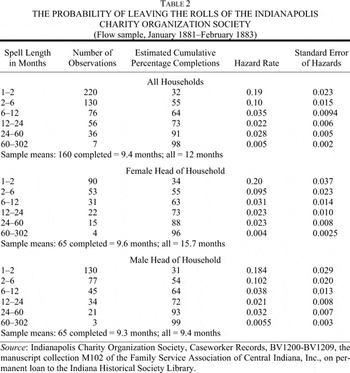
THE PROBABILITY OF LEAVING THE ROLLS OF THE INDIANAPOLIS CHARITY ORGANIZATION SOCIETY
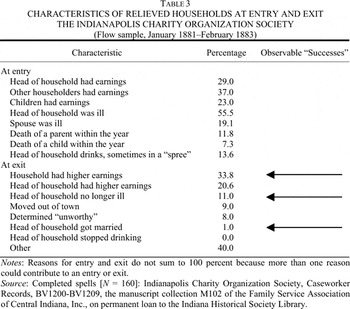
CHARACTERISTICS OF RELIEVED HOUSEHOLDS AT ENTRY AND EXIT THE INDIANAPOLIS CHARITY ORGANIZATION SOCIETY
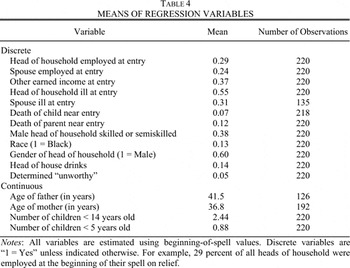
MEANS OF REGRESSION VARIABLES
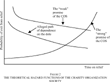
THE THEORETICAL HAZARD FUNCTIONS OF THE CHARITY ORGANIZATION SOCIETY
WEIBULL REGRESSIONS WITH AND WITHOUT THE “UNWORTHY” POOR DEPENDENT VARIABLE: DURATION OF SPELLS ON OUTDOOR RELIEF
WOMEN'S PROBABILITY OF EXIT FROM THE RELIEF ROLLS OF THE INDIANAPOLIS CHARITY ORGANIZATION SOCIETY, 1881 TO 1889
SKILLED WORKERS WERE MORE LIKELY TO LEAVE FOR HIGHER EARNINGS DEPENDENT VARIABLE: DURATION OF SPELLS ON OUTDOOR RELIEF
 You have
Access
- 15
- Cited by