Introduction
Patients with a glioma, the most common primary brain tumor, may experience deficits in several cognitive domains, including attention, memory, and executive functioning (Klein et al., Reference Klein, Taphoorn, Heimans, Van Der Ploeg, Vandertop, Smit and Aaronson2001; Laack et al., Reference Laack, Brown, Ivnik, Furth, Ballman, Hammack and Buckner2005; Meyers & Brown, Reference Meyers and Brown2006). The peak age of onset for low-grade (less malignant but not benign) gliomas lies between 30 and 40 years (DeAngelis, Reference DeAngelis2001). Both the tumor itself and its treatment can cause these deficits. Deficits in patients with a low-grade glioma are usually not severe (Anderson, Damasio, & Tranel, Reference Anderson, Damasio and Tranel1990; Correa et al., Reference Correa, Shi, Thaler, Cheung, DeAngelis and Abrey2008; Laack et al., Reference Laack, Brown, Ivnik, Furth, Ballman, Hammack and Buckner2005), but they can have a substantial impact on daily life (Meyers, Berger, & Prados, Reference Meyers, Berger and Prados2005). Particularly during the disease-free period, which can last for years, when patients are attempting to resume their normal work and social activities, these deficits can play a significant role. Moreover, subjective cognitive symptoms are among the most common problems reported by patients with brain tumors (Lidstone et al., Reference Lidstone, Butters, Seed, Sinnott, Beynon and Richards2003; Mukand, Blackinton, Crincoli, Lee, & Santos, Reference Mukand, Blackinton, Crincoli, Lee and Santos2001).
In a recent study (Gehring et al., Reference Gehring, Sitskoorn, Gundy, Sikkes, Klein, Postma and Aaronson2009), we reported the results of a randomized controlled trial of cognitive rehabilitation in 140 patients with a glioma, in which positive group effects were observed. In particular, the intervention group performed significantly better than the control group on neuropsychological tests of attention and verbal memory 6 months after undergoing the cognitive rehabilitation program.
Since group results can mask the variability in individual responses to cognitive rehabilitation, it is of interest to further investigate the specific patient factors that are associated with a more (or less) positive outcome. Undergoing a cognitive rehabilitation program can be quite time-consuming and burdensome for patients. Identification of specific patient characteristics that predict a positive response to cognitive rehabilitation could allow us to reassure patients who possess these characteristics that undergoing this type of intervention is almost certainly worth the effort. Conversely, if we are able to identify patients who are less likely to benefit from the currently available cognitive rehabilitation programs, we may advise them accordingly. Perhaps more importantly, we can use the knowledge gained to adapt cognitive rehabilitation programs to yield optimal benefit for a larger percentage of the target population.
Sociodemographic (e.g., age, sex, and education), clinical (e.g., radiotherapy), subjective (e.g., self-reported cognitive symptoms), and/or neuropsychological (pre-intervention neuropsychological functioning) factors may play a role in predicting the outcome of cognitive rehabilitation. From a practical point of view, it would be desirable to be able to identify patients who are most likely to respond to cognitive rehabilitation on the basis of information that can be collected with relatively little effort (e.g., sociodemographics, basic clinical data). However, use of other patient-reported outcomes (e.g., cognitive symptoms) and performance indicators (neuropsychological test results) may also provide useful in maximizing such predictions.
Identifying responsiveness to a cognitive intervention, or change over time at the individual patient level is complicated by the fact that the reliability of (neuro)psychological measures can be compromised by such factors as practice effects and regression to the mean. In recent years, the Reliable Change Index (RCI) has been introduced as a possible means of addressing this problem. The RCI represents a measure of improvement at the individual level in the context of observed changes over time in a control group (Evans, Margison, & Barkham, Reference Evans, Margison and Barkham1998); it reflects the individual change beyond that which can be attributed to measurement error, and practice effects. To date, very few studies have used RCIs to evaluate cognitive rehabilitation at the individual level (e.g., Medalia & Richardson, Reference Medalia and Richardson2005).
The present study investigated the potential predictors of individual responsiveness to a cognitive rehabilitation program that has previously been demonstrated to be successful at the group level in patients with gliomas. We examined whether individual improvement, based on the RCI, is predicted by sociodemographic and clinical variables, self-reported cognitive symptoms, and objective neuropsychological test performance.
Method
Study Sample and Design
For a detailed description of the randomized clinical trial and of the cognitive rehabilitation program, the reader is referred to Gehring et al. (Reference Gehring, Sitskoorn, Gundy, Sikkes, Klein, Postma and Aaronson2009). Briefly, 366 adult patients with (primarily low-grade) glioma and favorable prognostic factors, whose disease was in remission, were screened for the presence of cognitive symptoms. Those who screened positive and expressed potential interest in participating in a cognitive rehabilitation program completed a battery of neuropsychological tests of attention, memory and executive functioning. Patients who scored at least one standard deviation below the mean of a healthy comparison group (n = 294; van Boxtel et al., Reference van Boxtel, Buntinx, Houx, Metsemakers, Knottnerus and Jolles1998) on at least 4 of 20 neuropsychological variables were considered eligible. These subjective and objective cognitive eligibility criteria were used to identify patients who would both be motivated to participate in the program, and would potentially benefit from its content.
Eligible patients were randomized to an intervention group (n = 70) or to a (waiting list) control group (n = 70). To evaluate the effect of the rehabilitation program, the battery of neuropsychological tests and self-report questionnaires that was administered at baseline was repeated directly following cognitive rehabilitation (or an equivalent time point for the control group), and at 6-months follow-up.
The trial was approved by the institutional review boards of all participating hospitals and all patients provided written informed consent.
The Cognitive Rehabilitation Condition and the Control Condition
The cognitive rehabilitation program (Gehring, Aaronson, Taphoorn, & Sitskoorn, accepted for publication; Gehring et al., Reference Gehring, Sitskoorn, Gundy, Sikkes, Klein, Postma and Aaronson2009; for a more detailed description) consisted of six weekly, individual sessions of 2 hr. The intervention incorporated both cognitive retraining and strategy training. For the retraining component of the program, a computer program (C-Car; Gehring & Sitskoorn, Reference Gehring and Sitskoorn2004) was developed which consisted of a series of hierarchically graded tasks, designed to strengthen various aspects of attention, based on the patient's needs. The strategy training consisted of six integrated psycho-education sessions addressing attention, memory and executive function. These sessions included both didactic and practical elements aimed at teaching patients to compensate for impaired cognitive functions. Patients were also given weekly “homework” assignments to supplement both the retraining and strategy elements of the program. The waiting list control group received usual care (i.e., regular medical follow-up; no cognitive interventions), and was given the opportunity to follow the program at completion of the trial.
Results at the Group Level
For a detailed description of the trial results, the reader is referred to Gehring et al. (Reference Gehring, Sitskoorn, Gundy, Sikkes, Klein, Postma and Aaronson2009). To summarize, at immediate post-treatment, the intervention group reported significantly fewer cognitive symptoms and less symptom burden than the control group. At 6-months follow-up, the intervention group performed significantly better than the control group on a total of six neuropsychological test variables of attention and verbal memory, and reported significantly less mental fatigue. Group differences in other subjective outcomes were no longer statistically significant at 6-months follow-up.
Study Measures
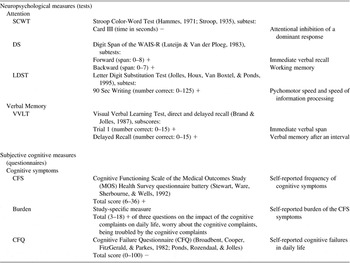
The neuropsychological and self-report measures of cognitive symptoms that were used in this report are summarized in Table 1.
Details of neuropsychological and subjective cognitive measures

Note. + = Higher score indicates better (performance) score; − = Higher score: worse (performance) score; In parentheses: Score/scale ranges.
Outcome Measures
For the current analyses, the six neuropsychological measures of attention and verbal memory for which statistically significant group differences were observed at 6-months follow-up (Gehring et al., Reference Gehring, Sitskoorn, Gundy, Sikkes, Klein, Postma and Aaronson2009) (see Neuropsychological measures in Table 1) were selected for further investigation at the individual level using a standardized regression-based RCI (McSweeny, Naugle, Chelune, & Luders, Reference McSweeny, Naugle, Chelune and Luders1993). One global dichotomous measure of improvement was calculated (see Statistical Methods), based on the RCIs of these six measures, that distinguished between patients who improved reliably on at least one of the six measures (“improvers”) and those who did not (“non-improvers”).
Predictors
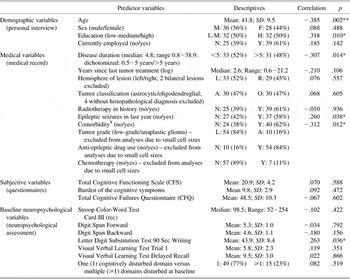
Potential predictors of outcome (Table 2) that were included in the analyses were: sociodemographics, clinical variables, self-reported cognitive symptoms, and neuropsychological test results. As all patients attended all sessions, “dose of therapy” was not a relevant predictor variable.
Candidate predictors of improvement: Descriptives and correlations (Pearson's correlation and Phi coefficient) with ‘reliable improvement on at least one of the six neuropsychological measures’ in the intervention group

Note. *p < .05, two-tailed. **p < .01, two-tailed; log = logarithmically transformed, rec = reciprocally transformed; ¥other concurrent diseases or disease symptoms not related to the brain tumor varying from chronic eczema to diabetes or cardiovascular disease.
Although we considered calculating a composite baseline neuropsychological score based on Z-scores, this was not possible because normative data were not available for all six neuropsychological measures that were also used for the global RCI outcome.
Statistical Methods
For each program participant, change in the six neuropsychological performance measures was calculated by the Reliable Change Index (RCI), reflecting change at the individual level in the context of observed changes for the control group. While several variants of the RCI have been proposed (Maassen, Bossema, & Brand, Reference Maassen, Bossema and Brand2009), all reflect the ratio of an estimate of the true change in the numerator and a corresponding (measurement) error in the denominator (Maassen et al., Reference Maassen, Bossema and Brand2009). For the current study, a standardized regression-based approach to the RCI was used (McSweeny et al., Reference McSweeny, Naugle, Chelune and Luders1993), that uses the available information of the control group more thoroughly than other types of RCIs (Maassen et al., Reference Maassen, Bossema and Brand2009). Practice effect is estimated by means of a regression of the post-test on the pre-test score in the control group; subsequently the relationship between practice effect and the initial score of an individual is used. The standard error of prediction of the control group is used as the standard error in the denominator. The index that is calculated is compared to the critical value for a one-sided t test with n = 64. The reader is referred to the Appendix for further details of the RCI formula used in this study.
Finally, a global, dichotomous measure of reliable improvement was created to distinguish between patients who improved reliably on at least one of the six measures (“improvers”) and those who did not (“non-improvers”). This global measure was used as the dependent variable in the analyses.
Because of the large number of possible predictors (21; see Table 2) and the relatively small sample size (n = 64), univariate correlations (Pearson's correlation and Phi coefficient) between (both dichotomous and continuous) predictor variables and the global RCI were first calculated. Independent variables that correlated with the global RCI outcome at the p < .05 level were included in subsequent multivariate analyses. Dichotomous predictor variables with cell sizes that were too small were excluded from the analyses. Variables that were not normally distributed (an assumption for Pearson's correlations) were transformed to normalize distributions, or were dichotomized.
Clusters of one or more variables that correlated significantly with the global RCI outcome at the univariate level were included in the logistic regression analyses according to a pre-specified hierarchy: sociodemographic variables, clinical variables, self-reported cognitive symptoms, and baseline neuropsychological test results. This hierarchical ordering was chosen to reflect the ease with which these data could be collected in daily clinical practice. That is, sociodemographic and clinical data can be relatively easily extracted from the medical records, while patient self-reported symptoms and objective neuropsychological test results require additional and, in the case of the neuropsychological tests, quite substantial data collection efforts. The final model was composed of those variables that contributed significantly to predicting reliable improvement in at least one of the six neuropsychological measures (the global RCI outcome).
To investigate whether the factors identified as being multivariate predictors of improvement within the intervention group might also be predictive of improvement in neuropsychological functioning in general, an additional logistic regression analysis was conducted for the entire study sample (the intervention and the control group combined) in which, in addition to the identified predictor variables, both the group variable and group × predictor interaction terms were included in the model.
Assumptions concerning (absence of) outliers/influential cases, empty cells and multicollinearity were tested for all of the logistic regression models. Variables that had been transformed or dichotomized for the univariate analyses remained modified for the logistic regression analyses. For all logistic regression analyses, a p value < .05 was considered statistically significant. Nagelkerke's pseudo R2 was used to provide an indication of the substantive significance of the logistic regression model (analogous to a R2 value as reported with multiple regression; Field, Reference Field2005).
Because of the relatively small sample size, a bootstrap sampling estimation was performed in which 2000 versions of the training group were generated to estimate regression coefficients and confidence intervals with a minimum of assumptions.
Finally, supplemental data on the area under the curve, sensitivity, specificity, positive (PPV) and negative (NPV) predictive values, and classification accuracy were calculated for both predictors, education and age, in the intervention group, using information from a receiver operating characteristic (ROC) curve. As age is a continuous measure, determination of these data depends on the cutoff used for age. This cutoff was determined on the basis of the smallest number of misclassifications (Youden's Index; Youden, Reference Youden1950), that is, on the optimal combination of sensitivity and specificity, by summing these two values for each value of age in the sample (a table provided by the SPSS ROC curve output).
For all statistical tests, the Statistical Package for the Social Sciences (SPSS; SPSS Inc. Chicago, IL) version 17.0 was used.
Results
Follow-up data were available of 64 intervention group patients. There were no statistically significant differences in sociodemographic, clinical, self-reported cognitive symptoms or baseline neuropsychological test scores between these 64 patients and the 63 control group patients whose baseline and follow-up neuropsychological test scores were used for calculating the RCI.
RCI Results per Measure and Global RCI-Score
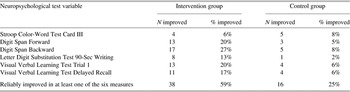
Fifty-nine percent of the patients in the intervention group, as compared to 25% in the control group (χ2(1) = 14.997; p = .000), improved reliably (i.e., corrected for measurement errors and practice effects) on at least one of the six neuropsychological measures (the global RCI outcome; see Table 3, also for the number and percentage of reliably changed individuals in both groups per neuropsychological test variable).
Reliably improved individuals in the intervention group (N = 64) and in the control group (N = 63)

Note. Number and percentage of improves at six months follow-up per neuropsychological test variable, and number and percentage of patients who improved reliably in at least one of the six neuropsychological measures (global RCI outcome).
Variables Associated Significantly with Reliable Change in Neuropsychological Functioning at the Univariate Level
Variables that were not normally distributed were transformed (logarithmically for “years since last tumor treatment”, or reciprocally for “Stroop color-word test”; see Table 2) to normalize distributions. One variable (“disease duration”) was dichotomized to solve problems with normality even after transformation, with the cutoff based on the median disease duration of 5 years. It should be noted that, since the majority of patients had a low-grade glioma, received anti-epileptic drugs and had not received chemotherapy, variables regarding tumor grade, anti-epileptic drugs and chemotherapy were not included in the analyses as the numbers of patients in these cells were too small.
The following variables were found to correlate significantly with reliable improvement in neuropsychological functioning over time (see also Table 2): From the sociodemographic cluster, age (younger age) and education (higher level); from the clinical cluster, disease duration (less than 5 years), epileptic seizures in last year (yes), and comorbidity (no). None of the self-reported cognitive symptom variables were correlated significantly with outcome. Of the baseline neuropsychological tests, only letter-digit substitution score (higher) was associated significantly with reliable improvement.
Logistic Regression Analyses
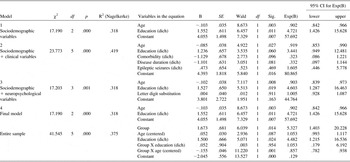
In the first logistic regression analysis (see Table 4), the demographic variables age and education were included as possible predictors. (Younger) age and (higher) education were associated with reliable improvement (model χ2(2) = 17.190; p = .000).
Logistic regression models

Note. dich = dichotomized.
Addition of the clinical variables disease duration, epileptic seizures and comorbidity did not result in a significant improvement of the model (step/block χ2(3) = 6.582; p = .086). Thus the clinical variables did not contribute significantly to the model and therefore these variables were not included. Finally, inclusion of the letter-digit substitution test to the existing model did not result in an improvement of the model (step/block χ2(1) = .012; p = .991).
The final model (model χ2(2) = 17.190; p = .000) predicting reliable change in the participants that had followed the cognitive rehabilitation program six months earlier was similar to the initial model and included age (p = .003) and education (p = .011) only. A Nagelkerke's pseudo R2 of .318 indicated moderate explanatory power of the model. The odds of improvement over time increased 0.9 times per year of age (range, 23 to 59 years), and were 4.7 times greater for higher (vs. low to medium) education level. The bootstrap sampling estimation confirmed these results.
For education, the area under the ROC curve in the intervention group was .66 (asymptotic 95% confidence interval: .585–.850). The sensitivity was 63% and the specificity was 69%. The overall classification accuracy was 65%. The PPV (i.e., given a higher education the chance to improve) was 75%, and the NPV (i.e., given a lower education, the chance of no improvement) was 56%. For age, the area under the ROC curve was .72 (asymptotic 95% confidence interval: .525–.799). At the optimal cutoff of age 50, sensitivity was 95%, specificity was 50%, and the overall classification accuracy was 77%. The PPV (i.e., given a younger age the chance to improve) was 73% and the NPV (i.e., given an older age the chance of no improvement) was 87%.
To investigate whether age and education specifically predicted intervention-related improvement, or were also involved in more general improvement, an additional logistic regression analysis was conducted for the entire study group (n = 127) with inclusion of the variables group, age, education, and the two-way interaction terms of group × age, and group × education. A high correlation was observed between the group variable and the interaction term group × age (r(125) = .95), resulting in a problem with multicollinearity. For this reason, age was centered around the total group mean age of 41.8 years for use in the interaction term.
This model (model χ2(5) = 41.545; p = .000; Table 4) confirmed that the intervention (p = .014) was associated significantly with improvement in the entire group, as was (higher) education (p = .024). (Centered) age, however, was only significant when incorporated in the interaction term (p = .001), indicating that (younger) age moderated improvement in neuropsychological test performance for the intervention group, but not for the control group. The odds for reliable improvement were 5.3 for the patients in the intervention group (versus the control group), and 4.5 for patients with higher education (versus low to medium education, irrespective of group). The odds ratio for group × centered age was .86, indicating that for every year above the mean age of 41.8 years, the odds of improvement decreased by a factor of 0.86.
Discussion
The current study investigated the patient characteristics that predicted individual neuropsychological improvement in glioma patients 6 months after undergoing a cognitive rehabilitation program (Gehring et al., Reference Gehring, Sitskoorn, Gundy, Sikkes, Klein, Postma and Aaronson2009). According to the criteria used, with measurement errors and practice effects taken into account, nearly 60% of the 64 patients in the intervention group had improved reliably on at least one of the six neuropsychological measures for which statistically significant intervention effects had been demonstrated at the group level. Four categories of candidate predictors of improvement in neuropsychological test performance were examined at the univariate level and, subsequently, in the context of a hierarchical logistical regression model. Of all of the variables examined, only two sociodemographic variables, age and education, significantly predicted individual improvement in the intervention group. Younger patients and those with a higher education had the highest likelihood of improvement over time. Additional results suggested that age was a specific, intervention-related predictor of improvement in neuropsychological functioning; that is, it did not predict such improvement among those patients not exposed to the cognitive rehabilitation program. Education, however, appeared to be a more general predictor of improvement in neuropsychological functioning, irrespective of whether patients were exposed to the program.
It should be noted that in calculating the RCI, data on practice effects as measured in the control group are taken into account. However, these data are based on “mean” practice effects for the control group. This means that some patients exhibit more than average, and others exhibit less than average practice effects. The 25% of the control group patients that improved “reliably” (a percentage that is significantly different from that observed in the intervention group) may be those patients with greater than average improvement. The results of the total group analyses suggest that education may (also) have moderated neuropsychological improvement in the control group, which is probably related to practice effects.
Furthermore, although the criterion of reliable improvement on at least one of six neuropsychological measures may seem minimal, it should be noted that the RCI is a very stringent index, excluding measurement errors and subjecting the adapted score to statistical testing (a t test). This resulted in clearly defined groups that could be used for analyses with reliable results. The difference in proportion of reliably improved patients in the intervention (59%) versus control (25%) group was statistically significant (χ2(1) = 14.997; p = .000). The results of the logistic regression analyses based on the current criteria with group sizes of 38 reliably improved versus 26 not (reliably) improved patients were supplemented by other statistical measures (in particular, the PPV and NPV of age of 73% and 87%, respectively), and yielded different predictor variables for the intervention group as compared to the control group.
The prediction of “success” of the program by age may reflect the nature and content of the program itself. The game-like retraining on a notebook computer may have been more attractive, and familiar to, younger patients. However, in studies on outcome of patients suffering from acquired brain injury (without interventions specifically aimed at treating cognitive deficits), sociodemographic variables such as age and education/intelligence, have also been predictive of functioning, in addition to medical injury severity variables (Chu et al., Reference Chu, Millis, Arango-Lasprilla, Hanks, Novack and Hart2007; Malec & Basford, Reference Malec and Basford1996; Robertson & Murre, Reference Robertson and Murre1999; Sherer et al., Reference Sherer, Stouter, Hart, Nakase-Richardson, Olivier, Manning and Yablon2006). Both older age (e.g., Chu et al., Reference Chu, Millis, Arango-Lasprilla, Hanks, Novack and Hart2007; Hukkelhoven et al., Reference Hukkelhoven, Steyerberg, Rampen, Farace, Habbema, Marshall and Maas2003; Robertson & Murre, Reference Robertson and Murre1999; Sherer et al., Reference Sherer, Stouter, Hart, Nakase-Richardson, Olivier, Manning and Yablon2006) and lower education (Brooks, McKinlay, Symington, Beattie, & Campsie, Reference Brooks, McKinlay, Symington, Beattie and Campsie1987; Grafman, Salazar, Weingartner, Vance, & Amin, Reference Grafman, Salazar, Weingartner, Vance and Amin1986; Robertson & Murre, Reference Robertson and Murre1999; Sherer et al., Reference Sherer, Stouter, Hart, Nakase-Richardson, Olivier, Manning and Yablon2006) have been associated with poorer neuropsychological outcome in many of these studies.
The finding that age plays a significant role in predicting (cognitive) recovery may be related to the concept of brain reserve. There is both epidemiological and biological evidence that individual differences in the brain allow some people to cope better than others with brain damage (Fratiglioni & Wang, Reference Fratiglioni and Wang2007; Stern, Reference Stern2009). These individual differences stem from quantitative factors such as brain size, or number of neurons or synapses. Furthermore, brain anatomy can be influenced by life experiences, via neurogenesis and angiogenesis that promote resistance to apoptosis and indirectly promote neural plasticity (Stern, Reference Stern2009). As aging has been related to losses in gray and white matter in medial-temporal, parietal and frontal areas (Charlton et al., Reference Charlton, Barrick, McIntyre, Shen, O'Sullivan, Howe and Markus2006; Gordon et al., Reference Gordon, Rykhlevskaia, Brumback, Lee, Elavsky, Konopack and Fabiani2008), it has been suggested that these diffuse age-related losses results in a larger threshold for recovery to take place (Robertson & Murre, Reference Robertson and Murre1999), decreasing the brain's reserve (Green et al., Reference Green, Colella, Christensen, Johns, Frasca, Bayley and Monette2008; Stern, Reference Stern2009).
Moreover, brain reserve factors may not only buffer the outcome of brain damage, and influence the initial cognitive status after the injury, they may also play a supporting role in restitution of function or functional reorganization during recovery (Green et al., Reference Green, Colella, Christensen, Johns, Frasca, Bayley and Monette2008). Some of the few studies on recovery trajectories conducted in brain-injured populations have suggested that age (but not education) can indeed moderate improvement in cognitive functioning in patients with traumatic brain injury (Green et al., Reference Green, Colella, Christensen, Johns, Frasca, Bayley and Monette2008; Zwaagstra, Schmidt, & Vanier, Reference Zwaagstra, Schmidt and Vanier1996). However, in other studies, factors such as age (or premorbid intelligence) only predicted the level of cognitive outcome, rather than influencing the recovery trajectory (Chu et al., Reference Chu, Millis, Arango-Lasprilla, Hanks, Novack and Hart2007; Green et al., Reference Green, Colella, Christensen, Johns, Frasca, Bayley and Monette2008).
With regard to improvement after cognitive rehabilitation in particular, age has also been reported to play a moderating role (e.g., Langbaum, Rebok, Bandeen-Roche, & Carlson, Reference Langbaum, Rebok, Bandeen-Roche and Carlson2009; Rohling, Faust, Beverly, & Demakis, Reference Rohling, Faust, Beverly and Demakis2009; Verhaeghen, de Mey, Helsen, van Assel, & Vanwijnsberghe, Reference Verhaeghen, de Mey, Helsen, van Assel and Vanwijnsberghe1992; Yesavage, Sheikh, Friedman, & Tanke, Reference Yesavage, Sheikh, Friedman and Tanke1990). Langbaum and colleagues (Reference Langbaum, Rebok, Bandeen-Roche and Carlson2009) studied the different patterns of response to memory training in 619 healthy older adults and concluded that higher education and higher baseline cognitive functioning were predictors of (patterns of) memory improvement. Age had also a moderating effect, although the relationship to response pattern was possibly not linear. However, other studies did not find moderating effects of age (or education) (Medalia & Richardson, Reference Medalia and Richardson2005; Neely & Backman, Reference Neely and Backman1995).
Thus, although it is well-known that age (and also education) influence (static) performance on neuropsychological tests, this study demonstrates that these variables may also moderate the (dynamic) response to cognitive rehabilitation. In line with this reasoning above, in the current study, younger patients may have a larger brain reserve capacity for dealing with the pathological effects of the brain tumor.
It would have been interesting if we, in addition to a proxy measure of brain reserve (age) also had used some proxy measure for cognitive reserve in the analyses. Although we collected data on the DART (the Dutch version of the NART), a measure of premorbid intelligence, we decided not to use these data in the analyses as we observed that they were confounded by hemisphere of lesion. Unfortunately we had no other measure for cognitive reserve available.
The order in which the variables were analyzed, according to our pre-specified clinical hierarchy, in combination with the relatively small power of the study, may have precluded some other possibly relevant variables from reaching statistical significance. The clinical variables that were tested in the multivariate model yielded statistical trends only. The finding that baseline neuropsychological functioning was not predictive of improvement following the program runs contrary to other evidence in the literature (e.g., Fiszdon, Cardenas, Bryson, & Bell, Reference Fiszdon, Cardenas, Bryson and Bell2005; Langbaum et al., Reference Langbaum, Rebok, Bandeen-Roche and Carlson2009; Strangman et al., Reference Strangman, O'Neil-Pirozzi, Goldstein, Kelkar, Katz, Burke and Glenn2008). This may, in part, be due to the fact that we used only one global measure of cognitive improvement, which was also dichotomized, to investigate the relationship with each of the six baseline neuropsychological test variables.
Furthermore, we cannot exclude the possibility that the positive results of the cognitive rehabilitation are not (only) attributable to the cognitive treatment itself, but might also be due, at least in part, to other non-specific factors such as the attention given to the patients. The RCI does not correct for these effects. We considered it unethical, impractical, and not credible to include a “placebo” condition in which patients would be required to attend a series of 2-hr sessions (comparable to the intervention group) in which no substantive rehabilitation program would be offered. However, non-specific treatment effects as the sole or even primary explanation for the improvements in objective test performance is less likely, considering the initially equal improvement in neuropsychological performance for both groups, and the intervention effect observed after a 6-month interval, in which possible placebo effects may be assumed to be absent.
The results of this study suggest that younger patients with a glioma are more likely to benefit from the cognitive rehabilitation program. As younger age at diagnosis is a major prognostic factor in brain cancer (Schiff, Brown, & Giannini, Reference Schiff, Brown and Giannini2007), it is useful to know that these patients are also most likely to benefit from the intervention. This should not, however, suggest that cognitive rehabilitation programs should not be offered to older patients. Rather, greater effort should be devoted to adapting our current training program to increase its effectiveness among older patients. Brooks and colleagues (Brooks, Friedman, Pearman, Gray, & Yesavage, Reference Brooks, Friedman, Pearman, Gray and Yesavage1999), in a study of 268 community-dwelling adults over the age of 55 years, reported that older participants benefited from increased training time coupled with a comprehensive pre-training regimen in memory (mnemonic) rehabilitation. Thus, pre-training, combined with more sessions over time, may facilitate program success in older patients.
A secondary, but relevant, finding of the study was that more highly educated patients were more likely to exhibit improved cognitive functioning over time, regardless of whether they participated in the program. This suggests that (clinical) neuropsychologists or (other) researchers should be aware that patients with a higher level of education are likely to show improvement over time after multiple neuropsychological test assessments.
Future cognitive rehabilitation approaches, in patients with brain tumors or other diseases that cause cognitive impairment should take the age of participants into account, and investigate whether adapted intervention characteristics (e.g., pretraining, and splitting up sessions) may facilitate enhanced program effectiveness in older participants.
Acknowledgments
We thank Gerard Maassen for his advice on the use of the Reliable Change Index, Wobbe P. Zijlstra for his statistical advice, and Ruth E. Nieuwenhuis-Mark for editing an earlier version of this draft of this manuscript. This study was supported by the Dutch Cancer Society (UU2003-2783) and Health Insurers Innovation Foundation (file 504). There are no conflicts of interest.
APPENDIX
The formula of the Reliable Chang Index (Maassen et al., Reference Maassen, Bossema and Brand2009; McSweeny et al., Reference McSweeny, Naugle, Chelune and Luders1993) is as follows:

Di = difference score: post-test score – pre-test score of the individual in the intervention group
Dc = difference score: mean of post scores of the control group – mean of pre scores of the control group
bc = regression coefficient of post-test on pre-test in the control group
Xi = pre-test score of the individual in the intervention group
Xc = mean of pre-test scores of the control group
Sy = standard deviation of the post-test scores of the control group
rXY = test–retest reliability of the pre- and post-test scores in the control group
RCI > 1.67 (one-sided t-test (N = 64) with p < 0.05) indicates reliably improved