INTRODUCTION AND BACKGROUND
Advances in management and improved survival in breast cancer means that long-term cosmetic outcome for breast cancer survivors is an increasingly important part of their recovery and may have psychological implications in terms of body image and sexuality.Reference Thomson, Brewster, Dewar and Twelves 1 , Reference Webb, Cummings, Bain and Furnival 2 It has been reported that good perception of cosmetic outcome in breast cancer patients is associated with good psychological adjustment and positive body image.Reference Al-Ghazal, Fallowfield and Blamey 3 – Reference Nicholson, Leinster and Sassoon 5 Various studies have shown that younger breast cancer patients suffer from more emotional distress in relation to body image and sexuality than older women.Reference Avis, Crawford and Manuel 6 – Reference Fobair, Stewart, Chang, D’Onofrio, Banks and Bloom 8
External beam radiotherapy is a key component in the majority of breast cancer patients treated with curative intent, usually as an adjunct to breast surgery.Reference Harbeck, Salem, Nitz, Gluz and Liedtke 9 , Reference Di Leo, Curigliano and Diéras 10 Accurate and reproducible patient positioning is essential for the safe and precise delivery of radiotherapy treatment, which involves making reference marks on the patients’ skin. These marks are a critical quality assurance aid for ensuring reliable treatment set-up.
Permanent tattoos have become the standard method of reference marking in most radiotherapy centres due to the lack of a satisfactory non-permanent marking option. Temporary alternatives such as pens or gentian ink, may be prone to error and inaccuracies due to the need to remark at regular intervals during a course of radiotherapy.Reference Griffiths and Murphy 11 The absence of permanent marks does not interfere with treatment accuracy, but the accuracy of temporary skin marks may rely heavily on the experience of the radiographers positioning the patient.Reference Probst, Dodwell, Gray and Holmes 12 Re-marking is also resource intensive and patient comfort may be compromised as washing is restricted around the treatment area.
Anecdotal evidence in the form of patient feedback cards obtained at our centre over the past few years has highlighted that some patients receiving breast radiotherapy are reluctant to have permanent tattoos and some feel they are a permanent reminder of their cancer.
For these reasons, semi-permanent marks present an attractive alternative to permanent tattoos. There is, however, limited peer-reviewed data regarding their use in breast radiotherapy set-up.
Wurstbauer et al. found that semi-permanent henna tattoos are stable and increase patient comfort.Reference Wurstbauer, Sedlmayer and Kogelnik 13 However, henna lasted ~3 weeks, resulting in the need for re-marking for some patients on longer courses of treatment. Another disadvantage was the time required for the marking procedure, which was 25–30 minutes.
More recently David et al. reported a technique using fluorescent ink used with black light as a potential alternative for radiotherapy skin marking. Refrigerated chicken breast was used as a substitute for human tissue and marks were assessed for 6 days.Reference David, Castle and Mossi 14 Results are promising, but due to the test tissue and the timeframe, may not be representative of patients undergoing a course of radiotherapy.
A similar technique was recently described by Landeg et al. who outlined how invisible ink used with ultraviolet light may be a viable radiotherapy marking option.Reference Landeg, Kirby and Lee 15
However both these approaches require additional lighting equipment in the treatment room and may increase the overall treatment session time. These marks may also prove to be a source of embarrassment if patients are in ultraviolet light conditions at a future date.
Micropigmentation, also known as intra-dermal tattooing, is currently well established in a number of healthcare settings including scar/burn camouflaging, reshaping cleft palates, hair simulation and areola marking following breast reconstruction.Reference Vassileva and Hristakieva 16
There is, however, a lack of published data regarding the suitability of micropigmentation specifically for radiotherapy treatment marking. A Swiss group presented data based on over 200 patients at a European conference (ESTRO 27) on the use of semi-permanent make-up and concluded that it was a viable alternative to pen marks.Reference Siegrist, Schneeberger, Stussi and Cossman 17
There are no publications on the use of micropigmentation for radiotherapy reference marking and durability of marks over time is unclear.
Given its use in the areas described, it is reasonable to propose that micropigmentation may present an alternative to the permanent marking procedure currently used in the radiotherapy department. The potential advantage is that these marks will fade over time and patients may have no permanent skin markings as a result of their radiotherapy treatment.
Purpose
The purpose of this study was to investigate the feasibility of micropigmentation as an alternative to the standard (permanent tattoo) method used for breast radiotherapy planning at our centre. The durability and visibility of semi-permanent tattoos made with the Precision Plus Micropigmentation System (PPMS) and radiographer satisfaction using the system were assessed.
Patients, materials and methods
This was designed as a double-blinded randomised-controlled phase II study.
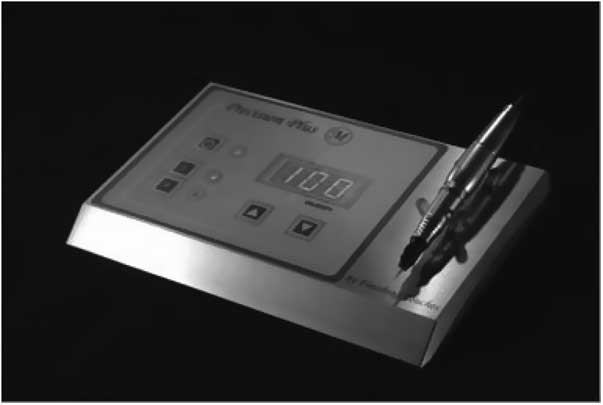
The PPMS used in this study (Figure 1) is a commercially available device used in the application of semi-permanent make-up and in cosmetic surgery procedures. It has Class 2a medical certification and was purchased from ‘Finishing Touches Ltd’ (Sussex, UK).
Precision plus micropigmentation system.
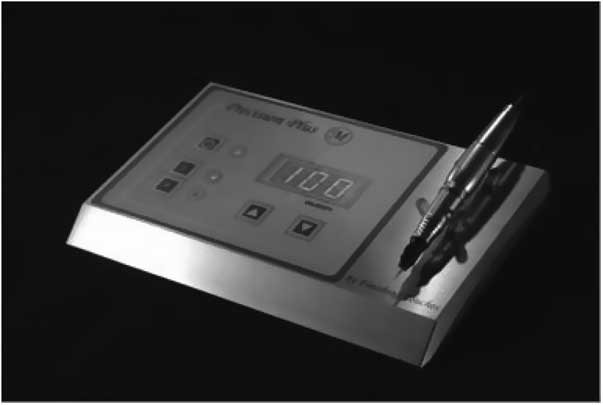
Disposable single use cartridges housing fine needles are inserted into a motorised pen drive. This is used to inject micro-pigments into the dermis at a more superficial level than permanent tattooing. These marks are expected to fade over time but the rate of fade is unclear.
The local standard procedure for applying treatment reference marks for standard breast or chest wall using tangential fields requires three permanent tattoos, one anterior reference mark on the mid-line and two lateral reference marks. A Unilet® (Woodstock, UK) general-purpose lancet is dipped in sterile black skin tattooing ink and used to pierce the skin at the reference points made with marker pen during simulation. Patients having supraclavicular nodal irradiation have an additional tattoo.
All women of 18 years or over with a diagnosis of primary breast cancer who consented for radical breast radiotherapy were eligible to enter the study. A study patient information sheet was developed and offered to all eligible patients. Informed consent was gained from each participant before inclusion in the study.
Randomisation was performed using sealed envelopes following informed consent and enrolment to the study and prior to patient simulation. Each envelope contained instructions regarding the marking method to be used for each participant. Each study participant had three marks applied following simulation using a combination of the standard permanent method and the PPMS method. Black micro-pigment was chosen for use with the PPMS to be comparable with the standard permanent tattoos. A sterile single use 5-point cluster needle cartridge was used at a needle speed of 120 insertions/second. This procedure was developed following consultation with the company specialist during PPMS training on the need to achieve a mark that would last the duration of a treatment course. Participants were randomised to have two marks by one method and the remaining mark by the other method. Participants were blinded to the type of each mark. The position of each type of mark was also part of the randomisation, that is anterior chest, right lateral or left lateral.
PPMS user feedback
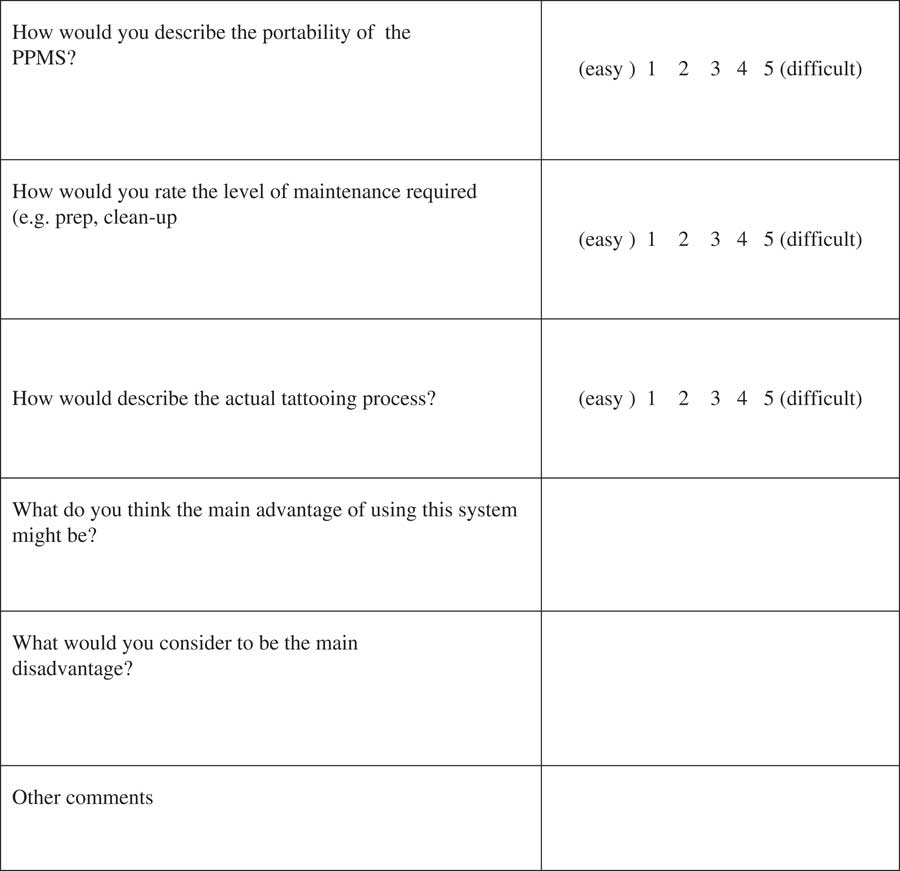
Training on how to use the PPMS system was undertaken by simulator radiographers before commencing the study. A sample of five simulator radiographers was asked to give feedback anonymously using a simple six-item questionnaire (Figure 2).
Radiographer feedback questionnaire.

Study follow-up
Participants were reviewed weekly during treatment to record durability and to monitor any skin reactions around the marks.
Each participant was reviewed at routine treatment follow-up appointments. They were asked to score the visibility of each mark using a 0–100 mm Visual Analogue Scale (VAS), 0 indicating that the marks were invisible and 100 indicating maximum visibility. A separate VAS was used for each mark, that is medial, right lateral and left lateral.
Each mark was also scored using a separate VAS at each follow-up appointment by an independent therapy radiographer also blinded to the origin of the marks.
Study approval
The trial received local research approval from the Belfast Health & Social Care Trust Research Office and ethical approval from the Northern Ireland Health & Social Care Research Ethics Committee.
Statistical analysis
The study design used triangular difference testing. 18 Two marks made with the same method were used to form a measure of repeatability within each participant. Each participant had two dots by one method and one by the other. The standard error of the mean difference is σ (1+½)1/2=1·225σ. If σ=10 this will be 12·25. The power calculation becomes equivalent to a one-sample test with effect size=5/12·25=0·41 and based on a two-sided significance level at 0·05, 48 participants are required. The target recruitment was set at 60 to allow for a 20% attrition rate. Tattoo scores at each time point and change in tattoo scores at 24 months were analysed by a general linear model with the patient as a fixed effect and the type of tattoo (standard or research) as covariate.
RESULTS
Study population
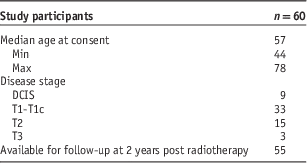
In total, 60 patients were recruited to the study between November 2011 and May 2012 (Table 1).
Study population

Durability of marks
None of the semi-permanent marks required re-marking prior to the end of radiotherapy. One participant required a repeat simulator session to re-mark a failed permanent tattoo. None of the participants demonstrated any adverse skin reaction to the micro-pigments used or the needles.
Visibility of marks
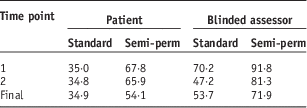
Both the participants and the blinded assessor scored all semi-permanent marks as more visible than the standard permanent tattoos at each follow-up.
Semi-permanent tattoos demonstrated a greater degree of fade than the permanent tattoos at 24 months (final time point) post completion of radiotherapy (Table 2). This was not statistically significant, although it was more apparent for the patient scores (p=0·071) than the blind assessor scores (p=0·27).
Mean tattoo scores by time-point and assessor

Radiographer feedback
On a scale of difficulty from 1 (easy) to 5 (difficult) the PPMS scored a mean of 2·8 for portability. Portability was stated as the main disadvantage from all five respondents, due to the cord from the device to the nearest mains power supply having to remain plugged into power the device while in use.
The level of maintenance required scored a mean of 1·6 and the tattoo process a mean of 1·0.
The main advantages stated were, ‘quick, unambiguous tattoos’, ‘quicker more consistent marks’, ‘less pressure required than standard method’, ‘tattoos larger’, and ‘quicker and seemingly less painful for patient’.
DISCUSSION
Although the semi-permanent marks were scored more visible at 2 years post radiotherapy, they also faded more than the permanent tattoos. This was not statistically significant, however. A longer duration of follow-up or a greater number of patients may have demonstrated the differential between semi-permanent and permanent tattoo rate of fading as statistically significant.
The rate of fade was unknown before the study and may have been influenced by a number of factors. It is possible that a different colour of pigment, a different needle cartridge or reduced needle velocity may have resulted in marks that faded in a shorter period of time. It is also reasonable to postulate that the tattooing techniques employed for both the permanent and semi-permanent tattoos may have been prone to a degree of inter- and intra-operator variability. It could also be reasoned that the degree of pressure used and the time taken to administer a standard permanent tattoo using an ink covered lancet is less consistent than the step by step, motorised technique requiring minimal pressure specific to the PPMS. The local standard tattooing method requires a degree of skill and pressure to be applied in order to ensure that the tattoo ‘takes’ or is successful. It is possible that radiographers, accustomed to applying pressure to ensure conventional tattoos are visible, applied similar pressure when using the PPMS, which may have been more than was necessary. Combined with the motorised action of the needle cartridge, this may have contributed to the semi-permanent tattoos being slightly larger than the permanent tattoo and influenced the visibility scores. Radiographer satisfaction responses would indicate that using the device is clinically feasible in the simulator room. Issues regarding portability could be resolved if a cordless re-chargeable model was developed. This would not only address the issue of portability, but also eliminate the potential risk introduced to a clinical area of a mains lead from the simulator couch to the nearest mains outlet.
It may have been appropriate to assess radiographer satisfaction relating to the standard method used for comparison. However this would have requested feedback comparing an established familiar technique with a new one and therefore would have been prone to a degree of bias.
Radiographer feedback was limited to five respondents. This was due to the minimal rotation of staff, trained in the use of the PPMS, from the simulation section. This small number is a limitation of the study but in fact is reflective of working practices in our department. Consideration was given to including feedback from staff not routinely working in simulation however the authors believed it more appropriate that the PPMS procedure was compared by those proficient in the standard procedure.
Radiographer feedback suggested that the PPMS caused less discomfort to the patient. However this is based on their perception of the patients’ reactions and responses and therefore subjective and anecdotal. Patient feedback on the tattooing procedure was not included as part of the study. Any real or perceived reduction in discomfort may have been because less pressure was needed, a reduced depth of penetration of the needles was required, and overall shorter exposure time to the needles was necessary.
The use of a 100 mm VAS is common in the patients’ assessment of pain and some evidence exists to suggest that it is a viable tool in assessing visibility.Reference Papas and Schultz 19 Both the VAS and questionnaire used in this study are un-validated and therefore may be a limitation of this study. In addition, due to the number of radiographers trained in using the PPMS and working in simulation, feedback is from only five respondents.
Also not assessed in this study but relevant from the patient perspective is that the PPMS device provided a choice of pigment colour. The colour of pigment used in this study was black. This was visible in all participants in this study population. Would-be participants of non-white colouring could have been offered an alternative colour of pigment to be more visible on their particular skin tone.
CONCLUSIONS
This is the first randomised study comparing two different methods for the administration of breast radiotherapy reference marks and also the first using the commercially available PPMS system. We conclude that it is feasible to use the PPMS for the administration of radiotherapy reference skin marks. It provides a suitable alternative to permanent ink and needles/lancets for the administration of breast radiotherapy set-up marks.
PPMS semi-permanent marks were assessed as more visible than the permanent marks at 2 years post completion of radiotherapy. Our results suggest that the semi-permanent marks faded more over this time than the permanent marks, but this was not statistically significant. This study would indicate that semi-permanent marks made using this device and the technique detailed will last a minimum of 2 years.
In terms of effectiveness, ease of use and patient choice, the PPMS offers an effective alternative to permanent tattooing. Further development and assessment of the technique is required to maximise fading of marks in a timely manner.
Acknowledgements
The authors thank Dr Ciara Lyons, MB BCh, MRCPI, FFRRCSI for providing local critical review. The Northern Ireland Cancer Trials Unit provided administrative support and advice during the design and approval phases of this study. ‘Finishing Touches Limited’ (Sussex, UK) provided PPMS training for radiographers.
Financial support
This research was financially supported by registered Northern Ireland charity ‘Friends of the Cancer Centre’.