In December 1977 an independent candidate named Mehdi Zana was elected mayor of Diyarbakır, one of the biggest cities in Turkey's southeastern region. His election was a striking event, upsetting the troika of class, party, and state that had maintained a tight hold over the local political apparatus in Diyarbakır since the 1940s. Unlike most prior mayors of Diyarbakır, Zana did not come from a prominent family of local notables but was a working-class tailor with a middle-school education. He was one of only two independent candidates who won electoral contests in Turkey's sixty-seven big-city races; his election therefore flew in the face of a national trend that favored candidates from the country's two main political parties. Zana was well known for his left-wing, KurdistFootnote 1 politics, and at the time of his election he already had spent several years in jail for his activism. In a system that suppressed collective expressions of Kurdish identity, he was thus a clear ideological interloper.
Why was Zana able to win the election in defiance of such odds? How was a marginal actor who lacked traditional social capital and espoused a radical, countersystemic agenda able to gain control of a major municipality? What conditions made it possible for an ethnopolitical entrepreneur like Zana to break into the political arena? If we read Zana's election as an indication that at least some parts of Turkey's southeast were exhibiting politically distinct dynamics in the 1970s, how can such differentiation be explained? This article explores these questions in an effort not only to understand the empirical riddle of Zana's election but also to open a window through which to view the complicated political terrain of 1970s southeastern Turkey—and, more generally, the emergence of regional and ethnic difference.
The questions we pose straddle divisions among disjointed bodies of scholarly literature on political participation, party volatility, ethnopolitics, and social movements, and they are not easily answered by existing work on either Turkish politics or Kurdish activism. Although studies of Turkish party politics and elections from this period do offer some analytical purchase into the structural factors producing what some analysts called a “realignment” of the Turkish political system in the 1970s, there are almost no studies of politics in Diyarbakır or the southeast in these years. Those works that do exist focus on the major political parties (in particular, their performance in the 1973 parliamentary elections), breakdowns in governance, politicization of institutions, and the increase in political violence.Footnote 2 Studies of the Kurdish national movement in Turkey, for their part, have not examined the 1970s in any empirical detail. Although providing useful overviews of organizational activity,Footnote 3 they are too general to offer much insight into the changing electoral dynamics of the region. Such gaps are surprising given the tumult and obvious import of Kurdish political activity in the years immediately preceding the 1980 military coup, which was rationalized in part as necessary to protect the country from Kurdish separatism.
Given this dearth of precise information, it would be easy to see Zana's election as an aberration—or, conversely, to conflate ethnicity with political behavior and assume that politics in the southeast has always been “different.” A general reading of the national politics of the 1970s makes it plausible to posit a kind of center-periphery argument in which Zana's election is attributed to the collapse of government authority and the subsequent “loss of control” of cities such as Diyarbakır, which then “fell” to Kurdish nationalists. There are two problems with this hypothesis. First, although the parties might not have been able to quell political violence, they did not lose control of elections. In most parts of Turkey, the major parties (taken together) maintained high levels of voter support. Second, to explain Zana's election this way would be to fall back on a kind of primordialist argument indicating that Kurdish nationalism was always there, ready to “bubble up” to fill any vacuum in the state's monopoly on control.
In contrast, our analysis makes two points. In the first, we suggest that the southeast was in a state of political crisis in the 1970s because the established political parties were unable to mobilize voters in the Kurdish-majority provinces. This is evident from the very high level of electoral support there for independent candidates. The elections of the 1970s mark one of the first moments in which voter preferences in the Kurdish-majority provincesFootnote 4 of Turkey began to look appreciably different than those in the rest of the country. Put another way, in some parts of the southeast, Kurdish ethnicity was beginning to demarcate the outlines of a territorial area with political characteristics different from those in other parts of the country. This ethnic variation complicates the developmentalist explanation of the vote for independents that was common to literature of the 1970s.Footnote 5 Somewhat counterintuitively, though, the process of differentiation we can observe was not simply a Kurdish nationalist development; it was part of a more complicated and fragmented set of dynamics that were neither linear (i.e., starting in the 1970s and continuing uninterrupted through the 2000s) nor necessarily irreversible.
Party-system breakdown is a regular occurrence in many countries;Footnote 6 what is striking in this case is the regional specificity of the parties' decline. We link this to the weakening power of local notables,Footnote 7 to the parties' failure to establish durable partnerships with the increasingly active social-movement organizations in Diyarbakır and other parts of the southeast, and to the parties' inability to incorporate new regionally and ethnically based frames into their agendas. New political actors emerged in urban areas and began articulating demands that had not been made in the past; in the case of cities such as Diyarbakır, these demands reflected specific cultural, administrative, and economic concerns not necessarily shared by groups in other parts of the country. The combination of the failure of national parties and the emergence of new actors offering alternative “blueprints for action and belief”Footnote 8 meant that instead of depending on the national party structure, actors such as Zana were able to assert their own interests and impose their own agendas on the local political scene. These structural factors created new conditions of possibility that outsiders might exploit. Nonetheless, such dynamics do not in and of themselves explain the outcome of the election: most independent candidates running for mayor lost.
Our second point, then, is that Zana was able to take advantage of the disarray of the national parties and win control of the mayor's office by building an eclectic coalition composed of new social-movement organizations and informal networks. His particular type of social capital allowed him to credibly offer alternatives to the national political parties and the local notables. His ability to acquire this sort of social capital outside of the usual elite institutions and to mobilize alternative, nonparty resources was a clear reflection of the changing political and social context.
On a more general level, this case suggests how party failure to adjust to structural changes can provide openings for political outsiders to enter the political field by using new frames and forming new coalitions as part of a process of regional differentiation. We point to concrete mechanisms by which socioeconomic transformations can produce political differentiation (defined here as a geographic or ethnic difference in political behavior) or even autonomization (a situation in which local actors are able to build coalitions on the basis of locally defined interests).
Sources on Zana's election and, more generally, on politics in the Kurdish-majority area of Turkey in the late 1970s are relatively meager. Like secondary sources, primary sources are difficult to find. Although a wide array of Turkish-language memoirs offer useful accounts of politics and movement activity in the 1960s and the early 1970s, very few discuss the second half of the 1970s.Footnote 9 General results of the national and local elections are readily available from the Turkish Statistical Association (formerly the Devlet İstatistik Enstitüsü, or DİE), and we rely on these. (Unfortunately, it does not appear that detailed results of the election at the level of neighborhood ballots were published.) In addition to such data, our sources include open-ended, face-to-face interviews, including with Mehdi Zana; national and local press reports from 1976 to 1980,Footnote 10 in particular from Yeni Yurt (New Country) and Diyarbakır Sesi (Diyarbakır Voice),Footnote 11 both published in Diyarbakır in the late 1970s (neither of which were Kurdist or very sympathetic to Zana, at least in the run-up to the election); left-wing and Kurdist periodicals from the period (especially Özgürlük Yolu [Freedom Road/Way]); memoirs; and other published interviews available in Turkish-language books, periodicals, and newspapers.
The article is organized into two main parts. The first, a regional-level analysis, examines the rise in electoral support for independent candidates in the Kurdish-majority regions of the country in the 1970s and why the national parties lost support there. The second part of the article moves to the level of the Diyarbakır municipality and analyzes the December 1977 election and Zana's campaign more closely.
DIFFERENTIATION OF THE KURDISH SOUTHEAST
Electoral results from the 1970s suggest that the Kurdish-majority provinces of the southeast were beginning to exhibit political tendencies distinct from the rest of the country.Footnote 12 In particular, these provinces evinced a higher than average level of support for independent candidates. In the December 1977 local elections,Footnote 13 a significant portion of the electorate in Kurdish-majority provinces in the southeast supported independent candidates for local office rather than candidates from the national political parties. In the provinces of Muş, Siirt, Ağrı, Mardin, Van, Bitlis, Tunceli, Elazığ, Bingöl, and Diyarbakır, the vote for independent mayoral candidates ranged from 12 to 71 percent (Table 1). Put another way, 77,828 people out of 283,304 who cast valid votes in these provinces—just over one in four—supported independent mayoral candidates. In the provincial councils, nearly one in three supported independents (Table 2).
Province-level votes for independents and turnout in mayoral elections (percentages)

In the provinces selected, independents won at least 10 percent of the vote in the 11 December 1977 elections.
Source: DİE, 11 Aralık 1977 Yerel Seçim Sonuçları (Results of the 11 December 1977 Local Elections) (Ankara: Devlet İstatistik Enstitüsü Matbaası, 1979).
Actual votes in Kurdish-majority provinces for independents in the 1977 provincial council and mayoral elections

Source: DİE.
This propensity to vote for independent candidates stands in marked contrast to voter behavior in the rest of the country. In both the national (parliamentary) and local elections of 1977, the vast majority of voters in Turkey overwhelmingly supported either the center-left Cumhuriyet Halk Partisi (CHP, Republican People's Party) or the center-right Adalet Partisi (AP, Justice Party). In the 11 December local elections, 83.4 percent of the country's total vote for mayors went to one of these two parties, with the CHP winning 45.6 percent and AP winning 37.8 percent. Voter support for one of the two major parties was on the upswing; in the 1973 local election, by comparison, the CHP and AP together had won just under three quarters of the total vote (73.2%).Footnote 14 On a national level, independent candidates running for mayor won only 6.1 percent of the vote in December of 1977 (Table 1). The support for independents in the Kurdish-majority provinces, coming in the midst of an increasingly polarized electorate, thus ran against national trends.
Such a penchant for independent candidates in this part of the country was part of a larger trend evinced in the 1973 and 1977 national elections (Tables 1,3, and 4). In June 1977 an average of 29 percent of voters in the Kurdish-majority provinces voted for independents. Again, this contrasts with the national average of 2.5 percent. A two-level (national–local) vote for independents is important because voters in Turkey often support independent candidates in municipal elections but much more rarely at the national level; we are looking not simply at typical support for local notables but also at a more significant development. Parties appeared incapable of adequately representing constituent concerns, and voters who were unhappy with the people and programs of the parties were able to choose alternatives.
Province-level votes for independent candidates in the regional councils (il genel meclisi)

In the provinces selected, independents won at least 10 percent of the vote in 1977 local elections.
Source: DİE.
Independents in the 1973 and 1977 parliamentary elections in selected provinces

In the provinces selected, independents won at least 10 percent of the vote in the 11 December 1977 local elections.
Source: DİE.
Also striking is the fact that provinces with a significant level of support for independent candidates in both national and local elections had an ethnic Kurdish majority. Put another way, all but one of the Kurdish-majority provinces in Turkey exhibited an unusually high level of support for independents in both these elections.Footnote 15 In twenty-one Turkish-majority provinces, higher than average numbers of voters supported independents in local elections, but independent candidates received no more than 5.3 percent of the vote in the 1977 June national elections. In fact, eighteen of these twenty-one received less than 1 percent of the vote for independents (Table 4).Footnote 16 In addition, in the 1977 parliamentary elections, eight of the eleven candidates elected as independents were from the Kurdish-majority provinces in the southeast. Probably for the first time, Kurdish ethnicity, although still linked to territoriality, was becoming identifiably correlated with electoral behavior.
It is important to emphasize that the independents campaigning in 1977 were not a unified bloc; they had different social profiles and political tendencies. Although some were Kurdist, many were not. The differentiation of the region cannot, then, be treated simply as a Kurdish nationalist process or movement. The eight representatives elected from the southeast as independents in the June 1977 parliamentary elections, for instance, were all local notablesFootnote 17 and generally did not articulate support for a Kurdist agenda. Running as independent candidates was not necessarily a committed stand on their part but often a short-term pragmatic decision made after negotiations with the parties broke down. In the case of local elections, the political identities of independent candidates are difficult to ascertain exactly because their names are not noted in the national statistics on local elections. Names—and thus social profiles—are generally available from local newspapers, but these lists are also sometimes incomplete. Our information on Diyarbakır and some other provinces does suggest, though, that independents in local elections were a diverse group, including candidates representing Kurdist and left-wing organizations (legal and illegal), local notables, small and big businesses, and others.
The Weakening of the Mainstream Parties
The high numbers of votes for independents among Kurdish voters in the southeast occurred as a collective phenomenon not because independents represented a collective agenda but because the established political parties were unable to mobilize voters. If national parties are indeed in the business of balancing the reproduction of some collective identities while they “preempt alternative forms of social mobilization,”Footnote 18 in this case they failed to do so. Why were the parties less able to attract voters in the region at this time? Why, instead, did so many Kurdish voters cast their votes for independents?
Three phenomena can help explain the weakening of mainstream political parties. First, social and political changes were undercutting the power of local notables, who had been an important part of the party structure in the southeast and the usual intermediaries for voter mobilization. Second, mainstream political parties were not well connected with new social movements, and social-movement organizations were increasingly capable of supporting outsiders in elections. Third, mainstream political parties lost control of the terms of debate. Especially in the southeast, a new ethnoregional discourse was becoming popular as a way of framing problems, but such regionally based distinctive frames were illegitimate in Turkish politics. This last point is of particular importance because the first two factors were not specific to the Kurdish-majority provinces. Parties seemed increasingly out of step with many voters in the region. Both political and social processes, therefore, weakened the capacity of mainstream parties to attract voters in the southeast, a problem they encountered in later decades as well.
Notable Politics
The 1970s saw significant weakening of notable politics in many parts of Turkey, and the southeast was no exception. This complex phenomenon resulted from two different dynamics. First, certain political parties began to favor party loyalists and ideologues more than notables. This was the case for the CHP and the Islamist Milli Selamet Partisi (MSP, or National Salvation Party)Footnote 19 in many parts of Turkey. An important component of CHP chairman Bülent Ecevit's national strategy for developing the party's electoral base had been to shift the party to the left in a strategic alliance with the unions.Footnote 20 This strategy clashed with party dynamics in some localities. Where the local party apparatus had been controlled by local notable families, the CHP had difficulty working with unions and promoting the party's leftist program. Even though some notables were elected as independents in the 1977 parliamentary elections, parties were less and less attached to networks of notables.
Second, notables' resources were less relevant than in the past due to socioeconomic transformations, notably, the modernization of agriculture and urban migration. In the 1950s and 1960s, expanding educational opportunities, demographic changes, industrialization, and urban migration produced an increasingly diversified and mobilized society. More than a million people moved to cities in the 1950s, and by 1960 Istanbul, Izmir, and Ankara were growing by 10 percent a year.Footnote 21 As an important body of work has documented, this altered class structures, patterns of social relations, and political dynamics throughout the country.Footnote 22 Such changes were particularly important in the southeast, where landed elites, often supported by central state institutions, had maintained substantial power. In Diyarbakır province, 71 percent of the population lived in rural areas in 1955; by 1975 this had dropped to 57 percent.Footnote 23 Notables were not completely out of the picture; the fact that all independent parliamentarians elected in 1977 in the southeast were notables signals that some of them were still influential. However, those who continued to win office were obliged to spend considerable personal resources to do so; they tended to be the most powerful and wealthiest of their class.
New Actors
Political parties also encountered problems in the Kurdish-majority provinces because they were not well connected to the new social-movement organizations increasingly active there in the 1960s and especially in the 1970s. Concurrent with the socioeconomic changes discussed previously, in the 1970s unions and professional organizations became important actors in political and social life in southeast urban centers like Diyarbakır. Provinces such as Diyarbakır were not industrialized, so civil-servant unions tended to be the biggest and most influential. Turkey's largest and most important trade union, Türkiye İsçi Sendikaları Konfederasyonu (Confederation of Trade Unions of Turkey), had been established there since the 1950s, and TÖB-Der—a large and influential teachers' association—was also very active. Many union activists were seasonal workers returning from western Turkey who had been politicized by their participation in left-wing organizations there. The unions were largely independent from the parties, even if they often chose to support them (for example, in the 1977 parliamentary elections, unions mostly supported the CHP). Many activists were Kurdist and active in leftist or union organizations such as TÖB-Der.
Both legal and underground left-wing Kurdist organizations also asserted more influence in local and regional politics, especially in the latter half of the 1970s.Footnote 24 Unlike in the 1960s, when actors articulating Kurdist demands were for the most part closely linked to the Turkish national left, in the 1970s they operated more autonomously. This autonomy encouraged the emergence of explicitly Kurdist political discourse and the prioritization of local concerns. The organizational cleavage from the Turkish left had begun at the end of the 1960s but was dramatically accelerated by the 1971 coup, resulting in the banning of both the Türkiye İşçi Partisi (TİP, or Workers Party of Turkey), which had housed many Kurdish activists,Footnote 25 and the important Kurdist umbrella group, the Devrimci Doğu Kültür Ocakları (DDKO, or Revolutionary Eastern Cultural “Hearths”). The coup also led to the imprisonment of many activists. After the general amnesty of 1974, left-wing and Kurdist activists and politicians could work more openly again, but unlike before, large numbers participated in quasi-legal or illegal associational activity. They were distinguished by different views about tactics (e.g., whether to use armed struggle) as well as personal and political differences.
Although TİP was refounded in May 1975, it never regained its status or electoral support, and many Kurdish activists who rejoined its ranks were working within parallel, competing, and sometimes illegal organizations.Footnote 26 Two comments about these organizations bear emphasizing. First, the fluidity of Kurdist organizational affiliations during this time is important both in explaining Zana's semiautonomous status and the type of coalition he was able to form. Second, these organizations were for the most part more important in reframing the Kurdish question in Turkey than in engaging in concrete action; the heavy emphasis in this period on printed journals (and the fierce disputes that took place in their pages) bears witness to this. The DDKO was reorganized in mid-1974 as the Devrimci Doğu Kültür Dernekleri (DDKD, or Revolutionary Eastern Cultural Association). Rızgari and the Türkiye Kürdistan Sosyalist Partisi (TKSP, Kurdistan Socialist Party of Turkey) were illegal groups that published important Kurdist journals. Özgürlük Yolu, published regularly from 1975 until January 1979, was one of the most important outlets for Kurdish-nationalist discussion and served as the legal, cultural front for the TKSP. The (illegal) Kürdistan Ulusal Kurtuluşçuları (KUK, or Kurdistan National Liberators) was also active in Diyarbakır.Footnote 27
Regional and Ethnic Framing of GrievancesFootnote 28
Multiple grievances existed at both the regional and national levels that these challengers could use to produce new frames and mobilize support. Inflation rose annually from around 20 percent in the early 1970s to 90 percent by 1979.Footnote 29 On a national level, unemployment increased throughout the 1970s, and in cities like Diyarbakır the municipality often could not pay the salaries of civil servants. The oil crisis of 1973–74 led to a steep rise in fuel costs and, by the end of the 1970s, cuts in power that sometimes lasted for hours. Political violence between left- and right-wing students and militias killed more than 200 people nationally in 1977.
Voter polarization between the CHP and the AP led to a series of very unstable coalition governments between 1973 and 1980 that were seen as unable to cope with these economic and political problems.Footnote 30 The number of nationwide recorded strikes rose from 22 in 1973 to 167 in 1977; the number of striking workers increased from 12,284 in 1973 to 59,889 in 1977.Footnote 31 Economic woes tended to be acutely felt in the eastern and southeastern provinces because of preexisting problems with the allocation of resources and the region's long-term infrastructural inefficiencies. Unlike in other parts of the country, in the Kurdish-majority provinces such grievances were framed not only within the bipolar left/right paradigm but also increasingly as part of a distinctive regional and ethnic problem. Ideological restrictions in Turkish national life meant, however, that the national parties could not incorporate regionally or ethnically distinctive frames into their narratives and programs, making them appear incapable of meeting voter needs and, ultimately, eroding their existing support base. In this sense, ethnic-based politics was not a product of the periphery but a systemic phenomenon.
Criticism of the poverty and underdevelopment of the east (and, later, the southeast) had been a theme in the press and political discourse since the 1950s.Footnote 32 Especially in the late 1960s, such differences began to be constructed outside the developmentalist and modernist discourse as something linked to cultural bias and internal (Turkish) colonialism. The idea that the people of the region constituted a distinctly Kurdish political community, that they were suffering at the hands of the state because they were Kurdish, and that at least part of the key to a better future lay with collective Kurdish cultural rights and regional autonomy became part of a public discourse.Footnote 33 These grievances had been harnessed to left-wing, class, and identity frames by activist politicians at the national levels beginning in the 1960s. In the 1970s, some Kurdish members of the parliament began talking explicitly about the status of Kurds in Turkey, most notably, Şerafettin Elçi, a parliamentarian from Mardin who became minister of public works in the Ecevit government in 1978 and 1979, and Nurettin Yılmaz (an independent deputy from Mardin). Headlines of mainstream newspapers reflected a sense of regional inequity and injustice, even for natural disasters.Footnote 34 The lack of state response to the 1975 Lice earthquake, for instance, in which thousands of people were injured and many more were left homeless, received extensive coverage in the regional and Kurdist press.Footnote 35 Another recurring complaint was the brutality of the commandos of gendarmerie.Footnote 36 In the mid-1970s the police and security forces had come under the influence of the Nationalist Action Party and were heavily infiltrated by ultranationalist militias (ülkücü). Attacks from right-wing militants and security forces were especially common in schools and seemed to worsen in the southeast after the June 1977 national elections. Police sometimes openly supported attacks against leftist students and union workers.Footnote 37
The articulation of Kurdist frames as a way to address these concerns was evident in the press, in political discourse, and in public gatherings. In 1967, for instance, a series of “eastern meetings” held in Kurdish cities across the southeast brought together tens of thousands of people in the country's first-ever public events of this kind. Participants called for resources, development, democratization, and Kurdish-language rights. Organized primarily by the local offices of TİP, these gatherings brought together Kurdish leaders from many parties on the right and the left, fostering a sense of community and highlighting the political relevance of Kurdish identity.Footnote 38
Global dynamics and regional events also helped produce new discourses and contexts that affected many different groups. The 1958 overthrow of the monarchy in Iraq, revolution and uprising in Algeria and Latin America, and the left-wing student movements of the 1960s offered powerful examples of political contestation. The return of Mustafa Barzani to Iraq in 1958 and Barzani's subsequent rebellion offered inspiration and new models of state–Kurdish relations. The transmission of Kurdish-language radio, Kurdish books and news from Iraqi Kurdistan, and the flow of people back and forth across a still porous border helped mobilize people and heightened a sense of distinctive Kurdish community.
However, although Kurdist and some left-wing groups were able to construct the area's problems as regional or ethnic, they were not without ambiguity about the “Kurdish question.” Part of TİP's Kurdish leadership opposed ethnic-based politics (Burkay, for example); the majority preferred the developmentalist or Marxist frame. The dark fate of parties identified (rightly or wrongly) with promoting regional recognition had been made clear in the early 1970s with the effective disappearance of TİP and the Yeni Türkiye Partisi (YTP, or New Turkey Party). Although these two parties had very different politics (TİP being a socialist party composed of intellectuals, academics, independents, and union leaders, and the YTP being a party mostly composed of local notables), they had nonetheless been providing representation to the Kurdish regions in the 1960s and early 1970s.Footnote 39 Both had sought to respond to specific demands from the southeast at a moment in which the Kurdish question was beginning to be publicly framed by many different actors (including the mainstream parties and press) as a regional/ethnic problem.
DİYARBAKIR IN THE 1977 LOCAL ELECTIONS: A PROCESS OF AUTONOMIZATION
This broader context helps explain why mainstream Turkish parties were finding it more difficult to attract voters in the Kurdish-majority provinces. However, despite winning substantially more votes than in the past, very few independent candidates were able to defeat established party candidates in mayoral races. Now we turn to an analysis of how and why someone like Mehdi Zana was able to capitalize on these conditions and win the Diyarbakır election.
Support for independents in Diyarbakır in the local elections had steadily increased throughout the decade, and the 11 December 1977 elections demonstrated how crowded and diverse the local political field had become. Along with Zana, the field of fourteen candidates included prominent local businessmen, former mayors and members of parliament, and trade-union leaders. Eleven of the fourteen ran as independents. We were not able to determine precisely how many people voted for Zana because the DİE results do not list independents and their votes by name and because we could find no local or national press results detailing the outcomes of the Diyarbakır municipal race. Zana claims that he received around 7,000 votes of a total he puts at 20,000.Footnote 40 This would give him 35 percent of the total vote. However, the DİE reports that 25,405 valid votes were cast in the Diyarbakır municipal raceFootnote 41 (5,405 more than Zana indicates), throwing these figures into some doubt. What is clear (from the DİE publications) is that independent candidates received 55 percent of the total vote and Zana a relatively high percentage of this vote given the full field of candidates.
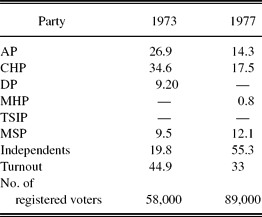
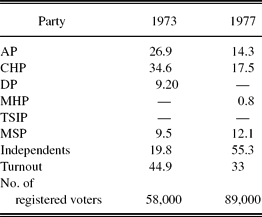
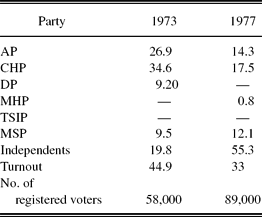
Particularly striking is the high level of support for the Kurdist left if we collectively tally the vote for Zana and votes for the second-place candidate, Yahya Mehmetoğlu, who ran as the representative for TİP and, unofficially, the (Kurdist) DDKD. Zana writes that Mehmetoğlu received 4,050 votes, which would mean that Zana and Mehmetoğlu between them took more than 50 percent of the vote. By contrast, the CHP received 4,400 votes (17.5%), the AP won about 3,600 (14%), and the MSP won about 3,000. Moreover, support for independents from Diyarbakır was not customary for the province. Among the Kurdish-majority provinces, Diyarbakır was among the least interested in independents in the 1960s; in the 1963 local elections, for instance, only around 12 percent of its voters supported independent candidates.
Mainstream Party Difficulties
The kinds of problems that the mainstream parties encountered generally in the southeast were very much in evidence in Diyarbakır in the 1977 local elections. National and local news reports suggest that the parties campaigned late and relatively ineffectively in the region. Ecevit visited Diyarbakır a week before the election and encountered protests, and violence interrupted his election tour in Gaziantep and Urfa.Footnote 42 Diyarbakır province's voter turnout was the lowest in Turkey, a sign that the political parties were especially inefficient in mobilizing voters. (There is no clear correlation, however, between a high vote for independents and low voter turnout in the southeast.)
Election results from December 1977 indicate that all the national parties fared worse in Diyarbakır province and city than in the past (Tables 5 and 6) and that their relative rankings among voters remained the same as in 1973 (CHP, AP, and MSP in that order). No clear internal factors explain the fall in support for the AP and the MSP, so the main explanation probably lies with broader structural shifts. However, three factors are important in explaining the decline in support for the CHP in the local elections in the Kurdish-majority provinces.
Selected votes in mayoral elections in Diyarbakır city center (merkez) in 1973 and 1977

Source: DİE.
Diyarbakır provincial council selective results for 1963–77
Source: DİE.
First, the social profile of the CHP leadership in Diyarbakır made it difficult for the party to cast the election on a polarized left–right basis at a local level. The Kurdist left withdrew the support from the CHP it had provided in the national elections, arguing that although it had been important to back the CHP in its greater fight against the “fascists” at the national level, the same did not hold true for local elections.Footnote 43 Mehdi Zana was able to use the contradiction between the left-wing CHP discourse, on the one hand, and the elite social profiles of CHP candidates, on the other hand, to craft a class-based discourse that did not directly attack the state establishment but instead the notable classes (a discourse similar to that employed elsewhere by the CHP).
Second, the CHP's mismanagement of the Diyarbakır election provided Zana with an organizational vacuum he could exploit. The CHP had won Diyarbakır in the 1973 local elections and won the city in the June 1977 national elections, putting it in a strong position to repeat its earlier successes. However, in the fall of 1977 the Diyarbakır branch of the CHP was beset by infighting over control of the local party apparatus. The candidate-selection process generated sustained debate, and the CHP's initial choice for the mayor's office—former Diyarbakır member of parliament Hasan Değer—withdrew from the race. The announcement of the party's new candidate—Recai İskenderoğlu (a notable)—was then overshadowed by a brawl in the party's Diyarbakır headquarters that resulted in the death of a party member and the arrest of the local branch chair.Footnote 44 The fight, which made national headlines, involved supporters of two men whose families were vying for control of the party and the local council candidate lists. Moreover, former Diyarbakır mayor Nejat Cemiloğlu's decision to quit the CHP in 1977 cost the local CHP branch some of its legitimacy among Kurdish activists because Cemiloğlu had been known as sympathetic to Kurdist sentiments.
Third, the notables who represented the national parties were locally in an awkward position due to the transformation of the city of Diyarbakır, which had seen dramatic and rapid sociodemographic changes. Diyarbakır province experienced its highest rate of population growth (40%) in the period from 1965 to 1970. Notable politics based on personal connections and limited resources could not mobilize enough voters, especially recent city émigrés not traditionally linked to the city's important families. The percentage of the population who could read and write also jumped up sharply; in 1960, for example, 70 percent of the male population of Diyarbakır province was classified as illiterate; by 1975 this had dropped to 44 percent. (Although female illiteracy had declined as well, 84% of women in Diyarbakır province were still classified as illiterate in 1975.Footnote 45)
Population growth had compounded the city's traditional infrastructural and service problems. Even a brief survey of local newspapers in 1977 highlights the many grievances. Complaints ranged from lack of health, educational, electric, water, and sewage services to problems with crime and violence, including blood feuds and police brutality. Student unrest among high school and university students was acute. Dissatisfaction was often directed against the municipality; Yeni Yurt newspaper reported in September 1977, for instance, that local people protested the mayor's years of failure to improve the sewage system, something critics argued had contributed to the spread of diseases such as cholera.Footnote 46
Zana's Social Capital and Resources
Unlike many other candidates, Zana's sociopolitical profile allowed him to credibly offer alternatives to the national political ticket and local notables. Three main characteristics gave him “narrative credibility” and helped him build a local coalition. First, he was not from a well-to-do or notable background.Footnote 47 He was born to a lower-middle-class family on 20 December 1940 in Silvan, a town in Diyarbakır province. His father worked in the municipality there and apprenticed Zana to a tailor when he was in his early teens. He completed only middle school and was quite poor. Unlike many other activists, most of whom lived for many years in Istanbul or Ankara, Zana had remained in Diyarbakır province. His habitus (speech, physical attitude, demeanor) was deliberately “popular,” and he was commonly referred to as halk çocuğu, literally, “child of the people.” All of these characteristics marked him as quintessentially local and set him apart from most other Kurdist leaders.
Zana was thus well positioned during the election to offer a class-based counterframe that emphasized the existence of rich and poor, privileged and underprivileged, and to link these class differences to Diyarbakır's poor services. Zana transformed his working-class background into an election asset by positioning himself as someone who shared ordinary people's needs and concerns. As such, he argued, he could represent voters more effectively than past administrators, whom Zana argued had been upper-class “beys and pashas” unresponsive to ordinary people's needs.Footnote 48 He was fiercely critical of the aghas (large landowners), accusing them of exploiting the local population. This anti-agha discourse was common in the 1960s and 1970s in left-wing parties and the socialist press and was a relatively safe target in national discourse because of the aghas' perceived link with underdevelopment and “premodernity.”
Second, Zana had long been an important part of left-wing and Kurdist political circles in Diyarbakır. Zana credits much of his early political education and growing activism to the influence of his mentor and onetime boss, tailor and political activist Niyazi Tatlıcı, better known as Niyazi Usta; the two were close until Tatlıcı died just before Zana's election in 1977.Footnote 49 Tatlıcı's tailor shop in Diyarbakır was a center of socialist and Kurdist political activity, and many activists described it as a kind of “university.” A member of TİP in Silvan in the 1960s, Zana served in administrative positions in the party's national office and the Diyarbakır branch. He also helped organize the eastern meetings of 1967. In the 1969 parliamentary elections the party chose him to run as a candidate for parliament (he did not win the seat). In the 1970s he was an important member of the Özgürlük Yolu movement associated with the journal by the same name and of Kemal Burkay's (illegal) Turkey–Kurdistan Socialist Party, and he had links to other left-wing, Kurdist associations.
At a time when it was uncommon for people to openly identify themselves as Kurds, he was well known as a Kurdish patriot (yurtsever). Even his name was a deliberate political statement: in the 1960s he changed his given family name, “Bilici” (Turkish for “one who knows”), to its Kurdish equivalent, “Zana.”Footnote 50 He had been imprisoned for his activism in the late 1960s for a year and again between 1971 and 1974. His Kurdist connections also extended beyond Diyarbakır; he had made several trips to Europe and to Iran and Syria to visit Kurdish groups prior to the election (although these international activities do not seem to have played a role in the campaign).
Third, Zana was well known by local people. Zana's long years in the tailor shop had provided him with an extensive network of grassroots contacts in the Diyarbakır area, and he had established a reputation as an advocate for local concerns not only through his involvement with Kurdist organizations but also through direct community action. His reputation as an activist and local leader came in good part from his willingness to confront authorities and security forces over, for instance, commando attacks in Silvan; from his role in attempting to bring petroleum refineries to the area; and from his help in organizing a large protest in 1975 that prevented Turkish ultranationalist leader Alparslan Türkeş from speaking in Diyarbakır.Footnote 51 Moreover, because of his modest education and relatively poor Turkish, Zana was not a typical Kurdist political elite; he was to some degree marginalized within the leftist and Kurdish movement. Unlike most other leading Kurdish activists of the 1960s and 1970s (e.g, Kemal Burkay, Musa Anter, Tarık Ziya Ekinci), he was not an intellectual. Instead of focusing on internal power and intellectual games inside the party, where he had fewer opportunities than others, he focused on “external” building of reputation and resources.
Mobilizing Support: The Autonomization Process
Zana capitalized on these three elements of his personal biography during the campaign when he mobilized an array of supporters. They provided him with valuable human and material resources that compensated for his lack of national-party support. Some of his supporters (unions, teachers, students) were linked to new social-movement organizations, and some were more informal (tribes, neighborhood networks). In stark contrast to the way politics in Diyarbakır had worked before, he was able to turn his working-class/Kurdist/activist profile into an election asset because, first, it connected him to all these different types of groups rather than forcing him to rely on one or the other, and, second, it legitimized his claims to be committed to local concerns.
Kurdist Networks
Although support from Kurdist movement organizations was essential to Zana's success, he exhibited sufficient autonomy from them to suggest he should not be seen simply as a movement candidate running as an independent. Zana's decision to seek office was apparently a personal one made without active recruitment on the part of Kurdist organizations.Footnote 52 He announced his candidacy in the local press in late August 1977.Footnote 53 He was able simultaneously to draw upon a popular base of support and some of the resources of Kurdist organizations without being particularly dependent on any one group.
Zana spoke openly about the need to defend Kurdish culture and community, forcefully advocating the right to use one's mother tongue and to identify oneself as Kurdish. He gave many of his election speeches in Kurdish, arguing that Kurds in Turkey had been subject to “colonialist” and “fascist” aggression and that he was a candidate who would forcefully resist this. He thus clearly posited a Kurdish “we” against an official and nationalist Turkish “they.” His election manifesto, published in the local newspaper Yeni Yurt, emphasizes these themes, with Zana promising he would “support the struggle of our people against imperialism, fascism, colonialism, and feudal reactionaries” and “expose the deceitful tricks being played on our labor, our culture, our homeland, in short, on our existence.”Footnote 54
He was backed by the Diyarbakır branch of the Türkiye Sosyalist İşçi Partisi, one heir of the original TİP, which decided in the month prior to the election to support him.Footnote 55 Illegal Kurdist groups such as the KUK supported him and began patrolling his house for his security (although Zana writes that he was unconvinced of the necessity).Footnote 56 The Özgürlük Yolu/TKSP group also campaigned hard on his behalf despite some leadership misgivings.Footnote 57 Although the influential teachers union, TÖB-Der, did not formally support him (reportedly because it was divided between Zana and the DDKD candidate, Yahya Mehmetoğlu), many of its members were known to be his supporters and voted for him.
In contrast, despite his long-term affiliation with the new TİP and the DDKD, arguably two of the most important political groups in Diyarbakır, Zana was not supported by either in his campaign. He split from the TİP in 1977 prior to the election, and, as we have noted, TİP and the DDKD organizations fielded another candidate against him (Yahya Mehmetoğlu).Footnote 58 Some left-wing intellectuals called Zana uneducated and unsuitable for candidacy, and although many union rank and file backed him, he does not appear to have garnered much formal union support. Yeni Yurt reported, for instance, that it was not Zana but another independent candidate who received formal backing from fourteen unions.Footnote 59
Social Networks
Rather than relying only on Kurdist political organizations, Zana assembled a broader coalition that included other new urban actors and grassroots networks. Among Zana's most loyal and passionate supporters were youth, some of whom openly clashed with their families over support for his candidacy.Footnote 60 The Devrimci Halk Kültür Derneği (Revolutionary People's Cultural Association), a youth group with high school and university-student membership linked to the TKSP, campaigned on his behalf. Zana and his associates recall the students working around the clock to collect funds, hang banners, hand out election materials, and recruit support.Footnote 61
Zana also garnered important resources from neighborhood-based networks, especially in Diyarbakır's peripheral poorer areas, such as Bağlar and Ben u Sen. His four-month grassroots campaign reflected this local grounding and was unusual for the time in both length and style. Running under the slogan “Mehdi Zana halktan yana” (Mehdi Zana is on the side of the people), he and his supporters went door to door, held nightly meetings at coffeehouses around Diyarbakır, and organized election rallies. The campaign had very little money, and various sources report that ordinary people turned out to help, gathering campaign funds, paying for tea and food, offering Zana free use of building space, and refusing to allow him to pay for basic necessities and services.Footnote 62 Interestingly, Turkish authorities appear to have interfered little until the final week of the campaign, when the governor and security director questioned Zana for a night before releasing him.Footnote 63
Less predictable, given Zana's personal profile and political record, were his overtures to key tribes and shaykhs in outlying villages and towns. In particular, he sought and received the backing of the Botan and Omeriyan tribes. It appears they gave him support not only because of his reputation for Kurdish nationalism but also because of a combination of personal connections and mediation. In Siirt, for instance, Zana called upon an old agha friend with whom he had shared jail time after the 1971 coup to gain the support of the Botan.Footnote 64 Although tribal affiliations did not play much of a role in Diyarbakır city politics by this time, the tribes were probably important in providing much needed material support and in mobilizing hemşehri (hometown) support in Diyarbakır neighborhoods among those who had recently migrated to the city.
Two further points about this coalition should be noted. First, it was temporary and not very stable. The relative informality of the coalition and Zana's high degree of organizational independence led to difficulties once he took office. His ties to some tribes angered some Kurdist supporters who accused him of pandering.Footnote 65 Despite Zana's working-class roots, his administration faced constant strikes, at least in part instigated by Kurdist and unionist actors who had formerly supported him and subsequently engaged in a bitter struggle for control of the municipality. Zana's relations with the Özgürlük Yolu/TKSP movement (in particular with TKSP chairman Kemal Burkay), already tense over his unilateral decision to run for office, strained and soon broke over who controlled the resources of the municipality.Footnote 66
Second, the coalition highlights the messiness of politics on the ground and the fluidity of allegiances, in turn emphasizing the limitations of discourse and institutional membership as a guide to predicting political behavior. The diversity of forces supporting and opposing Zana in his bid for the mayor's office complicates common perceptions that left-wing Kurdist organizations “naturally” support a left-wing Kurdist candidate and, conversely, that “traditional” social forces “naturally” oppose him. The reality appears much more complex, and the identities of the actors involved much more fluid, than we would necessarily expect given the often dichotomous discourse of the actors involved.
CONCLUSIONS
This article has examined how a working-class Kurdish activist was able to win the mayor's race in the December 1977 local election in Diyarbakir, defeating the established party candidates and a host of independents. Zana served as the city's mayor until the military coup of 12 September 1980, when he was imprisoned for eleven years. We attribute the election of an ethnopolitical challenger like Zana—and the broader transformation of politics in the country's Kurdish-majority region during these years—to two main factors. First, mainstream political parties were unable to mobilize as many voters in the Kurdish-majority provinces of the southeast as they had in the past. This was due to the weakening power of local notables, who had served as the parties' traditional allies; parties' inability to work closely with new and local social-movement organizations, many of them Kurdist; and parties' failure to integrate regionally based frames and demands into their agendas. Party incapacity thus provided new opportunities for outsiders to enter the political field.
Second, we have suggested that Zana's particular brand of social capital and flexible political links to the Kurdist movement put him in a strong position to create an election coalition outside the notables or mainstream parties. This coalition included some (but not all) Kurdist and left-wing organizations as well as other social groups and networks. Unlike other candidates, Zana possessed the narrative credibility to link the problems of ordinary Diyarbakır residents to exploitative, elite politics and ethnic chauvinism and to offer a radically different, working-class, Kurdist agenda designed to appeal not only to left-wing Kurdish activists but also to regular people. Put another way, he was able to obtain sufficient material and symbolic resources outside established institutions to build a viable campaign.
More than a case study of one man's election, Zana's campaign and the 1977 elections draw attention to the way ethnic and regional differentiation may occur. Contrary to common perceptions, the political distinctiveness of the Kurdish-majority southeast did not develop because of communal clashes between Kurds and Turks, economic underdevelopment, or uniformly experienced grievances. It occurred, rather, through a more complicated set of processes and events that affected various communities and parts of the region differently. This case demonstrates how in moments of structural and political transformation, the emergence of alternative frames and new social resources can produce a potential for autonomization, that is, the ability for local organizations to establish agendas and local coalitions that cannot readily be incorporated into the fabric of national politics. Especially when new frames are being constructed outside the legitimate political system and then used by new social-movement organizations, mainstream political parties may not be not able to integrate these frames into their agendas.
Such autonomization is not an inevitable outcome, however; it is often fragmented and not necessarily unidirectional (in other words, it can be reversed). The complexity of the process becomes evident if we note that other Kurdist candidates were elected in the cities of Urfa, Batman, and Ağrı but were not part of a network and did not necessarily work together before or after the election. This points to the importance of local-based coalitions as a precondition in the emergence of an ethnic or regional party able to coordinate these local dynamics.
That electoral differentiation did not occur because of a unified political stance on the part of Kurdish nationalists draws attention to the diversity of political preferences among Kurds in the region. This raises interesting questions about how and when people's demands can be unified (and the central role played by Kurdist parties in doing this) and, conversely, how such demands become diversified (or rediversified). Such a trend toward unification can be observed, for instance, in the very high level of support for Kurdist parties in urban areas of the Kurdish-majority southeast in the 1990s and 2000s.
Both the election and Zana's tenure in office (1978–80) also provide useful comparative perspectives on several decades' worth of politics in Diyarbakır. Like Kurdist officials in the late 1990s and 2000s, Zana sought to craft a form of specifically Kurdish representation. In 1977, as in the period between 1999 and 2009, municipalities were “captured” by actors who publicly used them as resources for furthering Kurdist agendas. The idea that Diyarbakır city constituted a kind of “castle” or fortress (kale) to be conquered by (or taken from) Kurdish nationalists—a metaphor and phrase very much in evidence in the 2000s—gained currency during these years. Transnational networks between Diyarbakır and Western Europe that became particularly important in the 1990s and 2000s were also developed under Zana's tenure; faced with a perennially indebted municipality, for instance, he made regular trips to Europe to muster support.
At the same time, attending to the dynamics of the Diyarbakir political scene in the 1970s highlights the dramatic transformations in both the Kurdist movement and the Turkish state that took place between the late 1970s and the late 1990s in the southeast. Local politics in Diyarbakır in the late 1970s was characterized by high levels of urban-based societal mobilization, considerable organizational diversity and intramovement competitiveness (especially among unions and within the Kurdist movement), very low levels of municipal resources, and a relatively inefficient and distracted state presence (until 1980, when this changed dramatically). In contrast, by the late 1990s and 2000s, local political dynamics were more bipolar, the movement dominated by one main organization (the PKK), and the level of official coercion against elected Kurdist representatives more systemic and multifaceted. Mehdi Zana's election thus signaled both the zenith of a cycle of Kurdist contention in Turkey and marked the beginning of its end.