A FAMOUS PAST
Peter Hervik describes the Yucatec Maya as “a native group with a famous past” in the opening line of his book on “social categories and lived identity in Yucatan” (1999:xix). His study explores the apparent identity disconnection between two concepts and categories of Maya, a disconnection pursued deeper into the historical record in a recent book by Wolfgang Gabbert (Reference Gabbert2004). These and other anthropologists have observed that today's “native groups” often call themselves mestizos and that many “think of the Maya as their long dead ancestors.” That connection serves to keep those ancestors alive in some sense, just as they are kept alive in the Maya world created by academia and tourism. This is more than just a case of modern Mayas “living with the ancestors,” to borrow Patricia McAnany's (Reference McAnany1995) phrase. As presented to the public, these ancient Mayas are not only buried inside the pyramid (or under the living room floor), but like the legendary El Cid (nailed to his horse to rally his followers and overawe the enemy), Maya lords are paraded posthumously through ancient sites to rally the tourists and overawe readers of National Geographic.
It may be just a matter of time before the reconstruction of the past at sites like Chichen Itza includes full-scale reenactments of the kind popular at Civil War battlegrounds. When this happens, scholars will not be able to resist debating issues of “accuracy” and “authenticity” but most likely in private; publicly, anthropologists and archaeologists will surely acknowledge that such reenactments reflect the importance of “diverse interests in the past” and the fact that scholars do not enjoy a monopoly on interpreting the past (I borrow here from the MATRIX project's principles for curriculum reform; see www.indiana.edu/~arch/saa/matrix/homepage.html).
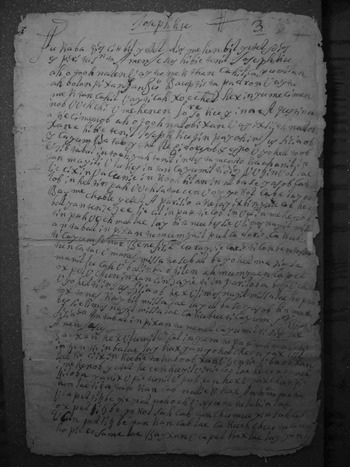
Similarly, historians recognize that colonial documents are not our property; they are part of the national patrimony. But historians do not often debate what “national patrimony” means. We may sympathize with the idea (even the principle) that today's Mayas in some way own the manuscripts written by their ancestors, but how is that ancestral link defined, and who therefore “owns” documents about Spaniards and Afro-Yucatecans (or should that be “Spaniards” and “Afro-Yucatecans”)? And what of the fact that the further documents traveled from towns and villages in Yucatan, the better they survived? (Merida is good, Mexico City better, Seville and Madrid better still; and just as good is a university library in a northern climate—see Figures 1, 2, and 3.) Public archives created by modern nations have allowed scholars, including (perhaps especially) foreign ones, to appropriate and interpret the pre-national past, often for the simple pleasure of posing riddles, constructing solutions, and making a living from doing so. When David Webster writes that “we have collectively appropriated” the Maya “for our larger cultural uses,” his “we” is not royal but confessional. “We expect things Maya to be beautiful, exotic, and dramatic,” he continues, “and especially mysterious” (Webster Reference Webster2002:29).
Folio 1r of the will of Joseph Ku, dictated in 1712 and written down by the notary of the cah of Xocch'el. An example of an archive-preserved, mundane document in Yucatec Maya. Reproduced by permission of the Princeton University Library, Special Collections (Mesoamerican MSS #5).

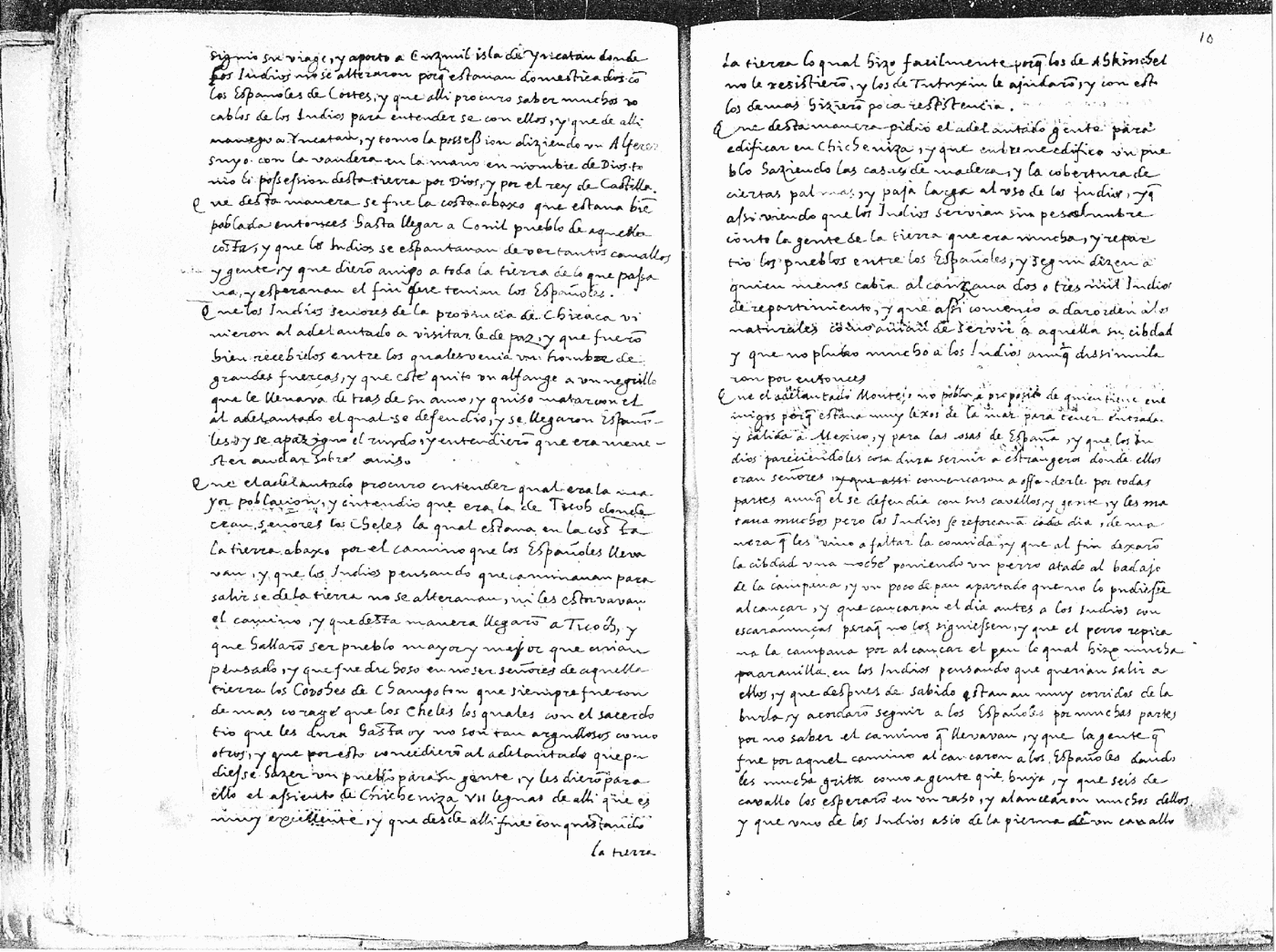
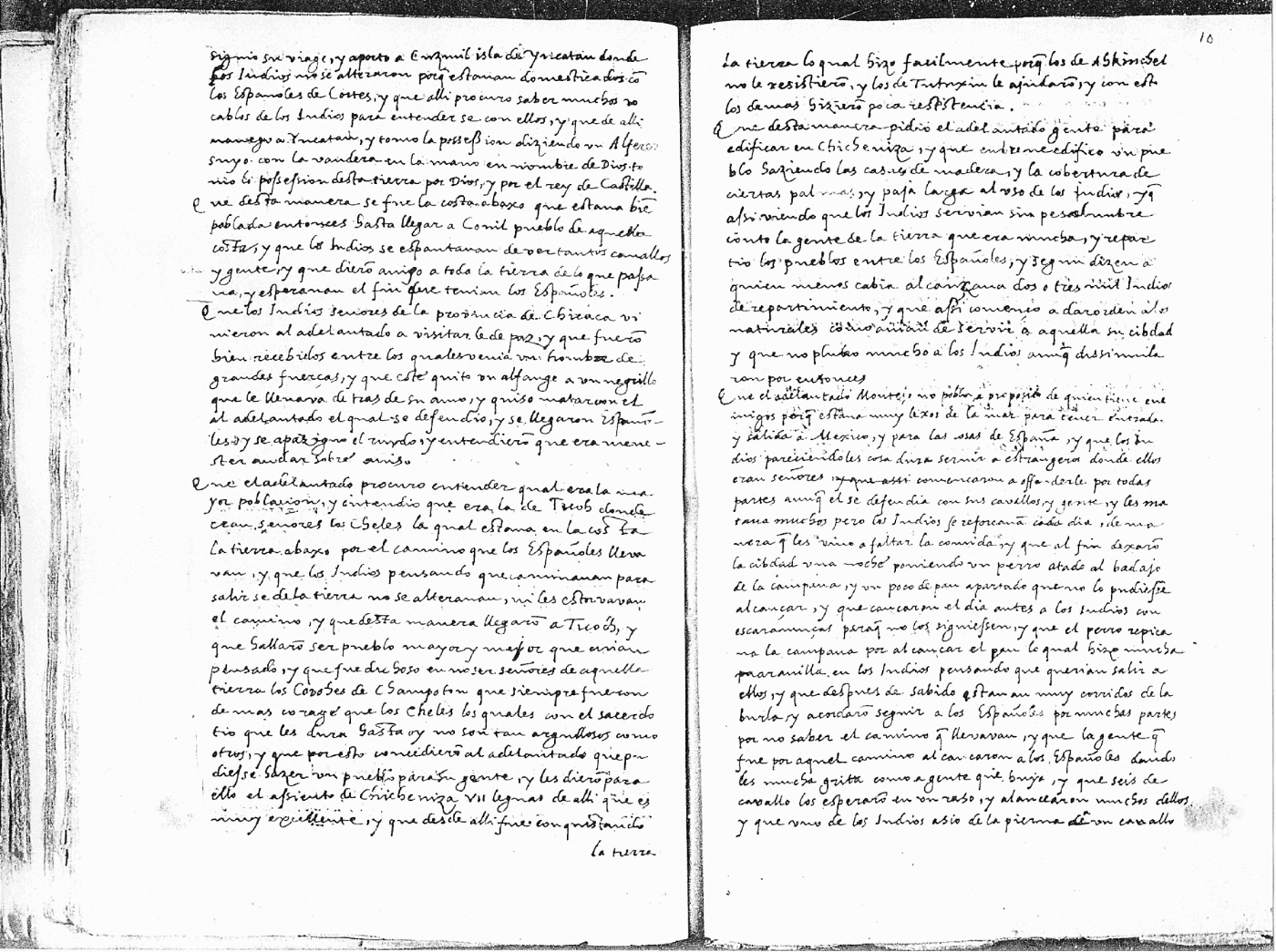
Folios 9v–10r of Landa's Relación, which is not a book written by Landa in 1566, as often claimed, but an eighteenth-century copy of excerpts from a long-lost larger work; some passages, like the one shown here, are a copyist's summary of sections of the larger work. The upper paragraph on folio 9v is a rare reference to the earliest medium of interaction between Mayas and Africans—that of military encounters between Maya warriors and black conquistadors. Reproduced by permission of the Real Academia de la Historia, Madrid (MS 9-5153).
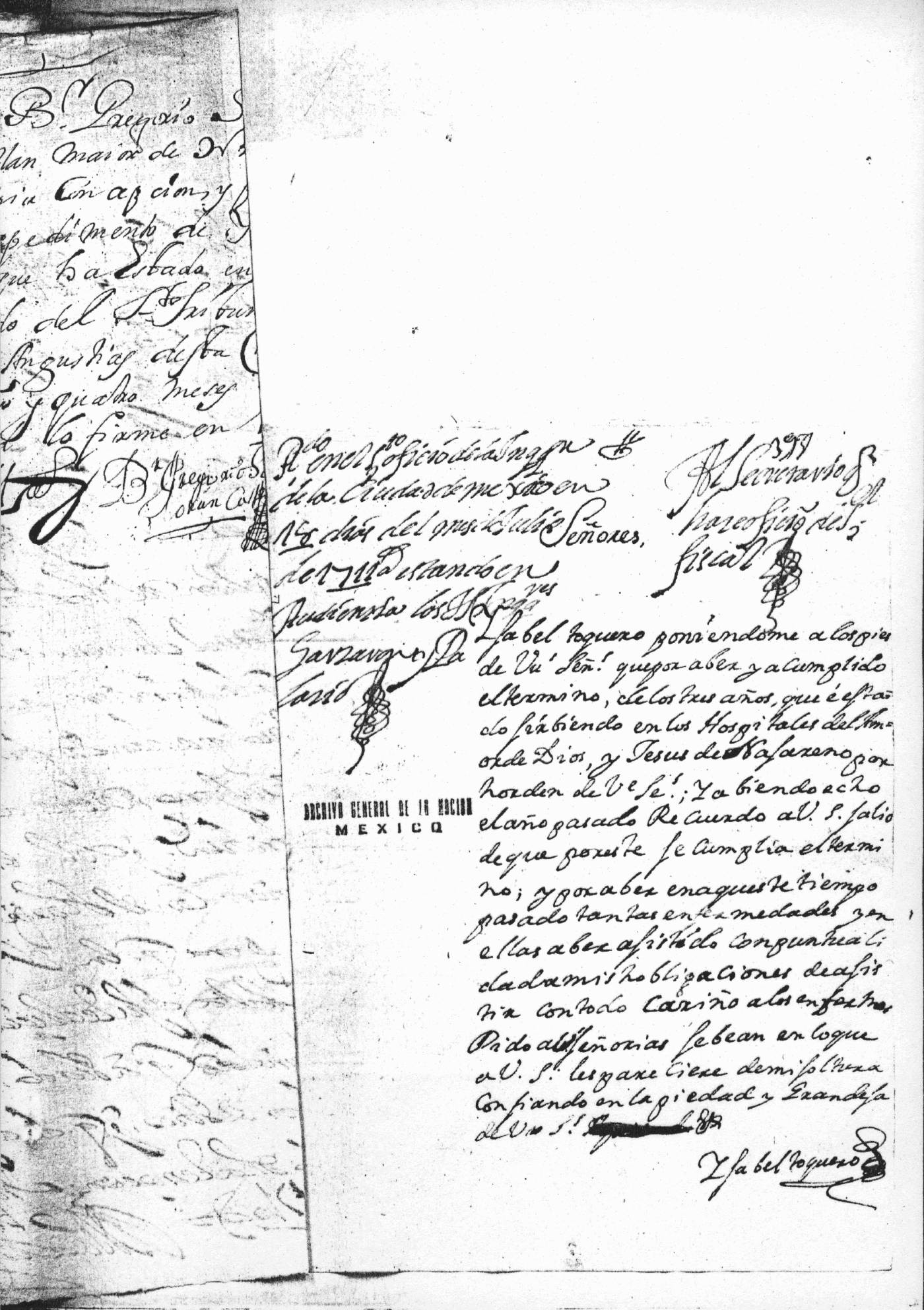
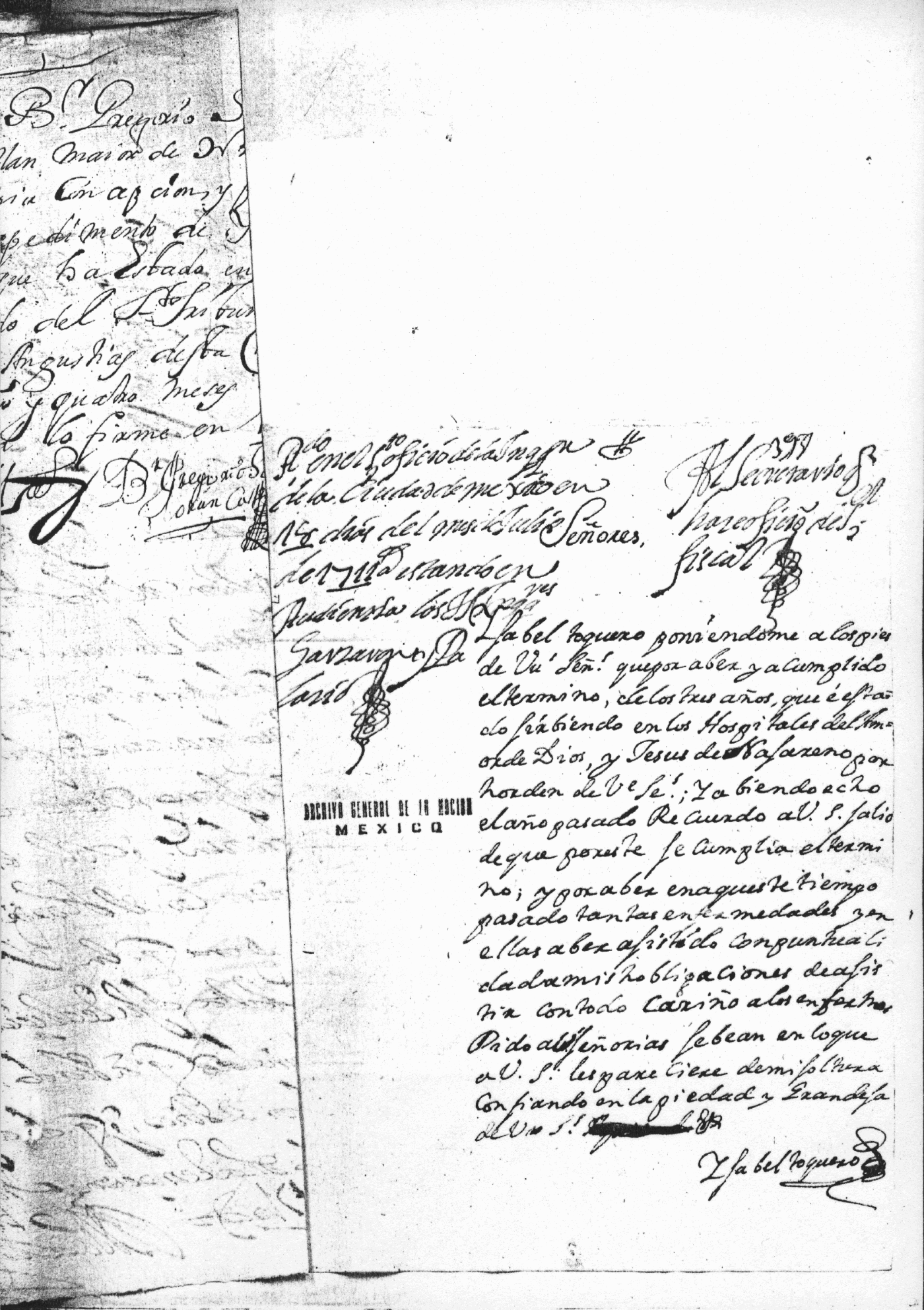
Folio 397r of the Inquisition's bigamy investigation into Isabel Toquero, in Inquisición 519 in the Archivo General de la Nación, Mexico City. Toquero was an Afro-Yucatecan woman born in the cah of Dzonotake in 1675, arrested in Merida in 1703 under accusation of bigamy, and subsequently convicted and imprisoned in Mexico City. Inquisition files are among the richest source materials on Afro-Yucatecan lives. The folio above is a request for release written by Toquero herself (her story is told in Restall Reference Restall2009:200–204, 234–246). Reproduced by permission of the AGN.
If the Mayas are, rather predictably, “the mysterious” of this essay's title, then who are “the invisible”? You may have assumed, quite reasonably, that the term is a reference to some other aspect of Maya history or historiography. In fact, it is a reference to that group of people who remain the least studied and most ignored in Yucatan's history—Africans and their colonial-era descendents. Indeed, this is true not just of Yucatan but of the larger region of Mexico and Central America; some quarter of a million Africans were brought as slaves into that larger region in the century and a half after the voyages of Columbus, making New Spain as big a stimulus to the early trans-Atlantic slave trade as Brazil, and creating a sector of colonial society in the viceroyalty of New Spain more demographically significant than that of the Spanish settlers (Vinson and Restall Reference Restall2009). In Yucatan, between the mid-sixteenth and early nineteenth centuries, the number of people of African descent (from black slaves to free mulattoes) was comparable to the number of Spaniards in the colony; both, of course, were greatly outnumbered by Mayas (at a Spanish-African-Maya ratio of roughly 1:1:500 at the time of the Spanish invasion, evolved by ca.1800 to a ratio of Spaniards to Africans-and-mulattoes to Mayas-and-mestizos of 1:1:6) (Restall Reference Restall2009:26–33). Africans, in other words, cannot be dismissed simply on the grounds that there were not many of them.
In his Breve historia de Yucatán, the eminent Yucatec historian Sergio Quezada (2001) divides the peninsula's history into thirteen chapters, containing 97 subheaded sections. The book's genre is that of a textbook, without footnotes or direct historiographical references outside the brief “bibliografía comentada” at the end; but in effect it is an expert summary of the state of Yucatec studies at the end of the twentieth century. As a reflection of that multidisciplinary historiography, Quezada's treatment of Mayas and Africans is of some significance. Mayas appear in his book in four guises: first, as the ancient Maya, a distant people accessed through archaeology and subject to an organic pattern of rise and fall; second, as the colonial Maya, a subordinated people accessed through historical records and characterized primarily by their role as laborers and taxpayers; third, as the cruzob, the rebel Maya resisting both the new national project and the legacy of colonial exploitation that preceded it; and fourth, as the modern Maya, a fragmented peoples whose various pieces—maquiladora workers, ch'a chak ceremonialists, zona turística guides—no longer seem to belong to the same puzzle. Quezada avoids terms like “puzzle” or “mystique,” but he cannot escape the fact that Maya history has been structured around puzzles and mysteries. Of the book's 97 sections, about a quarter refer to Mayas directly or indirectly in their section headings, and Mayas and mestizos (in the modern Yucatec sense) are discussed in many additional sections. In contrast, not a single section heading refers in any way to Afro-Yucatecans, and there are but a few cursory mentions of African slavery in the book's colonial chapters (Quezada Reference Quezada2001).
I will only briefly refer later to what happened in the nineteenth and twentieth centuries that made the Maya mysterious and kept Afro-Yucatecans invisible. There is too much written on the former subject to be easily summarized, especially as discussion of it tends to produce controversy more than consensus. I was flummoxed, for example, when my argument that colonial-era Mayas did not think of themselves as “Maya” was attacked at a conference as showing “lack of respect” for Maya people. I had not intended to strip Mayas of their historic identity, merely to explain how three centuries of written sources in Yucatec Maya proved that colonial-era Mayas did not claim a “Maya” identity. Rather they identified themselves in terms of affiliations of patronym group (ch'ibal) and municipal community (cah). Because my argument was based on mundane Maya-language sources (e.g., Figure 1), I naïvely thought that made it unprovocative. Students of the Colonial period seldom encounter controversy, but perhaps writing about colonial history becomes potentially contentious when a simple link between the Classic period and the present is threatened.Footnote 1
Modern identity politics are not the only category of problems presented by trying not to call colonial-era Mayas “Mayas.” The more historians examine colonial Yucatan, the more we become aware of the weakness of our well-used fundamental categories of identity—“Maya,” “Spaniard,” even “colonial”—while at the same time being obliged to invent new ones—such as “Afro-Yucatecan.” The miscegenative nature of colonial society—the category-blurring nature of sexual, social, cultural, economic, and political relations among putatively separate socio-racial groups—has forced historians to hold up terms of identity in one hand while chipping away at them with the other.
As we stare across the distance between us and those who lived in the colonial past, all these various filters—Maya mystery, Afro-Yucatecan invisibility, the plasticity of colonial-era terms of identity, contemporary identity politics, the challenges of the archives—serve to obscure one simple long-lost fact. That fact is that we cannot truly understand either Mayas or Afro-Yucatecans without understanding both—their origins, separate histories, interactions, and, ultimately, their common history.
THE LANDA LEGACY
Probably the most obvious colonial culprit, the founder of unsatisfactory modern notions about the Maya, is Fray Diego de Landa. But Landa is an obvious culprit not because of what he wrote or whom he influenced in the Colonial period, but because of how the Landa known to anthropologists, archaeologists, and historians was constructed in the late-nineteenth and twentieth centuries. Hervik, for example, blames National Geographic (first) and Landa (second) for the “external construction” of “the Maya” (his scare quotes), but for Hervik the problem lies as much in the modern use of Landa's writings as it does in the historical deeds of Landa himself. Landa's “socially distant view” has done most of its damage by being combined, after the discovery of his Relación in the 1860s, with “a different socially distant view that places the Maya within a global evolutionary framework” (Hervik Reference Hervik1999:60). Hervik is right to separate what Landa wrote from how his Relación has been used, but he understates that separation. Like so many scholars before him—from France Scholes and Ralph Roys in the 1930s to Inga Clendinnen in the 1980s—he is misled by published editions of the Relación into viewing it as a book written by Landa. In this view, Landa wrote his book in 1566, partly to defend his anti-idolatry campaign of 1562, partly to express his ethnographic fascination with the Maya. This is not to blame any of them, from Roys to Hervik; if fingers were to be pointed, they should be aimed at Alfred Tozzer, whose own ethnographic fascination with the Maya blinds the reader to what Landa actually wrote and might have meant by it (Tozzer Reference Tozzer1941).
In fact, the friar wrote no such book in 1566 or any single year. Rather, he compiled over several decades a compendium or Recopilación of sources on Yucatec history; some of the sources were written by him, some by others. This Recopilación was read and cited in the seventeenth century but then disappeared for good; in the eighteenth century, various notaries or friars on separate occasions copied passages from whatever copy or pieces of the Recopilación had survived to that point. Those passages, what we call the Relación, do not come close to having the textual integrity of “a book written by Landa” (Restall and Chuchiak Reference Restall and Chuchiak2002) (see Figure 2).
This does not negate Hervik's point about “social distance” in the Relación, but it changes the nature of that distance and how we might use it to understand how Yucatec history has been produced. Scholars who have used and abused Landa (myself included) have emphasized the conundrum of Landa as both torturer and doting ethnographer of the Maya; the friar and his “book” have been built and billed as a mystery (Hervik Reference Hervik1999:78–81, Clendinnen Reference Clendinnen2003:61–128; Restall Reference Restall1998:144–146, 151–168; Restall, Chuchiak, and Solari forthcoming 2012).
But the more Landa is placed within a widening series of historical contexts, the less mysterious and the more mundane he becomes. Two examples must suffice. First, he was not the only Franciscan to torture Mayas and burn codices in Yucatan; his campaign of 1562 was larger than those that followed, but Spanish priests in Yucatan periodically bullied, bribed, and in various ways coerced Mayas into turning over books and “idols” for destruction for almost two hundred years after Landa's famous auto-da-fé (Chuchiak Reference Chuchiak2000). Nor, of course, was Yucatan the only Spanish American site of anti-idolatry campaigns (see, for example, chapters in Griffiths and Fernando Cervantes 1999).
Second, Landa was hardly unique in the tough-love ambiguity of his attitude toward the Mayas or, put more broadly, toward native subjects of colonialism. We can find the same attitude among Landa's successors in Yucatan; Bishop Juan Gómez de Parada, for example, in his 570-page diocesan synod of 1722, portrayed los miserables Yndios (“the wretched Indians”), as he consistently referred to the Mayas, as a noble but child-like people both worthy of and in need of protection from the Spanish and Afro-Yucatecan colonists (Centro de Apoyo a la Investigación Histórica de Yucatán, Mérida, Colonial MSS #45). We can also find the same attitude in numerous other colonial situations; the most efficient way of making this point may be to compare Landa not to later colonial writers (as he has tended to be pulled toward the present and made inappropriately modern)Footnote 2 but to a European who wrote of colonial subjects fifteen centuries before Landa did. In his Agricola and Germania, the Roman historian Tacitus displayed a remarkably similar ambiguity toward both the process of conquest and colonization, and the nature of the people being thus subjected (Tacitus Reference Tacitus1970).
While Tacitus was problematizing the barbarism of ancient Britons, Maya scribes were carving out—literally—an historical tradition of lordly legitimacy that, by the time Landa arrived in Yucatan, had developed into an attitude toward the past that was rife with ambiguity, mystery, and social distance. In other words, the Maya themselves are as much responsible as Europeans are for the creation of a history drenched in mystery. Nowadays Mayanists take pains not to judge the elements of Maya history that seem contrived, constructed, or myth-like. Such elements, as recorded both hieroglyphically before the Conquest and alphabetically in the Colonial period, are usually characterized as simply reflecting a non-Western approach to the packaging of social memory or the construction of the historical record. In this view, Mayas (indeed, Mesoamericans) see time as cyclical rather than linear—although it is obvious that Mayas, early modern Spaniards, and we ourselves view time in both linear and cyclical terms (Restall Reference Restall1998:41–43). It is also supposedly characteristically Mesoamerican to blur “myth” (metaphorical tales that could not have actually happened) and “history” (events supported by multiple lines of evidence). Dennis Tedlock (Reference Tedlock1985) has called this “mythistory.” But arguably, “Maya mythistory” is a mere alias for “Maya mystique.”
I have argued elsewhere that cultivating mystique was a deliberate and deep-rooted policy among the Yucatec Maya elite, and a key component of elite ideology and lordly legitimacy. Elite claims to foreign origins did not reflect a literal history of past migration from central Mexico or elsewhere—as almost all historians of the peninsula since Landa have assumed—but rather represented the assertion of an exclusive, sacred, even celestial connection to remote places and ancestors. The more deliberately distant and vague these origin sites and ancestors were, the better they evoked the supernatural connections that allowed rulers to transcend their earthly roles and distance themselves from the commoners—thereby simultaneously (and paradoxically) legitimizing their earthly roles as rulers over those commoners (Restall Reference Restall, Inomata and Houston2001b:370–375). In various genres of colonial-era documents in Maya, including mundane materials such as land sale records, elites invoked their connection to specific ancestors and local places (Restall Reference Restall1997:170–173, 196–200; Reference Restall1998:77–143). The “mythistory” of elite origins was thus generated in order to inject mystery into the social distance between rulers and ruled. As further reflection of the pre-conquest roots of this ideology in Yucatan, when a new foreign elite arrived in the sixteenth century, Maya dynastic leaders exploited their association with the new elite to strengthen their local authority. Some adopted the name of Montejo, the conquering “dynasty,” or even “don Francisco de Montejo” as a first (Christian) name, thereby enhancing their legitimacy and adding to Maya lordly mystique (Restall Reference Restall, Inomata and Houston2001b:368–369).Footnote 3
If it is social distance we are looking for in Maya-language sources, perhaps we need look no further than the Books of Chilam Balam. If archaeologists are somehow complicit in the creation of a Mayanist cult that draws energy from “the aura of ruins” (Castañeda Reference Castañeda, Joseph, Rubenstein, Zolov, Rosenberg and Poniatowska2002:1), secretly imagining piloting Luke Skywalker's rebel fighter over the jungles of Tikal (Webster Reference Webster2002: 29), then ethnohistorians are guilty of imposing an esoteric mystique on the colonial Maya through their fanciful interpretations of the nine surviving manuscripts named after the prophet Balam. Yet it would be facile to argue that the Books seem opaque simply because we are unable to understand them. The social distance is not only between us and the notaries who compiled the Books; there was also plenty of distance between those notaries and the sources—both Spanish and Maya, written and oral—that they sought to reconcile and preserve within some kind of coherent, syncretic whole. The editors of the longest Chilam Balam and the most recent to be published, Victoria Bricker and Helga-Maria Miram, present the Kaua as a testament to “the process of syncretism” (Bricker and Miriam Reference Bricker and Miram2002:85). A scholar of Claude Lévi-Strauss called the Frenchman's life work “the result of a remarkable will to coherence” (Johnson Reference Johnson2003:191). The compilers of community copies of the Chilam Balam literature could be said to exhibit a will to syncretic coherence. No doubt Landa's original long-lost Recopilación was the product of a similar will. Indeed, it is hard to imagine a century in Yucatan's history that posed a greater challenge to coherent historical writing than the sixteenth.
DIGGING FOR DOCUMENTS
The production and transmission of history (or the codification of social memory; see Golden 2010) in sixteenth-century Yucatan posed a challenge of coherence to the “historians” of the time, from Landa to the successors of the eponymous prophet Balam. The challenge arose from the concatenation of sources. Source materials were disparate and bountiful in nature, representing various historical traditions and purposes. A small percentage of these sources have survived, but they are enough to present modern historians of Maya history with similar challenges. Scholars will always be drawn to the small number of “exotic” sources—Chilam Balam literature, codices, primordial titles—but the larger body of documentation written in Yucatec Maya from the late-sixteenth through late-nineteenth centuries amounts to thousands of extant items. The mundane material—wills, land sales, petitions, notarial records of various kinds—arguably pose challenges of interpretation just as great and have the potential to reveal just as much about the Maya experience as exotic sources. And while they may not serve to completely demystify the Mayas of the past (after all, would we really want that?), they certainly help us to better understand the nature of the distance between us and them (see Figure 1). (A more detailed comparison of sources on Maya “ethnohistory” and Yucatec “Afrohistory” is accessible online [Restall 2007].)
A scholar first entering the bountiful world of historical sources in the Yucatec Maya language, and about the colonial Mayas, is likely to be overwhelmed by its wealth. In contrast, historians of Afro-Yucatan have had the opposite problem—primary sources appear, at first, not to exist at all (which is perhaps why historians of Afro-Yucatan are so few in number).Footnote 4 In fact, sometimes one simply needs to dig a little deeper. Over the past decade I have found hundreds of written sources on colonial Afro-Yucatan buried in dozens of archives in Yucatan, Mexico City, Spain, the United States, and even England (and no doubt I have only found a fraction of what exists; see Figure 3). In few cases were there obvious keywords, such as negro or esclavo, to lead the historian down the highway from catalogue to document; more often one is obliged to take the pleasurable but prolonged scenic route through parish records, criminal cases, Inquisition investigations, notarial records of sales and mortgages and tax payments, and disputes among Spaniards of all kinds, to discover the thousands of Afro-Yucatecans who have been waiting in the archives to be rediscovered and brought back to life (Restall Reference Restall, Lockhart, Sousa and Wood2007, Reference Restall2009).
Put together, with a certain will to coherence, all these sources are gradually rendering the invisible visible while also offering clues as to why that invisibility persisted. To simplify, there are four reasons. First, the role of Africans in Spanish colonial society as slaves and servants denied them a corporate identity comparable to that of Maya communities or cahob, thus preventing the emergence of Afro-Yucatecan notaries or even many literates (Afro-Yucatecans did produce their own written sources, but not often; see Figure 3). Colonial Yucatan was not a slave society; it was a society with slaves. This distinction means that the master-slave relationship was not the exemplar relationship in colonial Yucatan; the exemplar was the complex relationship between the small Spanish elite and the Maya majority, whose labor sustained the colony. That relationship was mediated partly by Maya elites and partly by Afro-Yucatecans. The latter, both enslaved and free, lived in what I have called “attached subordination” to the Spanish community (Restall Reference Restall2009).
Second, as early colonial ideas about casta or socio-racial rank evolved in the eighteenth and nineteenth centuries into modern concepts of race, racism against blacks emerged in Yucatan as it did throughout the Americas, taking the form of a denial that Afro-Yucatan had ever existed. The modern Mexican mythology of a nation forged from the meeting of two—not three—races and civilizations is reflected at the local level in Yucatan's own Spanish-Maya origin myth.
Third, the process whereby Afro-Yucatan was gradually eclipsed was not disturbed or altered by abolition, which occurred with relatively little controversy, conflict, or drama in Yucatan (as in most parts of what became the Republic of Mexico). This was partly due to, fourth, the process of mestizaje. In addition to the intermixing of Afro-Yucatecans, Spaniards, and Mayas in the urban settings of Mérida and Campeche, there occurred a steady migration of Afro-Yucatecans into Maya villages (typically black and mulatto men who married Maya women); such migrants and their children were absorbed into Maya communities, effectively turning Yucatan's Mayas into Afro-Mayas by the end of the Colonial period (Lutz and Restall Reference Lutz, Restall and Restall2005; Restall Reference Restall2009). The combined impact of mestizaje and shifts in casta classifications helped turn Africans into mulattoes and eventually mestizos—a catch-all category that in the early nineteenth century came to include everyone in Yucatan that was not Spanish or Maya. The fact that today “Mayas” are often called “mestizos” underscores the extent to which this slippage of categories served to erase Afro-Yucatecans from the peninsula's social memory.
Studying the non-Spanish inhabitants of Yucatan's past requires not only bridging the social distance generated by differences of time and culture, but also grasping the specific nature of that distance. Because the Maya mystique in the modern imagination is as much the creation of ancient and colonial-era Maya elites as it is the product of scholars, we must move beyond exotic sources to engage the myriad extant mundane materials. But we must also cross an additional bridge and pay attention to “Afrohistory” as well as “ethnohistory.” If we can accept the latter as a codeword for the study of native peoples in the Americas, perhaps we can endorse the former as sibling code for studying African-descended peoples in the same colonies. Ideally, categories such as “Afrohistory” and “Afro-Maya” are temporary. The more we study them, the sooner we can move beyond them; the more we study Afro-Yucatecans and Afro-Mayas, the better we can understand “Mayas” in the Colonial period.
ALTERING HISTORY
In Alejo Carpentier's novel Los pasos perdidos, the nameless protagonist travels into the jungles of Latin America to reach what he believes is the Valley-Where-Time-Has-Stopped. Here he sets out to write down his magnum opus, only to find that he has insufficient paper and must resort to erasing earlier passages in order to keep composing. Eventually, out of desperation, the protagonist returns to the city for more paper and ink. But he is never again able to find the jungle refuge that is the source of his inspiration, and so his great work remains unfinished (first published in English as Carpentier Reference Carpentier and de Onís1956; also see Echeverría Reference Echeverría1990:1–4).
Carpentier's metaphor of literary frustration works on various levels for historians of Yucatan: Are we up to the challenge of imagining a magnum opus, of finding sufficient source materials, of finding too many? Will words fail us, or will we fail to find their end? Whatever the problem and its concomitant solution, the fact remains that in working on Maya history, a scholar creates his or her own “memory” of how Mayas worked their own history. In working on Afro-Yucatecans (few of whom had the opportunity to compose their own documents), a scholar must create such a “memory” from how Spaniards recorded what Afro-Yucatecans said and did. We can search for our own Valley-Where-Time-Has-Stopped and bring extra paper and ink; we can dig deeper in the archives and exert a will to syncretic coherence. But we are still engaged in the process of imagining and constructing; we are still indulging our own version of what the prophet Balam did.
In the spirit of a will to syncretic coherence (or perhaps an eccentric interpretation of it), I would like to end with a reference to the sixteenth-century French philosopher Michel de Montaigne. Montaigne has nothing whatsoever to say about Mayas, or Afro-Yucatecans, or Yucatan at all. But, in his essay Of Cannibals, he offers a relevant perspective on the process of historical production (or the effort to codify social memory). Cannibals were (and still are) notoriously mysterious and usually invisible, prompting Montaigne to comment on the difficulty of finding a “true witness.” “For clever people,” he remarks,
“observe more things and more curiously, but they interpret them; and to lend weight and conviction to their interpretation, they cannot help altering history a little. They never show you things the way they are.… We need a man either very honest, or so simple that he has not the stuff to build up false inventions and give them plausibility” (quoted in Davis Reference Davis1987:111).
Our challenge, as students of Mayas, Afro-Mayas, and Afro-Yucatecans, is not to avoid “clever people” in the sources and find only “honest” or “simple” ones, but to understand the cleverness of witnesses, to accept the plausibility of their inventions, and to appreciate the altered state of history.
RESUMEN
En este breve ensayo se argumenta que el estudio de los habitantes no-españoles del Yucatán pasado requiere disminuir la distancia social generada por las diferencias de tiempo y de cultura pero que la naturaleza específica de esa distancia debe ser entendido. Con respecto a los mayas, su mística en la imaginación popular y académica es tanto la creación de elites mayas precoloniales y coloniales, ya que es el producto de los arqueólogos e historiadores. Para desmitificar los pueblos mayas, tenemos que entablar fuentes mundanas así como exóticas y ser conscientes de la influencia de los que antes de nosotros han interpretado la cultura maya. Una imagen completa de Yucatán colonial y de los mayas coloniales debe incluir a afro-yucatecos, o los africanos y sus descendientes en la península. Hechos invisibles por los procesos históricos y la falta de atención académica, los afro-yucatecos deben ser ver si vamos a aprovechar plenamente la experiencia yucateca—incluida la experiencia de los mayas.
ACKNOWLEDGEMENT
I am grateful to Rani Alexander, Michel Oudijk, and Travis Stanton for their generously detailed comments on the original conference paper version of this essay; to the anonymous outside reader whose objections to the self-promotional nature of the original paper helped me to find a somewhat more appropriate tone; and to Charles Golden for his patient persistence in keeping me a part of this special section project.