



Introduction
The use of fresh pastures in ruminant production systems has various benefits, including environmental (Soder and Rotz, Reference Soder and Rotz2001), animal welfare (Von Keyserlingk et al., Reference Von Keyserlingk, Rushen, Passillé and Weary2009) and product quality for human consumption (Dewhurst et al., Reference Dewhurst, Shingfield, Lee and Scollan2006; Lourenço et al., Reference Lourenço, Van Ranst, Vlaeminck, De Smet and Fievez2008). However, nutrients intake and productive performance of animals fed only fresh forage is limited and, in addition, these animals are under fluctuations in the availability and quality of forage throughout the year (Wales et al., Reference Wales, Marett, Greenwood, Wright, Thornhill, Jacobs, Ho and Auldist2013). On the other hand, the use of total mixed ration (TMR), which usually include corn silage and concentrated feedstuffs, is formulated to meet the animal requirements and shows recognized advantages, as reduced selection of ingredients and adequate balance of the ingested nutrients by animals (Gill, Reference Gill1979). The combined use of TMR and forage has also been tested as a way of potentializing the positive aspects of both feeding systems for cattle (Wales et al., Reference Wales, Marett, Greenwood, Wright, Thornhill, Jacobs, Ho and Auldist2013; Mendoza et al., Reference Mendoza, Cajarville and Repetto2016; Santana et al., Reference Santana, Cajarville, Mendoza and Repetto2016; Pastorini et al., Reference Pastorini, Pomiés, Repetto, Mendoza and Cajarville2019) and sheep (Pérez-Ruchel et al., Reference Pérez-Ruchel, Repetto and Cajarville2017). In general, these preview studies have reported the impact of diet type on nutrients intake, digestibility, animal performance and some parameters of rumen fermentation.
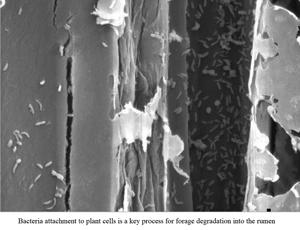
However, forage utilization by ruminants is directly associated to their degradation by rumen microorganisms, mainly fungi and bacteria, which have the most important role on fibre degradation (Koike et al., Reference Koike, Pan, Kobayashi and Tanaka2003; Krause et al., Reference Krause, Denman, Mackie, Morrison, Rae, Attwood and McSweeney2003; Kamra, Reference Kamra2005). Once fibre degrading enzymes are present in microbial cell wall, microbial adherence is the first and essential step to forage degradation (Michalet-Doreau et al., Reference Michalet-Doreau, Fernandez, Peyron, Millet and Fonty2001; Wang and McAllister, Reference Wang and McAllister2002), a process which is affected by several factors associated to feed characteristics and rumen environment. For example, the level of microbial adherence on residue of forage particles incubated in vitro linearly increased when the pH of the incubation medium increased from 5.5 to 7.0 (Farenzena et al., Reference Farenzena, Kozloski, Mezzomo and Fluck2014). On the other hand, the impact of pH on fibrolytic enzymes activity has been variable. For example, Morgavi et al. (Reference Morgavi, Beauchemin, Nsereko, Rode, Iwaasa, Yang, McAllister and Wang2000) extracted enzymes from rumen of cattle and observed that the xylanase activity was not affected at pH varying from 5.0 to 6.5 whereas the carboxymethylcellulase (CMCase) activity was maximum at pH 6.0. Farenzena et al. (Reference Farenzena, Kozloski, Mezzomo and Fluck2014), in an in vitro study, observed maximum activity of both enzymes at pH 6 whereas, however, the negative impact on enzyme activity by reducing the pH to 5.5 was more pronounced for xylanase than for CMCase. In an opposite way, Russell and Wilson (Reference Russell and Wilson1988) reported that the cellulase from B. succinogenes appear to have a pH optimum of 5.5, a rumen condition usually not obtained when animals are fed with only forage.
The objective of this study was to evaluate the effect of diet type on feed intake and on variables of rumen in situ incubation in sheep. We hypothesized that offering decreased proportion of fibre in sheep diet will probably decrease microbial adherence and degradability of forage samples, an effect which would be only partially compensated by increased CMCase activity.
Materials and methods
Animals, diets and experimental design
Three rumen cannulated Santa Inês male sheep (average body weight (BW) of 69.4 ± 0.4 kg), housed in individual metabolism cages, were used in a 3 × 3 Latin square experiment to test three diet treatments: only forage, only TMR or a mixed diet (forage + TMR, 50:50, dry matter [DM] basis). Experimental periods were 13 days long with the first 10 days for adaptation followed by 3 days of sampling and measurements. The forage consisted of a mixed temperate fresh pasture at the initial vegetative stage, composed by oat (Avena strigosa) and ryegrass (Lolium multiflorum), cut at 5 cm above the ground level from a local pasture plot, plus Cynodon spp. hay (70:30, DM basis). All fresh forage was cut at the beginning of the experiment and stored at −18°C. Both forage types were chopped and mixed daily before meal.
The TMR contained (g/kg DM): soybean meal, 350; cracked dry corn grain, 321; whole plant corn silage, 300, sodium bicarbonate, 12 and a mineral salt, 17. The mineral salt contained (g/kg): Ca, 120; P, 87; Na, 147; Mn, 1.3; Zn, 3.8; Fe, 1.8; Cu, 0.59; Co, 0.040; I, 0.080; Se, 0.015 and F, 0.87. Diets were offered ad libitum twice a day, at 08:00 and 16:00 h, in an amount 10% above the average DM intake observed in the three preview days. Animals fed with the mixed diet received TMR at 08:00 h and forage at 16:00 h.
Measurements and sampling
Feed intake was evaluated daily during the measurement period by weighing the amount of feed offered and refused. Samples of feedstuffs and orts were collected daily, dried in a forced-air oven at 55°C, ground to pass to a 1 and/or 2 mm screen (Thomas Willey mill, USA) and stored for analysis and/or in situ incubation. Dried and ground (1 mm) samples were analysed for DM content by oven-drying at 110°C overnight. Ash was then determined by combustion at 600°C for 3 h and organic matter (OM) by mass difference. Total N was assayed by the Kjeldahl method (Method 984.13) of AOAC (1997) and crude protein (CP) calculated as N × 6.25. The acid (ADF) and neutral detergent fibre (NDF) analysis were based on the procedures described by AOAC (1997, method 973.18) and Mertens (Reference Mertens2002), respectively, except that the samples were weighed in polyester filter bags (porosity of 16 μm) and treated with acid or neutral detergent in an autoclave at 110°C for 40 min (Senger et al., Reference Senger, Kozloski, Bonnecarrère Sanchez, Mesquita, Alves and Castagnino2008). The NDF analysis was performed without using sodium sulphite and with use of a heat-stable α-amylase. The chemical composition of forage and TMR is shown in Table 1.
Chemical composition (g/kg dry matter [DM]) of the experimental dietsa

a Mean values ± standard deviation from 29 samples taken during the experimental period.
b Fresh Avena strigosa plus Lolium multiflorum mixed with Cynodon sp. chopped hay (70:30, DM basis).
c Total mixed ration containing (g/kg DM): soybean meal, 350; cracked dry corn grain, 321; whole plant corn silage, 300; sodium bicarbonate, 12 and mineral salt, 17.
The in situ incubations were performed daily during the three measurement days of each experimental period as follows. Approximately 1 g of dried and ground (2 mm) samples were weighed in polyester bags (5 × 5 cm, porosity of 40 μ), which were sealed and incubated in situ for 24 h. Fifteen bags of each forage type were incubated daily in each animal and experimental period (Fig. 1). These set of small bags were inserted in a bigger and porous nylon bag, which was attached to an iron chain as to maintain all incubated bags in a medium position into the rumen during all incubation period. In animals receiving only forage, the substrate incubated was the mixture containing the temperate pasture plus hay (70:30, DM basis) and, in animals fed with TMR, the substrate incubated was the whole plant corn silage which was included in the TMR and, in those receiving the mixed diet, both the forage mixture and the whole plant corn silage were incubated. After 24 h of rumen incubation, ten bags of each forage type were washed with tap water, then soaked in a 9 g/l NaCl solution for 5 min to extract the non-adhered bacteria, washed again with distilled water, dried in an air forced-oven at 55°C and weighed (Fig. 1). Thereafter, five of these bags were treated with neutral detergent solution as described above and dried again at 55°C for further analysis. The content of P was analysed in residue of bags before and after neutral detergent treatment using the colorimetric method of Fiske and Subbarov (Reference Fiske and Subbarov1925), which was adapted and described by Farenzena et al. (Reference Farenzena, Kozloski, Mezzomo and Fluck2014). The level of microbial adherence was calculated as the difference of P content in residues before and after neutral detergent treatment (Mezzomo et al., Reference Mezzomo, Stefanello, Castro and Kozloski2023). The remaining five bags were also washed with tap water, then soaked in a 9 g/l NaCl solution for 5 min to extract the non-adhered bacteria and washed again with distilled water (Fig. 1). Thereafter, approximately 1 g of wet residue from each of these bags was sonicated (UNIQUE, Model 1450A, 25 kHz frequency) in cold water and filtered as described by Farenzena et al. (Reference Farenzena, Kozloski, Mezzomo and Fluck2014). The filtrate was stored frozen (−20°C) for later analysis of enzymatic activity whereas the particulate residue was dried at 110°C overnight and weighed. Enzyme activity in the filtrate was determined as described by Farenzena et al. (Reference Farenzena, Kozloski, Mezzomo and Fluck2014) using carboxymethylcellulose (CMC, Sigma C5678) as substrate. Briefly, 1 ml of the filtrate and 2 ml of CMC solution (20 g/l) were added in triplicates in test tubes and incubated in a water bath at 39°C for 240 min. Additional tubes (triplicates) containing 1 ml of filtrate and 2 ml of phosphate buffer without substrate (Control 1) or 1 ml of phosphate buffer (i.e. without enzyme) and 2 ml of the substrate solution (Control 2) were also included. At the end of incubation all tubes were inserted during 6 min in boiling water to stop the enzymatic reaction. Released reducing sugars was measured with the 3,5-dinitritrosalycylic acid method of Miller et al. (Reference Miller, Blum, Glennon and Burton1960) using glucose as standard. Protein content in filtrate was determined using the Comassie reagent (Bradford, Reference Bradford1976) and albumin as standard. Enzyme activity was expressed either as mg of reducing sugars released per g of residual DM or as mg of reducing sugars released per mg of protein, corrected for the sum of reducing sugars concentrations in both control tubes (i.e. Controls 1 and 2). In the last day of each experimental period, the pH of rumen fluid, extracted manually from the ventral sac with a 50 mL beaker, was measured every 2 h with a digital pH meter (Marte Científica, Brazil).
Scheme of ruminal incubations of forage samples and laboratorial analysis in residual material. For each diet treatment, a set of 15 bags containing samples of the respective forage in each diet were incubated daily during three consecutive days in each experimental period. In each experimental period, a total of 45 bags of forage grass and corn silage were incubated in only forage or only TMR treatment whereas a total of 90 bags (45 of forage grass and 45 of corn silage) were incubated in mixed diet treatment.

Statistical analysis
Data on intake were analysed with the MIXED procedure of SAS (version 8.2; SAS Institute, Cary, NC, USA) using the following model: Yijk = μ + Ai + Pj + Tk + eijk, where, Yijk was the dependent variable, μ was the general mean, A i the random effect of animal, P j the random effect of period, T k the fixed effect of treatment and e ijk the residual error. The effect of day or time of the day, as repeated measurements, and the interaction treatment × day or time were included in the model for analysing the in situ and pH data, respectively. Once the samples of grass forage mixture and corn silage were not incubated in animals receiving either only TMR or only forage, respectively, data obtained with the mixed diet were separately compared to either treatment only forage or only TMR. In addition, linear and quadratic relationships between relevant continuous variables were tested by grouping all data set. The average values by animal and period of all variables were used for this analysis. Significant differences were declared at P ≤ 0.05.
Results
Animals fed with the mixed diet had higher OM intake (P < 0.05) and tended to have higher CP intake than those fed either only forage or only TMR (Table 2). The NDF and ADF intakes were lower by animals fed only TMR (P < 0.05) which also have the lowest rumen pH values (P < 0.05) throughout most time along the day (Fig. 2). Rumen pH was, on average, 6.67, 6.29 and 5.95 for only forage, mixed diet and TMR treatments, respectively. The in situ DM degradability of the grass forage mixture was higher (P < 0.05) in animals receiving only forage than in those receiving the mixed diet whereas the DM degradability of the corn silage was higher (P < 0.05) in animals receiving the mixed diet than in those receiving only TMR. In a similar way, the level of microbial adherence in residues of grass forage mixture, measured as microbial P in residue, was higher (P < 0.05) when samples were incubated in situ in animals fed with only forage than in those fed with the mixed diet and, the level of microbial adherence in residue of corn silage was higher (P < 0.05) in animals receiving the mixed diet than in those receiving TMR. The CMCase activity in residues of grass forage was higher (P < 0.05) in sheep fed the mixed diet whereas not significant effect of diet type was observed for CMCase activity in residue of corn silage.

Rumen pH throughout the day in sheep fed only forage, total mixed ration (TMR) or a mixed diet (forage plus TMR). Arrows indicate the time of diet was offered and bars are the means standard deviation.

There was not significant relationship between rumen pH and CMCase activity whereas, regardless the sample was grass forage or corn silage, the in situ DM degradability and microbial adherence on residue of incubation increased curvilinearly at increased pH of the rumen fluid (Fig. 3, Table 3).
Relationship between rumen pH and dry matter (DM) degradability, CMCase activity (mg of glucose/g residual DM) or level of microbial adherence (mg of P/g residual DM) in residues of grass forage or corn silage samples incubated in the rumen of sheep fed forage alone and/or a total mixed ration (TMR). The symbols denote the diet type sheep were fed: forage alone (○); TMR (Δ); mixed diet (▴,●).

In situ variables of forage samples incubated for 24 h in the rumen of sheep fed forage, total mixed ration (TMR) or a mixed diet (forage plus TMR, 50:50 dry matter (DM) basis)

a Fresh Avena strigosa plus Lolium multiflorum mixed with Cynodon sp. chopped hay (70:30, DM basis).
Discussion
Animals fed the mixed diet consumed 43% more OM at a similar intake of NDF compared to those fed only forage whereas, in turn, OM and NDF intakes were higher by animals fed the mixed diet compared to those receiving only TMR. These results indicate that rumen fill was a major limiting factor affecting feed intake in either treatment only forage or mixed diet whereas the nutrients availability was the major factor determining the level of feed intake by sheep in TMR treatment (Forbes and Mayes, Reference Forbes, Mayes, Freer and Dove2002).
The main hypothesis of this study was that offering increased proportion of fibre in sheep diet would probably decrease microbial adherence and degradability of forage samples, an effect which would be only partially compensated by increased CMCase activity in residues of feedstuffs incubated in situ, an effect associated to changes in ruminal fluid pH. As expected, the rumen fluid pH decreased and the CMCase activity in residue of grass forage mixture increased by including TMR in sheep diet. However, the CMCase activity in residue of corn silage was not improved by offering only TMR to sheep compared to the mixed diet. Moreover, the in situ DM degradability and the degree of microbial adherence in residues of the grass forage mixture were higher in animals fed only forage compared to those fed with the mixed diet. In the same way, both variables, measured in corn silage samples, were also higher in sheep fed the mixed diet compared to those receiving only TMR. As previously reported by Sung et al. (Reference Sung, Kobayashi, Chang, Ha, Hwang and Ha2007), Kozloski et al. (Reference Kozloski, Lima, Cadorin, Bonnecarrère Sanchez, Senger, Fiorentini and Härter2008) and Farenzena et al. (Reference Farenzena, Kozloski, Mezzomo and Fluck2014), these results indicate that the mainly factor affecting forage degradability is the level of microbial adherence instead of changes in the activity of their fibrolytic enzymes.
By assuming an average concentration of P in bacteria biomass of 8.6 mg/g DM (Mezzomo et al., Reference Mezzomo, Stefanello, Castro and Kozloski2023), a value among those reported for pure bacteria strains (Fernell and King, Reference Fernell and King1953), the level of microbial biomass attached to residues in the present study varied on average from 31 mg DM/g DM for corn silage incubated in the rumen of sheep fed only TMR to 232 mg DM/g DM for grass forage mixture incubated in the rumen of sheep fed only forage. These values are among those obtained by Mezzomo et al. (Reference Mezzomo, Stefanello, Castro and Kozloski2023), using purines or P as microbial marker, as well as among those reported by Rodríguez and González (Reference Rodríguez and González2006) for forage samples incubated in situ and using 15N as a microbial marker. Rodríguez et al. (Reference Rodríguez, González, Alvir, Redondo and Cajarville2003), in turn, reported higher values (i.e. approximately 350 mg DM/g rumen content DM) of solid-associated bacteria in rumen contents of sheep, which were not affected by level of feed intake. In the present study, by grouping data of all trials, the level of feed intake also did not have a significant relationship with microbial adherence (results not shown). Moreover, in general, the level of microbial adherence in residues of incubation was on average higher in grass forage than in corn silage samples, even though at similar rumen pH values. Rodríguez and González (Reference Rodríguez and González2006) have also observed higher levels of microbial adherence in forages and cell wall-rich byproducts than in concentrate feedstuffs incubated in situ. Mezzomo et al. (Reference Mezzomo, Stefanello, Castro and Kozloski2023) observed that different forage species had distinct chemical composition and histological structure which may impact the relationship between level of microbial attachment and DM degradability.
There are consistent literature demonstrating that rumen pH at values lower than 6.2 inhibits growth and activity of cellulolytic bacteria (Russell and Dombrowski, Reference Russell and Dombrowski1980; Mould and Ørskov, Reference Mould and Ørskov1983; Mould et al., Reference Mould, Ørskov and Mann1983; Grant and Mertens, Reference Grant and Mertens1992, Grant and Weidner, Reference Grant and Weidner1992; Mouriño et al., Reference Mouriño, Akkarawongsa and Weimer2001), even though maximal cellulolytic activity have been observed at pH between 5.5 to 6.0 (Russell and Wilson, Reference Russell and Wilson1988; Morgavi et al., Reference Morgavi, Beauchemin, Nsereko, Rode, Iwaasa, Yang, McAllister and Wang2000; Farenzena et al., Reference Farenzena, Kozloski, Mezzomo and Fluck2014). Moreover, most quantitative predictive models assume that at values above 6.0 the pH variation shows minor impact on fibre degradation (Dijkstra et al., Reference Dijkstra, Ellis, Kebreab, Strathe, López, France and Bannink2012). In the present study, there was not significant relationship between rumen pH and CMCase activity. However, regardless the forage sample was grass forage or corn silage, DM degradability and microbial adherence increased at increased pH above 6.0. These in situ results corroborate those reported by Kozloski et al. (Reference Kozloski, Lima, Cadorin, Bonnecarrère Sanchez, Senger, Fiorentini and Härter2008) and Farenzena et al. (Reference Farenzena, Kozloski, Mezzomo and Fluck2014) in studies in vitro.
Conclusion
Increased inclusion of TMR in sheep diet showed a negative impact on microbial adherence and forage degradability in situ, an effect mediated by changes in rumen pH which is not compensated by increased CMCase activity.
Authors’ contributions
A. Pérez-Ruchel and G. V. Kozloski conceived/designed the study and wrote the article; A. Pérez-Ruchel and M. P. Mezzomo conducted data gathering and laboratorial analysis; C. Cajarville and J.L. Repetto contributed with data analysis and all authors have reviewed the manuscript critically.
Funding statement
The authors thank the Conselho Nacional de Desenvolvimento Científico e Tecnológico (CNPq, Brazil) and Coordenação de Aperfeiçoamento de Pessoal de Nível Superior (CAPES, Brazil) for scholarship support.
Competing interests
None.
Ethical standards
All experimental procedures in trials contributing to the present study complied with the regulations governing the use of animals in experimentation of the Federal University of Santa Maria, Santa Maria, RS, Brazil.



