Origin of glass-forming tendency
Ever since the inception of academic glass research, practitioners have often wondered—what is so special about the select few melts that can bypass crystallization and be supercooled to form bulk glasses at the glass-transition temperature (T g)? With the important strides made in glass science in the past 35 years, both in theory and experiments, we now have a wealth of new information on the crucial role of network topology in decoding the origin of the glass-forming tendency.
The Phillips–Thorpe Rigidity Theory Reference Phillips1–Reference Thorpe3 has been pivotal in elucidating the physics of network glasses. The key parameter in the theory is the number of constraints per atom, n c,, due to chemical bonds, in particular, bond-stretching and bond-bending interactions. When n c = 3, glassy networks are optimally constrained, fulfilling the Maxwell criteria for rigidity (i.e., n c = 3 for three-dimensional networks). Such optimally constrained networks within the Phillips–Thorpe approach possess a mean coordination number of 2.40. At n c < 3, networks possess low-frequency floppy modes and are flexible, those with n c > 3, possess stress-creating redundant bonds and are stressed-rigid, while those with n c = 3 form networks that belong to an intermediate phase (IP). The comparative functionalities of the underlined three topological phases have evoked much interest in glass science.
The first tests of these topology-driven ideas were applied to the chalcogenide glasses. These glasses represent alloys of Group VI (S, Se) elements with Group IV (Si, Ge) or Group V (P, As) elements. An attractive feature of these elements is that their chemical bonding conforms to the 8-N bonding rule, where N represents the number of valence electrons. Thus, the coordination number r acquired by Ge, As, and Se usually is 4, 3, and 2, respectively. One can thus enumerate the mechanical constraints per atom, n c, from a knowledge of the chemical stoichiometry alone of an alloyed glass composition such as GexAsySe100–x–y.
Thermally reversing windows and birth of the IP
The most unusual nature of isostatically rigid networks came to the forefront when Raman scattering measurements and modulated differential scanning calorimetry (MDSC) experiments were performed in precise compositional studies of the chalcogenides.
Reference Selvanathan, Bresser and Boolchand4–Reference Boolchand, Georgiev and Goodman6
Isostatically rigid networks are those in which optimally constrained local structures percolate across the glass sample. These experiments showed that IP networks do not form merely at one characteristic stoichiometry of r
c = 2.40, but rather, over a small but finite range of connectivity, the IP window r
c
1 <
 $\langle r\rangle$
< r
c
2, near 2.40, with sharply defined edges r
c
1 and r
c
2 representing the rigidity and stress transitions, respectively. To obtain such sharp edges, it is crucial that the alloyed melt/glass batch be highly homogeneous.
Reference Bhosle, Gunasekera, Boolchand and Micoulaut7
Within the IP window, glasses possess unusual functionalities: (1) they form stress-free networks;
Reference Wang, Mamedov, Boolchand, Goodman and Chandrasekhar8
(2) they possess a near vanishing enthalpy of relaxation
Reference Boolchand, Jin, Novita and Chakravarty9,Reference Chakraborty and Boolchand10
at T
g, which ages minimally; (3) they form space-filling or compacted networks;
Reference Bhageria, Gunasekera, Boolchand and Micoulaut11
and (4) they display glass transitions that are thermally reversing in character.
Reference Selvanathan, Bresser and Boolchand4
The dynamic reversibility is the signature for self-organization of these glasses.
MDSC and nature of Tg
Differential scanning calorimetry (DSC) has been widely used Reference Angell, Ngai, McKenna, McMillan and Martin12 to establish T g of glasses since the early 1960s. In a DSC experiment, a glass is heated typically at a linear scan rate of 20°C/min, and one observes a T g endotherm, which broadly consists of (1) a rounded step on which is superposed (2) a Gaussian-like overshoot. The midpoint or inflection point of the step-like feature is usually taken as a measure of T g, while the integrated area under the Gaussian profile provides a measure of enthalpy relaxation (ΔH nr). One of the challenges in DSC is to reliably separate (1) the step feature from (2) the overshoot feature.
An alternating current (AC) variant known as MDSC (modulated DSC) was introduced Reference Thomas13 in the mid-1990s, wherein a sinusoidal temperature modulation on the linear scan rate leads to an endothermic heat flow similar to the one seen in DSC, but with several crucial refinements. The AC nature of MDSC permits the full power of phase-sensitive lock-in detection to be used, which permits the use of rather slow scan rates (0.5–5°C/min) without loss of signal, thus completely suppressing not only T g upshifts, but also broadening of the T g endotherm due to the high scan rates used in DSC.
More importantly, MDSC shows that the step-like feature (1), which tracks the T-modulation, appears in the reversing heat flow, while the overshoot feature (2), which does not track the T-modulation, appears quite separately as a nonreversing heat flow. That separation is of fundamental importance in glass science since the former (1) captures ergodic features (thermodynamics), while the latter (2) captures the nonergodic (nonequilibrium) ones characteristic of T g. Experiments reveal that ΔH nr vanishes in the IP, but increases as networks become nonisostatic (│n c – 3│> 0); ΔH nr is closely tied to aging and is altered by glass impurity content and glass heterogeneity.
The fundamental importance of ΔH
nr is as follows. When non-IP glass compositions age, their configurational entropy decreases, and leads ΔH
nr to increase. Furthermore, since ΔH
nr of non-IP compositions always exceed those in the IP ones, heterogeneous glasses will usually display a greater ΔH
nr than homogeneous ones, and will also show aging of ΔH
nr, even for IP compositions. Presence of bonded water as an impurity in glasses leads to dangling ends, changing the degrees of freedom and increasing ΔH
nr. The reversing heat flow yields the heat capacity difference, ΔC
p, between the supercooled melt and the glass, and is largely
 $\langle r\rangle$
-independent.
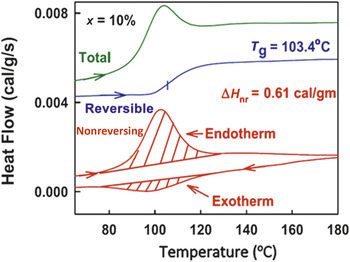
Figure 1 shows a typical MDSC scan of a Ge10Se90 glass taken at a 3°C/min scan rate, 1°C modulation amplitude, and 100 s modulation period. For this flexible-phase glass composition, the scan shows enthalpy of relaxation, ΔH nr (= 0.61(2) cal/g), and ΔC p (= 0.031(6) cal/g/°C). A modulation-frequency independent ΔH nr term is established by recording the endotherm in the heating cycle and subtracting the exotherm in the cooling cycle. Reference Thomas13
Modulated differential scanning calorimetry (MDSC) scan of Ge10Se90 glass showing the total, reversing, and nonreversing signals in the heating cycle. Reference Bhosle, Gunasekera, Boolchand and Micoulaut7

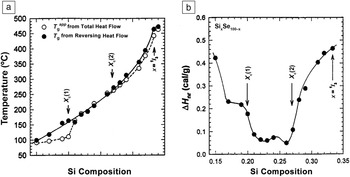
One of the first MDSC studies on a chalcogenide was on the SixSe100–x binary, before the crucial role of homogeneity was appreciated. It was found that T g(x) increased with Si content ( Figure 2a), reflecting the progressive cross-linking of the polymeric Sen chains by Si. There was, nonetheless, a strikingly abrupt reduction of ΔH nr(x) by almost a factor of 10 near x c(1) = 20%, the rigidity transition (Figure 2b), and an equally spectacular recovery near x c(2) = 27%, the stress transition; ΔH nr(x) was minuscule in between these two points. Thus ΔH nr is a measure of the departure of a glass network from isostaticity. Such calorimetric windows have now been observed in more than 50 glass systems Reference Mantisi, Bauchy and Micoulaut14 and correlate with their optical, electrical, and mechanical properties. Characteristic power laws in Raman mode frequencies ν(x), and in low-frequency AC conductivity in solid electrolyte glasses also display compositional thresholds that coincide with the two elastic phase boundaries.
Trends in T g(x) and nonreversing enthalpy of relaxation in SixSe100–x glasses, showing variation of T g(x) and ΔH nr(x). The square-well like variation of ΔH nr(x) shows walls at x c(1) and x c(2) representing the rigidity and stress transition. Reference Selvanathan, Bresser and Boolchand4

Slow homogenization of nonstoichiometric chalcogenide melts
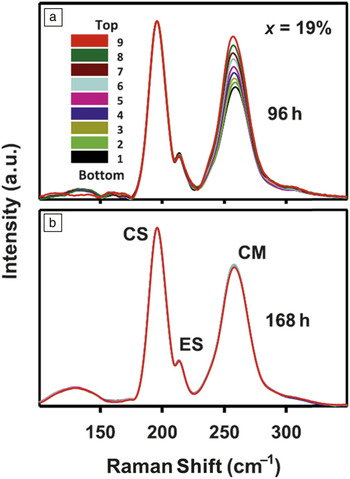
Recently, FT-Raman profiling of chalcogenide melts during synthesis has elucidated the challenges in homogenizing nonstoichiometric glasses, even those of small sizes. A two-gram melt size homogeneously alloys over tens of days rather than hours. Figure 3 shows FT-Raman profiling results for a Ge19Se81 batch composition encased in a 5-mm ID quartz tubing. Spectra recorded at nine equally spaced locations along the 1-in.-long melt column showed that the local vibrational density of states (measure of local7 glass stoichiometry) of quenched melts varies significantly along the tube length even after reacting at 950°C for t r = 96 h (Figure 3a). The Ge content x was deduced from the scattering strength ratio of the Sen chain mode (250 cm–1) to the corner-sharing mode (200 cm–1), and displays a spread of about 6% in Ge content. At t r = 168 h (Figure 3b), Raman profiling showed that melts were completely homogenized. In such homogeneous glasses, the reversibility window becomes square-well like, Reference Bhosle, Gunasekera, Boolchand and Micoulaut15 with abrupt walls, and with the width of the rigidity and stress transitions becoming less than 0.5% in Ge content. Reference Bhosle, Gunasekera, Boolchand and Micoulaut7,Reference Chakraborty and Boolchand10
FT-Raman profile of a Ge19Se81 quenched melt taken (a) after 96 h (where x = Ge content) and (b) 168 h of reaction of Ge with Se. Reference Bhosle, Gunasekera, Boolchand and Micoulaut7,Reference Bhosle, Gunasekera, Boolchand and Micoulaut15 Note: CS, corner-sharing mode of GeSe4 tetrahedra; ES, edge-sharing mode of GeSe4 tetrahedra; CM, chain mode of Sen chains.

The long homogenization times reflect the fact that the viscosity of melts at the reaction temperature, particularly in the IP composition range, are at least one to two orders of magnitude greater than those of melt compositions outside the IP. Thus, the overall melt homogenization is being controlled by the higher viscosity phase in the IP. The recognition Reference Gunasekera, Bhosle, Boolchand and Micoulaut16 emerged from the fragility index m(x) of homogeneous melts. The fragility index is defined next.
Fragility windows and super-strong behavior of IP melt compositions
In MDSC, one may also choose to analyze the glass-transition endotherm in terms of the in-phase Re(C p) and out-of-phase Im(C p) components of the complex specific heat Reference Carpentier, Bustin and Descamps17 instead of the reversing and nonreversing heat flows. The Re(C p) signal shows a step-like variation and tracks the modulations (akin to reversing heat flow), while the Im(C p) signal displays a Gaussian profile just as the nonreversing heat flow. There is a scaling factor (scan rate) that comes in since Im(C p) has units of a specific heat (cal/g/°C) while ΔH nr(x) has units of heat flow (cal/g/s). By examining Im(C p) as a function of modulation frequency ω, one deduces the fragility index m of melts as follows. The peak in the Im(C p) signal corresponds to the condition ωτ = 1, where τ is the enthalpy relaxation time. At the peak in Im(C p) the melt has completely tracked the impressed modulation frequency (ω). Thus as ω increases, the peak in Im(C p) shifts to higher T. By plotting log10 τ against 1/T, one deduces an effective activation energy EA of relaxation. The fragility index m at T = T g then follows from the following relation:
 $$m = {E_A}/\left[ {{T_g}\,{\mathop{\rm l}\nolimits} n10} \right].$$
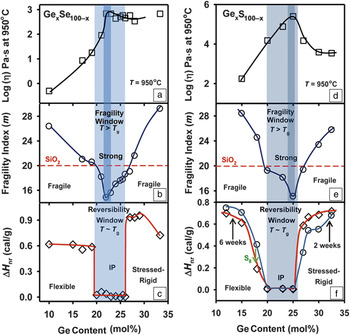
In Angell’s well-known Reference Angell, Macfarlane and Oguni18 display of log10 η versus 1/T for a variety of glass systems, those with m < 20 are associated with an Arrhenius-like behavior, η(T) = A exp (EA/kT), and the effective activation energy EA(x,T) is independent of T. Here, A represents the value of η when T = ∞. In Figure 4 , where the IP window is delineated in blue, we see that the melts there are super strong. Finally, since the fragility index (m) of non-IP melt always exceeds those in the IP, one expects heterogeneous melts to always display a greater m than homogeneous ones.
Variations in (a) estimated viscosity η(x) at 950°C, (b) measured fragility index, and (c) enthalpy of relaxation of homogeneous GexSe100–x glasses in left panel. (d–f) Corresponding data on GexS100–x glasses appear in the right panel. Reference Chakraborty and Boolchand10,Reference Gunasekera, Bhosle, Boolchand and Micoulaut16 Note: IP, intermediate phase.

Extension of rigidity theory to oxide glasses
Rigidity theory started as a T = 0K description of the glassy state of matter. As the field evolved, it became clear that for SiO2 glass, if, at the temperature T
g of nearly 1200°C, the weaker of the two bond-bending force constraints centered on oxygen were broken in the melt, the glass formed during the quench would be near isostatic (n
c = 3, or
 $\langle r\rangle$
= 2.40), thus accounting for its excellent glass-forming tendency.
Reference Zhang and Boolchand19
The O-bond-bending force constraint is intact (broken) when the Si-O-Si bond angle has a fixed (variable) value. However, upon alloying 10 mol% of soda, T
g of sodium silicates rapidly decreases to almost 650°C, and one would expect the O-centered bond-bending constraints to be restored in the melt, driving the modified glass to now become stressed-rigid. Confirmation of that view was given by the observation of an IP in the 18%–23% range of soda that correlated nicely with Brillouin scattering deduced elastic constants.
Reference Vaills, Qu, Micoulaut, Chaimbault and Boolchand20
With the introduction of T-dependent constraints Reference Mauro, Gupta and Loucks21 along with molecular dynamics (MD) simulations Reference Micoulaut22 to confirm them, rigidity theory has evolved into a formidable quantitative tool for predicting Reference Mauro23 physical properties of commercial oxide glasses. It has also addressed a long-standing problem in the field of how to enumerate bonding constraints of monovalent (e.g., Li, Na, and K) and divalent (e.g., Ca, Sr, and Ba) modifiers in oxide glasses. The MD simulations Reference Bauchy, Micoulaut, Celino, Le Roux, Boero and Massobrio24 showed that in sodium silicates, although the Na+ ion has a coordination number in the 5–6 range, the bond-stretching and bond-bending constraints with only one of the 5 or 6 oxygen near-neighbors are intact, while those with the rest of the oxygen near neighbors display a large variance in distance, suggesting that the underlying constraints are broken. Thus, one came to recognize that in estimating constraints in the modified oxides, the appropriate mechanically effective number of constraints is 1, consistent with its valence.
IP, ideal melts, and glasses
IPs have now been observed in several families of chalcogenide glasses Reference Mantisi, Bauchy and Micoulaut14 in polaronic conducting oxide glasses, Reference Chakraborty, Boolchand, Malki and Micoulaut25 in solid electrolyte glasses, Reference Novita, Boolchand, Malki and Micoulaut26 in alkali-germanates, and in alkali Reference Vignarooban, Boolchand, Micoulaut, Malki and Bresser27 and alkaline-earth Reference Holbrook, Chakraborty, Ravindren, Boolchand, Goldstein and Stutz28 borates. In the IPs, enthalpy of relaxation ΔH nr almost vanishes, the boundaries become abrupt, and molar volumes show a global minimum. Furthermore, ΔH nr ages minimally for IP compositions, in sharp contrast to compositions outside the IP. The stress-free nature of IPs is seen from pressure Raman experiments, Reference Wang, Mamedov, Boolchand, Goodman and Chandrasekhar8 which show vibrational modes that blue-shift linearly for IP glass compositions, just as in crystalline solids, when an external pressure is applied. The observation underscores the absence of internal stress in IP glasses and in crystals. In ionic conductors, an exponential increase in conductivity appears only in the flexible phase where networks can easily deform because of floppy modes; in the IP, a new conductive regime sets in, which displays an anomalous behavior for typical jump distance as inferred by DC permittivity measurements. In Raman scattering, select vibrational modes blue-shift with composition, displaying a power-law in the IP and in the stressed-rigid phase.
Recently, a special effort using Raman profiling was made to synthesize homogeneous melts/glasses of the Ge-Se and Ge-S binary, and trends in m(x), and ΔH nr(x) were established using MDSC. In Figure 4, the upper two panels show the expected viscosity η(x) and the measured fragility index m(x) of the melt, while the lowest panel shows the nonreversing heat ΔH nr(x) of the solid to melt transition. The IP window of the glass is delineated in blue. Figure 4 shows a remarkable correlation of super-strong (m < 20) melts with the IP. The viscosity η(x) is also the largest there, and the molar volume (not shown) the lowest for such glasses. The small ΔH nr(x) seen in the lowest panels, for x in the IP, points to a remarkable correlation in that composition range between the structures of the solid and liquid. The thermodynamic relation dH = TdS, when integrated across the relatively small melting glass-transition temperature range in the MDSC, gives ΔH nr = T g(S melt – S glass), so that the structural (configurational) entropy (S c) near T g of IP glasses (S glass) is almost the same as in their melts (S melt). The larger values of ΔH nr(x) outside the IP are taken to mean that their structures substantially change during melting. This gives us some insight, namely, that their isostatic subunits can rearrange themselves rather easily under thermal motion or shear stress while remaining connected, and so should persist into the melt phase above the IP, at least for temperatures low enough for the constraints to remain intact. This implies that the available configuration space for globally isostatic structures is relatively flat and easily sampled by diffusive motion. The glass should then be stress free and, most significantly, already aged. The statistical ensemble of such spaces leads to a relatively high entropy.
The plots of η(x) on the top row of Figure 4 suggest why the homogenization kinetics of the initial melts are slow. This follows from the somewhat counterintuitive inverse behavior of η(x) and the diffusion coefficient D(x) as illustrated by the Stokes-Einstein relation, η = k B T/aD for a colloidal fluid mixture in which the variable a is the mean separation of colloidal particles. Recently, Reference Yildirim, Raty and Micoulaut29 MD simulations of Ge-Se melts have confirmed this relation in impressive detail. For x outside the IP window, there are spatially random interruptions of the isostatic structures that form localized barriers trapping the initially nonequilibrium available structures produced by the quenching to form an ensemble of relatively high entropy. Over time, thermal hopping will permit the ensemble to move toward equilibrium states of lower entropy and the window to become square-well like.
Returning to the question at the beginning of this article—What is so special about melts that so easily bypass crystallization even under slow air cooling? These inorganic alloy melts lie in or close to IP composition windows where networks are isostatically rigid. Their other physical features, such as showing much reduced aging, distinguish them as being in some sense “ideal” among glasses. The traditional notion Reference Angell, Macfarlane and Oguni18 of ideality for glass seems to be related to the concept of the Kauzmann temperature at which the melt should supposedly reach the low configurational entropy of the crystalline phase. Our association of ideality with a high entropy phase confounds this notion, but still leaves us with the challenge of better understanding the IP.
Summary
Glasses of chalcogenides and modified oxides show common trends in calorimetric properties, Raman scattering, infrared reflectance, AC conductivity, and molar volumes as their connectivity or mean coordination number
 $\langle r\rangle$
increases in the 2 <
 $\langle r\rangle$
< 3 range. They all have three topological phases—flexible, intermediate, and stressed-rigid. Although T
g increases monotonically with
 $\langle r\rangle$
, the enthalpy of relaxation at T
g shows a square-well like minimum with the walls representing the rigidity and stress transitions, respectively. For carefully homogenized melts, the glasses display a set of unusual properties, which earn their designation as being ideal. These include absence of network stress and compact networks with low-molar volumes. Additionally, they have a thermally reversing glass-to-melt transition, with corresponding melts displaying a high glass-forming tendency and with fragility index m < 20 (i.e., being super strong). Optical elastic power laws deduced from Raman scattering, and ionic-conductivity deduced from AC conductivity, reveal thresholds at the rigidity and stress transitions. These new functionalities are a consequence of the isostatically rigid nature of networks with n
c = 3.
Acknowledgments
This research was supported by the National Science Foundation (Grant DMR 08-53957). We thank K. Gunasekera, S. Bhosle, S. Chakraborty, C. Holbrook, R. Bhageria, K. Vignarooban, S. Dash, and S. Ravindren at the University of Cincinnati who have contributed to the experimental effort. We appreciate discussions with M. Micoulaut and C. McDonald during the course of this work.

Punit Boolchand joined the University of Cincinnati in 1969 and is currently Professor of Electrical and Computer Engineering and Physics. He received his PhD degree in physics in 1969 from Case Western Reserve University. He has held visiting positions at Stanford University, University of Paris, France, and KU Leuven, Belgium. The new intermediate phase was observed in network glasses in 1998 at the University of Cincinnati. He is a Fellow of the American Physical Society and recipient of the Stanford Ovshinsky Award. Boolchand can be reached by phone at 513-556-4790 or by email at boolchp@ucmail.uc.edu.

Bernard Goodman has been Professor Emeritus of Physics at the University of Cincinnati since 1993. He received his PhD degree in physics in 1955 from the University of Pennsylvania. After 13 years at the University of Missouri, he joined the University of Cincinnati in 1965 as a professor of physics. His expertise is in theory of condensed matter—many-body theory of electron correlations and lattice dynamics of disordered systems. He is a Fellow of the American Physical Society and has been a Guggenheim Fellow and Fulbright Fellow. He has been a Nordita Visiting Professor at two Swedish universities. Goodman can be reached by phone at 513-556-0537 or by email at goodman.bernard@gmail.com.