Significant outcomes
-
Similar to healthy controls, adolescents with major depression better recognised positive emotions than negative ones.
-
In adolescents with major depression, there was no association between symptom severity or anxiety level and performance on theory of mind or emotion perception tasks.
-
Adolescents with major depression who had poorer performance on the Facial Expression Recognition Task during the index depressive episode showed more residual depressive symptoms on follow-up 2 years later. This suggests that impairment in facial expression recognition may have prognostic value in this population.
Limitations
-
Findings are limited by the small sample size.
-
Participants of the study were recruited in a closed ward and in an outpatient clinic in a mental health centre. Accordingly, these patients may have tended to exhibit more severe depressive symptoms than MDD-diagnosed adolescents in the community.
-
Interviews in the follow-up were performed via telephone, which limited the reliability of the CDRS-R scores (assessment of severity of depressive symptoms), since that scale contains items that need to be assessed face-to-face.
-
The authors assert that all procedures contributing to this work comply with the ethical standards of the relevant national and institutional committees on human experimentation and with the Helsinki Declaration of 1975, as revised in 2008.
-
The authors assert that all procedures contributing to this work comply with the ethical standards of the relevant national and institutional guides on the care and use of laboratory animals.
Introduction
Major depressive disorder (MDD) is one of the most prevalent mental disorders among youth. It is associated with a disruption of emotional and cognitive development in adolescents, as it reduces psychosocial functioning and affects interpersonal skills, social relationships, and family relationships (Cusi et al., Reference Cusi, Nazarov, Holshausen, Macqueen and McKinnon2012). Recent studies have examined these social impairments through the perspective of “social cognition” – the ability to understand and respond to the thoughts and feelings of others (Adolphs, Reference Adolphs2001). Two important aspects of social cognition are emotion perception (EP) and theory of mind (ToM). EP refers to the ability to understand the emotional state of others based on non-verbal cues, such as prosody and facial expression (Gallup, Reference Gallup1982). Previous studies in adults with MDD, during depressive episodes, showed an increased identification of sad facial expressions, and significant deficits in identifying emotions and facial expressions of happiness, as compared to healthy controls (HCs) (Cusi et al., Reference Cusi, Nazarov, Holshausen, Macqueen and McKinnon2012). There is a lack of consensus in contemporary literature regarding the temporal stability of the negative perceptual bias in adults with MDD. Some studies have shown that biased emotion recognition continues even after recovery from major depressive episodes (Leppanen et al., Reference Leppänen, Milders, Bell, Terriere and Hietanen2004; LeMoult et al., Reference LeMoult, Joormann, Sherdell, Wright and Gotlib2009), while other studies have found that negative perceptual bias is correlated with patients’ clinical states (Munkler et al., Reference Munkler, Rothkirch, Dalati, Schmack and Sterzer2015) and tends to improve after symptom remission (Mikhailova et al., Reference Mikhailova, Vladimirova, Iznak, Tsusulkovskaya and Sushko1996; Naudin et al., Reference Naudin, Carl, Surguladze, Guillen, Gaillard, Belzung, El-Hage and Atanasova2014). Interestingly, a recent systemic review demonstrated that changes in the capacity to recognise emotion based on others’ facial expressions might serve as a predictor of antidepressant response in patients with MDD (Park et al., Reference Park, Pan, Brietzke, Subramaniapillai, Rosenblat, Zuckerman, Lee, Fus and Mclntyre2018). Only a few studies have examined facial emotion processing in adolescents with MDD. As is the case in studies of adult patients, these studies in adolescents have also demonstrated conflicting findings. For example, several studies of adolescents with dysthymia or MDD showed a bias towards identifying sad (Hankin et al., Reference Hankin, Gibb, Abela and Flory2010; Auerbach et al., Reference Auerbach, Stewart, Stanton, Mueller and Pizzagalli2015) and angry (Van-Beek & Dubas, Reference Van-Beek and Dubas2008) facial expressions, while other studies showed impairment in identifying negative facial expressions (Lenti et al., Reference Lenti, Giacobbe and Pegna2000). Alternatively, a recent study that compared girls with MDD to HC found no impairment in recognition of facial expressions (Sfarlea et al., Reference Sfarlea, Greminel, Platt, Dieler and Schulte-Korne2018; Schepman et al., Reference Schepman, Taylor, Collishaw and Fombonne2012). To date, we have found no study that investigated the association between facial emotion recognition impairment and long-term outcome of MDD in adolescents.
ToM refers to the ability to attribute mental states such as beliefs, desires, and intentions to oneself and others. Its affective aspect is the ability to recognise the state of mind of others, particularly their emotions, while its cognitive aspect refers to the ability to discriminate and respond to a complex social environment (Abu-Akel & Shamay-Tsoory, Reference Abu-Akel and Shamay-Tsoory2011). Previous studies showed a poorer performance on ToM tasks among adults with MDD compared to healthy individuals (Wolkenstein et al., Reference Wolkenstein, Schönenberg, Schirm and Hautzinger2011). Additionally, improvement on ToM tasks was found to be correlated with improvement in clinical depression scales (Cusi et al., Reference Cusi, Nazarov, Holshausen, Macqueen and McKinnon2012). Studies in adolescents have also shown impairment in ToM tasks in adolescents with unipolar and bipolar depression (Schenkel et al., Reference Schenkel, Marlow-O’Connor, Moss, Sweeney and Pavuluri2008; Klinicel et al., Reference Klinicel, Vural and Klinicel2020) and with borderline personality disorder (Sharp et al., Reference Sharp, Pane, Ha, Venta, Patel, Sturek and Fonagy2011).
Since the development of neurological pathways related to EP and ToM occurs during childhood and adolescence (Thomas et al., Reference Thomas, De-Bellis, Graham and LaBar2007; Guyer et al., Reference Guyer, Monk, McClure-Tone, Nelson, Roberson-Nay, Adler, Fromm, Leibenluft, Pine and Ernst2008), and because impairment in social cognition aspects of MDD may help shed light on the biological mechanisms underlying depression in adolescents, it is important to explore these constructs in this population. Moreover, exploring a possible association between impairment in EP and ToM, and clinical state and long-term outcome of a depressive episode, might help detect patients at risk for future depressive symptoms.
In this study of adolescents with MDD, we evaluated patients’ EP and ToM abilities and assessed whether impairment in emotion recognition predicts poor prognosis. We hypothesised that, in comparison to HC, adolescents with MDD would show poorer performance on the Facial Expression Recognition Task (FERT) and the ToM task, and that they would have a bias towards recognising negative emotions. In a follow-up analysis performed 2 years later, we hypothesised that poor performance in EP and ToM tasks during the index depressive episode would be associated with higher scores in the depression scale and with lower remission rates.
Methods
Participants
Thirty-nine adolescents, 12–18 years of age, participated in the study. Participants in the experimental group were recruited from the adolescent ward and outpatient clinic at Shalvata Mental Health Center, including 14 participants with MDD (9 females, mean age 15.35 ± 1.68). The control group included 25 participants with no known major psychiatric disorders (17 females, mean age 15.27 ± 1.89). The study was approved by the hospital’s institutional review board; all participants and their parents signed informed consent. Adolescents with potential intellectual disability (i.e. a score of ≤ 7 on the Similarities subtest of wechsler intelligence scale - IV [WISC-IV]) or those receiving psychotropic medications (other than antidepressants) on a regular basis were excluded.
Measures and procedure
All participants were examined by a child and adolescent psychiatrist and were diagnosed using the Mini International Neuropsychiatric Interview for Children and Adolescents (MINI-KID) (Sheehan et al., Reference Sheehan, Sheehan, Shytle, Janavs, Bannon, Rogers and Wilkinson2010), a short standardised diagnostic interview for DSM-IV. Estimated IQ scores were assessed using the Similarities subtest from the WISC-IV assessment (Flanagan & Kaufman, Reference Flanagan and Kaufman2004). The psychiatrists involved also completed the Children’s Depression Rating Scale–Revised (CDRS-R) (Poznanski et al., Reference Poznanski, Grossman, Buchsbaum, Banegas, Freeman and Gibbons1984), a widely used rating scale used to assess severity of depression and change in depressive symptoms for clinical research trials in children and adolescents with depression. This scale was found to have high internal consistency and was found to be highly correlated with symptom severity (Mayes et al., Reference Mayes, Bernstein, Haley, Kennard and Emslie2010). Anxiety level was measured using the State-Trait Anxiety Inventory (STAI) (Spielberger et al., Reference Spielberger, Gorsuch and Lushene1970), a 40-item questionnaire scored on a Likert scale, which was also found to have high internal consistency (0.86–0.95) (Spielberger et al., Reference Spielberger, Gorsuch and Lushene1970). State anxiety represents a transient emotional status that results from situational stress; trait anxiety represents a predisposition to react to stressful situations with anxiety. Scores in each of the scales range from 20 (very low anxiety level) to 80 (very high anxiety level). Socioeconomic status (SES) was evaluated using the Hollingshead scale (Hollingshead, Reference Hollingshead1975). Each participant completed two social cognition tasks: the FERT and the Interpersonal Perception Task (IPT). Two years following the index depressive episode, we contacted all 14 patients via telephone and assessed their depressive symptoms using the CDRS-R (Poznanski et al., Reference Poznanski, Grossman, Buchsbaum, Banegas, Freeman and Gibbons1984).
The Facial Expression Recognition Task
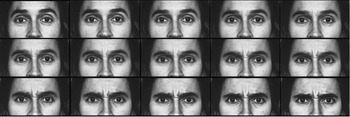
This task examines the relative ability of the participant to correctly identify basic emotions. It uses computer-generated images in which facial expressions change gradually from a neutral expression to an emotional expression. It contains grey-scale standardised photographs of six different individuals whose facial expressions vary to reflect the six basic emotions (happy, sad, fearful, disgusted, angry, and surprised). Three male and three female images were selected from the Ekman series (Ekman & Friesen, Reference Ekman and Friesen1975; Shamay-Tsoory et al., Reference Shamay-Tsoory, Aharon-Peretz and Perry2009). All stimuli were presented on a 17-in. computer screen against a black background. The emotion recognition test was designed with e-prime 2.0 software. Six stimuli were displayed for each photographed individual, for a total of 36 stimuli. Using graphic image morph software (Face Morph Lite 2.0), the facial expressions were gradually altered from neutral to one of the six basic emotions (see Fig. 1). During the task, the participant was asked to choose one emotion that most accurately describes the emotion expressed in the eyes on screen, and to do so as quickly as possible. Scoring consisted of the percent of the total correct responses, converted to Z-scores. In a study evaluating the validity of the task, Baron et al. found a good discriminate validity between healthy participants and participants diagnosed with autism or with Asperger’s disorder (Baron-Cohen et al., Reference Baron-Cohen, Wheelwright, Hill, Raste and Plumb2001; Shamay-Tsoory et al., Reference Shamay-Tsoory, Aharon-Peretz and Perry2009).
Facial Expression Recognition Task sample frames in which a neutral face is gradually morphed into an angry face.

The Interpersonal Perception Task
This task is a standardised method for evaluating non-verbal communication and social perception. It evaluates both the affective and cognitive aspects of ToM (Abu-Akel & Shamay-Tsoory, Reference Abu-Akel and Shamay-Tsoory2011). Video clips are divided into three categories: kinship (which presents close familial relationships), intimacy (which presents the ability to identify a romantic relationship between couples), and competition (which captures the ability to identify which character won a competition). For our purposes, we shortened the American version of the task to six scenes: two for each category. Each video clip is preceded by a question in Hebrew that requires the participant to make a judgement about the relationships between the individuals involved in the interaction. Validation studies have demonstrated that performance on the IPT correlates with self- and peer-ratings of sociability and social competence. Test–retest reliability for the IPT over a 5-week period was found to be 0.7 (Fisher-Shofty et al., Reference Fischer-Shofty, Brüne, Ebert, Shefet, Levkovitz and Shamay-Tsoory2013).
Data analysis
Demographic and clinical comparisons between groups (MDD, HC) were performed using t-test and χ 2 test, as appropriate. Due to the small sample size, the distribution of the difference between the groups could not be assumed to be normally distributed. Hence, we used the Wilcoxon signed rank test to compare between-group face recognition abilities, such that the dependent variable was rate of successful recognition of the presented emotion. Correlations between level of depressive symptoms (as reflected by CDRS-R scores), anxiety levels (in the STAI), and accuracy in face recognition were examined using the Pearson coefficient. All statistical tests were conducted at α level of ≤ 0.05.
We analysed the data using SPSS version 23 statistical software (SPSS Inc., Chicago, IL, USA) and used snowball sampling, as we could not randomly sample participants.
Results
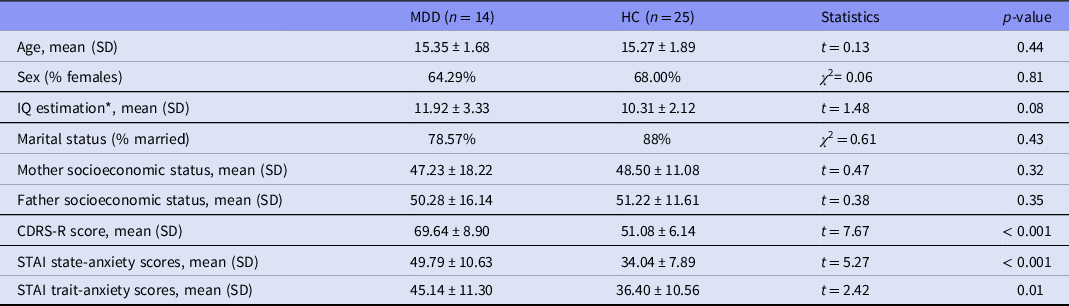
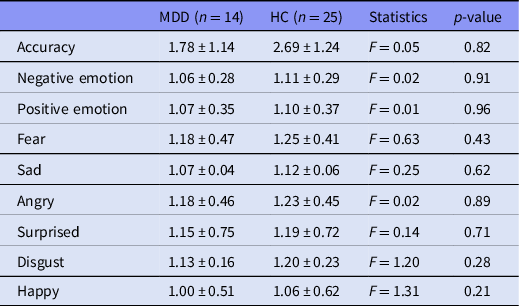
As shown in Table 1, there were no between-group differences in age, parental SES, marital status, or estimated IQ scores. As expected, the experimental group had significantly higher mean scores in the CDRS-R (69.64 ± 8.90 vs. 51.08 ± 6.14; p < 0.001), the STAI state-anxiety measure (49.79 ± 10.63 vs. 34.04 ± 7.89; p < 0.001), and the STAI trait-anxiety measure (45.14 ± 11.30 vs. 36.40 ± 10.56; p ≤ 0.01). No significant difference was found in general accuracy on the FERT between adolescents with MDD and HC [F (1, 37) = 0.055; p = 0.816]. There was also no significant between-group difference in FERT scores for each of the specific expressions (see Table 2). Interestingly, converse with our hypothesis, within each group, participants successfully recognised more positive stimuli than negative stimuli (HC: Z-score = −2.94, p = 0.003; MDD: Z-score = −2.85, p = 0.004). Scores in the IPT task were not statistically different between the groups [F (1, 37) = 0.442; p = 0.51]. There was no correlation within the MDD group between depression and anxiety levels, as rated by the CDRS-R and the STAI, respectively, and the accuracy on the tasks. In the 2-year follow-up of patients with MDD, the mean CDRS-R score was 28.53 ± 11.36. A multiple regression analysis showed a correlation between the follow-up CDRS-R scores and accuracy in the FERT during the index episode (r 2 = 0.35; p = 0.021). When correlating the follow-up CDRS-R scores with accuracy in the Facemorph task for each facial expression using Pearson’s correlation test, we found a marginally significant association between higher CDRS-R scores and greater accuracy in identifying fearful facial expressions (r 2 = 0.19; p = 0.057). For the rest of facial expressions, however, we found no correlation with the CDRS-R scores. There was also no correlation between accuracy in the FERT and the change in CDRS-R scores between the index episode and the follow-up.
Demographic and clinical characteristics of patients with major depression (MDD) and healthy controls (HCs)

CDRS-R, Children’s Depression Rating Scale-Revised; STAI, State-Trait Anxiety Inventory.
* Mean score in the Similarities subtest of the WISC-IV.
Comparison of performance in the emotion recognition task between patients with major depression (MDD) and healthy controls (HCs)

Discussion
In this study, we aimed to compare ToM and emotion recognition between adolescents with MDD and HC. Notwithstanding our hypothesis, no difference was found in both tasks performed by the two groups, and both groups tended to better recognise positive emotions than negative ones. Within the MDD group, we found no association between depression severity or anxiety level and performance on ToM and EP tasks. This finding may imply that depressed adolescents’ social cognition abilities are not affected by the severity of their depressive and anxiety symptoms as found in some of the studies in adults suffering from depression (Naudin et al., Reference Naudin, Carl, Surguladze, Guillen, Gaillard, Belzung, El-Hage and Atanasova2014; Park et al., Reference Park, Pan, Brietzke, Subramaniapillai, Rosenblat, Zuckerman, Lee, Fus and Mclntyre2018). One possible explanation for this finding is the reactive nature of MDD in adolescence, which is characterised by frequent changes in mood based on external events (Compas et al., Reference Compas, Connor-Smith and Jaser2004). Two years later, we followed up with the participants in the MDD group to assess the association between impairment in ToM or emotion recognition and long-term residual symptoms. Outcomes of previous studies have suggested a possible association between changes in cognition and a positive response to pharmacological treatment resulting in better outcome in adults with MDD (Hankin et al., Reference Hankin, Gibb, Abela and Flory2010). Similarly, we found a moderate but significant correlation between lower levels of accuracy in emotion recognition in the MDD group during the index depressive episode and higher levels of depressive symptoms (CDRS-R scores) on follow-up. This result suggests that higher levels of impairment in facial expression recognition may predict poorer prognosis in adolescents with MDD. This finding is consistent with previous findings that trait emotion recognition impairment might be associated with higher risk for depressive symptoms (Joormann et al., Reference Joormann, Gilbert and Gotlib2010; Lopez-Duran et al., Reference Lopez-Duran, Kuhlman, George and Kovacs2013). However, in contrast to findings in adult patients with MDD in remission, we did not find a bias towards better recognition of negative expressions. A previous study showed that adult patients with recurrent MDD in remission demonstrated persistent emotional biases towards emotionally negative stimuli, which might be mechanistically important for recurrence and prevention thereof (Ruhe et al., Reference Ruhe, Mocking, Figueroa, Seeverens, Ikani, Tyborowska, Browning, Vrijsen-Harmer and Schene2019). One study showed patients with remitted MDD had higher accuracy rate for recognition of sadness compared to those of controls (Biyik et al., Reference Biyik, Keskin, Oguz, Akdeniz and Gonul2015). Another study showed that patients with remitted MDD had a similar sensitivity rate in identifying happy facial expressions as compared to patients with an active depressive episode (Shiroma et al., Reference Shiroma, Thuras, Johns and Lim2014). Differences between the results in our study and the mentioned results in the adult population might be attributed to the greater sensitivity adults experience towards minor changes in facial expressions, as compared to adolescents (Thomas et al., Reference Thomas, De-Bellis, Graham and LaBar2007). For example, a recent fMRI study, which supports this explanation, showed that adolescents modulate activity to a greater degree based on the nature of emotion in the stimulus, whereas adults modulate activity in relevant brain structures to a greater degree based on attention demands. Therefore, adults may have an increased ability to engage relevant brain regions for goal-directed attention in the presence of emotionally evocative, attention-grabbing events (Monk et al., Reference Monk, McClure, Nelson, Zarahn, Bilder, Leibenluft and Pine2003). Our results might also differ from those studies in adults due to lack of sufficient power of our study because of the small sample size.
Several limitations of the study need to be addressed. First, our findings are limited by the small sample size. Nevertheless, the data presented here provide a justification for further investigation of the connection between EP and levels of depressive symptoms in adolescents with MDD. Second, we recruited participants for the MDD group from the ward and outpatient clinic in a mental health centre, and they may exhibit more severe depressive symptoms than MDD-diagnosed adolescents in the community. Therefore, it is difficult to generalise the results to the entire population. Third, in our follow-up, interviews were performed via telephone, which limits the reliability of the CDRS-R scores, since this scale contains items that need to be assessed face-to-face.
In conclusion, the findings of the current study suggest that adolescents with MDD do not demonstrate the ToM and emotion recognition impairment typically related to adults with MDD. Additionally, like HC, adolescent patients with MDD tend to be more accurate in identifying positive emotional cues than negative ones. Importantly, however, more severe impairment in emotion recognition during a depressive episode might serve as a prognostic factor for poor long-term outcome in adolescents with MDD. To our knowledge, few studies to date have examined social cognition aspects of depression in adolescents and their association with depressive symptoms. More research with larger sample sizes is needed to understand if bias in those social cognition functions can predict poor prognosis in adolescents with MDD. Ensuing research may also reveal developmental, social, and behavioural differences between adolescents with MDD and adults with MDD; this may also help us to further understand the role of ToM and EP in these populations.
Acknowledgements
We would like to thank all patients and professionals of the child and adolescent outpatient clinic in “Shalvata” mental health center for their participation and support.
Author contributions
Dr. CD, MD, contributed to collecting data and writing of the current manuscript. Dr. SD-R contributed to collecting data and performing the tasks with the participants. Mr. VP was responsible for data analysis and was guided by Dr. YG, PhD. Dr. YB assisted in data analysis and interpretation. Dr. DB assisted in collecting data, manuscript writing and editing. Dr. HM was the PI of the study and assisted in collecting and analysing the data and manuscript writing.
Financial support
The current study was not funded by any organisation.
Conflict of interest
On behalf of all authors, the corresponding author states that there is no conflict of interest.