The incidence of disasters has increased in the world over the past 10 y. Reference Williams, Nocera and Casteel1 These events affect the capacity of the healthcare system to provide healthcare services. The key to this is to have a prepared health emergency preparedness to deal with disasters. Reference Daily, Padjen and Birnbaum2 There is a collective agreement that working in disaster situations is different from normal situations. Reference Dunniway3 Health workers’ readiness is focused on improving their ability to respond to disasters. Reference Gebbie and Qureshi4 Identifying competencies necessary for disaster relief is clearly a challenge that must be addressed through examining various actions by people at the scene of incident. Reference Daily, Padjen and Birnbaum2 Regardless of the specialties of personnel, staff training for disaster situations should be based on the acquisition of professional, interdisciplinary skills acquired through competent credential training programs. Reference Johnson, Idzerda and Baras5 In a series of studies, it has been suggested that a set of agreed competencies should be established for the standard curriculum framework. Reference Schultz, Koenig and Whiteside6
Women’s reproductive health is potentially affected by disasters, and neglecting it may have serious consequences. Reference Slepski7 In addition, the lack of obstetrics and gynecology clinics, and the lack of skilled staff at the time of childbirth can lead to acute and chronic problems for women’s health in disasters. Reference Hays and Prepas8 Approximately 15% of pregnant women in emergencies suffer from serious complications during pregnancy or childbirth and need emergency care. In the absence of appropriate care, the likelihood of maternal mortality is increased. The provision of family planning services can prevent 25-30% of maternal deaths. Reference Hopkins and Cross9
Disaster preparedness is necessary for health-care providers. Reference Cranmer, Chen and Kayden10 They should be prepared to meet the needs of affected women. Reference Gebbie and Qureshi4 The World Health Organization (WHO) has proposed that in-service training courses or training packages are required for the education of midwives and nurses 11 to bridge any gap in their disaster management skills.12
Although the number of studies on the education of disaster-related issues has increased in recent years, they have not specifically addressed the educational needs of midwives in disasters. Therefore, there is a need for the development programs for the education of midwives in crisis management. Reference Pinkert, Dar and Goldberg12
The first step in developing midwifery education programs in natural disasters is to identify skills that are needed in disasters. Reference Selby and Kagawa13 The main aim of this study was the exploration of professional competencies that midwives need to provide appropriate care in disasters. Specific skills are required for reproductive health in disasters. While skills for all health-care providers in disasters should be addressed, this research has not considered cross-cutting skills. 14
Methods
Study Design
This study was conducted using a qualitative content analysis approach. Data were collected directly and without any presuppositions. Next, codes, subcategories, and categories were explored using the deductive process. Reference Graneheim and Lundman15
Setting
Iran has a population of more than 80 million people, with almost identical gender distribution (49.6% women). The majority of people (99.4%) are Muslims. The official language is Farsi. More than 80% of women are literate. 16 Iran (IRI) is a country exposed to various dangers that have been affected by natural and human-made incidents. Reference Fatemi17
Participants
Participants of this study were midwives with the work experience of practice in disasters and were keen to participate in interviews. The purposive sampling method was used for their recruitment.
Data Collection
In-depth semi-structured, face-to-face interviews were informed to collect data. They would be asked to share their experiences of skills should be required for midwives to participate in disasters.
Date Analysis
Data were analyzed simultaneously with data collection using the qualitative content analysis approach suggested by Graneheim and Lundman. Reference Graneheim and Lundman15 The classification process was continued, and subcategories and main categories were developed.
Trustworthiness
To confirm the accuracy of the findings, credibility, dependability, confirm ability, and transferability were performed. Reference Polit and Beck18 For credibility, assigning enough time to collect data and checking the findings with the participants and peer checking were used. For dependability, the external supervisor helped with assessing the findings to reach a similar perception with the researcher. For transmissibility, the findings were presented to those who did not participate in the study to judge the similarity between the results and their experiences. The interviews, codes, and categories were provided to external researchers for confirmation.
Results
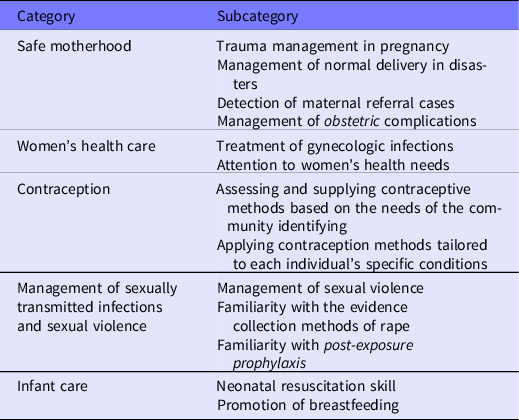
Six major meaningful narrative data were collected from the midwife interviews in this study. These include: “safe pregnancy,” “safe childbirth,” “women’s health care,” “contraception,” “violence and sexually transmitted infections,” and “infant care” (Table 1).
Categories and subcategories developed in this study

The main categories have been described as follows.
Safe Motherhood
Care for pregnant women is necessary in times of crisis, and midwives should have skills to provide required services. Trauma management in pregnancy was the diagnosis and reason for referral of high-risk pregnant mothers.
The participants mainly pointed out the provisions of care to traumatized mothers as a skill of midwives. They believed that they did not have the necessary skills to deal with traumatized pregnant women in earthquakes and that they needed to acquire theses skills.
One of the midwives said: “I was in the clinic after the earthquake, and I saw a pregnant woman. I went to hear the child’s heart beating, the woman was in good condition, but she was beginning to get worse. Blood was coming out of her ear. The doctor examined her and ordered for her referral. She died in the ambulance, and we could not do anything for the fetus. Also, I’m always upset, because the fetus was alive until the mother died” (participant 11).
Because midwives were always involved in childbirth in conditions that facilities and assistance were available, it would be difficult and sometimes impossible to perform childbirth in circumstances without necessary facilities. However, labor in disaster situations was a skill that a midwife must have to play an effective role in promoting women’s health.
“Detection of referral cases” is another skill that a midwife must have. It is important to note that unplanned referrals involve the use of an ambulance, increase traffic on the road, and are a waste of forces.
A midwife stated: “There was a woman in labor pain. I thought that with such traffic, the probability of childbirth is ambulance is high.” “I said I can manage it here” (participant 7).
Postpartum hemorrhage is an obstetric emergency, which is one of the main causes of maternal mortality, and midwives, must have required skills to manage it.
Women’s Health Care
After the disaster, the spread of genital tract infections was increased due to the lack of access to adequate water for health purposes, use of public toilets, lack of sanitary pads, and reduction of access to detergents. Midwives must have the clinical skills and knowledge to diagnose and treat gynecological infections.
One of the midwives said: “Based on our experiences with practice in earthquakes, we found out that the main problem was with nonpregnant women, especially with regard to infections” (participant 10).
Contraception
Another category was related to contributors to the prevention of pregnancy and unsafe abortions in crisis situations.
One midwife said: “A woman who had an unwanted pregnancy with a severe fever and bleeding was brought to me. I realized that she wanted to abort a child. She said that she used pills before, but she could not access them anymore and became pregnant” (participant 9).
Management of Sexually Transmitted Infections and Sexual Violence
It was indicated that sexually transmitted diseases and sexual violence should be addressed and naturally are some part of the professional skills of midwives. They included: management of sexual violence, familiarity with the evidence collection methods of rape and familiarity with postexposure prophylaxis.
Health-care professionals, especially midwives, who have a closer relationship with women, should be aware of the method of managing sexual violence.
A midwife said: “The management of a rape case that came to us in the field was a new issue for our kids, and they really did not know what to do for her. I said that the first step should be to prevent pregnancy and sexually transmitted diseases” (participant 10).
How to collect legal evidence of a crime are also the skills that midwives need to be aware of.
One midwife described her own experience as follows: “There was a rape in the area; a male doctor told me how to collect the sample, because the woman refused to be examined by the male doctor” (participant 3).
After a rape, the anti-viral prophylaxis drugs should be used to prevent the transmission of sexually transmitted diseases, especially AIDS. It should be noted that these drugs should be given within the first 72 h after the rape to be effective. In addition, midwives must be aware of the exact scientific approach. Hepatitis B and C, gonorrhea, syphilis, chlamydia, trichomoniasis should also be considered in dealing with these women.
Infant Care
Subcategories included: child resuscitation skills, care for premature and low birth weight children, and promotion of breastfeeding.
Resuscitation skills for the mother and child were highlighted by the participants. Labor was an unpredictable issue that could happen as a matter of emergency. A midwife said:
“A meconium delivery happened and the child was born with a low Apgar score. I did not have the possibilities of a newborn resuscitation, no suction or anything. I created a sterile gas; I gave the baby breathing on the child’s mouth, and performed the cardiovascular massage and resuscitated the child” (participant 1).
Preserving the child body temperature after birth, especially if it was premature, was especially important. A midwife should be aware of the importance of this condition. A midwife said: “It was the second day after the incident that I had to manage preterm labor under a tent; I knew that I should take care of hypothermia in that condition” (participant 12).
One important education needed by a midwife in the midst of a crisis was to be able to explain the importance of breastfeeding to women. One of the midwives said: “I myself saw that my colleagues, with the supposition that women were unable to feed their infants due to their psychological issues in disasters, easily prescribed formula. Midwives need to have adequate knowledge of feeding the child in crisis” (participant 17).
Discussion
This study was conducted to explore skills needed by midwives to provide reproductive health services in disaster areas. According to research findings, the major skills of midwives after disasters included “safe motherhood,” “women’s health care,” “contraception,” “management of sexually transmitted infections and sexual violence,” and “infant care.”
In disasters, the probability of maternal and fetal problems may be increased. Reference Harville, Xiong and Buekens19 Due to the destruction of health-care centers, access to maternity care is impossible in some places, Reference Williams, Nocera and Casteel1 and pregnant mothers may not refer to health-care centers. For example, in Kosovo during the war, most mothers only once in mid-pregnancy were referred to health centers, Reference Heymann and Raisler20 although they need at least 4 visits during pregnancy. Reference O’Heir21 Additionally, care must be taken to accurately diagnose and manage the risk of pregnancy. Reference Williams, Nocera and Casteel1,Reference Hopkins and Cross9
Midwives are key care providers and can play a role in women health. Reference Gasseer, Dresden and Keeney22 If midwives, physicians, or nurses take care of mothers, the mortality rate is reduced. To this end, midwives should have the ability to accurately assess maternal health. Reference O’Heir21 Delay in identifying the problem, delay in making a decision to refer the woman, and delay in providing appropriate and timely care endanger the woman’s health. Reference Hopkins and Cross9 The process of delivery is physiologic, but emergency cases requires immediate interventions. Reference O’Heir21 Use of vacuum, management of breech delivery, restoration of cervical tears, resuscitation of the mother and child are skills that the midwife has to deal with in emergency situations. Reference Hopkins and Cross9 Given that bleeding is the main cause of maternal mortality and in delivery, Reference Hopkins and Cross9,Reference Chandraharan and Krishna23,Reference Homer, Clements and McDonnell24 a midwife should have the ability to manage it with calm. The timely use of blood and intravenous fluids, and uterine contraction drugs (oxytocin), the ability to manually detach placenta and remove the retained products of pregnancy and uterine massage are important skills for preserving a mother’s life in a crisis. Reference Hopkins and Cross9 A midwife should be able to prevent seizure by properly managing pre-eclampsia. 25
Women’s Health Care
According to the findings, genital infections were the most common problems for women after disaster. Different studies revealed the health problems in women in the crisis, mainly due to a lack of access to soap, underwear, sanitary pads, bathroom, and toilet. Reference Khaneh, Kayandokht and Mohammadi26,Reference Parker, Smith and Verdemato27 Given a limited number of sanitary facilities, a large number of people results in increased genital infections. Reference Bahmanjanbeh, Kohan and Yarmohammadian28 Menstrual irregularities are another problem in women after disasters. Reference Liu, Han and Xiao29,Reference Hannoun, Nassar and Usta30 Neglecting the menstrual needs of women and girls affects their health and daily activities. Reference Parker, Smith and Verdemato27 Midwives should be able to manage these problems.
Family Planning
Midwives need to manage family planning issues in terms of assessing extent of the population need to a variety of contraceptive methods. Reference Hopkins and Cross9
Medicines and contraceptive supplies are often unavailable for a long time in affected areas. In addition, provision of early relief efforts is not considered a priority, and couples have no access to contraceptive methods. Reference Callaghan, Rasmussen and Jamieson31 Access to family planning services is one of the most important strategies that can reduce maternal mortality through creating longer intervals between pregnancies and preventing unwanted pregnancies and abortions. 32–Reference Harville and Do35 The use of injectable contraceptive, such as depot-medroxy progesterone acetate (DMPA), which provides quarterly protection and is reversible, is recommended in emergencies. Reference Ellington, Kourtis and Curtis36 However, women should have access to all methods of contraception. Reference Sohrabizadeh, Jahangiri and Jazani37 Considering emergency contraception in post-crisis situations is of particular importance. Midwives should note that these methods also apply to unprotected sexual relationships, especially in the acute phase of a crisis where access to contraception can be difficult, and in cases of sexual violence is used to prevent pregnancy. Reference Hopkins and Cross9,Reference Ellington, Kourtis and Curtis36
Management of Sexually Transmitted Infections and Violence
An increase in the incidence of sexual violence in emergency situations has been mentioned in other parts of the world. 25 Due to the existence of postdisaster sexual violence, health personnel, especially midwives, should be aware of the appropriate methods of managing such cases and should receive necessary education to deal with such cases. Reference Sohrabizadeh, Jahangiri and Jazani37
Available information on sexual violence from legal sources, health or any other sources represents a small proportion of the actual number of violence cases. Collecting data of rape, management of the victim and postexposure prophylaxis, and taking appropriate measures to prevent sexually transmitted diseases, are important skills of a midwife. 25
Infant Care
Mastering the physical examination of the child and finding potential congenital problems are essential skills of a midwife. Awareness of the necessary measures after childbirth for the prevention of eye infection, vaccination, and vitamin K injections are essential. The ability to detect early abnormalities and birth problems for referring high-risk infants to well-equipped centers is required. Reference Kliegman, Behrman and Jenson38
Many infant mortalities can be prevented through the provision of health-care services at the disaster site. Approximately 5-10% of children do not breathe spontaneously after childbirth and require respiratory stimulation, and some of them require resuscitation. Newborn death can be prevented if the midwife has the required ability to perform resuscitation.
Conclusions
Meeting the health-care needs of affected populations requires a high-quality healthcare system and skillful staff. The results of this study showed that a midwife should have abilities to provide health-care services using limited resources, identify and refer especial cases of pregnancy and childbirth for better treatment, manage obstetric emergencies during labor, manage non-pregnant women’s health in the region, and help with the treatment of gynecological infections, properly supply contraceptive methods to women, and manage sexual violence in disaster areas. Development of an education program for the improvement of midwifery competencies is very important. On the other hand, reproductive health domains do not have the same importance for midwifery practice, and the importance of each area should be determined on the basis of the prevalence of the problem in the society. Due to differences in cultural, social, and economic conditions in different countries of the world, it is suggested that midwives’ educational programs are devised based on the context of each country. Further research is needed to explore the midwives’ professional activities and responsibilities in postdisaster areas and improve midwifery care standards.
Acknowledgments
The authors thank all midwives who shared their experiences generously with the researchers. The authors appreciate the efforts of midwives for the promotion of health care around the world. This article is the result of a research to fulfill the requirements of a doctoral degree in “health in disasters and emergencies” at Shahid Beheshti University of Medical Sciences, Iran.
Conflicts of interest
The authors declared no conflict of interests.
Ethics statement
The present study was approved by the ethics committee affiliated with Shahid Beheshti University of Medical Sciences (code: IR.SBMU.RETECH.REC.1396.273). Ethical considerations included informed consent, privacy, and confidentiality of data throughout the study process.