I. INTRODUCTION
Hydrogels are cross-linked polymer networks swollen in an aqueous solution. A number of hydrogels are stimuli-responsive; they swell in response to external stimuli, such as temperature,Reference Tanaka1 electrical field,Reference Tanaka, Nishio, Sun and Ueno-Nishio2 light,Reference Suzuki and Tanaka3 and pH.Reference Tanaka, Fillmore, Sun, Nishio, Swislow and Shah4 Such responsive materials are useful in the development of microfluidic devices,Reference Dong, Agarwal, Beebe and Jiang5, Reference Beebe, Moore, Bauer, Yu, Liu, Devadoss and Jo6 actuators and sensors,Reference Richter, Paschew, Klatt, Lienig, Arndt and Adler7, Reference Gerlach, Guenther, Sorber, Subchaneck, Arndt and Richter8 media for cell immobilization,Reference Jen, Wake and Mikos9 and carriers for drug delivery.Reference Jeong, Bae, Lee and Kim10–Reference You and Auguste13 Optimized design of these materials requires a quantitative understanding of how the mechanical and transport properties of the stimuli-responsive hydrogels change as the environment changes. A powerful and convenient characterization technique is necessary.
Among the various stimuli-responsive hydrogels, the most widely used are pH-sensitive gels because of their practical applications.Reference Dong, Agarwal, Beebe and Jiang5–Reference Jen, Wake and Mikos9, Reference You and Auguste13 Hydrogels that are pH-sensitive contain acidic (e.g., acrylic acid) or basic (e.g., tertiary amine) functional groups that donate or accept protons in response to changes in the pH of the environment. For instance, hydrogels containing tertiary amine groups (as does the material used in this research) become protonated when the pH of the surrounding medium falls below the pK a value of the conjugate acid of the amine groups. To maintain charge neutrality, counter ions migrate into the hydrogel together with the protons. The increased concentration of counter ions in the gel provides an osmotic driving force for the hydrogel to swell. The swelling ability of the hydrogel depends on the cross-link density of the gel, the salt concentration of the external solution, and the density of the tertiary amine groups.
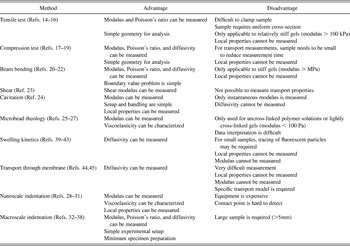
The mechanical and transport properties of hydrogels have been studied by many researchers using various test methods. Widely used methods for measuring the stiffness of hydrogels include tension,Reference Johnson, Beebe and Crone14–Reference Urayama, Takigawa and Masuda16 compression,Reference Muniz and Geuskens17–Reference Cai, Hu, Zhao and Suo19 bending,Reference Zhang, Hu and Li20–Reference Vichit-Vadakan and Scherer22 shearing,Reference Stammen, Williams, Ku and Guldberg23 cavitation,Reference Zimberlin, Sanabria-Delong, Tew and Crosby24 and rheological methods,Reference Mason and Weitz25–Reference Mukhopadhyay and Granick27 as well as nano-, and macroindentation.Reference Ebenstein and Pruitt28–Reference Hu, Chan, Vlassak and Suo38 The accessible length scale and stiffness range for each method are summarized in Table I. Poisson’s ratios of hydrogels are rarely measured. When a load is suddenly applied to a hydrogel, water molecules do not have enough time to migrate into or out of the polymer network right away. Consequently, the volume of the hydrogel is conserved and the instantaneous value of Poisson’s ratio is very close to 0.5.Reference Johnson, Beebe and Crone14–Reference Urayama, Takigawa and Masuda16 Given enough time, however, water molecules diffuse into or out of the network until equilibrium is reached. The volume of the hydrogel changes and Poisson’s ratio decreases to a value below 0.5.Reference Cai, Hu, Zhao and Suo19, Reference Vichit-Vadakan and Scherer22, Reference Hu, Zhao, Vlassak and Suo36, Reference Hu, Chen, Whitesides, Vlassak and Suo37, Reference Hu, Chan, Vlassak and Suo38 The most widely used method for measuring the transport properties of hydrogels is based on the kinetics of the swelling process.Reference Li and Tanaka39–Reference Brannon-Peppas and Peppas43 This method measures the average diffusivity of water in a hydrogel as it evolves from its dry to its swollen state. However, it has been observed experimentally that the diffusivity of hydrogels changes with water concentration,Reference Lightfoot46 so that this method cannot be used to measure the diffusivity of a pH-sensitive hydrogel at different pH levels.
Existing methods for measuring mechanical and transport properties of gels.

In our recent work,Reference Hu, Zhao, Vlassak and Suo36–Reference Hu, Chan, Vlassak and Suo38 we proposed an indentation method for characterizing the mechanical and transport properties of hydrogels based on linear poroelasticity. The theory of poroelasticity was originally developed by TerzaghiReference Terzaghi47 and BiotReference Biot48 to study the consolidation of soil. The indentation method proposed in our previous articleReference Galli and Oyen35 is superior to other experimental techniques in several aspects. First, most hydrogels are compliant and some of them are very slippery, so that traditional techniques such as tensile, bending, and torsion testing can only with difficulty be applied to gels. Indentation experiments, in contrast, do not require much sample handling and are readily performed on a hydrogel. Second, both the mechanical and transport properties of a hydrogel can be obtained through a single indentation measurement. These properties can be measured at different hydration states, corresponding to specific salt concentrations and/or pH levels of the external medium. In this article, we demonstrate the indentation load relaxation technique by measuring the mechanical and transport properties of various hydrogel formulations (cross-link density and composition) under a range of environmental conditions (pH and salt concentration of the external solution).
II. THE INDENTATION LOAD RELAXATION METHOD
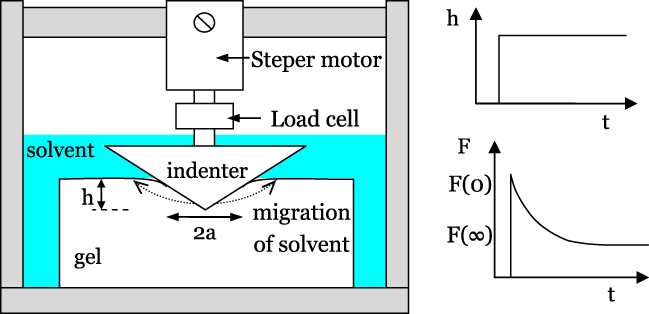
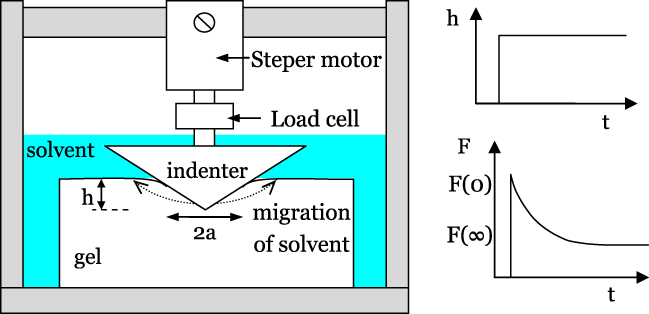
The geometry of the indentation method is shown in Fig. 1. An indenter is pressed to a depth h into a gel submerged in a solvent, and the force on the indenter is recorded as a function of time. As the force on the indenter relaxes, the contact area between the indenter and gel remains unchanged.Reference Hui, Lin, Chuang, Shull and Ling32, Reference Hu, Zhao, Vlassak and Suo36 In the short-time limit, the concentration of solvent molecules in the gel is constant, i.e., the gel behaves like an incompressible elastic material with a shear modulus G. For a conical indenter pressed into an incompressible elastic material, the force on the indenter is given byReference Sneddon49

A disk of a gel is submerged in a solvent throughout the experiment. Prior to indentation, the gel imbibes the solvent and swells to a state of equilibrium. An indenter is then rapidly pressed into the gel and is subsequently held at a fixed depth h. The indenter causes the solvent to migrate in the gel, so that the force F on the indenter decreases as a function of time, until the gel reaches a new state of equilibrium.
where F (0) is the instantaneous force on the indenter. The radius of contact a relates to the depth of indentation h as
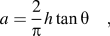
where θ is half the included angle of the conical indenter.
In the long-time limit, the gel attains a new state of equilibrium and the solvent in the gel equilibrates with the external solvent. The gel now behaves like a compressible elastic material with shear modulus G and Poisson’s ratio ν. The force in the long-time limit, F(∞), is related to the instantaneous force, F(0), byReference Hu, Zhao, Vlassak and Suo36

For the gel to evolve from the short-time to the long-time limit, the solvent in the gel under the indenter must migrate. The relevant length scale is the radius of the contact area between the indenter and the gel. The time required for diffusion to occur over this distance scales with a 2 / D and indeed the force on the indenter, F(t), obeys the following equationReference Hu, Zhao, Vlassak and Suo36
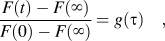
where τ = Dt / a 2 is a nondimensional time. The dimensionless ratio on the left-hand side of Eq. (4) is a measure of how far the gel is from equilibrium. The function g (τ) must be determined by solving the poroelastic boundary value problem. Our previous work indicates that, for a given type of indenter, g is a function of the single variable τ, as long as the radius of contact is much smaller than the size of the disk of the gel. The poroelastic boundary value problem was solved for indenters of various shapes using the finite element methodReference Hu, Zhao, Vlassak and Suo36 and the function g (τ) for a conical indenter is given by the following expression

III. EXPERIMENTS
A. Synthesis
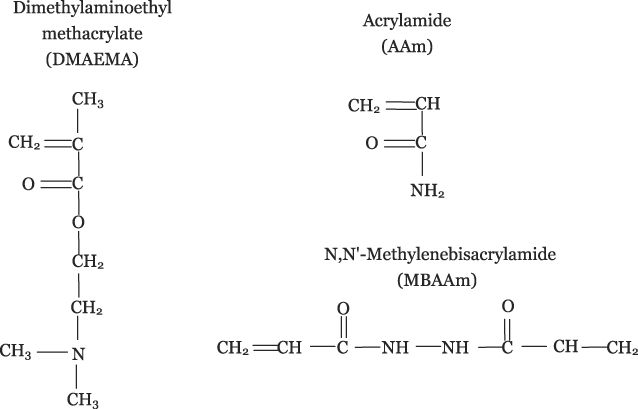
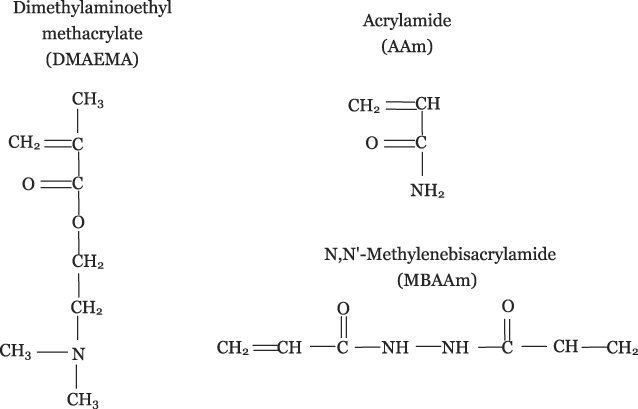
Hydrogels were synthesized using dimethylaminoethylmethacrylate (DMAEMA) and acrylamide (AAm) monomers, N,N′-methylenebisacrylamide (MBAAm) as a cross-linker, and ammonium persulfate (APS) as an initiator. AAm, MBAAm, and APS were purchased from Sigma-Aldrich Inc. (Atlanta, GA). DMAEMA was acquired from Fisher Scientific Company (Boston, MA). The chemical structures of the agents are shown in Fig. 2. AAm is a neutral monomer, while DMAEMA is a hydrophobic monomer with cationic groups. Buffer solutions were prepared by mixing sodium phosphate monobasic and sodium phosphate dibasic heptahydrate obtained from Sigma-Aldrich Inc. in the appropriate ratios as described by reference Reference Yıldız, Işık, Kış and Birgül50.
Chemical structures of dimethylaminoethylmethacrylate and acrylamide monomers and N,N′-methylenebisacrylamide cross-linker.
Four sets of poly (DMAEMA-co-AAm) hydrogel samplesReference Yıldız, Işık, Kış and Birgül50 were synthesized as listed in Table II. The following formulation was used to make the samples in the first set. First, a monomer solution was prepared by mixing 6.67 mL DMAEMA and 6.67 g AAm with 10 mL deionized water. The cross-linker and initiator solutions were prepared by dissolving 166.7 mg MBAAm in 6.67 mL deionized water and 330 mg APS in 6.67 mL deionized water, respectively. The MBAAm and APS solutions were mixed and then poured into the monomer solution. The mixture was gently mixed for 40 s and then poured into a glass petri dish with an inner radius of 52 mm. After allowing the hydrogel to polymerize for 2 h, the gel was removed from the petri dish and individual gel samples were submerged into 10 mM sodium phosphate buffer solutions of various pH as listed in Table II. Samples were submerged for a period of at least 2 weeks to allow them to swell. After 2 weeks, no more changes in the dimensions of the samples were observed and the samples were assumed to be in equilibrium with the buffer solutions. Indeed, the time needed for water to be transported throughout a sample with a thickness H of approximately 10−2 m and a minimum diffusivity D of 10−10 m2/s is on the order of H 2/D ∼106 s, i.e., 2 weeks are sufficient time for the samples to equilibrate. These gels are used as baseline in the experiments and are denoted as “REF.” In addition, three more sets of gels were fabricated following the same procedure but with different amounts of chemicals and/or buffer solutions as indicated in Table II: one set of gels was fabricated and submerged in a 100 mM buffer solution—this set of gels is denoted as “Salt-Hi.” Another set was fabricated using 100 mg of cross-linker and is denoted as “XL-Lo.” A last set of gels had a larger ratio of DMAEMA to AAm and was submerged in a 100 mM buffer solution. This set of gels is referred to as “Salt-Hi-DMAEMA/AAm-Hi.”
Compositions of the factors that influence the mechanical and transport properties of the poly(DMAEMA-co-AAm) hydrogels.

The weights of the swollen samples, w gel, were measured after superficially drying the samples with a paper towel, and the swelling ratio λ was calculated from
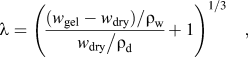
where ρ w and ρ d are the densities of water and the dry polymer network, respectively. The weights, w dry, and densities of the dry hydrogels were calculated from the weights of the individual components of the polymer networks and their respective densities.
B. Indentation measurements
The indentation load relaxation measurements were performed using a stainless steel conical indenter with a half included angle of θ = 70°. The indenter was pressed into the samples using a custom-built load frame with a force resolution of 0.5 mN and a displacement resolution of 1 μm. The indenter approached the surface of the gels at a constant speed of 2 μm/s until the slope of the recorded force–displacement curve became positive. The position of the surface was then determined by back extrapolation. The error in the position of the surface using this methodology was less than 5 μm for all measurements. Once the surface was found, the indenter was pressed into the samples at a constant speed of 300 μm/s, the maximum speed allowed by the load frame. During the experiments, the force on the indenter was recorded as a function of time. The time used to press the indenter into the gel (∼2 s) was much shorter than the relaxation time recorded experimentally (hours), so that any poroelastic relaxation during the initial loading segment was entirely negligible. Indentations were performed to three different depths, 400, 600, and 800 μm. For each depth, three load–relaxation measurements were carried out. In total, nine relaxation curves were recorded for each sample. The length of time for the load to fully relax was determined during the experiments by visual inspection of the relaxation curves. To ascertain the load was fully relaxed, data was recorded for an additional period of time equal to two times the relaxation time. All measurements were performed with the samples submerged in the appropriate buffer solution. The effects of the ionic strength of the buffer solutions, the cross-link density, and the amine group density on the properties of the hydrogel were evaluated using the samples in different sets. Indentations on these samples were performed using the same experimental protocol as for the samples in the baseline set.
IV. RESULTS AND DISCUSSION
A. Swelling ratio
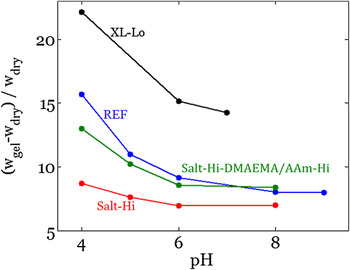
Figure 3 shows as a function of pH the change in sample mass between the dry and the swollen state. Compared with REF gels, the Salt-Hi gels swelled in buffer solutions of higher salt concentrations. Evidently the pH sensitivity of the gel decreases with increasing salt concentration. When the gel is put in an aqueous solution with a pH below the pK a of the amines on the polymer network, the amine groups are protonated. To maintain charge neutrality, counter ions need to migrate into the gel along with the protons. If the salt concentration of the buffer solution is high, the change in the concentration of counter ions inside the gel induces only a small change in the osmotic pressure and consequently only a small increase in swelling.
Gravimetric swelling ratios for the four sets of gels as a function of pH.

The effect of cross-link density on swelling is illustrated by comparing the results for REF gels and XL-Lo gels. Figure 6 shows that in the same buffer solutions, XL-Lo gels swell significantly more than REF gels. In equilibrium, the degree of swelling is determined by the balance between the osmotic driving force for water to enter the gel network and the elastic energy stored in the network. As the cross-link density increases, the network becomes stiffer and the amount of swelling is reduced.
The influence of the ratio between the two monomers (DMAEMA and AAm) is illustrated by comparing the results for Salt-Hi gels and Salt-Hi-DMAEMA/AAm-Hi gels. For Salt-Hi gels, the ratio of DMAEMA to AAm is 1:1 in weight, while for Salt-Hi-DMAEMA/AAm-Hi gels, the ratio is 2:1, i.e., the Salt-Hi-DMAEMA/AAm-Hi gels contain more tertiary amine groups. Consequently, when these amine groups are protonated, the Salt-Hi-DMAEMA/AAm-Hi gels require a greater concentration of counter ions than Salt-Hi gels. This in turn creates a greater osmotic pressure driving water molecules into the gel and the degree of swelling increases. A similar trend was observed by You and AugusteReference You and Auguste13 in their study of DMAEMA/HEMA (2-hydroxyethyl methacrylate) nanoparticles to regulate gene transfer.
B. Mechanical properties
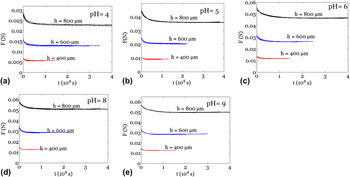
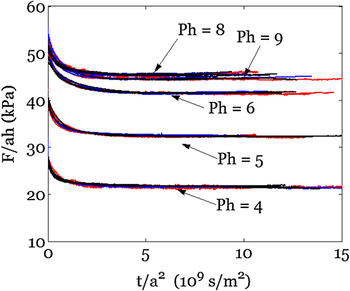
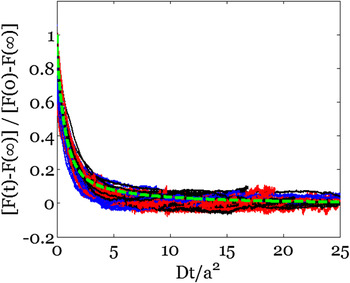
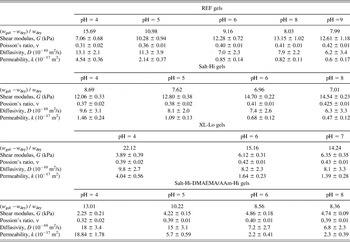
Figure 4 shows the force–relaxation curves for five different pH levels obtained for the REF gels. Three curves are shown for each of three indentation depths. Figure 5 depicts the same data with force normalized as F/ah and time as t/a 2. It is evident from the figure that the nine relaxation curves obtained for each pH level collapse into a single curve. This behavior is consistent with poroelastic behavior of the hydrogel. That the curves from samples swollen in different buffer solutions do not collapse is an indication that the mechanical and transport properties of the gel change with pH. The shear modulus and Poisson’s ratio were calculated using Eqs. (1) and (3), while the diffusivity was extracted by fitting the theoretical curve, Eq. (5), to the experimental data. When the results are properly scaled, all 45 load–relaxation curves collapse into a single master curve as illustrated in Fig. 6. The dashed line in Fig. 6 represents the theoretical curve given by Eq. (5). The experimental results for the gels in the other three sets were evaluated using the same analysis. All material parameters obtained for each set of gels, including shear modulus, Poisson’s ratio, and diffusivity are summarized in Table III.
Experimentally measured force–relaxation curves for the REF gel. The pH values of the buffer solutions are (a) pH = 4, (b) pH = 5, (c) pH = 6, (d) pH = 8, and (e) pH = 9.

Experimental stress–relaxation curves for the REF gel. The force is normalized as F / ah, and the time is normalized as t / a 2.

Experimental stress–relaxation curves for the REF gel. The force is normalized as [F(t) − F(∞)] / [F(0) − F(∞)], and the time is normalized as Dt / a 2. For the experimental data to fit the function g (τ), each buffer solution needs a distinct value of D, as listed in Table III.

Measured swelling ratio, shear modulus, Poisson’s ratio, and diffusivity of four sets of gels in various pH solutions.

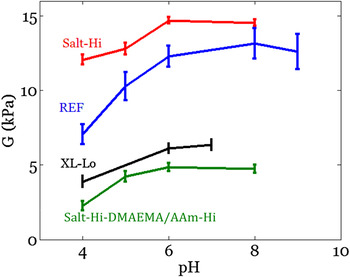
Figure 7 shows the shear moduli for the four sample sets as a function of buffer solution pH. As each gel swells, its shear modulus decreases because the number of chains per unit volume is reduced. Decreasing the cross-link density, increasing the ratio of DMAEMA to AAm, or decreasing the salt concentration increases the swelling ratio of the gels and thus lowers their shear modulus. A similar trend was reported for other pH-sensitive gels.Reference Johnson, Beebe and Crone14 The thermodynamic properties of gels have been investigated extensively by Flory.51 According to Flory–Huggins’ theory, the shear modulus of a neutral gel can be related to its swelling ratio byReference Hu, Chen, Whitesides, Vlassak and Suo37

Experimental shear moduli for the four sets of gels plotted as a function of pH.

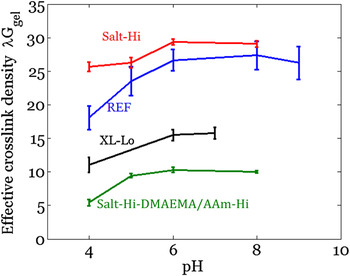
where k BTis temperature in units of energy and N is the number of polymer chains in the gel divided by the volume of the dry polymer, a measure for the cross-link density of the gel. Thus, according to the Flory–Huggins’ model, λG gel should be constant. Figure 8 shows the experimental values of λG gel for each set of samples as a function of pH. It can be observed that λG gel is constant at high pH levels but decreases below pH 6. Evidently, Eq. (7) breaks down for poly-(DMAEMA-co-AAm) in this pH range. One likely reason is the presence of electric charges associated with the protonated amine groups on the polymer chains. The precise mechanism of how these charges affect the stiffness of the gel is at present unknown, and a good mechanical model for polyelectrolyte gels such as the one studied here remains to be developed.
Experimental values of the effective cross-link density λG gel (Eq. 7) for the four sets of gels plotted as a function of pH.

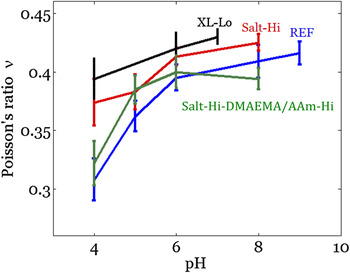
Poisson’s ratio describes the architecture of a network via the lateral-to-axial strain ratio. Few studies have been performed on measuring the Poisson’s ratio of hydrogels. Determining Poisson’s ratio of a gel quantitatively is more complicated than for solid materials because it involves the flow of solvents. When an external load is suddenly applied to a gel, there is initially not enough time for the solvent to migrate out of or into the gel. Consequently, the gel is incompressible and Poisson’s ratio approaches 0.5. In most previous studies, Poisson’s ratio was measured in the near instantaneous state using the tensile test.Reference Johnson, Beebe and Crone14–Reference Urayama, Takigawa and Masuda16 In this study, however, Poisson’s ratio is defined as the ratio of lateral to vertical strain when the gel is in its equilibrium state. Since a certain amount of solvent has been squeezed out of or absorbed into the gel to attain equilibrium, the equilibrium value of Poisson’s ratio is smaller than 0.5. Figure 9 shows Poisson’s ratio as a function of pH. It is observed that Poisson’s ratio decreases with decreasing pH, i.e., with increasing swelling ratio. To appreciate the physical significance of Poisson’s ratio of a poroelastic material, consider a hypothetical experiment involving compression of a cylindrical gel of diameter A and thickness L in the axial direction. The gel cylinder is submerged in a solvent and a fixed strain ε is imposed. Initially solvent molecules do not have enough time to migrate into or out of the network, and the gel cylinder acts as an incompressible material with diameter A(1 + ε / 2) and thickness L(1 − ε). The compression increases the chemical potential of the solvent within the gel above the value of the external solvent. This inequality of chemical potential drives the solvent molecules to migrate out of the gel. In the equilibrium state, the diameter of the gel cylinder decreases to A(1+νε). Thus, a smaller value of ν implies that more solvent migrates out of the gel. The experimental results (Fig. 9) show that it is easier to squeeze the solvent out of the gel as the degree of swelling increases.
Experimental Poisson’s ratios for the four sets of gels plotted as a function of pH.

C. Water diffusivity
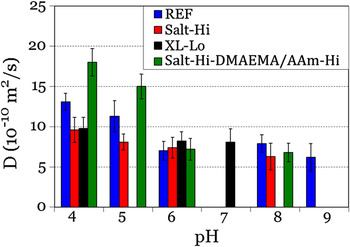
The time-dependent behavior of hydrogels is limited by the diffusion of water molecules. It has been observed that the diffusivity of water in hydrogels depends on the solvent concentration of water.Reference Lightfoot46 Currently, the most widely used method for measuring the diffusivity of hydrogels is based on swelling kinetics.Reference Li and Tanaka39–Reference Brannon-Peppas and Peppas43 The diffusivity measured using this method is an average value for the gel as it changes from the dry state to the swollen state. In this study, the gel samples were first submerged and equilibrated in an aqueous solution. The indentation measurements were then performed on these samples. Consequently, the water diffusivity measured in the indentation experiments is the value at that particular water concentration. Figure 10 shows the water diffusivity in each sample as a function of pH. The diffusivity is constant at large pH values but increases when the pH drops below 6. This is consistent with water molecules migrating faster in a network of large mesh size than in a network of small mesh size. This trend has also been observed in other gels.Reference Susoff and Oppermann53
Experimental water diffusivities for the four sets of gels plotted as a function of pH.

Based on Darcy’s law, the diffusivity is related to the permeability of the gel, k, by
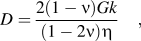
where η is the viscosity of the solvent. The permeability of each sample was calculated using a water viscosity of 8.9×10⁻⁴Pa·s and is listed in Table III.
V. CONCLUSION
In this article, we have used instrumented indentation to characterize the mechanical and transport properties of a series of pH-sensitive hydrogels. The influence of solution pH, solution ionic strength, cross-link density of the polymer network, and the density of functional groups on the mechanical and transport properties of the hydrogel has been evaluated. In general, the shear modulus and Poisson’s ratio of the hydrogel decrease as it swells, while water diffusivity increases. Unlike neutral gels, the stiffness of the pH-sensitive gel at low pH values is not well described by the Flory–Huggins’ model. We attribute this to the presence of electric charges associated with the protonated amine groups on the polymer chains, although the detailed mechanism is not clear at present. The indentation load relaxation measurement was proved a convenient and effective method for hydrogels in various environments.
ACKNOWLEDGMENTS
This work is supported by the National Science Foundation (NSF) (CMMI-0800161), Multidisciplinary University Research Initiative (MURI) (W911NF-09-1-0476), and the Materials Research Science and Engineering Center at Harvard University (DMR-0820484). The authors are grateful to Li Han for help with the experimental setup. This material is based upon work supported by the Space and Naval Warfare Systems Command (SPAWAR) Award Number N66001-09-1-2110. Any opinions, findings, and conclusions or recommendations expressed in this publication are those of the authors and do not necessarily reflect the views of SPAWAR.