I. INTRODUCTION
Due to the low density, high fracture toughness, high fatigue durability, and ease of fabrication, Al–Zn–Mg–Cu alloys have been widely used as the ideal materials in aerospace industries for several decades. Reference Zhou, Lin, Deng and Jiang1–Reference Lin, Li, Xia and Jiang3 In recent years, with the development of aviation and aerospace industries, the excellent mechanical performance and satisfactory corrosion resistance of Al–Zn–Mg–Cu alloys are increasingly demanded considering the safety, service life, and reliability of modern aircraft components. Reference Jiang, Xiao, Yang, Shao, Yuan and Zhen4,Reference Sun, Jiang, Zhang, Su and Yuan5 Generally, the desired properties of Al–Zn–Mg–Cu alloys are mainly related to the microstructures, Reference Jenab and Taheri6 which highly depend on the heat treatment processes.
In the past, great efforts have been made on heat treatment processing of aluminum alloys. Reference Anjabin, Taheri and Kim7–Reference Nový, Janeček and Král10 Besides the one-stage aging, Reference Berg, Gjønnes, Hansen, Li, Knutson-Wedel, Waterloo and Wallenberg11 some other heat treatment procedures, including multistage aging, Reference Yang, Ji, Zhang and Wang12,Reference Liu, Jiang and Li13 retrogression and re-aging (RRA) treatment, Reference Marlaud, Deschamps, Bley, Lefebvre and Baroux14–Reference Peng, Chen, Chen and Fang16 nonisothermal aging, Reference Jiang, Tang, Yang, Zhang, Yuan and Zhen17 pre-aging, Reference Liu, Li and Jiang18 and stress-aging (or creep-aging), Reference Liu, Lin, Zhang and Jiang19,Reference Lin, Xia, Jiang, Zhou and Li20 are also developed. Among these heat treatment processings, stress-aging or creep-aging, which combines the mechanical and aging treatment processes, is considered as a favored method for fabricating the integral and complex panels. Due to the low residual stress in formed components, high accuracy and low forming equipment cost, considerable investigations have been done on stress-aging or creep-aging. Reference Lin, Jiang, Chen, Wen and Zhou21–Reference Fribourg, Bréchet, Chemin and Deschamps25 Lin et al. Reference Lin, Jiang, Chen, Wen and Zhou21 reported that the stress-aging processing has significant influence on the precipitation hardening process of 7075 aluminum alloy. Meanwhile, the size and morphology of aging precipitates are greatly affected by external stress and stress-aging temperature. Bakavos et al. Reference Bakavos, Prangnell, Bès, Eberl and Grossmann22 found that the external stress can accelerate the nucleation of Guinier–Preston (GP) zones during two-stage stress-aging of 7475 aluminum alloy. Meanwhile, the two-stage stress-aging easily leads to the rapid over-aging of 7475 aluminum alloy due to the increased dislocation activity, compared to conventional aging. Guo et al. Reference Guo, Guo, Wang, Yang, Li, Wen and Zhang23 found that the stress-aging of an Al–Zn–Mg–Cu alloy (7075 aluminum alloy) under various tensile stresses can result in remarkable and distinctive microstructural changes. Lin et al. Reference Lin, Zhang, Liu and Liang24 investigated the influence of solution and retrogression pre-treatments on aging precipitate and corrosion resistance of a stress-aged Al–Zn–Mg–Cu alloy, and concluded that a reasonable distribution of aging precipitate and excellent corrosion resistance can be obtained when the alloy is stress-aged after suitable retrogression pre-treatment. Fribourg et al. Reference Fribourg, Bréchet, Chemin and Deschamps25 investigated the evolution of precipitate microstructures in crept 7449 aluminum alloy and concluded that the accelerated precipitation coarsening can be attributed to the introduction of dislocations during creep deformation.
Generally, aluminum alloys usually experience corrosion attack in the extreme in-service conditions, which will impact the integrity and reliability of components or structures used in aircrafts. For example, Al–Zn–Mg–Cu alloys are sensitive to pitting corrosion, Reference Abodi, DeRose, Van Damme, Demeter, Suter and Deconinck26,Reference Burns, Kim and Gangloff27 exfoliation corrosion, Reference Liu, Chen, Li, Dai, Deng and Zhang28,Reference Marlaud, Malki, Deschamps and Baroux29 intergranular corrosion, Reference Knight, Salagaras, Wythe, De Carlo, Davenport and Trueman30 and stress corrosion cracking. Reference Wang, Ni and Ma31 In the past, the corrosion behaviors of Al–Zn–Mg–Cu alloys have been studied extensively. Reference Jiang, Xiao, Yang, Shao, Yuan and Zhen4,Reference Yang, Ji, Zhang and Wang12,Reference Lin, Jiang, Zhang, Deng and Chen32–Reference Knight, Birbilis, Muddle, Trueman and Lynch36 Lin et al. Reference Lin, Jiang, Zhang, Deng and Chen32 investigated the corrosion behaviors of a stress-aged Al–Zn–Mg–Cu alloy and concluded that the corrosion resistance is highly related to the size and distribution of precipitates. Yang et al. Reference Yang, Ji, Zhang and Wang12 investigated the mechanical and corrosion properties of Al–0.6Zn–2.3Mg–1.8Cu–0.1Zr alloy under various aging treatment conditions, and found that the RRA can provide higher strength and improved corrosion resistance, compared to the conventional T6 and T74 aging. Dey et al. Reference Dey, Gunjan and Chattoraj33 discussed the pitting severity in T6 and T73 tempers of AA 7075 alloy immersed in NaCl solution and explained the differences in pits distribution based on the role of constituent and strengthening particles, as well as grain boundary η phases. Xu et al. Reference Xu, Birbilis and Romesch34 reported that the retrogression heating rate and pre-aging temperature have significant influence on the strength and corrosion resistance of RRA-treated 7150 aluminum alloys. Meanwhile, the good corrosion resistance and high strength can be obtained under a slow retrogression heating rate and an intermediate pre-aging temperature. Marlaud et al. Reference Marlaud, Malki, Henon, Deschamps and Barous35 proposed that the damage induced by intergranular dissolution and intergranular fracture are the two different mechanisms which lead to exfoliation corrosion of various heat-treated Al–Zn–Mg–Cu alloys. Jiang et al. Reference Jiang, Xiao, Yang, Shao, Yuan and Zhen4 investigated the aging behavior and stress corrosion cracking (SCC) resistance of a nonisothermally aged Al–Zn–Mg–Cu alloy and pointed out that the evolution of microchemistry at grain boundaries and adjacent regions may contribute to the improvement of SCC resistance of the studied aluminum alloy. Furthermore, Knight et al. Reference Knight, Birbilis, Muddle, Trueman and Lynch36 reported that there is a strong correlation between the SCC susceptibility and copper content of grain boundary precipitate in Al–Zn–Mg–Cu alloy.
Based on the above review, although some investigations have been conducted to study the corrosion behaviors of Al–Zn–Mg–Cu alloys, there are few studies on the corrosion resistance of two-stage stress-aged Al–Zn–Mg–Cu alloys. In the present investigation, the effects of two-stage stress-aging processing on corrosion behaviors of an Al–Zn–Mg–Cu alloy will be investigated. The relationship between aging precipitates and corrosion resistance will be discussed in detail.
II. MATERIAL AND EXPERIMENTS
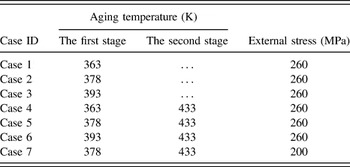
The material used in this study is a typical Al–Zn–Mg–Cu alloy with the chemical composition (wt%) of 5.8Zn–2.3Mg–1.5Cu–0.21Cr–0.16Fe–0.07Si–0.05Mn–0.02Ti–(bal.)Al. The heat treatment status of the as-received alloy is T651. Stress-aging specimens were machined from the rolled aluminum alloy sheet in the rolling direction. The diameter and gauge length of the specimen are 10 and 50 mm, respectively. Prior to the stress-aging treatments, the material was first solution treated at 743 K for 60 min and then water quenched. To investigate the effect of two-stage stress-aging temperatures on corrosion behaviors, three different aging temperatures, 363, 378, and 393 K, were selected for the first stage stress-aging. While the second stage stress-aging temperature was selected as 433 K, which is commonly used in the two-stage aging process. Reference Bakavos, Prangnell, Bès, Eberl and Grossmann22,Reference Deschamps, Fribourg, Brechet, Chemin and Hutchinson37 According to the authors' previous studies, Reference Lin, Jiang, Chen, Wen and Zhou21,Reference Lin, Jiang, Zhou and Liu38 the used external stress was selected as 260 MPa. Meanwhile, the additional external stress of 200 MPa was also used to comparatively discuss the effects of external stress on corrosion behaviors. The detailed two-stage stress-aging experiments were summarized in Table I. The stress-aging times for the first and second stages were designed as 6 and 18 h, respectively. The stress-aging tests were conducted on a tensile test machine MTS-GWT2105 (MTS Systems Corporation, Minneapolis, Minnesota) according to ASTM E139-11. 39 The control precisions of stress, displacement, and temperature are ±0.1 MPa, ±0.1 µm, and ±1 K, respectively. The following are the detailed experimental processes. The specimen was firstly heated to the temperature of first stage stress-aging at 10 K/min and kept for 0.5 h. Then, the external stress was applied. At the end of the first stage stress-aging, the specimen was immediately heated to the second stage stress-aging temperature. The external stress was kept constant during the whole two-stage stress-aging. Once the second stage stress-aging was finished, the specimen was unloaded and naturally cooled down to room temperature in the furnace.
Two-stage stress-aging experiments of the studied Al–Zn–Mg–Cu alloy a .

a Cases 1–3 are one-stage stress-aging experiments; cases 4–7 are two-stage stress-aging experiments.
Electrochemical experiments were performed using CHI660E electrochemical work station. A classic three-electrode system was used in this study. Saturated calomel electrode (SCE) and platinum were regarded as the reference electrode and the auxiliary electrode, respectively. The tested sample with the exposed area of 78.5 mm2 acted as the working electrode. Prior to electrochemical experiments, the samples were cloth-polished and rinsed with ethanol after being mechanically grinded with 2000 grit emery paper. Additionally, the nontested surfaces were coated with ethoxyline resin in preventing the corrosion attack. The open-circuit potential (OCP) was recorded for 10 min to obtain the stable potential, before the electrochemical experiments. Electrochemical impedance spectroscopy (EIS) experiments were carried out at the OCP. The test solution was 0.1 mol/L HNO3 + 0.5 mol/L KNO3 + 4.0 mol/L NaCl, which is the same as EXCO solution. The EIS spectra were recorded by applying a sinusoidal activated charcoal with the amplitude of 10 mV in the frequency domain of 100 kHz–1 Hz. Additionally, cyclic potentiodynamic polarization tests were also conducted, which were performed under the scan rate of 1 mV/s in 3.5 wt% NaCl solution. After cyclic potentiodynamic polarization tests, the corroded surface of each sample was scanned using a scanning electron microscope (SEM) TESCAN MIRA 3 (Tescan Corporation, Brno, Czech Republic).
The transmission electron microscope (TEM) observations were carried out using a F20 microscope operating at 200 kV. TEM samples sliced from stress-aged specimens were mechanically grinded into thin foils with the thickness of 70–80 μm. Then, several 3 mm thick disks punched out from these thin foils were double-jet electro-polished in a mixture of 75% methanol and 25% hydrogen nitrate under −293 K.
III. RESULTS AND DISCUSSION
A. Effects of two-stage stress-aging processing on microstructures
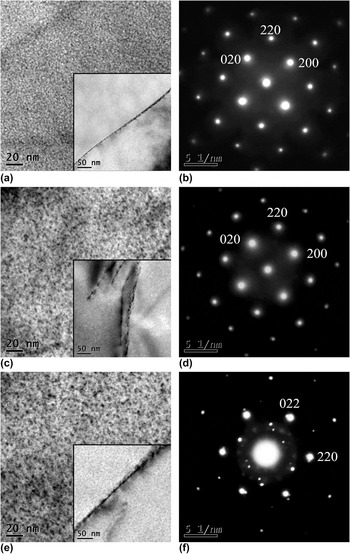
Figure 1 shows the precipitate microstructures and corresponding diffraction patterns of the one-stage stress-aged Al–Zn–Mg–Cu alloys (cases 1–3). From Fig. 1(a), small spherical aging precipitates can be detected, which are homogenously distributed within grains. According to the selected area electron diffraction (SAED) patterns [Fig. 1(b)], these aging precipitates are mainly GP zones (Zn- and Mg-rich clusters). Reference Berg, Gjønnes, Hansen, Li, Knutson-Wedel, Waterloo and Wallenberg11 When continuously increasing the first stage stress-aging temperature, the sizes of aging precipitates are enlarged, as shown in Figs. 1(c) and 1(e). Meanwhile, from Figs. 1(d) and 1(f), the type of aging precipitates gradually transform from GP zones to η′ phases (metastable aging precipitates). Reference Lin, Zhang, Liu and Liang24 It indicates that increasing the stress-aging temperature can enhance the activity and migration speed of solute atoms, which result in the accelerated evolution of GP zones. Additionally, from Fig. 1, it can also be found that the grain boundary precipitates of one-stage stress-aged alloys are continuously distributed. Furthermore, the sizes of grain boundary precipitate increase with increasing the first stage stress-aging temperature.
TEM micrographs and corresponding diffraction patterns of the one-stage stress-aged Al–Zn–Mg–Cu alloys under: (a, b) case 1; (c, d) case 2; (e, f) case 3.

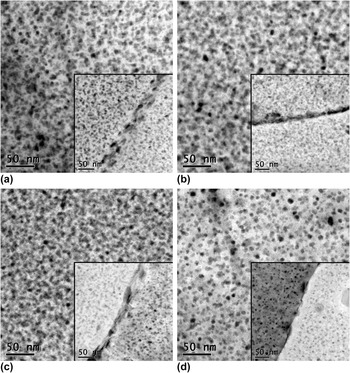
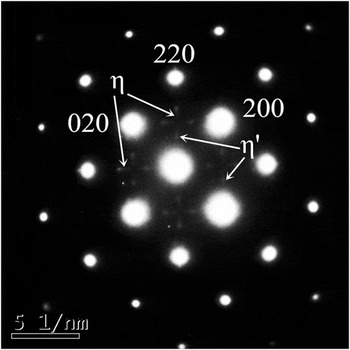
Figure 2 shows the precipitate microstructures of the two-stage stress-aged Al–Zn–Mg–Cu alloys (cases 4–7). From Fig. 2, large aging precipitates appear after the alloys are two-stage stress-aged. According to the SAED patterns illustrated in Fig. 3, clear patterns can be detected at 1/3 and 2/3{220}Al sites, indicating that these large-sized precipitates are mainly η′ and η phases (MgZn2). Reference Lin, Jiang, Chen, Wen and Zhou21,Reference Lin, Zhang, Liu and Liang24 Furthermore, coarse and discontinuously distributed precipitate appear at grain boundaries. The concentration and coarsening of precipitates at grain boundary result in clear precipitate free zones (PFZs) adjacent to grain boundaries. These phenomena suggest that the second stage stress-aging usually leads to the transformation and growth of substantial metastable precipitates to stable precipitates. Additionally, from Fig. 2, it is clearly observed that the density of intragranular aging precipitate increases firstly and then decreases, when increasing the first stage stress-aging temperature. Meanwhile, the average sizes of intragranular aging precipitates under cases 4, 5, and 6 can be calculated as about 6.42, 5.91, and 6.68 nm, respectively. Clearly, the average sizes of aging precipitates under cases 4 and 5 are smaller than that under case 6. This can be attributed to the different nucleation mechanism and growth kinetics of aging precipitates during the second stage stress-aging.
TEM micrographs of the two-stage stress-aged Al–Zn–Mg–Cu alloys under: (a) case 4; (b) case 5; (c) case 6; (d) case 7.

SAED patterns of the two-stage stress-aged alloy under case 5.

Additionally, from Fig. 2, it can also be found that the external stress has significant effects on the growth and coarsening of aging precipitates. When the alloy is stress-aged under 200 MPa, it can be found that the globular-like aging precipitates appear within grains with almost the same size, as shown in Fig. 2(d). However, when the external stress is increased from 200 MPa to 260 MPa, the aging precipitates gradually grow up and some rod-like precipitates appear, as shown in Fig. 2(b). Obviously, the average size of aging precipitate under case 5 is larger than that under case 7. Furthermore, Fig. 2 indicates that the size of grain boundary precipitate increases and the width of PFZs is broadened, when the external stress is increased. These results strongly suggest that the large external stress induces an accelerated growth of aging precipitate and promotes the formation of η phases.
B. Effects of two-stage stress-aging processing on electrochemical corrosion behaviors
1. EIS characteristics
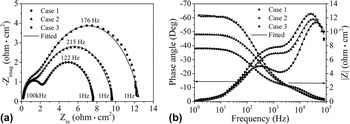
Generally, the EIS is usually applied to study the corrosion behaviors of aluminum alloys. Reference Garcia, Markley, Mol and Hughes40,Reference Lin, Liu, Chen, Huang, Chen, Ma and Li41 Fig. 4 shows the Nyquist and Bode plots of the one-stage stress-aged Al–Zn–Mg–Cu alloys immersed in EXCO solution. From Fig. 4(a), two capacitive impedance arcs can be found in the Nyquist plot at high frequency and low frequency ranges, respectively. The first capacitive arc appearing at high frequency corresponds to the charge transfer resistance and double-layer capacitance between the electrolyte and the studied alloys. The second capacitive arc appearing at low frequency represents the electrochemical corrosion process of the studied Al–Zn–Mg–Cu alloys in EXCO solution. Meanwhile, the radius of capacitive impedance arc at low frequency range increases with increasing the first stage stress-aging temperature. Also, the results suggest that the corrosion resistance of the one-stage stress-aged alloys under cases 1–3 increases with increasing the first stage stress-aging temperature. From the Bode plot in Fig. 4(b), two time constants can be observed, as two peaks in the phase angle occur. Furthermore, it can be found that the height and width of maximum phase angle increase with increasing the first stage stress-aging temperature. Generally, the reduction of maximum phase angle in height and width is closely related to the charge transfer resistance during corrosion of alloys. The impedance modulus in the high frequency range (approach to 105 Hz) corresponds to the solution resistance. From Fig. 4, the corrosion behaviors of one-stage stress-aged Al–Zn–Mg–Cu alloys are susceptible to the solution containing chlorine ion (Cl−).
Electrochemical impedance spectra of the one-stage stress-aged alloys under cases 1–3: (a) Nyquist plot; (b) Bode plot.

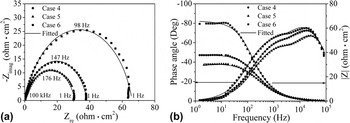
Figure 5 presents the Nyquist and Bode plots of two-stage stress-aged Al–Zn–Mg–Cu alloys immersed in EXCO solution. As described in the experimental procedure, the second stage stress-aging was conducted at a given temperature of 433 K. From Fig. 5(a), only one capacitive impedance arc can be found after the alloys are two-stage stress-aged. Meanwhile, the capacitive impedance arc radiuses of the two-stage stress-aged Al–Zn–Mg–Cu alloys are greatly increased compared to those of one-stage stress-aged Al–Zn–Mg–Cu alloys, indicating a better corrosion resistance of the two-stage stress-aged alloys. From Fig. 5(b), the width of the maximum phase angle is broadened, which can be ascribed to the superposition of two time constants. Meanwhile, it suggests that the passive oxide films of the two-stage stress-aged alloys are corrosive-resistant. According to the Nyquist and Bode plots shown in Fig. 5, it can be found that the corrosion resistance of the two-stage stress-aged alloys first decreases and then increases with increasing the first stage stress-aging temperature. This can be attributed to the different composition and distribution of aging precipitate in Al–Zn–Mg–Cu alloys.
Electrochemical impedance spectra of the two-stage stress-aged alloys under cases 4–6: (a) Nyquist plot; (b) Bode plot.

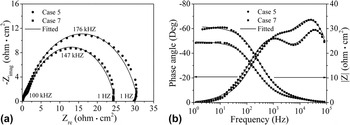
Figure 6 illustrates the effects of external stress on electrochemical impedance spectra of the two-stage stress-aged Al–Zn–Mg–Cu alloys. From Fig. 6(a), only one capacitive impedance arc can be observed in the Nyquist plot, and its radius increases with increasing the external stress. Meanwhile, Fig. 6(b) shows that both the maximum impedance modulus and maximum phase angle are increased with the increase of external stress. These results suggest that the corrosion resistance of the two-stage stress-aged alloys increases with increasing the external stress.
Comparison of the electrochemical impedance spectra of the stress-aged alloys under cases 5 and 7: (a) Nyquist plot; (b) Bode plot.

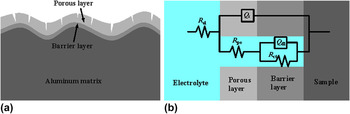
To quantitatively analyze the electrochemical impedance spectra of the studied Al–Zn–Mg–Cu alloy in EXCO solution, the equivalent electrical circuit model is commonly used to fit the EIS plots. Reference Moreto, Marino, Bose Filho, Rocha and Fernandes42 Fig. 7(a) shows the schematic of passive oxide film formed on aluminum matrix. It is generally accepted that the oxide film generated under normal atmosphere consists of two layers. The outer layer is a permeable layer composed of hydrated oxide with numerous pores. The inner oxide layer close to aluminum matrix is a compact amorphous barrier layer. It is well known that the corrosion process of aluminum alloys is closely related to these oxide layers. Based on the above surface texture, a well-known equivalent circuit model R(Q(R(QR))) is used, Reference Mouanga, Puiggali and Devos43,Reference Lin, Liu, Chen, Zhang, Chen, Jiang and Li44 as depicted in Fig. 7(b).
Schematic of the studied Al–Zn–Mg–Cu alloy in EXCO solution: (a) passive oxide film; (b) equivalent circuit model.

In the presented equivalent circuit, the physical significance of the elements can be described as follows: R el is the electrolyte resistance, depending on the distance between the working electrode and the reference electrode, as well as on the solution concentration; R po is the resistance of porous layer; R ct corresponds to the charge transfer resistance, which is associated with the barrier layer of oxide film. Considering the non-uniformed appearance of oxide film, constant phase element (CPE) is used to characterize the nonideal capacitance behaviors (dispersion effect), which is denoted by symbol Q. In this work, Q c and Q dl are the CPEs of outer porous layer and double-layer, respectively. Obviously, the parameter Q c together with R po represents the electrochemical reactions between the electrolyte solution and the oxide film. Meanwhile, the parameters Q dl and R ct indicate the corrosion process between the electrolyte and aging precipitates or aluminum matrix. Generally, the impedance of a CPE can be defined by Reference Fadaee and Javidi45,Reference Osorio, Freitas and Garcia46 :
 $${Z_{{\rm{CPE}}}} = {Y_0}^{ - 1}{\left( {j\omega } \right)^{ - n}}\quad ,$$
where Y 0 corresponds to the capacitance. ω is the angular frequency (j 2 = −1). n is the empirical exponent between −1 and 1, representing the nonideal capacitance behaviors of the corroding system. The CPE is an inductance, pure resistance and ideal capacitance, when n = −1, 0, and 1, respectively. Particularly, when n = 0.5, the CPE represents the Warburg impedance, which indicates the occurrence of charge diffusion during electrochemical corrosion.
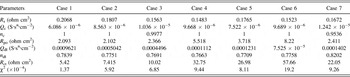
With the proposed equivalent circuit model in Fig. 7(b), the measured electrochemical impedance spectra were fitted using ZsimpWin software. The fitted electrochemical parameters are listed in Table II. In general, the fitting precision is evaluated by Chi-squared (χ2) values. From Table II, it can be found that the values of Chi-squared (χ2) are about 10−4, indicating that the experimental results are well fitted to the proposed equivalent circuit model. Meanwhile, from Figs. 4–6, it can also be found that the fitted plots agree well with the experimental ones.
Fitted electrochemical parameters of the equivalent circuit.

From Table II, it can be found that the electrolyte resistances (R s) of all tested cases keep approximately constant. The average of R s is about 0.17 ohm cm2, which corresponds to the resistance of EXCO solution. As mentioned above, the electrolyte resistance is mainly decided by the distance between the working electrode and the reference electrode, as well as the solution concentration. Therefore, it can be concluded that the stress-aging processing has little influence on the electrolyte resistance. The values of CPE of outer layer (Q c) lie in the range between 6.086 × 10⁻⁶ and 1.242 × 10⁻⁵ S·sn·cm−2. Meanwhile, no obvious regularity can be found through the fitted data, indicating that the outer layers of the samples under different stress-aging processings are non-uniform. However, it is interesting to find that the values of n c are around 1, which suggests that the outer layer of oxide film has the ideal capacitance characteristic. Therefore, the CPE of outer layer (Q c) in the equivalent circuit model can also be replaced by the capacitance element. On the contrary to the CPE of porous layer, it can be found that the CPE of double-layer has both the capacitance and resistance characteristics. This can be inferred from the values of empirical exponent n dl.
From Table II, the Q dl of the one-stage stress-aged Al–Zn–Mg–Cu alloys are higher than those of the two-stage stress-aged Al–Zn–Mg–Cu alloys. Meanwhile, the values of Q dl decrease with increasing the first stage stress-aging temperature under cases 1–3. These phenomena suggest that the one-stage stress-aged alloys are corroded severely. The corrosion products produced by these reactions result in high capacitance. After the alloys are two-stage stress-aged, the value of Q dl increases firstly and then decreases with increasing the first stage stress-aging temperature (cases 4–6). Furthermore, from cases 5 and 7, it can be seen that Q dl decreases with increasing external stress.
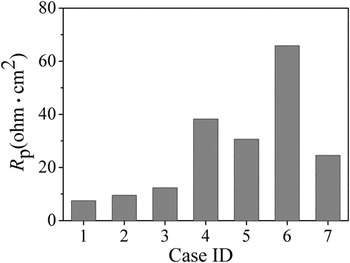
Generally, the corrosion resistance of alloys can be evaluated by the porous layer resistance (R po) and the charge transfer resistance (R ct). Reference Yang, Wang, Tu, Li and Huang47,Reference Liu, Li, Zou, Luo, Zhang, Zeng and Li48 From Table II, it can be seen that the value of R po is less than that of R ct for all the cases, suggesting that the corrosion protection is mainly provided by the barrier layer. Furthermore, it is generally accepted that the higher charge transfer resistance means the lower corrosion current density in the alloy. Thus, the better corrosion resistance can be achieved. In this work, the charge transfer resistance together with the porous layer resistance is used to evaluate the corrosion resistance of the stress-aged alloy, Reference Trdan and Grum49,Reference Chen, Frankel, Jiang, Shao and Zhen50 i.e., the polarization resistance R p = R ct + R po. Generally, the high polarization resistance corresponds to the good corrosion resistance. Figure 8 shows the polarization resistance of the Al–Zn–Mg–Cu alloys under all the cases. From Fig. 8, it can be found that, for the one-stage stress-aged Al–Zn–Mg–Cu alloys, the polarization resistance increases from 7.513 to 12.386 Ω·cm2, when increasing the first stage stress-aging temperature from 363 to 393 K. However, it is interesting to find that the polarization resistance increases significantly after the alloys are two-stage stress-aged, i.e., the polarization resistances are 38.268, 30.698, and 65.88 Ω·cm2 under cases 4, 5, and 6, respectively. It indicates that, for the two-stage stress-aged Al–Zn–Mg–Cu alloys, the polarization resistance decreases firstly and then increases with increasing the first stage stress-aging temperature. Additionally, compared to the two-stage stress-aged alloy under case 5, the two-stage stress-aged alloy under case 7 has the relatively low polarization resistance (24.581 Ω·cm2). This clearly suggests that the polarization resistance increases with increasing the external stress.
Corrosion resistance of the stress-aged Al–Zn–Mg–Cu alloys in EXCO solution.

From the above analysis, the two-stage stress-aged alloys present good corrosion resistance, while the one-stage stress-aged alloys are susceptible to electrochemical corrosion. Furthermore, the corrosion resistance of the alloys increases with increasing the external stress. These results can be attributed to the evolution of microstructures, which significantly affect the corrosion resistance of the stress-aged alloys.
2. Cyclic polarization characteristics
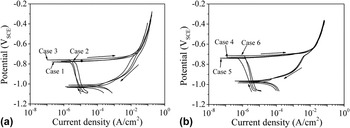
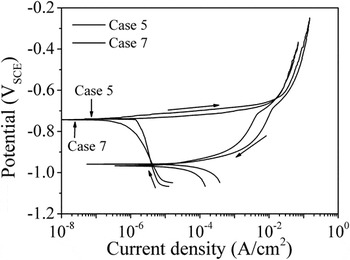
In this section, the cyclic polarization characteristics of the stress-aged Al–Zn–Mg–Cu alloys are studied. Figures 9 and 10 show the cyclic polarization curves of the stress-aged alloys immersed in 3.5% NaCl solution. Generally, the corrosion resistance of aluminum alloy is often evaluated by the pitting potential (E pit). Simply stated, the potential at which current density increases sharply is called the pitting potential. Obviously, the pitting potentials are not obvious in the quiescent 3.5% NaCl solution in Figs. 9 and 10. However, the polarization curves show that the current density increases sharply when the potential is above the corrosion potential (E corr). It indicates that the oxide layer, which covers on the surface of aluminum matrix, is ruptured. Meanwhile, the nucleation of corrosion pits occurs on aluminum matrix. So, corrosion process (pitting corrosion) may occur at the corrosion potential in this study. Therefore, the corrosion potential can be used to evaluate the corrosion resistance of the studied Al–Zn–Mg–Cu alloy. From the cyclic polarization curves, the corrosion potential (E corr) can be derived, which are listed in Table III. Obviously, the corrosion potential of the studied alloy is sensitive to the stress-aging processing.
Cyclic polarization curves of the stress-aged Al–Zn–Mg–Cu alloys in 3.5% NaCl solution under: (a) cases 1–3; (b) cases 4–6.

Comparison of the polarization curves of the stress-aged Al–Zn–Mg–Cu alloys in 3.5% NaCl solution under cases 5 and 7.

Electrochemical parameters of the stress-aged Al–Zn–Mg–Cu alloys in 3.5% NaCl solution.
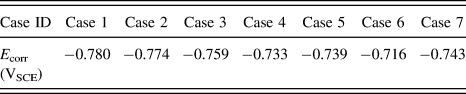
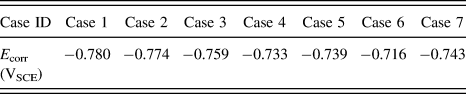
From Table III, it can be found that, after the first stage stress-aging (cases 1–3), the alloys exhibit low corrosion potentials under the tested conditions. The corrosion potentials of the stress-aged alloys under cases 1–3 are −0.780, −0.774, and −0.759 VSCE, respectively. This result indicates that the corrosion resistance is poor when the alloys are one-stage stress-aged under relatively low temperatures (363, 378, and 393 K). It can be concluded that the corrosion pits are easily induced. Furthermore, for the one-stage stress-aged Al–Zn–Mg–Cu alloys, the corrosion potential increases with increasing the first stage stress-aging temperature. For the two-stage stress-aged alloys under cases 4–6, the corrosion potentials are −0.733, −0.739, and −0.716 VSCE, respectively. It indicates that the corrosion potentials are significantly enhanced when the one-stage stress-aged alloys are re-aged at 433 K. Meanwhile, the changes in corrosion potential indicate that the corrosion resistance of the two-stage stress-aged alloys firstly decreases and then increases with increasing the first stage stress-aging temperature. Additionally, from Table III, it can be found that for the stress-aged alloys under cases 7 and 5, the corrosion potential increases from −0.743 VSCE to −0.739 VSCE, when increasing the external stress from 200 MPa to 260 MPa. It suggests that the corrosion resistance can be enhanced with increasing the external stress. These findings are in good accordance with the results from EIS experiments.
Generally, the difference in corrosion potentials of the stress-aged alloys is closely related to microstructures. Reference Wang, Zhang, Wu and Ma51,Reference Liu, Li, Gao, Liang, Zhang and Cui52 As discussed in Sec. III. A, for the one-stage stress-aged alloys, small spherical aging precipitates can be detected within grain, as shown in Fig. 1. The main aging precipitates are GP zones when the alloy is stress-aged under case 1. Meanwhile, the transformation of GP zones to η′ phases occurs when the first stage stress-aging temperature is increased (cases 2 and 3). During the first stage stress-aging, only part of solution atoms (Mg and Zn atoms) precipitate from aluminum matrix, while a lot of solution atoms remain in aluminum matrix. It is well known that Mg and Zn elements have high electrochemical activity. Therefore, the large amounts of Mg and Zn atoms will shift the corrosion potential towards the anodic direction, which will decrease the corrosion resistance. Meanwhile, due to the high electrochemical activity, the small-sized GP zones and η′ phases will be preferentially dissolved during the electrochemical corrosion, thus resulting in etch pits in these regions. Furthermore, the continuously distributed aging precipitates along grain boundaries offer a preferential path for electrochemical corrosion. As a result, the first stage stress-aged alloys are easily corroded, and the corrosion resistance is poor.
However, when the alloys are two-stage stress-aged (cases 4–7), the corrosion resistance is greatly improved. This can be attributed to the evolution of precipitates during the second stage stress-aging. For the two-stage stress-aged alloys under cases 4–7, large aging precipitates appear within grains. Meanwhile, coarse and discontinuously distributed precipitates form along grain boundaries, as shown in Fig. 2. Obviously, after the second stage stress-aging, the solute atoms in aluminum matrix fully precipitate. On the one hand, according to the other researchers' report, Reference Dey, Gunjan and Chattoraj33 the corrosion pits most likely nucleate at η′ and η phases in Al–Zn–Mg–Cu alloys. From Fig. 2, the density of aging precipitate under cases 4–7 is smaller than those under cases 1–3. The relatively low-density aging precipitates reduce the probability of corrosion pit nucleation, which increase the corrosion resistance of the studied alloy. On the other hand, it is well known that the corrosion resistance of Al–Zn–Mg–Cu alloys is closely related to grain boundary precipitates. Generally, the grain boundary with continuous precipitates becomes a susceptive anodic channel, which will result in the galvanic reaction between the anodic precipitates and aluminum matrix. From Figs. 2(a)–2(c), the grain boundary precipitates are discontinuously distributed. The average sizes of grain boundary precipitates under cases 4–6 first decrease and then increase with increasing the first stage stress-aging temperature. Obviously, when the precipitates are coarse and discontinuously distributed at grain boundaries, the anodic corrosion path is cut off, and the corrosion resistance of the studied alloy can be improved. Furthermore, the widths of PFZ under cases 4–6 are evaluated as about 37.85, 33.50, and 52.12 nm, respectively. Recently, it is found that the migration of Cu atoms from PFZ to grain boundary precipitate can occur when the temperature is above 423 K. Reference Marlaud, Deschamps, Bley, Lefebvre and Baroux14 Researches show that the increase of Cu content in grain boundary precipitates can reduce the electrochemical activity of MgZn2 precipitates in Al–Zn–Mg–Cu alloys. Reference Xu, Birbilis and Romesch34 Thus, the corrosion resistance of the two-stage stress-aged alloys under cases 4–6 decreases firstly and then increases with increasing the first stage stress-aging temperature. Additionally, from the comparison of the alloys under cases 5 and 7, the size of grain boundary precipitates increases and the width of PFZ is broadened with increasing the external stress. Meanwhile, the width of PFZ increases from 31.43 nm to 33.50 nm, when increasing the external stress from 200 MPa to 260 MPa. The evolution of precipitate microstructures results in the increased corrosion resistance of the studied alloy when the external stress is large.
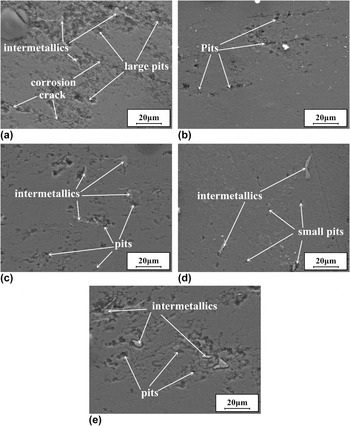
Figure 11 shows the corroded surface morphologies of the stress-aged Al–Zn–Mg–Cu alloys after cyclic polarization experiments. Obviously, the stress-aging processing has significant effects on the corroded morphologies, which can reflect the corrosion resistance to some extent. Reference Trdan and Grum49 From Fig. 11(a), large and high-density corrosion pits can be observed on the exposed surface. Meanwhile, several corrosion cracks can also be detected. It indicates that the one-stage stress-aged alloy under case 2 is seriously corroded during polarization in 3.5% NaCl solution. However, when the alloys are two-stage stress-aged, the exposed surfaces are less corroded. From Figs. 11(b)–11(d), only a small number of isolated corrosion pits appear under cases 4–6, compared to that of the stress-aged alloy under case 2. Furthermore, the density of corrosion pits firstly increases and then decreases with increasing the first stage stress-aging temperature. This result reveals that the two-stage stress-aged alloys under cases 4–6 are strongly resistive to electrochemical corrosion. Meanwhile, from Figs. 11(c) and 11(e), it can be found that decreasing the external stress from 260 MPa to 200 MPa, the size and density of corrosion pits increase. It suggests that the external stress has substantial impact on corrosion resistance of the stress-aged alloys. Furthermore, the corrosion resistance increases with increasing the external stress. The scanned morphologies agree well with the results from EIS and cyclic polarization experiments.
Corroded surface morphologies of the stress-aged alloys under: (a) case 2; (b) case 4; (c) case 5; (d) case 6; (e) case 7.

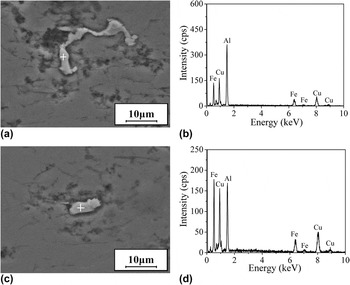
Additionally, from Fig. 11, some gray irregularly shaped particles can also be detected in both one-stage and two-stage stress-aged alloys, and severe corrosion attack occurs in the neighboring areas of the particles. According to the previous study, Reference Lin, Jiang, Chen, Wen and Zhou21 the particles present in the studied Al–Zn–Mg–Cu alloy with the dimension of above 1 μm are intermetallics, which primarily form due to the interactions between alloying elements and impurity elements. To better understand corrosion mechanism around intermetallics, the high-magnification SEM morphologies and corresponding energy dispersive spectrometer (EDS) are obtained, as shown in Fig. 11. Obviously, the intermetallics exhibit excellent anticorrosion during electrochemical corrosion in 3.5% NaCl solution and induce severe corrosion attack around them, as shown in Figs. 12(a) and 12(c). From the EDS analysis in Figs. 12(b) and 12(d), it can be found that the intermetallics mainly consist of Al, Cu, and Fe elements. Researches show that Cu- and Fe-rich intermetallics are cathodic with respect to aluminum matrix and often act as cathodes during electrochemical corrosion. Reference Chemin, Marques, Bisanha, de Jesus Motheo, Bose Filho and Ruchert53,Reference Andreatta, Terryn and De Wit54 Due to the strong galvanic coupling, the intermetallics promote the corrosion attack of aluminum matrix, resulting in large corrosion pits. However, it is found that the Fe- and Cu-rich intermetallics are insoluble and quite stable even at 778–788 K. Reference Xu, Rometsch and Birbilis55 Considering the low stress-aging temperatures used in this study, it can be inferred that the distribution and size of intermetallics cannot be changed during two-stage stress-aging. Therefore, the intermetallics have little influence on the difference in corrosion behaviors of the stress-aged alloys.
SEM images and corresponding EDS of intermetallic particles under: (a–b) case 2; (c–d) case 5.

IV. CONCLUSIONS
The effects of two-stage stress-aging processing on corrosion resistance of an Al–Zn–Mg–Cu alloy were investigated. The following conclusions are emphasized:
-
(1) The corrosion behaviors of the studied Al–Zn–Mg–Cu alloy are greatly affected by the stress-aging processing. The one-stage stress-aged alloys are sensitive to the electrochemical corrosion, and thus show poor corrosion resistance. However, when the alloys are two-stage stress-aged, the corrosion resistance is greatly improved. The corrosion resistance of the two-stage stress-aged alloys decreases firstly and then increases with increasing the first stage stress-aging temperature. Meanwhile, increasing the external stress can enhance the corrosion resistance of two-stage stress-aged alloys.
-
(2) The difference in corrosion resistance of the stress-aged alloys can be attributed to the size and distribution of aging precipitates. The small-sized aging precipitates within grains and continuous distribution of grain boundary precipitates result in the poor corrosion resistance of the one-stage stress-aged alloys. However, for the two-stage stress-aged alloys, the coarse and relatively low-density intragranular aging precipitates reduce the probability of corrosion pit nucleation. Meanwhile, the discontinuously distributed grain boundary precipitates can cut off the anodic corrosion path during electrochemical tests, which will enhance the corrosion resistance of the studied alloy.
-
(3) Based on the above discussions, to obtain excellent corrosion resistance, the studied alloy should be two-stage stress-aged, and the optimized first stage stress-aging temperature is about 393 K under the tested conditions. Meanwhile, the external stress can be selected as about 260 MPa.
ACKNOWLEDGMENTS
This work was supported by the National Natural Science Foundation Council of China (Grant Nos. 51375502 and 51305466), the Project of Innovation-driven Plan in Central South University (No. 2016CX008), the National Key Basic Research Program (Grant No. 2013CB035801), the Natural Science Foundation for Distinguished Young Scholars of Hunan Province (Grant No. 2016JJ1017), and State key laboratory of High Performance Complex Manufacturing (No. zzyjkt2014-01), China.