Implications
Artificially inseminated (AI) boars have large number of offspring, therefore choice of boars has become an extremely responsible decision with long-term consequences. Optimal growth parameters during the rearing period may be a good factor strongly affecting the improvement of reproductive performance. Our study demonstrated the significant effect of breed, daily gains and meat content on the analyzed parameters. On the basis of study outcomes, boars growing 800 to 850 g/day and with 62.5% to 65% meat content achieved the best production performance. The presented results permit increase in the total number of insemination doses by up to 300 portions/boar within a year taking into account growth parameters during selection to station. Our solution may clearly help AI stations improve the efficiency and economic viability.
Introduction
Boars have a decisive impact on the implementation of genetic and production progress in pig production. The application of AI has dramatically increased the number of offspring born from each male, which has directly influenced the hard selection of boars (Oh et al., Reference Oh, See, Long and Galvin2006). However, the selection of boars for AI is based mainly on selected growth parameters and carcass characteristics, with minimal emphasis on the quantity and quality of semen or fertility (Robinson and Buhr, Reference Robinson and Buhr2005). Currently, the most common features evaluated intravitally are daily gains (measured from the time of rearing until the assessment), backfat thickness and muscle depth (components of the meat content measured during the assessment day). High levels of genetic improvement of individuals only in terms of production traits can affect their exploitation value (Smital, Reference Smital2009).
It has been suggested that increasing the weight gains and carcass meat content can adversely affect the fertility of boars (Andersson et al., Reference Andersson, Hullberg, Malmgren, Lundström, Rydhmer and Squires1999; Oh et al., Reference Oh, See, Long and Galvin2006). However, as pointed out by Robinson and Buhr (Reference Robinson and Buhr2005), there is still too little objective research in this field. The issue of genetic correlations between the production features and the quality of semen production has been discussed (Smital et al., Reference Smital, Wolf and De Sousa2005; Oh et al., Reference Oh, See, Long and Galvin2006; Flowers, Reference Flowers2008; Wolf, Reference Wolf2009). However, a realistic breeding assessment of boars is still lacking and the only solution is its estimation based on the selection parameters.
The effectiveness of the AI boars and their reproductive performance can be evaluated using basic semen parameters (defined as indirect reproductive traits), which include semen volume, spermatozoa concentration, total number of spermatozoa, the number of insemination doses, as well as fertility (defined as direct reproductive traits) measured at least by conception rate indicators (Smital et al., Reference Smital, Wolf and De Sousa2005; Roca et al., Reference Roca, Vazquez, Gil, Cuello, Parilla and Martinez2006). AI stations selecting breeding material, including production traits, take into account factors that may increase the effectiveness of use. The choice of AI boars has become an extremely responsible task that should be preceded by a thorough analysis of the expected productivity (Ren et al., Reference Ren, Xing, Lin, Wu, Li, Li, Yang, Guo, Ren, Ma, Lan and Huang2009), because this has long-term consequences. The evaluation and assortment of AI boars, also in terms of semen production estimation, may increase the efficiency and profitability of selected individuals (Oh et al., Reference Oh, See, Long and Galvin2003).
The intensity of use of breeding-production boars is integrally combined with high breeding values for economically important traits (selection traits) and the body’s ability to properly produce semen. Therefore, it seems important to provide a precise analysis of the selected rearing factors of young boars and the effect of these factors on semen and fertility parameters in their further use. There is no recent information about the optimal growth parameters during the rearing period on the reproductive performance of modern breed boars later used in AI stations. This is a key issue because monitoring the traits influencing the quality and quantity of resultant insemination doses has huge economic impact (Smital, Reference Smital2009).
In our previous studies on the evaluation of the semen parameters and reproductive performance of boars, we demonstrated the effects of breed, season, photoperiod and time of birth (Knecht et al., Reference Knecht, Środoń, Szulc and Duziński2013, Reference Knecht, Środoń and Duziński2014a and 2014Reference Knecht, Środoń and Duzińskib). However, we did not find any experiments determining the optimal growth rate or meat content on the basis of the results of AI boar performance. Therefore, in this study, we conducted semen parameter and conception rate analyses based on the growth rate and meat content assessments made during the rearing of AI boars of different genotypes before their qualification and the start of their exploitation.
Material and methods
Experimental location and design
The study was carried out between 2010 and 2014 at the Boar Exploitation Station in Częstochowa and included 184 boars in five breed combinations: 46 Polish Large White (PLW), 50 Polish Landrace (PL), 27 Pietrain (P), 36 Duroc×Pietrain (D×P) and 25 Hampshire×Pietrain (H×P). The presented population was representative in terms for the most common breed components used for AI in Poland.
Experimental animals
All boars, regardless of the breeds, were qualified for the experiment on the basis of daily gains and meat content. The assessment was made between days 170 and 210 of life. Daily gains were calculated by dividing the BW of young boars (during the assessment time) by the age at the assessment day. The measurements of the animals for the estimation of daily gains were made using Mensor WM150P1 electronic scales (Mensor, Warsaw, Poland). Daily gains were standardized to 180 days using the model developed for standardization in accordance with the methodology of Mucha and Różycki (Reference Mucha and Różycki2005), in order to reduce the age differences during assessment. The percentage of meat content in carcasses was estimated intravitally on the basis of backfat thickness (points P2 and P4) and lion eye height (point P4) measurements. The measurements were made using a PIGLOG 105 (SFK, Carometec A/S, Grodzisk Mazowiecki, Poland) ultrasonic device, behind the last rib (between the thoracic and lumbar vertebrae), 3 cm off the midline (point P2) and 8 cm off the midline (point P4). To increase the accuracy of the assessment, the standardization of traits was performed to 110 kg BW. Formulas for standardization are based on the measurements repeatedly performed on every animal for a long time from 100 to 210 days of age according to the methodology of Mucha and Różycki (Reference Mucha and Różycki2005). The measurement values were inserted into a specially developed equation (Szyndler-Nędza and Różycki, Reference Szyndler-Nędza and Różycki2005), which allowed an estimation of the intravital proportion of meat in the carcass on the assessment day. The results for meat content were also standardized to day 180 (Mucha and Różycki, Reference Mucha and Różycki2005).
Boars were divided into groups with regard to breed, daily gains or meat content. During the distribution of boars hierarchy division was retained. All subgroups were characterized by a proportional number of boars according to all three studied factors. It means that animals representing specific breed occupied all other groups of daily gains and meat content in the similar number. There were three main groups: five breed groups (PLW, PL, P, D×P, H×P), five daily gain groups (<700, 700 to 750, 750 to 800, 800 to 850, >850 g) and four meat content groups (<60%, 60% to 62.5%, 62.5% to 65%, >65%). Boars were regularly monitored for breed standard, correctness of testicular development with the analysis of anomalies and overall construction in accordance with the methodology of the object. Actions have been taken to eliminate effects of season and age of the boar. Therefore, in each season (Winter, Spring, Summer, Autumn) was an almost identical number of young (8 to 16 months), middle-aged (16 to 24 months) and old (24 to 32 months) boars of the same genotype. Seasonal and age variations were also determined separately for each respective season and age to minimize the problem of comparing the results for these effects, so they could be removed from the model. In the absence of significant differences between atmospheric conditions during the analyzed years, the effect of the year was not evaluated.
Semen data
Ejaculates for analysis were obtained from boars between 8 and 32 months of age, that is, from the beginning of the reproductive performance of boars (8 month) and for the next 24 months. Ejaculates were collected 2 times/week from each boar. A total number of 38 272 fresh ejaculates were examined directly after collection based on selected parameters: semen volume (ml), spermatozoa concentration (×106 ml−1), total number of spermatozoa in ejaculate (×109) and number of insemination doses obtained from one ejaculate (n). Ejaculates were collected by masturbation via manual method (King and Macpherson, Reference King and Macpherson1973) using a container with a filter. The gelatinous fraction was separated. Immediately after collection, the volume of semen was measured using a scalar cylinder. The concentration of spermatozoa was evaluated using a SpermaCue device, Model 12300/0500 (Minitube International, Verona, WI, USA). On the basis of semen volume and spermatozoa concentration, the total number of spermatozoa in the ejaculate was calculated. Semen dilution was effected using the same semen extender (short-term BTS boar semen extender, Version 13525/0100 Antibiotic free; Minitube International) and insemination doses of 80 ml contained a constant 2.8×10⁹ spermatozoa. Semen was stored at 15°C for not longer than 48 h. The fertility of the boars was determined by the conception rate (%). Ejaculates were included in the analysis of results and classified as normal for further dilution, when it met the following requirements: color from gray to milky white, flavor specific, lack of foreign admixtures, >70% of progressive motile sperm cells, pH 7.0 to 7.9, morphological abnormal spermatozoa not more than 15% (5% primary abnormalities, 10% secondary abnormalities). The amount of ejaculates not fulfilling the aforementioned criteria was equal in the experimental groups (data not shown).
Conception rate was specified as the non-return of estrus within 35 days of the first insemination. In total, 32 sows were inseminated using AI doses of each (single) boar to calculate conception rate. The number of sows were uniformly spread over the seasons. The genotype, age and parity structure of sows involved in the experiment was similar across all groups. The unified process of insemination was used. Indications of estrus were detected in the presence of the boar (visual and olfactory contact) twice a day, starting on the 4th day after weaning. Estrus of sows was diagnosed by standing reflex using the back pressure test. Experimental groups were formed randomly from sows showing their estrus at a regular interval of 4 to 8 days after weaning. Sows were inseminated with Safe Blue Clear Glide™ catheters (Minitube International) for standard (cervix) insemination. Before insemination, seminal doses were warmed to a temperature of 35°C. Insemination was always repeated after 24 h. In total, 32 sows were inseminated per boar and year, that is, 8 sows/season. Each sow was inseminated twice, therefore, 64 insemination doses were used of each boar.
Housing and feeding
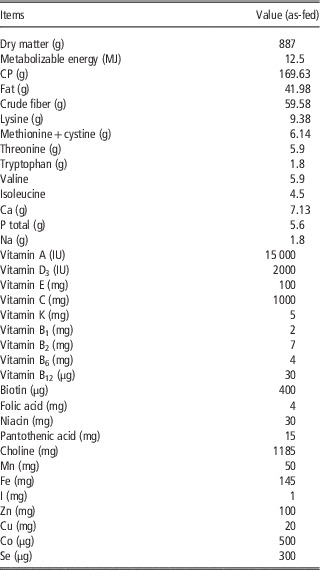
Boars were single-housed and maintained in accordance with the principles of animal welfare (OMARD, 2010). Preventive care and vaccination has been carried out regularly for all boars at the same time intervals in accordance with the methodology of the object. The individual pen area was 8 m2/boar. The air temperature in all the boar pens was close to 15°C (minimum 12°C, maximum 20°C). Relative humidity was close to 75% (minimum 65%, maximum 85%). The air circulation inside the building was equal to 0.15 m/s in winter and 0.20 m/s in summer. Over the whole study period, boars were fed the same all-mash mixture, dosed according to the recommended nutrition standard for boars (Polish Swine Nutrition Requirements, 2014), with permanent access to water (Table 1).
The nutritional value of 1 kg of compound feed for boars

Statistical analysis
The numerical material was analyzed using the STATISTICA (2014) statistical program. Average values in the tables are arithmetical means
 $\left( {\bar{x}} \right)$
and SEM. The collected data were checked for normality with the Kolmogorov–Smirnov test with the Lilliefors correction. In addition, the Brown–Forsythe test determined whether the distributions of the variables had the same variance. Conception rate were analyzed using Pearson’s χ
2 test. An advanced mixed model using the GLM procedure was used and ANOVA was conducted for factorial designs to determine the effect of growth rate and meat content on the tested parameters including boar breed. Among many factors influencing the semen parameters in the model only factors statistically significant at P⩽0.05 were considered. The main effects of breed, growth rate, meat content and interactions between these effects were included in the model. The significance of differences was calculated on the basis of Tukey’s multiple range test. In addition, Pearson’s correlation coefficient (r) was calculated between the experimental factors and analyzed parameters within the breeds. The levels of significance of differences were given conventionally: significant (0.01<P<0.05) and highly significant (P<0.01).
Results
Main effects and interactions
Experimental factors analyzed in this study determined the selected parameters, and the impact of the main effects is shown in Table 2. The highest statistically proven effect of breed were noted for semen volume, spermatozoa concentration and conception rate (P<0.01), followed by the total number of spermatozoa and number of insemination doses (P<0.05). The statistically proven effect of daily gains was confirmed for spermatozoa concentration, number of insemination doses, conception rate (all P<0.01) and total number of spermatozoa (P<0.05). Effect of intravitally evaluated meat content was observed only for semen volume, number of insemination doses and conception rate (all P<0.05). The applied statistical analysis allowed a demonstration of the impact of the interaction between the main effects on the assessed parameters. Statistically proven interactions for breed×daily gains were noted for spermatozoa concentration, conception rate (P<0.01) and number of insemination doses (P<0.05). The interaction breed×meat content determined conception rate (P<0.01) and semen volume (P<0.05). The number of insemination doses and conception rate were influenced by daily gains×meat content interaction (P<0.05 and <0.01, respectively), and conception rate was additionally influenced by the interaction of all three main effects.
The influence of main effects and interactions on selected parameters

B=breed; DG=daily gains; M=meat content.
*Statistically significant effect at P⩽0.05.
**Statistically significant effect at P⩽0.01.
Effect of breed
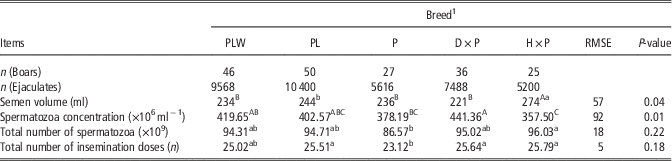
The effect of boar breed on the selected semen parameters is presented in Table 3. The highest semen volume was noted for H×P boars, and the difference between the rest of breeds was statistically proven at the level of P<0.01 for PLW, P, D×P and at the level of P<0.05 for PL breed. H×P crossbreeds were characterized by the lowest spermatozoa concentration; however, the highest was noted for D×P crossbreed boars and the difference was 83.86×10⁶ ml−1 and this was statistically proven (P<0.01). Crossbreed boars had the highest total number of spermatozoa in ejaculates, although the difference between extreme values (the highest for H×P and the lowest for P) was statistically significant (P<0.05). The number of insemination doses depending on the breed was almost similar, but the highest unfavorable difference was observed for P breed (P<0.05) in comparison with other breeds.
The effect of boar breed combination on selected semen parameters

RMSE=root mean square error; n=Number of ejaculates.
A,B,CStatistically significant differences between the breeds at P⩽0.01.
a,bStatistically significant differences between the breeds at 0.01<P⩽0.05.
1 Breed of boars: PLW=Polish Large White; PL=Polish Landrace; P=Pietrain; D×P=Duroc×Pietrain; H×P=Hampshire×Pietrain.
Effect of daily gains
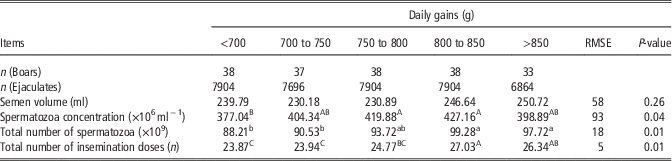
The results of selected semen parameters depending on the daily gains are presented in Table 4. An upward trend for all analyzed variables was observed for daily gain growth. However, the peak of growth for spermatozoa concentration, total number of spermatozoa and number of insemination doses was achieved for 800 to 850 g gains. Differences confirmed by the analysis model for the spermatozoa concentration were demonstrated between the lowest daily gains (<700 g) and daily gains (750 to 800, 800 to 850 g; P<0.01). The total number of spermatozoa differed significantly for <700 and 700 to 750 g (the lowest values) and 800 to 850, >850 g (the highest values) (P<0.05). Statistically proven differences (P<0.01) were also demonstrated for the number of insemination doses.
The effect of daily gains on selected semen parameters

RMSE=root mean square error; n=Number of ejaculates.
A,B,CStatistically significant differences between the breeds at P⩽0.01.
a,bStatistically significant differences between the breeds at 0.01<P⩽0.05.
Effect of meat content
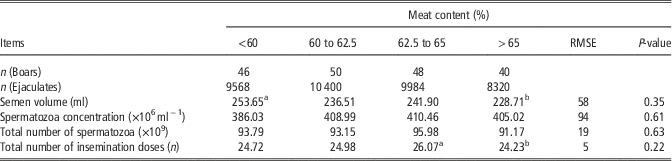
The effect of intravitally assessed meat content on selected semen parameters is presented in Table 5. A positive increase of meat in the carcass was observed only to the content of 65% (with a subsequent decrease) and only with the exception of semen volume. There are statistically proven differences between the meat content and the semen volume, and the number of insemination doses. The difference between the lowest semen volume for >65% group and the highest for <60% group was 24.94 ml (P<0.05). The largest insemination portion was obtained from the 62.5% to 65% group and the least in the >65% group, with a difference of 1.84 portions (P<0.05).
The effect of meat content on selected semen parameters

RMSE=root mean square error; n=Number of ejaculates.
a,bStatistically significant differences between the breeds at 0.01<P⩽0.05.
Conception rate
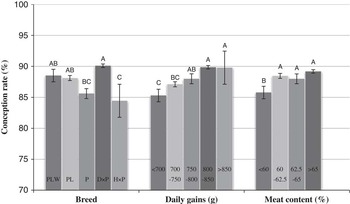
The conception rate of the tested boars according to breed, daily gains and meat content is presented in Figure 1. The extreme values for this parameter were obtained by crossbreeds D×P (the highest) and H×P (the lowest) and the difference (5.68%) was statistically proven at P<0.01 level. A low conception rate of slightly above 85% was also noted for P boars (a difference at the level P<0.01 in comparison with D×P). Very similar values above 88% were achieved by PLW and PL boars. The increase in daily gains determined the increase in the conception rate, although the >850 g group had a slightly lower value (about 0.1%) than the 800 to 850 g group. The highest statistically proven differences were reported between these previously discussed groups and the groups <700, 700 to 750 g (P<0.01) and additionally between the groups 750 to 800 and <700 g (P<0.01). Clear differences (P<0.01) between conception rate and meat content in the <60% group were observed in comparison with other groups.
Conception rate of boars according to breed, daily gains and meat content. A,B,CStatistically significant differences between the same factor at P⩽0.01. PLW=Polish Large White; PL=Polish Landrace; P=Pietrain; D×P=Duroc×Pietrain; H×P=Hampshire×Pietrain.

Correlation coefficients
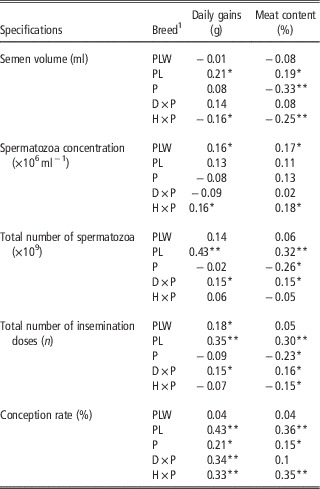
The correlation coefficients between the studied parameters and daily gains and meat content are shown in Table 6. Among the numerous correlations, statistically positive correlations were confirmed between semen volume for PL boars, regardless of the experimental factor (P<0.05). Negative correlations for the semen volume parameter were reported for P boars (meat content factor) and crossbreeds of breed H×P (regardless of factor) (P<0.05 and <0.01). Positive correlations were demonstrated between spermatozoa concentration and daily gains or meat content for PLW boars and H×P crossbreeds (P<0.05). The total number of spermatozoa in ejaculate correlated positively with daily gains and meat content for PL (P<0.01) and D×P boars (P<0.05), and negatively with meat content for P boars (P<0.05). A correlation between daily gains with the number of insemination doses was observed for PL breed (P<0.01), PLW breed and D×P crossbreeds (both P<0.05). Meat content positively correlated with the number of insemination doses for PL and D×P boars (P<0.01 and <0.05, respectively). However, this correlated negatively for P and H×P boars (P<0.05). The most statistically proven correlation between daily gains and carcass meat content was observed for conception rate. No correlation for conception rate was reported for the PLW breed alone. The highest coefficient was presented for PL boars and H×P crossbreeds (P<0.01), and then for the P breed (P<0.05), regardless of experimental factor. For D×P crossbreeds only conception rate and daily gain correlations were observed (P<0.01).
The correlation coefficients (r) between the studied parameters and daily gains and meat content including breeds

1 Breed of boars: PLW=Polish Large White, PL=Polish Landrace; P=Pietrain; D×P=Duroc×Pietrain; H×P=Hampshire×Pietrain.
*Statistically significant correlation at P⩽0.05.
**Statistically significant correlation at P⩽0.01.
Discussion
The presented results clearly confirm the validity of the study. Estimation of the optimal growth of young boars to assess ejaculates and conception rates can increase the accuracy of their selection for production traits.
Breed is one of the most important factors affecting the quantity and quality of ejaculates of breeding male (Smital, Reference Smital2009; Knecht et al., Reference Knecht, Środoń, Szulc and Duziński2013, Reference Knecht, Środoń and Duziński2014a and 2014Reference Knecht, Środoń and Duzińskib; Schulze et al., Reference Schulze, Buder, Rüdiger, Bayerbach and Waberski2014). Oh et al. (Reference Oh, See, Long and Galvin2006) even suggest that there is no leading breed for all semen parameters. The diversity of breeds and crossbreeds in AI station boars must be maintained at a level to satisfy the preferences and demands of consumers, because insemination portions are distributed for both breeding and widespread pig production goods. High difference levels in terms of semen volume, spermatozoa concentration and total number of spermatozoa are one of the main observations concerning boar breed division, including the population of boars used in AI stations, and this is partly due to the strong correlation between different parameters (Wolf, Reference Wolf2009; Knecht et al., Reference Knecht, Środoń, Szulc and Duziński2013, Reference Knecht, Środoń and Duziński2014b). However, the demonstrated differences between breeds of single parameters were also the result of the heterosis effect (Smital, Reference Smital2009; Banaszewska and Kondracki, Reference Banaszewska and Kondracki2012).
Already in the early 1980s it had been shown that a higher total number of spermatozoa in the ejaculate, faster sexual development and higher BW were the main results of heterosis (Neely and Robison, Reference Neely and Robison1983), and this was also confirmed in our work. However evaluated, the heterosis manifestation of crossbreed boars is now weaker than it was even a few years ago (Smital, Reference Smital2009). Accordingly, the results of some crossbreeds can clearly differ from other crossbreeds or purebreeds, despite taking into account paternal and maternal components. The high negative correlation between the semen volume and spermatozoa concentration of crossbreed boars in our research population only highlighted the differences in the results. Differences distinguished between D×P and H×P boars in terms of semen volume and spermatozoa concentration are the result of differences between the purebreed D, P and H, used to create crossbreeds. Among all of the most popular purebreeds of AI boars, H breed is characterized by the highest semen volume, and in turn D breed by the highest spermatozoa concentration (Kennedy and Wilkins, Reference Kennedy and Wilkins1984; Smital et al., Reference Smital, De Sousa and Mohsen2004; Wysokińska and Kondracki, Reference Wysokińska and Kondracki2013).
Most wide-ranging studies carried out on boars have been based solely on the quantity and quality indicators of semen without taking into account the subsequent use of insemination portions. It is suggested that the reproductive performance depends mainly on the fertility of boars (Banaszewska and Kondracki, Reference Banaszewska and Kondracki2012). In the present study, we therefore considered the conception rate, which was a reflection of the semen quality used for AI. However, it should be noted that the formation of this indicator can be interdependent with factors derived from the sows (Duziński et al., Reference Duziński, Knecht and Środoń2014; Knecht and Duziński, Reference Knecht and Duziński2014), because the semen characteristics are specific features and do not reflect the reproductive fertility of sows but rather the boar fertility rate (Smital et al., Reference Smital, De Sousa and Mohsen2004). The conception rate, excluding female dysfunction, may be conditioned by the quality of male semen (Chenoweth, Reference Chenoweth2005). Conception rates observed in our study for crossbreeds differed the most from all tested genotypes. This is a counter-argument in the case of H×P to the statement of Buchanan (Reference Buchanan1987), who reported that crossbreed boars are characterized by higher fertilization rates than pure-breed boars.
Genetic improvement of the paternal line is aimed at improving fattening and slaughter parameters, which affects the rapid growth of young animals. In the present study, an increase in daily gains to a certain level resulted in the improvement of semen parameters, with the best results being achieved for 800 to 850 g daily gains. Spermatozoa concentrations and the total number of spermatozoa are the main determinants for the total number of insemination doses obtained from one ejaculate (Knecht et al., Reference Knecht, Środoń and Duziński2014a). Hence, the observed higher productivity for increasing daily gains during the rearing. In contrast to the results of the study conducted by Oh et al. (Reference Oh, See, Long and Galvin2003), there should be a modification to the statement that the improvement in growth parameters negatively affects semen characteristics and defines the boundaries for the modern material. Advances in genetics mean that currently used boars can grow intensively during rearing and have a high meat content, without there being any negative impact on semen parameters, or at least up to a specified point. Detailed division for the group used in the work allowed us to designate critical values for daily gains (>850 g) and meat content (>65%), the exceeding of which may adversely affect the efficiency of ejaculate production, especially spermatozoa concentration, total number of spermatozoa and number of insemination doses.
The increase in the concentration and number of spermatozoa in the ejaculate during higher rates of growth was probably due to the raised activity of Sertoli cells. The number of Sertoli cells functioning properly is essential for reproductive capacity and male fertility, and the culmination of the growth of these cells occurs between immediately after birth and at the age of 4 months (França et al., Reference França, Silva, Chiarini-Garcia, Garcia and Debeljuk2000). The number of Sertoli cells during puberty determines the number of spermatozoa produced by sexually mature individuals (Berndtson et al., Reference Berndtson, Igboeli and Pickett1987). It is possible to draw conclusions on this basis about whether higher daily gains may also affect the intense growth of these cells. Similarly, it might be possible to explain the observed improvement in the ejaculates and conception rate as being connected with the higher daily gain.
Correlation is a precision tool for accurately determining the degree of relationship of the two variables. In the study conducted by Oh et al. (Reference Oh, See, Long and Galvin2006) on three boar breeds, positive correlations were demonstrated between daily gains and semen volume, whereas negative for spermatozoa concentration. The coexistence of two phenomena may also be proved owing to the direct impact of another factor. Our results indicate that a precise correlation analysis with regard to breed (as another factor) is justified. The total value does not give a detailed differentiation of breeds and individual factors within them, which had also earlier been confirmed by Wolf (Reference Wolf2009). Results obtained in this study are not as clear as the one obtained from Wolf (Reference Wolf2009). The greatest correlations between study factors and semen parameters were noted, however, for PL breed (on the level of P⩽0.05 and ⩽0.01). Such observations for PL as the most popular breed of boar in Poland requires further research in this area. Perhaps it will help determine the boundaries of the later breed improvement. Almost similar conclusions can be drawn for H×P and D×P crossbreeds. A clear negative correlation has also been proven between the thickness of the longissimus dorsi muscle and semen parameters and the average positive correlation with the thickness of backfat (Oh et al., Reference Oh, See, Long and Galvin2006). P breed, characterized by a wide longissimus dorsi muscle and high lean meat content typically generated a negative correlation. However, several correlations in this study were weak to moderate (r<0.5). The individual and combined impact of study variables on semen characteristics should therefore be proven and validated in subsequent experiments.
The quantity and quality of semen (especially volume, spermatozoa concentration, spermatozoa motility) determine the total number of insemination doses obtained from one ejaculate. So, the total number of insemination doses affects the costs associated with the use of AI (Flowers, Reference Flowers2008). Boars producing large amount of semen, from which many insemination portions can be prepared throughout their exploitation period, should be especially valued. The total number of insemination doses produced only because of the growth rate during rearing period can vary by as much as 3.16 doses from one ejaculate, which including collection of semen at a minimum of twice a week per boar produces 328.64 more doses annually, together with a higher conception rate. Profit is direct and not burdened with additional costs, because the operating and maintenance costs are fixed. This clearly illustrated example shows that the choice of AI boars for further use should be based on daily gains and meat content.
Conclusions
In conclusion, our study demonstrated an innovative determination method for optimal growth rate and meat content in young boars to improve the semen parameters and conception rate during further exploitation in AI stations. Our results confirm the significant effect of breed, daily gains and meat content on the analyzed parameters. The crossbreed boars were characterized by the best semen parameters, which contributed to the production of more insemination doses, although their conception rates were extreme, that is, the highest (D×P) and the lowest (H×P) among all the studied genotypes. Young boars intended for AI stations showed the best semen parameters when were growing 800 to 850 g/day during rearing, which also resulted in a better conception rate. Better semen quality and a similar conception rate were observed for 62.5% to 65% meat content, in comparison with other groups. Rearing boars while maintaining daily gains at the 800 to 850 g level and 62.5% to 65% meat content helps AI stations to promote their more effective use. The total number of insemination doses may be increased by up to 300 portions/boar within a year simply with the additional consideration of daily gains and meat content. Therefore, in consequence, such an approach assists in increasing the efficiency and economic viability of AI stations.
Acknowledgments
This work was financed from statutory activity. The authors wish to thank Franciszek Wiśniowski, Director of Boar Exploitation Station in Częstochowa, Małopolska Biotechnology Center for providing an opportunity to conduct this research and Karl Bernhardt for revising the English version of the manuscript.