Introduction
Organ preservation strategies with radiotherapy or chemoradiotherapy are now well-established options for advanced laryngeal and hypopharyngeal cancer.Reference Sayles and Grant 1 – Reference Patel, Moore, Wax, Rosenthal, Sweeny and Militsakh 3 However, when the cancer persists or recurs, salvage total laryngectomy is often necessitated, with rates of 31–36 per cent and 16–28 per cent following radiotherapy and chemoradiotherapy, respectively.Reference Sayles and Grant 1 , Reference Gendreau-Lefèvre, Audet, Maltais and Thuot 2 Because of obliterative endarteritis and fibrosis caused by radiation and worsened by chemotherapy, major wound complications after salvage total laryngectomy are often encountered, with pharyngocutaneous fistula being the most common.Reference Sayles and Grant 1 , Reference Gendreau-Lefèvre, Audet, Maltais and Thuot 2
The incidence of pharyngocutaneous fistula has been reported as 30–75 per cent following salvage total laryngectomy and as only 9–25 per cent in primary surgery.Reference Patel, Moore, Wax, Rosenthal, Sweeny and Militsakh 3 , Reference Sharma, Chaukar, Laskar, Kapre, Deshmukh and Pai 4 In order to reduce the risk of this complication, vascularised flaps such as a radial forearm free flap, an anterolateral thigh free flap, a sternocleidomastoid muscle flap, a temporoparietal flap, an infrahyoid myofascial flap and a pectoralis major flap have been introduced into the compromised wound.Reference Sayles and Grant 1 – Reference Patel, Moore, Wax, Rosenthal, Sweeny and Militsakh 3 , Reference Gil, Gupta, Kummer, Cordeiro, Kraus and Shah 5
Pectoralis major flaps are the most common flaps used to reinforce neopharyngeal closure in an onlay technique.Reference Sayles and Grant 1 – Reference Patel, Moore, Wax, Rosenthal, Sweeny and Militsakh 3 , Reference Gil, Gupta, Kummer, Cordeiro, Kraus and Shah 5 Many observational studies of this technique have been conducted, with variable results reported.Reference Sayles and Grant 1 – Reference Gil, Gupta, Kummer, Cordeiro, Kraus and Shah 5 Recently, a systematic review reported a reduction in pharyngocutaneous fistula incidence with the use of a pectoralis major flap in salvage total laryngectomy, but the incidence of fistula in both the control and study groups was relatively high in the included studies, and the morbidities associated with using a pectoralis major flap were not evaluated.Reference Guimarães, Aires, Dedivitis, Kulcsar, Ramos and Cernea 6
This study aimed to evaluate: the fistula rate after salvage total laryngectomy, the impact of the pectoralis major flap on pharyngocutaneous fistula incidence, factors that may increase the risk of pharyngocutaneous fistula formation, complications of pectoralis major flap reconstruction, and the techniques we used to reduce pharyngocutaneous fistula rate and their complications.
Materials and methods
A retrospective review was conducted of consecutive patients who underwent salvage total laryngectomy, with or without partial pharyngectomy, for laryngeal or hypopharyngeal squamous cell carcinoma after radiotherapy or chemoradiotherapy, between January 1995 and January 2016. All patients had surgery performed exclusively by the first author. Patients who underwent primary laryngectomy (no pre-operative radiotherapy or chemoradiotherapy) or who had pharyngeal defects that could not be closed primarily were excluded.
Pectoralis major flap reconstruction, to cover the pharyngeal defects, was performed from 2006 to 2012. Subsequently, we reduced pectoralis major flap use because our preliminary review indicated that the pectoralis major flap did not seem to decrease the pharyngocutaneous fistula rate. Therefore, most of the patients with pharyngeal defects primarily closed without the pectoralis major flap were operated on during the years 1995 to 2005 and 2013 to 2016, except in patients with tumour invasion of cervical skin. In the latter patients, the cutaneous paddle of the pectoralis major flap was used to reconstruct the skin defect, with the myofascial side of the flap covering the pharyngeal suture line. All patients had a minimum follow-up duration of one year.
The following data were extracted from each patient's medical record: age, sex, diabetes history, smoking history, prior radiotherapy or chemoradiotherapy, pre-operative albumin level, post-operative haemoglobin level, tumour site, primary tumour (T) staging, type of surgery performed (total laryngectomy, with or without partial pharyngectomy), concomitant neck dissection, surgical margin status, wound infection, pharyngocutaneous fistula development, fistula treatment, time between surgery and oral feeding, hospitalisation duration, swallowing difficulty, speech satisfaction (whether voice was easily produced or mildly strained) with tracheoesophageal puncture and prosthesis insertion, and shoulder disability (difficulty performing self-care activities, such as washing hair and putting on clothes). The patients were defined as having dysphagia, voice failure or shoulder disability when the symptoms persisted for longer than six months post-operatively.
Statistical analysis was performed using SPSS® software, version 20.0. Clinical, demographic and disease variables were analysed using non-parametric qualitative and quantitative tests. Fisher's exact test, independent t-test, chi-square test, and odds ratio with 95 per cent confidence interval (CI) were used to compare the data. A p-value of less than 0.05 was considered statistically significant.
Institutional review board approval was granted.
Surgical technique and post-operative management
A routine total laryngectomy, including partial pharyngectomy and neck dissection when indicated, was performed. A U-shaped skin incision was made and a subplatysmal skin flap was raised. If there was tumour invasion to the skin, it was removed in an en bloc resection with the larynx.
Only cold, sharp instruments (e.g. scalpel, Metzenbaum scissors) were used for skin incision, flap raising, pharyngeal incision and all tissue dissections. Bleeding was primarily stopped with silk suture tying. Unipolar electrocautery was used only at small bleeding points where vessels could not be identified.
The pharyngeal defect was closed with a T-shaped, two-layer technique, using size 3–0 vicryl. The pectoralis major myofascial flap was raised from the chest wall. The flap was tunnelled into the neck, and the muscle and its overlying fascia were sutured to the base of the tongue muscles, constrictor muscles and prevertebral fascia. Four male patients had a pectoralis major myocutaneous flap with the cutaneous paddle used for cervical skin defect reconstruction. Two vacuum drainage tubes, size 12 Fr, were placed along each side of the neopharynx, 2 cm from the pharyngeal suture line. The patients and doctors made the decision to perform primary tracheoesophageal puncture with prosthesis insertion.
Nasogastric (NG) tube feeding was started on the first post-operative day. If there was no sign of fistula tract or pus in the tube drains, the patient was encouraged to sip 10 drops of methylene blue solution in 100 ml of water on days 7–10 post-operatively. The NG tube was removed, and the diet was advanced to a liquid and soft diet in the following days, when no dye was observed from the wound or in the drainage tubes. The drainage tubes were removed the day after the soft diet was started. Peri-operative intravenous antibiotics (clindamycin and ceftriaxone) were administered and stopped the day the drainage tubes were removed.
Results
Of the 64 patients included in the study, 34 underwent primary pharyngeal closure alone (control group), and 30 patients had pharyngeal closure with an onlay pectoralis major flap (pectoralis major flap group). Prior radiation therapy doses of 6600–7000 cGy and 6000–7000 cGy were administered in patients who received radiotherapy alone and chemoradiotherapy, respectively.
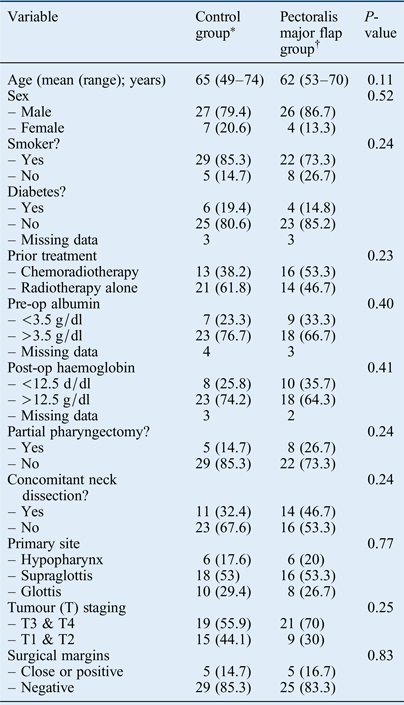
Patient demographics and potential risk factors for pharyngocutaneous fistula are summarised in Table I. Patients’ overall mean age was 64 years (range, 49–74 years). The majority of patients were male with a history of smoking. The following parameters were similar in both groups: smoking history, diabetes, prior treatment, pre-operative albumin levels, post-operative haemoglobin levels, partial pharyngectomy, concomitant neck dissection, primary tumour site, T staging and surgical margin status. Compared to the control group, the pectoralis major flap group comprised more patients who had previously undergone chemoradiotherapy (53.3 per cent vs 38.2 per cent) or concomitant neck dissection (46.7 per cent vs 32.4 per cent), and more patients with a higher T stage (70 per cent vs 55.9 per cent), but the differences were not statistically significant (p = 0.23, p = 0.24 and p = 0.25, respectively).
Demographic data for control group and pectoralis major flap group

Data represent mean numbers of patients (with percentages in parentheses), unless indicated otherwise. *n = 34; † n = 30. Pre-op = pre-operative
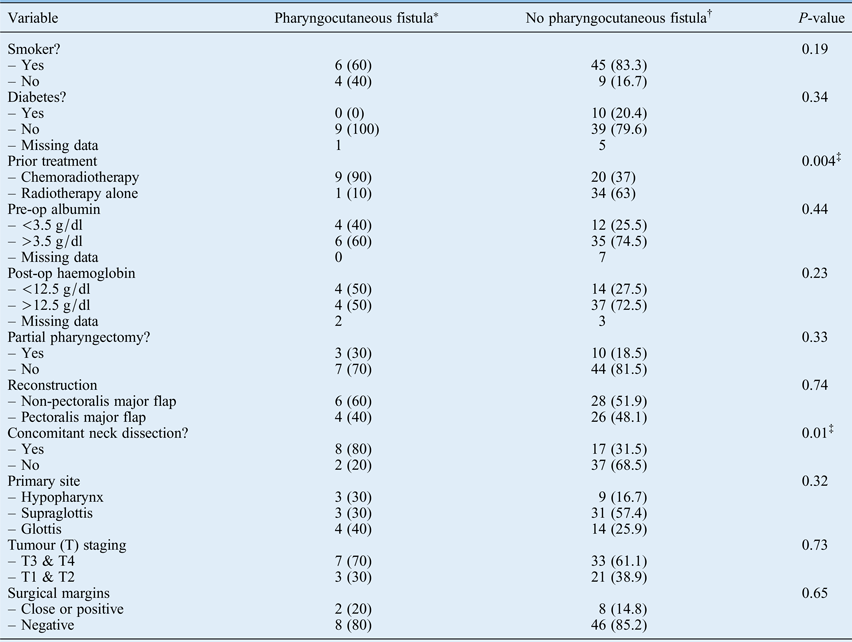
Eleven variables were included in the univariate analysis to determine the risk factors for pharyngocutaneous fistula formation. Only chemoradiotherapy and concomitant neck dissection were associated with pharyngocutaneous fistula development (p = 0.004 and p = 0.01, respectively; Table II).
Univariate analysis of risk factors for pharyngocutaneous fistula development

Data represent mean numbers of patients (with percentages in parentheses), unless indicated otherwise. *n = 10; † n = 54. Post-op = post-operative. ‡Indicates statistical significance
On multivariate analysis, both of these factors still had a significant effect on pharyngocutaneous fistula formation (prior chemoradiotherapy – p = 0.005, odds ratio = 26.5 (95 per cent CI = 2.6–266.4); concomitant neck dissection – p = 0.02, odds ratio = 9.6 (95 per cent CI = 1.4–68.7)).
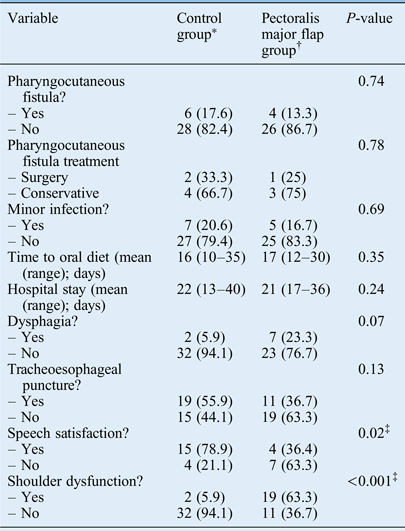
The main outcomes and the post-operative data are shown in Table III. Ten patients developed a pharyngocutaneous fistula, with an overall fistula rate of 15.6 per cent. Six of these patients (17.6 per cent) were in the control group and four (13.3 per cent) were in the pectoralis major flap group; this difference was not significant (p = 0.74). Two patients with a fistula in the control group (33.3 per cent) required surgical correction; one underwent debridement of infected tissue with adjacent muscle advancement and reclosure of the pharynx, and the other needed a pectoralis major myocutaneous flap for the pharyngeal defect interposition. One patient in the pectoralis major flap group (25 per cent) required wound debridement and reclosure. The remaining patients with a pharyngocutaneous fistula in both groups were treated conservatively with observation, a delayed oral diet and intravenous antibiotics.
Post-operative period and complications of control group and pectoralis major flap group

Data represent mean numbers of patients (with percentages in parentheses), unless indicated otherwise. *n = 34; † n = 30. ‡Indicates statistical significance
Minor wound infection was diagnosed when pus was found in the drainage tube. Minor infection was detected in seven patients (20.6 per cent) in the control group and five patients (16.7 per cent) in the pectoralis major flap group. All 12 patients with minor infection were successfully treated conservatively.
The mean time from surgery to oral diet intake was 16 days in the control group and 17 days in the pectoralis major flap group. Length of hospital stay was 22 days in the control group and 21 days in the pectoralis major flap group. There was no statistical difference between the groups for either of these factors.
Dysphagia was reported more in the pectoralis major flap group (23.3 per cent) than in the control group (5.9 per cent), although the difference was not statistically significant (p = 0.07). All nine patients with dysphagia were able to take only liquid and a soft diet. Two patients in the pectoralis major flap group required periodic oesophageal dilatation.
In patients with a tracheoesophageal puncture, the voice was satisfactory in 78.9 per cent of the control group and in 36.4 per cent of the pectoralis major flap group (p = 0.02). Significantly more patients with a pectoralis major flap reported shoulder disability (63.3 per cent) compared to the control group (5.9 per cent) (p < 0.001).
There was no record of bleeding, haematoma, necrosis of the pectoralis major flap, or peri-operative mortality.
Discussion
Salvage total laryngectomy following radiotherapy or chemoradiotherapy carries a significant complication rate of 67.5 per cent.Reference Hasan, Dwivedi, Gunaratne, Virk, Palme and Riffat 7 Commonly reported complications include wound infection, wound dehiscence, bleeding and pharyngeal stenosis.Reference Hasan, Dwivedi, Gunaratne, Virk, Palme and Riffat 7 , Reference Dedivitis, Aires, Cernea and Brandão 8 Pharyngocutaneous fistula is the most common complication; it has profound deleterious effects on wound healing, nutrition, the initiation of an oral diet, length of hospitalisation, use of medical resources and quality of life.Reference Patel, Moore, Wax, Rosenthal, Sweeny and Militsakh 3 , Reference Hasan, Dwivedi, Gunaratne, Virk, Palme and Riffat 7 , Reference Dedivitis, Aires, Cernea and Brandão 8
Meta-analysis reviews of the contributors to pharyngocutaneous fistula development identified the following risk factors: previous radiotherapy or chemoradiotherapy, haemoglobin level of less than 12.5 g/dl, advanced primary tumour, supraglottic subsite, hypopharyngeal site, concomitant neck dissection, and positive surgical margins.Reference Dedivitis, Aires, Cernea and Brandão 8 , Reference Liang, Li, Li, Fang, Zhao and Li 9 In our study, only prior chemoradiotherapy and concomitant neck dissection were significantly associated with a higher risk of pharyngocutaneous fistula, on both univariate and multivariate analyses.
The use of a vascularised flap has been introduced to reduce the fistula rate in irradiated tissue, with the pectoralis major flap being the most accepted option.Reference Sayles and Grant 1 , Reference Sharma, Chaukar, Laskar, Kapre, Deshmukh and Pai 4 , Reference Paleri, Drinnan, van den Brekel, Hinni, Bradley and Wolf 10 The flap can be used as an onlay myofascial flap to reinforce the pharyngeal repair site, as an interposition myocutaneous flap to augment the pharyngeal defect, or to reconstruct the cervical skin defect with the myofascial side to cover the pharyngeal suture line.Reference Paleri, Drinnan, van den Brekel, Hinni, Bradley and Wolf 10
Various studies have reported a significant reduction in fistula rates by using the pectoralis major flap in salvage total laryngectomy, while some studies have failed to show a significant reduction.Reference Sayles and Grant 1 , Reference Sharma, Chaukar, Laskar, Kapre, Deshmukh and Pai 4 – Reference Guimarães, Aires, Dedivitis, Kulcsar, Ramos and Cernea 6 , Reference Righini, Lequeux, Cuisnier, Morel and Reyt 11 – Reference Patel and Keni 13 A recent systematic review and other previous reports demonstrated a 22 per cent decreased risk of a fistula, but the overall incidence was quite high in both groups, at 37.6 per cent (181 of 488 cases) in the control group and 19.4 per cent (49 of 253 cases) in the pectoralis major flap group.Reference Sayles and Grant 1 – Reference Patel, Moore, Wax, Rosenthal, Sweeny and Militsakh 3 , Reference Gil, Gupta, Kummer, Cordeiro, Kraus and Shah 5 , Reference Guimarães, Aires, Dedivitis, Kulcsar, Ramos and Cernea 6 , Reference Righini, Lequeux, Cuisnier, Morel and Reyt 11 – Reference Rothmeier, Bergmann, Mattheis, Weller and Lang 19
Pharyngocutaneous fistula is treated via surgery or conservative treatment. The rate of surgical treatment for pharyngocutaneous fistula has been reported as 66.7 per cent (0–82.3 per cent of patients required surgery for a pharyngocutaneous fistula) in the control group and 28.6 per cent (0–66.7 per cent of patients required surgery) in the pectoralis major flap group.Reference Sharma, Chaukar, Laskar, Kapre, Deshmukh and Pai 4 , Reference Guimarães, Aires, Dedivitis, Kulcsar, Ramos and Cernea 6 In our study, the fistula rate was 17.6 per cent in the control group and 13.3 per cent in the pectoralis major myofascial flap group. The rate of surgical treatment was 33.3 per cent in the control group and 25 per cent in the pectoralis major myofascial flap group. These differences did not reach statistical significance. Our rates of pharyngocutaneous fistula and surgical correction of pharyngocutaneous fistula were obviously less than the reported rates, especially the pharyngocutaneous fistula rate in the control group.
The rate of minor wound infection was 20.6 per cent in the control group and 16.7 per cent in the pectoralis major flap group, which is less than that reported in a previous study (39 per cent in the control group and 33 per cent in the pectoralis major flap group).Reference Gendreau-Lefèvre, Audet, Maltais and Thuot 2
We introduce a surgical technique that prevents pharyngocutaneous fistula by limiting the use of electrocautery, which is associated with increased tissue damage and a significant reduction in the tensile strength of healing wounds.Reference Rappaport, Hunter, Allen, Lick, Halldorsson and Chvapil 20 – Reference Ruidiaz, Messmer, Atmodjo, Vose, Huang and Kummel 22 Compromised wound healing in the irradiated pharynx is a major cause of pharyngocutaneous fistula development.Reference Gendreau-Lefèvre, Audet, Maltais and Thuot 2 , Reference Moukarbel, Doyle, Yoo, Franklin, Day and Fung 23 In the early post-operative period, there may be a small amount of saliva leakage from the pharyngeal wound when initiating oral intake. A vacuum drain will remove the collection of saliva under the skin flap and prevent wound infection that can lead to pharyngocutaneous fistula development. Delaying the initiation of oral intake until 7–10 days post-operatively, delaying drain tube removal until the patient was taking a soft diet and prolonging the administration of peri-operative antibiotics may have lowered the pharyngocutaneous fistula incidence in our patients.
There were no significant differences between the groups in terms of mean time to initiation of an oral diet and hospitalisation duration (16 days and 22 days in the control group, and 17 days and 21 days in the pectoralis major flap group, respectively). These findings are comparable with the results of a previous study (25 days and 31 days in the control group, and 15 days and 21 days in the pectoralis major flap group, respectively).Reference Gendreau-Lefèvre, Audet, Maltais and Thuot 2
Use of the pectoralis major flap has the disadvantages of bulkiness of the anterior and lower lateral neck and deformity of the chest wall, especially in women; in addition, neck and shoulder pain and disability may affect a patient's voice rehabilitation and increase swallowing difficulty.Reference Gendreau-Lefèvre, Audet, Maltais and Thuot 2 , Reference Moukarbel, Doyle, Yoo, Franklin, Day and Fung 23 Both voice failure and shoulder disability were significant morbidities in our patients who underwent pectoralis major flap reconstruction. Dysphagia was the most commonly reported complication in the pectoralis major flap group, although the difference between groups was not significant.
-
• Use of the onlay pectoralis major flap is associated with significant flap morbidities
-
• Its use does not reduce the fistula rate compared to primary closure alone in salvage total laryngectomy
-
• The flap should be considered only in patients with a high risk of fistula formation
-
• Appropriate surgical technique and post-operative care may reduce the fistula rate
The limitations of this retrospective study are the small number of patients, the risk of bias associated with pharyngeal closure technique selection and some missing data. Nevertheless, most of the outcomes, including the fistula rate in the pectoralis major myofascial flap group, were comparable with previous reports, except for the low fistula rate in our control group.Reference Sayles and Grant 1 – Reference Patel, Moore, Wax, Rosenthal, Sweeny and Militsakh 3 , Reference Gil, Gupta, Kummer, Cordeiro, Kraus and Shah 5 , Reference Guimarães, Aires, Dedivitis, Kulcsar, Ramos and Cernea 6 , Reference Righini, Lequeux, Cuisnier, Morel and Reyt 11 – Reference Rothmeier, Bergmann, Mattheis, Weller and Lang 19
Conclusion
Our results showed low rates for pharyngocutaneous fistula incidence, pharyngocutaneous fistula surgical correction and minor wound infection. This indicates that the surgical technique and post-operative management methods employed, which have not been detailed in previous studies, should be considered in salvage total laryngectomy cases. Given the high incidence rates of dysphagia, voice failure and shoulder disability, the pectoralis major flap should not be routinely used for fistula prevention. This flap might be judiciously considered only in patients who have previously undergone chemoradiotherapy and concomitant neck dissection.