Introduction
Scandinavian rock art of the southern tradition is an immensely rich source for our understanding of Bronze Age society. The southern tradition is defined as a separation from the northern tradition of rock art, which is attributed to hunter-gatherers and has a somewhat earlier chronology and image programme that may have inspired the later southern tradition (Sognnes, Reference Sognnes, Chippindale and Taçon1998; Goldhahn, Reference Goldhahn2002). Besides the omnipresent cupmarks, it is a tradition rich in naturalistic and abstract depictions of objects and living beings. There are canoes, footprints, wagons, ards, axes, humans, deer, horses, birds, and many other images. Rock art panels were completed over long periods of time (Bertilsson, Reference Bertilsson1987; Nordbladh, Reference Nordbladh, Larsson and Lundmark1989; Bradley, Reference Bradley2000: 68; Fredell, Reference Fredell2003; Bengtsson, Reference Bengtsson2004: 75–82; Ling, Reference Ling2008; Skoglund, Reference Skoglund2016). Taking a longue durée perspective, rock art panels involved multiple individuals creating the appearance we encounter today. It has been suggested that similar motifs may have been engraved by different individuals (Bengtsson, Reference Bengtsson2004: 95–112). The reworking of individual figures has been discussed for anthropomorphic figures and canoe images (Fredell, Reference Fredell2003; Hauptman Wahlgren, Reference Hauptman Wahlgren, Milstreu and Prøhl2004; Ling, Reference Ling2008), and researchers have attempted to record such changes—especially for reused cupmarks (for example Fredsjö, Reference Fredsjö1971). Recently, Per Nilsson suggested the possibility that individuals interacted with rock art long after it had been carved (Nilsson, Reference Nilsson, Back Danielsson, Fahlander and Sjöstrand2012). One way of distinguishing the different individuals involved in making rock art is to identify different engraving techniques (see Burenhult, Reference Burenhult1980). Different engraving techniques have been observed on the stone slabs of a burial in Sagaholm (Wihlborg, Reference Wihlborg1978), which Goldhahn attributes to separate individuals being present at the burial (Goldhahn, Reference Goldhahn2016: 33–55).
Our aim is to elaborate on these notions by using a methodology we think will improve the recording and understanding of rock art. In the following, four figures from a large rock art panel in Finntorp are analysed (Bohuslän, RAÄ Tanum 89:1 [Swedish National Heritage Board inventory number]; see Figures 1–2): the large spearman, an axe bearer, and a pair of warriors with bent legs. The team, consisting of Christian Horn (University of Kiel) and Rich Potter (Gothenburg University), visited the panel four times between 2013 and 2015. This made it possible to undertake an in-depth analysis. Reflectance Transformation Imaging (RTI hereafter), a recording method previously unused at the site, was employed to study the panel. It is a method uniquely suited to observing the order in which individual lines were engraved.
We hope to demonstrate that some figures are better understood as a sequence of events. Such images are not static entities that were complete after one event. We will argue that the images were not conceived and engraved by a single individual. Further, we suggest that people actively engaged in rock art in the past. This approach is complementary to large-scale analyses focused on the social setting of rock art panels (see Bertilsson, Reference Bertilsson1987; Ling, Reference Ling2008). However, the in-depth analysis of the process of production gives us an indication of how people encountered the past, curated their heritage, and demonstrates how time coalesced on the rocks.
Method
The individual figures on the panel at Finntorp were recorded with RTI using Polynomal Texture Maps, an invention by Tom Malzbender of Hewlett Packard in 2000 (Malzbender et al., Reference Malzbender, Gelb, Wolters and Zuckerman2000, Reference Malzbender, Gelb, Wolters and Pocock2001; Mudge et al., Reference Mudge, Schroer, Noble, Matthews, Rusinkiewicz, Toler-Franklin, McDonald and Veth2012; for a recent review see Earl et al., Reference Earl, Martinez and Malzbender2010). We used a method called ‘Highlight RTI’ as described by Mudge et al. (Reference Mudge, Malzbender, Schroer, Lum, Ioannides, Arnold, Niccolucci and Mania2006). This method computes a pseudo-3D or 2.5D file from the surface reflections. A static camera is set up on a tripod to take a series of images with lighting from oblique angles such as raking light. The Cultural Heritage Imaging group (CHI) provided guidelines, with which we complied (Cultural Heritage Imaging, 2013). Ideally, 60–70 photographs should be taken (Díaz-Guardamino et al., Reference Díaz-Guardamino, García Sanjuán, Wheatley and Rodríguez Zamora2015). However, wind and sudden rain during our fieldwork seasons necessitated completing the work quickly. We aimed to take as many photographs as possible with a Canon 7D dSLR and a Canon Speedlite 430EX flash unit, and achieved good results with 40–50 images. In order to not disturb the tripod while taking images, the camera was remotely operated by Phottix Stratos 2 triggers. The panel was cleaned with a brush beforehand. There was lichen growth on the panel, but it was minimal and did not affect the engraved lines enough to impair the analysis. The photographs were converted into ptm files with RTI Builder Version 2.02. Afterwards, analysis was carried out in RTI Viewer Version 1.1. Both software programmes are open source, and CHI provides them on their website (http://culturalheritageimaging.org). RTI Viewer computes surface normals (that is, a vector which is perpendicular to a given pixel; a normal map is an image which stores these directions) and creates an artificial representation of the shape of the surface. The application of filters and the dynamic movement of the lighting enhances the visibility of features. We primarily used the diffuse gain and specular enhancement filters.
Superimposition has been used in studies of painted rock art to infer relative painting sequences (for example Schaafsma, Reference Schaafsma1986: 14; Bednarik, Reference Bednarik1992). Equally, for engraved rock art, it has helped to establish relative chronologies of, for example, canoe petroglyphs and individual panels (see Bednarik, Reference Bednarik1992; Ling, Reference Ling2008: 238; Fredell, Reference Fredell2009). Mudge and his colleagues have shown that RTI is an excellent tool to observe sequences in the production of rock art by analysing a Portuguese goat image dating to the Palaeolithic (Mudge et al., Reference Mudge, Malzbender, Schroer, Lum, Ioannides, Arnold, Niccolucci and Mania2006). In recent years, an analysis of the Folkton drums (incised Neolithic chalk objects from Yorkshire, UK) has shown a sequence of production using RTI to detect intersecting and cross-cutting lines and features (Jones et al., Reference Jones, Cochrane, Diaz-Guardamino, Carter, Dawson, Kotoula and Minkin2015). Another analysis carried out on Bronze Age stelae from Spain focused, like our work, on the sequence of production of the petroglyphs and on superimpositions (Díaz-Guardamino et al., Reference Díaz-Guardamino, García Sanjuán, Wheatley and Rodríguez Zamora2015). Despite these endeavours, the production sequence of individual figures has not been considered much; instead, the focus was on the production of entire panels (Bertilsson, Reference Bertilsson1987; Nordbladh, Reference Nordbladh, Larsson and Lundmark1989; Bradley, Reference Bradley2000: 68; Bengtsson, Reference Bengtsson2004: 75–82). It has been demonstrated that lines in Scandinavian rock art have been re-engraved at later times (Hauptman Wahlgren, Reference Hauptman Wahlgren2002; Goldhahn, Reference Goldhahn2011), which would hamper our analysis; but, at Finntorp, only the spearhead showed signs of this sort of activity. We relied on a combination of four aspects: line thickness, line depth, superimpositions, and the relative dating of the objects depicted. To a lesser extent, we relied on differences in engraving techniques, because most engravings were made using a similar technique in Finntorp. Frottage (taking rubbings) was very useful to judge the different width of the lines. However, frottage is less suited to record superimpositions or give a good perception of depth because it only picks up the highest surface features, while features within grooves are left out. RTI is very good for judging line depth and, therefore, for recognizing superimpositions. Generally, superimposition indicates more recent additions (Mudge et al., Reference Mudge, Malzbender, Schroer, Lum, Ioannides, Arnold, Niccolucci and Mania2006; Jones et al., Reference Jones, Cochrane, Diaz-Guardamino, Carter, Dawson, Kotoula and Minkin2015), although we allow for the possibility that more recent lines could have been shallower than earlier ones. The idea that time depth existed between separate engravers was based on the comparison of parallels for the engraved objects in the archaeological record. Thus, it is a combination of features that allows us to argue for separate carving events. In the future, macro RTI and photogrammetry will be carried out in further fieldwork to test our methodology (see Plisson & Zotkina, Reference Plisson and Zotkina2015).
Site and Documentation
The rock art panel RAÄ Tanum 89:1 is located in Finntorp, Tanum, close to Vitlycke museum. Its exact location is: Finntorp, Tanum, Bohuslän, Sweden, N 58° 42' 18,98”, E 11° 19' 26,73” (WGS84; Figure 1). Figurative rock art was engraved on a rock outcropping in the lower part of a gentle slope overlooking a shallow depression in the landscape. The rock itself is Bohus granite, a very hard Precambrian type of rock (Eliasson & Schöberg, Reference Eliasson and Schöberg1991). The images generally avoided quartz intrusions so that no change in technique was required when applying the image to the rock. If different techniques were used, then it was by choice, not by necessity. The panel consists of seventeen or eighteen anthropomorphic figures, four canoes, at least seventeen individual cupmarks not incorporated into figurative petroglyphs, and a number of individual lines without coherent composition. There were probably more figures engraved in the past, but the upper part of the panel broke away some time after the Bronze Age. The area itself is rich in rock art panels. At least four larger compositions with more than one engraved image, and an even larger number of single image panels, have been discovered in Finntorp. The scenes described below are separated by two natural cracks that divide the panel into four or five different canvases (Coles, Reference Coles2000).
Overview of the location of Finntorp (large, black circle; RAÄ Tanum 89:1) in relation to other sites with anthropomorphic rock art (smaller circles).

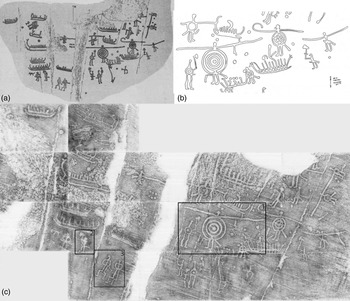
The panel is well known and has been documented by several researchers. In 1889, Lauritz Baltzer produced a graphic of the panel (for a history of research, see Bertilsson, Reference Bertilsson, Ling, Skoglund and Bertilsson2015). It shows the scene in good, but not full, detail; the damage on the upper part of the rock is already visible (Figure 2a). Torsten Högberg's 1970 tracing paper documentation records the phallus and other features, but the spear point of the big spearman is missing (Figure 2b). Furthermore, the figures seem somewhat out of proportion. Lastly, Tanums Hällristningsmuseum in Underlös documented the scene in 2005 using frottage (Figure 2c). All the details of the spearman are visible. Nevertheless, due to the problems outlined earlier, the order of intersecting lines was recorded very weakly or not at all.
History of documentation of Finntorp (RAÄ Tanum 89:1). (a) graphics by Lauritz Baltzer, 1889; (b) tracing paper by Torsten Högberg, 1970; (c) frottage by Tanums Hällristningsmuseum Underslös, 2005. Figures discussed in the text are indicated.

The Big Spearman
Description
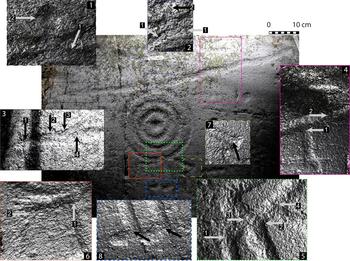
The spearman is a large figure, roughly 40 cm tall, located on the south-eastern section of the panel (Figure 3). The figure holds an 82.5 cm-long spear, a shield, and a sword. His two legs and feet are visible and there is a phallus. No arms could be recognized, and were probably never engraved. On the head, there are two small circular features that could be ears or earrings. In light of the large, anthropomorphic figure from Litsleby (RAÄ Tanum 75:1), we will use the term earrings in the following.
RTI documentation of the big spearman. 1: cupmark and shield rim; 2: neck; 3: spear points; 4: spear shaft with small human and line; 5: legs, sword sheath and lower shield; 6: phallus; 7: sword sheath; 8: legs and feet.

RTI was carried out three times on the big spearman. First in August 2014 and then twice in July 2015 under difficult circumstances due to high winds. Nevertheless, an investigation of the RTI files revealed several cross-cutting features. Starting from the top, the spear is cut by the largest concentric circle (Figure 3.1.1). The neck of the figure cuts the outer concentric circle and the spear (Figure 3.2.1). The head potentially cuts the neck, but in another image it seems more likely that the neck cuts into the head (Figure 3.2.2). Although the earrings are not cut as deeply as the head, chipping of the rock inside the head indicates that they were later additions (Figure 3.1.2). There may be up to four different spear points, each of which has a smaller point which cuts into the successively larger spear points (Figure 3.3.1–4). On the other side, there are two lines, one of which intersects with the spear shaft. No direct cutting could be observed on the line closer to the spearman's body (Figure 3.4.1); however, the inside of the shaft was slightly chipped by this line. Further along the shaft, there is a second line that intersects with the shaft and the canoe above (Figure 3.4.2).
Cross-cutting can also be observed in the lower part of the figure. Both legs intersect the outer shield circle (Figure 3.5.1–2). It is possible that the right leg formed a major part of the lower torso that bisects the second concentric circle. Nonetheless, the left leg cuts into the right leg (Figure 3.5.3). Interestingly, the sword sheath cuts the outer concentric ring, but does not intersect with the right leg (Figure 3.5.4). Conversely, the phallus was engraved deeper into the outer circle as well as the left leg (Figure 3.6.1). There is a line on the tip of the phallus, but it does intersect with the phallus (Figure 3.6.2). The chape cuts through the lower part of the sheath itself (Figure 3.7). Lastly, both feet cut into the legs (Figure 3.8).
Production sequence
Perhaps the earliest feature to be carved in the composition was the cupmark that was later incorporated into the composition as the head of the figure. If this is so, it may be reasonable to assume that other cupmarks, like those at the centre of the concentric circles, were also engraved before the figurative features were applied (Figure 4.1). Both cupmarks were ground or smoothed after engraving, unlike all the other lines. Individual cupmarks on the panel open up the possibility that Finntorp was originally a cupmark panel (see for example Bengtsson, Reference Bengtsson2004: fig. 6.2a). Based on the observed superimpositions, the shaft of the spear was perhaps engraved next, together with the largest spearhead (Figure 4.2). Subsequently, gradually smaller spear tips were engraved, suggesting at least four separate events (Figure 4.4–6).
Engraving sequence of the big spearman.

The outermost concentric circle was engraved before the neck that connects the head, shaft, and the circle. Therefore, these circles may have been next in the sequence (Figure 4.3). Since all the rings have the cupmark rather precisely at their centre and maintain an equal distance to each other, the rings may have been engraved from the inside outwards. Similar imagery has been interpreted as sun symbols (Almgren Reference Almgren1927; Bradley, Reference Bradley2009: 155–61); but, in Finntorp, the circles are in close proximity to the spear, which suggests that an interpretation of it being part of a warrior's equipment is more likely. That, however, does not mean that this was the only meaning this engraving possessed. The colour of bronze shields could have contributed to the imagery and meaning attributed to sun symbols (Horn, Reference Horn2016). Individual concentric circles in combination with individual spears are known on other panels, for example in Hede (Bohuslän; RAÄ Kville 125:1). Therefore, with the additions of the circles, in Finntorp the cupmark was transformed into a shield. The concentric rings and the neck may, therefore, have been engraved in separate events (Figure 4.4). The initial idea may have been to carve objects, such as a spear and later a shield. This is plausible because the engraved lines of the shield and the legs differ in width and depth. Therefore, interpreting this figure as a human is perhaps a more recent development.
The legs were engraved next, the right before the left. It is impossible to distinguish whether the sword sheath was applied before or after the legs (Figure 4.4). Given their similarity, we assume that these additions were made during the same art-making event. Feet were then added to the figure. Judging by the superimposition, the right foot may have been engraved after the left, which inverts the order the legs were engraved in. Due to their stylistic similarity, the chape and the feet were possibly added directly after the sheath and the legs.
The phallus and the earrings deviate in style from all of the other lines. Compared to their diameter, the earrings appear to be relatively deep, and they are made very coarsely. The line of the phallus is narrower than that of the shield and the legs. Although the earrings and phallus are potentially the last additions in the overall sequence, they do not appear to be made by the same individual (Figure 4.6). The line in front of the phallus may have been added even later, but it is entirely uncertain whether this line was intended to be an addition to the spearman at all (Figure 4.7). The completed figure includes two possibly coincidental additions along the spear's shaft (Figure 4.8).
An Axe Bearer
Description
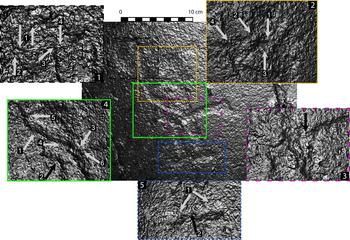
This figure is situated to the west and slightly to the south of the big spearman. Overall, weathering caused its appearance to be less clear than that of the spearman. On the upper body and neck area there is some chipping on the rock surface, but it is not severe enough to destroy the area. The axe bearer is approximately 16 cm tall, which is considerably smaller than the spearman figure, but observations are still possible (Figure 5). We carried out RTI in 2015 which allowed us to construct a tentative sequence of actions on the rock.
RTI documentation of the axe bearer. 1. axes; 2: head, arms, and upper body; 3: leg and sword sheath; 4: lower body; 5: lower legs and feet.

Starting from the top, the axe head has been re-engraved, and a smaller axe (Figure 5.1.1) was cut into the larger one (Figure 5.1.2). The handle overlays the lower part of the larger axe head (Figure 5.1.3), but is itself intersected by the smaller axe head (Figure 5.1.4). The head of the figure cuts into the neck and the body (Figure 5.2.1). The upper arm marginally cuts into the head (Figure. 5.2.2) and the lower intersects with the body (Figure 5.2.3). Due to the damage noted above, the position of the arms is difficult to interpret. It seems that the arms intersect the handle (Figure 5.2.4), although this can only be inferred for the upper arm. Lower down, the sheath cuts into the body line (Figure 5.3.1). The figure seems to possess two erect male genitals (Figure 5.4.1–2). Both overlay the sheath (Figure 5.4.3), the body line, and the frontal leg (Figure 5.4.4). The longer phallus cuts into the axe handle (Figure 5.4.5), but is itself intersected by the smaller phallus (Figure 5.4.6). The feet cut their respective legs (Figure 5.5.1), with the front foot intersecting the other (Figure 5.5.2).
Production sequence
Unlike the big spearman, the image of this axe bearer could not have started with a cupmark since the head intersects the bodyline and is flat, rather than spherical. Compared to the other lines of the figure, the larger axe head is not cut very deeply into the stone. The first petroglyph was possibly the larger axe that is likely to have been engraved without a handle, because the smaller axe and the handle cut through this image (Figure 6.1). The handle, therefore, was potentially engraved at the same time as the smaller axe head since it fits its upper and lower side. This petroglyph might have originally been intended to be an individual object (Figure 6.2).
Engraving sequence of the axe bearer.

The human figure was potentially started by engraving the line that forms the hind leg and body (Figure 6.3). From a stylistic perspective, the legs are parallel to those of the big spearman with the front leg splitting away from the rear leg in a slight curve. Although overlaid by phalli and the sheath, the body/leg may have been engraved continuously as both line up. The figure could also have started with the front leg, as the phalli obscure the intersection with the rear leg. However, since the foot on the front leg cuts the foot of the rear leg, it is perhaps more likely that the rear leg/body line was engraved first, then the foot on that leg, and afterwards the front leg and its foot (Figure 6.3). The similar width of the lines may indicate that they were engraved during the same event. If that is the case, then the arms were not applied at that time, because they are considerably narrower and deeper. These arms may have destroyed the original arms, if there were any. Applying these arms may be what damaged the upper torso (Figure 6.4). If the figure had no arms to begin with, then the first attachment to the axe may have been the first phallus. Alternatively, it could also represent a somewhat misplaced arm. Following that, the sword was engraved at the same time as the phallus/arm, the legs, and the head. Support for this is provided by their similar width and depth. The shorter phallus including testicles was engraved afterwards; it is a somewhat more realistic rendition. For stylistic reasons, the thin arms are assumed to be last in the overall production sequence (Figure 6.5).
A Pair of Warriors with Bent Legs
Description
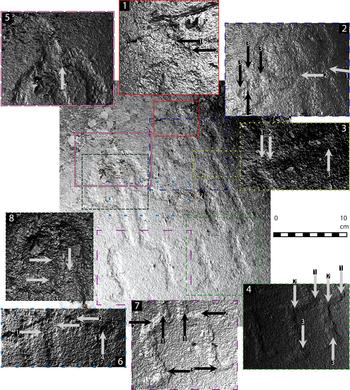
The two human figures were engraved to the south of the other figures (see Figure 2), but they are closer to the axe bearer. We carried out RTI once in 2015. The left figure (from the observer's point of view) was 24.7 cm long and the right 26.5 cm (Figure 7). Slight damage occurred to the neck area of the right figure after it was engraved. A recent frottage of these anthropomorphs seems to indicate a nose on the right figure (Figure 2c). In images from the RTI files, we observed that this ‘nose’ was more likely to be a crack that runs through the head. The fissure does not show up very well in the frottage, but given its weathered edges, it is probably an old crack.
RTI documentation of the warriors with bent legs (1–4 right warrior, 5–8 left warrior). 1: head and neck; 2: lower body; 3: sword sheath; 4: bent legs; 5: head and neck; 6: lower body and sword sheath; 7: bent legs; 8: upper body.

The following observations could be made about the right figure. The head cuts into the neck (Figure 7.1.1). The neck itself intersects with a ring that may form the arms (Figure 7.1.2). The body/left leg line also bisects the arms (Figure 7.2.1), but is itself superimposed by the phallus (Figure 7.2.2). The genitals may form what could be perceived as a ‘flower’ with three petals at the tip and a leaf. None of the ‘petals’ cut into the phallus (Figure 7.2.3). Close to the tip is a circle that cuts into the three surrounding ‘petals’ (Figure 7.2.4). The right leg also cuts into the arms (Figure 7.3.1). Very weak chipping on the border between the right leg and the sheath may indicate that the sheath cuts into the leg (Figure 7.3.2). The sword sheath overlays the arms (Figure 7.3.3). The peculiar shape of the legs is of particular interest. At the ‘knee’, there is a small oval shape that overlays the upper leg (Figure 7.4.1) which is itself intersected by the lower leg (Figure 7.4.2). The lower leg is cut by another oval shape (Figure 7.4.3).
Unlike the right figure, the head and neck of the left figure seem to consist of one continuous line that then cuts into the ring and forms the arms (Figure 7.5). The right leg and the sword sheath also cut the arm (Figure 7.6.1). The right leg and sword sheath touch each other, and the leg might cut through the sheath (Figure 7.6.3). Again, the chape cuts the sheath (Figure 7.6.4). Both legs show the same pattern as the legs of the right figure (Figure 7.7.1–4). It is possible that the left leg cut the arms as well; however, it is difficult to observe because the phallus, including the testicles, bisects this area (Figure 7.8).
Production sequence
With these observations, we may suggest a possible sequence of production and find an explanation for the legs. Since the arms do not seem to overlap any other feature, they may have been the first feature of the composition (Figure 8.1). Due to the positioning of the body/leg line, it is unclear whether they were engraved as a closed or open ring. Single rings are known on many rocks; for example, Skee in Tanum (RAÄ Skee 602:2). It may be that the carvers of the Finntorp panel chose such individual rings to add human features to them. The rings themselves have a peculiar shape; they are not quite round, but rather oval and sharply curved. The top is thicker than the lower part, and one seems to be slightly curved inwards.
Engraving sequence of the warriors with bent legs.

All the lines representing the neck on the right figure, the head and neck of the left human, and the thighs are wider. Therefore, they may have been applied by different carvers (Figure 8.2). If we visually isolate the thighs and the ‘knees’, it is possible that they originally formed a normal pair of legs with feet (Figure 8.2–3). We think that the production event ended after the application of this initial pair of legs, because we assume that anyone who makes the effort of engraving a complete pair of legs does not immediately go on to amend their work. Nevertheless, it is currently impossible to determine how much time passed before the legs were transformed. The swords were potentially added during this session as well. On the right figure, the sheath cuts very marginally into the right leg, on the left figure both lines are next to each other. This kind of precision may lend support to the thesis that the same individual applied the sheath and the initial legs. A similar width and depth of all these lines speaks in favour of their contemporaneity.
We suggest that people visiting this site at a later date added a new pair of legs to both human representations (Figure 8.3). This transformed the old feet into very pronounced knees. The new feet were engraved after the line of the new legs was applied. Since the old feet pre-determined the direction of the knees, the new feet follow the positioning of the old feet. The astonishing similarity of how each transformation was carried out on the two figures suggests that it was done during the same event.
The phalli on both figures were applied after the first legs (Figure 8.4). Both figures show a parallel development until that point, but, after it, one was fitted with a physiologically correct representation of a phallus, while the other was more complex. This may indicate that steps to differentiate the two figures were taken after the addition of the second pairs of legs.
Hypothetical Chronology of the Production Sequences
The relative production sequences outlined above have no specific time depth. The images could have been made within a few hours, weeks, years, or centuries as nothing in the technique used to engrave the lines indicates a chronology. It is only when we are able to date some of the features that we can argue for a chronological separation of engraving events. Dating human representations in southern Scandinavian rock art is notoriously difficult. Typically, associated objects are the best option to narrow the chronology down, because parallel metal objects exist in the archaeological record (Hildebrand, Reference Hildebrand1869: 425–26; Nordén, Reference Nordén1925; Almgren, Reference Almgren1987: 38). As we shall see, however, there is some doubt that human figures are always contemporary with the object they hold. Shoreline dating has proven successful in establishing a chronology of canoe images (Ling, Reference Ling2008), but has not yet been used to evaluate anthropomorphic representations. Superimpositions of, or by, canoes have been used, but they are rare (Fredell, Reference Fredell2009). Comparisons of petroglyph style are problematic for anthropomorphic images and can only be used as a first guess. Stylistic approaches have been used for the Scandinavian material only (Almgren, Reference Almgren1987) and by drawing parallels to other regions (Fredell, Reference Fredell2003; Fredell & Quintela, Reference Fredell, Quintela, Fredell, Kristiansen and Boado2010). To get some indicators of the chronology of the figures, we will examine some of the linked objects. Other objects, i.e. the axes and the rings, are too non-descript to attempt dating them.
The spears
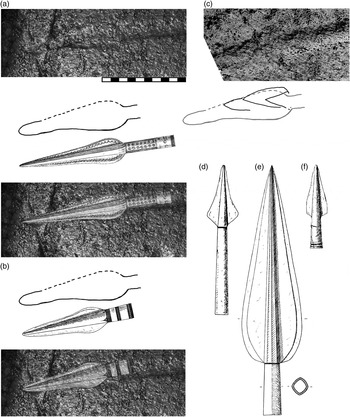
The big spearman is best suited to address the chronology of the Finntorp figures because of the objects associated with him. Unfortunately, three later images obstruct the original spear point. The elongated form and the potentially smooth outward swing of the lower part of the blade could suggest a Valsømagle type (Figure 9a). Later spears have different proportions (Figure 9b). This may indicate that the first spear belongs to period Ib (1600–1500 bc) in the Nordic Bronze Age chronological scheme. Other early individual spear petroglyphs have been discovered; for example, on a panel in Himmelstalund (Östergötland; Östra Eneby RAÄ 1:1) or Kalleby (Bohuslän; RAÄ Tanum 248:1). The three subsequent spearheads are very schematic. This may point to a date after period II (1500–1300 bc), because during the initial phase of rock art, carvers seem to have preferred a more realistic style for metal objects (Burenhult, Reference Burenhult1973: 45; Ling, Reference Ling2008: 53–54). The last two reworkings of the spearhead represent triangular blades with straight or slightly concave edges, the second oldest (spear two) seemingly narrower and longer (see Figure 4.4). Spear three is somewhat larger than the final spear tip (see Figure 4.5–6). Spear three could potentially resemble a Lüneburg type I or III spear (Figure 9d–e). The edges of these Lüneburg type spears sometimes join the socket almost perpendicularly. Spearheads from Bassen-Tüchten (Germany, no. 1217a; this number and all the following numbers refer to Jacob-Friesen, Reference Jacob-Friesen1967), Ladeburg (Germany, no. 1432), and Bad Oldesloe (Germany, no. 785) are not perfect fits, but they could be seen as the closest available parallels. Other parallels could be the spears from Boerakker (Netherlands, no. 1736), or from the Borbjerggård hoard (Denmark, no. 589). The last spear engraving in the Finntorp spearman's image bears a closer resemblance to a Saxo-Thuringian type spear (Figure 9f), for example those from Bäk (Germany, no. 698), Ahlem (Germany, no. 902) or from the Basland hoard (Denmark, no. 522). Another possibility is that points three and four represent flint spearheads (see for example Montelius, Reference Montelius1917: 450–90).
Comparison of the largest spear point with (a) Valsømagle type spear (Falköping, Sweden; original length 37.2 cm; Jacob-Friesen Reference Jacob-Friesen1967, no. 221.); and with (b) a period II type Smørumøvre spear (Smørumøvre, Denmark; original length 18.8 cm; Jacob-Friesen Reference Jacob-Friesen1967, no. 365.); (c) later spearheads with possible comparisons for spearhead engraving 3 at Finntorp; (d) Bassen-Tüchten, Germany (18.2 cm; Jacob-Friesen Reference Jacob-Friesen1967, no. 1217.); (e) Borbjerggård, Denmark (30.4 cm; Jacob-Friesen Reference Jacob-Friesen1967, no. 589.); and for spearhead engraving 4; (f) Bäk, Germany (10.2 cm; Jacob-Friesen Reference Jacob-Friesen1967, no. 698.). Spearheads (a)–(b) scaled to the size of the engraving. All images redrawn by Christian Horn.

The coexistence of longer and shorter spearheads, for example in a hoard from Bargfeld (Germany, no. 1120), makes the chronology of spear points three and four complicated. However, reviewing the evidence collected by Jacob-Friesen (Reference Jacob-Friesen1967), we could perhaps suggest that finds of longer spearheads, for example Bassen-Tüchten and Ladeburg, could be dated somewhat earlier, i.e. from period III to the beginning of IV (Jacob-Friesen, Reference Jacob-Friesen1967: 180) of the Nordic Bronze Age chronology (1300–1000 bc). Assemblages with shorter spearheads of the types that resemble the engraved ones tend to date to period IV–V (1100–720 bc); for example, the hoards from Bäk and Basland (Jacob-Friesen, Reference Jacob-Friesen1967: 237). This is also true for hoards in which longer and shorter forms of spears are associated, such as the hoard from Bargfeld (Jacob-Friesen, Reference Jacob-Friesen1967: 182). This dating is consistent with the newer literature (Schmidt, Reference Schmidt1993; Maraszek, Reference Maraszek2006). However, none of these parallels fit the later spearhead engravings perfectly. If the two triangular points are flint points, then the chronology becomes even more problematic as, to our knowledge, there is no chronological study for this group of finds.
The shield
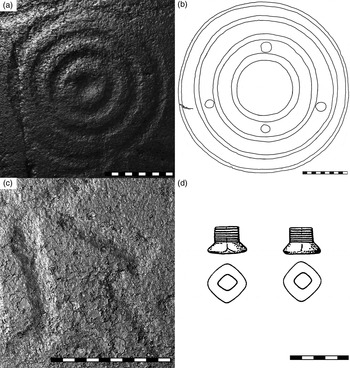
The second object the spearman carries may be a shield. The shields of the Nipperwiese type (with simple concentric ribs) may represent a good parallel (Figure 10a), which in turn has a parallel in Schiphorst, Northern Germany (Uckelmann, Reference Uckelmann2012: 21). This shield type spread from Germany and Poland to the British Isles and dates to the transition from Period II to III of the Nordic Bronze Age (1350–1200 BC).
Comparison of the shield of the big spearman (a) and the shield from Schiphorst (b), drawn by Christian Horn after Uckelmann, Reference Uckelmann2012: no. 12; comparison of the chape of the big spearman (c) and chapes from Debsted (d), drawn by Christian Horn after Laux Reference Laux2009: no. 413.

The swords
The style of the human features on the big spearman deviates from both the spear's shaft and the concentric circles; and the figure superimposes the lines of the objects and the cupmarks in all instances. This means that the earliest point in time the image could have been transformed into a fully articulated human representation is after the shield had been engraved. The chape of the sheath may give some indication of its date. Parallels may include the rhombic chapes of Westersode type (stepped, widest at the end; Laux, Reference Laux2009: 137–38) from oak coffin graves, for example in Debsted (Laux, Reference Laux2009: no. 413) (Figure 10). The bronze chape is much more delicate than the engraving, but if the engraving represents a general idea it may be an appropriate parallel. These chapes are dated to period III of the Nordic Bronze Age (Aner & Kersten, Reference Aner and Kersten2001: 15–16; Laux, Reference Laux2009: 137–38). Of course, such chapes also occur on figures considered to be much later, like the horned warriors (recently Ling & Rowlands, Reference Ling, Rowlands, Ling, Skoglund and Bertilsson2015). It may also be that the horns were added later, but this needs to be tested. All other figures have similar sword chapes.
Ships on the panel
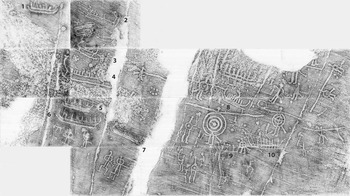
There are more than eleven ships on the panel, ten of which possess enough details to be datable (Kaul, Reference Kaul1998; Ling, Reference Ling2008, Reference Ling2013). Many canoes can be dated to periods II–III of the Nordic Bronze Age as shown by inturned, almost semi-circular prows and slightly upturned or oval keel extensions (Figure 11: canoes 1, 4–7). A cluster of these canoes is located between the four figures discussed here. Late Bronze Age canoes are also present and can be recognized by the very detailed animal heads at the prows’ ends, by straight or inwardly-angled prows, and by a very sketchy and thin style of engraving that is akin to the arms of the axe bearer (Figure 11: canoes 2–3, 9–10). Most intriguingly, the canoe that is directly above the spear dates to period I–II, as indicated by the long, semi-circular prows and the straight keel extension (Figure 11: canoe 8). Although there is no definitive evidence, the chronology and location of the canoes complements the suggested chronology.
Dating of canoes in Finntorp (RAÄ Tanum 89:1); canoe 1: period II–III; canoe 2: period VI; canoe 3: period IV–V; canoe 4: period II–III; canoe 5: period II–III; canoe 6: period II–III; canoe 7: period II–III; canoe 8: period I–II; canoe 9: period V–VI; canoe 10: period V–VI.

Discussion
For reasons of clarity, we shall summarize the sequence of events for each petroglyph before discussing their implications.
Big spearman
Two cupmarks were the first event, followed by the engraving of the first spear. The shield was then added and the spear point updated. In a fourth event the spearhead was updated again and the first anatomical features were engraved. Afterwards, the spear was renewed a fourth time and the earrings and phallus were added. This was done in one to three further events. In total, it may have taken four to ten separate events to give the composition its final appearance.
Axe bearer
The first event was the image of a single axe. Thereafter, the axe was transformed into a ‘complete’ implement. In a third event, head, body, legs, feet, and the phallus/arm were added to the composition. Later, someone added a realistic phallus. A considerable time after that, the two thin arms were engraved, which partially destroyed the figure. Five different events may have taken place.
Warriors with bent legs
Two rings were engraved during the initial event. Afterwards, they were transformed into human figures whose feet were further transformed into legs with pronounced knees. In a potentially final event, the realistic phallus and the ‘flower-like’ phallus were added. There were up to six different events to complete this composition, assuming the two phalli and the sheaths were engraved in separate events. It seems, however, more likely that there were only four.
Implications
It appears that none of the figures discussed here were originally conceived as human. During the Late Neolithic and Early Bronze Age, cupmarks and individual objects like halberds were engraved (Burenhult, Reference Burenhult1980). The spearhead at Finntorp was the focus of considerable attention, with three recuts. Similarly, the axe of the axe bearer was also updated. Although only based on comparison, all sword sheaths seem to have been added in the course of period III of the Nordic Bronze Age. All human features have a very similar style, with each other and with the sword sheaths. This may lend support to the notion that they were engraved close together in time. They may even have been created by the same community or individual. On all figures, phalli may have been added later, because they deviate in style. The phallus/arm of the axe bearer may be the one exception. As opposed to the human features, the phalli are very varied in form and technique. On the engraved burial slab at Sagaholm (Wihlborg, Reference Wihlborg1978), this has been interpreted as an intentional device for a narrative. This was possible because the different styles were used simultaneously, intentionally creating a difference between the images. The burial was sealed after the interment so we know that the carvings were made at approximately the same time. The possibility of time passing between engraving events in Finntorp should nevertheless be taken into consideration because objects of different periods are depicted. We must at least assume that a different style represents a different individual.
Differences can be found in the kinds of objects connected to the figures and some of the bodily transformations, such as the pronounced knees or the later arms of the axe bearer. Taking all the evidence together, this particular panel in Finntorp may have been revisited periodically. Each of the three compositions was subject to at least four or five separate events, possibly taking place from the Late Neolithic/Early Bronze Age I to Bronze Age III (2200–1100 bc). The phalli may have been added at an even later time. Canoe petroglyphs from several periods on the same panel support this sequence. This indicates a long-term curation of rock art at Finntorp.
We suggest that more than one individual was involved in giving the compositions their final appearance. If we assume that arms, legs, and sword sheaths were engraved during period III, and were indeed engraved by a single individual, then the minimum number of people involved over time would be twelve. However, if different carvers added these anatomical features, such as the two pairs of legs on the warriors with bent legs, then a minimum of fifteen individual carvers may have been involved. This number could be higher if, for example, two separate people engraved the cupmarks on the spearman.
Meeting the Past on the Rocks – Interpretation
Based on these observations, it seems that multiple individuals were engaged in transforming images at Finntorp and, if our chronological suggestions are accepted, then some time may have passed between separate events. Later engagements with petroglyphs have previously been recognized. Recently, Per Nilsson discussed later activities on rock art panels and pointed out that additions were made to Bronze Age petroglyphs (Nilsson, Reference Nilsson, Back Danielsson, Fahlander and Sjöstrand2012: 87–88). He interprets this as a dialogue with the past in which the meaning of the engravings was transformed. However, he talked about much later additions to panels after the tradition of making figurative rock art had ended. Katherine Hauptman Wahlgren observed that a reactivation of particular features may have taken place by engraving lines repeatedly, since the re-engraved lines show up lighter (Hauptman Wahlgren, Reference Hauptman Wahlgren, Milstreu and Prøhl2004; Goldhahn, Reference Goldhahn2014). At Finntorp, this may only apply to the repeated engraving of the spearheads. All other parts were not re-engraved, but added to pre-existing images. Even the spearheads were not just re-engraved, but also transformed. Australian Wandijna paintings could be cited as an ethno-archaeological parallel. These are paintings of heroic ancestors in caves. Parts of them were re-painted regularly by clans to secure a continuous supply of animals (Layton, Reference Layton1985). This engagement of people with the rocks to secure outcomes in the real world has been attributed to the secondary agency with which rocks and petroglyphs are imbued (Mowaljarlai Reference Mowaljarlai, Vinnicombe, Ward and Chippindale1988; Ling & Cornell, Reference Ling and Cornell2010). In Scandinavia, it has been argued that this is directly linked to the depiction of real-life activities and objects (Ling & Cornell, Reference Ling and Cornell2010).
This could have been the case at Finntorp. The site still stands out because objects were not just re-engraved, but also transformed. Similarly, there were not only features added to the pre-existing images, but the images themselves were transformed. A notion put forward by Tim Ingold is that landscape ‘enfolds the lives and times of predecessors who, over the generations, have moved around in it and played their part in its formation’ (Ingold, Reference Ingold2000: 189). In that sense, communities could engage physically with the past and their ancestors or the heroes of their stories with every transforming event. Temporal boundaries are transcended through the materiality of the rocks and the repeated material action of making petroglyphs (Fahlander, Reference Fahlander, Back Danielsson, Fahlander and Sjöstrand2012). Nonetheless, Ingold goes on to say that individuals contemplated their own socio-environmental setting; they did not anticipate the sensibilities of future observers (Ingold, Reference Ingold2000: 198).
After their initial engravings, the rocks represent a framework anchored in time and space, where people could engage with their forebears. Whether they were heroes, as in the Wandijna example, or other ancestors is open to discussion. Regardless, the images were not stable, but malleable. Every engraver updated what was most important, or brought about change in their own socio-environmental setting. Therefore, every transformation produced a finished product. However, the successors of the initial carvers not only contemplated their own social environment, but something already made that oriented possible transformations. That these transformations were made suggests that these images were not sacrosanct.
Lastly, the potentially long history of some of the images is also a call to modern observers to exercise caution. What appears to us to be a great phallic spearman was only perceived as such relatively late in the existence of this image. Before that, it was purely combat weaponry. What was perhaps once perceived as a pair of (arm-?) rings was transformed into two phallic warriors with pronounced knees, possibly centuries later. In sum, engravings condense the material culture, rituals, and social ideas of many ages, and that should change the way we think about rock art too.
Summary
The application of new recording methods on rock art panels has enabled us to record an already known rock art site in greater detail. By moving to the micro-level of observation, we were able to retrace the sequence of events of individual lines and thus reconstruct specific events separated and distributed in time. The figures follow a similar sequence, from petroglyphs of individual objects to the addition of human features transforming them into warriors; phalli were added even later. We have suggested a tentative chronological sequence, spanning from the Late Neolithic to the Bronze Age.
With this, we could show that several individuals were involved in assembling specific figures in rock art that is usually perceived as a whole by modern observers. Interpreting the rock as a spatio-temporal meeting point, we argue that the rocks not only link individual carvers and their respective societies, but that engraved panels partially break down the barriers of time and space. Older petroglyphs attract, affect, enable, and constrain future transformations. Through their actions on the rocks, the carvers were able to engage almost physically with their ancestors.
Acknowledgements
We are indebted to the German Research Council for support of this work under Grant number GSC 208.