Introduction
Vafsi is one of the Iranian languages belonging to the Tati group of northwestern Iranian languages which is spoken only in the four villages of Vafs, Chehreghan, Gurchan, and Fark in Markazi province.Footnote 1 Eighteen thousand speakers use Vafsi, which by UNESCO's estimate belongs to the “definitely endangered” class of languages, consisting of 11 percent of the world's languages. The purpose of this research is to analyze the dative case marking (DCM) in Vafsi within the OT (optimality theory) framework introduced by Prince and Smolensky and by using the faithfulness and markedness constraint hierarchies introduced by Woolford.Footnote 2
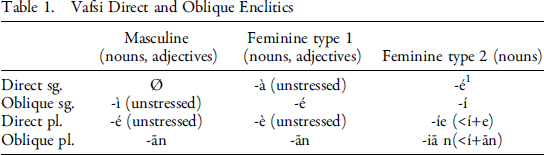
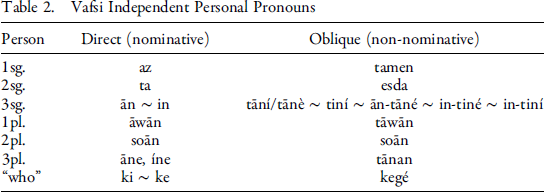
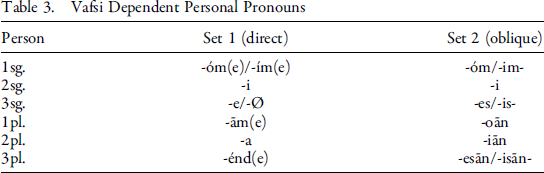
Vafsi nouns have two genders (masculine and feminine), two numbers (singular and plural), and two morphological cases (direct and oblique). Based on the Vafsi corpus, appearance of the plural form for both genders is common.Footnote 3 Vafsi adjectives usually appear post-head without any connecting morpheme, but are usually in agreement with the nominal head in number and gender features. Table 1 shows the direct and oblique enclitics in Vafsi nouns and adjectives.Footnote 4 Tables 2 and 3 show the dependent and independent personal pronouns.Footnote 5

Note: 1Vafsi IPA symbols.


The Vafsi dative case appears in three structures: (1) the case of the experiencer in sensory/experiential/cognitive verbs, (2) the case of the indirect object (IO), and (3) the case of the object of the preposition /da/ (to), or the preposition /az/ (to) or the enclitic /-o/ (to), or the object of the postposition /rā/ (for).
Research Methodology
This research is analytical, descriptive, and corpus-based methodologically. The main Vafsi linguistic corpus used is the 24 G-Vafsi folktales from Vafsi Folktales by Donald Stilo, narrated by two Gurchani speakers aged sixteen and sixty years, including 228 minutes of transcribed recorded voice. Also, in order to find the necessary structures in Vafsi, some sentences are produced by a native Chehreghani speaker which is referenced by the character (C).Footnote 6
Vafsi Dative OT Analysis
The required constraints will be discussed in the following sections and the optimal analysis for each dative structure will be encapsulated in the optimality tableaux.
The optimality analysis of the dative case of “experiencer.”
Quirky subjects
In some languages having a morphological case-marking system, predicates which have sensory, or cognitive, or experiential features necessitate the appearance of subjects which are not nominative case marked. These subjects are called quirky subjects, or non-nominative subjects or oblique subjects.Footnote 7 Some of the Vafsi sensory/experiential/cognitive verbs are: /gow-an/ (to want), /xoš ^ owi-an/ (to feel good, to like), /xow ^ owi-an/ (to feel sleepy), /garm/sard ^ bi-an/ (to feel cold/warmth), which in all tenses have quirky subjects. These subjects, which have the experiencer function, will be overtly dative case marked, similar to Vafsi IOs which, based on the verb meaning, have one of the goal, recipient, or beneficiary functions.Footnote 8
However, Vafsi does not have relators specific to the dative case, so uses the oblique enclitics (see Table 3) as portmanteau morphemes used generically for all oblique cases. But, based on the genetic linguistics and areal typology, it can be deduced that the oblique case of the experiencer is actually a dative case.Footnote 9
According to Bickel, dative case constructions for experiencers is a feature specific to the South Asian and Indo-European languages. The following examples illustrate the Vafsi quirky subjects in context.Footnote 10
Example 1: quirky subject (experiencer)—/gow-an/ (to want)

In example 1 (a), the cognitive verb /gow-an/ (to want) has the first singular subject. But instead of using the subject pronoun /az/ (I) in the nominative case, the oblique pronoun (dative) /tamen/ (me) appears along with the first person singular pronominal morpheme /-m/ fronted to the direct object (DO); /siva/ (apple) is the DO which, according to the Vafsi differential object marking (DOM), will be direct case marked as it is inanimate and indefinite. Therefore, the sentence verb will show agreement with the DO by using the zero morpheme.

In example 1 (b), the cognitive verb /gow-an/ (to want) is in the present tense and its subject is a first person plural pronoun. Instead of using the nominative pronoun /āwān/ (we), the oblique (dative) pronoun /tāwān/ (us) is used along with the first person plural pronominal morpheme /-oān/ fronted to the DO, /xar/ (donkey). The DO is animate and by the appearance of the possessive pronoun /esda/ (your), as a pre-head modifier, will become definite, so according to the Vafsi DOM, the DO should be oblique case marked as /xar-i/; but because of the phonological phenomenon of hiatus (two vowels occurring in adjacent syllables, with no intervening consonant), the oblique morpheme /-i/, which in the sonority scale of ā>o>u>e>i is less sonorous than /o/, will be deleted.Footnote 11 Hence, /xar-i-oān/ turns to /xar-oān/; consequently, in this sentence, both subject and object will be oblique case marked and as the Vafsi verb agrees with an argument which is direct case marked, the default agreement (third person singular) will appear by using a zero morpheme.Footnote 12


In examples 1 (c) and (d), the cognitive verb /gow-an/ (to want) is in the past tense, so these two examples show that the experiencer case pattern and the agreement system in clauses including cognitive verbs are not tense-based. /gow-an/is a polysemous verb. Therefore, if meaning “to like,” it will not be considered a cognitive verb in Vafsi; its grammatical subject will have the function of an agent rather than an experiencer.
Example 2: subject (agent) -/gow-an/ (to like) (C)

Example 2 (a) shows that /gow-an/ (to like) has the subject /az/ (I) in the direct case. /gol/ (flower) is an indefinite DO, so, according to the Vafsi DOM, it will be direct case marked, the same as the subject.

/gow-an/ (to like) is a transitive verb. So, in the past tense, it should follow the Vafsi ergative system. Therefore, the subject /tamen/ (me) will be ergative case marked and the indefinite DO /gol/ (flower) will be direct case marked (according to the Vafsi DOM).
In Hindi/Urdu, Pashto, and Balochi, as in Vafsi, quirky subjects will appear.Footnote 13 The following example from Butt shows the appearance of quirky subject in Hindi.Footnote 14
Example from Hindi: quirky subject in Hindi

Generation of the dative case marking (DCM) constraints for the experience. According to the universal case licensing principles introduced by Chomsky, every argument requires the appearance of a licensed case.Footnote 15 Therefore, in OT analyses, any input which violates these principles will be outcast before the application of other constraints.Footnote 16
But the universal case licensing principles only observe the case marking and do not specify the case type. So the specification of the case type will be determined by using the markedness constraints. Hence the constraints will be classified into two groups—faithfulness constraints and the markedness constraints—which will be extracted in the following sections.
Faithfulness constraints
Within the principles and parameters (P&P) model, the existence of the case marking (license giving) feature in every verb is part of the subcategorical features of that verb to which the related case will be assigned in the lexicon level in the D-structure. If a verb has the case licensing feature, this feature should be controlled for each input. So we need to introduce a constraint which will observe this feature at the initial stage. In optimality terms, it means that this constraint should be highest in rank and observe the consistency of the input and the output. The priority of the inherent cases in the Chomskyan generative grammar is justified by their assignment in D-structure, as the structural cases will be assigned in S-structure which is a higher stage relative to D-structure. Therefore, the inherent case assignment has priority over the assignment of the structural case.Footnote 17
Optimality equivalence of the priority of the inherent case assignment in D-structure is the faithfulness constraint in Model 1.
Model 1:
faith-lex: inherent case licensing feature in lexicon should be controlled.Footnote 18
This faithfulness constraint is context-based—i.e. this faithfulness should be followed only if the specific context like the transitive verb or the perfective aspect occurs.Footnote 19 In Vafsi, this constraint will act in the context of transitive/intransitive verbs: in verbs which include the case licensing feature in their subcategorical features.
Markedness constraints
The faithfulness constraint introduced in Model 1 is only applicable in the control of the existence of the inherent case feature in output. Therefore, in order to specify the type of the case of the output, markedness constraints are used. According to Dixon and Woolford, the nominative case is the least marked and is a universal case which will appear in all world languages.Footnote 20 According to Grimshaw and Woolford, inherent cases are more probably morphologically case marked relative to the structural cases; and hence are more marked.Footnote 21 According to the data, the markedness constraints hierarchy can be extracted as follows:Footnote 22
Model 2:
*ERG≫*DAT≫*ACC≫*NOM
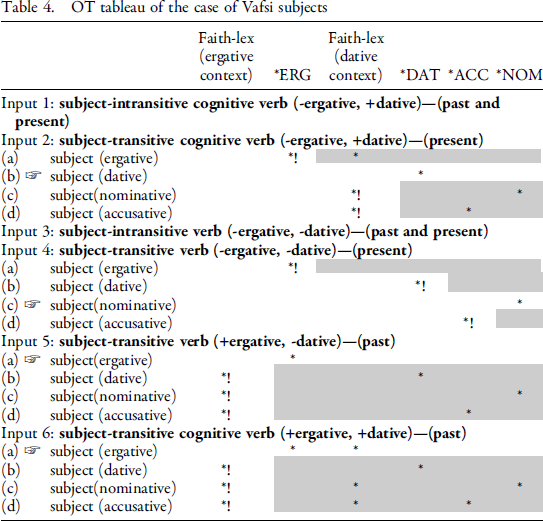
The ranking of the faithfulness and markedness constraints mentioned in Models 1 and 2 respectively is shown in Table 4. According to the constraints hierarchy in Model 2, *ERG is ranked higher than *DAT and as the faith-lex is context-based, if the past transitive clause occurs, the ergative structure will appear and faith-lex (ergative) will be relevant. Otherwise, this constraint will be irrelevant.

Note: The shaded cells have no effect on the outcome because the competition has been decided by the higher-ranking constraints.
Table 4 has six inputs from which inputs 1‒4 react to the constraints similarly in pairs, so they are classified and analyzed in these same reacting pairs. Inputs 1 and 2 both have cognitive verbs with the subcategorical features of +dative and -ergative. So the first constraint—i.e. faith-lex (ergative)—is irrelevant. Candidate “a,” because of ergative case marking, will be eliminated. Candidates “c” and “d,” because of failure in satisfaction of faith-lex (ergative context), will also be losers; therefore, candidate “b,” despite the violation of *DAT, will be the winner and the optimal candidate.
Example 3:
(a) subject-intransitive cognitive verb (-ergative, +dative)—(present)

Example 3 (a) is based on the input 1 structure. In this example, the compound verb /sard ^ bi-an/ (to feel cold) is a cognitive verb which requires the subject (experiencer) /tamen/ (me) in the dative case. But the compound verb /sard-ome/ (I am cold), by using the first person singular morpheme /-ome/ from set 1 (see Table 3) will show agreement with the sentence subject despite being in the dative case.
(b) subject-intransitive cognitive verb (-ergative, +dative)—(past)

Example 3 (b), like example 3 (a), has the same cognitive verb and the same subject in the dative case. But the sentence is in the past tense. These two examples show that the Vafsi cognitive/experiential/sensory verb will license the dative case for subjects in both past and present tenses.
Example 4: subject-transitive cognitive verb (-ergative, +dative)—(present)

In example 4, the cognitive verb /gow-an/ (to want) has a first person singular subject. But instead of using the nominative subject pronoun /az/ (I), the object pronoun /tamen/ (me) in dative case is used in coordination with the first person singular pronominal morpheme /-m/ fronted to the DO /siva/ (apple). The DO, according to the Vafsi DOM, because of being inanimate and indefinite, is direct case marked. This example is evidence of the prediction of the OT tableau in choosing the dative subject for the structure related to input 2.
Inputs 3 and 4 both have non-cognitive and non-ergative verbs. So the faith-lex constraint for both the ergative and dative contexts will be irrelevant. Therefore, the verb does not require any oblique case marking on the subject, so it will appear unmarked. Consequently, all three candidates “a,” “b,” and “d” will be eliminated because of fatal violation of the related constraints and “c,” the only candidate which is nominative case marked, will be the optimal candidate and the winner.
Example 5:
(a) subject-intransitive verb (-ergative, -dative)—(present)

In the above example, the intransitive verb /a-ch-óm/ (I go) is in the present tense so the nominative-accusative system will rule.Footnote 23 Therefore, the nominative pronoun /az/ (I) will appear unmarked.
(b) subject-intransitive verb (-ergative, -dative)—(past)

In example 5 (b), the intransitive verb /ba-ss-im/ (I went) is in the past tense so the nominative-accusative system will rule. Therefore, the nominative pronoun /az/ (I) will appear unmarked.
Example 6: subject-transitive verb (-ergative, -dative)—(present)

In example 6, the transitive compound verb /bar ^ at-ār-ènde/ (they bring out) is in the present progressive tense, so the nominative-accusative system will rule. The subject is the deleted pronoun /āne/ (they) which is nominative (direct) case marked and its co-referential dependent pronoun is the third person plural pronoun /-ènde/ of set 1 (see Table 3), which is suffixed to the sentence verb as an agreement marker (AM).
Inputs 5 and 6 both have the ergative structures but input 6 has also a cognitive verb, so it will require the satisfaction of the constraint *DAT. Candidates “b,” “c,” and “d” are all eliminated because of violation of the highest ranked constraint, which is faith-lex (ergative context), and candidate “a,” despite violating the markedness constraint *ERG in input 5 and the double violation of the constraint *ERG and faith-lex (dative context) in input 6, will come out as the optimal candidate. The optimal output for both inputs 5 and 6 is candidate “a,” but the difference between these two inputs is that the existence of the dative context in input 6 will be more marked relative to that of candidate 5.
Example 7: subject-transitive verb (+ergative, -dative)—(past)

In example 7, the non-cognitive transitive verb /b-ard-a/ (brought) is in the past tense and licenses the ergative case for the subject, so the dependent third person plural subject pronoun /-san/ is of set 2 (see Table 3), which as the optimal candidate “a” predicts, will be ergative case marked.
Example 8: subject-transitive cognitive verb (+ergative, +dative)—(past)

In example 8, the cognitive transitive verb /gow-an/ (to want) is in the past tense so it licenses both ergative and dative cases for the subject. As Vafsi does not have special morphemes for ergative and dative cases, it cannot be judged morphologically whether the case of the subject pronoun /tawan/ (us), which is oblique case marked, is ergative or dative. For distinguishing this case, the OT tableau will help us to find out that the oblique case of the subject of the transitive verbs in Vafsi is actually the ergative case. The interesting point here is the power of prediction in OT tableaux, so we can deduce a universal rule for Vafsi according to the optimality theory. This rule would be as in Model 3:
Model 3
In Vafsi, if both ergative and dative cases appear simultaneously, the dative morpheme will be eliminated and the ergative morpheme stands.
This rule is shown in Table 4 by the optimal candidate of input 6 and is illustrated by example 8.
The OT analysis of the dative case of IO
The Vafsi IO, like that of Magar (an Indo-European language spoken mainly in Nepal, Southern Bhutan, Darjeeling, and India by the Magar people), which conveys one of the three functions of goal, or recipient or beneficiary, is always dative case marked. But Magar DO, always as a patient, follows a DOM pattern based on the animacy or definiteness features.Footnote 26 Therefore, in case marking of the Magar DO, DDCM (differential dative case marking) will appear, which is sensitive to the animacy and definiteness features—that is, in this language, the human DO (definite or indefinite) will be oblique case marked and will receive the dative case morpheme /-ke/ and the non-human DO (animate or inanimate) will be dative case marked only if it is definite, otherwise it will receive the direct case marking.Footnote 27 In Magar as in Vafsi, oblique case marking of the experiencer appears.Footnote 28 As mentioned earlier, the faith-lex constraint is context-based, so it will require the emergence of the dative case for the IO in Vafsi double object construction (DOC).
As the focus of this section is on the OT analysis of the dative case and is not related to the analysis of the ergative case, the *ERG constraint in Model 2 will be redundant, resulting in its elimination in the constraint hierarchy in Model 4.
Model 4
*DAT≫*ACC≫*NOM
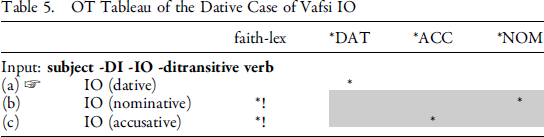
Consequently, the constraint rankings and the OT tableau for the dative case of Vafsi IO will be as in Table 5. Table 5 is relevant only to the inputs including the Vafsi DOC. The Vafsi DOC includes an IO which is always dative case marked.

Note: The shaded cells have no effect on the outcome because the competition has been decided by the higher-ranking constraints.
Candidates “b” and “c” will be eliminated because of violating the highest ranked constraint faith-lex. As a result, candidate “a,” despite the non-fatal violation of the markedness constraint *DAT, will be selected as the optimal candidate and the winner.
Example 9: subject-DI-IO-ditransitive verb (DOC)
In example 9, the ditransitive verb /ad-do-ø/ (gives) is in the present tense and its DO is

/yadegāri/ (memorial), which according to the Vafsi DOM, is direct case marked because of being inanimate and indefinite and the IO /berā-y/ (brother) will be dative case marked by suffixation of the singular masculine oblique morpheme /-y/ (see Table 1).
The OT analysis of the dative case of object of adposition (OA)
As Vafsi does not have a specific morpheme representing the dative case, in case the oblique portmanteau morpheme (set 2) (see Table 3) appears in the animate objects of the preposition /da/ (to), or the preposition /az/ (to), or the postposition /rā/ (for), or the enclitic /-o/ (to), the OT analysis of the dative case of the OA will be the same as for the Vafsi DACM (differential adpositional case marking), which is analyzed in another paper by the authors titled: “DACM in Vafsi within OT framework.”Footnote 30
Conclusion
According to this paper, there are three conditions under which the dative case appears: (a) the case of the experiencer in sensory verbs, (b) the case of indirect object (IO), and (c) the case of the object of the preposition /da/ (to), or the preposition /az/ (to) or the enclitic /-o/ (to), or the object of the postposition /rā/ (for). In Vafsi, as in many other Indo-European languages, sensory/experiential/cognitive verbs necessitate the emergence of quirky subjects which have the experiencer function and are dative case marked. Regarding the OT analysis of dative case marking of the experiencer in constructions having sensory verbs, first the faithfulness constraint of faith-lex in Model 1 and the markedness constraint hierarchy of *ERG≫*DAT≫*ACC≫*NOM in Model 2, introduced by Woolford,Footnote 31 was used to draw the OT in Table 4. The data was illustrated using examples 1 to 8. Regarding the second condition, by using examples, the paper showed that Vafsi always allocates the dative case to the IO of ditransitive verbs. In order to show the prediction of the recent phenomenon by use of an OT tableau, the same faithfulness constraint of faith-lex in Model 1 is used, but the markedness constraint hierarchy in Model 2 was changed to the constraints hierarchy in Model 4 by eliminating the irrelevant constraint *ERG; hence the markedness constraint hierarchy *DAT≫*ACC≫*NOM. And finally regarding the third construction, some Vafsi ditransitive verbs dative case mark the IOs using adpositions. If so, Vafsi DACM will rule, as the IOs are simultaneously OAs—i.e. an IO which is also an OA will be dative case marked only if it is human or animate. For OT analysis of the recent structure, see the above mentioned article.Footnote 32 In conclusion, the OT tableaux used in this paper correctly predicted the optimal candidate for each Vafsi dative construction which was corroborated by examples from Vafsi linguistic corpus.
Appendix A. List of Abbreviations