Learning any language requires mastery of all the different components of language: phonology, lexicon, syntax, semantics, and pragmatics. Development in each of these areas occurs gradually over the first few years of life, starting before birth (for a review, see Guasti, Reference Guasti2002). Congenitally deaf children can have typical development if they acquire sign language from fluent signers who provide them with a sufficiently rich input (cf. Petitto, Holowka, Sergio, & Ostry, Reference Petitto, Holowka, Sergio and Ostry2001, among others). However, they may not have typical development if they are exposed to sign language with delay (Boudreault & Mayberry, Reference Boudreault and Mayberry2006) or if they acquire a spoken language, which they cannot fully access because they cannot hear (Mayberry, Reference Mayberry1993; see Mayberry, Lock, & Kazmi, Reference Mayberry, Lock and Kazmi2002 for review and reference cited there). Both situations are common, because fewer than 10% of deaf children are born to deaf parents (Schein & Delk, Reference Schein and Delk1974) and hearing parents typically expose their deaf children to a spoken language.
To meet the needs of those deaf children who acquire a spoken language, one solution is to offer early access to auditory stimulation through cochlear implants (CIs), which are fit at increasingly younger ages, with early implantation occurring before 1 year (Tomblin, Barker, & Hubbs, Reference Tomblin, Barker and Hubbs2007). Cochlear implantation raises important ethical questions. Although many promote it as an effective way to support deaf children's language development, others claim that CIs are only effective with some recipients and can deprive the others of natural language input and associated social and cognitive benefits that would come with exposure to a signed language. Regardless of the ethical debate, increasing numbers of deaf children are receiving CIs. Therefore, it is crucial to collect careful data documenting their effects on language development. Without such studies, it will be difficult to determine the best course of fostering spoken-language development for deaf children in different environments and learning situations. To date, most studies have focused on the effect of age of implantation on language outcomes. It has been established that age of implantation is one factor that contributes to the variability observed in language outcomes, with children implanted earlier achieving better outcomes in various language components (Harrison, Gordon, & Mount, Reference Harrison, Gordon and Mount2005; Meyer, Bertram, & Lenarz, Reference Meyer, Bertram and Lenarz1995; Tomblin et al., Reference Tomblin, Barker and Hubbs2007; Tomblin, Barker, Spencer, Zhing, & Gants, Reference Tomblin, Barker, Spencer, Zhing and Gants2005; Vlastarakos et al., Reference Vlastarakos, Proikas, Papacharalampous, Exadaktylou, Mochloulis and Nikolopoulos2010). “Earlier” denotes different ages, depending on the studies in question: before 12 months (Miyamoto, Hay-Mccutcheon, Kirk, Houston, & Bergeson-Dana, Reference Miyamoto, Hay-Mccutcheon, Kirk, Houston and Bergeson-Dana2008), before 18 months (Robbins, Reference Robbins and Niparko2009), before 2 years (Anderson et al., Reference Anderson, Weichbold, D'Haese, Szuchnik, Quevedo and Martin2004), and before 5 years (Fryauf-Bertschy, Tyler, Kelsay, Gantz, & Woodworth, Reference Fryauf-Bertschy, Tyler, Kelsay, Gantz and Woodworth1997; Manrique, Cervera-Paz, Huarte, & Molina, Reference Manrique, Cervera-Paz, Huarte and Molina2004a, Reference Manrique, Cervera-Paz, Huarte and Molina2004b; Nikolopoulos, Dyar, Archbold, & O'Donoghue, Reference Nikolopoulos, Dyar, Archbold and O'Donoghue2004; Robbins, Svirsky, & Kirk, Reference Robbins, Svirsky and Kirk1997; Tye-Murray, Spencer, & Woodworth, Reference Tye-Murray, Spencer and Woodworth1995). These studies differ in the tasks employed and in the language components investigated, which can explain why they identify different thresholds for age-of-implantation effects. In contrast to these studies, Geers (Reference Geers2004), who used a variety of tests ranging from speech perception to productive syntax (as measured by the Index of Productive Syntax; Scarborough, Reference Scarborough1990), did not find an age of implantation effect in children implanted between 2 and 4 years.
Given that an effect of age of implantation is found at a variety of ages and is even lacking altogether in one study, it is worth considering at least two further variables that can have a substantial impact on language outcomes in children with CIs: area of language and typological features of the language. Support for our interest in the first variable comes from studies on second language (L2) acquisition: the age at which an individual can achieve a nativelike competence in the L2 varies, depending on the specific linguistic component considered. For example, a foreign accent is evident in L2 learners exposed to the L2 after the age of 4 (Flege, Reference Flege and Birdsong1999; Flege, Yeni-Komshian, & Liu, Reference Flege and Birdsong1999); in addition, perception of some L2 speech sounds is already nonnative in the L2 as of age 3 (Pallier, Bosch, & Sebastián-Gallés, Reference Pallier, Bosch and Sebastián-Gallés1997). By contrast, L2 learners obtain the same scores as native learners in syntactic and morphosyntactic tests if they are exposed to the L2 by age 7 (Flege et al., Reference Flege, Yeni-Komshian and Liu1999; Johnson & Newport, Reference Johnson and Newport1989). This means that in order to achieve a native competence in phonology, exposure to the L2 must occur before age 3, while for native morphosyntactic competence, age 7 is sufficient (see also Perry & Harris, Reference Perry, Harris, Skarabela, Fish and Do2001). We can cautiously affirm that, even though children with CIs are learning their first language (L1) and not an L2, the results from L2 acquisition predict slightly different age of implantation effects depending on specific linguistic areas. The similarity between delayed L1 acquisition and L2 acquisition is clearly evident in research carried out by Mayberry and colleagues (Reference Mayberry, Lock and Kazmi2002 and references cited there) on both spoken and signed languages. In several studies, Mayberry and colleagues have shown that the delayed acquisition of L1 and L2 shares similarities at all linguistic levels. For example, late L1 and L2 learners of American Sign Language display similar behavior when processing the phonological structure in lexical decision tasks. Moreover, early L1 acquisition enhances the acquisition of an L2.
Support that the typological dimension is relevant comes from studies on typical development and on specific language impairments (SLIs). Languages vary, and the difficulties children experience in one language are not necessarily experienced in another, because the same area may be less challenging in a different language. For example, English has a poor morphosyntactic or inflectional system and a rigid word order (generally, subject–verb–object), while Italian has a rich inflectional system (e.g., all verbs in all tenses and in all persons are marked with an inflectional suffix; articles, nouns, and adjectives are all marked for gender and number) and a relatively free word order (e.g., subjects can occur before or after any verb). Such differences pose different challenges to the child, as revealed in some studies on typically developing Italian-speaking children compared to English-speaking children (Pizzuto & Caselli, Reference Pizzuto, Caselli and Levy1993) and on Italian-speaking children with SLIs compared to English-speaking children with SLIs (Leonard, Bortolini, Caselli, McGregor, & Sabbadini, Reference Leonard, Bortolini, Caselli, Mcgregor and Sabbadini1992). The impact of the typological dimension is also evident in some studies on the acquisition of language by children with CIs. Svisky, Stallings, Ying, Lento, and Leonard (Reference Svirsky, Stallings, Ying, Lento and Leonard2002) have shown that 9 English-speaking children with CIs acquired the uncontractible copula before plural inflection on nouns and the regular past tense. In contrast, the sequence of acquisition appears to be different in German. Szagun (Reference Szagun2000, Reference Szagun2004) demonstrated that German-speaking children with CIs acquire plural inflection on nouns and a substantial portion of verbal inflections more accurately than the copula (as well as morphological case on articles and modal verbs). It is evident from these studies that the acquisition sequence in children with CIs is not the same across the languages examined. Another piece of evidence comes from a comparative study on the acquisition of the verbal paradigm by Hebrew- and Dutch-speaking children with CIs: The former group acquired the verbal paradigm more rapidly than the latter (Herzberg, Ravid, Nir, & Gillis, Reference Herzberg, Ravid, Nir and Gillis2010). It is interesting that Hebrew is a language with a highly rich synthetic morphology compared to English or Dutch, and this richness may make the morphology particularly salient to Hebrew-speaking children such that they are sensitive to morphological modifications, which are extremely relevant in their language (for evidence of the effect of morphological information on the development of Hebrew and Dutch orthographies, see Gillis & Ravid, Reference Gillis and Ravid2006).
The type of language also matters in another cognitive area: phonological memory, as indexed by nonword repetition (Burkholder-Juhasz, Levi, Dillon, & Pisoni, Reference Burkholder-Juhasz, Levi, Dillon and Pisoni2007; Cleary, Pisoni, & Kirk, Reference Cleary, Pisoni and Kirk2002; Dillon, Burkholder, Cleary, & Pisoni, Reference Dillon, Burkholder, Cleary and Pisoni2004; Dillon & Pisoni, Reference Dillon and Pisoni2006). This task measures phonological short-term memory, involving the use of nonwords that typically display the phonological properties of words in a given language. But phonology varies across languages (Abercrombie, Reference Abercrombie1967; Ladefoged, Reference Ladefoged1975), and this may matter. For example, while English has vowel reduction (e.g., the final vowel of the article the reduced to a schwa), Italian does not; English has many consonant clusters and Italian has fewer. Nonword repetition distinguishes children with SLIs from typically developing children (Oetting & Cleveland, Reference Oetting and Cleveland2006) in English. Particularly challenging for children with SLI are (a) consonantal clusters, depending on their position in the word (see Gallon, Harris, & Van der Lely, Reference Gallon, Harris and Van der Lely2007; Marshall & Van der Lely, Reference Marshall and Van der Lely2009); (b) nonsyllabic inflections, which may result from vowel reduction (e.g., –ed in I walked is a nonsyllabic inflection; Leonard, Reference Leonard1998); and (c) weak syllables (i.e., syllables without stress; Bortolini & Leonard, Reference Bortolini and Leonard2000). Nonword repetition is not challenging for Cantonese-speaking children with SLIs (Stokes, Wong, Fletcher, & Leonard, Reference Stokes, Wong, Fletcher and Leonard2006), because Cantonese is a language that differs from English in that it has few consonant clusters, every syllable has a tone, and most syllables have consonant–vowel structure. A potentially relevant difference between Italian and English phonology is that English has a high number of different syllable types whereas Italian does not (16 vs. 8). This property combined with the other reported phonological properties (vowel reduction and consonantal clusters) gives rise to a more irregular rhythmic structure of words in English than in Italian (Mehler & Nespor, Reference Mehler, Nespor and Belletti2004; Ramus, Nespor, & Mehler, Reference Ramus, Nespor and Mehler1999), and this may be more challenging for children. Based on what is reported above, it is evident that identification of children with SLIs by using nonword repetition is contingent on the phonological system of the language, as suggested by Bortolini and colleagues (Reference Bortolini, Arfé, Caselli, Degasperi, Deevy and Leonard2006). The phonological properties of different languages have been invoked to explain the differences in manifestation of SLIs in Italian and English. Leonard (Reference Leonard1998) claims that Italian inflections on verbs are less problematic than English ones because Italian inflection is syllabic (i.e., the inflectional suffix is always a syllable), while English inflections can be just a consonant, such as the English third-person singular –s. Thus, in a study on verbal short-term memory as assessed through nonword repetition, the cross-linguistic dimension cannot be neglected (see Papagno, Valentine, & Baddeley, Reference Papagno, Valentine and Baddeley1991 for evidence about the relevance of this aspect).
In summary, the age of implantation is certainly a variable that impacts language outcomes in children with CIs. However, from studies on L2 and L1, we can add that age of exposure may have different effects depending on the specific language. At the same time, we know from studies on typical language development in SLIs and on language development in children with CIs, that the typological properties of a given language may differently affect language acquisition.
Given these premises, the purpose of this study is to assess whether (a) children with CIs are more proficient in some linguistic areas than in others; (b) children with CIs who speak a heretofore uninvestigated language, Italian, display different linguistic behavior with respect to children with CIs who speak previously studied languages; or (c) the age of implantation and age of diagnosis affect the acquisition of the various linguistic components differently. To this aim, we administered several tasks to children with CIs, including at least one for each major linguistic area: lexicon, phonology, morphosyntax, semantics, and pragmatics.
Although several studies on speech perception and production abilities of children with CIs exist (e.g., Dawson et al., Reference Dawson, Blamey, Rowland, Dettman, Clark and Busby1992; Fryauf-Bertschy et al., Reference Fryauf-Bertschy, Tyler, Kelsay, Gantz and Woodworth1997; Herzbert et al., Reference Herzberg, Ravid, Nir and Gillis2010; Wie, Falkenherg, Tvete, & Tomblin, 2007), there is less research on grammatical development (Geers, Reference Geers2004; Geers, Moog, Biedenstein, Brenner, & Hayes, Reference Geers, Moog, Biedenstein, Brenner and Hayes2009; Geers, Nicholas, & Sedey, Reference Geers, Nicholas and Sedey2003; Hammer, Reference Hammer2010; Svirsky et al., Reference Svirsky, Stallings, Ying, Lento and Leonard2002). In addition, most studies concern English-speaking children with CIs (with only a few studies on Dutch, French, or Hebrew). Our study is the first conducted on a variety of language aspects in Italian-speaking children with CIs (see Berrettini et al., Reference Berrettini, Forli, Genovese, Santarelli, Arslan and Chilosi2008 for a study evaluating speech perception and the general benefits in daily life of a CI in Italian-speaking children with associated learning disabilities).
The results of our investigation will have theoretical and practical implications. On the theoretical side, the examination of language development when exposure does not start at birth can also provide information about the course of language acquisition in typically developing children and can highlight those aspects whose development is set in motion only through early exposure. On the practical side, our results will be useful for clinicians who plan and carry out rehabilitation programs. Some areas may need to be supported more than others, but rehabilitation programs may be centered on those areas in which children with CIs are strong.
METHODS
Participants
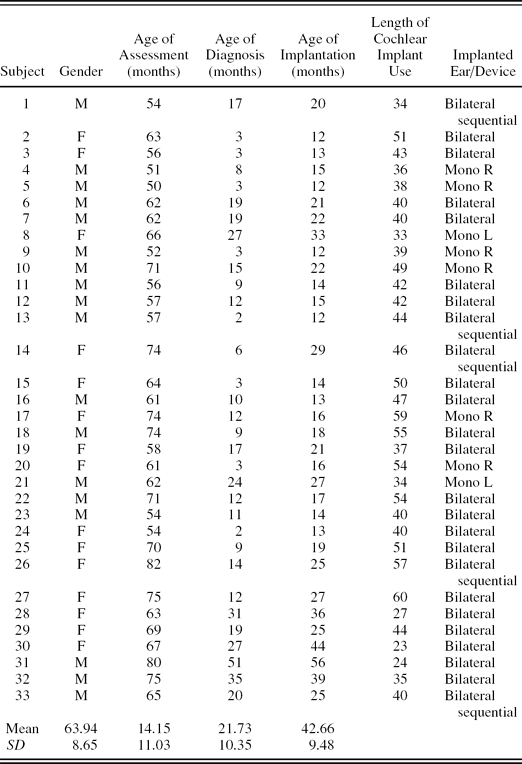
Thirty-three prelinguistically deaf children with CIs ranging in age from 50 to 82 months, 15 girls and 18 boys (M = 63.9, SD = 8.66), participated in the study. They were all born to hearing parents and were diagnosed as being deaf at between 2 months and 51 months of age (M = 14, SD = 11). They received CIs at the Ospedale di Circolo di Varese (Hospital of Varese, Italy) between 12 and 56 months of age (M = 21.7, SD = 10.4), and the length of implant use varied between 23 and 60 months (M = 42.7, SD = 9.5). All children were born deaf, with one exception. This single child had meningitis at 11 months. Eight of the children had monoaural CIs and wore a hearing aid on the other ear, 5 children had bilateral sequential CIs (fitted with an interval of 2 to 3.5 years from each other), and the remaining 20 had bilateral simultaneous CIs. All had NUCLEUS devices, although different models were used. All the children underwent the same rehabilitation program at the Ospedale di Circolo di Varese, both before and after surgery, and were learning Italian as their L1.
It was crucial that the children included in this study started a rehabilitation program as soon as they were diagnosed as being deaf (i.e., before the surgery). This treatment continued after surgery for as long as it was judged necessary. During the first year after implantation, the children lived in Varese with their caregivers and had regularly scheduled appointments for rehabilitation and educational purposes. Thus, they received intensive speech and more general educational treatment in strict connection with the hospital. After the first year, the children moved back to their homes with their caregivers but still had regularly scheduled appointments. At home, they underwent a rehabilitation and educational program based on the achievement of specific objectives and were supervised through videoconferences by speech therapists in Varese. This program lasted until the children had reached the specific standards set for them. Afterward, children were monitored twice a year. For this study, they were tested during one of these appointments. No child was reported as having any mental deficit, including the child who suffered from meningitis, as assessed through a neuropsychological evaluation carried out at the hospital. Information concerning children with CIs is reported in Table 1. No child used sign language as a means of communication with his/her family.
Biographical information concerning the children with cochlear implants

Thirty-three normal hearing (NH) children (age range = 50–70 months, M = 62.6, SD = 7.59) recruited from the Milan metropolitan area and matched in chronological age to the children with CIs served as control participants. Each NH child participant was within 3 months of age of a child in the CI group (in one case a child was 5 months younger than the matched CI). CI and NH groups did not differ in age, t (64) = 0.68. Although all children with CIs included in this study had lived in northern Italy for about one year after surgery, some came from other regions in Italy and therefore were exposed to different varieties of Italian. All matched NH children, however, were living in the same area and exposed to the same variety of Italian. As far as we can tell from their production, the variety of Italian to which CI children were exposed affected pronunciation and, occasionally, type of construction (e.g., use of the preposition to before direct objects in speakers from southern Italy).
Informed consent was collected from the parents of all participating children. Parents were given feedback about their children's results. The study was approved by the ethical committee of the Hospital of Varese and of the University of Milano-Bicocca. Participants received no money for participation.
Materials, procedure, and scoring
Children were administered three standardized and two nonstandardized language tests by a research assistant with a good linguistic background. In the case of the children with CIs, the first or the second author was also present during the administration. The standardized tests were aimed at assessing the following: (a) for lexical comprehension, the Italian version of the Peabody Picture Vocabulary Test (PPVT; Stella, Pizzoli, & Tressoldi, Reference Stella, Pizzoli and Tressoldi2000); (b) for grammatical comprehension, the Test di Comprensione Grammaticale per Bambini (TCGB; Chilosi & Cipriani, Reference Chilosi and Cipriani1996); and (c) for nonword repetition, Prove di Prerequisito per la Diagnosi delle Difficoltà di Lettura e Scrittura (PRCR-2; Cornoldi, Miato, Molin, & Poli, Reference Cornoldi, Miato, Molin and Poli1995).
The PPVT examines Italian word comprehension. The examiner reads a word and the child has to choose the target picture from among four alternatives. The TCGB evaluates comprehension of eight types of structures: locative sentences (e.g., “The ball is under the table”); number marking on nouns (e.g., chair-s vs. chair); number marking on verbs (e.g., fly-3PL vs. fly-3SG); present, past, and future tense on verbs; positive and negative declarative sentences (e.g., “The child is (not) sleeping”); positive and negative passive sentences (e.g., “The apple is eaten by the girl” or “The piano is not played”); relative clauses (e.g., “The cat jumps on the mouse that is on the chair”); and dative sentences (e.g., “The girl gives a schoolbag to the child”). Children are invited to point to a picture (from an array of four) that matches the sentence spoken by the experimenter. The nonword repetition test (PRCR-2) is considered a good measure of phonological memory (Gathercole, Willis, Emslie, & Baddeley, Reference Gathercole, Willis, Emslie and Baddeley1992). It consists of 25 nonwords ranging from one to four syllables in length. For each length, 5 nonwords are presented (2 series of two-syllable nonwords are included). All nonwords conform to the phonotactic patterns of Italian (examples of items with indication of syllabification: pun, ror-do, mim-bri, tà-sto-la, dul-ca-brì-te). The child is asked to repeat each nonword after the experimenter has uttered it without masking her lips.
Participants’ responses were always transcribed on a response sheet. In addition, responses for the nonword repetition test were audio recorded. Due to a malfunction in our recording system, several recordings were unfortunately of too low a quality to facilitate independent verification of the responses after the actual session. Nonetheless, we believe that the accuracy of the in-session transcriptions is high enough to merit analysis for three reasons. First, the assistant transcribing the responses during the session had no other responsibilities (another experimenter administered the tests), so his/her full attention was paid to the transcription. Second, Italian orthography is very transparent, that is, words are generally pronounced as they are written, and this simplifies transcription. Third, a trained assistant independently transcribed the productions of the seven participants for whom we had audible recordings (three with CIs, four controls, which is 10% of all participants). Agreement between the online and independent offline transcription was 95% (399/420 syllables). The children's scores in nonword repetition were defined as the number of syllables correctly repeated (range = 0–60). A syllable is considered appropriate if each sound included in the syllable is correctly repeated. This means that if a phoneme is omitted or substituted, the syllable as a whole is considered incorrect.
Scores obtained in these three standardized tests were transformed into z scores based on means and standard deviations obtained from normative samples of typically developing Italian-speaking children.
Children were also submitted to two nonstandardized tests: a task assessing the production of clitic pronouns (Arosio et al., Reference Arosio, Branchini, Forgiarini, Roncaglione, Carravieri, Tenca and Yukio2010) and a task assessing sensitivity to pragmatic understanding, the conversational violation task (Siegal, Iozzi, & Surian, Reference Siegal, Iozzi and Surian2009). In contrast to the other three tests, which were administered live by the research assistant, these tasks were administered through a portable computer manipulated by the research assistant. Pictures and voices were played through the computer connected to two loudspeakers. The prerecorded voice was a female voice.
The clitic task elicits the production of third-person direct object clitic pronouns, a typical feature of Romance languages, and the use of past participle agreement. Clitic pronouns are monosyllabic forms that cannot be used in isolation but must be accompanied by a verb. Unlike their nominal counterparts in (1a), they do not follow the finite verb but precede it, as in (1b). FEM in the glosses represents feminine gender.
- (1)
a. La rana mangia la mosca
the-FEM frog-FEM eats the-FEM fly-FEM
“The frog eats the fly.”
b. La rana la mangia
the-FEM frog-FEM it-FEM eats
“The frog eats it.”
Clitic pronouns are difficult to acquire for many types of learners of Italian, possibly because their mastery requires the coordination of phonological, morphosyntactic, syntactic, and pragmatic competence. Typically developing children start to use them around the age of 2 years, 6 months (2;6) to 3;0. They then use them sometimes, but optionally. Full mastery is achieved at around 4 to 5 years of age (Antelmi, Reference Antelmi1997; Cipriani, Chilosi, Bottari, & Pfanner, Reference Cipriani, Chilosi, Bottari and Pfanner1993; Pizzuto & Caselli, Reference Pizzuto, Caselli and Levy1993; Schaeffer, Reference Schaeffer2000; Tedeschi, Reference Tedeschi2009). Children with SLIs omit clitic pronouns more often than typically developing children and do so for a longer period (Bortolini et al., Reference Bortolini, Arfé, Caselli, Degasperi, Deevy and Leonard2006). Adult L2 learners of Italian often produce the noun corresponding to the clitic or omit the nominal phrase altogether (Leonini & Belletti, Reference Leonini, Belletti, Kampen and Baauw2003). Thus we expected that the production of clitic pronouns might also prove difficult for children with CIs. Another interesting issue is what children do when they fail to produce a clitic: do they omit it, replace it with the corresponding noun, or replace it with some other type of pronoun? The test aimed at eliciting clitics in sentences with simple present, as in (1b), but also in sentences with compound tenses, like the present perfect. In (2a) the sentence has a feminine nominal complement and the past participle has the default (masculine) form. In (2b), a feminine (partially elided) clitic in the preverbal position is used and feminine agreement, marked by the suffix –a, is observed on the past participle.Footnote 1
- (2)
a. La rana ha mangiato la mosca
the-FEM frog-FEM has eaten the-FEM fly-FEM
“The frog has eaten the fly.”
b. La rana l'ha mangiata
the-FEM frog-FEM it-FEM has eaten-FEM
“The frog has eaten it.”
Studies on NH children have shown that they start expressing agreement on the past participle when they use a clitic as early as age 2;6, but they still produce errors at age 4. In addition, one study reports that children consistently use past participle agreement when they omit clitics (McKee & Emiliani, Reference McKee and Emiliani1992), whereas others challenge this claim, showing that past participle agreement is only sporadically used when the clitic is omitted (Moscati & Tedeschi, Reference Moscati and Tedeschi2009; Schaffer, Reference Schaeffer2000). Investigation of the use of past participle agreement gives us insights into the use of an aspect of verbal inflection. Given these controversial results, it is relevant to establish to what extent children with CIs use past participle agreement and whether they use it with or without clitics.
In order to elicit clitics, children were shown figures depicting situations accompanied by audio material. There were 16 situations meant to elicit a sentence like the ones in (1) and (2). In half of the trials, the verb was in the present tense, while in the remaining trials the verb was in the present perfect. Thus, sentences with the verb either in the former or in the latter form were elicited. Four of the eight sentences with the present perfect required a feminine pronoun, thus the feminine agreement of the past participle with the feminine clitic, as shown in (2b). The other four sentences required a masculine pronoun and masculine agreement on the past participle (e.g., for the second example, the masculine past participle would have been “mangiat-o,” eaten-Masc-Sg). However, notice that masculine singular agreement is also the default form in Italian, which is used when there is no agreement involved, as displayed in (2a). Therefore, for the last set of sentences, we cannot be sure that the use of a masculine past participle with a masculine clitic is an indication that agreement has been employed. The verbs of these sentences are very common in children's vocabulary and include the following: asciugare (dry), pettinare (comb), lavare (wash), coprire (cover), svestire (undress), bere (drink), leggere (read), spaventare (frighten), mangiare (eat), prendere (catch), legare (tie), aggiustare (repair), rompere (break), sporcare (dirty), svegliare (wake up), and tagliare (cut).
The procedure went as follows. A picture was displayed to the child and a prerecorded voice described what was happening in the picture. For example, in order to elicit the response in (2), the voice said, “In this picture there are a frog and a fly.” Then a second picture showing the frog eating the fly was presented and the voice said, “Here the frog has eaten the fly. Can you tell the puppet what the frog did to the fly?” An appropriate answer to this question would be (2b). Note that all the relevant words necessary to answer, except for the clitic pronoun, are given to the child by the recorded voice, in order to minimize short-term memory demands and also to control for lexical knowledge. Before starting the experimental session, children received some training consisting of two items similar to the experimental ones, and they got feedback if they did not use clitics: children were told the sentence with the clitic and asked whether they would agree that this was the appropriate way to answer.
Sentences were transcribed on site and recorded for further double-checking. Each response was assigned to one of four categories: clitic present, clitic omitted, use of the corresponding noun rather than pronoun, or irrelevant response. If the child did not produce the expected verb (but a synonym), the response was considered appropriate and scored as above. If the sentence contained a clitic, in the wrong form (e.g., feminine rather than masculine or plural rather than singular), the sentence was scored as “clitic present” but marked for further analysis. If the child produced a dative clitic, rather than an accusative one, the sentence was scored in the category clitic present. This happened when a two-complement verb rather than a one-complement verb was used. For example, instead of saying “lo copre” (him-M covered; “She covered him”), children would say “gli mette la coperta” (him-M-DAT puts the blanket; “She puts the blanket on him”), which was an appropriate answer in the provided context. Past participle agreement was scored correct if agreement was correct.
The Conversational Violation Test (CVT) examines pragmatic competence and is aimed at establishing whether a maxim of conversation in the Gricean framework has been violated. The maxim of quantity (be as informative as required by the current situation), quality (say only what you believe is true), relation (be relevant), and manner (be polite) were tested. For concreteness, we give one example from each of the maxims tested.
(5) a. Maxim of quantity
What would you like to buy in a pet shop?
A pet (incorrect, because underinformative)
A cat (correct)
b. Maxim of quality
Do you have brothers?
Yes, I have 500 brothers. (incorrect, because implausible)
Yes, I have 2 brothers. (correct)
c. Maxim of relation
What do you like to eat?
I like the sea. (incorrect, because not relevant to the question)
I like ice cream. (correct)
d. Maxim of manner
Do you want to play with me?
No, you are stupid. (incorrect, because not polite)
No, I am too tired. (correct)
To offer the reader an idea of what is being tested with this task and why we use it for evaluating children's pragmatic competence, we illustrate how the maxim of quantity was tested. One male doll asked a question like “What did you buy in the pet shop?” This was answered by one female doll with the sentence “I bought a pet.” This answer is true, but it is not informative, as it is obvious that in a pet shop you can buy a pet. This answer is considered strange in the context. The other female doll, instead, answered by saying “I bought a cat.” This answer is true, and it is also informative. Thus, it is more appropriate in the given situation.” The task included 10 items for the quantity maxim and 5 for each of the other maxims, for a total of 25 items. To control for strategic effects, two lists were created in which the 25 items were randomized in two different ways. The task was presented through a portable computer. Children were presented with a DVD displaying 25 short conversational exchanges staged by three doll speakers, one male and two females. At the beginning of the presentation, the male doll appeared and explained to the child that he was going to ask questions to two female friends, who would then answer. The child's task was to choose which friend had answered something silly or strange. For example, for the question in (5b), one female puppet answered, “I have 500 brothers,” and the other said, “I have 2 brothers.” The child was expected to say that the first answer was the strange one. Each response was categorized as either correct or incorrect. One child with a CI did not finish the task and another did not respond; both were therefore discarded.
Children with CIs were tested individually in a quiet room at the University of Milano–Bicocca and NH children at their school. The whole assessment was performed in two sessions on different days for NH children and on the same day for most children with CIs, but with a 90-min interval between the two sessions. This single session for children with CIs was necessary because they were coming from different areas of Italy. During each session, a short pause took place between the various tasks, and the children were invited to play. We admit that this procedure could have affected the sustained attention of children with CIs. In addition, NH children were tested in a familiar environment, while children with CIs were tested in an unknown place. Finally, NH children were recruited from the same school and benefit from the same type of environment and education, while these factors were extremely variable for the CI participants. These and other uncontrolled factors must be taken into account when drawing conclusions about the performance of children with CIs on language tasks.
As for the statistical analysis, continuous data, such as scores on standardized tests, were analyzed using an analysis of variance (ANOVA). Categorical data, such as response accuracy from the clitic task and the CVT were analyzed with mixed logit models using the statistical programming environment R (R Development Core Team, 2011). In mixed logit models, it must first be established whether one or more predictors significantly contribute to the model by comparing a model with those predictors against a model without them using a chi-square test (Jaeger, Reference Jaeger2008). In addition, the z value, which is based on Wald statistics, allows for the estimation of the statistical significance of each predictor in the model. The decision to use a mixed logit model was motivated by the prerequisites for using an ANOVA not being met (Dixon, Reference Dixon2008), because response accuracy data are discrete, possibly leading to artifacts. Regression analyses were carried out to study the correlations.
RESULTS
This section reports the results from standardized and nonstandardized tests.
Standardized tests
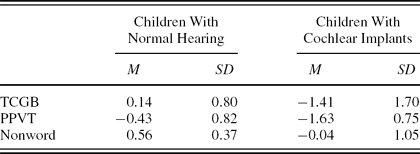
Means and standard deviations of the z scores obtained by the two groups of children in the three standardized tests (PPVT, TCGB, and nonword repetition) are reported in Table 2. Children with CIs obtained lower z scores than NH children, although the difference was less evident in nonword repetition. In addition, performances in the three tests varied, with the TCGB eliciting the lowest performance, followed by the PPVT and nonword repetition, with a similar trend in the two groups. This is confirmed by a 2 × 3 ANOVA, 2 Groups (CI, NH) × 3 Types of Test (PPVT, TCGB, nonword repetition), with z scores as a dependent variable. A significant effect of group, F (1, 64) = 39.89, MS = 60.49, p < .001, and type of test, F (2, 128) = 38.07, MS = 27.95, p < .001, was found. The interaction Group × Type of Test was also significant, F (2, 128) = 4.99, MS = 3.67, p < .01. This significant interaction is because, although scores on all tests were lower for children with CIs than for NH children, the difference between the two groups was less marked in nonword repetition, causing a deviation from parallelism. Post hoc Scheffé tests confirmed that children with CIs’ performance in the TCGB and the PPVT differed from their performance on the nonword repetition (p < .01), because they achieved lower scores in the former two tasks than in the latter. Performance in the PPVT differed from performance in the nonword repetition in NH children (p < .05). Finally, the two groups differed in the TCGB and the PPVT (p < .01), but not in the nonword repetition (p = .53).
Means and standard deviations of the z scores in the three standardized tests by children with normal hearing and children with cochlear implants

Note: TCGB, Test di Comprensione Grammaticale per Bambini; PPVT, Peabody Picture Vocabulary Test.
In order to obtain an approximate measure of the delay in the TCGB and PPVT, we determined the age at which the raw scores reached by children with CIs corresponded to the mean, then we subtracted that age from the chronological age. On average, children with CIs were 15 months (SD = 11 months) behind their chronological age on the TCGB and 11 months behind (SD = 10.6 months) on the PPVT. Thus, children with CIs were less accurate than NH children, but they showed a similar trend in the three tests. Figure 1, Figure 2, and Figure 3 provide three box plots that show the distribution of scores in the two groups of subjects.
Box plot representing z scores on the Test di Comprensione Grammaticale per Bambini (test for reception of grammar) of children with cochlear implants and children with normal hearing. [A color version of this figure can be viewed online at http://journals.cambridge.org/aps]
Box plot representing z scores on the Peabody Picture Vocabulary Test (test for vocabulary comprehension) of children with cochlear implants and children with normal hearing. [A color version of this figure can be viewed online at http://journals.cambridge.org/aps]
Box plot representing z scores on nonword repetition of children with cochlear implants and children with normal hearing. [A color version of this figure can be viewed online at http://journals.cambridge.org/aps]
Then we examined the outcomes of the PPVT and the TCGB, taking into account the length of implant use; that is, we assigned standard scores on the PPVT and the TCGB based on the duration of CI use in place of chronological age. This was possible only for children who had at least 3;9 and 3;6 years of CI use, respectively, as these tests are standardized starting from those ages.Footnote 2 For the PPVT, this was done for 12 children. Of these, 5 were below the 25th percentile, 5 between the 25th and the 50th percentiles, and 2 above the 50th percentile. In the case of the TCGB, this analysis was performed on 17 children. In this subset, 5 children were between the 25th and the 50th percentiles and 12 were above the 50th percentile. In other words, with a few exceptions on the PPVT, the performance of children with CIs was well within the normal range when their age of CI implantation was considered.Footnote 3 The TCGB and PPVT scores positively correlated in children with CIs (r = .39, p = .03) and in NH children (r = .37, p = .05). Scores on the TCGB and the nonword repetition also correlated in children with CIs (r = .35, p < .05) but not in NH children.
Clitic task
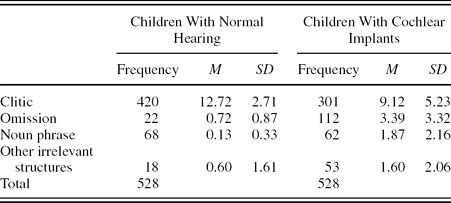
Responses produced by NH children and children with CIs on the clitic task are shown in Table 3, where frequencies, means, and standard deviations of sentences with clitics, omissions, noun phrases, or other irrelevant structures are reported. Means are calculated by dividing the number of responses by all participants in a given category over the total number of participants. The maximum number of responses per participant was 16. We obtained 528 responses for each group. As expected, children with CIs produce fewer clitics than did NH children.
Frequencies, means of correct responses and standard deviations of sentences with clitics, omissions, noun phrases, or other irrelevant structures in children with normal hearing and children with cochlear implants
Note: The maximum number of responses is 16 for each child.
This is confirmed by the statistical analysis. Accurate responses were fit into a mixed logit model with group (NH vs. CI) as a fixed factor and two random factors (items and participants). The inclusion of group as a fixed factor provided significant information to the model, χ2 (1) = 83.23, p < .001, and the effect of group was significant, Wald Z = 8.71, p < .001, indicating that NH children produced more clitics than children with CIs.Footnote 4
We then analyzed children's responses when they failed to produce a clitic to verify whether there was any difference between the two groups of children with respect to the alternative structures used. For this purpose, we considered only sentences without clitics (i.e., a subset of the total number of responses produced by children). First, we analyzed omissions versus all other types of errors. The mixed logit models on the proportion of omissions revealed that children with CIs were more likely to omit clitics than were NH children, χ2 (1) = 19.51, p < .001; Wald Z = −5.31, p < .001. Children with CIs used full nouns less frequently than did NH children, χ2 (1) = 37.34, p < .001; Wald Z = 6.10, p < .001, while no difference was found in the case of irrelevant responses, χ2 (1) = 1.18, p > .05; Wald Z = −1.10, p > .05. We examine the distribution of accuracy in the performance of children with CIs by transforming raw scores into z scores with respect to the mean and standard deviation of their group. All the subjects showed a z score above −1.7.
Then we examined whether there was a correlation between the use of clitics and age of implantation. The mixed logit model analysis revealed that age of implantation provided a significant contribution to the model, χ2 (1) = 8.34, p < .003, and significantly predicted accuracy in clitic production (Wald Z = −3.14, < .001).
Finally, we analyzed whether children produced past participle agreement when the target clitic was feminine and agreement is obligatory in adult Italian. For this purpose we did not consider irrelevant sentences or sentences in which the corresponding noun was produced instead of the clitic.Footnote 5 We found that children with CIs produced past participle agreement less frequently than did NH children when it was required, χ2 (1) = 17.97, p < .001; Wald Z = 4.06, p < .001. Children with CIs provided agreement on the past participle in 69% of the cases, while NH children did so in 89%. For children with CIs, failure to provide past participle agreement was observed both when the clitic was present (i.e., in 76% of those sentences displaying the use of a clitic) and when it was omitted (i.e., in 34% of those sentences that lacked a clitic), while for NH children this was observed only when the clitic was present. Finally, both groups made some errors in gender and number in the clitic choice. These errors were 4% (13 out of 301) for children with CIs and about 3% (11 out of 419) for the NH group.
The CVT
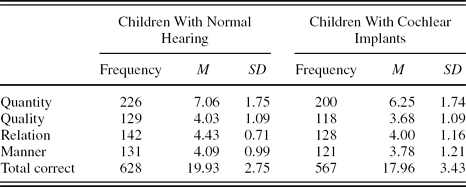
Because two children with CIs did not complete the CVT, they were excluded from the analysis, which is therefore based on the responses of 31 children with CIs and 31 matched NH children. We obtained 775 responses for each group. Frequencies, means, and standard deviations for each maxim are reported in Table 4. Means are calculated by dividing the number of responses in a given category produced by all children over the total number of children. Recall that there were 10 total responses for the maxim of quantity and 5 for each of the other maxims. Children with CIs produced fewer correct responses than did NH children. In addition, differences among maxims are evident in both groups. These findings are supported by the statistical analysis. As we said earlier, to control for strategic effect, the items were presented in two lists with different random orders; “type of list” refers therefore to the random list in which the experimental items were presented. As for the variable “type of maxim,” it refers to the maxim investigated in each item (e.g., quantity, quality, relation, and manner).
Frequencies, means and standard deviations of correct responses for each maxim by children with normal hearing and children with cochlear implants.
Note: The maximum number is 10 for the quantity maxim and 5 for the other maxims.
We found a significant effect of group, showing that NH children were more accurate than children with CIs overall (Wald Z = 2.54, p < .01). Thus, group appeared to be a significant predictor of performance in the CVT, χ2 (1) = 6.09, p < .01, whereas type of list, χ2 (1) = 0.08, p = .76, did not. We found a main effect of type of maxim (Wald Z = 3.43, p < .001). There were significantly fewer correct responses to items concerning the maxim of quantity as compared to items regarding the maxim of quality (Wald Z = 2.82, p < .01), relation (Wald Z = 4.51, p < .001), or manner (Wald Z = 2.71, p < .001). To examine the response distribution of children with CIs, we transformed raw scores into z scores with respect to the mean and standard deviation of their group. Only one participant showed a z score of –3. All the other children exhibited a z score above –1.4.
Age of implantation, χ2 (1) = 1.96, p > .05, did not significantly predict accuracy, but age of diagnosis marginally contributed to the fit of the model, χ2 (1) = 3.59, p = .058, and was a significant predictor of accuracy (Wald Z = –1.96, p < .05), with children diagnosed later being less accurate than those with an earlier diagnosis.
DISCUSSION
This study investigated the language performance of a group of prelingually deaf children in a variety of areas, ranging from phonology to lexicon, morphosyntax, syntax, and pragmatics. The three aims of the study were (a) finding out whether children with CIs are more proficient in some linguistic areas than in others; (b) examining language acquisition by children with CIs in Italian, a language typologically different from English; and (c) examining the effects of age of implantation and age of diagnosis in the language areas examined.
Although individual variations are observed both in children with CIs and in NH children, this was not the focus of our study and is not further discussed.
Proficiency across different linguistic areas
As expected, children with CIs performed less proficiently on average than their chronological age peers, but some linguistic areas proved more taxing than others. In particular, while lexical, pragmatic, and phonological knowledge do not show severe delay, some areas of morphosyntax seem to be particularly taxing for children with CIs. These children were 15 and 11 months behind NH children on grammar (the TCGB) and vocabulary comprehension (the PPVT), respectively. On the clitic task, children with CIs produced the same raw number of clitics as the 3-year-old Italian-speaking NH children in Schaeffer's (Reference Schaeffer2000) study. In other words, children with CIs are 2 years behind NH children, and this suggests that clitic production is a particularly taxing area for them. This is not surprising because clitic production is also difficult for NH children, who perform at an adultlike level only by the age of 4;6 (Schaeffer, Reference Schaeffer2000), L2 learners (Leonini & Belletti, Reference Leonini, Belletti, Kampen and Baauw2003), and children with SLIs (Bortolini et al., Reference Bortolini, Arfé, Caselli, Degasperi, Deevy and Leonard2006). Children with CIs also produced obligatory past participle agreement less frequently than did NH controls, and at a similar frequency to the 3- to 4-year-old NH children in Moscati and Tedeschi (Reference Moscati and Tedeschi2009). Like some younger children, they failed to provide agreement consistently, using the default masculine form instead. The failure to use past participle agreement was more evident when the clitic was expressed (76% of past participle agreement errors), meaning that the children with CIs (like younger children) could already use clitics but did not master all the grammatical consequences of their use. Finally, in contrast to previous literature, in nonword repetition (the PRCR-2) the performance of children with CIs did not differ from that of NH children. Thus, nonword repetition stands out as an area of strength for Italian children with CIs. If nonword repetition taps into phonological knowledge, this is an area of relative strength.
As for pragmatic competence in the CVT, children with CIs obtained slightly lower scores overall than did NH children, but both groups responded less accurately to the quantity maxim than to the other maxims (a finding also reported in Siegal et al., Reference Siegal, Iozzi and Surian2009, for monolingual and bilingual NH children).
Although children with CIs were weaker than chronologically age-matched NH children, they performed adequately on the various linguistic tests when their age was measured in terms of length of CI use and not in terms of chronological age. Moreover, they seem to follow the same pattern of development as controls although their development is delayed. This was evident in the types of errors produced and in the pattern of development. In clitic production, omission was the prevalent error, as in younger NH children. Failure to produce past participle agreement is also present in younger NH children. Similarly, in typical development, a correlation is also found between scores on receptive vocabulary and those on the test for grammatical comprehension (Bates, Dale, and Thal, Reference Bates, Dale, Thal, Fletcher and MacWhinney1995). This finding suggests that children with CIs and NH children use similar mechanisms of acquisition. Children with CIs and control children behaved similarly on the three standardized tests.
Language acquisition in Italian-speaking children with CIs and the cross-linguistic perspective
A comparison of our results with other studies concerning children with CIs who speak other languages underlines the relevance of the cross-linguistic dimension in language acquisition. Children with CIs acquiring Italian seem to differ in nonword repetition from children with CIs acquiring English. In previous studies, children with CIs were shown to be impaired on nonword repetition (Burkholder & Pisoni, Reference Burkholder-Juhasz and Pisoni2003; Dillon et al., Reference Dillon, Burkholder, Cleary and Pisoni2004), having a narrower verbal span than NH children. As outlined in the Introduction, we emphasized the possible impact of cross-linguistic differences on the course of language acquisition by children with CIs. Our results on nonword repetition can be due to these differences. As discussed earlier, the Italian and English phonological systems are quite distinct in at least three ways. First, vocalic sounds in Italian do not undergo vowel reduction and are clearly audible. Second, consonant clusters are scarce in Italian and generally consist of no more than two consonants when they do occur. Third, the rhythmic structure of Italian words is quite regular because the most frequent syllable has a consonant–vowel structure. Thus, these aspects may have fostered the ability of children with CIs to repeat nonwords. Future research on languages with a phonological system similar to Italian (e.g., Spanish) may confirm our hypothesis. On the basis of our results on nonword repetition, we conjecture that the features of Italian phonology may make encoding, storing, and long-term learning of new words easier, and this may free resources for more complex tasks, such as those involved in comprehending sentences. Nonword repetition correlated with sentence comprehension in this study, as measured through the TGCB. This outcome suggests that phonological short-term memory, as assessed by nonword repetition, plays a role in the development of grammar in children with CIs, as it does in other populations, and future research should investigate this issue (see also Dillon et al., Reference Dillon, Burkholder, Cleary and Pisoni2004; Montgomery, Reference Montgomery1995). The hypothesis that phonological short-term memory mediates the acquisition of syntactic knowledge has been suggested because children who performed well on memory tasks produced a wider range of syntactic structures than children who performed poorly on them (see Baddeley, Gathercole, & Papagno, Reference Baddeley, Gathercole and Papagno1998, for a review). We did not assess verbal span, and thus we cannot verify whether span and nonword repetition correlate or whether children with CIs have a narrower span than do NH children, as found in other studies (see, e.g., Burkholder-Juhasz et al., Reference Burkholder-Juhasz, Levi, Dillon and Pisoni2007). These questions in languages other than English need further investigation. Burkholder-Juhasz et al. (Reference Burkholder-Juhasz, Levi, Dillon and Pisoni2007) proposed that English-speaking children with CIs have a narrower span than NH children because of inefficient subvocal rehearsal and slower scanning for heard items. If these two processes are independent from the specific language learned, we would expect that Italian children with CIs would also have a narrower span than do NH children. However, it is possible that subvocal rehearsal is less demanding in a language with a simpler phonology, and this may have an impact on the span of Italian children with CIs. Thus, there is evidence that the performance of children with CIs may vary as a function of the language of exposure, as mentioned in the Introduction (Herzberg et al., Reference Herzberg, Ravid, Nir and Gillis2010; see also Hammer, Reference Hammer2010).
Another area in which cross-linguistic variation is important is the richness of the morphological information in a language. A direct comparison between the performance of Italian-speaking children with CIs and the performance of children with CIs exposed to other languages cannot be made because we tested aspects of Italian morphosyntax, which are not present in other languages. However, the findings regarding nominal and verbal inflections from the test for comprehension of grammar, as well as those regarding past participle agreement from the test of clitic production, suggest a general comment. Although Italian-speaking children with CIs performed at a lower level than NH controls, they were sensitive to nominal and verbal inflections, and their delay (15 months) equals the length of time before they benefitted from hearing. Thus, although some morphosyntactic aspects (nominal and verbal inflections) of Italian are delayed, their acquisition is probably quicker than in poorly inflected languages or languages with sparse morphology, such as English (in which, for example, only the third person of the present tense is marked with the inflectional morpheme –s, in contrast to Italian, in which all persons are marked with a distinct morpheme). Thus, our result is reminiscent of the findings mentioned in the introductory section, which is that the verbal paradigm is acquired more rapidly by Hebrew-speaking children with CIs (a language with a rich morphology) than by their peers who speak Dutch (a language with a sparse morphology; Herzberg et al., Reference Herzberg, Ravid, Nir and Gillis2010). If confirmed by further research, this less than obvious result would suggest that the richness of the morphological system can be beneficial rather than taxing for children with CIs. We speculate that the reason is that all nouns and verbs bear morphological affixes and are consistently present in the input provided to children.
Effects of age of implantation and diagnosis
There were few effects of age of implantation. However, they did predict the accuracy in clitic production. The lack of further effects of age of implantation may be because the majority of children were homogeneous in terms of age of implantation, because they were mostly implanted before age 3 (22 before age 2, 8 before age 3, 2 before age 4, and 1 at 4;7). As mentioned in the introductory section, different age-of-implantation effects are reported in the literature, and we suggested that they depended on the specific task and on the language component investigated. In this study, many of the areas of language investigated did not show age of implantation effects. This is not surprising in light of previous findings in the literature, where different ages of implantation effects were found between children implanted before 3 or 4 years and children implanted after 4 years. For example, Manrique et al. (Reference Manrique, Cervera-Paz, Huarte and Molina2004a, Reference Manrique, Cervera-Paz, Huarte and Molina2004b) reported that children implanted before 5–6 years achieved higher scores on speech perception tests, the PPVT, and Reynell Developmental Language Scales (Reynell, Reference Reynell1977) than children implanted after this age (see also Tye-Murray et al., Reference Tye-Murray, Spencer and Woodworth1995, for similar age effects based on speech perception tests). Nikolopoulos et al. (Reference Nikolopoulos, Dyar, Archbold and O'Donoghue2004) have shown that on the Test of Reception of Grammar (a test for grammar comprehension similar to our TCGB), children who received CIs before the age of 4 outperformed those receiving their CIs after 4 years (see also Pisoni & Remez, Reference Pisoni and Remez2005). Thus, the critical age in these studies is between 4 and 5, while most of our children were implanted at a younger age. Clitic production (a very peculiar aspect of Italian and Romance languages in general) is unique in that the age of implantation already has an effect in children implanted between the ages of 1 and 3 years. In the Introduction, we discussed studies on L2 acquisition showing that different sensitive periods are evident depending on linguistic ability. The result of an age of implantation effect exclusive to the production of clitics is in line with this perspective. Future studies are required to uncover additional differential effects of this variable. As for age of diagnosis, we only found a marginal effect on the CVT. However, the same caveat applies as with the absence of a strong effect of age of implantation. Children with CIs in our study were diagnosed relatively early. An effect of age of diagnosis is likely to be found for subjects with delayed diagnoses.
Two final considerations deserve discussion, although they were not the focus of our study. We examined the linguistic performance of a group of children who underwent the same rehabilitation program before and after the CI. To our knowledge, this is exceptional in Italy because children implanted in other centers are treated by different speech therapists and follow different rehabilitation programs. We believe that homogeneity in the rehabilitation programs before and after implantation may have impacted our results, and more generally, differences in rehabilitation programs may contribute to variability in outcomes, an issue that will need further investigation.
Finally, failure to produce clitics is a clinical marker of an SLI in Italian (Bortolini et al., Reference Bortolini, Arfé, Caselli, Degasperi, Deevy and Leonard2006). Typically, Italian-speaking SLI children are weaker not only in the production of clitics but also in the repetition of nonwords (Bortolini et al., Reference Bortolini, Arfé, Caselli, Degasperi, Deevy and Leonard2006). Thus, on the basis of our findings, we suggest that the combination of clitic production and nonword repetition (in which NH children and children with CIs did not differ) may prove useful in Italian in identifying those implanted children who have SLIs (see Hammer, Reference Hammer2010, for a study comparing children with CIs and those with SLIs). We have already discussed that age of implantation predicts accuracy in clitic production. This means that when evaluating the possibility of language disorders in children with CIs, age of implantation has to be considered. Children implanted at later ages may show problems in clitic production, not because they are at risk for language disorders, but because of their late age of implantation.
In summary, we examined the linguistic abilities of Italian-speaking children with CIs by means of tasks assessing various areas of language: phonology, lexicon, morphosyntax, syntax, semantics, and pragmatics. Although children with CIs obtained lower scores than their NH peers in a number of areas, their linguistic behavior followed the same trend as in NH children, suggesting that early implantation is compatible with a developmental pattern similar to that of NH children, at least in the abilities we examined and when children are implanted by 4 years of age. We also showed that in Italian some areas are less taxing than others. Finally, age of implantation only affected clitic production, suggesting that this area needs special consideration in later implanted children and to help detect language disorders in children with CIs.
ACKNOWLEDGMENTS
This research was supported by a grant from the Fondazione Audiologica Varese to Costanza Papagno, a PRIN grant (to M.T.G.), and a FIRB 2006 grant (to M.T.G.). We thank Carlo Geraci, Chiara Branchini, and Nella Biressi for discussions with us and for helping in various stages of the research.