Introduction
Paragonimiasis (lung fluke disease) is a Neglected Tropical Disease that is found primarily in tropical, subtropical and temperate countries around the world (WHO, 2010). The disease is caused by infection with the trematode Paragonimus. The flukes develop to maturity in the lungs of mammals (including humans) that eat raw or undercooked freshwater decapods, usually brachyuran crabs, which are infected with the larval stages of the fluke. At least 10 species of Paragonimus are pathogenic to humans including four West and Central African species: P. africanus, P. gondwanensis, P. kerberti and P. uterobilateralis (Table 1). The exact prevalence of human paragonimiasis throughout the world, however, is vague (Marty and Neafie, Reference Marty, Neafie, Myers, Neafie, Marty and Wear2000). For example, the World Health Organization (WHO, 1995) estimated that some 20 million people in Asia, the Americas and Africa may be exposed to, or may be at risk of contracting the disease. Paragonimiasis is regarded as a debilitating disease that causes morbidity capable of delaying socio-economic development and needs to be recognized as an emerging public health problem.
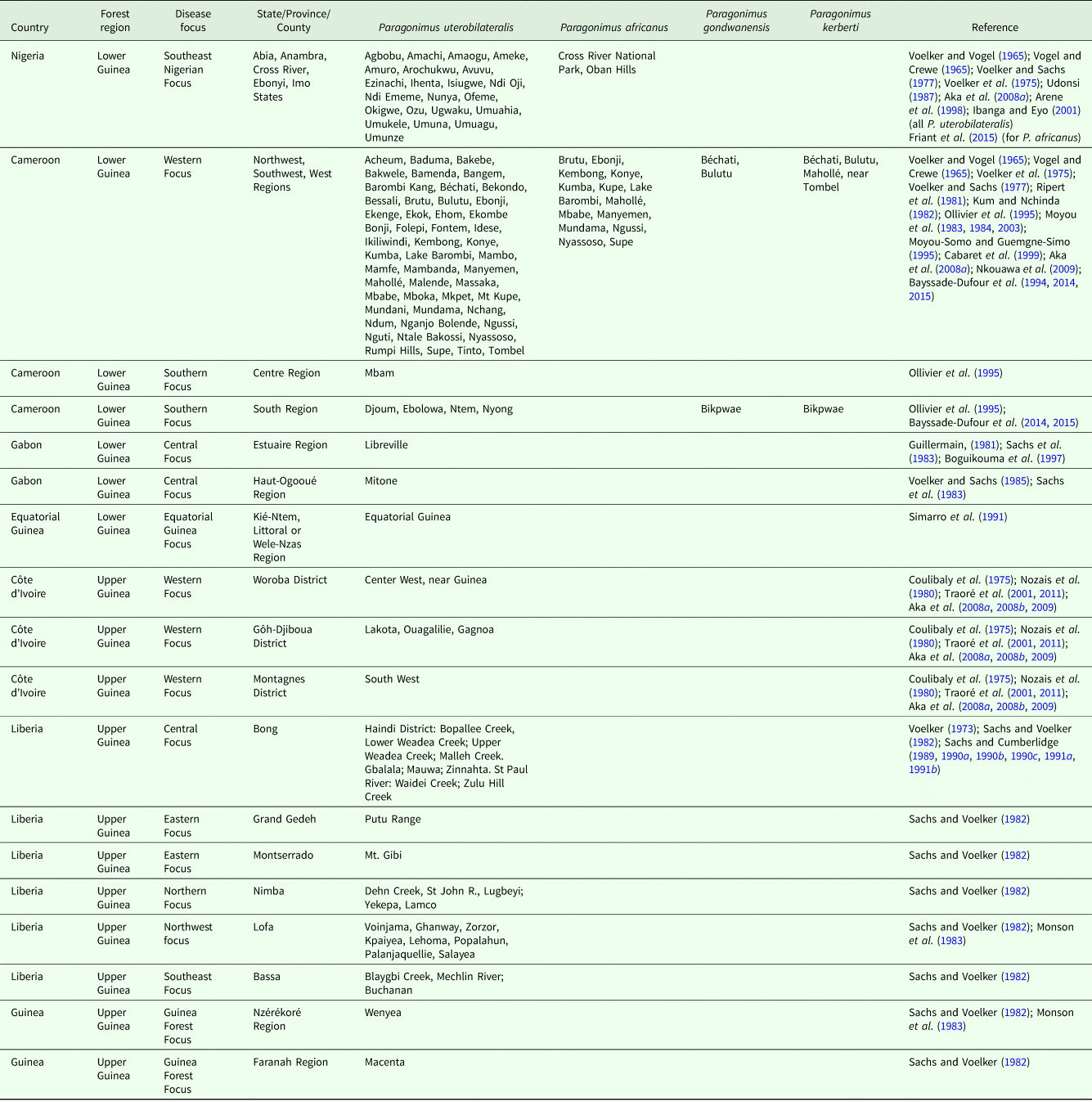
Confirmed localities in the seven countries in the Upper and Lower Guinea Forests of Africa where species of Paragonimus have been identified either from parasite eggs in sputum or faecal samples, from metacercariae recovered from crab second intermediate hosts, or from adult parasites recovered from the lungs of mammal hosts

Reports of Paragonimus spp. from other African countries (summarized in Aka et al., Reference Aka, Assoumou, Adoubryn, Djino, Domoua, Ouhon, Kouassi, Rondelaud and Dreyfuss2009) have not been included here because of doubts about the identification of the parasite in those records. Paragonimus uterobilateralis and P. africanus were recovered together from the same crab host in three localities in Cameroon (Brutu, Kembong and Supe); P. uterobilateralis, P. gondwanensi and P. kerberti were all recovered from crab hosts at the same two sites in Cameroon (Béchati and Bulutu); and P. uterobilateralis, P. africanus and P. kerberti were recovered from crab hosts at the same two sites in Cameroon (Bulutu and Mahollé).
Paragonimiasis is common in parts of Asia due to the culture of pickling or eating raw or uncooked freshwater crabs. In Africa however, food-borne trematodiases are rarely found because of the tradition of cooking most foods thoroughly, a process which kills the infective metacercariae (Traoré et al., Reference Traoré, Odermatt, Bonfoh, Utzinger, Aka, Adoubryn, Assoumou, Dreyfuss and Koussémon2011). Furthermore, in Asia both adults and children suffer from the disease whereas in Africa, children are the main victims of pulmonary paragonimiasis possibly because they often snack on raw uncooked food such as freshwater crabs (Moyou-Somo et al., Reference Moyou-Somo, Enyong, Kouamouo, Dinga, Couprie and Ripert1983, Reference Moyou-Somo, Enyong and Kouamouo1984, Reference Moyou-Somo, Kefie-Arreym, Dreyfuss and Dumas2003; Sachs et al., Reference Sachs, Albiez and Voelker1986; Sachs and Cumberlidge, Reference Sachs and Cumberlidge1990b). The prevalence of paragonimiasis in Africa however, remains unclear with little research focus since the first discovery of this disease in the 1960s (Voelker and Vogel, Reference Voelker and Vogel1965).
Endemic foci of human paragonimiasis have been reported mainly in the forests of Lower Guinea (Nigeria, Cameroon, Equatorial Guinea and Gabon) and Upper Guinea (Liberia, Guinea and Ivory Coast); see Table 1. There are no recent data, but up to 2008 it is estimated that there have been 2,295 confirmed cases of paragonimiasis in Africa, with the vast majority of these occurring in Nigeria and Cameroon (Aka et al., Reference Aka, Adoubryn, Rondelaud and Dreyfuss2008a). This review focuses on the current understanding of the life cycle and transmission of Paragonimus in Africa, discusses its diagnosis and public health importance and highlights the many gaps in knowledge that still exist.
Paragonimus life cycle
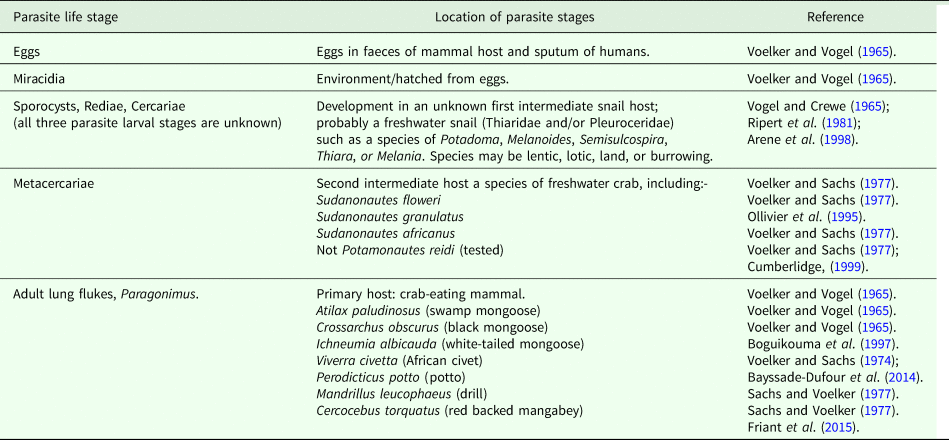
Paragonimus westermani is the most well-known etiologic agent of Asian paragonimiasis (and the most prevalent of the lung fluke diseases globally) and its life cycle and intermediate hosts are well understood. However, although two of the agents of African paragonimiasis (P. uterobilateralis and P. africanus) have been known for over 50 years, it remains the only human parasitic disease whose causative species each have an incompletely resolved life cycle and an undescribed first intermediate host. Freshwater crabs were identified as the second intermediate host of P. africanus and P. uterobilateralis in Cameroon at the same time as the disease was first described (Voelker and Vogel, Reference Voelker and Vogel1965), but the historically unstable taxonomy of these crustaceans means that there is still some confusion surrounding the exact identity of the species that served this role (Aka et al., Reference Aka, Adoubryn, Rondelaud and Dreyfuss2008a). The lack of knowledge of the snail hosts involved in the transmission means that the rediae, sporocysts and cercariae of African Paragonimus are undescribed and that the precise modes of transmission between hosts are unknown.
Final host (mammal)
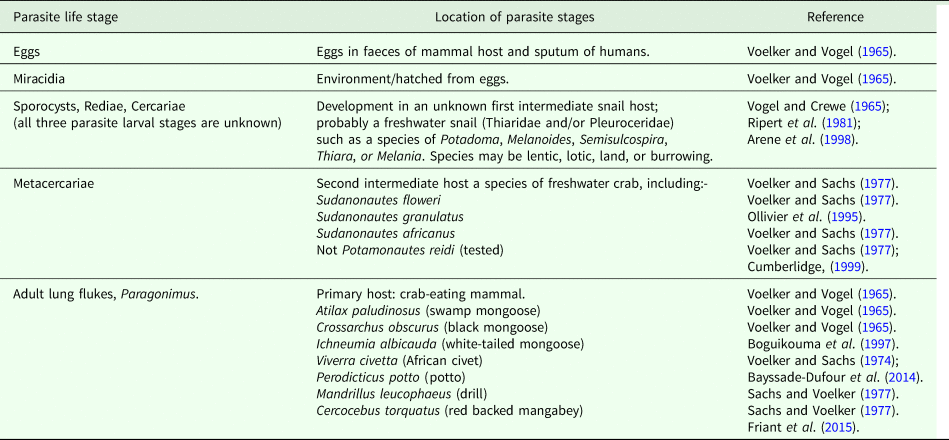
Paragonimus is a euryxenous parasite with numerous mammalian reservoir hosts (Table 2) that contract the disease following consumption of freshwater crabs infected with advanced metacercarial larval stages of the parasite. The metacercaria is the only stage of the parasite life cycle that is infective to the final mammalian host. Metacercaria develop in large numbers inside freshwater crabs where the parasite larvae encyst in the muscles, gills (Sachs and Cumberlidge, Reference Sachs and Cumberlidge1990b) and/or hepatopancreas (Brenes et al., Reference Brenes, Hangen and Duarte1984). Parasites inside the infected crabs are inactive and remain in the crab host for many years. In Africa, ingestion of crabs by the mammalian host frees larvae from the cysts that can then migrate through the wall of the duodenum to the peritoneal space before passing through the diaphragm in search of the lungs, where they settle and develop into adult flukes within 6–10 weeks (Waikagul et al., Reference Waikagul, Yaemput and Visiassuk1986). Humans with adult Paragonimus worms established in their lungs exhibit a severe respiratory pathology detectable as haemoptysis (coughing up blood) that contains Paragonimus eggs. If the migrating flukes miss the lungs they can end up in the brain or spinal cord and establish ectopic infections that cause symptoms of meningitis and even the death of the host (Blair et al., Reference Blair, Agatsuma, Wang, Murrell and Fried2008). Adult trematode worms can also ectopically locate to other organs in their mammalian hosts including the liver, muscle, skin and testes, from where their eggs cannot be released outside the body. Normally, pairs of adult trematodes become established in the lungs where they cross-fertilize and begin to produce eggs ca. 30 days after the initial infection. Lung damage is caused by egg-producing adult flukes lodged in the lungs (Fürst et al., Reference Fürst, Duthaler, Sripa, Utzinger and Keiser2012) and without treatment, they remain encysted in the lungs of their host for years (Sachs and Voelker, Reference Sachs and Voelker1977; Calvopiña et al., Reference Calvopiña, Romero, Casteñeda, Hashiguchi and Sugiyama2014), producing thousands of eggs that are released periodically when the lung cysts burst, causing bleeding and stimulating coughing. These eggs may either be coughed up and spat out as bloodstained sputum or can be swallowed and subsequently passed out of the body in the faeces of the infected individual (Despommier et al., Reference Despommier, Gwadz, Hotez and Knirsch2000).
Life cycle stages of Paragonimus uterobilateralis and P. africanus in Cameroon and Nigeria, with location of each parasite stage
First intermediate host (snail)
Once out of the primary host, the lung fluke eggs require wet conditions where miracidia either hatch and then penetrate the first intermediate host, or the mollusc becomes infected by possibly consuming the eggs. After several weeks (Keiser and Utzinger, Reference Keiser and Utzinger2009) the host snail then releases cercariae into the watershed and these, in turn, penetrate the second intermediate host, a decapod crustacean.
There are a number of issues raised by the two diagrams depicting the life cycle and hosts of Paragonimus by Noble et al. (Reference Noble, Noble, Schad and MacInnes1989; Fig. 1) and the Center for Disease Control and Prevention (CDC; www.cdc.gov/parasites/paragonimus/biology.html) which relate to the better understood Asian situation. Both diagrams suggest that Paragonimus cercariae are released by a species of aquatic snail into a freshwater habitat where they infect a decapod crustacean that populates the same catchment. In Africa it has been assumed that the snails involved in transmission are fully aquatic species, rather than semi-terrestrial species that inhabit the moist conditions of the tropical forest floor. The latter hypothesis is supported by the morphology of the cercariae which are microcercous (short-tailed) rather than long-tailed (typical of actively swimming cercariae such as those of Schistosoma spp.). The short stub-like tail of Paragonimus cercariae implies that they move by looping and crawling and that once released from their snail host they somehow find and infect the second intermediate host directly despite their limited locomotory capacity. Although the direct mechanism of penetration is unknown, infection by the cercariae of crabs may occur via entry into the branchial (gill) chamber followed by penetration of the gills, or by passing into the alimentary canal via the crab's mouth or the anus. Alternatively, the cercariae may remain inside the snail until the infected mollusc is eaten by a crab (Fig. 2), but this requires clarification.
Life cycle of Paragonimus westermani.

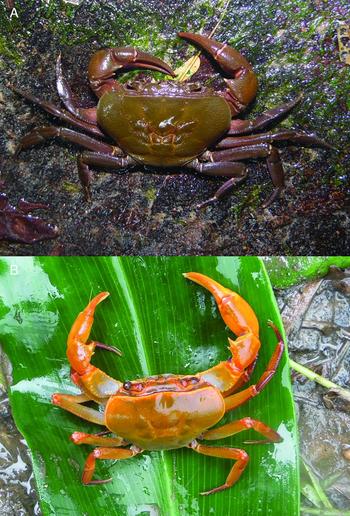
These two species of freshwater crab from Cameroon are known to be the second intermediate hosts of Paragonimus: (a) Sudanonautes africanus; (b) S. floweri. Photographs kindly provided by Pierre A. Mvogo Ndongo.

The search for the first intermediate host of Paragonimus in Africa (and the parasite larval stages that develop there) has mainly focused on aquatic species of snails found at identified foci of the disease; but such investigations have not been successful (Voelker and Vogel, Reference Voelker and Vogel1965; Mouyo-Somo et al., Reference Moyou-Somo, Enyong and Kouamouo1984; Sachs and Cumberlidge, Reference Sachs and Cumberlidge1989, Reference Sachs and Cumberlidge1990a). The non-swimming morphology of the typical Paragonimus spp. cercaria suggests that it would be reasonable to broaden the search for this missing stage beyond the aquatic environment to include adjacent land where semi-terrestrial/terrestrial snail species such as Homorus (Striasubulina) striatella are found (Sachs and Cumberlidge, Reference Sachs and Cumberlidge1989, Reference Sachs and Cumberlidge1991a; Moyou-Somo and Guemgne-Simo, Reference Moyou-Somo and Guemgne-Simo1995).
In Asia, laboratory experiments with snail hosts of Paragonimus collected from streams at foci of paragonimiasis demonstrated that under these conditions the fully developed cercariae are released from the snails into the surrounding water. It has long been assumed that this model also applies to the transmission of the parasite between hosts in the African species of Paragonimus. This is reasonable given that transmission of the stages of Paragonimus between its various hosts takes place in (or close to) freshwater streams and catchments draining the moist tropical forests in African foci of the disease in Guinea, Liberia, Cote d'Ivoire, Nigeria, Cameroon, Equatorial Guinea and Gabon.
Second intermediate host (crab)
There is also an issue with the depiction of the crustacean second intermediate host in the CDC diagram because it appears to show either a shrimp or prawn, presumably a freshwater species. There are, however, few records of carideans serving as hosts of Paragonimus and all of these are from Asia (Sanford et al., Reference Sanford, Jong and Pottinger2016) with none from Africa. It should be noted that in the USA (a country that completely lacks any species of primary freshwater crabs) species of Orconectes crayfish serve as the second intermediate host of P. kellikotti (Lane et al., Reference Lane, Barsanti, Santos, Yeun, Lubner and Weil2009). In nearly all the life cycles so far elucidated worldwide, and in all African instances, the crustacean second intermediate host of Paragonimus infecting humans is a species of freshwater crab. Freshwater crabs dominate tropical and subtropical freshwater systems throughout Africa, the Neotropics and Asia, and most species (including all known hosts of Paragonimus in Africa) live and feed in streams, rivers and on adjacent land, where they consume both plant and animal matter, either dead or alive (Yeo et al., Reference Yeo, Ng, Cumberlidge, Magalhaes, Daniels, Campos, Balian, Lévequè, Segers and Martens2008).
The figure of the ‘Life cycle of Paragonimus westermani’ by Noble et al. (Reference Noble, Noble, Schad and MacInnes1989; Fig. 1) shows a Chinese mitten crab, Eriochier sinensis, as the second intermediate host in Asia. Mitten crabs are catadromous, they live most of their lives in freshwater habitats but must return to higher salinity estuarine waters to breed. In Asia, mitten crabs are considered to be a delicacy and are captured in large numbers during their autumnal migration downstream. Potamid and gecarcinucid crabs are also highly abundant in Asian freshwaters and are consumed widely (though considered to be less of a delicacy than mitten crabs), and are by far the most likely second intermediate host of Paragonimus in Asia. In the UK, E. sinensis is an invasive species that is well established in the River Thames, London and has been studied extensively (Mills et al., Reference Mills, Clark and Morritt2016). In the laboratory, mitten crabs when underwater feed on a local species of mollusc (Radix peregra) from the River Thames (https://nhm.box.com/s/4i12xordg20x7cp5l1iulqihav0jale6 courtesy Chris Mills; Mills et al., Reference Mills, Clark and Morritt2016). These laboratory observations suggest that mitten crabs in their natural environment could become infected with Paragonimus cercariae when they eat freshwater snails, although it is still possible that crabs could become infected by cercariae released from snails that then actively seek out crabs. Similarly, field observations of primary freshwater crabs at active foci of paragonimiasis in Africa indicate that potamonautids found naturally infected are most active at night when they feed on land as well as in water and that snails are part of their diet. This supports hypotheses that these crabs could become infected by consuming infected snails, but still leaves open the question of whether transmission of the parasite from snail to crab takes place in water and involves a fully aquatic snail species, or whether it can take place on land and involves a land-living or semi-aquatic species of snail.
Paragonimus spp. in Africa appear to not be specific in their choice of crustacean second intermediate host. For example, four species of Liberonautes and three species of Sudanonautes have been shown to host Paragonimus in Nigeria, Cameroon and Liberia (Voelker and Sachs, Reference Voelker and Sachs1977; Sachs and Cumberlidge, Reference Sachs and Cumberlidge1990Reference Sachs and Cumberlidgeb, Reference Sachs and Cumberlidge1990c, Reference Sachs and Cumberlidge1991b; Ollivier et al., Reference Ollivier, Boussinesq, Albare, Cumberlidge, Farhati, Chippaux and Bayssade-Dufour1995; Cumberlidge, Reference Cumberlidge1999). These crabs are also abundant in highly active foci of the disease in Nigeria and Cameroon, with high prevalence rates and intensities of infection (up to 80% of crabs infected, averaging 100 metacercariae per crab; Voelker and Sachs, Reference Voelker and Sachs1977; Sachs et al., Reference Sachs, Albiez and Voelker1986). Perhaps not surprisingly, freshwater crabs have therefore been involved in the discovery of much of what is known about the larval stages of the parasite and foci of the disease. The foci of the disease can be identified by overlapping the distributions of freshwater crabs infected with metacercariae of Paragonimus spp. with a range of infected humans and/or mammal hosts.
Unresolved questions remain in tropical Africa
(1) Do Paragonimus miracidia hatch from eggs expelled by their mammalian hosts into an aquatic environment and then actively infect an aquatic snail, or do the miracidia remain inside the expelled eggs and then passively infect their host when they are eaten by an aquatic or semi-aquatic snail?
(2) Do Paragonimus cercariae actively infect a freshwater crab host following their expulsion from an aquatic snail into an aquatic environment, or do the cercariae remain inside the snail host, and then passively infect the next host when they are eaten by a freshwater crab feeding either in water or on land?
Public health and diagnosis
The relatively recent discovery of lung fluke disease in Africa and the slow research response to its presence means that the human infection rate of paragonimiasis is likely underestimated and that its distributional range may be wider than is presently known. Furthermore, consumption of freshwater crabs is a relatively abundant source of cheap protein for tropical forest communities but has the potential for infection with lung fluke parasites if the infected crabs are not thoroughly cooked. In addition, mammals hosting adult parasites act as a natural reservoir that maintains the long-term transmission of the disease at endemic foci, with the associated high potential for the future re-emergence of the human disease. This makes regular monitoring for Paragonimus transmission at disease foci necessary.
Clinics and health centres in areas close to foci of paragonimiasis should be approached for data on human patients who may be suffering from this disease in order to understand its prevalence and to study the exact means of transmission of the parasite to the people who have eaten uncooked crabs. Compiling accurate numbers of patients affected by paragonimiasis from the literature and official registers of illnesses kept by the Ministries of Public Health is difficult (even in countries where the disease is endemic) because many cases of the disease may be undetected, unrecorded or misidentified. Indeed, it is not compulsory to report most parasitic diseases to public health authorities and therefore official reports are unlikely to reflect the true prevalence or incidence of disease occurrences (Aka et al., Reference Aka, Adoubryn, Rondelaud and Dreyfuss2008a). Furthermore, the relatively low number of records of paragonimiasis in countries such as Cameroon may reflect routine under-reporting and poor diagnosis.
A problem regarding the under-reporting of paragonimiasis arises from the fact that patients suffering from lung fluke disease experience a chronic cough, fever, and haemoptysis. The similarity of these symptoms to those of tuberculosis (TB) means that it is possible that cases of paragonimiasis may be misdiagnosed as TB (Luo et al., Reference Luo, Wang, Liu, Zhu, Yang, Liang and Liang2016; Morter et al., Reference Morter, Adetifa, Antonio, Touray, De Jong, Gower and Gehre2018), especially when the local health professionals are unfamiliar with the symptoms of paragonimiasis. Medical staff involved in the diagnosis and treatment of TB in areas where paragonimiasis is endemic should be informed about the similarity of the symptomatology and the geographical overlapping of these two diseases (Lane et al., Reference Lane, Barsanti, Santos, Yeun, Lubner and Weil2009). In areas potentially endemic for paragonimiasis administering a dose of praziquantel without a definitive diagnosis to suspect TB cases would be beneficial for those patients infected with paragonimiasis and could avoid a long, costly and in their case, ineffective TB treatment using antibiotics (Connolly et al., Reference Connolly, Edelstein and Ramakrishnan2007). Furthermore, it is important to examine cases of resistant TB that might have been misdiagnosed as paragonimiasis.
Local medical staff working in hospitals and health centres near foci of the disease in Africa need to update procedures for diagnosing paragonimiasis, including epidemiological, clinical, radiological and biological examinations (Volkmer and Braband, Reference Volkmer and Braband1975). In areas where laboratory facilities for DNA sequencing are not available, then an initial diagnosis of paragonimiasis can be undertaken by microscopic examination of sputum or stools, seeking the golden yellow operculated eggs of Paragonimus (Voelker et al., Reference Voelker, Sachs, Volkmer and Braband1975). In stools, it may be difficult to differentiate eggs of Paragonimus and Fasciola. Paragonimiasis can be diagnosed from chest radiographs showing ‘olympic rings’ in the lungs (Volkmer and Braband, Reference Volkmer and Braband1975) and by blood tests showing hypereosinophilia. Other tests for paragonimiasis such as antibody detection (ELISA or hemagglutination) are available in Asia but not yet in Africa (Aka et al., Reference Aka, Adoubryn, Rondelaud and Dreyfuss2008a). Patients that have a persistent cough including bloody sputum, or that are coughing up blood or bloodstained mucus (haemoptysis) may well have adult worms established in their lungs. These symptoms mean that paragonimiasis can often be initially misdiagnosed because a persistent cough and haemoptysis are also symptomatic of more prevalent diseases such as TB, bronchitis, pneumonia and lung cancer.
The differences between the diagnosis for TB and the diagnosis of lung fluke disease require emphasizing and the different treatments of these two lung diseases need to be highlighted (Traoré et al., Reference Traoré, Odermatt, Bonfoh, Utzinger, Aka, Adoubryn, Assoumou, Dreyfuss and Koussémon2011). This would also serve to clarify the infection rates of TB in areas where paragonimiasis is prevalent. The differences in the prevalence rates of TB and paragonimiasis are partly due to the method of infection and rate of development in the host (rapid for TB and slow for lung fluke disease) and partly due to the amount of research effort (high for TB, but low for lung fluke disease). There is, therefore, a requirement to clarify the infection rates of TB in areas where paragonimiasis is present by separating out the cases where patients suffering from lung fluke disease have been misdiagnosed and recorded as having TB. For example, only about 500 cases of human paragonimiasis have been reported in Cameroon since its discovery (Aka et al., Reference Aka, Tchamra, Fadiga and Yapi1995; WHO, 1995), whereas there were more than 26 500 cases of TB reported before 2014 (Noeske et al., Reference Noeske, Nana Yakam and Abena Foe2016).
Disease control methods
Control and treatment strategies for paragonimiasis in Asia and the Americas have been aimed at reducing further incidences of infection and at developing co-ordinated measures that break the transmission of the parasite so that the disease can eventually be eliminated. Modern approaches to the management of paragonimiasis have two main parts: drug treatment coupled with community education (because this disease can be prevented by avoiding the consumption of uncooked crabs in the first place).
Medication
Praziquantel has been used extensively in many countries in West Africa for preventive chemotherapy of schistosomiasis, usually by mass drug administration. The WHO recommendation for the treatment of the adult stages of Paragonimus in the lungs is to use doses of 25 mg kg−1 praziquantel 3 times a day for 2 days (Monson et al., Reference Monson, Koenig and Sachs1983; WHO, 2010). An overall cure rate of 94% was obtained in six studies of patients with infections of Paragonimus spp. who followed this treatment schedule (Keiser and Utzinger, Reference Keiser and Utzinger2005). The impact of wide-scale mass drug administration using praziquantel to control schistosomiasis may have had an unknown and beneficial impact on the prevalence of paragonimiasis. Triclabendazole has also been shown to be an effective treatment (Keiser et al., Reference Keiser, Engels, Büscher and Utzinger2005).
Education
The second approach to the control of paragonimiasis is an education programme in the form of public health messaging warning of the dangers of consuming undercooked or raw freshwater crabs. This typically involves the development of an educational program specifically tailored for villagers and townspeople living in tropical forest communities at disease foci.
It is important to note that edible marine crabs and many freshwater crustacean species are not implicated in the complex life cycle of paragonimiasis in Africa. Public health messages need to publicize the links between crab-eating mammals, freshwater crabs and freshwater snails, the dangers of eating certain species of freshwater crabs raw and the need to remove the faeces of wild mammals from near their households. This part of a public health programme includes the distribution of leaflets, posters, news items, lectures, media discussions and open access websites. Public education messaging in known foci of the disease aimed at warning about the dangers of eating uncooked or poorly cooked crabs would be a relatively low-cost approach to control the disease.
Future research
Life cycle
A contributing factor hampering lung fluke research is that the study of the complex life cycle of this parasite with its multiple hosts requires a team of researchers skilled in a number of different disciplines. Consequently, despite the importance of paragonimiasis, relatively little research has been undertaken since its discovery in Africa in the 1960s. This review of African paragonimiasis pays particular attention to the biodiversity-rich forested foci of the disease in Upper Guinea and Lower Guinea. Of particular interest are the foci in Nigeria and in the South and Southwest regions of Cameroon where endemic areas of paragonimiasis support all four African species of Paragonimus, three of which cause lung disease in humans (Nwokolo, Reference Nwokolo1974; Voelker and Sachs, Reference Voelker and Sachs1977; Bayssade-Dufour et al., Reference Bayssade-Dufour, Chermette, Šundić and Radujković2014). Reports of human cases of paragonimiasis occurring outside of the forest zones of West and Central Africa have failed to confirm the presence of the parasite in the savannah zone (Morter et al., Reference Morter, Adetifa, Antonio, Touray, De Jong, Gower and Gehre2018).
Paragonimus
Future research in Africa should focus on systematic surveys for the presence of Paragonimus spp. in humans, mammals, crabs and snails at foci of the disease. The most efficient method of surveying for Paragonimus spp. is to collect freshwater crabs from suitable habitats and to examine them for the presence of Paragonimus metacercariae. Once found, studies can then be broadened to include the search for infected snail and mammalian hosts. Baseline data for mapping the presence of Paragonimus spp. can be compiled by searching for the parasite in known disease foci and then extending the survey into adjacent regions of the rainforest where the ecological conditions favour the co-existence of the first, second and definitive hosts. Potential intermediate host species should be preserved and screened for infections. Faecal samples of crab-eating mammals in African foci (such as the civet and water mongoose, Table 2) should be examined in order to harvest Paragonimus spp. eggs for morphological and molecular analysis. Similarly, freshly collected parasite stages (metacercariae and cercariae) extracted from snail and crab intermediate hosts should be preserved in ethanol for molecular characterization.
Identification of parasites to the species level can be undertaken in the light of recent taxonomic advances, new discoveries and DNA technologies (Bayssade-Dufour et al., Reference Bayssade-Dufour, Chermette, Šundić and Radujković2014, Reference Bayssade-Dufour, Chermette, Šundić and Radujković2015; Friant et al., Reference Friant, Brown, Saari, Segel, Slezak and Goldberg2015). This could establish which species of snails, freshwater crabs and crab-eating mammals serve as hosts and help to clarify the life-history traits of this complex pathogen (Table 1). The availability of DNA sequence data now makes it possible to identify Paragonimus spp. from metacercariae or indeed from any part of the life cycle: eggs, larval stages and adult flukes (Bayssade-Dufour et al., Reference Bayssade-Dufour, Chermette, Šundić and Radujković2014, Reference Bayssade-Dufour, Chermette, Šundić and Radujković2015; Friant et al., Reference Friant, Brown, Saari, Segel, Slezak and Goldberg2015). Using molecular data to identify Paragonimus spp. is more accurate than past methods that relied on measurements of adult flukes, metacercariae and eggs recovered from sputum or faecal samples, due to parasite morphological plasticity (Voelker and Vogel, Reference Voelker and Vogel1965; Voelker, Reference Voelker1973; Voelker et al., Reference Voelker, Sachs, Volkmer and Braband1975). The availability of improved identification methods is especially important as new species have recently been discovered, suggesting there may be many more to find (Bayssade-Dufour et al., Reference Bayssade-Dufour, Chermette, Šundić and Radujković2014, Reference Bayssade-Dufour, Chermette, Šundić and Radujković2015; Friant et al., Reference Friant, Brown, Saari, Segel, Slezak and Goldberg2015).
Freshwater crabs
Freshwater crabs (Potamonautidae) are the only decapod crustaceans that have been linked to human lung fluke disease in Africa (see CDC; www.cdc.gov/parasites/paragonimus/biology.html), while the large, abundant and widely eaten West African freshwater prawns (e.g. Macrobrachium vollenhoveni) have never been found to be infected with Paragonimus and are not suspected to be a host (N. Cumberlidge, pers. comm., 2018). It is relevant to note that there are no native species of crayfish found in continental Africa, although invasive species of crayfish are becoming established in some parts of the continent (Foster and Harper, Reference Foster, Harper and Gherardi2007), but not yet in the areas where paragonimiasis is known to occur. If in the future invasive species of crayfish do become established in known foci of paragonimiasis, then these decapods too may need to be studied and screened in the long term. Examination of potamonautid freshwater crabs for Paragonimus metacercariae is perhaps the easiest method to locate the presence of the parasite at a locality. The species of freshwater crab and the Paragonimus sp. that it is infected with, can be established accurately by morphological and molecular analyses (Cumberlidge, Reference Cumberlidge1999; Daniels and Bayliss, Reference Daniels and Bayliss2012; Friant et al., Reference Friant, Brown, Saari, Segel, Slezak and Goldberg2015). This is essential for future research because a great deal of the literature on paragonimiasis in Cameroon, for example, is based on out-of-date morphological identification systems for both the freshwater crabs (species of Sudanonautes) and the parasites (species of Paragonimus; Voelker and Sachs, Reference Voelker and Sachs1977). The identification of the species of African freshwater crabs, known to host Paragonimus spp. in Africa was updated by Cumberlidge (Reference Cumberlidge1999) and that work remains the most modern account. Furthermore, in Cameroon, it is not known whether any of the species of the endemic freshwater crabs Potamonemus and Louisea (whose ranges overlap with that of the disease; Cumberlidge, Reference Cumberlidge1999) serve as hosts to the parasite as they have never been analysed. Therefore it is important to include all freshwater crab specimens found at disease foci in future epidemiological studies in order to better understand exactly which taxa may serve as second intermediate hosts of Paragonimus spp. in Cameroon.
Snails
The first intermediate host of Paragonimus in Africa and the parasite stages found within the host are also still unknown. Past efforts to discover the first intermediate host of Paragonimus in Africa were guided by comparisons with the well-established snail hosts of the disease in Asia and the Americas (Malek et al., Reference Malek, Brenes and Rojas1975), where the snail hosts are all fully aquatic species and the incidence of infection is extremely low (around 0.1‒1%). The examination of thousands of aquatic snails collected throughout the year from active foci of the disease in Cameroon and Liberia (Voelker and Sachs, Reference Voelker and Sachs1977; Sachs and Cumberlidge, Reference Sachs and Cumberlidge1989, Reference Sachs and Cumberlidge1991a) failed to find a single specimen that either contained or released the cercariae of Paragonimus spp. Therefore, the search for the first intermediate host in Africa needs to be broadened to include all species of snails collected in the vicinity of active foci of the disease (i.e. aquatic, semi-terrestrial and terrestrial species). Finding the snail first intermediate host may be difficult due to a combination of factors. These include the fact that the lung fluke larval stages may exhibit host specificity and may be restricted to a single species of snail and will likely occur at low prevalence, as has been observed for the hydrobiid snail Aroapyrgus costaricensis from Costa Rica that transmits Paragonimus mexicanus (Malek et al., Reference Malek, Brenes and Rojas1975).
Crab-eating mammals
Data on the species of mammals that serve as the final host of adult Paragonimus spp. (mongooses, civets, otters, primates and domestic dogs and cats) can be compiled by examination of the stools of suspected mammal hosts collected at disease foci. The presence of the eggs of Paragonimus spp. in the stool signals that the animal has adult flukes in its lungs. DNA analysis of parasite eggs is a non-invasive means of identifying the infecting species (Friant et al., Reference Friant, Brown, Saari, Segel, Slezak and Goldberg2015). In comparison, the removal of adult flukes from the lungs of a mammal host requires that the animal be sacrificed and this should only be performed when absolutely necessary (hopefully rarely). In addition, the definitive identification of the species of Paragonimus should be undertaken using both morphological and molecular analyses of adult lung flukes and eggs from selected infected specimens, helping to clarify host–parasite relationships.
Concluding remarks
A new comprehensive approach is needed to resolve uncertainties within the Paragonimus life cycle, and to provide realistic data on the true prevalence of paragonimiasis across West and Central Africa. The results would enable better-informed decisions on the diagnosis of paragonimiasis in patients, as well as guiding the formulation of appropriate treatment, control measures and future monitoring of paragonimiasis. There is also a need to change human behaviour regarding the consumption of raw freshwater crabs and to recommend where best to focus treatment and control measures. Further DNA sequencing of a large number of species of freshwater crabs and snails associated with paragonimiasis, together with the larval stages of the parasite, will undoubtedly pinpoint the many hosts involved in the complex life cycle and enable the molecular identification and transmission pathways of the different species of Paragonimus in Africa to be clarified.
Acknowledgements
We would like to thank Caren Erlichman, Senior Production Manager at Wolters Kluwer, Health/Lippincott Williams & Wilkins, for granting us permission to use the illustration of the Paragonimus westermani life cycle from Noble et al. (Reference Noble, Noble, Schad and MacInnes1989), Figure 10–24, p. 197.
Financial support
This research received no specific grant from any funding agency, commercial or not-for-profit sectors.
Conflict of interest
None.
Ethical standards
Not applicable.