Still in the early days of the dry Los Angeles summer, I left my shaded, equestrian neighborhood of Shadow Hills to drive south on the 710 with my sister and two neighbors. We were on our way to join the Compton Cowboys’ Peace Ride, a protest organized in support of the larger Black Lives Matter movement. It was around 12:30 p.m. on Sunday 7 June 2020, and we were running a little behind. Traffic slowed as we exited the freeway and pulled into the meeting point: a Home Depot parking lot at the back of Gateway Towne Center. Passing multiple rows of parked horse trailers, we grew quiet with anticipation. About one hundred people on horseback were in the store’s parking lot, corralling together until it was time to march. Many of them had ridden over from nearby Richland Farms while others had trailered their horses from equestrian communities like Sylmar, Altadena, and Topanga to take part in the Peace Ride. The majority of riders were African American with some Latinx and white riders as well. The dress was as varied as the breeds of horses: a distinct mix of cowboy hats, Gucci belts, plaid shirts, and Jordan kicks. Since I was not riding my horse, I wore my black cowboy boots, a denim shirt, and jeans to signal that I belonged to this group of horse people.
In the weeks leading up to the Peace Ride, a flyer had been shared widely on Instagram, inviting anyone in the Los Angeles area to join the march. The other protesters, who like me would be on foot, hovered on the sidelines, waiting for the spectacle to begin. When the Compton Cowboys came into view, we began whooping and hollering from the car. We slowed to let one of the Compton Cowboys move his horse diagonally across the street in a delicate cross-step as cameras clicked excitedly. After parking, we scrambled to join the rear of the group as it funneled out of the parking lot onto Greenleaf Boulevard.
The Peace Ride was organized, in part, as a response to the police brutality and systemic racism reverberating throughout the neighborhood of Compton and across the United States. It was also meant to challenge negative racial stereotypes and strengthen community in Compton. The Compton Cowboys are a collective of lifelong friends “on a mission to uplift their community through horseback and farming lifestyle, all the while highlighting the rich legacy of African-Americans in equine and western heritage” (Compton Cowboys 2020). In black shirts with “Compton Cowboys” printed in ornate white letters across the back, the group’s 10 riders led the procession down the boulevard. Equestrians from neighboring communities joined them, forming relaxed, regal rows. Protesters on foot bordered the procession of horses, spreading out along the sidewalks and between parked cars as photographers darted among the horses’ swishing tales. As we turned off Greenleaf Boulevard onto Tamarind Avenue, I marched alongside my sister and two neighbors, flanking a large brown horse with striking blue eyes.
Situated just south of downtown Los Angeles, Compton is one of the oldest neighborhoods in the city. With nearly 100,000 residents today, Compton is a thriving, predominantly African American and Latinx community (City of Compton n.d.). Despite a 70% drop in crime over the last two decades, Compton is still largely associated with its previously high murder rates of the 1980s and ’90s. In 1988, the influential rap group N.W.A put the city of Compton in the “national consciousness with the release of Straight Outta Compton, a chronicle of the life on the streets and fury aimed at the police” (Tse Reference Tse2015). What has remained outside of this national consciousness, however, is that Richland Farms, in the heart of urban Compton and where the stables are, has a rich agricultural and equestrian history (Thompson-Hernández Reference Thompson-Hernández2020:14). Back in the 1980s, the Compton Junior Posse was established here as an alternative for young people at risk of gang violence and other dangers of the street (26). Now those members are adults taking the program in vital new directions, evident in actions such as the Peace Ride. This ephemeral, site-specific event materialized the long legacy of Black men and women riders in the United States. These protest bodies on horseback imagine alternative futures for Black communities through embodied memory and a rewriting of the archive.
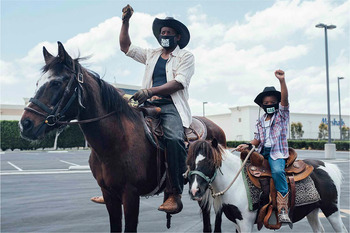
A cowboy marches beside a smaller cowboy and his pony. Compton, California, 7 June 2020. (Photo by Kemal Cilengir)

In the United States, the cowboy is a “uniquely American romantic hero immortalized in story and song” (Hardaway Reference Hardaway2001:27). The more familiar cowboy archive comprises old Hollywood films, literature, and other stories starring white cowboys. An IMDb search for Westerns in movies and TV shows results in 33,355 titles (IMDb 2020b). However, a search for Black Westerns in movies and TV shows calls up only 44 titles (IMDb 2020a). According to that archive, Black cowboys barely existed. Black cowboys have been so thoroughly written out of this cultural archive that it is difficult for many Americans to imagine Black men and women on horseback (Hardaway Reference Hardaway2001:27). The archive of documents, maps, and films shapes the history we come to remember and allows for “domination by ‘definition,’ by claims to originality and authenticity” (Taylor [2003] Reference Taylor2007:12). The historical erasure of Black cowboys from film and other archival forms has a lasting influence on American cultural imaginaries and shows the ways in which the archive sustains power for a society built on white supremacy. Through some of these same mechanisms, the United States government rewrites history, attempting to make invisible the past and present genocide of Native Americans by the settler state.
The Compton Cowboys’ presence in their community, and at the protest more specifically, pushes back against this dominant archive of the mythic American cowboy as white. Such ephemeral acts, in Diana Taylor’s words, “reconstitute themselves, transmitting communal memories, histories, and values from one group/generation to the next” ([2003] 2007:21). This more fluid repertoire is something that, through performance, gesture, or movement, can enact “embodied memory” (20). The Peace Ride can be looked at through this lens: as a live, embodied performance that materialized hidden histories of Black men and women on horseback. Randy Savvy, the leader of the Compton Cowboys, explained that for a long time Compton was largely farmland; horses are in the city’s DNA despite the impression created by popular culture that associates Compton only with its pioneering rap stars and gang activity. Reminding people of this history is one of the reasons Savvy rode out that day (Bermont and Carter Reference Bermont and Carter2020). The Compton Cowboys don’t just ascribe to one way of being a cowboy, as demonstrated by their range of attire. Rather, they creatively repurpose the stagnant cowboy narrative to fit their individual experiences and tastes, which are influenced both by contemporary Compton and their equestrian heritage.
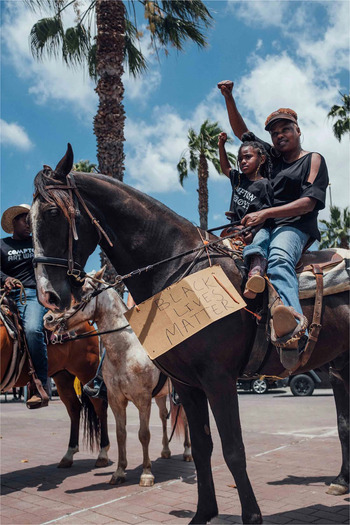
The procession continued along Tamarind Avenue to the sound of horses’ hooves against the pavement. I looked to my left and saw a rider stand up on the back of his horse’s saddle. The horse stood at a halt, seemingly unfazed as its rider took photos of the march from above. Just next to him a woman rode past on a tall, brown mare with her young granddaughter tucked on the saddle in front of her. The little girl, in a Compton Cowboys black T-shirt, waved to us as she went by. Around the arched neck of the horse hung a sign that read, “Black Lives Matter,” secured with some string. My own sign read, “Horse Girls for Black Lives,” written in thick marker. Just up ahead, I saw a man with a sign pinned to the back of his plaid button-down that read, “Racism Ain’t Cowboy.” Implicit in this message is the contestation of an archive that privileges a white cowboy history.
Fortunately, the archive is also changing. There is a small but growing area of historical inquiry chronicling African American presence on the Western frontier (Hardaway Reference Hardaway2001:27). There is evidence that by the late 19th century there were several thousand African Americans who were cowboys (Hardaway Reference Hardaway2001:27). Nat Love was one of the most famous Black cowboys, largely because in 1907 he wrote a memoir: The Life and Adventures of Nat Love Better Known in the Cattle Country as “Deadwood Dick” (28). This firsthand account of the life of one cowboy emphasized the necessity of “cooperation and camaraderie in the performance of work on the trails” (29). This important and notable collaboration between races at a time when that was unusual has been lost within a white-saturated tale of the lone, American hero. In her piece “On Horseback” in The Paris Review, Nell Painter, responding to the wave of protests against police brutality in June 2020, writes that history is being remade, “visualized in images of black men and women on horseback” (2020). This revisioning of the archive is inextricably linked to the larger fight against systemic racism in the United States.
A woman and her granddaughter pose with their fists in the air atop a towering horse. Compton, California, 7 June 2020. (Photo by Kemal Cilengir)

We continued through Compton, amidst the harsh heat of the afternoon sun. Three young men sitting in the back of a pickup truck, blasting rapper and Compton native Kendrick Lamar, passed out water to passing protesters. I was grateful when one of the guys tossed me a cold bottle. Although most of us were wearing masks — we were still in the first wave of the Covid-19 pandemic — everyone still passed around greetings and shared space gallantly. Other Black Lives Matter protests I had been to recently in downtown Los Angeles had felt discombobulated: all of us just bodies in the crowd, disconnected, our masks accentuating our anonymity. The presence of the National Guard at a prior BLM protest I had attended on 4 June 2020 in downtown Los Angeles made the atmosphere even more charged. In contrast, this Peace Ride was a community event. The march felt animated as members of the Compton Cowboys conversed with friends and onlookers alike. It seemed that most people already knew each other, and those who did not were brought into the fold to form one cohesive crowd. People were welcomed in through greetings, jokes, and considerate maneuvering between the horseback riders and protesters on foot. Kids and grandparents stood in front of their houses, some with signs and others cheering us on as we passed. Randy Savvy was livestreaming the march on Instagram and other observers amassed their own iPhone footage of the procession. Everywhere we looked there was imagery of Black power, community, and joy. It was as if nobody could stop documenting this day.
Where the traditional archive has often failed to represent Black histories accurately and the repertoire lives on only through bodily memory, social media documentation acts as a kind of unstable repository for a repertoire of ephemeral, lived acts. This form of documentation does not rely on official state record but, instead, is comprised of ambient content that is happening in real time, created by the people who are present. Social media repositories allow for aspects of these fleeting performances to be written into permanence, creating a lived archive of experience. The imagery gathered by those at the Peace Ride, celebrating Black power, resilience, and legacy, is creating regenerative representations of Black men and women in America today. These first-person narratives, mediated through Instagram or other platforms, are important fragments of a larger picture.
These personally documented narratives of lived experience have significance beyond the Peace Ride. Such archives have provided very real evidence of police brutality and systemic racism in the United States. Nationwide, mass protests (including the Peace Ride) were organized in the wake of the death of George Floyd, caught on viral video as Minneapolis police officer, Derek Chauvin, kept his knee pressed on Floyd’s neck for 8 minutes and 46 seconds (Bermont and Carter Reference Bermont and Carter2020). Citizen documentation like this is changing police and other official narratives by exposing the violence officers are perpetuating against Black and Brown people every day. These videos and photos, combined with police bodycam footage, will hopefully aid in holding officers accountable and lead to widespread policy changes. Digital platforms are crucial repositories for the storage and dissemination of footage that, when put in the hands of citizens, unsettles both historical and present-day official state narratives.
Although the documentation during the Peace Ride was thorough, there were still elusive aspects that escaped capture. Digital platforms could not transcribe the way in which the horses infused the space with bodily awareness, making both their riders and the protesters on foot more connected. The human-animal assembly was attuned both within the group and to the larger space around us. At one point in the parade, when we were momentarily held up at a red light, I noticed unsteady hoofbeats clacking nervously on the pavement about 20 feet behind me. A man was trying to calm his huge horse, which was beginning to panic. If the horse did spook, it might take off through the crowd, trampling anyone in the way. Instead, the horse reared up and the man fell off his perch, landing flat on his back on the pavement. There was a suspended moment when the horse was loose without its rider, unsure of what to do next. The air felt kinetic as my group moved closer to grab its reins in case it decided to run. Fortunately, another helpful bystander grabbed hold of the nervous animal, averting potential collision. The rider was fine if not a bit embarrassed. With all the music, chanting, and honking, the overall composure of the horses was a testament to the cohesion of the event.
Horses are prey animals, sensitive and reactionary; they require in this kind of situation attentive presence. The role of our bodies as we moved through the crowd was to negotiate the space between the horses with sensitivity. Judith Butler, in Notes Toward a Performative Theory of Assembly ([Reference Butler2015] 2018), deconstructs the politics of public assembly and the bodily aspect of demonstrations such as this one: “no one body establishes the space of appearance, but […] this performative exercise happens only ‘between’ bodies, in a space that constitutes the gap between my own body and another’s” ([2015] 2018:77). At the Peace Ride, the performativity of the space between the bodily was heightened by the presence of the horses. There was a collaborative space between and among the protest bodies, both human and animal, as we marched beside one another through the streets. The inclusive sense that permeated the protest was in drastic contrast to the deep divisions throughout the United States — including those that had led to the protests of which we were a part.
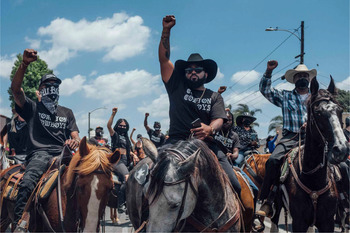
Randy Savvy, head of the Compton Cowboys, leads the Peace Ride. Compton, California, 7 June 2020. (Photo by Kemal Cilengir)

Nearing a red light just before the Metro tracks that cut through Compton, we slowed once more to a stop. As we corralled at the intersection, our voices blended in a steady chant of “No justice, no peace.” The Compton Cowboys raised their right fists in the air while photographers moved in closer. They sat tall in their saddles, completely at ease on their towering animals. Historically, horses have been used by law enforcement as a way to show authority — “their visibility, height and commanding nature a symbol of power” (Thompson-Hernández and Reefer Reference Thompson-Hernández and Reefer2020). In becoming protest bodies on horseback, the Compton Cowboys symbolized power and authority from atop their own steeds. The horses also offered them protection against a police department that has been criticized for excessive force since the 1980s. The Compton Cowboys have said that the cops do not bother them when they are on their horses, nor do gangs (2020). At the Peace Ride, the horses added a sense of impenetrability and safety from the police that was different from other protests I had attended.
Nearing the end of the Peace Ride, protesters on horseback and on foot funneled into a large square outside of Compton City Hall. A crowd of at least a couple hundred was already assembled there, forming a thick circle around central speakers like Mayor Aja Brown and NBA star Russell Westbrook. The protesters on foot, myself included, were absorbed into the outer rows of the circle. The Compton Cowboys gathered in an open section off to the side, conversing and taking photos with people that approached them. The crowd went silent for 8 minutes and 46 seconds to honor the life of George Floyd and the other lives lost to police brutality. A few horses let out soft whinnies during this interlude. Then the music and chanting rebounded throughout the space, once more forming a chain of vocal linkages.
The Compton Cowboys peeled off from the crowd first, trotting and cantering their horses down a side street and out along the train tracks. Even at a distance, I could still make out those bold, white letters across their backs that proudly staked their claim on both Compton and its rich cowboy lineage. Across the country, Americans were participating in Black Lives Matter protests against police brutality, tearing down “emblems of colonialism and the Atlantic slave trade” (Painter Reference Painter2020). The presence of the Compton Cowboys at the Peace Ride added to the disruption of Western settler colonial narratives and the call for a rewriting of the cowboy archive. This rewriting, visualized in powerful imagery of Black men and women on horseback, is inextricably tied to the larger fight against systemic racism in the United States. At the Peace Ride, these riders harnessed the activist potential of embodied memory to reclaim the past and imagine alternative futures for Black communities. In this way, the Compton Cowboys become living legacies of the West.