

Researchers from Australia and elsewhere assert that young people with disabilities fare worse than their peers without disabilities when transitioning from secondary education to their postschool lives (Wagner, Newman, Cameto, & Levine, Reference Wagner, Newman, Cameto and Levine2005; Winn & Hay, Reference Winn and Hay2009). Poor postschool outcomes have negative impacts on wellbeing, social inclusion levels, and employment rates (Eggleton, Robertson, Ryan, & Kober, Reference Eggleton, Robertson, Ryan and Kober1999; Gannon & Nolan, Reference Gannon and Nolan2007; Gilbert & Hay, Reference Gilbert and Hay2004). The provision of transition programs, work-study programs, and vocational education have, however, been shown to improve postschool outcomes for students with disabilities in the United States (USA; Test, Mazzotti, et al., Reference Test, Mazzotti, Mustian, Fowler, Kortering and Kohler2009).
In Australia, young people with a disability are less likely than their peers without a disability to complete their secondary education to Year 12, attend university, or gain employment. In 2009, 78% of young people without a disability completed Year 12, with that percentage decreasing as the severity of disability increased from 73% for students with a mild disability to 46% for students with a profound or severe disability (Australian Bureau of Statistics, 2011). In 2012, only 5.2% of people attending universities in Australia identified as having a disability (Koshy, Reference Koshy2014). The labour participation rate for young people without disabilities aged 15–24 years in 2009 was 73.2%; for their peers with disabilities the participation rate was 58.2%, 14.4% lower (Australian Bureau of Statistics, 2012), with participation declining with the severity of the disability (Organisation for Economic Co-operation and Development, 2003). Young Australians with disabilities are not faring as well in their postschool lives as those without.
In response to the poor postschool life outcomes of young people with disabilities, considerable funding and research into transition services, programs, and planning has occurred in the USA since the early 1980s (Kohler & Field, Reference Kohler and Field2003), and to a much lesser degree in Australia since the 1990s (Meadows, Reference Meadows2009). In Australia, Riches and colleagues conducted research into the transition initiative funded by the New South Wales Department of Education (see, for example, Parmenter & Riches, Reference Parmenter and Riches1991; Riches & Parmenter, Reference Riches and Parmenter1993; Riches, Parmenter, & Robertson, Reference Riches, Parmenter and Robertson1996). Riches (Reference Riches1996) identified eight critical features of transition planning from school to community for young Australians with disabilities. Features included a commitment by governments and departments to central policy and support, individual transition planning by a multidisciplinary team, appropriate curricula and instruction, vocational training and postschool options and opportunities, linkage of students to postschool options, ongoing professional development, community involvement, and interagency collaboration. Despite these findings, no government commitments were made at that time to mandate transition planning for young Australians with disabilities. Little research has since been published in Australia that has examined critical features of transition planning for young people with disabilities (Strnadová & Cumming, Reference Strnadová and Cumming2014).
Unlike their Australian counterparts, young people with disabilities in the USA have, however, benefitted from transition research conducted since the 1980s. Benefits include the federal mandating of transition services and programming, and the identification of best (Landmark, Ju, & Zhang, Reference Landmark, Ju and Zhang2010) and evidence-based practices (Cobb & Alwell, Reference Cobb and Alwell2009; Test, Fowler, et al., Reference Test, Fowler, Richter, White, Mazzotti, Walker and Kortering2009; Test, Mazzotti, et al., Reference Test, Mazzotti, Mustian, Fowler, Kortering and Kohler2009). In the USA, the mandating of transition services occurred under the 1990 Individuals with Disabilities Education Act (IDEA; Baer & Flexer, Reference Baer, Flexer, Flexer, Baer, Luft and Simmons2013). A statement of needed transition services was then required as part of individualised education plans (IEPs). Subsequent reauthorisations of IDEA in 1997 and 2004 led to a focus on ‘results-oriented transition services’ (Landmark et al., Reference Landmark, Ju and Zhang2010, p. 166). In the USA, all students who have an IEP must, by the age of 16, have a written individual transition plan (ITP; Cobb & Alwell, Reference Cobb and Alwell2009).
There is also no Australian legislation that requires IEPs for students with disabilities (Cumming, Strnadová, & Dowse, Reference Cumming, Strnadová and Dowse2014), although it is recognised as best practice (Lyons, Reference Lyons, Foreman and Arthur-Kelly2014). Dempsey (Reference Dempsey2012) investigated the use of IEPs for children in Australian schools and found significant variability in their use across both state and educational sectors. Almost two thirds of students with a disability did not have an IEP. Although having an IEP is not a guarantee of quality instruction, it does, however, demonstrate accountability that the student has an IEP. The Nationally Consistent Collection of Data (NCCD) calls for person-centred planning and evidence from schools in the areas of assessment, adjustment, monitoring and review, and consultation and collaboration. This would imply that schools must write individual learning/education plans, but the Australian Government does not explicitly mandate IEPs or require evidence of planning for students’ transition to postschool environments (Commonwealth of Australia, 2014).
In 2015, the recommendations from transition research conducted in the USA or locally have yet to manifest into legislation in Australia to ensure that students with disabilities receive an ITP to assist their transition to postschool life. There is some evidence, however, that transition research recommendations are positively influencing some, but not all, teacher attitudes and practices (Strnadová & Cumming, Reference Strnadová and Cumming2014). The lack of a legal requirement continues despite calls for ITP legislation by Riches as far back as 1996, and more recently by the Standing Committee for Social Issues (New South Wales Parliament, Legislative Council, Standing Committee on Social Issues, 2012). With no laws in place to ensure ITP provision, young Australians with disabilities must rely on education systems’ compliance to transition-related articles in international treaties such as the United Nations Convention on the Rights of Persons with Disabilities (UNCRPD; United Nations, 2006), and statements in national policies such as the National Partnership Agreement on Youth Attainment and Transitions (Council of Australian Governments [COAG], 2011a).
The Commonwealth is currently in the process of rolling out the National Disability Insurance Scheme (NDIS), which is a person-centred system of providing support for individuals with disabilities throughout their life span (Commonwealth of Australia, 2013). The NDIS has provision for life-span transition planning and supports and specifically mentions transitions supports delivered in schools through the Australian curriculum but, like the NCCD, does not specifically require a transition plan.
The Identification of Transition Practices and Predictors in Secondary to Postschool Transitions
From the early work of Kohler (Reference Kohler1993), who distilled the extant literature on transition practices and programs, the taxonomy for transition programming model was developed. This model was considered to be research-based (Landmark et al., Reference Landmark, Ju and Zhang2010). Five areas were identified in the model for effective individual transition plan programming: student-focused planning, student development, interagency and interdisciplinary collaboration, family involvement, and program structure.
More recently, Landmark et al. (Reference Landmark, Ju and Zhang2010) identified eight best practices based on research published since and including that used in Kohler's (Reference Kohler1993) original study. Best practices are defined here as those established via analysis of exemplary programs, reviewing literature, and surveying teachers (Landmark et al., Reference Landmark, Ju and Zhang2010). The eight practices included paid or unpaid work experience, participation in an employment preparation program, enrolment in general education (inclusion), family involvement, social skills training, daily living skills training, self-determination training, and community or agency collaboration.
In the late 2000s, the U.S. Department of Education, Office of Special Education Programs, funded a number of systematic literature reviews to determine evidence-based transition practices for students with disabilities (Cobb & Alwell, Reference Cobb and Alwell2009). Two reviews were conducted by Test and colleagues (Test, Fowler, et al., Reference Test, Fowler, Richter, White, Mazzotti, Walker and Kortering2009; Test, Mazzotti, et al., Reference Test, Mazzotti, Mustian, Fowler, Kortering and Kohler2009) from the National Secondary Transition Technical Assistance Center (NSTTAC; http://www.nsttac.org) and one for the What Works Transition Research Synthesis Project by Cobb and Alwell (Reference Cobb and Alwell2009).
The review conducted by Test, Fowler, et al. (Reference Test, Fowler, Richter, White, Mazzotti, Walker and Kortering2009) led to the identification of 32 evidence-based transition practices for secondary students with disabilities. Identified practices were then categorised as having a strong (e.g., teaching life skills), moderate (e.g., teaching leisure skills), or potential level (e.g., teaching job-related communication skills) of evidence. No practices were identified as having a moderate or potential level of evidence for interagency collaboration.
In an attempt to quantify the impact of teaching transition-related skills to secondary students with disabilities, Test, Mazzotti, et al. (Reference Test, Mazzotti, Mustian, Fowler, Kortering and Kohler2009) conducted a review of research that involved correlation analyses in order to (a) identify predictors (in-school experiences) that correlated with positive postschool outcomes in employment, education, and/or independent living, and (b) report the effect sizes of the correlations. They located 22 studies that yielded 16 predictor categories (e.g., community experiences) comprised of 42 predictor (independent) variables (e.g., paid work). The strongest predictors of successful postschool educational outcomes were participation in vocational education, a transition program, inclusion in general education, and paid employment/work experience. For employment, the strongest predictors of success were vocational education, work-study programs, inclusion in general education, and paid employment/work experience. The strongest predictors of success in independent living were self-care and inclusion in general education.
Meanwhile, Cobb and Alwell (Reference Cobb and Alwell2009) embarked on a systematic review of transition literature, focusing on studies involving coordination and planning of the transition process (those aligned with Kohler's student-focused planning and student development). Using meta-analysis techniques, Cobb and Alwell reported that for student-focused planning, a highly statistically significant effect of large size was found, and for student development studies, a highly significant average effect of moderate size was reported. Using qualitative meta-synthesis methods, they extracted six primary themes, including low levels of student–parent involvement and a lack of understanding and respect by some educators.
To create a readily accessible, centralised location for evidence-based transition practices, the U.S. Department of Education, Office of Special Education Programs, created the NSTTAC. The NSTTAC annually updates the list of evidenced-based transition practices and predictors (initially informed by Test and colleagues’ 2009 reviews). NSTTAC defines practices as individual teaching methods (including strategies or programs) employed to teach a particular skill. Predictors are defined as in-school experience variables (e.g., vocational goals written in the IEP) that predict postschool education, employment, and independent living success.
Currently, NSTTAC provides information on 64 evidence-based transition practices linked to the skill to be taught, and provides lesson plan starters across all five of Kohler's taxonomy areas to support teacher implementation (Mazzotti, Test, & Mustian, Reference Mazzotti, Test and Mustian2014). Educators worldwide now have easy access to effective, evidence-based transition programs and practices to support young people with disabilities as they transition from secondary school to postschool life. For some countries, all that now remains is the legislation to ensure evidence-based ITP provision.
Although there are no laws requiring ITP provision in Australia, Australia is signatory to a number of international conventions, for example, the United Nations Convention on the Rights of the Child (UNCRC; United Nations, 1989), and has committed nationally to the education, transition, and attainment goals for all young Australians (COAG, 2011a; Ministerial Council on Education, Employment, Training and Youth Affairs [MCEETYA], 2008). All, therefore, includes young Australians with disabilities. To call attention to Australia's compliance obligations to its young people with disabilities, conventions and agreements will be examined for articles or statements referring to/aligned with individual transition planning. Additionally, these articles or statements will be examined for alignment with evidence-based practices and Kohler's taxonomy for transition planning areas in postschool transition for secondary students with disabilities.
The research questions addressed in this study were:
(1) What international conventions and statements have Australia signed that contain articles related to the provision of evidence-based transition practices for secondary students with disabilities to enable positive postschool outcomes?
(2) What national agreements or standards have Australian federal (Commonwealth) and state/territory ministers of education signed that contain items, actions, or outcomes related to the provision of evidence-based transition practices for secondary students with disabilities to enable positive postschool outcomes?
(3) Of those articles, items, action, or outcome statements located in international and national conventions, statements, agreements, or standards, how many align with Kohler's taxonomy for transition programming areas?
Method
Determining Evidence-Based Practices in Secondary to Postschool Transitions
In the process of reviewing the extant literature on evidence-based transition practices, those advocated by the NSTTAC were deemed to be the most comprehensive, reliable, valid, and up-to-date available. As it was unlikely that international and national policy documents and statements would mention individual instructional practices that have been proven to support transition skill development (e.g., least-to-most prompts), a broader approach to locating evidence-based practices was taken. The list of 26 skills (e.g., job-specific skills) and 17 predictor variables provided on the NSTTAC website was first consulted. Focusing on evidence-based transition skills and predictors that promote positive postschool outcomes for students with disabilities is prudent, as these provide key stakeholders with a strong foundation to develop a comprehensive ITP.
For practical as well as conceptual reasons, it was desirable to condense the 43 items (26 skills and 17 predictor variables) for policy (document) analysis purposes. The first step in condensing items was to avoid duplicated themes between the two lists. As previously noted, practices support skill acquisition, which in turn assist in the implementation of predictors. If the item was a better fit as a skill that could be taught to secondary students with a disability to improve postschool outcomes, it was removed from the predictor list and maintained in the skill list. This process resulted in social skills, self-advocacy/determination, and self-care/independent living skills being removed from the predictor list. Although parents can be supported via training to take a more active and equal role in their child's IEP/ITP (see, for example, Rowe & Test, Reference Rowe and Test2010), for the purposes of this study, this item was moved to the predictor list. Keeping the skill list focused on the student with the disability, rather than other stakeholders was important for our argument. A condensed list of 25 transition skills and 14 predictors was the result of this first step.
The second step involved condensing items in both lists into broader categories by employing inductive content analysis techniques developed by Elo and Kyngäs (Reference Elo and Kyngäs2008). The information sheets on evidence-based instructional practices linked to each transition skill on the NSTTAC webpages were read by the first author for a definition of the skill and examples for greater clarity. The first author created open categories then grouped these categories into higher order categories, moving from the specific to general to ensure that the higher order categories were conceptually grounded. All but academic skills could be condensed into one of five higher order transition skill categories, with 10 of the 25 transition skills belonging conceptually to the higher order category functional life skills, which included skills in leisure or recreation, personal care, maintaining a home, and becoming involved in the wider community. The five condensed skill categories to be used in the policy analyses were student participation in goal planning and attainment, academic skills, functional living skills, interaction skills, and employment-related skills.
An inductive content analysis approach was also taken with the remaining 14 predictor variables listed by NSTTAC, with a view to condensing the number of predictor variables to a smaller number of conceptually higher order categories. The two predictors involving parents/families were condensed into one higher order category, and four predictor variables associated with vocational/occupational courses could be conceptually condensed into one: courses to support postschool goals. The list of predictor variables was thus reduced to 10.
To provide a level of internal validity for the list-condensing process, the second and third authors independently examined the list of transition skills and predictors, and the ultimate higher order categories as assigned by the first author. The second and third authors then commented on the assignment of skills and predictors to the higher order category created by the first author, and to the assignment of each to Kohler's five main areas. Any disagreements between the three authors were resolved via discussion. (The process of skill and predictor category collapsing is available from the first author on request.)
Selection of Policies for Analysis
As no international or Australian policies exist that focus solely on the transition needs of secondary students with disabilities, it was necessary to locate policies that account for this population, first, as young people who should receive an education that prepares them for postschool life, and, second, as young people with a disability who often require additional support across the life span (Strnadová & Evans, Reference Strnadová and Evans2013). Policies that focused on young people, education, disability, inclusion, and vocational education and training were then located. Policies that were in operation as of 2014 were included in the analysis, with the exception of one national policy focused on youth transitions that expired in 2013.
International conventions and statements
The United Nations (UN) is the peak world body invested in improving the lives and rights of people, particularly those who are marginalised and disadvantaged due to poverty, race, religion, gender, or disability. Two conventions and one statement address the rights of this population: the UNCRC (United Nations, 1989), the UNCRPD (United Nations, 2006), and The Salamanca Statement and Framework for Action on Special Needs Education (United Nations Educational, Scientific and Cultural Organization [UNESCO], 1994; henceforth referred to as the Salamanca Statement). Australia was a founding signatory to the UNCRC, UNCRPD, and Salamanca Statement, thereby committing the Australian Government to abide by or actively work towards achieving the convention articles and the framework for action statements. These three international policies were chosen for analysis due to their high relevance to the first research question, high credibility, and balance (Bowen, Reference Bowen2009).
National standards and agreements
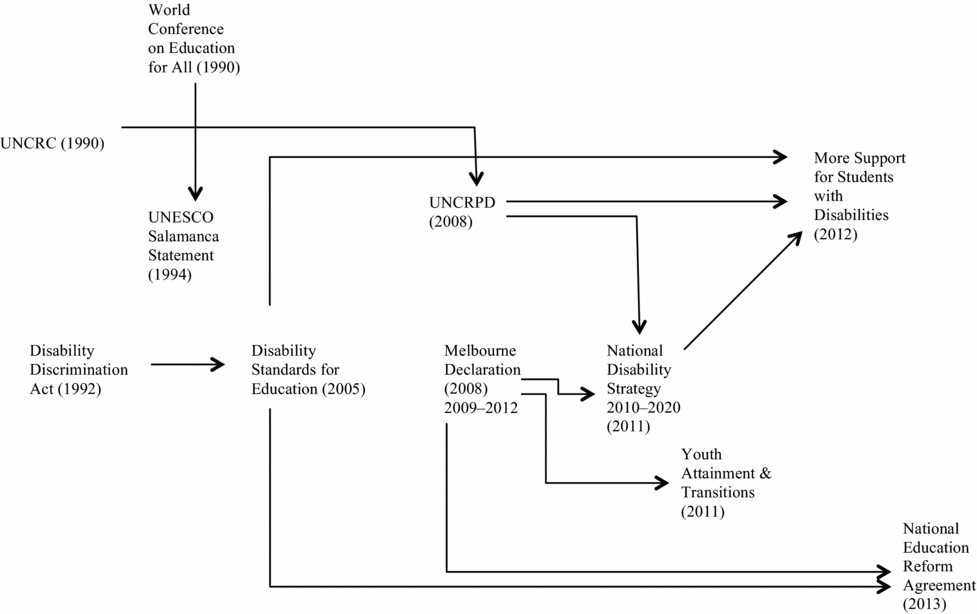
Six national policies were selected for analysis that could potentially include statements relevant to the transition needs of secondary students in Australia with disabilities, the National Education Reform Agreement (COAG, 2013), the National Partnership Agreement for More Support for Students with Disabilities (COAG, 2012), the National Partnership Agreement on Youth Attainment and Transitions (COAG, 2011a), National Disability Strategy 2010–2020 (COAG, 2011b), Melbourne Declaration on Educational Goals for Young Australians (MCEETYA, 2008), and the Disability Standards for Education (Australian Government Department of Education and Training, 2005). All state and territory education ministers in Australia have signed these agreements and all education providers, regardless of the age/stage of the student must abide by the Disability Standards for Education. Three of these policies, the National Partnership Agreements, arose to address the goals outlined in the Melbourne Declaration on Educational Goals for Young Australians (see Figure 1).
Relationship Between International and National Policies.

Document Analysis
The methodology used to locate statements that pertained to transition planning and support was that of document analysis, due to its interpretative strength for analysing policy. Bowen (Reference Bowen2009) noted that document analysis involves the selection, sense-making, and synthesis of the text/images in documents. A central benefit of this methodology is its stability; documents are not affected by the researcher's presence (Merriam, Reference Merriam1988), and can be reviewed repeatedly. Document analysis was used in this study to corroborate or contradict assertions in the literature regarding the lack of transition planning and support in the Australian educational context for students with disabilities.
To overcome the possible bias from a single investigator's analysis of the policy documents, the first and second author independently analysed each policy. A first-pass document review was undertaken, akin to skim reading (Bowen, Reference Bowen2009) the documents (henceforth referred to as policies) for articles, statements, items, or outcomes (henceforth referred to as statements) for alignment with the five skill and 10 predictor categories. Once identified, the located statements were then re-read thoroughly and categorised, and if the statement aligned with one or more of the skills or predictor categories, the statement number or an identifying location feature (e.g., page number), and the relevant text was included in the corresponding table cell to permit reliability checks between the authors. The categorisation process is akin to that involved in content analysis (Elo & Kyngäs, Reference Elo and Kyngäs2008).
The first and second authors then examined each other's coding. Differences were resolved via discussion, and where necessary, the third author was consulted to reach a consensus. For a statement to be included in one of the skill categories the statement wording must have included terms such as taught, guidance, assist, enable, shown, or the like to indicate that the skill would be addressed in the student's education plan. Asserting that an individual with a disability has, for example, a human right to a say in matters that affect their future was not deemed sufficient, as a right must be taught, and the means by which to actualise it, to contribute to positive life outcomes. For transition skill and predictor categories, the statement must have had a clear connection to transition planning/support or postschool/life outcomes to be included.
Results
From the analysis of the nine policy documents (three international and six national), 88 evidence-based, transition-aligned statements were located. The majority of statements were found in international policies, and in one policy in particular, the Salamanca Statement (UNESCO, 1994). In the nine policies analysed, statements that aligned with all of the five evidence-based transition skills and eight of the 10 predictors were found; absent were exit exam/high school diploma and work-study programs. Statements that aligned with all of Kohler's taxonomy for transition planning areas were evident in the policies examined. The following section will present the results from the examination of each of the international and national policies, and where statements intersected with Kohler's taxonomy areas.
Evidence-Based, Transition-Aligned Statements in International Policies
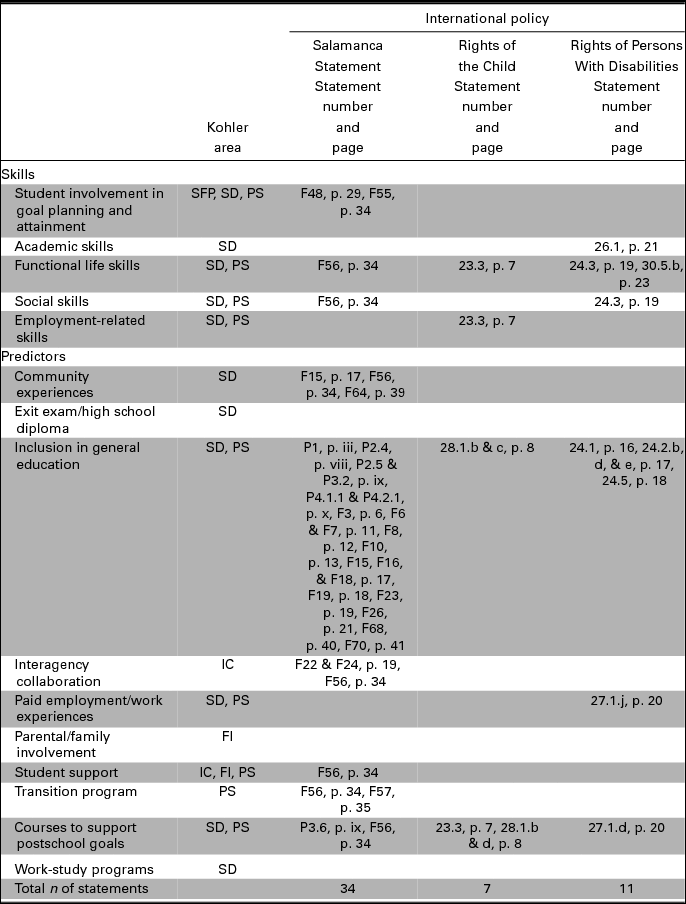
Among the 52 statements located in the three international policies that aligned with evidence-based transition skills (n = 8) and predictors (n = 46), all five transition skill categories and seven of the 10 predictor categories were represented (see Table 1). Absent were statements that aligned with exit exam/high school diploma, parental/family involvement in transition planning, or work-study programs. Statements pertaining to inclusion in general education were the most numerous, accounting for half (n = 26) of all statements located in the international policies.
Evidence-Based Skills and Predictor Statements in International Policies
Note. SFP = student-focused planning; F = framework; SD = student development; PS = program structure; P = preface; IC = interagency collaboration; FI = family involvement.
The Salamanca Statement (UNESCO, 1994) contained the most evidence-based, transition-aligned statements of any of the nine policies analysed, accounting for 34 (38.6%) of the 88 statements located. Given the policy's thrust of inclusive education for all, 19 of the 34 statements supported inclusion, such as, ‘those with special educational needs must have access to regular schools which should accommodate them within a child centred pedagogy capable of meeting these needs’ (p. viii). This policy was the only one of the nine policies to contain statements (n = 3) aligned with the predictor category of students accessing community experiences.
The UNCRC (United Nations, 1989) contained the least number of evidence-based, transition-aligned statements of the three international policies analysed (n = 7). It was the only international policy to contain a statement that explicitly supported skills in employment preparation. Additionally, three of the seven statements aligned with the provision of courses to support postschool goals. The policy called for states to ‘Make educational and vocational information and guidance available and accessible to all children’ (p. 8).
The UNCRPD (United Nations, 2006) policy, like the Salamanca Statement (UNESCO, 1994), had the weight of transition-aligned statements in the predictor area of inclusion in general education (5/11). This policy was the only international policy to intimate that students should be given the opportunity to develop academic skills; ‘State Parties shall take effective and appropriate measures, including through peer support, to enable persons with disabilities to attain and maintain maximum independence, full physical, mental, social and vocational ability, and full inclusion and participation in all aspects of life’ (p. 21). It was also the only international policy to contain a predictor statement on the need for people with disabilities to have access to work experience: ‘Promote the acquisition . . . of work experience in the open labour market’ (p. 20).
Evidence-Based, Transition-Aligned Statements in National Policies
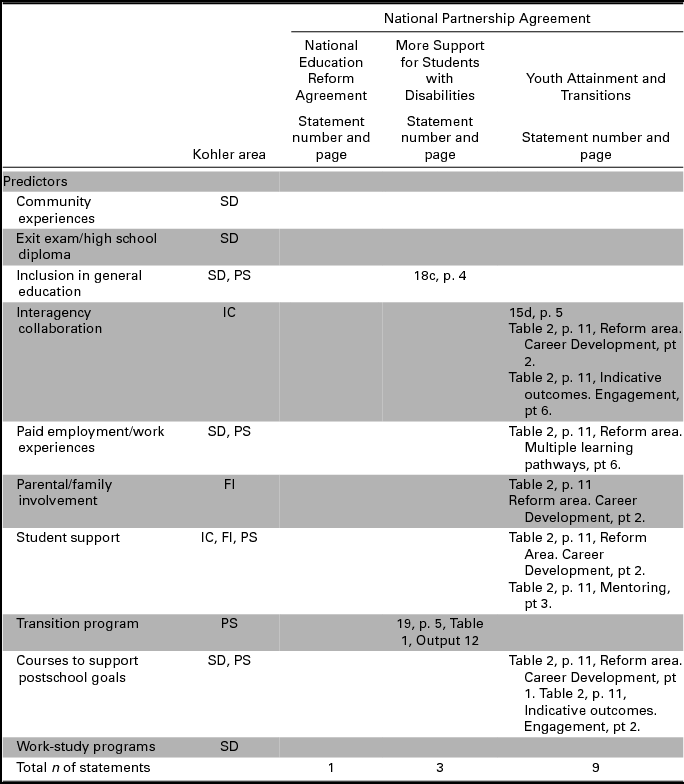
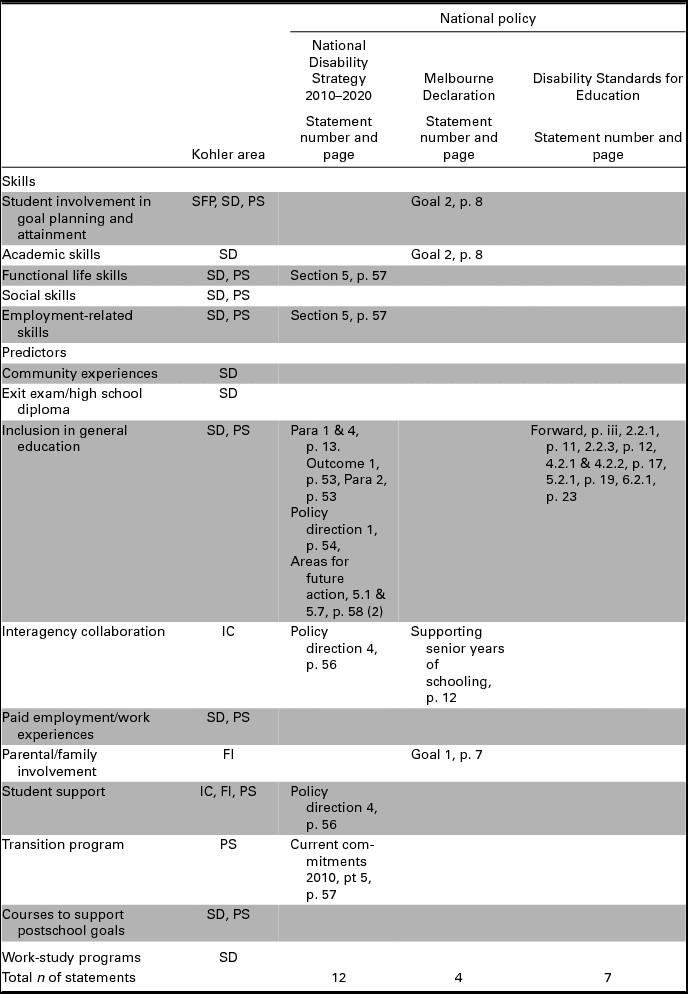
The analysis of the six national and state policies yielded 36 (40.9%) of the 88 statements aligned to evidence-based transition skills or predictors. Only four statements of the 36 were aligned with skills in the six national policies examined (see Tables 2a and b). The National Partnership Agreement policies contained just over one third (n = 13) of the transition-aligned statements located in the national policies. No statements aligned with the five evidence-based transition skill categories in the three National Partnership Agreements. The 13 statements aligned with seven of the 10 predictor categories (see Table 2a). Absent were statements to suggest that community experiences, exit exam/high school diplomas, or work-study programs should be provided to all students.
Evidence-Based Predictor Statements in National Partnership Agreements
Note. SD = student development; PS = program structure; IC = interagency collaboration; pt = bullet point; FI = family involvement.
Evidence-Based Skills and Predictor Statements in Other National Policies
Note. SFP = student-focused planning; SD = student development; PS = program structure; IC = interagency collaboration; FI = family involvement.
Analysis of the National Education Reform Agreement (COAG, 2013) yielded only one transition-aligned statement, 54c on page 16, asserting inclusive education should be provided to meet the needs of students and those at risk. The More Support for Students with Disabilities (COAG, 2012) policy contained three transition-aligned statements, two advocating for transition programs to be provided, for example, ‘Providing additional support for students with disabilities to transition effectively . . .’ (p. 5). The Youth Attainment and Transitions (COAG, 2011a) policy contained the most transition-aligned statements (n = 9) in five of the 10 categories (see Table 2a). Unlike the other two partnership agreements, statements supporting collaboration between agencies, communities, and family involvement were included, for example, ‘Involving business and industry and parents/families . . .’ (p. 11).
In the three other national policies, a total of 23 statements that aligned with evidence-based transition skills or predictors were found. A wider range of statements were found, aligned with four of the five transition skills and five of the 10 predictor categories (see Table 2b). The National Disability Strategy 2010–2020 (COAG, 2011b) had the highest number of transition-related statements (n = 12). This policy was the only national policy to include statements aligned with functional life skills and employment related skills: ‘develop the skills . . . to increase independence and participation as active members of the community’ (p. 57). The Melbourne Declaration (MCEETYA, 2008) contained the second of two statements on academic skill development in the nine policies analysed: ‘are able to plan activities independently, collaborate, work in teams and communicate ideas’ (p. 8). The Disability Standards for Education (Australian Government Department of Education and Training, 2005) contained only statements pertaining to inclusion in general education, for example, ‘An education provider treats a prospective student with a disability on the same basis as a prospective student without a disability’ (p. 11).
Policy Statements Aligned with Kohler's Taxonomy for Transition Programming Areas
As can be seen in Table 3, the majority of 160 evidence-based, transition-aligned statements located in the nine policies analysed were located within Kohler's taxonomy areas of program structure (n = 69, 43.1%) and student development (n = 73, 45.6%). The reader should note that some statements (ergo skills and predictors) were often aligned with more than one of Kohler's taxonomy areas. Statements aligned with these two taxonomy areas were found in all nine policies analysed. Poorly represented in the policies were student-focused planning (n = 3) and family involvement (n = 2) areas.
Number of Policy Statements Aligned with Kohler's Taxonomy for Transition Areas

Note. UNCRC = United Nations Convention on the Rights of the Child; UNCRPD = United Nations Convention on the Rights of Persons with Disabilities; NERA = National Education Reform Agreement; MSSD = More Support for Students with Disabilities; YAT = Youth Attainment & Transitions; NDS = National Disability Strategy 2010–2020; DSE = Disability Standards for Education.
The Salamanca Statement (UNESCO, 1994) and the Melbourne Declaration (MCEETYA, 2008) were the only two policies to contain statements aligned with all of Kohler's five taxonomy areas (see Table 3). The Youth Attainment and Transitions (COAG, 2011a) agreement and the National Disability Strategy 2010–2020 (COAG, 2011b) included statements that were aligned with four of the five taxonomy areas; however, statements involving student-focused planning were not found. The remaining five policies contained statements aligned with student development and program structure only.
In summation, through the method of document analysis, statements aligned with all five evidence-based transition skills were located in either international or national policies that Australia is signatory to. For transition predictors, eight of the 10 categories could be found in the nine policies examined, with no statements found indicating requirements for exit exam/high school diplomas or work-study programs, to enhance school to postschool life transitions.
Discussion
The provision of individualised transition plans (ITPs) within or alongside IEPs for students with disabilities to improve postschool life outcomes is seen as essential practice (Mazzotti et al., Reference Mazzotti, Test and Mustian2014). Despite calls for action on central policy from Riches in 1996, and more recently from the Standing Committee for Social Issues (New South Wales Parliament, Legislative Council, Standing Committee on Social Issues, 2012), the Australian government has yet to legislate for postschool transition planning and support for students with disabilities. In the absence of legislation, our young people with disabilities must rely on the federal and, via extension, state/territory governments’ compliance to obligations as set out in international treaties such as the United Nation conventions, statements, and national policies. It should be noted that compliance to international treaty obligations is more of a moral obligation than a legal requirement (Human Rights and Equal Opportunity Commission, 2004).
With the firm knowledge that there are certain evidence-based transition predictors and practices established through international research that promote positive postschool outcomes for students with disabilities, it is imperative that teachers ensure that students with disabilities have access to these in-school experiences (predictors) and are taught the transition skills needed via these practices (Mustian, Mazzotti, & Test, Reference Mustian, Mazzotti and Test2013). The analysis of the nine policies deemed relevant to students with disabilities in Australia for transition-aligned statements, indicated that there were some predictors and skills that have a moderate level of effectiveness in postschool outcomes, that were vulnerable to being overlooked, with little to no level of policy including them. Conversely, one transition predictor, inclusion in general education, was frequently included. The following section will discuss the implications of what predictors and skills were abundant and lacking in the transition policies analysed.
Inclusion in general education is reported to have a moderate level of evidence of effectiveness for postschool education, employment, and independent living (Test, Mazzotti, et al., Reference Test, Mazzotti, Mustian, Fowler, Kortering and Kohler2009). Statements supporting the inclusion of students with disabilities in general education classrooms accounted for one third of statements overall, and were relatively abundant in national policies such as the National Disability Strategy 2010–2020 (COAG, 2011b) and the Disability Standards for Education (Australian Government Department of Education and Training, 2005). A great many of these statements, however, were located in the Salamanca Statement (UNESCO, 1994).
A pertinent question in 2015 is how well is Australia responding to the Salamanca Statement's call for action for inclusive education? Forlin (Reference Forlin2006) suggested that Australia, 10 years after the signing of the Salamanca Statement, was moving towards inclusion. Up from less than 10% in 1998 to close to 50% in 2002 (Vinson, Reference Vinson2002), more recent figures suggest 73% of students with disabilities are now enrolled in mainstream classes, with a further 27% in support classes within regular schools (Australian Education Union, 2011). On the surface, it appears that Australia has moved towards inclusive education, attempting to meets its own local, nuanced interpretation of its international obligations (Engsig & Johnstone, Reference Engsig and Johnstone2015).
Paradoxically, it should be noted that little reference was made in the policies to the development of academic skills or vocational skill development while in inclusive settings. At one extreme, a focus on highly academic coursework can result in students missing out on much needed vocational courses, transition programs, and community-based work experiences (Goodman, Hazelkorn, Bucholz, Duffy, & Kitta, Reference Goodman, Hazelkorn, Bucholz, Duffy and Kitta2011). In some schools, students with disabilities may not receive the academic support or specialised instruction necessary to succeed in attaining their goals (Leo & Barton, Reference Leo and Barton2006).
In order to improve the postschool outcomes of students with disabilities, mainstream schools must embrace inclusion, and support students by communicating high expectations, providing a challenging curriculum for all, and via learning support coaching that assists in goal monitoring, preparing students for their roles in IEP meetings, and organisation skills (Eisenman, Pell, Poudel, & Peete-Odle, Reference Eisenman, Pell, Poudel and Pleet-Odle2015). Getting the balance right between academic skill development and other non-academic transition skills is imperative (McConnell et al., Reference McConnell, Martin, Juan, Hennessey, Terry, el-Kazimi and Willis2013).
Akin to inclusion in the general education classroom, participation in paid work/work experiences and vocational education courses were found to have a moderate level of effectiveness in postschool education and employment outcomes (Test, Mazzotti, et al., Reference Test, Mazzotti, Mustian, Fowler, Kortering and Kohler2009). Both predictors not only are associated with obtaining a job after high school completion, but also enhance the maintaining of the position over time (Rabren, Dunn, & Chambers, Reference Rabren, Dunn and Chambers2002). Statements aligned to these two predictor areas were seldom located in the policies analysed. Statements for both these predictors were located in the National Partnership Agreement on Youth Attainment and Transitions (COAG, 2011a), but the time frame for this policy has recently ceased, with no current or ongoing national policy drawing attention to these important transition predictors. Australian students with disabilities must now rely on their nation's compliance with the one international policy, the UNCRC (United Nations, 1989), which expressly called for states to make educational and vocational information available to all students and their families.
This UN policy (and others) neglects to acknowledge the importance of student participation in paid work experience or employment, which has been linked to positive postschool employment outcomes (Stewart et al., Reference Stewart, Freeman, Law, Healy, Burke-Gaffney, Forhan, Guenther, Stone and Blouin2010). This practice is especially important for students with severe disabilities, who have the poorest postschool employment outcomes but for whom paid work experience has been shown to increase their odds of obtaining future employment (Carter, Austin, & Trainor, Reference Carter, Austin and Trainor2012).
Via participation in vocational education courses while at high school, career information can be accessed and vocational skills can be developed. Participation in such courses enhances postschool outcomes (Test, Mazzotti, et al., Reference Test, Mazzotti, Mustian, Fowler, Kortering and Kohler2009), providing an advantage in the labour market for students with disabilities that can translate to higher wages and more hours of work per week (Harvey, Reference Harvey2002). In Australia, however, access to vocational education and information has been problematic in some states.
In the report to the Standing Committee on Social Issues (New South Wales Parliament, Legislative Council, Standing Committee on Social Issues, 2012), the availability and accessibility of educational and vocational information to students and their families was found wanting. Information sharing is an issue that needs to be addressed, as Strnadová and Cumming (Reference Strnadová and Cumming2014) identified in their study of teachers in New South Wales regarding transition processes and challenges. If students and families are to make informed choices to facilitate planning and goal setting, this information needs to be available to them.
Developing students’ skills in goal planning and attainment is an important transition skill that Test, Fowler, et al. (Reference Test, Fowler, Richter, White, Mazzotti, Walker and Kortering2009) asserted had a moderate level of evidence of effectiveness, yet there were few statements located in any of the policies analysed. These skills fall under Kohler's student-focused planning taxonomy area, and from our policy analyses, was one of two poorly represented areas. This is especially concerning, given that students’ involvement in transition planning where they can self-advocate is considered to be best practice (Roberts, Ju, & Zhang, Reference Roberts, Ju and Zhang2014). This lack of commitment to student-focused planning is unfortunately also reflected in educational practice in Australia (Laragy, Reference Laragy2004).
In their study of transitions-related practices and experiences in New South Wales government primary and secondary schools, Strnadová and Cumming (Reference Strnadová and Cumming2014) found that student-focused planning was not mentioned at all by participating schools. Although research studies examining students’ involvement in transition planning have focused mainly on students’ involvement in IEP meetings, the lack of provision of a mandated IEP reduces the chances of a powerful opportunity for students to develop their self-determination skills (Wagner, Newman, Cameto, Javitz, & Valdes, Reference Wagner, Newman, Cameto, Javitz and Valdes2012).
Although Test, Mazzotti, et al. (Reference Test, Mazzotti, Mustian, Fowler, Kortering and Kohler2009) reported that, as a predictor, family involvement had a potential level of evidence of effectiveness for postschool employment, it was the other of Kohler's taxonomy transition programming areas to be poorly represented in the policies analysed. Only two statements relevant to family involvement were found in two national policies. Given that family involvement in transition planning is crucial for a student's successful transition to postschool life (Strnadová & Cumming, Reference Strnadová and Cumming2015), and that it is one of the quality indicators of services provided to youth with disabilities (Wehmeyer, Garner, Yeager, Lawrence, & Davis, Reference Wehmeyer, Garner, Yeager, Lawrence and Davis2006), its minimal presence in policies at an international or national level is of concern.
Conclusion and Recommendations
If Australia were meeting its obligations, secondary students with disabilities would be receiving education and training in all five evidence-based transition skill areas and eight of the 10 predictors. Research conducted locally by Strnadová and Cumming (Reference Strnadová and Cumming2014) would suggest otherwise, as there was no evidence of any set of standards or guidelines for teachers in regard to transition planning, and the picture painted by teachers was inconsistent across schools. When these skills or predictors are not well addressed, students with disabilities experience poorer outcomes (e.g., poor graduation rates, low rates of enrolment in tertiary education, being underemployed or unemployed) and become dependent on public assistance (Newman, Wagner, Cameto, & Knokey, Reference Newman, Wagner, Cameto and Knokey2009).
It is clear that future policymakers should take these and similar findings under advisement, and explicitly require education authorities to provide evidence-based transition planning and instruction to students with disabilities. Without national legislation that mandates best practice, in regard to transition processes, many schools in Australia may not feel compelled to create ITPs, teach academic and vocational skills related to transition, involve the student and family in transition planning and goal setting, and provide paid/unpaid work experience for students with disabilities transitioning from high school to postschool life.
To avoid substandard transition planning and poor outcomes for students with disabilities, it is recommended that Australian policy address this deficit and oblige schools to provide students with student-focused, evidence-based transition planning and instruction. Transition planning should begin early enough (age 16 at the latest) to provide academic, social, and vocational skills that are aligned with each student's individualised plan. The student's and family's goals, opinions, and wishes should provide the basis for the plan (Test, Mazzotti, et al., Reference Test, Mazzotti, Mustian, Fowler, Kortering and Kohler2009).
Effective implementation of these practices is key; therefore policy should also include training for school staff (Anderson et al., Reference Anderson, Kleinhammer-Tramill, Morningstar, Lehmann, Bassett, Kohler and Wehmeyer2003) and families about transition planning and processes (Wagner et al., Reference Wagner, Newman, Cameto, Javitz and Valdes2012). Included in staff training is a need to ensure that ITPs are implemented with integrity and evaluated annually via the collection and analysis of data (Finn & Kohler, Reference Finn and Kohler2009). Resources developed by the Council for Exceptional Children and their Division on Career Development and Transition could be useful in guiding teacher development in transition planning and instruction (see Council for Exceptional Children, 2013). Further, a development of guidelines for education providers in Australia outlining the best transition practices would be of great benefit, as would a transition-planning framework.
It is therefore essential that Australian state and federal governments enact legislation to require education providers to design and implement quality, student-centred transition plans to students with disabilities to increase the participation rate of young people with disabilities and improve life outcomes.