The last decade has seen extensive debate on the interpretation of the flash-lag effect (FLE). Unfortunately, the target article fails to further scientific progress in this area. One problem is that many terms and concepts used in the article are not defined precisely. For example, the target article makes no clear distinction between “prediction” and “compensation” and claims that: “The notion that sensory processes per se may be predictive is not widely recognized. In fact, previous suggestions of sensory prediction (Nijhawan Reference Nijhawan1994) have led to controversy” (sect. 2, para. 4). That sensory processes may be predictive is neither new nor controversial. A multitude of mechanisms – from inhibition to light adaptation, occurring at neural loci from retina to cortex – have been discussed in the context of predictive processes and codes (e.g., Attneave Reference Attneave1954; Barlow Reference Barlow and Rosenblith1961a; Reference Barlow and Rosenblith1961b; Reference Barlow, Thorpe and Zangwill1961c; Hubel & Livingstone Reference Hubel and Livingstone1987; Grzywacz et al. Reference Grzywacz, Watamaniuk and McKee1995). What is controversial is the specific hypothesis proposed by Nijhawan, namely, compensation of neural delays at the perceptual level. A lack of conceptual clarity is exemplified also by the author's failure to distinguish between processes that contribute to compensation and the locus of compensation. The target article incorrectly attributes to us the suggestion that “visual processes do not contribute to compensation for neural delays” (sect. 6.1, para. 1). Our point was that the locus of compensation is primarily within the motor rather than the perceptual system (Purushothaman et al. Reference Purushothaman, Patel, Bedell and Öğmen1998).
The target article is selective in addressing other published data and criticisms. For example, Murakami (Reference Murakami2001) reported a FLE of approximately 60 msec for targets moving in random trajectories. Because the perceptual compensation model (PCM) proposed by Nijhawan relies on the predictability of motion trajectories, it cannot explain this outcome. Patel et al. (Reference Patel, Öğmen, Bedell and Sampath2000) and Öğmen et al. (Reference Öğmen, Patel, Bedell and Camuz2004) showed that the flash misalignment in a flash-lag paradigm depends on when the flash is presented relative to the onset of motion. If the flash was presented simultaneously with the onset of motion, a flash-lag was observed. If, using the same stimulus parameters, the flash was presented during continuous motion, a flash-lead was observed. Without ad hoc assumptions, this critical outcome cannot be explained by the PCM. Our review led to the conclusion that “given this large body of contradictory evidence, the lag-compensation through extrapolation model appears untenable” (Öğmen et al. Reference Öğmen, Patel, Bedell and Camuz2004). We also showed that when the luminance of a flashed or a continuously moving target is changed, the magnitude of the FLE varies systematically in accordance with the predictions of the differential latency hypothesis (Kafalıgönül et al., in press; Ögmen et al. 2004; Patel et al. Reference Patel, Öğmen, Bedell and Sampath2000; Purushothaman et al. Reference Purushothaman, Patel, Bedell and Öğmen1998). This luminance-dependent variation in the flash-lag magnitude implies that the putative delay-compensation mechanism is unable to take into account stimulus-dependent variabilities in latencies.
Besides failing to address relevant published data and criticism, empirical data questioning the plausibility of the PCM based on substantial “compensation errors” are dismissed by stating that the model operates within an unspecified luminance range or that “over-extrapolation could be useful” (sect. 5.2.1.2, para. 3). The inability to specify after a decade of research even an approximate luminance range within which visual compensation works suggests that no such range exists. The Hess effect clearly demonstrates this point by showing that perceptual compensation for differential delays in targets of different luminance does not occur, within any range of target luminance (Williams & Lit Reference Williams and Lit1983; Wilson & Anstis Reference Wilson and Anstis1969).
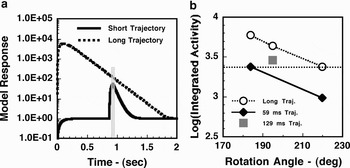
Virtually all of the examples given to illustrate the need for a perceptual compensatory mechanism include motor action. The only unequivocal example offered for a perceptual spatial extrapolation of visual motion is the report by Maus and Nijhawan (Reference Maus and Nijhawan2006). However, in order to demonstrate that perceptual spatial extrapolation occurs, one needs to show that the perceived trajectory of a moving object extends beyond its physical trajectory, that is, to locations where no retinal stimulation occurred. Maus and Nijhawan's findings can be explained by spatio-temporal integration along the motion path, which lowers the detection threshold for a target with a longer trajectory. Our analysis, shown in Figure 1, captures Maus and Nijhawan's findings quantitatively and illustrates that what they interpret as “extrapolation” is essentially a difference in sensitivity.
The results of simulating a unity gain, first-order low-pass temporal filter with stimuli used by Maus and Nijhawan (Reference Maus and Nijhawan2006). (a) The dotted curve shows temporal filter (time constant 1 63.5 msec) output for a stimulus that decreases smoothly in log luminance from a value of 104 units during 360 degrees rotation. The solid curve represents the filter response to the same stimulus that moves only between angular positions 178 and 190 degrees. These simulate the long trajectory and short trajectory conditions in Maus and Nijhawan's Experiment 1. The gray vertical bar represents the temporal window within which the response is summed and compared for long and short trajectories, under the assumption that detectability increases with the log of the summed filter activity. (b) The logarithm of the summed output as a function of angular position during rotation, for the three conditions indicated in the inset. The activity produced at any angle of rotation is always less for short than long trajectory motion. Further, the integrated activity corresponding to short trajectories of motion at 184 and 195 degrees of rotation (59 and 129 msec motion durations) are very similar to that for the long trajectory of motion at 220 degrees rotation (horizontal dotted line). These three angular positions correspond to the positions reported by Maus and Nijhawan (Reference Maus and Nijhawan2006) for the detection or disappearance of the moving spot, for the same durations of target motion.

Finally, the target article suggests that the proposed latency compensation mechanism can be viewed as producing a “lag constancy,” analogous to a putative “sharpness constancy.” It goes on to state that, in the absence of sharpness constancy, “the same moving object, traveling at different speeds, would appear more or less elongated (smeared)” (sect. 8, end of para.). Psychophysical data indicate that the length of perceived smear for moving targets varies systematically with speed (Bedell & Lott Reference Bedell and Lott1996; Chen et al. Reference Chen, Bedell and Öğmen1995). Because the target article provides no convincing evidence for visual compensation of latency, the appropriate analogy between these “constancies” is that neither has been shown to exist.
ACKNOWLEDGMENTS
We thank Srimant Tripathy and Ozgur Yilmaz for suggesting relevant literature.