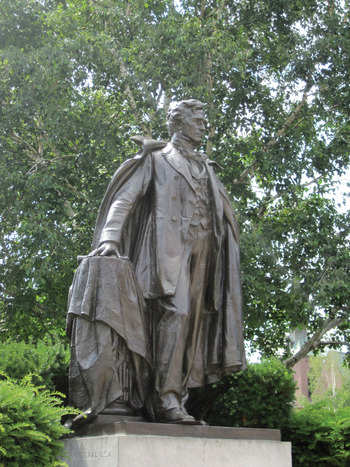
New Hampshire Democrats struggled for years to raise a statue to their state's only president, Franklin Pierce, but Republicans repeatedly thwarted them. The state's other great luminaries—Daniel Webster, John Parker Hale, and General John Stark—had already been honored, but Pierce's name rankled opponents for years. To his detractors, he was the prototypical antebellum “doughface,” a northern man bowing to southern wishes, compromising on the great moral issue of his day and marking himself and his party as being on “the wrong side of history.” No man ambiguous on slavery or the Civil War could be remembered as anything less than a wrongheaded unfortunate. Still, in the Progressive Era, with Democrat Woodrow Wilson in the White House and thousands attending Civil War remembrance ceremonies, the political winds shifted just long enough for Pierce to be honored in bronze. Democrats captured the New Hampshire governorship in 1913, the pro-Pierce forces quickly voted to honor their man, a New York sculptor completed a statue for the State House grounds, and a small celebration was held in November 1914. They agonized in speaking of Pierce, alternately praising and condemning him, but succeeded at the very least in honoring the fact that he was the President and he did try his best. Beyond that, no one could agree.
The Pierce dedication came in the midst of a national wave of similar events all meant to foster sectional reconciliation fifty years after the war, most famously the 1913 Gettysburg reunion where aged Civil War veterans met on their former battlefield for several days of nostalgia and friendship. Recently, historians have interpreted these events not only as a celebration of twentieth-century nationalism on the eve of World War I, but also as an episode charged with racial significance. Black veterans were not invited and slavery and secession hardly mentioned. Speeches and newspaper articles on the reunion lacked even passing commentaries on the war's causes. The reunion and reconciliation was for whites only, or in historian David W. Blight's words, it was a “Jim Crow reunion … white supremacy might be said to have been the silent, invisible master of ceremonies.” This racial element no doubt played some role in Pierce's statue dedication—talk of finally uniting North and South was common—but there were other factors as well.Footnote 1
National party politics also played a key role as the era of the “bloody shirt” dwindled and the Civil War declined as a campaign issue. The honoring of Pierce, however, did not immediately close a fifty-year chapter of American political campaigning. Bitterness lingered, typified by Republicans implicating Democrats in treason and insufficient loyalty to the nation even decades after the war ended. While Republicans and Democrats nationally moved on to debate twentieth-century issues, New Hampshire politicians re-fought the war. The statue would be built as a grudging reconciliation but with extreme reluctance and heated rhetoric. Further, speakers at the dedication ceremony, many of the post-Civil War generation, did not shun commentary on slavery, secession, or antebellum political disputes. Indeed they welcomed it to offer their own interpretations of the nineteenth century (thereby telegraphing brief glimpses into their own philosophies), interpretations that often made Pierce into a hero and a seer. Others used the dedication as a venue to criticize progressivism and made Pierce a foil for the activist politics of Theodore Roosevelt. By 1914, President Pierce remained a symbol of postbellum political anxieties and a useful vehicle for elucidating emerging twentieth-century politics.Footnote 2
The memorialization of Franklin Pierce also occurred when New England, a region steeped in history and the habits of ancestor-worship, inaugurated an era of nostalgic commemoration of its past. For example, Governor Frank Rollins launched New Hampshire's “Old Home Week” in 1899 to celebrate the state's small-town virtues in the midst of urbanization and to invite former residents back to their birthplaces to visit and spend money. Colonial Revival architecture dominated turn-of-the-century homes and public buildings, consciously drawing on eighteenth-century forms to recreate a pre-modern environment against the whirl and dynamo of modern America. The Society for the Preservation of New England Antiquities formed in 1910 to save historic homes from destruction and to save regional identity from waves of industrial growth, urban sprawl, and corrupt boss politics. The Progressive Era had a backward-looking tendency to serve its political and cultural ends. “Progressives invoked heartfelt yearnings for the past's imagined order,” notes historian James M. Lindgren, “focused on economic development, and strove to regenerate older values for a newer age. … They fell into the paradox of looking back on a romanticized past, fighting cultural and economic battles in the present, but all the while trying to plan for an uncertain future.” Raising statues to Daniel Webster, John Parker Hale, and even Franklin Pierce served this nostalgic purpose. Each figure became models of civic virtue, public service, and regional pride, as well as a marketable tourist culture for New Hampshire visitors when combined with, for example, Daniel Webster's birthplace and the colonial traditions of Portsmouth. In the case of Pierce, many state leaders contested the creation of regional memory. Put differently, only some of New England's past should be memorialized. In the riot of commemoration, Democrats wanted to honor their legacy, too, and mold how future Americans viewed their past. Republicans viewed New England history as Republican history, however, and sought to commemorate only those events and people who fit their particular party image and ideological lens. Partisanship shaped public memory. The anti-abolitionist, Jacksonian Democrat Pierce, fell beyond the pale.Footnote 3
Franklin Pierce was born in 1804, the son of revolutionary war veteran and Jeffersonian Democrat New Hampshire governor Benjamin Pierce. Surrounded at a young age with political talk (his father also ran a popular local tavern), young, well-connected Pierce entered into a legal and political career after graduation from Bowdoin College in the 1820s. He quickly capitalized on family connections and showed political skill in becoming a young state legislative leader, a congressman, and by the late 1830s a U.S. senator. In Washington, he made fast friends with rising political leaders, most particularly Mississippi senator Jefferson Davis, but unhappy away from New Hampshire, he returned home in 1842 to become a leading New England lawyer and Democratic boss.
In 1852, after the Democratic Party deadlocked over a presidential nominee, the convention turned to Pierce as a “dark horse candidate,” and he won the election easily over Whig nominee Winfield Scott. His presidency began under a cloud, however. A family man and lover of children, he and his wife Jane Means Appleton Pierce had three children, but only one son Benjamin survived past the age of four. While traveling by train just before his inauguration, their train derailed, and young “Benny” was killed in front of them. The next four years, begun in tragedy and gloom, were ones of controversy. Pierce backed Illinois senator Stephen A. Douglas's Kansas-Nebraska plan to organize the western territories, and opponents accused him of fomenting civil war in Kansas, spreading slavery into the West via “popular sovereignty,” and alienating northern anti-slavery Democrats. He also failed to acquire Cuba from the Spanish Empire in the face of abolitionist charges that he and other “doughface” Democrats wanted to add the island as a new slave state. Denied renomination in 1856, he retired from politics, toured Europe in the late 1850s, and settled into his role as elder Democratic Party statesman. In the Civil War years, he criticized Northern war policy and the Lincoln administration and was accused by many Republicans of being a treasonous pro-Confederate copperhead. He died in 1869 a controversial and unpopular political figure.Footnote 4
Immediately after President Pierce's death, the national battle over his legacy began. On the whole, historical reaction was negative, alternating between criticisms of his administration's policies on Kansas and Cuba, and accusations of southern sympathies because of his friendship with Confederate president Jefferson Davis. Writing in the 1888 American history series called The Republic, John R. Irelan described Pierce as “conscientious” and dedicated to the Constitution, but his administration “left the country in a worse condition than it had been in before.” In addition, Pierce opposed slavery but was trapped by the exigencies of Democratic politics into criticizing the abolitionist movement: “There was nothing in the idea of slavery of any kind that could possibly be congenial to the feelings of Franklin Pierce. It was a calamity to be borne by the whole country until time and compromise, not war, should develop some way out of it.” That said, he was also wholly responsible for the Kansas-Nebraska Crisis by not exerting party leadership to oppose Stephen Douglas. By backing the Douglas plan, he also violated his campaign and inaugural promise to keep the sectional peace forged by the Compromise of 1850. Failing in this, he failed as president.Footnote 5
In particular, Pierce's last two annual addresses to Congress rankled Irelan. One reads the 1855 address with “mixed feelings of disappointment and amazement,” he wrote. “The President handles the whole irritating subject of sectional strife with an utter absence of that native delicacy and refinement which this [book] attributed to him, a fact no doubt owing to Cabinet modifications.” Pierce's words were un-presidential and lacking decorum. “This whole performance was extra-official and coarse, and wholly uncalled for from the President, and decidedly injurious in its influence.” In effect, the address was “an Executive castigation of the North” that showed he “embraced” the Douglas Kansas-Nebraska plan rather than attempting a “conciliatory appeal.” If Pierce's 1855 address earned Irelan's disappointment, the 1856 annual address brought scorn. This public document showed “no trace of the statesman or President, but is characterized at every point by the evasion, sophistry, if not also misrepresentation, of the mere politician.” That Pierce attempted to discuss national affairs in the spirit of both his “personal convictions” mixed with “his official obligations to scan with an impartial eye the interests of the whole and of every part of the United States” seems to have bothered Irelan the most. Even Andrew Jackson, “who was a law unto himself,” avoided such editorial tactics in this official addresses. Unprovoked attacks on the “prejudice” and “fanaticism” of abolitionists and free-state settlers showed that his “condemnation was only for one side. For the other there was no wrong.”Footnote 6
Pierce had his early defenders, most importantly his loyal ex-personal secretary Sidney Webster. Upset at the mischaracterizations and distortions of “Republican historians,” Webster mounted two pamphlet defenses of his former boss, bundled as one work, Franklin Pierce and His Administration, in 1892. Pierce was not responsible for the rising sectional tensions of the mid-1850s, Webster noted, and was a victim “of the all-absorbing emotion of the time.” He attempted “to keep the peace among eager and angry partisans, determined on both sides that there should be no peace,” but could not succeed. “Men's minds were in such a state, on both sides, that they would have an issue between slavery and anti-slavery at whatever costs. Men did not control events, but events controlled men” [emphasis in original]. Pierce did not steer events toward war but was steered by them. In addition, answering the oft-repeated charge that Pierce was “pliable and yielding” to Democratic leaders like Douglas, Webster countered, “In non-essentials, his motto was compromise but, in essentials, no power swerved him to the right hand or left.” His political ideas were consistent. Webster's Pierce was powerless but principled.Footnote 7
Webster denied Pierce urged repeal of the Missouri Compromise or passage of the Kansas-Nebraska Act, calling the charge “the biggest bogey of them all.” Power over initiating legislation lay entirely with the Congress, and Pierce had been genuinely surprised by Douglas's ideas. “The President had not advised it, directly or indirectly.” Had Pierce done as “Republican historians” suggested and used his authority to oppose Douglas, the Democratic Party would have imploded. “If the Senate stood by Douglas on the Kansas issue, and the Administration had thrown its influence for the dozen Whigs and Free Soilers in the Senate resisting the Douglas plan, Pierce would have ruptured the Democratic party then and there, and thereby electing Fremont in 1856.” Pierce went along for party reasons, and to claim he happily approved of the Douglas plan was “the merest flim-flam.” Webster's defense of his chief appeared as damning him with faint praise. Although thoughtful, President Pierce never controlled his own administration, was oblivious to the legislation of Democratic congressional leaders, and went along with the major domestic policy initiative of his presidency to avoid a party breakup. Pierce progressed from being a blunderer to a non-entity at the hand of his friend Sidney Webster.Footnote 8
Beginning around 1900, Pierce's reputation experienced a renaissance, a renewed interest in his presidency that reflected wider American anxieties about progressivism, democracy, and race during the Progressive Era. Fundamental to pro-Pierce histories of this period was the intellectual tug-o-war between the immorality of slavery and the dangers of disunion, civil disobedience, and violence. This pulled re-appreciation in two directions at once, in criticism of his political amorality and in appreciation of his adherence to the Constitution and the rule of law. Most were unable to resolve this tension and refused to judge the man outside his times. Others claimed for Pierce a superior wisdom, an admirable level-headedness in a hyper-emotional age, and a practical political sense more in tune with humans as they were, rather than abolition's idealistic and dogmatic fantasies on how they should be.
The Pierce recovery began with prominent New Hampshire Democrat Harry Bingham. An old-line Jacksonian attorney and perennial senatorial candidate, Bingham intended to honor Pierce with an essay, but when his health failed he abandoned the project. Instead, he helped write a 1900 address by New Hampshire judge David Cross. Drawing on personal encounters with the ex-president, Bingham wrote Cross a letter and remembered Pierce as “easy, dignified, graceful, and courteous,” with a “keen, discriminating, legal mind” expert at swaying juries. As a politician, however, he fell victim to the times, defending the principle of constitutional unionism during the turbulent 1850s and 1860s:
This was a practical revolution, changing the dominant sentiment of the country from what it had been from the foundation of the government to the breaking out of the Civil War, bringing all those who in the discharge of official duty during the strife preceding the war had sought to maintain peace and the Union by a strict adherence to the compromise on which the Constitution was based under a shadow, and making them unpopular.
A conservative man in a radical age, Pierce was defeated by dogmatic moral righteousness. “It availed Franklin Pierce nothing as against the unreasoning passions, animosities, and prejudices engendered by the war that he had administered the government with honesty, fidelity, and ability.” Judge Cross's New Hampshire Bar Association Address in March 1900 concentrated on Pierce's legal career. At a time when ex-soldiers met on old battlefields, Cross wondered why the same magnanimity did not extend to politicians like Pierce. In what became a familiar refrain with Pierce defenders, Cross asked how Americans could embrace Daniel Webster, decried for backing the Compromise of 1850, yet banish Pierce.Footnote 9
The campaign to raise a Franklin Pierce statue in front of the New Hampshire State House marked the most comprehensive defense of the ex-president, but acquiring state funds to purchase it turned into a tremendous multi-year political battle. As early as the 1880s, New Hampshire Democrats pushed to honor Pierce but were defeated by Republicans in the state legislature. (Republicans controlled state politics almost uncontested between the 1860s and 1910s.) The Grand Army of the Republic, the dwindling but still powerful Union veterans' organization that dominated political life in post-Civil War America, lobbied against honoring Pierce as well. In 1893, New Hampshire Republican William E. Chandler, who served as secretary of the Navy and in the U.S. Senate over a distinguished career, spearheaded a state effort to erect statues to Daniel Webster and abolitionist John Parker Hale at Statuary Hall in the U.S. Capitol. When Democrats in the state senate balked and demanded similar statue honors for Pierce, he lobbied them fiercely in a letter-writing campaign to reconsider. “I feel as free to write you strongly upon this subject as if you were a Republican,” Chandler confided to one Democratic senator. He also promised them to back a Pierce statue on the State House grounds. “His fame will be cared for.” The bill passed, and the Hale and Webster statues were erected, along with a Hale statue on the State House grounds in 1892, but Republicans blocked a corresponding Pierce monument. Chandler kept his promise and tried again in 1901, going so far as to contact John N. Cushing, brother of Pierce's attorney-general Caleb Cushing, to inquire if he had any good photographs of the ex-president to help sculptors. Again, the effort failed, with the Pierce statue delayed indefinitely.Footnote 10
When the 1909 New Hampshire legislature opened its session, a bill was introduced to fund a Franklin Pierce memorial statue, likely for the State House grounds. The Republican-controlled legislature gagged on the idea of raising a tribute to the state's most famous Democrat, and New Hampshire lawmakers denounced Pierce as a pro-Confederate traitor to the Union. The bill died in committee, and for good measure, state representatives voted down another bill funding a “Pierce Memorial Bridge” across the Merrimack River just north of Concord, so named to honor both Franklin Pierce and his father, ex-governor and Revolutionary War veteran Benjamin Pierce. Lawmakers shunned public projects bearing the Pierce name.Footnote 11
In 1911, a Pierce statue bill was again introduced and eventually approved by the legislature's Committee on Public Improvements. When it came to the floor for discussion in late February, however, the statue bill ignited the “hottest debate of the session.” Interestingly, it was a Republican state representative from Concord, Irad E. Keeler, who began the legislative fight by backing passage of the funding bill; indeed as the debate showed, the dispute was largely between Republicans rather than Republicans and Democrats. Keeler, the son of a Methodist minister and a former journalist, declared that Franklin Pierce was “the only man ever elected from our state to this high office, and in all human probability, the only one ever likely to be.” Pierce was loyal during the war, he said, comparing his Unionism to Daniel Webster and giving legislators a brief defense of the ex-president's activities in the Civil War years. Accusations, mostly from bitter Grand Army of the Republic (G.A.R.) members, that he backed the Confederacy or betrayed his country were “baseless and unjust.” “I think the time has come to forgive and forget. The Grand Army should do this,” Keeler pleaded. “The sentiment ‘No North, No South’ is now applauded from border to border in our land and those who have any feeling against the memory of Pierce can afford to overlook it in this spirit.”Footnote 12
Opponents of the bill immediately showed they were not taken with the same conciliatory spirit. Republican Augustus Wagner of Manchester, a German émigré, Civil War veteran, and prominent G.A.R. officer, refused to consider any Pierce statue bill until monuments honoring New Hampshire's war dead were raised on all southern battlefields. Oscar F. Moreau, a French Canadian Republican representative from Manchester, thought the ex-president had honors enough already. “We have Pierce's portrait in the State House,” he reminded his colleagues, “but let us not set up his statue outside in the faces of those men who carried the musket in '61.” The young Claremont Republican and G.A.R. member Henry S. Richardson “did not consider that the achievements of Franklin Pierce entitled him to the honor here proposed. … He is a lasting disgrace to New Hampshire.” He accused Pierce of deliberately transferring arms to southern forts to aid secession, a glaring error on Richardson's part that confused charges against Pierce with those made against his successor James Buchanan. Still, no legislator bothered to correct him. The only question, Richardson sarcastically added, was whether the statue's inscription read “our only President” or “our disgrace.”Footnote 13
The emotional crescendo of the debate came when Londonderry representative Rosecrans W. Pillsbury rose to oppose the statue bill. Pillsbury was a wealthy and prominent New Hampshire Republican, shoe manufacturer, and owner of the Manchester Daily Union. He attended the 1904 Republican National Convention as a delegate and routinely ran as a candidate for both governor and U.S. Senate. Noting the importance of the date, he pointed at Washington's portrait hanging in the chamber, thundering that “it was a poor time—on Washington's birthday—to press a measure for the erection of a monument to a traitor.” Boos, hisses, and scattered applause came from the legislators and onlookers. “Don't spend your money, gentlemen, to insult the veterans of the Civil War by honoring the man who was in correspondence with Jefferson Davis when our nation was in danger,” Pillsbury counseled. Furious at the attack, Keeler left his desk to rebut Pillsbury to his face. Many Republican New Hampshire legislators were not interested in reconciliation in 1911. These sectional wounds were so deep, personal, and local that, contrary to national trends, healing came far slower.Footnote 14
The New Hampshire press followed the debate closely and condemned much of the anti-Pierce rhetoric. The Concord Daily Patriot reported that the bill's opponents “stooped to hurl wicked and unproved epithets at Pierce.” “New Hampshire we believe has committed a greater crime than Pierce was ever guilty of by being so dilatory in moving to a substantial recognition of this statesman,” they editorialized. Indeed, if state legislators railroaded this project, the paper suggested, perhaps the only way to force their hands was to hold a state-wide Pierce statue referendum vote, a typical Progressive Era solution to intransigent, unresponsive legislatures. The more reserved Concord Daily Monitor printed a letter to the editor from U.S. District Court judge Edgar Aldrich, a Republican appointed to his seat by President Benjamin Harrison. “We do ourselves little honor by trying to pull down and disgrace the name of Franklin Pierce because he held a different view from others of us as to what would destroy or save the Union,” Aldrich warned legislators. The February debate also gained negative attention nationally. The Philadelphia Public Ledger bemoaned the “unrelenting sympathies of inherited politics” it detected in Representative Pillsbury's attack on Pierce, connecting him with his distant relative, the nineteenth-century New Hampshire abolitionist publisher of the Herald of Freedom, Parker Pillsbury: “It is now Representative Pillsbury who now, half a century after, recalls this old feud in declaring poor Pierce a ‘traitor to his country.’ And yet New Hampshire claims to be ‘progressive.’”Footnote 15
Still, the Pierce Statue Bill moved forward, this time to the Committee on Appropriations, but a committee majority rejected funding the statue. When the committee's report came before the full New Hampshire House in late March, another rousing debate over the Pierce statue ensued. Parker J. Noyes, Republican representative from far north Lancaster, a prominent pharmacist, and former commander of African American troops in the Union Army, opposed any further movement on the bill because in his mind Pierce was disloyal and did not deserve any honors. Representative Wagner, one of the bill's nemeses from the previous month's debate, declared that “history has rendered its verdict upon him. Let it stand. Not one dollar of state money should go to preserve the memory of Pierce.” The elderly Salem representative Benjamin R. Wheeler, a shoe manufacturer, Civil War veteran, and G.A.R. member, grumbled that “facts are stubborn things and the facts that stain the record of Franklin Pierce will still be facts when the Angel Gabriel blows his horn.” The opposition of Manchester representative John F. Clough was particularly hard-hitting. Son of a Revolutionary War veteran who fought at Saratoga and a Union veteran himself, Clough was severely wounded at the 1863 Battle of Chancellorsville and left for dead on the battlefield for sixteen days. Not surprisingly, he too opposed a Pierce statue, bitterly charging that while he lay wounded on the battlefield, Pierce was back in New Hampshire conspiring with Confederates against the Union war effort. But the bill continued to have its backers. The Republican representative from Haverhill, William F. Whitcher, spoke out eloquently in Pierce's defense, leading one newspaper correspondent to compliment the speech as a “real gem of oratory.” When legislators continued to hurl charges of treason at the ex-president, Frank W. Preston, the Republican New Hampton representative and school headmaster “pleaded with the House to rise above narrowness, bias and prejudice.”Footnote 16
The 1911 Pierce Statue Bill survived committee disapproval in a House vote, fought off another attack on April 4, this time against charges that the statue cost too much and wasted state money, and passed the House. The New Hampshire Senate took up the Pierce Statue Bill on April 10 and promptly voted it down without extended discussion, 10–6. The Concord Daily Patriot expressed disgust and doubted if a statue would ever be built with public monies. Perhaps the only solution lay in a private subscription campaign to raise funds, the paper wondered.Footnote 17
But in 1913 the political climate changed in New Hampshire, as it did nationally, with the election of Woodrow Wilson to the White House, only the second Democrat elected president since the Civil War. A coalition of Democratic and Progressive Party legislators elected the state's first Democratic governor since the 1870s, Samuel D. Felker of Rochester. Felker had been House minority leader the previous two sessions and also spoke in favor of the Pierce Statue Bill. As the legislature gathered in January 1913, the Concord Daily Patriot noted that “political sharps” predicted passage of the statue bill. Other parallel events in and outside New Hampshire assisted the bill. State political leaders like Chandler and two-time Democratic candidate for governor Clarence E. Carr organized the high-profile restoration of Daniel Webster's birthplace in Salisbury, New Hampshire. A large celebration dedicating the Webster Birthplace was held in August 1913. Chandler was ill and could not attend, but his address was read by a surrogate. Governor Felker and Judge David Cross, who delivered the address supportive of Pierce back in 1900, also spoke at the event. Webster's State House statue had been dedicated in 1886, and now with the birthplace rebuilding project, comparisons between Webster and Pierce and the uneven public celebration of their lives intensified.Footnote 18
New Hampshire also boasted close connections with presidents Grover Cleveland and Woodrow Wilson, in addition to Pierce—three of the last four Democratic presidents. Cleveland spent many of his last years at a large vacation cottage and farm called Intermont in Tamworth, New Hampshire. President Wilson announced on March 30, 1913, that he would establish his summer White House near the art colony at Cornish in the western part of the state. In fact, Cornish remained Wilson's summer holiday residence for three years, 1913 to 1915, where he rented Harlakenden, the sprawling estate of American author Winston Churchill. A state-sponsored Pierce statue finally honoring their only president, a Democrat, dovetailed well with Wilson's selection of Cornish as his “Summer White House.”Footnote 19
Two events nationally also may have helped push the Pierce bill toward passage. First, in 1911 the United States Congress voted to fund a suitable monument at President John Tyler's grave in Richmond, Virginia, to be dedicated in 1915. In 1912 and 1913, the War Department organized construction of the grave and chose a sculptor for the project. If President Tyler could pass muster with Congress, given that he followed Virginia out of the Union and served in the Confederate Congress, why not the loyal Unionist president Pierce? Second, beginning in 1909, plans were laid for the tremendous Blue–Gray reunion at the Gettysburg battlefield, a celebration finally held in July 1913 and attended by President Wilson on a brief diversion on his way to Cornish. “The war was remembered primarily as a tragedy that led to greater unity and national cohesion, and as a soldiers' call to sacrifice in order to save a troubled, and essentially good, Union,” notes David W. Blight on the Gettysburg celebration, “not as the crisis of a nation deeply divided over slavery, race, competing definitions of labor, liberty, political economy, and the future of the West, issues hardly resolved in 1913.” The event's overarching theme of “nationalism, patriotism, and harmony,” notions prominently exhibited by Pierce statue supporters in 1909 and 1911, no doubt also helped the bill's progress.Footnote 20
Democrats made it clear early in the session that the Pierce statue was a central issue. On January 7, 1913, Representative Guy H. Cutter of Jaffrey—only thirty years old and born thirteen years after Pierce's death, the first Democrat elected from his hometown since the 1860s—introduced two bills to the New Hampshire House: to ratify the Sixteenth Amendment to the Constitution (a federal income tax), and to appropriate $16,000 for a statue to President Franklin Pierce. With Cutter's aid, the bill sailed unharmed through the Committee on Public Improvements later that month. Chandler also returned to the fray in favor of a statue, remained optimistic, and worked behind the scenes to ensure the bill's passage. “I am glad to see that you are still on the ‘warpath,’” David Cross wrote to Chandler in early March. He replied to Cross, asking him to round up past supporters to aid in the fight: “Stir up Judge Aldrich to say something.” Opposition remained but was more muted than in previous years. Talk of treachery and disloyalty receded for more practical demurrals based on thrift and parsimony. The Newport Champion, mentioning the statue bill's previous failures, suggested it would be cheaper and easier to name a new building in Pierce's honor at the rapidly expanding New Hampshire College of Agriculture and Mechanical Arts at Durham (soon to become the University of New Hampshire). Perhaps a “Franklin Pierce Memorial Building” would be a fitting tribute, the paper offered. Grander but even less expensive, the Concord Daily Monitor proposed naming one of the White Mountains after President Pierce. “Taking one of the White Mountain peaks as a memorial to President Franklin Pierce seems like a good deal like letting the Lord do it.” The legislature listened and passed a bill February 25, 1913, renaming Mt. Clinton, originally named for DeWitt Clinton, New York governor and patron of the Erie Canal, Mt. Pierce, which remains the name to this day.Footnote 21
The naming of Mt. Pierce did not substitute for the statue, however. With little debate, the Pierce Statue Bill passed the New Hampshire House and Senate and was signed by Governor Felker on May 13, 1913, “closing a controversy over the subject that has been waged for years,” noted the Daily Monitor. Congratulations flowed into Chandler. One Massachusetts correspondent compared Pierce's honor to the recently deceased Republican senator Mark Hanna. “Cleveland, Ohio has dedicated a statue to Mark Hanna; and if such a man's life and public service justify the honor of a costly memorial, opposition to an outward mark of regard for Franklin Pierce is most absurd.” Out of the legislature, the statue issue passed into the hands of Governor Felker and the Pierce Statue Committee, which was appointed in July 1913. The committee comprised Chandler and Carr, both members of the Webster Birthplace restoration, along with early statue supporter Judge Aldrich, and Manchester department store magnate and Catholic Democrat David E. Murphy. Franklin Pierce Carpenter, the wealthy owner of the Amoskeag Paper Mills, banker, and railroad director, acted as committee chair.Footnote 22
The first business of the committee was choosing a sculptor. Pressure came from the recently elected Democratic U.S. senator Henry French Hollis and his lawyer brother Allen Hollis to appoint their uncle, the famous sculptor Daniel Chester French. The New Hampshire native French, best known for the “Minute Man” memorial at Concord, Massachusetts, the John Harvard statue at Harvard Yard, and the sitting Lincoln statue at the Lincoln Memorial, reported he would be willing to accept the Pierce contract but was busy and needed three years to complete the project—far too long a timetable for the committee. Instead, French joined the committee and recommended his friend and fellow sculptor Augustus Lukeman of New York, a protégé of Augustus St. Gaudens. There is some irony that Pierce, whom critics dogged for being a closet Confederate, was eventually sculpted by Lukeman, an artist best known for his work on the Confederate relief at Stone Mountain, Georgia, in the 1920s (which portrays Pierce's friend Jefferson Davis along with Generals Lee and Jackson), while the real Confederate John Tyler had his Richmond grave sculpted by a firm from Boston, Massachusetts. Lukeman presented them with a model of the Pierce statue on New Years Eve 1913 at the New Hampshire Historical Society, and they voted to contract his services.Footnote 23
Locating the statue proved contentious. Rather than placing Pierce on the State House grounds with Webster, Hale, and Revolutionary War hero General John Stark, the ex-president's likeness would instead be placed in front of the Capitol just off the sidewalk. French and Lukeman wanted a highly visible street location, while Aldrich strongly disagreed. A Pierce statue along the capitol city's main street might add drama to the presentation, but it seemed inappropriate, given the subject and the monument's goals. “The State would lose much in dignity, and the sculptor as well, by opening it up to the sidewalk of a business street. … I think the criticism would be severe,” Aldrich complained to Governor Felker. A memorial to a wealthy businessman or commercial magnate might earn street-side honor, but a president deserved enclosure on the State House grounds with other political leaders. Aldrich ultimately lost the argument, and workers prepared the statue's base on the southeast sidewalk edging the State House grounds. “I have thought the only way out of it to let [French] decide,” Aldrich complained to Chandler, “and then if anybody find fault, we can say that it was located by a man who is supposed to have great judgment in respect to such matters.” If people did not approve the location, let them blame French.Footnote 24
Statue of President Franklin Pierce along the sidewalk on Main Street in Concord, New Hampshire. Unlike the statues of John Parker Hale, John Stark, and Daniel Webster, Pierce is exiled off the State House grounds. Photo by Mary Beth Fraser-Connolly.

Organizing the dedication ceremony also caused problems. In the spirit of sectional reunification, Governor Felker suggested inviting an “eminent southern democrat” to speak at the event. Senator Hollis wrote that Georgia senator Hoke Smith (whose father was from New Hampshire) would be willing to speak. Governor Felker himself had earlier spoken to President Wilson about making an appearance, and the native Virginian “said he would be glad to come even if he did not make any talk.” Ultimately, Republican U.S. senator Jacob Gallinger managed to acquire the services of elderly Alabama senator and ex-Confederate soldier Frank White, who wrote Chandler of his admiration and memories of Pierce. Considering the decades of partisan controversy in raising the Pierce statue, inviting Senator White risked another round of condemnation from Pierce's critics. Otis G. Hammond, director of the New Hampshire Historical Society, wrote Chandler that White's involvement was “a serious error, serving only to revive a sectional feeling which has happily subsided. … These old charges of copperheadism against the President, unjust and unreasonable, have now somewhat subsided, and I should think it was hardly the best of judgment to revive them again.” Hammond's intercessions had their effect, and White did not attend the statue's unveiling. Wilson stayed away as well.Footnote 25
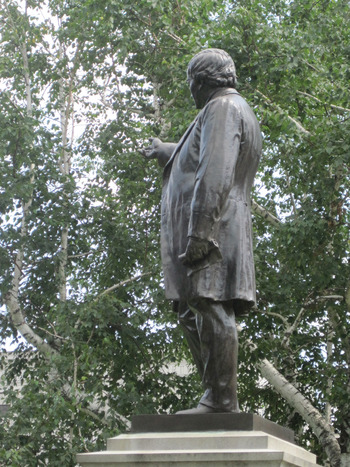
The final statue combined Lukeman's skill and the committee's assiduous work. Chandler, Aldrich, Cross, and Felker cooperated on the inscriptions for the statue's base, which on three sides briefly described Pierce's career and included a quotation from Ulysses S. Grant complimenting Pierce's Mexican War service. The front declared in large engraved letters, “Franklin Pierce, Fourteenth President of the United States,” and the back side, later hidden by shrubs, stated simply, “Erected by the State of New Hampshire, 1914.” Lukeman used the advice and descriptions of Pierce's nephew Kirk D. Pierce to assist in his design. The life-sized statue of a standing and caped Pierce, left hand on waist and staring eastward, reflected all sides of Pierce's long career: the confident and defiant pose of an expert jury attorney making his case, the cloaked brigadier general in battle, and the compromise-minded “doughface” antebellum president with his hand resting on a flag-draped fasces, a symbol of presidential authority and union. Unnoticed until later was the placement of Lukeman's statue in relation to that of the John Parker Hale memorial on the State House grounds. Pierce and Hale began life as classmates and friends at Bowdoin College in Maine but by the 1840s became bitter enemies over slavery: Pierce the anti-abolitionist and Hale the determined opponent of slavery. Hale's statue portrays the politician with an upraised right hand, gesturing to the east, directly at the 1914 Pierce statue on the street. After visiting Concord in 1915, Boston Herald editor Robert L. O'Brien asked Chandler if he was responsible “that the outstretched hand of John P. Hale, who ‘wanted his family to remember at his grave that he preferred to abandon office and power rather than bow to the slave power’ is pointed directly to the one conspicuous example in American history who did bow to the slave power for the purpose named? … How on earth does it happen that one points to the other with such a text? I have rarely seen anything more startling in all my life. It seems like a message from the spirit world.” Chandler admitted the remarkable placement but denied any intention: “I must insist that the arm does not point the accusing finger, but the hand of friendship. Will you accept the idea?”Footnote 26
Statue of abolitionist politician John Parker Hale on the New Hampshire State House grounds. Hale seems to point toward the statue of President Franklin Pierce, a one-time friend from whom Hale had become estranged over issues of slavery and sectionalism. In the 1910s, visitors wondered if the alignment was deliberate to condemn the memory of Pierce. Photo by Mary Beth Fraser-Connolly.

The weather did not cooperate in Concord on November 25, 1914, but hundreds braved the elements to see the Franklin Pierce Statue unveiling. When the ex-president's grandniece Susan H. Pierce removed the cloth covering the statue, “hearty and spontaneous applause” rose from the crowd. First to speak was Clarence E. Carr. He felt a sense of closure in honoring Pierce, the last of New Hampshire's famous statesmen to be memorialized. The president's greatest achievement was defending Webster's “Seventh of March Address” and the compromise principles it embodied. “[It was] one of the crowning glories of Franklin Pierce's career,” Carr declared. “[Pierce] understood and defended the physically enfeebled statesman from the bitter and senseless attacks of an angry and misunderstanding people. Subsequent events vindicated Webster's vision and patriotism and honored Franklin Pierce for his understanding and chivalry.” Pierce and Webster were philosophically indistinguishable, and their calumny was thankfully at an end. Governor Felker likewise complimented Pierce for his personal courtesies and character, his honest cabinet officers, and the diplomatic achievements of his administration, adding the caveat, “Everyone admits that aside from the slavery question President Pierce met the expectations of the country.”Footnote 27
The most outspoken Democrat on the Pierce dedication program was Oliver W. Branch, a Harvard Law School graduate appointed by Governor Felker to the state supreme court in 1913. Branch suggested that with the death of the Civil War generation a shift in interpretation was occurring, as a new American generation with no memories of the 1860s judged history for themselves. “How strange it seems to us that human slavery once existed as a recognized protected institution in a large portion of this land! It is as unreal to us as the fact that King George's statue once stood in Bowling Green, and that royal governors from England ruled over what now are sovereign states.” He denied that most Americans opposed slavery in the 1850s, portraying the institution as constitutionally protected from federal interference; there would have been no ratification of the Constitution but for compromise on slavery. Still, agitation against slavery was inevitable because freedom and bondage mixed in the same founding document created an “anomaly.” “Could such a condition of things long endure? Could abstract right and active wrong be made to work in harmony?” Branch even used the term “irrepressible conflict.” Unionist politicians like Pierce, wary of disorder and fearful of American politics outside and without the Constitution, were trapped. In the end, abolitionist moral fervor trumped the Constitution. “I think it is beyond doubt that during this period he was sincerely concerned over the threatened dismemberment of the Union, and felt that in comparison with this menace the question of the destruction or continuance of slavery was of secondary concern.” Pierce did as he was legally required to do by the Constitution. Branch went so far as to justify antebellum southern concerns on legal protections of slavery, sympathizing with Pierce's dilemma:
The fugitive slave law, the Kansas-Nebraska bill, and the Missouri Compromise were all party and administration measures which Mr. Pierce could not do otherwise than support, and which were designed to protect slavery and to counteract the effects which were being made in the North to abolish it. But so long as slavery was sanctioned and protected by the Federal Constitution it could not be said that the South was not justified in demanding that its constitutional right to hold slaves should not be questioned or attacked. To the people of this day it seems incredible that such legislation could have been enacted or defended. It is only in the retrospect of fifty years and by putting ourselves in imagination in the place of the southern people that we may find justification for the motives that actuated them, and for the sincerity of their belief, not only that their cause was just, but that secession and the establishment of a separate nation were the only alternative remaining to them if they were to be denied or deprived of their right under the Federal compact.
Pierce should be measured by the standards of his own time, not 1913. “Time has softened the passions that were aroused by that mighty struggle … although Mr. Pierce may have made serious mistakes, as the events showed, in the position which he took upon the momentous questions that concerned the nation in the supreme crisis of its existence, he was not a traitor, nor an ingrate, nor a coward, but a true lover of his country.”Footnote 28
Pierce also had some Republican backers at the 1914 dedication. William F. Whitcher, the state representative who passionately defended the ex-president in 1911, used the statue ceremony as a venue to criticize progressivism. In particular, he applauded Pierce's states' rights politics: “His country's welfare depended upon a constant discrimination between the separate rights and responsibilities of the states, and the common rights and obligations of the whole people under the general government. … From this conception of Country and Union he never swerved in word or deed during a career in which he was often misunderstood, often cruelly maligned. For his course and conduct he was calmly content to wait the judgment of later generations.” The time to judge those ideas anew had arrived, proclaimed Whitcher. He portrayed Pierce as an anti-progressive counter to the alarming tendencies of politicians like Theodore Roosevelt: “We have come upon a time when the old idea of statehood is being obscured by a cloud of fantastic experiments under the name of a centralized ‘New Nationalism,’ but there are happily indications that the pendulum will yet swing towards a reasonable regard for reasonable and constitutional statehood.” Whitcher's remark signaled a larger ideological shift in American politics, as decentralist politicians like Pierce increasingly appealed to the Party of Lincoln over progressive centralizers like Roosevelt, and looked forward to conservative Republican politics post-1920.Footnote 29
Most other Republicans were more reserved than Whitcher. Judge Aldrich pictured Pierce as a native son deserving the honor but did not celebrate his ideas. “This statue is not erected to Franklin Pierce because all agreed in the political views which he held upon the great political views of the period to which he belonged. It is erected to the memory of a New Hampshire man of high and notable accomplishments.” Aldrich attempted to soothe the lingering passions of the 1850s by casting them in reasonable terms: “The questions at issue in the United States, preceding the Civil War, were of such a character that men of strength and patriotism might honestly disagree.” Like Branch, Aldrich was reticent to judge Pierce and his contemporaries too harshly: “We must not be too swift in becoming the dictators or the arbiters of the thoughts and the principles of others. We ought and must accord to them the right to hold their own responsibilities and to be the keepers of their own consciences in respect to their duties to their country and their God.” American politics would have no more bloody shirts. If England could place Oliver Cromwell's bust in the House of Lords Library, New Hampshire could honor Franklin Pierce at Concord.Footnote 30
The most influential Republican speaker of the day was Chandler, who understood Republican reluctance at honoring Pierce but suggested it was time to move on: “There is no wisdom in ignoring the reasons for the delay which has taken place. They are President Pierce's relations to the subject of slavery. He was a pro-slavery president and therefore must have no statue—it is said. At the end of fifty years after slavery has been blotted out of existence this reason should be disregarded.” Lewis Cass and Daniel Webster, two politicians equivocal on slavery, had already been honored. However, like Democrats on the platform, Chandler admitted renewed appreciation for the dilemma unionists like Pierce faced in the 1850s:
You all know the animosities aroused in those days. They ought not longer to prevail against Pierce. The real reason why we should not at this late day longer refrain from erecting statues to such men is that their hesitancy to make efforts for the abolition of slavery, their willingness to make compromises in behalf of slavery, arose from their deep devotion to the union of these states which it was believed would be endangered if controversy over slavery continued. Bear in mind that these men were nearer to the days of the formation of the constitution than we now are after more than one hundred years of national life have passed, and the Union has been cemented and strengthened as the result of bloody war. They felt during the first half of the nineteenth century that the Union, although a very sacred bond, might easily be broken into numerous discordant single states if the love of Union was not cherished in the hearts of all men and sacrifices made for its preservation.
Pierce and those like him did not believe that America or the Constitution could survive a breakup. They erred, said Chandler, but Americans should not persecute them for their reasonable concern. None of this signaled he approved of Pierce's policies, far from it. Chandler called the Kansas-Nebraska Act and the repeal of the Missouri Compromise “utterly indefensible.” However, unionist Democrats could be celebrated as honest, hardworking, if ultimately mistaken, statesmen: “Stephen A. Douglas and Franklin Pierce are to be acquitted of unforgivable public acts and are to be praised and honored for their careers as a whole of statesmanship and patriotism.” Proud of his Pierce Day speech, Chandler printed copies and sent them to friends. Senator Gallinger reported back to Chandler that he presented the speech to Republican Massachusetts senator Henry Cabot Lodge, a Harvard history PhD and biographer of Daniel Webster. “Lodge says your estimate of Pierce is rather extravagant,” he dryly teased.Footnote 31
The heady days of 1914 when Franklin Pierce's name held the esteem of major state politicians and businessmen did not last long. By the 1930s, historians returned to the themes of 1870s and 1880s historiography, that Pierce like James Buchanan helped cause the Civil War, a refrain that continued through the twentieth century. For several years in the Progressive Era, however, President Pierce became one of the most contentious issues in New Hampshire politics, with boisterous defenders and opponents. “From our own point of view, the greatest and best lesson taught by today's tribute to Franklin Pierce is that the blood red marking of Mason and Dixon's line is effaced,” editorialized the Concord Daily Monitor on the Pierce dedication ceremony, “that the passions which embittered the awful sorrows of men and woes of women fifty years ago is spent; that the heart of the North no longer cherishes that resentment of the South and hatred for its sympathies which for too many years blinded the eyes of New Hampshire to the real eminence of its one President.” The Monitor overstated the case. Sectional healing and the end of the “bloody shirt” came slowly to Yankee New Hampshire. A region delighted to celebrate its past and invite others into its borders to share its history showed great reluctance to applaud New Hampshire's only president. With Franklin Pierce, reconciliation and commemoration came with starts, stops, and hesitation.Footnote 32