


Introduction
Anxiety disorders are the world’s most common mental disorders, with an estimated 359 million people affected globally in 2021. 1 They pose a significant burden on individuals, families, healthcare systems, and economies by interfering with work, education, and social functioning. Mental illness, including anxiety disorders, cost the global economy an estimated $1 trillion annually due to lost productivity. 2 Additionally, anxiety disorders are the leading cause of years lived with disability. It accounted for 28.7 million disability-adjusted life years (DALYs) globally in 2019, representing 1.1% of total DALYs and 22.9% of DALYs for all mental disorders.Reference Zhou, Li and Song 3 , 4 However, only 27.6% of the affected people receive treatment. 1
Anxiety disorders are known to be complex mental health conditions. 1 , Reference Robinson, Vytal, Cornwell and Grillon 5 The common types include generalized anxiety disorder (GAD), panic disorder, social anxiety disorder, and various phobia-related disorders. 6 Patients with anxiety disorders often show cognitive and psychomotor impairments.Reference Snyder, Hankin, Alosco and Stern 7 , Reference Nicolini, Villarreal, Ortega-Soto and de la Fuente 8 In a study comparing patients with GAD (n = 63) to controls (n = 907) across multiple cognitive domains, 19% of the patients with anxiety scored below the standard score threshold compared to only 4% of controls.Reference Gualtieri and Morgan 9 Another longitudinal study (N = 2187) evaluating the relationship between anxiety and cognition using observational and genetic methods in young adults found a negative association between anxiety and working memory, altered emotion recognition, and some evidence for deficits in executive functioning.Reference Suddell, Mahedy, Skirrow, Penton-Voak, Munafò and Wootton 10 A recent meta-analysis of 8 studiesReference Hadzic 11 and a systematic review of 33 studiesReference Gkintoni and Ortiz 12 corroborated the findings that compared to healthy controls, individuals with anxiety disorders had cognitive impairment in global cognition, memory, attention, cognitive inhibition, decision-making, and social cognition. Anxiety disorders impair psychomotor performance by affecting muscle tension, rigidity, and stimulus processing, leading to slower reaction times, reduced movement fluency, and increased errors in fine motor tasks.Reference Reardon, Gorczynski, Hainline, Hitchcock and Rice 13 A meta-analysis based on evidence from 71 studies comparing motor function in individuals with anxiety and depression to healthy controls found a small but significant motor impairment effect in anxiety disorders.Reference Elkjær, Mikkelsen, Michalak, Mennin and O’Toole 14 Studies have also shown patients with anxiety disorders to have poorer quality of life (QoL) as compared to non-anxious individuals.Reference Barrera and Norton 15 , Reference Mendlowicz and Stein 16
Every patient’s experience is unique considering each type of anxiety disorder varies in its triggers and symptoms, making it challenging to find the right treatment approach. Choosing an appropriate treatment strategy that provides personalized, effective, and safe care becomes crucial for patients to have enhanced functioning and improved QoL. 1 , Reference Mangolini, Andrade, Lotufo-Neto and Wang 17 , Reference Papola, Miguel and Mazzaglia 18
Benzodiazepines, including alprazolam (a gamma-aminobutyric acid [GABA]-positive allosteric modulator), have been prescribed for the treatment of various anxiety disorders for over four decades. Due to its rapid onset of anxiolytic effect, alprazolam is particularly useful in the treatment of acute anxiety,Reference Krieger 19 , Reference Berlanga, Canetti and Enrique 20 making it critical for some patients. However, one of the common concerns with alprazolam is sedation and related side effects 21 that often discourage clinicians from prescribing it. Most of the published evidence assessing the impact of benzodiazepines, including alprazolam, on cognition and psychomotor function is from long-term users or a small group of healthy volunteers.Reference Chowdhury, Morshed, Shahriar, Bhuiyan, Islam and Bin Sayeed 22 , Reference Crowe and Stranks 23 , Reference Nader and Gowing 24 Evidence specifically assessing the impact of alprazolam on cognition and psychomotor performance caused by anxiety disorders is limited, especially for short-term use in eligible patients for approved indications. The objective of this review was to summarize relevant data assessing the impact of short-term use of alprazolam on associated features of anxiety disorders such as cognitive dysfunction and psychomotor impairment at recommended therapeutic doses.
Methods
Using the participants, intervention, comparisons, and outcomes (PICO) framework, an independent search was conducted for a combination of medical subject headings (MeSH) and keywords, including “Xanax,” “alprazolam,” AND “anxiety disorder,” “panic disorder,” “anxiety,” “panic,” AND “cognition,” “psychomotor function,” “quality of life,” “tremor,” “agitation,” “rigidity,” in the Public Medline (PubMed) and Excerpta Medica Database (Embase) databases. Computer-based and manual searches were performed using PubMed and Embase, as per the search strategy described in Supplementary Table S1. Clinical trials and observational studies evaluating the impact of short-term administration (≤ 8 weeks) of alprazolam on cognition, psychomotor function, or QoL in adult patients with anxiety disorders were retrieved. While short-term treatment is mostly described to be 2–4 weeks, reports in the literature allude to long-term treatment as over 2–8 monthsReference Bandelow, Allgulander and Baldwin 25 and a recent scoping review collates the reporting of short term as up to 12 weeks for benzodiazepine use in anxiety disorders.Reference Brandt, Bressi and Lê 26 Consequently, a treatment duration cutoff of ≤8 weeks was applied. Comparators considered for inclusion were other anxiolytics or placebo. Only studies conducted in humans and published as full-text articles in the English language were included. The latest search was conducted in September 2025 without any restrictions on the time frame. Screening of abstracts and full text was performed, and relevant studies were selected based on the inclusion criteria.
For each of the symptoms, a variety of outcomes including mental alertness, memory tasks, psychomotor speed, other aspects of memory and mood, and QoL were included. For each selected article, the first author, publication year, study type, study population, sample size, treatment arms and duration, and study outcomes were tabulated.
To maintain scientific rigor, this review employed a structured PICO-guided search and predefined eligibility criteria to identify relevant clinical evidence. The intent was to provide a focused narrative synthesis of human studies evaluating the short-term effects of alprazolam on cognition, psychomotor function, and QoL in anxiety disorders. Given that most included studies are more than two decades old and used methodologies that predate current standards, a formal quantitative assessment of study quality or risk of bias was not performed.
Results
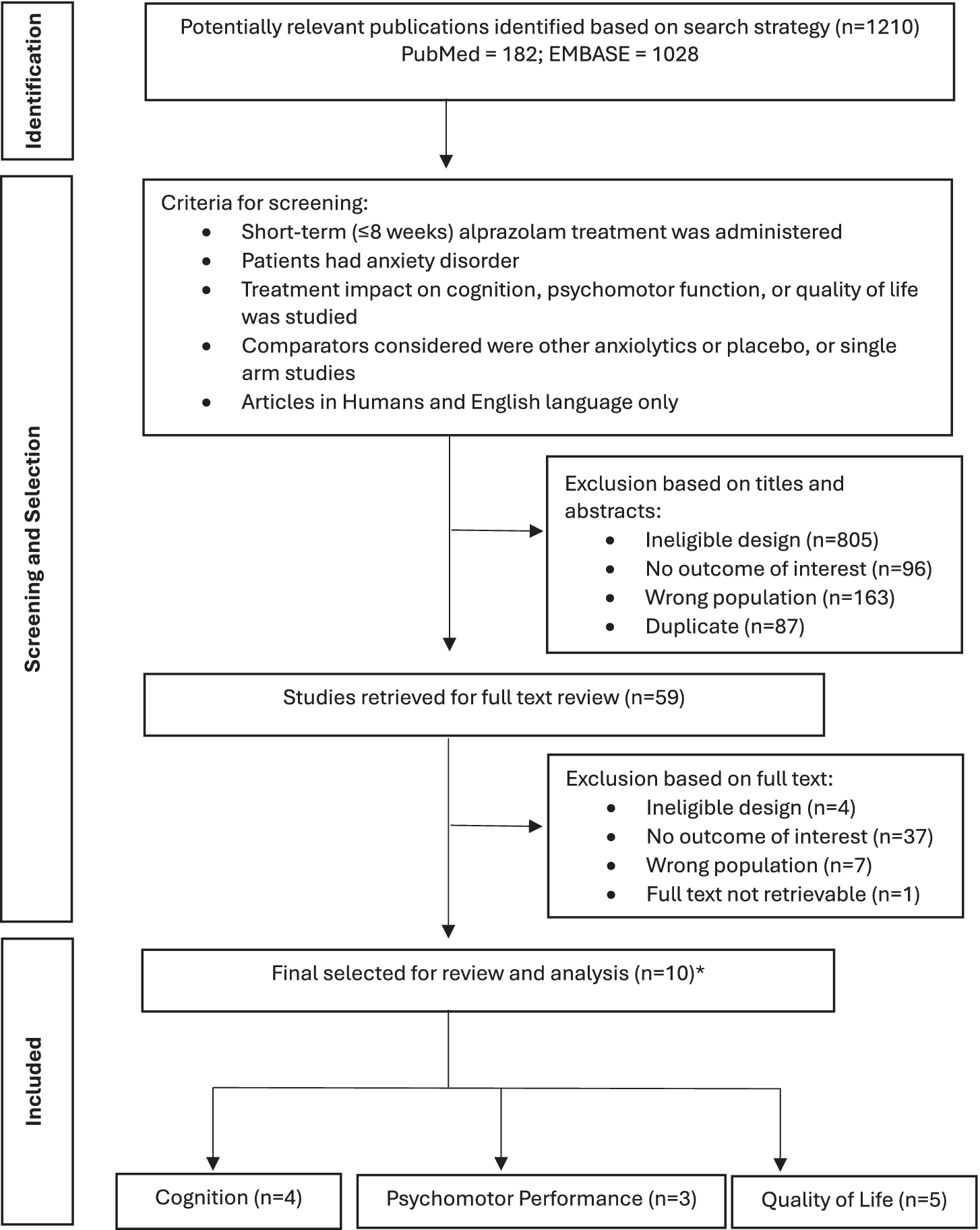
A total of 1210 articles were identified by electronic literature search. After abstract and full-text screening, 1200 articles were excluded, and a total of 10 articles were included in this review (Figure 1). Of the 10 studies, 8 were controlled clinical trials and 2 were open-label clinical trials. The effect of treatment with alprazolam (short term) on cognition was assessed in four studies, psychomotor function in three studies, and QoL in five studies. There was a paucity of evidence assessing the impact of alprazolam on tremors, agitation, and muscle rigidity; hence, these symptoms were not considered in this review.
Study selection flow diagram. *Two studies evaluated both cognition and psychomotor performance and are included in both categories.

Figure 1. Long description
Overall, 10 studies met the eligibility criteria and were included in the final review and analysis. Of these, four assessed cognitive outcomes, three assessed psychomotor performance, and five assessed quality of life. Two studies evaluated both cognition and psychomotor performance and are therefore counted in both categories.
After full-text assessment, 49 studies were excluded: 37 did not report an outcome of interest, 7 evaluated the wrong population, 4 used an ineligible study design, and 1 could not be retrieved in full text.
This study selection flow diagram summarizes the literature review process. Database searches identified 1210 potentially relevant publications: 182 from PubMed and 1028 from Embase. During title and abstract screening, 1151 records were excluded because of ineligible study design (805 records), lack of an outcome of interest (96 records), wrong population (163 records), or duplication (87 records). The remaining 59 studies proceeded to full-text review.
Details of Studies Evaluating the Effect of Alprazolam on Cognition in Patients with Anxiety Disorders

Table 1. Long description
Table 1 summarizes four studies evaluating cognitive and neuropsychological effects of alprazolam in anxiety disorders, including study design, population, treatment, assessments, results, and conclusions. Curran et al. (1994), in an RCT of 38 patients with agoraphobia and panic disorder, found no significant effect on primary memory, implicit memory, or motor speed after 8 weeks of alprazolam, while episodic memory, especially word recall, was impaired. Bond et al. (1995), in a placebo-controlled study of 21 patients with panic disorder and agoraphobia, reported increased behavioral aggression on a laboratory-based objective task and reduced self-reported hostility, while mood and relaxation improved in both groups. Kaplan et al. (2000) found transient impairment on the Digit Symbol Substitution Test after a single 1 mg dose, returning toward baseline within 8 hours. Gladsjo et al. (2001) found no meaningful neuropsychological change after 8 weeks of extended-release alprazolam.
ALP-XR, alprazolam extended release; ARS, Aggression-Rating Scale; CRT, competitive reaction time; CVLT, California Verbal Learning Test; CVMT, Continuous Visual Memory Test; DSST, Digit Symbol Substitution Test; MRS, Mood Rating Scale; PL, placebo; SMQ, Subjective Memory Questionnaire; VSR, Visual Selective Reminding; WAIS-R, Wechsler Adult Intelligence Scale—Revised.
Cognition
A total of four studiesReference Curran, Bond and O’Sullivan 27 –Reference Gladsjo, Rapaport and McKinney 30 assessed the impact of alprazolam treatment on cognition in patients with panic disorders (Table 1). Cognitive performance was evaluated using various methods that examined intellectual function, language, memory, attention, psychomotor speed, executive functioning, and alertness among other parameters.
Curran et al.Reference Curran, Bond and O’Sullivan 27 in a longitudinal study assessed if alprazolam treatment for 8 weeks impaired memory functions in 38 patients with agoraphobia and panic disorder. Patients were randomly assigned to 1 of 4 parallel treatment groups: 2 drug conditions (alprazolam or matching placebo) combined with 2 psychological treatment conditions (exposure or relaxation). The mean dose taken by those on alprazolam was 5.25 mg/day (range 0.5 to 9 mg/day). Alprazolam did not impair performance on the implicit memory task (assessed as word-stem completion) and did not affect primary memory as assessed by digit span. However, impairments were seen for the word recall task (episodic memory), though news recall was not affected by treatment. No evidence of sedation was found in this study, as assessed with the motor-speed task (finger tapping). Conversely, patients taking alprazolam mentioned that they felt drowsier as assessed by subjective rating scales. At the end of treatment (8 weeks), while contentedness and calmness increased in all the treatment groups, a slight decrease in alertness was seen in the alprazolam group. It should be noted that the alprazolam dosage was slightly higher than the therapeutic recommendation of 4 mg/day. 21 Furthermore, as this was one of the first longitudinal studies assessing the effects of benzodiazepine on patients’ memory function, its methodological limitations should be taken into consideration. Nonstandardized timing of cognitive assessments relative to alprazolam dosing and therapy sessions may have masked drug effects. Since benzodiazepines are recommended for short-term relief (2–4 weeks) of severe anxiety or panic disorder,Reference Kennedy and O’Riordan 31 an early clinical assessment at 4 weeks would have been meaningful.
In a double-blind randomized trial, Bond et al.Reference Bond, Curran, Bruce, O’Sullivan and Shine 28 assessed the impact of four treatment conditions (alprazolam and exposure or relaxation [n = 12], placebo and exposure or relaxation [n = 9]) on alertness, contentment, and calmness in patients with panic disorder (N = 21). A self-rated visual analog mood rating scale (MRS) was used at study entry and after 8 weeks of treatment. The mean dose of alprazolam was 4.7 mg/day (range 0.5 to 8 mg/day). At baseline, the treatment groups were similar on most clinical measures. For MRS, patients rated themselves as more contented, tranquil, and relaxed, following both alprazolam and placebo. After 8 weeks of treatment, there was no difference between the groups in subjective sedation. Only 1 scale out of the 9 scales assessed showed a difference, on which patients rated themselves as more mentally slow after alprazolam treatment compared to placebo. Interestingly, the objective laboratory-based task showed an increase in behavioral aggression. There is some evidence to suggest that benzodiazepine dose may influence aggressive behavior,Reference Albrecht, Staiger, Hall, Miller, Best and Lubman 32 and in this study, alprazolam doses exceeded the therapeutically recommended dose of 4 mg/day. 21 This underscores the importance for clinicians to use the minimum effective dose. This is the first study to employ an objective measure of aggression in a small sample of patients, and results need to be validated in larger studies.
A single-dose crossover study by Kaplan et al.Reference Kaplan, Greenblatt, Ehrenberg, Goddard, Harmatz and Shader 29 was conducted to evaluate the effects of alprazolam 1 mg administered orally in patients with panic disorder (n = 8) and demographically matched healthy volunteers (n = 8) across repeated assessments conducted at 0.5, 1, 2, 3, 4, and 8 hours post-dose, focusing on cognitive performance and psychomotor functioning. Cognitive and psychomotor performance, assessed using the Digit Symbol Substitution Test (DSST), showed no significant baseline differences between participants with panic disorder and healthy controls. Among healthy participants receiving alprazolam, the change in DSST score ranged from approximately −18 at 1 hour post-dose to −1 at 8 hours post-dose. In patients with panic disorder, alprazolam-related changes ranged from approximately −15 to +5 over the same period. Among healthy participants receiving placebo, the change in DSST score ranged from approximately 4 to 9, and in patients with panic disorder, it ranged from approximately 9 to 12 across the 0.5 to 8 hours post-dose window. Given that a decline of 3 to 6 fewer correct substitutions on the DSST is considered clinically meaningful impairment,Reference Jehu, Davis, Madden, Parmar and Liu-Ambrose 33 the findings suggest an early temporary slowing of cognitive and/or psychomotor performance soon after taking alprazolam. This effect gradually diminished over time and showed improvement after 8 hours.
In a placebo-controlled trial by Gladsjo et al.Reference Gladsjo, Rapaport and McKinney 30 38 patients with panic disorder were randomized to receive either extended-release alprazolam (alprazolam XR; n = 18) or placebo (n = 20) for 8 weeks (2-week titration, 6 weeks at target dose of 4 mg/day) alongside cognitive-behavioral therapy (CBT) for 12 weeks. Patients included in the study did not have any history of significant neurologic disorders or conditions known to affect neuropsychologic function (including learning disabilities). Neuropsychological function was assessed before and after treatment using a comprehensive battery covering intellectual function, language, memory, attention, psychomotor speed, and executive functioning. After 8 weeks of therapy, results showed no significant group-by-time interactions and no significant differences between the treatment groups. Neither group demonstrated any decline in neuropsychologic performance compared with baseline. However, a statistically significant improvement from baseline to reassessment was observed in attention, executive functioning, psychomotor speed, and visual memory (p < 0.001) in both groups and these improvements were attributed to practice effects. The key conclusion was that the use of alprazolam with a longer half-life at a fixed dose in patients with panic disorder did not result in any detrimental effect on neuropsychologic performance.
Psychomotor function
Three studies assessed the impact of alprazolam treatment on psychomotor performance in patients with panic disorders. Studies conducted by Curran et al.Reference Curran, Bond and O’Sullivan 27 and Gladsjo et al.Reference Gladsjo, Rapaport and McKinney 30, described under cognitive outcomes, reported that alprazolam use did not impair (Curran et al.)Reference Curran, Bond and O’Sullivan 27 or improve (Gladsjo et al.)Reference Gladsjo, Rapaport and McKinney 30 psychomotor performance in patients with panic disorder. The third study conducted by Uhlenhuth et al. is described below and is also summarized in Table 2.
Details of Studies Evaluating the Effect of Alprazolam on Psychomotor Function in Patients with Anxiety Disorders

Table 2. Long description
Table 2 summarizes Uhlenhuth et al.’s prospective open-label study of alprazolam effects on psychomotor function in 26 patients with panic disorder, with or without agoraphobia. Patients received alprazolam for 8 weeks, titrated to 4 mg/day by Week 4, and maintained thereafter. Finger tapping, Continuous Performance Task, and DSST measures showed no significant change except reduced DSST processing speed at Week 8. Higher alprazolam plasma levels were inversely correlated with psychomotor performance. It is important to titrate alprazolam dosage upward gradually, to better preserve psychomotor function.
CPT, Continuous Performance Task; DSST, Digit Symbol Substitution Test.
Uhlenhuth et al.Reference Uhlenhuth, Starcevic and Qualls 34 investigated the association between alprazolam plasma levels, baseline levels of a general anxiety-prone cognitive style (measured by the Anxious Thoughts and Tendencies Questionnaire [AT&T]), and the magnitude of improvement in outcome measures over the course of treatment in patients with panic disorders (N = 26). The duration of panic disorder ranged from 6 to 528 months. Patients were free of all psychotropic medications for at least 2 weeks prior to study initiation. Alprazolam was administered for 8 weeks, titrated from 1 mg/day to 4 mg/day for the first 4 weeks, which was then maintained for further 4 weeks. Psychomotor performance was measured using the Neurobehavioral Evaluation System 2 (NES2, version 4.32) and included finger tapping (TAPS 1 and 2), continuous performance task (CPT), and DSST. The results indicated that functions related to finger tapping and CPT were well preserved after 8 weeks of treatment (median values, baseline vs Week 8): tap 1, 168.0 vs 163.0 (p = 0.48) and tap 2, 162.0 vs 156.5 (p = 0.71); CPT omissions were 0.0 vs 0.0 (p = 0.67); CPT false positives were 0.0 vs 0.0 (p = 0.08); and CPT rate (trials per second) was 2.50 vs 2.44 (p = 0.49). DSST errors did not significantly change after alprazolam treatment (0.0 vs 1.0; p = 0.39). Although the DSST rate (symbols per minute) showed a statistically significant decline (28.41 vs 25.90; p = 0.002), this reduction in DSST rate (2.51 symbols) did not indicate a clinically meaningful impairment as the threshold for clinical relevance is a reduction of 3 to 6 fewer correct substitutions on the DSST.Reference Jehu, Davis, Madden, Parmar and Liu-Ambrose 33 An inverse correlation was found between alprazolam plasma levels and psychomotor functioning (measured using TAPS, CPT, and DSST), with lower plasma levels corresponding to better preserved functioning. High baseline AT&T scores were associated with more CPT omissions. The results demonstrate that administering alprazolam within recommended daily doses, using a gradual upward titration, may help preserve psychomotor functioning. The intensity of a patient’s anxiety-prone cognition at baseline was not a predictor of treatment response, and hence, the choice of alprazolam as a treatment should not be based on baseline AT&T scores.
Quality of life
The impact of alprazolam on QoL was assessed in 5 studiesReference Reich and Yates 35 -Reference Pecknold, Luthe, Munjack and Alexander 39 using various disability scales, which primarily assessed functioning across 3 categories—work, social life, and family functioning (Table 3).
Details of Studies Evaluating the Effect of Alprazolam on Quality of Life in Patients with Anxiety Disorders

Table 3. Long description
Table 3 summarizes five clinical studies evaluating alprazolam’s effects on quality of life and functional disability in patients with anxiety disorders, including social phobia and panic disorder. Outcomes were assessed using tools such as the Sheehan Disability Scale, Work and Social Disability Scale, and Patient Global Improvement scale. Across studies, alprazolam was generally associated with reduced disability and improved work, social, family, and leisure functioning. Open-label data showed progressive improvement over 8 weeks, while randomized trials showed benefits versus placebo and outcomes comparable to or greater than active treatments such as clonazepam, buspirone, phenelzine, and cognitive-behavioral therapy.
CBT, cognitive-behavior therapy; CT, alprazolam immediate release; PGI, patient global improvement; XR, alprazolam extended release.
In a pilot study, Reich and YatesReference Reich and Yates 35 evaluated the impact of alprazolam on social phobia. Enrolled patients were required to be without any anti-anxiety medication for a week, following which baseline measurements were made. Fourteen patients received alprazolam for a period of 8 weeks, and the dosage was started from 1 mg/day and could be titrated up to 10 mg/day. The mean daily dose was 2.9 mg/day (range: 1 to 7 mg/day). Patients rated their disability before and after treatment using the Sheehan Disability Scale (SDS). After 8 weeks of treatment, patient ratings showed that they felt an overall improvement in their QoL indicated by reduced SDS scores (mean ± SD, baseline vs Week 8): overall (3.6 ± 1.0 vs 2.0 ± 0.6, not significant) and also specifically for categories of work (3.6 ± 2.6 vs 0.9 ± 0.5, p = 0.002), leisure/social (5.5 ± 2.9 vs 1.4 ± 0.6, p = 0.0001), and family (2.2 ± 2.0 vs 0.7 ± 0.6, not significant). The changes in SDS scores fell within the established minimal important difference (MID) range of 1.4 to 6.7 but were slightly below the best MID estimate of 4 points for SDS,Reference Abdin, Seet and Jeyagurunathan 40 indicating that the observed improvements were still clinically meaningful in everyday practice. Open study design and lack of control groups were the limitations of this pilot study, which should be noted while interpreting the results.
Gelernter et al.Reference Gelernter, Uhde and Cimbolic 36 in a double-blind randomized study, compared a CBT program (n = 20) with alprazolam (n = 15), phenelzine sulfate (n = 15), or placebo (n = 15) plus instructions for self-exposure to phobic stimuli in 65 patients with social phobia. The mean dosage for alprazolam was 4.2 mg/day (range: 2.1 to 6.3 mg/day) and for phenelzine sulfate was 55 mg/day (range: 30 to 90 mg/day). Physician rating and self-rating of the Work and Social Disability Scale were assessed at baseline, 12 weeks after treatment (the study was included as the treatment duration was approximately 8 weeks and relevant outcome measures were available), and at follow-up. The scale used a 5-point rating to evaluate symptoms and impairment: 1 = no disability, 2 = mild, 3 = moderate, 4 = marked, and 5 = severe. After 12 weeks of treatment, patients in all treatment groups reported significantly lower work and social disability scores compared with baseline: Mean (±SD) scores decreased from 4.3 (0.5) to 3.1 (1.3) with alprazolam, from 4.2 (0.7) to 2.8 (1.0) with phenelzine, from 4.3 (0.9) to 3.0 (0.9) with placebo, and from 4.2 (0.8) to 3.2 (0.9) with CBT. The physician-rated disability scores in the 3 medication-treated groups showed that all 3 groups had significant reductions from baseline to post-treatment: Mean (±SD) scores decreased from 4.7 (0.5) to 1.6 (0.5) with alprazolam, from 4.4 (0.5) to 1.9 (1.0) with phenelzine, and from 4.6 (0.5) to 3.0 (1.3) with placebo (all p < 0.05); both active medications were considered superior to placebo (all p < 0.05). The results seen for alprazolam and phenelzine indicated a clinically meaningful reduction in disability, as the post-treatment scores were below 2 (a level indicating mild or no disability). This study concluded that both CBT and pharmacotherapy (alprazolam, phenelzine) were effective in patients with social phobia.
Tesar et al.Reference Tesar, Rosenbaum and Pollack 37 studied the impact of alprazolam (n = 24), clonazepam (n = 26), or placebo (n = 22) on QoL and functional disability outcomes in a double-blind controlled clinical trial in patients with panic disorder (N = 72) and associated with limited or extensive phobic avoidance over a 6-week treatment period. The QoL domains were evaluated using the Patient Global Improvement (PGI) scale and the Work and Social Disability Scale, capturing overall well-being and the degree of impairment in daily activities. The PGI scale used a 7-point rating: with 1 indicating “very much improved,” 2 “much improved,” 3 “minimally improved,” 4 “no change,” 5 “minimally worse,” 6 “much worse,” and 7 “very much worse.” The Work and Social Disability Scale used a 5-point rating: 1 = no complaints, normal activity, 2 = mild symptoms, but not interfering with normal work or social activities, 3 = symptoms interfere with normal work or social activities in a minor way, 4 = symptoms interfere with normal work or social activities markedly but they are not prevented or radically changed, and 5 = symptoms radically change or prevent normal work or social activities. The PGI scores showed improvement in QoL at endpoint compared to Week 1: improved from 2.5 ± 1.0 to 2.3 ± 1.5 with alprazolam, from 2.3 ± 0.9 to 1.9 ± 1.0 with clonazepam, while the scores increased from 3.6 ± 1.0 to 4.3 ± 2.5 with placebo (ie, patients deteriorated), indicating that both the active treatments were significantly better than placebo (p < 0.001). Daily functioning also showed greater improvement with alprazolam and clonazepam compared with placebo, as assessed by the Disability Scale. The mean reduction in disability at endpoint compared with baseline was 1.5 ± 1.3 vs 3.8 ± 1.0 for alprazolam, 1.4 ± 1.5 vs 3.7 ± 1.0 for clonazepam, and 0.6 ± 1.1 vs 3.8 ± 1.9 for placebo (p < 0.05). This study concluded that treatment with alprazolam and clonazepam showed greater improvement in overall QoL compared with placebo.
Among patients with panic disorders, Sheehan et al.Reference Sheehan, Raj, Harnett-Sheehan, Soto and Knapp 38 evaluated the impact of 8 weeks of treatment with alprazolam (n = 34), buspirone (n = 27), or placebo (n = 31) on disability using the SDS (3-factor scale). At baseline, no significant differences were found across treatment groups on any of the ratings including disability. At study completion, the mean (±SD) daily dosage of alprazolam was 5.2 (2.6) mg and of buspirone was 61 (6.5) mg. After 8 weeks of treatment, alprazolam showed the most marked improvement in work-related disability, reducing mean scores from 4.9 to 3.5 (a 1.4-point decrease), followed by buspirone that showed a 1.2-point decrease (5.9 to 4.7), while placebo showed no change (5.4 to 5.4). Alprazolam demonstrated superiority over both buspirone and placebo on work-related disability during almost all weeks of the study. Similarly, improvement in social functioning was more pronounced with alprazolam compared with buspirone or placebo. The mean scores decreased from 5.9 to 3.9 (a 2.0-point reduction) with alprazolam, from 6.6 to 5.1 (a 1.5-point decrease) with buspirone, and from 6.2 to 6.1 (a minimal change) with placebo. For family-related disability, alprazolam showed a 2.1-point reduction in mean scores (from 4.8 to 2.7), buspirone showed a 1.8-point reduction (from 6.3 to 4.5), and placebo showed only minimal improvement (from 4.8 to 4.6). A change of 1.4 to 6.7 points on the SDS is considered the MID and therefore clinically meaningful,Reference Abdin, Seet and Jeyagurunathan 40 and alprazolam achieved a ≥ 1.4-point improvement across all 3 domains (work, social, and family functioning). Alprazolam was superior to both buspirone and placebo from Week 4 on social and family disability scales. At study completion, significantly fewer patients taking alprazolam (39%) reported at least moderate work-related disability (SDS score ≥ 4) compared with those taking buspirone (69%) or placebo (62%) (χ2 = 5.8, df = 2, p < 0.05). Similar trends were observed for family-related disability (24%, 65%, 54%, respectively; χ 2 = 10.4, df = 2, p < 0.01) and social functioning (42%, 70%, 72%, respectively; χ 2 = 7, df = 2, p < 0.05). By Week 8, 58% to 76% of patients on alprazolam achieved an SDS score of ≤3 (indicating mild or no impairment) across all 3 domains, which showed alignment with the pattern of optimal early response thresholds described by Soares et al. (which reported response rates of 20% to 25% at Week 2 and 30% to 42.9% at Week 4)Reference Soares, Zhang and Boucher 41. This study showed that alprazolam substantially reduced disability and improved QoL in patients with panic disorder, with clinically meaningful improvements observed across work, social, and family functioning domains.
In a 6-week flexible-dose randomized clinical trial, Pecknold et al.Reference Pecknold, Luthe, Munjack and Alexander 39 compared QoL and functional outcomes in patients with panic disorder, with or without agoraphobia, treated with alprazolam immediate release (CT; n = 70), alprazolam XR (n = 70), or placebo (n = 69). Both alprazolam formulations were initiated at 1 mg/day, with alprazolam CT reaching mean doses of 3.24 ± 1.51 mg/day and 3.95 ± 1.86 mg/day at Weeks 4 and 6, respectively, and alprazolam XR reaching mean doses of 3.73 ± 1.75 mg/day and 4.35 ± 2.30 mg/day at Weeks 4 and 6, respectively. Medication was gradually increased to achieve maximum therapeutic benefit or was reduced when side effects were reported. Disability was rated weekly using the Work and Social Disability Scale, which assessed impairment across 3 categories: work-related, impairment on social life, and ability to manage home responsibilities. With respect to daily functioning, there was a trend toward greater improvement in social disability over time (p < 0.07), with comparisons showing better outcomes for alprazolam CT compared with placebo; a Week 6 analysis also favored alprazolam CT over placebo (p < 0.06). Similarly, family disability scale scores improved significantly over time (p < 0.05), with CT alprazolam being superior to placebo. Overall, both alprazolam CT and XR demonstrated greater improvements in work-related disability compared with placebo, although drowsiness was more frequent with active treatment (reported by 86% of patients taking CT, 79% taking XR, and 49% taking placebo). Authors concluded that both CT and XR alprazolam demonstrated meaningful improvements in work-related disability compared to placebo; however, CT alprazolam additionally showed improvements in social and family disability scales.
Discussion
To our knowledge, this is the first review evaluating the impact of short-term alprazolam treatment on cognitive, psychomotor, and QoL impairments associated with anxiety disorders. The final review and analysis included 10 studies (8 controlled and 2 open label). After nearly four decades of use of alprazolam, studies assessing its effect on neuropsychological performance in patients with anxiety disorders seem to be limited. More importantly, recent studies are lacking.
The 4 studies evaluating the impact of alprazolam on cognition were in adult patients with panic disorders. In the study by Gladsjo et al.Reference Gladsjo, Rapaport and McKinney 30 XR alprazolam along with CBT administered for 8 weeks showed that a longer half-life at a fixed dose did not have a detrimental effect on cognitive performance. Interestingly, in the 2 studies conducted by Curran et al.Reference Curran, Bond and O’Sullivan 27 and Bond et al.Reference Bond, Curran, Bruce, O’Sullivan and Shine 28, the results showed that with respect to sedation and aggression, the patient-rated outcomes and objective tests showed opposing results. In both studies, alprazolam dosage was higher than the recommended therapeutic dose of 4 mg/day. While these findings provide useful insights into dose-related effects, they may not fully reflect typical clinical use, as average dosing levels were higher than current therapeutic recommendations. In 1 study (Curran et al.), no evidence of sedation was found on the motor-speed task (finger tapping), while subjective ratings showed that patients felt alprazolam made them drowsier. In the other study (Bond et al.), after alprazolam treatment, patients rated themselves as more content and relaxed, whereas the objective laboratory-based task showed increased behavioral aggression. A single-dose study conducted by Kaplan et al.Reference Kaplan, Greenblatt, Ehrenberg, Goddard, Harmatz and Shader 29 showed that despite early impairment at 1 hour post-dose, DSST performance improved over time, with scores returning toward or exceeding baseline by 8 hours post-dose. Overall, alprazolam use in adult patients with panic disorder does not appear to be consistently associated with notable cognitive impairment. Discrepancies between subjective and objective measures may indicate the complexity in interpreting patient-reported outcomes in an inherently complex disease like panic disorder.
Most of the studies evaluating the impact of alprazolam on psychomotor function are in healthy volunteers.Reference Chowdhury, Morshed, Shahriar, Bhuiyan, Islam and Bin Sayeed 22 , Reference Barbanoj, Urbano, Antonijoan, Ballester and Valle 42 , Reference Brown, Milavetz, Gaffney and Spurgin 43 , Reference Danjou, Warot, Hergueta, Lacomblez, Bouhours and Puech 44 , Reference Leufkens, Vermeeren, Smink, van Ruitenbeek and Ramaekers 45 In this review, 3 studies evaluated various psychomotor parameters in patients with panic disorders. Curan et al.Reference Curran, Bond and O’Sullivan 27 and Gladsjo et al.Reference Gladsjo, Rapaport and McKinney 30 showed that alprazolam either improved or maintained psychomotor performance, while mostly preserving cognitive function over 8 weeks at therapeutic doses. Uhlenhuth et al.Reference Uhlenhuth, Starcevic and Qualls 34 recommended a gradual upward titration of alprazolam to therapeutically recommended doses to better preserve psychomotor function. Overall, alprazolam does not seem to be associated with any sustained detrimental effects on psychomotor performance when administered short term and titrated upward gradually in patients with panic disorders.
While the overall body of evidence suggests that short-term alprazolam use does not consistently impact cognitive or psychomotor performance at recommended therapeutic doses, transient effects were seen in a few studies in the initial few hours of therapy initiation. These included a brief slowing in psychomotor tasks, episodic memory effects, and increased subjective sedation, particularly within the first few hours following administration or at higher-than-recommended doses. These effects mostly seem to be dose-dependent and time-limited and appear to reduce with gradual upward titration. When assessed at the end of short-term therapy, cognitive and psychomotor performances appear to be largely preserved, and improvements in anxiety symptoms were accompanied by gains in QoL and daily functioning. Nonetheless, awareness of early transient effects is clinically relevant, particularly for activities requiring high levels of alertness, underscoring the need for individualized dosing strategies and patient counseling.
Anxiety disorders have a substantial detrimental impact on QoL that affects every dimension of human functioning including physical health, productivity, social relationships, and overall psychological well-being.Reference Wilmer, Anderson and Reynolds 46 , Reference Comer, Blanco and Hasin 47 Of the 5 studies evaluating the impact of alprazolam on disabilities, 1 was an open-label study and 4 were comparative studies. In the studies conducted by Reich and YatesReference Reich and Yates 35 and Sheehan et al.Reference Sheehan, Raj, Harnett-Sheehan, Soto and Knapp 38 using the SDS, it was demonstrated that after 8 weeks of treatment with alprazolam, patients’ ratings showed a clinically meaningful improvement in the domains of work, social functioning, and family. Similarly, Gelernter et al. Reference Gelernter, Uhde and Cimbolic 36 showed using the Work and Social Disability Scale that 12 weeks of alprazolam treatment significantly reduced work and social disability compared to placebo. Tesar et al.Reference Tesar, Rosenbaum and Pollack 37 showed that both alprazolam and clonazepam significantly reduced functional disability relative to placebo. In the study conducted by Pecknold et al.,Reference Pecknold, Luthe, Munjack and Alexander 39 both alprazolam CT and XR formulations produced significant improvements in work-related disability compared with placebo over the 6-week treatment period. In conclusion, current evidence suggests that alprazolam improves overall QoL by reducing disabilities in patients with anxiety disorders. The quality improvements may be reflective of reductions in core anxiety symptoms. This information about the medicine’s impact on patients’ overall well-being will help physicians tailor the most appropriate treatment strategy according to each patient’s QoL before treatment.
Though there is a paucity of trials assessing the impact of alprazolam on anxiety disorder-linked tremors, we have summarized the available evidence given the clinical relevance of this physical symptom. Studies in patients with essential tremors have shown that alprazolam reduces tremors,Reference Ibáñez, González de la Aleja and Gallego 48 , Reference Gunal, Afşar, Bekiroglu and Aktan 49 , Reference Gunal, Afsar, Kuscu and Aktan 50 , Reference Huber and Paulson 51 significantly improving their QoL. Since tremors are also a common physical manifestation in patients with anxiety disorders, 1 medicines that reduce tremors along with their anxiolytic impact could be highly beneficial in a specific set of patients. We found 1 study where the effect of alprazolam and propranolol was studied in patients with tremors and GAD. Both treatments had a favorable effect on tremors, showcasing the benefits of specific treatments targeting tremors caused by anxiety.Reference Milanov 52 Alprazolam has the potential of providing dual benefits in anxiety disorders by reducing both psychological and physical symptoms like tremors; however, well-designed trials are needed to further validate these findings.
Clinical guidelines and reviews suggest that benzodiazepines, including alprazolam, play a well-defined role when used on a short-term or adjunctive basis, for example, during initiation of therapy or in patients who require rapid symptom relief and have no contraindications.Reference Krieger 19 , Reference Strawn, Geracioti, Rajdev, Clemenza and Levine 53 , Reference Garakani, Murrough and Freire 54 , Reference Fagan and Baldwin 55 It should be noted that benzodiazepines are associated with known risks such as tolerance and physiological dependence with prolonged use, though the percentage of patients meeting the criteria for benzodiazepine use disorders remains low (1.5%).Reference Blanco, Han, Jones, Johnson and Compton 56 There are also some inconclusive reports of long-term exposure linked to residual cognitive impairment.Reference Nader and Gowing 24 , Reference Navarrete, Marín-Mayor, Martínez-Hostyn, Rubio and Manzanares 57 Selective serotonin reuptake inhibitors (SSRIs) and serotonin–norepinephrine reuptake inhibitors (SNRIs) are generally recommended as first-line maintenance therapies because of their efficacy in long-term symptom control and lower risk of dependence. They have been shown to have a delayed onset of action and the potential for early tolerability issues that should be noted.Reference Strawn, Geracioti, Rajdev, Clemenza and Levine 53 , Reference Fagan and Baldwin 55 Optimal treatment selection therefore requires individualized risk–benefit assessment, considering symptom severity, treatment urgency, comorbidities, and potential adverse effects.
A recent review by Dubovsky and MarshallReference Dubovsky and Marshall 58 highlights how benzodiazepines have suffered from a shift in public and clinical opinion over time toward favoring other options like SSRIs for treating anxiety disorders. This was despite the American Psychiatric Association review of 800 studies that found most benzodiazepine prescriptions to be appropriate and abuse to be rare. Additionally, this negative opinion was formed without any direct comparisons between SSRIs and benzodiazepines as they were off-patent and lacked industry backing. The authors thus make an argument that the shift was not based on any clear evidence of superiority or equivalence.Reference Dubovsky and Marshall 58 Furthermore, there is a disconnect between the efficacy seen by clinicians and patients in the real world and expert guidelines discouraging their use, creating a gap between real-world practice and policy.Reference Silberman 59 This underscores the need for a balanced evaluation of benzodiazepines recognizing their efficacy and appropriate use in anxiety disorders, while also considering other patient-specific factors. Given the limited number of comparative studies, reviews such as this one can help practitioners and patients make informed treatment decisions based on existing evidence. This review is one of the few to corroborate clinical evidence to understand the impact of alprazolam, administered short term (up to 8 weeks), on cognition, psychomotor performance, and QoL in addition to its anxiolytic properties.
While the anxiolytic effect of alprazolam for the short-term management of anxiety disorders is well established,Reference Väisänen and Jalkanen 60 , Reference Uhlenhuth, Matuzas, Glass and Easton 61 , Reference Taylor, Hayward and King 62 , Reference Swinson, Pecknold and Kuch 63 , Reference Munjack, Crocker and Cabe 64 meticulous clinical judgment continues to be important along with a thorough risk–benefit assessment. Prescribing doses higher than the approved limit and durations longer than recommended should be avoided. Alprazolam should not be prescribed to patients at increased risk of suicide or those using alcohol, opioids, or other sedating drugs. High caution should be used in patients with a personal or family history of substance use disorders. In such patients, the XR formulation for a shorter duration may be preferred to minimize misuse. Regular monitoring and open discussions on risks, benefits, and expectations with patients would help minimize the risks.Reference George and Alprazolam 65 , Reference Ait-Daoud, Hamby, Sharma and Blevins 66 , Reference King, Nicolini and de la Fuente 67 A well-planned treatment strategy and ongoing patient communication are key to effectively administering alprazolam.
All the studies, except 1, included in this review were conducted more than 2 decades ago. The results from these studies need to be interpreted with caution due to the possibility of bias in the study methodology and the conventional measurement tools and scales, which were available at that point in time. This may limit direct applicability in current practice. Also, the studies included in this review had small to moderate sample sizes (sample size range: 14 to 157 patients). While interpreting results across studies, heterogeneity in baseline disease characteristics, comorbidities, study design, outcome measures, and treatment duration also needs to be considered. A formal quantitative assessment of study quality or risk of bias was not performed, as most included studies are over two decades old and employ designs and methods that may not map appropriately to current risk-of-bias tools. Additionally, there is a lack of similar studies/outcome measures that allow for pooling of data. Limited evidence was available for tremors, muscle rigidity, and agitation in patients with anxiety disorders, highlighting the need for future research to focus on these measures.
Nevertheless, our findings are one of the few to consolidate evidence for alprazolam to be effective in maintaining cognition, psychomotor performance, and QoL that are impaired by anxiety disorders by treating the underlying disorder (Table 4). To bridge the gap in current evidence, more recent and reliable clinical studies are required.
Overall Direction of Effects Across Domains (n = 10 Studies)

Table 4. Long description
Table 4 qualitatively summarizes 10 studies evaluating alprazolam effects on cognition, psychomotor function, and quality of life in patients with anxiety disorders. Four cognition studies generally showed preserved implicit and primary memory, attention, learning, executive function, and reaction time, with some transient or mixed effects, including episodic memory impairment after longer treatment and temporary slowing after single-dose use. Three psychomotor studies found most measures, including finger tapping, psychomotor speed, continuous performance task outcomes, and Digit Symbol Substitution Test errors, largely unchanged; reported impairments were usually transient and dose-related. Five quality-of-life studies showed consistent improvements in work, social, family, and home functioning.
↑ = improvement; ↔ = preserved/no meaningful change; ↓ = impairment; ↕ = mixed or variable findings; (T) = transient effect (typically early after dosing); DSST, digit symbol substitution test; PGI, patient global improvement; QoL, quality of life; SDS, Sheehan Disability Scale.
a Two studies overlap between cognition and psychomotor function.
Conclusions
After nearly four decades of alprazolam use, there are studies (although limited) that have investigated the impact of short-term treatment of alprazolam in patients with anxiety disorders, on key parameters such as cognition, psychomotor function, tremors, and muscle rigidity. The evidence suggests that alprazolam use in the short term in adult patients with anxiety disorders (primarily panic disorders) appears to mostly preserve cognitive and psychomotor performance, alongside improved QoL. A gradual upward titration of alprazolam is recommended for better physiological accommodation and to minimize the potential dose-related adverse effects and risk of dependence and misuse. These conclusions are broadly consistent with findings from a recent network meta-analysis,Reference Guaiana, Meader and Barbui 68 which support a time-limited, individualized approach to benzodiazepine use, balancing short-term benefits with potential longer-term risks. Large trials with a robust methodology using contemporary assessment scales are required to corroborate these findings. Considering the complex nature of anxiety disorders, understanding alprazolam’s early and time-limited effects on cognitive and psychomotor symptoms, in addition to its anxiolytic properties, would help identify the patient population most likely to derive therapeutic benefit.
Supplementary material
The supplementary material for this article can be found at http://doi.org/10.1017/S1092852926101102.
Data availability
Data sharing is not applicable to this review article as no new datasets were generated, collected, or analyzed during the course of this review.
Acknowledgements
We would like to thank NTT Data, Ambika Subramanian, and Mehrpreet Saluja for their manuscript writing and editorial assistance. We would also like to thank Shanthakumar V, Shobhana N, and Pramod Mallikarjuna (Global Medical Services, Viatris) for the literature review and coordination support with various teams.
Author contribution
Conceptualization: H.N., S.B.S., K.S.; Data curation: H.N., S.B.S.; Formal analysis: H.N., S.B.S.; Investigation: H.N., S.B.S.; Methodology: H.N., S.B.S.; Project administration: H.N., S.B.S., K.S.; Software: H.N., S.B.S.; Supervision: H.N., K.S.; Validation: H.N., S.B.S.; Visualization: H.N., S.B.S., K.S.; Writing - original draft: H.N., S.B.S.; Writing - review & editing: H.N., S.B.S., K.S.; Funding acquisition: S.B.S., K.S.
Financial support
Medical writing assistance was funded by Viatris.
Disclosures
J.H.N.S. has no competing interests to declare in this work. S.B.S. and K.S. are employees of Viatris.


 Open access

