Introduction
Depression in patients with medical comorbidities is potentially harmful because it might potentiate the deleterious effects of comorbid conditions on overall health.Reference Gold, Kohler-Forsberg and Moss-Morris 1 Severe depression associated with life-threatening medical conditions may lead to an imminent risk of death, especially in patients who refuse to eat or drink. Electroconvulsive therapy (ECT) is the first-line treatment for these patients due to its antidepressant potency and rapid action.Reference Kerner and Prudic 2 However, ECT is a complex procedure that requires a multidisciplinary team. Although rare, serious adverse events can occur after ECT, such as cardiac arrhythmias and aspiration, as well as confusion and cognitive impairment.Reference Kerner and Prudic 2 Moreover, the practice of ECT is often hampered by the stigma attached to it.
Due to the limitations of ECT, we considered the off-label use of subcutaneous (SC) ketamineReference Cavenaghi, da Costa, Lacerda, Hirata, Miguel and Fraguas 3 as an alternative treatment option for severe depression, not necessarily resistant to antidepressants, associated with multiple medical comorbidities in older and oldest-old inpatients, many of whom were frail and in need of a rapid antidepressant improvement due to the risk of clinical deterioration. The aim of this study was to discuss the off-label use of SC ketamine in this population.
Methods
This is a case-based narrative review. We reviewed the medical records of all consecutive older and oldest-old inpatients with severe depression and multiple medical comorbidities who were referred for ECT but treated with SC ketamine from March 2019 to March 2020 at the Social Security Institute for Public Servants of the State of Minas Gerais (Instituto de Previdência dos Servidores do Estado de Minas Gerais, or IPSEMG for short, in Portuguese), Brazil. All patients were admitted to the geriatric unit and received ketamine treatment in the psychiatric unit. The patients had been referred for ECT, but the procedure was either refused by the patient/family or considered too risky by the medical team. SC ketamine was then used for a rapid and potent antidepressant improvement to prevent worsening medical conditions and clinical deterioration. SC ketamine doses ranged from 0.5 to 1.0 mg/kg. The doses and total number of sessions were established on an individual basis according to tolerability and treatment response. In general, sessions were held twice a week.
All diagnoses were made according to the Diagnostic and Statistical Manual of Mental Disorders, Fifth Edition (DSM-5). The Montgomery-Åsberg Depression Rating Scale (MADRS) and the Clinical Global Impression-Severity (CGI-S) or Improvement (CGI-I) scale were administered at baseline and before each SC injection of ketamine. Remission was defined as a MADRS total score ≤ 12, except for a patient with dementia in whom a CGI-I score = 1 was used. Relapse was defined as the return of the core symptoms of depression, meeting the criteria for an episode of major depression. Treatment-resistant depression (TRD) was defined as indicating individuals who show a reduction of less than 25% in major depressive disorder severity to at least two antidepressants.Reference Sforzini, Worrell and Kose 4.
The study was conducted after approval by the institution’s research ethics committee with the assurance that the study data would be used only for scientific purposes, preserving patient anonymity (CAAE: 51702821.3.0000.5136). Two of the cases have been previously published as case reports.Reference Rocha, de Vasconcelos Cunha, Paschoalin, Hara and Thomaz 5 , Reference Cunha, Rocha, Carvalho and Duarte 6
Results
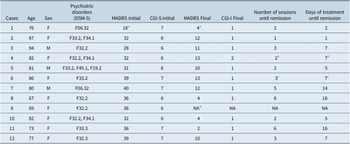
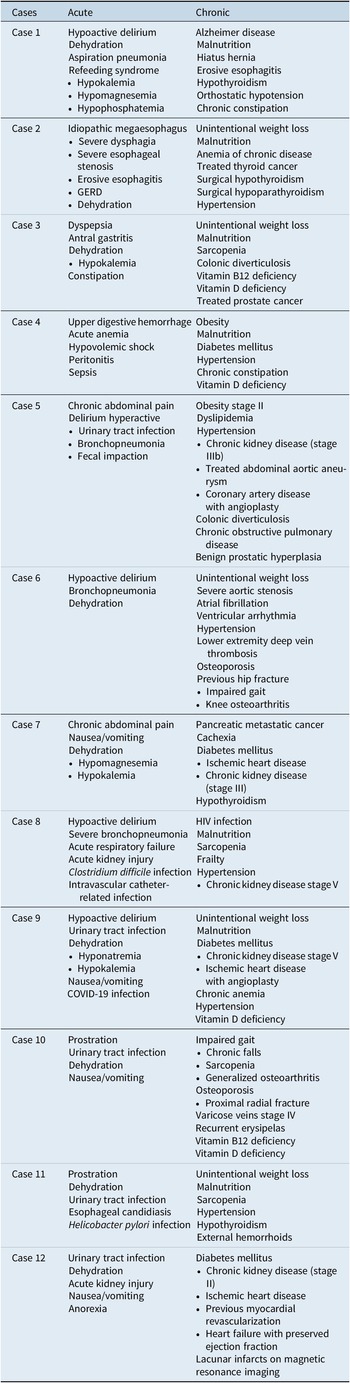
All 12 consecutive older and oldest-old inpatients with referral for ECT during the study period used SC ketamine instead and were included in the study (Table 1). All patients were rated as severely ill and had several medical comorbidities (Table 2), requiring a potent, fast-acting antidepressant to prevent clinical deterioration. Only two patients had TRD (Cases 5 and 12). We summarize here the two previously published cases to illustrate the profile of patients included in the present study: older and oldest-old adults with multiple medical comorbidities and referral for ECT but who received ketamine due to the potential adverse effects of ECT or family refusal. The first case, referred to as Case 1 in this study, was a 76-year-old woman with 14 acute and chronic medical conditions (Table 2). To our knowledge, this was the first case report of the use of ketamine for the treatment of a severe depressive episode in an advanced stage of Alzheimer’s disease. ECT was considered due to the severity of the depressive exacerbation and deterioration of medical status. Although dementia is not an absolute contraindication to ECT, treatment with SC ketamine was recommended to prevent cognitive damage. The patient achieved complete remission after two doses. She remained asymptomatic on desvenlafaxine over a 28-month follow-up period.Reference Rocha, de Vasconcelos Cunha, Paschoalin, Hara and Thomaz 5 The second case, referred to as Case 3 in this study, was a 94-year-old hospitalized man with marked functional impairment for the past 4 months. Twelve acute and chronic medical conditions were diagnosed during hospitalization (Table 2), in addition to a severe depressive episode. Treatment with SC ketamine was suggested as an alternative to ECT due to the patient’s frailty status. The patient achieved complete remission of symptoms after three doses. He remained asymptomatic with antidepressant use over a 17-month follow-up period.Reference Cunha, Rocha, Carvalho and Duarte 6
Demographic Data, Psychiatric Disorders, and Ketamine Efficacy

Abbreviations: DSM-5, Diagnostic and Statistical Manual of Mental Disorders, fifth edition (ICD-10-CM codes); CGI, Clinical Global Impression-severity; MADRS, Montgomery-Åsberg Depression Rating Scale; NA, not applicable.
a Cornell SDD.
b Mild depression.
c Borderline depression.
d Treatment interrupted due to COVID-19.
Medical Conditions Detected During Hospitalization

Note: •= Secondary.
Summary of results
This case series consists of 12 older and oldest-old patients aged 67 to 94 years, with a median age of 80.5 years (mean, 79.4; SD 7.5); 83% were women (Table 1). Patients had a mean of 12.6 (SD, 1.4) acute and chronic medical conditions, in addition to severe depression (Table 2). All patients were rated as severely ill, with a CGI-S score of 6–7 and a mean MADRS of 34.6 (SD, 3.7) (Table 1). Two patients had organic depression (Cases 1 and 7), two had psychotic depression (Cases 11 and 12), and three had double depression (Cases 2, 4, and 5). One patient had two psychiatric comorbidities (Case 5) and four patients had a severe depressive episode without psychosis (Cases 3, 6, 8, and 9) (Table 1).
Reasons for SC ketamine indication
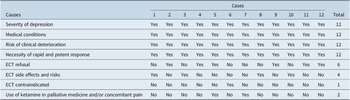
In all patients, the main reasons for SC ketamine indication were depression severity, concomitant medical conditions, clinical instability that could lead to poor outcomes, and the need for a rapid and potent antidepressant improvement due to the risk of clinical deterioration. Other indications included the analgesic effect of ketamine, patient/family refusal of ECT, and the risks of ECT. ECT was refused by the patient/family in six cases (50%). In five cases (42%), ECT was contraindicated or was considered too risky due to the patient’s clinical condition (Table 3).
Reasons for Ketamine Indication

Abbreviation: ECT, electroconvulsive therapy.
Efficacy
Nine patients (75%) completed treatment according to medical planning (Cases 1, 2, 3, 5, 7, 8, 10, 11, and 12) (Table 1). Two patients (Cases 4 and 6) asked to interrupt the treatment before the last dose because they experienced significant improvement and were already satisfied with the results of the treatment. At discharge, they were rated as mildly ill (Case 4) and borderline mentally ill (Case 6). In addition, the first patient (Case 4), together with the family members, argued that hospitalization was lengthy. The other patient (Case 6) complained that the adverse effects were unpleasant. Finally, in another patient (Case 9), treatment was discontinued after two doses, with no improvement, because the patient was infected with COVID-19.
Considering all 12 patients (intention-to-treat [ITT] population), nine (75%) achieved complete remission of depressive symptoms, two (17%) experienced substantial improvement but remained mildly or borderline mentally ill and were referred for outpatient treatment, and one (8%) discontinued treatment for medical reasons. Considering the nine patients who completed treatment according to medical planning (treatment completers), all (100%) achieved complete remission (Table 1).
The number of sessions until remission ranged from 1 to 6, with a median of two sessions (mean, 3.0; SD, 1.4). The mean time from the first SC ketamine session to complete remission was 8.6 (SD, 4.6) days, ranging from 1 to 16 days (median, 7) (Table 1).
Tolerability
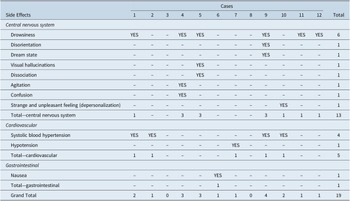
Ten patients had at least one adverse event during SC ketamine sessions. These events were neuropsychiatric (8 events), cardiovascular (2 events), and gastrointestinal (1 event) (Table 4). The most common adverse events were drowsiness (6 patients) and increased systolic blood pressure (SBP; ≥ 140 mm Hg) (4 patients) (Table 4). Most events were mild and transient, requiring no intervention. Only two patients required medical attention. One experienced confusion with restlessness for approximately 40 minutes, controlled with lorazepam (2 mg). The other patient had increased SBP and, in subsequent sessions, was given oral captopril before SC injection of ketamine, with good results.
Frequency of Side Effects by Systems and Types

Follow-up
Of the nine treatment completers in remission (Cases 1, 2, 3, 5, 7, 8, 10, 11, and 12), one died during hospitalization (Case 7). The remaining eight continued treatment with antidepressants. All of them remained stable, without relapse or recurrence, for 8–28 months of follow-up. Two patients asked to interrupt SC ketamine treatment despite the presence of mild (Case 4) or borderline (Case 6) depressive symptoms. One of these patients (Case 6) relapsed within 3 months of SC ketamine treatment due to discontinuation of the prescribed antidepressant. The other patient (Case 4) was discharged with residual symptoms, remaining stable with antidepressant therapy, without relapse, for a 15-month follow-up period.
Discussion
In this study of seriously ill older and oldest-old patients with severe depression and an average of 12.4 acute and chronic medical comorbidities, SC ketamine remission rate was 75% in the ITT population and 100% in treatment completers. These are impressive remission rates, even considering that the results of open-label studies are often better than those of clinical trials.
Esketamine was investigated in the older population in a clinical trial for the approval of intranasal esketamine in TRD (nonresponse to ≥ 2 antidepressants).Reference Ochs-Ross, Daly and Zhang 7 The study failed to achieve significance in the primary outcome measure (a change in MADRS scores from baseline to day 28), reporting remission rates (MADRS ≤ 12) of 17.5% in the esketamine/antidepressant group and 6.7% in the placebo/antidepressant group.Reference Ochs-Ross, Daly and Zhang 7 A pilot, randomized, double-blind, placebo-controlled trial investigating the use of SC ketamine in older patients with TRD (nonresponse to ≥ 1 antidepressant) showed a significant reduction in depressive symptoms and a 50% remission rate.Reference George, Gálvez and Martin 8 In our case series, the remission rate was 75% for the ITT population and 100% for completers. A major explanation for the difference in remission rates is the level of antidepressant resistance.Reference George, Gálvez and Martin 8 -Reference Subramanian and Lenze 10 In the present study, only two patients (out of 12) had a history of TRD (nonresponse to ≥ 2 antidepressants).
Esketamine was shown to be more effective in patients aged 65–74 years than in those aged ≥ 75 years.Reference Ochs-Ross, Daly and Zhang 7 In contrast, 100% of treatment completers in our study achieved remission, of whom 89% were aged ≥ 75 years (Table 1). That is, all patients aged ≥ 75 years achieved remission, reinforcing the hypothesis that the level of antidepressant resistance could be a major predictor of non-remission.
In the present study, remission was achieved after one to six sessions, within 1 to 16 days of treatment (mean 8.1, SD 5.8; median 7) (Table 1). Among remitters, 100% improved within 16 days, 78% within 14 days, and 67% within 7 days. Rapid remission, in addition to the relief of depressive symptoms, has a favorable impact on medical comorbidities, leading to earlier hospital discharge, which may reduce the risk of infection and return patients to their families sooner. Traditionally, ECT is the first-line treatment for patients with these characteristics. There is no double-blind trial comparing ECT versus ketamine in this population. However, there is evidence that ketamine could act more rapidly and effectively than ECT in the first week of treatment for patients with TRD who were scheduled for ECT, although efficacy was the same at the end of treatment.Reference Ghasemi, Kazemi and Yoosefi 11 In addition, it appears that patients treated with ECT have a longer duration of antidepressant effect.Reference Kheirabadi, Kheirabadi, Mirlohi, Tarrahi and Norbaksh 12
Treatment with SC ketamine was safe and well tolerated in our sample. At least one adverse event occurred in 83% of patients during SC ketamine sessions, with drowsiness (5 patients) and increased SBP (4 patients) as the most common events. Most side effects were mild and transient, with only two patients requiring medical attention. Ochs-Ross et alReference Ochs-Ross, Daly and Zhang 7 reported adverse event rates similar to those observed in previous esketamine studies in younger patients. Also, adverse event rates were not higher in patients with associated comorbidities (including cardiovascular and thyroid disease) and/or on concomitant medications. The most common adverse events were dizziness, nausea, increased BP, fatigue, headache, dissociation, and vertigo.Reference Ochs-Ross, Daly and Zhang 7
Our sample consisted of older and oldest-old patients with referral for ECT but who used SC ketamine instead. In a previous study comparing ECT versus SC ketamine in patients aged 18–70 years, both treatments were well tolerated.Reference Kheirabadi, Kheirabadi, Mirlohi, Tarrahi and Norbaksh 12 As expected, most patients receiving SC ketamine developed dissociative symptoms and nystagmus lasting from 0.5 to 4 hours. The main complications of ECT were cognitive and memory impairments lasting up to 1 month. Other ECT-related adverse events included headache, nausea, and musculoskeletal pain.Reference Kheirabadi, Kheirabadi, Mirlohi, Tarrahi and Norbaksh 12 Unfortunately, a negative stigma is still attached to ECT. In our study, 50% of patients and/or their family members refused ECT.
Of all nine treatment completers who achieved remission in the present study, one died during hospitalization and eight remained stable, asymptomatic, without relapse or recurrence over a follow-up period of 8–28 months. These data contrast with the literature on ketamine discontinuation after remission in patients with TRD. A major drawback of ketamine treatment is the high rate of depression relapse in a relatively short time after treatment discontinuation. In a review of prospective studies, the mean response rate to ketamine (MADRS: ≥ 50% improvement) was 64.2%, and the relapse rate (≤ 50% of baseline MADRS score at follow-up visit) was 77.8%. After treatment discontinuation, the mean time until relapse ranged from 16 to 24 days.Reference Shiroma, Johns and Kuskowski 13 , Reference Mathew, Murrough, aan het Rot, Collins, Reich and Charney 14 Another issue is the lack of robust evidence for effective treatments to prevent relapse in these patients, except for the long-term use of ketamine.Reference McMullen, Lee and Lipsitz 15 Our hypothesis for the apparent conflict between our findings and those in the literature is that the rate of relapse or recurrence in patients treated with ketamine is proportional to the level of TRD.
Our findings are limited by the retrospective open-label design of the study and small sample size. Also, the lack of a control group makes case series more prone to bias. However, we attempted to reduce the risk of bias by limiting the survey period and including all patients treated during the study period, according to preestablished criteria. Although the study was retrospective in nature, it should be noted that the assessment tools were administered during the treatment of each patient.
Conclusion
This study reports the use of SC ketamine in a specific group of patients: older and oldest-old adults with severe depression, not necessarily resistant to antidepressants, and multiple medical comorbidities at risk of clinical deterioration. These patients require a potent, rapid-onset antidepressant treatment, and ECT is most often the first-line treatment. Due to refusal of ECT by the patient/family or potential risks of the procedure, SC ketamine was used. Our findings showed high efficacy and good tolerability of SC ketamine. The patients also remained asymptomatic with antidepressant use up to 28 months of follow-up. Randomized controlled trials are needed to adequately test the use of ketamine in this specific group.
Funding Statement
This study did not receive any specific grant from funding agencies in the public, commercial, or not-for-profit sectors.
Disclosures
Fábio Lopes Rocha has received honoraria from Janssen-Cilag as clinical investigator. Ulisses Gabriel V. Cunha, Débora B. Duarte, and Cláudia Hara do not have any disclosures.