INTRODUCTION
Understanding the psychological and social aspects of the final stages of human development is essential to providing optimal care to palliative care patients. In Erik Erikson's (Reference Erikson1963) psychosocial theory of lifespan development, middle adulthood was conceptualized as an active and dynamic interplay between generativity and stagnation. Generativity includes provision of care and guidance to future generations, maintaining productivity through work or other activities, and a sense of leaving a lasting legacy. On the other hand, stagnation refers to apathy, lack of contribution to society, preoccupation with one's own needs, and an absence of care for others. Although critical in middle adulthood, Erikson and Erikson (Reference Erikson and Erikson1997) acknowledged that generativity is essential to successful aging among older adults as well.
In comparison, late adulthood was conceptualized by Erikson as an interplay between ego-integrity and despair. Ego-integrity includes looking back on one's life with a sense of meaning, acceptance of past life events, a sense of growing wise with age, and an absence of death anxiety. Despair refers to a sense of disappointment with life's trajectory, guilt or regret about past events, and a poor sense of accomplishment in life. Successful transition through these stages involves reaching a balance between their opposing poles (van Hiel et al., Reference van Hiel, Mervielde and de Fruyt2006) and incorporating both poles into a dynamic and complex understanding of the world (Torges et al., Reference Torges, Stewart and Duncan2008).
Erikson's theory has served as a basis for investigations on psychosocial development throughout the lifespan. There is evidence for the validity of both the generativity and ego-integrity stages (Bradley, Reference Bradley1997; Bradley & Marcia, Reference Bradley and Marcia1998; James & Zarrett, Reference James and Zarrett2005; Hearn et al., Reference Hearn, Saulnier and Strayer2012). McAdams and de St. Aubin (Reference McAdams and St. Aubin1992) developed and tested a comprehensive model of generativity that encompasses inner cognitions, desires, generative behaviors, and cultural demands. An increased sense of generativity was associated with self-report indices of life satisfaction, happiness, self-esteem, goal stability, and a sense of coherence in life, and was negatively associated with depression (McAdams & Azarow, Reference McAdams and Azarow1996). Similarly, achieving a sense of ego-integrity was negatively associated with depression and positively associated with psychological well-being (Rylands & Rickwood, Reference Rylands and Rickwood2001; James & Zarrett, Reference James and Zarrett2005). Consistent with Erikson's model, there is empirical evidence of a positive association between generativity and ego-integrity, including data from longitudinal studies (Torges et al., Reference Torges, Stewart and Duncan2008).
Measurement of generativity and ego-integrity has typically involved analyses of self-report questionnaires, behavioral checklists, and autobiographical recollections. However, the intended aims, wording of items, and length of administration of such measures are not readily suitable for use with older people (Schoklitsch & Baumann, Reference Schoklitsch and Baumann2011) or with palliative care patients, whose health is typically deteriorating. Measures with excellent face validity for use with palliative care patients (e.g., the Patient Dignity Inventory; Chochinov et al., Reference Chochinov, Hassard and McClement2008) include, at best, single-item measures of generativity and ego-integrity. No measure has been designed specifically to assess these concepts in the palliative patient population, and this is a significant barrier against an understanding of their importance at, or near, the end of life. In order to address this issue, the aim of our present study was to develop and evaluate a measure of generativity and ego-integrity that would be suitable for use in palliative care settings.
SCALE DEVELOPMENT
The new brief measure of generativity and ego-integrity was based on two existing and validated measures of these concepts that were derived from Erikson's psychosocial theory of lifespan development: the Loyola Generativity Scale (McAdams & de St. Aubin, Reference McAdams and St. Aubin1992) and Ryff and Heincke's (Reference Ryff and Heincke1983) Ego-Integrity Questionnaire. Both measures have good internal consistency, test–retest reliability, and convergent and discriminant validity. Some 20 items from the Loyola Generativity Scale were grouped into their 5 theoretical components (McAdams & de St. Aubin, Reference McAdams and St. Aubin1992), after which 6 items were selected based on their representativeness of each theoretical component and suitability for administration to palliative care patients. Similarly, five items were selected from Ryff and Heincke's Ego-Integrity Questionnaire based on their representativeness of the theoretical concept of ego-integrity and suitability for administration to palliative care patients.
Minor adjustments to the wording of original items were made to five original items from the Loyola Generativity Scale and three from Ryff and Heincke's Ego-Integrity Questionnaire in order to further improve item face validity. The selected 11 items were combined into one measure, and a 5-point Likert-type scale (strongly disagree, disagree, neutral, agree, strongly agree) was utilized. The final measure was named the Brief Measure of Generativity and Ego-Integrity (see Table 1).
Items comprising the brief measure of generativity and ego-integrity

METHOD
Participants were 143 adults living in New Zealand who were recruited via a research-oriented website (www.researchstudies.co.nz) after the research had been approved by a human research ethics committee. All participants completed the new questionnaire and a demographics questionnaire online. No financial or other compensation was provided. The sample size is adequate for factor-analytic studies of 11-item questionnaires (Tabachnick & Fidell, Reference Tabachnick and Fidell2001). The mean age of the sample was 44.9 years (SD = 13.9, range = 20–82). The majority of the sample were women (78.3%). The median number of children was two, ranging between none and seven, with 72.7% of participants having at least one child. The most frequent marital status was married (46.9%), followed by never married (21.7%), de facto (14%), separated or divorced (13.3%), and widowed (4.2%). The majority of the sample completed one or more years of tertiary education (77.5%), while the rest either completed high school (15.5%) or did not complete high school (7%). The majority were currently working and/or studying (80.1%), and the remaining participants were retired (11.3%) or semiretired (8.5%).
RESULTS
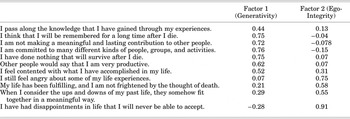
The data were screened and the factorability of 11 questionnaire items was examined. A principal-component analysis was employed to identify the latent structure of the items to check if the generativity items loaded together on one latent variable and if the ego-integrity items loaded together on a second latent variable. Oblique (oblimin) rotation was performed due to the theoretical and empirical relationships between generativity and ego-integrity. Two empirical indices regarding the data's correlation matrix revealed that it was suitable for factor analysis: Bartlett's test of sphericity was significant (χ2(55) = 423.37, p < 0.001), and Kaiser's measure of sampling adequacy was 0.82. Parallel analysis was conducted in order to accurately determine the number of components to retain (O'Connor, Reference O'Connor2000). Two factors exceeded the parallel test cutoff (3.94 > 1.61, 1.63 > 1.43, respectively) and explained a total of 50.57% of the variance. The two-factor solution showed that the six generativity items from the Loyola Generativity Scale had the highest loadings on the first factor (see Table 2). Four of five ego-integrity items from the Ryff and Heincke's (Reference Ryff and Heincke1983) Ego-Integrity Questionnaire had the highest loadings on the second factor, while the remaining item, “I feel contented with what I have accomplished in my life,” had the highest loading on the first factor.
Pattern matrix for the two-factor solution (total sample)

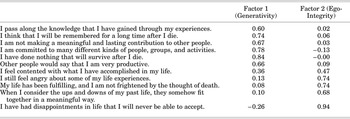
Given that the ego-integrity items are more relevant and applicable to middle and late adulthood, it was unclear whether the same latent structure obtained for the whole sample would be present in older participants. Therefore, factor analysis was repeated with the 80 participants who were at least 40 years of age. The assumptions of sampling adequacy (Kaiser–Meier–Olkin measure = 0.80) and sphericity (Bartlett's test, χ2(55) = 324.27, p < 0.001) were met. Principal-component analysis with oblique (oblimin) rotation was repeated with all 11 items. Similar to the previous analysis, the two factors exceeded the parallel test cutoff (4.53 > 1.83, 1.73 > 1.58, respectively) and explained a total of 56.90% of the variance. The two-factor solution showed that the six generativity items had the highest loadings on the first factor and the five ego-integrity items had the highest loadings on the second (see Table 3).
Pattern matrix for the two-factor solution (participants 40 years old and above)

Finally, Cronbach's α was computed for the generativity and ego-integrity subscales in order to determine their internal consistency. The values of α for both subscales (0.78 and 0.73, respectively) suggested acceptable internal consistency, particularly as the total number of items in each scale was relatively low. The α coefficients further improved (0.83 and 0.81, respectively) to demonstrate good internal consistency when only data from participants 40 years and above were included. No improvements in internal consistency were found with deletion of any items in either of the two analyses.
DISCUSSION
The aim of our study was to develop and evaluate a brief self-report measure of Erikson's concepts of generativity and ego-integrity for use with participants who have a limited life expectancy. The results showed that the 11 selected items were good representatives of the larger scales from which they were selected in that they were able to consistently and efficiently measure aspects of generativity and ego-integrity. This was particularly the case when middle-aged and older adults were included in the analysis, in line with the theoretical and empirical models of these two concepts. The resulting 11-item questionnaire addresses a number of difficulties in reliably measuring a sense of generativity and ego-integrity in palliative care settings. First, the wording of items and the relatively brief administration time would allow for more efficient assessment than previous measures among participants who may be medically unwell, have reduced energy levels, or shorter attention spans. Second, the use of a standardized measurement of generativity and ego-integrity allows for direct theoretical and empirical comparisons of these two concepts while eliminating challenges associated with comparison of measures that may significantly differ from each other. This is particularly important given that Erikson's psychosocial stages are both sequential and interrelated (Erikson, Reference Erikson1982). Finally, the inherent flexibility of this measure allows for further modification and testing, as required.
The development of this brief self-report measure takes us closer to being able to assess and understand the importance of a sense of generativity and ego-integrity in palliative care settings. However, further evaluations of this measure are required in order to determine its utility at or near the end of life, including (a) further testing with participants with limited life-expectancy, (b) further validation of the subscales by examining their associations with other relevant measures, and (c) inclusion of items controlling for the possible effect of social desirability. As such, this measure is likely to further evolve with subsequent research and testing. Of note is that a comprehensive multimodal approach to assessment of Erikson's psychosocial stages in palliative care settings would also need to include measurement of population-specific behavioral indicators and narrative accounts (McAdams & de St. Aubin, Reference McAdams and St. Aubin1992) as well as consideration of various time perspectives (e.g., past, present, future) and inclusion of family perspectives (Schoklitsch & Baumann, Reference Schoklitsch and Baumann2011). Therefore, further development and testing of other assessment tools and methodologies is needed in order to comprehensively assess Erikson's psychosocial stages among palliative care patients. Overall, the newly developed Brief Measure of Generativity and Ego-Integrity possesses good initial psychometric properties and contributes to our ability to assess these concepts among people who have a limited life expectancy.