Introduction
Tobacco use in high-income countries changed radically over the twentieth century. In the early decades of the century, the production and promotion of manufactured cigarettes drove up smoking prevalence. By the 1940s and 1950s, cigarette smoking (hereafter referred to as ‘smoking’) had become ‘an acceptable and noncontroversial part of US life’ (Troyer and Markle, Reference Troyer and Markle1983: 124) as it had in the Netherlands and the UK (Forey et al., Reference Forey, Hamling, Lee and Wald2002). Recent decades have seen smoking rates fall, a downward trend more pronounced in higher socioeconomic groups (CDC, 2010; Helasoja et al., Reference Helasoja, Lahelma, Prattala, Patja, Klumbiene, Pudule and Kasmel2006; Huisman et al., Reference Huisman, Kunst and Mackenbach2005). In the US and England, the lowest income groups have smoking rates over twice those in the highest income groups: 25 per cent compared with 10 per cent in the US and 37 per cent compared with 15 per cent in England (Craig et al., Reference Craig, Mindell and Hirani2009; Pleis and Lethbridge-Çejku, Reference Pleis and Lethbridge-Çejku2007).
Tobacco control policies are attributed a major role in the overall decline in smoking, through information campaigns and smoking restrictions that convey its social unacceptability. While seen as essential to protect public health, there is a growing appreciation among health researchers that such policies may have contributed to a social climate in which smoking and smokers are stigmatised. The paper reviews and critiques this debate. It focuses on OECD high-income countries and, in particular, on the UK and the US where much of the research on stigma and smoking is located.
The paper begins by noting the changing public attitudes to smoking and the role attributed to tobacco control policies in this cultural shift. It then describes the emerging focus on stigma among public health and tobacco control researchers (hereafter referred to as the public health research community) and the restricted way in which the debate has been framed to date. The subsequent section argues for a broader perspective on the stigmatisation of smoking, situating the process in the context of the widening socioeconomic differentials in smoking and the broader reconfigurations of social class in high-income countries.
Changing social attitudes to smoking
The downward trend in smoking in high-income countries has been associated with increasingly negative perceptions of smoking, both with respect to its health effects and its social acceptability.
Firstly, an increasing proportion of adults regard smoking as a risk to health. In the US, smoking prevalence declined from the 1950s across decades in which the proportion agreeing that smoking was a cause of lung cancer increased (from around 40 per cent in the early 1950s to over 90 per cent in the late 1990s) (Kim and Shanahan, Reference Kim and Shanahan2003; Link and Phelan, Reference Link and Phelan2009). In the 1970s, 58 per cent of US adults considered that passive smoking was harmful to health; a decade later the proportion had climbed to 88 per cent (MMWR, 1988). Similar patterns are evident in Britain. From the 1960s, public awareness of the link between smoking and lung cancer increased – and smoking prevalence declined (Marsh and Matheson, Reference Marsh and Matheson1983; Wald and Nicolaides-Bouman, Reference Wald and Nicolaides-Bouman1991). Today, surveys report high levels of public knowledge about the risks of smoking; less than 1 per cent of the population are not able to identify at least one health risk of smoking and nearly 90 per cent can identify one or more adverse effects of second-hand exposure to smoking (Wardle et al., Reference Wardle, Pickup, Lee, Hall, Pickering, Grieg, Moodie and MacKintosh2010).
Secondly and relatedly, public attitudes to smoking have changed. Summarising the changes in the US, Brandt noted that ‘the fragrant has become foul; an emblem of attraction has become repulsive; a mark of sociability has become deviant; a public behaviour now is virtually private’ (Brandt, Reference Brandt, Reynolds and Tansey1998: 176). A similar cultural shift is evident in the UK. In the 1940s, surveys described how ‘chocolates, cigarettes and really “classy” evenings out all put you one step higher on the ladder’ (Calder and Sheridan, Reference Calder and Sheridan1984: 134). By the 1960s, attitude change was well underway, with half the population agreeing that ‘smoking is a dirty habit’ (McKennell and Thomas, Reference McKennell and Thomas1967: 259). By the mid-1990s, over 50 per cent of non-smokers were reporting that they minded if a smoker smoked near them, a proportion that now exceeds 60 per cent (Lader, Reference Lader2009). Not wanting smokers nearby is not primarily about protecting one's health. While health concerns are cited, the unpleasant smell of cigarette smoking, including the smell it leaves on clothes, is the major reason given for disliking physical proximity to smokers; an increasing proportion of non-smokers report that being near a smoker makes them feel sick (Lader, Reference Lader2009).
Public health policies are seen to have played a central role in increasing public knowledge of, and changing public attitudes to, smoking (Troyer and Markle, Reference Troyer and Markle1983; Hammond et al., Reference Hammond, Fong, Zanna, Thrasher and Borland2006). In the US and the UK, health promotion campaigns were initially focused on the risks to the smoker (Berridge, Reference Berridge, Lock, Reynolds and Tansey1998; Brandt, Reference Brandt2007). From the mid-1970s, the risks to others, and specifically to children born to pregnant smokers, were incorporated into government campaigns (Berridge and Louglin, Reference Berridge and Loughlin2005). Through the 1980s and 1990s, smoking was increasingly recast as a threat to the wider public, a shift in public health discourse that was particularly marked in the US (Brandt, Reference Brandt1990; Kim and Shanahan, Reference Kim and Shanahan2003). Today, minimising non-smokers’ exposure to tobacco smoke has assumed a central place in tobacco control policy. The risks of exposure are communicated through information campaigns and warnings on cigarette packs as well as through environmental regulation: legislation governing smoking on public transport, in workplaces and in public places has progressively restricted the locations in which smoking is permitted.
As public health researchers recognise, these polices have both material and cultural impacts. They serve to protect public health, and particularly the health of those unknowingly and unwillingly exposed to smoking – and they also signal the social unacceptability of smoking and, by extension, of smokers. Analyses of internal tobacco industry documents make clear that this is precisely what the industry fears. As early as 1984, it was acknowledged that ‘the single most important issue facing our industry is the erosion of the social acceptability of smoking’. The internal memo continued (Philip Morris International, 1984):
The world's anti-smoking forces have been successful in persuading the general public, the bureaucracy and legislators that smoking is a serious health risk. Following two decades of intense propaganda, this has led to significant shifts in attitudes concerning the smoking habit. Today, it is probably true to state that even a majority of smokers feel that theirs is an undesirable habit.
Shifting social norms is hypothesised to be an important mechanism through which tobacco control policies operate, by contributing to a public sentiment which is anti-smoking and supportive of further restrictions on smoking (Chapman and Freeman, Reference Chapman and Freeman2008; Hammond et al., Reference Hammond, Fong, Zanna, Thrasher and Borland2006). There is evidence to support this hypothesis: communities where smoking is less acceptable have lower smoking rates, lower cigarette consumption and, among smokers, greater willingness to quit (Alamar and Glantz, Reference Alamar and Glantz2006; Kim and Shanahan, Reference Kim and Shanahan2003). It is therefore concluded that ‘increasing the social unacceptability of smoking is a highly effective policy tool . . . Tobacco control programs should stress the dangers of environmental tobacco smoke and reinforce the non-smoking norm’ (Alamar and Glantz, Reference Alamar and Glantz2006: 1362).
Reinforcing the non-smoking norm is described as ‘social denormalisation’, a process that seeks ‘to push tobacco out of the charmed circle of normal desirable practice to being an abnormal practice’ (Hammond et al., Reference Hammond, Fong, Zanna, Thrasher and Borland2006: 225). It is widely regarded as essential if tobacco policies are to make headway in further reducing tobacco-related morbidity and mortality, particularly in the face of the continuing influence of the tobacco industry (Feldman and Bayer, Reference Feldman and Bayer2004). However, while the overall approach is not fundamentally questioned, public health researchers have expressed concerns that policies to denormalise smoking can, by design or default, denigrate smokers. As Stuber et al. (Reference Stuber, Galea and Link2008: 422) observe about policies restricting smoking in public spaces, ‘although smoke free air laws are imposed on the act of smoking and not on the smoker as an undesirable type of person, one need only look at the huddle of smokers commonly seen outside public buildings in inclement weather to witness the decreased social standing of smokers relative to non-smokers’. A smoker in a recent Scottish study put it more bluntly: ‘I think it's a load of crap, I don't like to be made to feel like a leper and feeling as if we're being persecuted because we smoke’ (quoted in Ritchie et al., Reference Ritchie, Amos and Martin2010: 625). As these comments suggest, stigma has emerged as an important issue for tobacco control policy.
The debate on smoking and stigma
Discussions about smoking and stigma are grounded in Irving Goffman's account of the experiences of the individual who ‘possesses a trait that can obtrude itself upon attention and turn those whom he meets away from him’ (Goffman, Reference Goffman1963: 15). While stigma is often treated as an individual attribute, Goffman emphasised that it is socially produced; his interest is therefore in ‘the structural preconditions of stigma’ (Goffman, Reference Goffman1963: 11). Social inequalities figure prominently among these preconditions (Link and Phelan, Reference Link and Phelan2001; Parker and Aggleton, Reference Parker and Aggleton2003). For identities to be successfully ‘spoiled’, those on the receiving end must be disadvantaged relative to the individuals, agencies and institutions engaged in denigrating them: ‘stigma is entirely contingent on access to social, economic, and political power’ (Link and Phelan, Reference Link and Phelan2001: 375).
Goffman's work has informed studies of smoking for over two decades. A Canadian study conducted in the 1980s drew on his insights to document how both smokers and non-smokers operated with negative stereotypes of smokers, seeing them as ‘dirty’, ‘inconsiderate’ and ‘weak-willed’ (Goldstein, Reference Goldstein1991). Through the 1990s and early 2000s, smoking research continued to reference Goffman (for example Brandt, Reference Brandt, Brandt and Rozin1997; Kim and Shanahan, Reference Kim and Shanahan2003). However, the last five years has seen a more sustained engagement with stigma, both theoretical and empirical (for example, Bayer and Stuber, Reference Bayer and Stuber2006; Burgess et al., Reference Burgess, Fu and van Ryn2009; Ritchie et al., Reference Ritchie, Amos and Martin2010; Thompson et al., Reference Thompson, Pearce and Barnett2007).
While a brief summary cannot capture the differences of view and nuances of argument that characterises this work, it can identify the central foci of debate. Describing the negative ways in which smoking is depicted is one major focus (Goldstein, Reference Goldstein1991; Stuber et al., Reference Stuber, Galea and Link2008). For example, an Australian study of cultural representations of smokers in various media, including news reports, online polls and dating websites, found them characterised as malodorous, selfish, unattractive and excessive users of public services (Chapman and Freeman, Reference Chapman and Freeman2008). Qualitative studies have confirmed these findings. Non-smokers describe smoking as ‘a disgusting habit’ and smokers as ‘outcasts’ and ‘lepers’ marked by their smell (‘reek’, ‘stink’, ‘stale’) and appearance (‘dirty’, ‘brown teeth’, ‘grey, dry, wrinkly skin’) (Farrimond and Joffe, Reference Farrimond and Joffe2006). Smokers are acutely aware of these negative depictions and report a pervasive social disapproval which they feel reflects ‘an unfair stigmatizing judgement of them as a person’ (Louka et al., Reference Louka, Maguire, Evans and Worrell2006: 445; see also Platt et al., Reference Platt, Amos, Godfrey, Martin, Ritchie and White2009; Ritchie et al., Reference Ritchie, Amos and Martin2010). However, not all researchers are convinced that being a smoker qualifies as a stigma. For example, the discrediting trait that smokers possess is seen to have a transitory quality, operating when they smoke but absent at other times (Ritchie et al., Reference Ritchie, Amos and Martin2010). Burris has more fundamental concerns. While accepting that smoking is widely regarded as undesirable, he rejects ‘an effete sensitivity in which even the least whiff of social disapproval of a behavior is seen as coercive or stigmatizing’ (Burris, Reference Burris2008: 475).
A second area in the debate about the smoking and stigma concerns ‘policy-induced stigma’ (Bayer, Reference Bayer2008: 470), a term that signals how policies can mobilise and sanction hostility towards those deemed to be a threat. The potential for such effects is widely appreciated within the public health community: the history of public health is scarred by policies which, pursued in the name of health protection and promotion, have served to intensify public vilification and state-sanctioned discrimination against already disadvantaged groups. Studies have documented how, across the nineteenth and twentieth centuries, poorer communities, including migrant and indigenous groups, were cast as ‘the contaminating other’ whose habitual behaviours were seen to threaten ways of life that were, in contrast, presented as normal, healthy and desirable (Finch, 1996; Petersen and Lupton, Reference Petersen and Lupton1996). In the more recent past, public health responses to HIV/AIDs are similarly seen to have intensified pre-existing inequalities constructed around sexuality, gender and social class (Bayer and Stuber, Reference Bayer and Stuber2006; Parker and Aggleton, Reference Parker and Aggleton2003).
Given this ignoble history, it might be expected that stigma-inducing policies would be abhorred. Indeed, concerns are raised (see, for example, Bayer and Stuber, Reference Bayer and Stuber2006; Burgess et al., Reference Burgess, Fu and van Ryn2009). But they typically fall short of unequivocal condemnation. Instead, the broad conclusion is that tobacco control policies can legitimately involve a degree of stigma if they achieve their objective of protecting people's health. The moral claims of non-smokers figures prominently in this assessment. Thus, discussing the restrictions on smoking in public places, Ritchie et al. (Reference Ritchie, Amos and Martin2010: 68) argue that ‘it is inevitable that such a policy will cause some marginalisation (or stigma) of some smokers . . . but that . . . is justified by the protection of non-smokers from physical harm’. The potential health benefits of stigmatising policies are seen to extend to smokers, for example by encouraging them to quit: ‘if they work, they may represent a significant contribution to the wellbeing of the very people they burden’ (Bayer, Reference Bayer2008: 470). The continuing need to blunt corporate efforts to promote their product lends further weight to the case that stigma can be an acceptable instrument of public health policy (Chapman and Freeman, Reference Chapman and Freeman2008; Ritchie et al., Reference Ritchie, Amos and Martin2010). While this principle is broadly accepted, caution is urged around its practice: for example, sensitivity to how stigma is deployed by the anti-tobacco movement and an appreciation of its psychological impact on smokers (Bayer and Stuber, Reference Bayer and Stuber2006; Burgess et al., Reference Burgess, Fu and van Ryn2009).
In both areas of debate, individuals are typically represented by their smoking status. Thus, the question of whether smoking and smokers are stigmatised, like the stigma-inducing potential of policy, is generally discussed as if smokers were similar to non-smokers in other respects. Yet, at the same time, it is acknowledged that smokers and non-smokers have other identities and are different and unequal in multiple ways. For example, many studies note that smokers are disproportionately drawn from disadvantaged groups. In consequence, ‘all the restrictive and burdensome public health measures designed to further limit the prevalence of tobacco consumption are borne by those at the bottom of the social ladder’ (Bayer, Reference Bayer2008: 470). With disadvantaged smokers vulnerable to the ‘dual stigmatisation’ of poverty and smoking (Thompson et al., Reference Thompson, Pearce and Barnett2007: 508), tobacco control interventions need to help disadvantaged smokers ‘translate feelings of stigma into productive rather than deleterious responses’ (Burgess et al., Reference Burgess, Fu and van Ryn2009: S156). Studies have also compared the experience of smoking-related stigma across socioeconomic groups. They conclude that disadvantaged smokers report greater (Farrimond and Joffe, Reference Farrimond and Joffe2006), less (Stuber et al., Reference Stuber, Galea and Link2008) and similar levels of smoking-related stigma (Ritchie et al., Reference Ritchie, Amos and Martin2010).
In these important ways, socioeconomic inequalities in smoking permeate the debate about smoking and stigma. However, there is little direct engagement with social class. Thus, while socioeconomic differentials in smoking are noted, there is little discussion of whether and how the dynamics of social class are implicated in the social denormalisation of smoking. In consequence, socioeconomic inequalities, both in people's circumstances and in their smoking behaviour, are not interrogated as ‘structural preconditions of stigma’ (Goffman, Reference Goffman1963: 11).
Social class, smoking and stigma
Like other foundational concepts in the social sciences, there is no one agreed definition of social class (Savage, Reference Savage2000). However, in broad terms, social class refers to enduring inequalities in people's lives, which are structurally and discursively produced and resisted (Breen and Rottman, Reference Breen and Rottman1994; Weis, Reference Weis2008). The centrality of such enduring inequalities to the production of smoking as a stigma is illustrated in this section in two ways: through the changing social profile of smokers and the increasing importance of the body and behaviour in public discourses about social class and moral worth.
Changing patterns of smoking
Evidence suggests that tobacco companies initially targeted their new product at dominant social groups. In the US for example, cigarettes conveyed the social distinction of affluent, white, heterosexual men (Brandt, Reference Brandt2007). The association with social prestige was also central to opening up a female market for the new tobacco produce: the popular media set women's smoking within the heterosexual courtship of the social elite (Tinkler, Reference Tinkler2001). The limited evidence indicates that these marketing strategies were successful (Brandt, Reference Brandt2007; Hilton, Reference Hilton2000). However, while the habit was taken up first by young adults in socially advantaged groups (Graham, Reference Graham2009a; Lopez et al., Reference Lopez, Collishaw and Piha1994), prevalence quickly rose among lower-income groups. For example by the 1940s in Britain, smoking rates were uniformly high across socioeconomic groups, both for men (over 60 per cent) and women (over 40 per cent) (Wald and Nicolaides-Bouman, Reference Wald and Nicolaides-Bouman1991).
The social cachet of cigarettes inevitably declined as the habit spread: social distinction cannot be claimed for a commodity bought and consumed on a mass scale. By the time that trend data were first available – in the 1940s in the UK – male prevalence was already declining in the higher socioeconomic groups (Wald and Nicolaides-Bouman, Reference Wald and Nicolaides-Bouman1991). Interestingly, this downward trend predated the scientific papers (Doll and Bradford Hill, Reference Doll and Bradford Hill1950) which warned of the health risks of smoking and the reports (e.g. RCP, 1962) which moved the issue into the public domain.
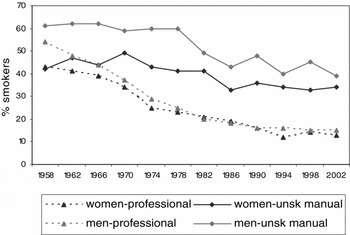
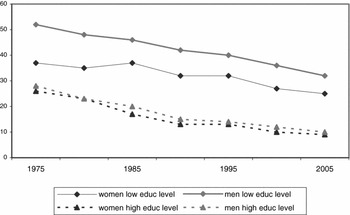
Socioeconomic differentials in smoking continued to widen in Britain through the 1970s, 1980s and 1990s (Figure 1), decades in which social attitudes shifted against smoking. In the US, too, the increasing social unacceptability of smoking coincided with its increasing concentration in disadvantaged groups (Figure 2). Similarly in Australia, ‘smoking is increasingly a badge of unemployment, low socioeconomic status and low educational achievement’ (Chapman and Freeman, Reference Chapman and Freeman2008: 27). As this suggests, smoking identities are inseparable from class identities; the negative labels which studies suggest are increasingly attached to smoking (‘a disgusting habit’) and to smokers (‘inconsiderate’, ‘weak-willed’, ‘dirty’) are inevitably class labels as well.
Prevalence of cigarette smoking among men and women in the highest (professional) and lowest (unskilled manual) socio-economic groups, Britain, 1958–2000
Sources: Wald and Nicolaides-Bouman (Reference Wald and Nicolaides-Bouman1991, table 5.2), Office for National Statistics (2001, table 8.8).

Prevalence of cigarette smoking among men and women in the highest and lowest educational groups, US, 1975–2005
Source: CDC (2010, table 62).

Drilling deeper into the class patterning of smoking, quantitative analyses suggest that smoking careers are shaped by persisting disadvantage. UK studies have documented how disadvantaged pathways, from poor childhood circumstances through early school leaving and into poor adult circumstances, are associated with an increased risk of smoking. For women, domestic trajectories also matter. Thus, early motherhood and single motherhood increase smoking risk over and above the effects of childhood disadvantage, educational disadvantage and poor adult circumstances (Graham et al., Reference Graham, Inskip, Francis and Harman2006; Graham et al., Reference Graham, Hawkins and Law2010). Among mothers on disadvantaged pathways – whose childhood circumstances were poor, who left school at the minimum permitted age, became a teenage mother and now lived on a low income – smoking rates approach 70 per cent (Graham, Reference Graham and Graham2009b).
These quantitative analyses suggest that being a smoker is a social marker of class-related disadvantage. Qualitative studies of the everyday lives of disadvantaged groups − of young people from poorer backgrounds, teenage mothers and welfare claimants, for example – make clear that they are framed both by material hardship and by a public discourse which undermines claims to moral worth (Charlesworth, Reference Charlesworth2000; Graham and McDermott, Reference Graham and McDermott2006; Seccombe et al., Reference Seccombe, James and Walters1998). As one example among many, a young mother summarised her experience of stigma by noting, ‘they look at you like you are a slag or something. No one smiles at you or anything, they just give you dirty looks’ (Letherby et al., Reference Letherby, Wilson, Bailey and Brown2001: 20).
Stereotypes of smokers draw on the repertoire of negative representations that young mothers, like other disadvantaged groups, experience and resist on a daily basis. As both quantitative and qualitative studies make clear, non-smokers align smokers with other stigmatised groups. In a UK study, non-smokers referred to ‘teenage smokers’, ‘smoking mothers’, ‘lower social class benefits kind of image’, ‘poor council house tenants’, ‘working class’ and ‘unemployed’ (Farrimond and Joffe, Reference Farrimond and Joffe2006: 487). An Australian study of the ‘spoiled identity’ of smokers similarly noted that smokers were seen as ‘undereducated and a social underclass’ (Chapman and Freeman, Reference Chapman and Freeman2008: 27). Such negative representations are actively challenged, with smokers asserting a moral identity in the face of representations which cast them as selfish and undeserving (Coxhead and Rhodes, Reference Coxhead and Rhodes2006; Thompson et al., Reference Thompson, Pearce and Barnett2007).
Smoking and the classed body
The increasing social disapproval of smokers has not only emerged across decades in which social inequalities in smoking have widened. Cultural shifts in attitudes to smoking have also occurred in the context of broader social changes in high-income countries. Among these changes has been a marked decline in manual work, with displaced manual workers who lack the credentials needed to access skilled non-manual jobs increasingly dependent on insecure and low-paid work (Mishel et al., Reference Mishel, Bernstein and Allegretto2007; Müller and Gangl, Reference Müller and Gangl2003). At the same time, patterns of partnership and parenthood have changed. The average age of becoming a parent has risen, particularly among young people from advantaged backgrounds, and parenthood increasingly takes place outside marriage, a trend more pronounced among young people from poorer backgrounds and without educational qualifications (Singh et al., Reference Singh, Darroch and Frost2001).
Sociological analyses suggest that these social changes are reflected in discursive shifts in the representation of social distinction and social disadvantage in the UK, US and other high-income countries (Savage, Reference Savage2000; Weis, Reference Weis2008). It is argued that labour market position – traditionally measured by own occupation for men and the occupation of male head of household for women and children – has lost its pre-eminence as a marker of social position. Instead, the boundaries between ‘us’ and ‘them’ are signalled by a more diffuse set of indicators. While embodied differences have long been important, analyses suggest that how bodies look and behave is assuming increasing centrality as oblique signifiers of social class. Thus, body shape and sartorial style, together with everyday practices – health behaviours, leisure pursuits, parenting patterns – are treated as markers of broader differences in social background and cultural values, a way of referencing social class without explicitly naming it (Lawler, Reference Lawler2005; Southerton, Reference Southerton2002). A parallel shift has been identified within public health discourses, where ‘the body has become an increasingly important signifier of moral worth . . . work on the body has become a crucial means by which the individual can express publicly such virtues as self-control, self-discipline, self denial and will power’ (Petersen and Lupton, Reference Petersen and Lupton1996: 25). As this suggests, bodies and behaviours are centrally placed in the changing cultural landscapes of social class and responsible citizenship.
Smoking behaviour is deeply embedded in these coded discourses. It is among the recurrent signifiers used by those who wish to position themselves as part of what they see as mainstream middle class society. For example, a participant in a UK study described those ‘who are not like me’ as follows (Southerton, Reference Southerton2002: 185):
It sounds awfully snobbish to say, but if you stand behind somebody in Tesco's . . . it's blatantly obvious where they live because of the way, there's a different dress code . . . you've got this almost downtrodden image . . . And you seem to get this overweight syndrome, mum's always got a cigarette in her hand . . . even the kids are different, the behaviour, the noise, the way they play.
The reference to smoking (‘cigarette in her hand’) is wrapped into an unrelentingly derogatory account (‘different dress code’, ‘downtrodden image’, ‘overweight syndrome’, ‘the noise’). By inferring class through bodily and behavioural cues, the effect is to construct ‘working class people . . . as foundationally “other” to middle class existence that is silently marked as normal and desirable’ (Lawler, Reference Lawler2005: 431). Analyses of the media – the press, TV, websites and internet forums for example – suggest that the ‘otherness’ of the working class is frequently presented as synonymous with an underclass, thereby stripping it of any association with social respectability and self-worth (Lawler, Reference Lawler2005; Tyler, Reference Tyler2008). As in the account above, the figure of the smoking mother figures prominently in these depictions, which often convey an undisguised and visceral contempt for what one journalist refers to as ‘the mums . . . with pallid faces telling tales of a diet of hamburgers, cigarettes and pesticides’ (Aaronovitch in Lawler, Reference Lawler2005). This class contempt hits home. For example, the young women in Skeggs’ ethnography of working-class identities were acutely aware that behaviours like smoking marked the boundary between the ‘rough’ and the respectable. As one young woman put it, those on the wrong side of the divide were ‘common as muck you know, always have a fag in their mouths’ (Skeggs, Reference Skeggs1997: 75).
It is therefore not surprising to find that the image of the smoker lurks within such pejorative terms as ‘welfare mother’ in the US and ‘chav’ in the UK (Hayward and Yar, Reference Hayward and Yar2006; Kelly, Reference Kelly2010; Tyler, Reference Tyler2008). Such terms have widespread currency, including in the online media. Racially coded in different ways (as African-American and white respectively), the terms signal that ‘they think you ain't much of nothing’ (Seccombe et al., Reference Seccombe, James and Walters1998: 849). A US study of images of the ‘welfare mother’ on TV news programmes noted how women dependent on welfare benefits were depicted as too unintelligent and lazy to work, having excessive numbers of ill-disciplined children – and being smokers (Kelly, Reference Kelly2010: 84). Similarly, in the UK, cigarette smoking figures in the assumed consumption practices of ‘chavs’. Young men are depicted ‘with baseball cap at ninety degrees . . . strutting around, fag in one hand, jewellery all over the other, outside MacDonalds’ (Urbandictionary, 2003). With respect to young women, a newspaper noted that (Davidson quoted in Tyler, Reference Tyler2008: 21):
We will know them by their dress . . . and trail of fag ends, sparkling white trainers, baggy tracksuit trousers, branded sports top, gold-hooped earrings, ‘sovvy’ [sovereign] rings and the ubiquitous Burberry baseball cap. Throw them together, along with a packet of Regal [cigarettes] and you have the uniform of what is being identified as the UK's new underclass – the chav.
Conclusion
With cigarette smoking identified as the leading cause of loss of healthy life in high-income countries (Lopez et al., Reference Lopez, Mathers, Ezzati, Jamison and Murray2006), it is not surprising that an effective tobacco control policy is a public health priority. Changing public attitudes to smoking is regarded as integral to such a policy; maintaining the momentum of normative change is therefore seen as essential. However, a series of studies have noted that normative change has important downsides. As Bayer and Stuber put it, ‘the antitobacco movement has fostered a social transformation that involves the stigmatisation of smokers’ (Bayer and Stuber, Reference Bayer and Stuber2006: 47).
To date, the debate about smoking and stigma has been largely conducted by and within the public health research community. While there are dissenting voices, it is generally agreed that smoking and smokers are stigmatised and that tobacco control policies are likely to have contributed to this process, but the public health gains outweigh these social costs. In reaching this conclusion, the link between social disadvantage and smoking is recognised. However, smoking as a classed identity remains on the margins of debate.
The paper has queried the marginalisation. It has argued that neither the stigmatised status of smoking nor the stigma-inducting potential of policy can be understood without sustained engagement with social class and, by extension, with social inequalities more generally. In support of its argument, the paper has drawn on sociological research to illuminate how class operates in people's lives to produce smoking and smokers as stigmatised. It has described how class inequalities, as materialised across the lifecourse and projected onto the bodies of others, underpinned the rise and fall of cigarette smoking prevalence – and the emergence of smoking as a class signifier and stigmatised identity.
It is important to note that the paper's analysis is a preliminary exploration of a large and complex canvas; much is inevitably left uncovered. Further, the debate about smoking and stigma has been led by tobacco researchers in a small number of high-income countries, particularly the UK and US, but also Australia and New Zealand. This group of countries is distinguished by marked inequalities in life chances, living standards and health-related behaviours; these inequalities are especially pronounced in the UK and US where the debate has been focused. It would be important to examine the social denormalisation of smoking in societies where class differences were less evident and, particularly, to establish whether it has been achieved without a class-inflected stigmatisation of smoking.
If the argument advanced here is correct, and the dynamics of social class do indeed play a central role in the social denormalisation and consequent stigmatisation of smoking, what would be the implications for tobacco control research and policy? Firstly, if the contribution of policy to changing social attitudes towards smoking derives, at least in part, from the power of the class discourses with which it resonates, then evaluations may over-estimate the effects of policy. In other words, the increasing undesirability of smoking may be driven by its increasingly visible association with social disadvantage. This possibility has been indirectly signalled by Chapman and Freeman, who urge the public health community to pay greater attention to unmeasured ‘distal cultural and environmental factors’ that, by ‘priming’ vocal sections of the population to be anti-smoking and anti-smoker, ensures the success of tobacco control policies (Chapman and Freeman, Reference Chapman and Freeman2008: 25; see also Chapman, Reference Chapman1993). This paper's analysis suggests that social inequalities are prime examples of such distal cultural and environmental factors. As other researchers note, the tobacco control community should pay closer attention to the contextual mediators of policy effects (Poland et al., Reference Poland, Frohlich, Haines, Mykhaloyskiy, Rock and Sparks2006).
Secondly, the paper points to the importance of equity-oriented evaluations of tobacco control policies. In particular, it argues for evaluations that explicitly incorporate societal contexts and multiple outcomes. The principles of equity impact assessments are widely known; in broad terms, they seek to scope and to assess the impacts of policies both on overall health and the health of different population groups.
One well-known approach, equity focused health impact assessment, lends itself to the assessments of contextual influences and broader outcomes (Harris-Roxas et al., Reference Harris-Roxas, Harris, Harris and Kemp2011). An early stage of the assessment process is ‘impact identification’, a stage in which a range of possible outcomes, positive and negative, can be mapped. A broad understanding of outcomes would allow discursive impacts to be identified at this scoping stage. For example, it would enable explicit attention to be paid to how tobacco control policies can feed into a class discourse in which cigarettes are a recurrent trope (‘this overweight syndrome, mum's always got a cigarette in her hand’, ‘common as muck, always have a fag in their mouths’). As Thompson et al. (Reference Thompson, Pearce and Barnett2007: 515) note, ‘much more careful thought needs to be given to the effects of multiplying levels of stigma, however unintentionally’. The central stage of the process of equity impact assessment focuses on the ‘assessment of impacts in this setting at this time’, thus making engagement with context an explicit part of impact assessment. Framed in this way, it could capture how the same tobacco control policy – for example, prohibiting smoking in public places and having picture warnings on cigarette packs depicting the smoking-ravaged bodies of smokers – can have different impacts in societies where the politics of class are configured differently. In societies where class is coded through behaviours like smoking, policies conveying the message that smokers are outsiders who threaten public health are likely to do little to reduce class prejudice and to promote social cohesiveness.
Thirdly, and most importantly, the paper argues for tobacco control policies that engage directly with social inequalities. Despite a widespread appreciation that social inequalities drive the uptake of smoking in adolescence and its persistence across adulthood, tobacco control policy continues to be directed at changing smoking behaviour – and not at changing people's circumstances. Thus, while it is agreed that only a comprehensive approach will reduce the social and economic costs of smoking (DH, 2011; WHO, 2008), the components of such an approach are all smoking focused. They are about providing better information on its health risks, increasing the price of cigarettes, restricting advertising and the places where smoking is permitted, improving smoking cessation services, etc. (see, for example, Joosen and Raw, Reference Joosens and Raw2006; World Bank, 2003). None of the ‘comprehensive’ approaches includes policy levers to tackle the inequalities in life chances and living standards which leave poorer groups at greater risk of smoking. Such wider polices are likely to be essential if the dominant approach to tobacco control is not to be associated with the increasing stigmatisation of poor smokers.
The public health community recognises that consensus about tobacco control policy is a major political asset in the face of well-funded corporate opposition and, not infrequently, resistance from governments. The registering of doubt about the shape and content of policy may jeopardise progress which has been very hard won - and can be easily lost. However, not to raise questions about the place of social class in the debate about smoking and stigma runs other and potentially greater risks. It risks sidelining the structural conditions which underlie not only smoking and stigma but the broader social inequalities of which smoking is part.
Acknowledgements
I would like to thank Sally Stephenson, University of York, for her help in chasing down references, and two anonymous referees and the editors for their helpful comments on the paper.