

Introduction
Politics increasingly takes place not only within the traditional public sphere, but outside of it. Much has been written about ‘politics beyond the state’ (Wapner, Reference Wapner1995) and non-governmental organizations' (NGOs') turn towards firms and industries as the location of their political action. Common accounts hold that this is a product of globalization and the rise of transnational supply chains (Clarke et al., Reference Clarke, Barnett, Cloke and Malpass2007; Gereffi and Lee, Reference Gereffi and Lee2016), or the rise of ‘political consumers’ – especially in Europe and the developed world – willing to boycott or purchase products based on their political or social beliefs (Micheletti, Reference Micheletti2003). However, these explanations have focused on how groups choose targets within the market – including which firms are most likely to be targeted (Vogel, Reference Vogel1978; Mena and Waeger, Reference Mena and Waeger2014) – how these campaigns take place (Soule, Reference Soule2009). Very little research examines the choice between the state and the market, and under which conditions groups target their campaigns at one or the other, or combine both. At the national level, such choices can rarely be examined through the lens of globalization or corporate power, as they fail to explain why groups would campaign at the domestic level if their aim is transnational corporate change.
This study examines this choice between the state and the market in NGO campaigns through the lens of lobbying and advocacy. One of the key questions of lobbying research has been why different interest groups choose the strategies they do. Research has shown that their strategic choices are constrained by a variety of factors, from the structures within which they act, to the resources they control and the type of issue at hand. Despite the plethora of research on groups' advocacy strategies, however, there are two major gaps in our knowledge about their choices. The first is that despite the increasing focus on combinations of strategies across a group's campaign (Binderkrantz, Reference Binderkrantz2005; Dellmuth and Tallberg, Reference Dellmuth and Tallberg2017), the operationalization and measurement of these combinations has remained elusive. The second is that conventional studies of lobbying exclude one form of influence: those strategies that take place within the market. While the traditional definition of lobbying is action targeted at changing public policy (Baumgartner and Leech, Reference Baumgartner and Leech1998), this definition does not take into account the increasingly active role of (multinational) corporations and the growing number of citizen actions towards companies (Mayer and Gereffi, Reference Mayer and Gereffi2010; Stolle and Micheletti, Reference Stolle and Micheletti2013). Existing frameworks, which exclude market-oriented strategies, thus risk missing a large proportion of certain groups' actions.
This study aims to fill these two gaps, examining one simple question with three outcomes: when do NGOs choose to target their advocacy campaigns at (a) the market, (b) the state and (c) both?Footnote 1 It builds upon previous, novel theoretical work (Colli and Adriaensen, Reference Colli and Adriaensen2018) to empirically examine 24 cases using fuzzy-set qualitative comparative analysis (fsQCA). Each case is one NGO campaign on a particular issue, providing the opportunity to examine a broader range of activities and combinations of strategies across the state and the market. This research is not only important to gain a better understanding of the broader picture of NGO advocacy; the findings may also have implications for the democratic legitimacy of policymaking (Schattschneider, Reference Schattschneider1960). NGOs, in particular, are seen to represent citizens, and assessing how they lobby is important to know how their voices are represented in debates. Moreover, targeting the market may be seen as a way of ‘exiting’ the political system. If, for instance, groups exit because they are excluded from decision-making institutions, this would imply that certain voices are excluded from the policy-making process, with significant ramifications for the health of democracy.
The rest of this paper proceeds as follows. I first introduce the lobbying approach taken in the paper, introducing the types of advocacy strategies that groups can choose between in the state and the market, before outlining the factors expected to influence this choice. I then introduce the method and data collection, before a brief outline of the operationalization of conditions and outcomes. Finally, I present the fsQCA results for each outcome, before drawing all of the analyses together, providing broader interpretations and discussing their implications.
Advocacy strategies: inside and outside, state and market
Work examining interest group advocacy and social movement action has generally split strategies up into dichotomous typologies. Dominant among these is the inside–outside typology, which has been extensively used in both the interest group and social movement literature (Beyers, Reference Beyers2004; Dür and Mateo, Reference Dür and Mateo2016). Inside strategies are those targeting policymakers directly, while outside strategies mobilize public opinion in the group's favour and signal this to policymakers. These terms have sometimes been changed to focus on the targeting of different institutions, for instance parliamentary and bureaucracy-targeted lobbying (Binderkrantz, Reference Binderkrantz2008) or media-oriented lobbying (Berkhout, Reference Berkhout2010). In a similar manner, tactics in social movement studies have been classified as working within existing institutions for change, or seeking their replacement from outside (McCarthy and Zald, Reference McCarthy and Zald1977).
Nonetheless, there are two main gaps in our current understanding of groups' strategic choices. The first is the use of combinations of strategies. In reality, groups rarely use only one type of tactic in their campaigns; a more diverse approach – while more resource-intensive – may also increase their effectiveness. This is increasingly acknowledged by the literature on advocacy (Binderkrantz, Reference Binderkrantz2005; Dür and Mateo, Reference Dür and Mateo2013; Buffardi et al., Reference Buffardi, Pekkanen and Smith2015). Inside and outside strategies are more commonly perceived as ‘complementary rather than competing’ (Dellmuth and Tallberg, Reference Dellmuth and Tallberg2017: 708), with groups using different strategies at different stages of the policy process or to target different policy-making actors and institutions, alongside other tactics such as coalition-building or framing (Kollman, Reference Kollman1998; Walker et al., Reference Walker, Martin and McCarthy2008; Hanegraaff et al., Reference Hanegraaff, Beyers and De Bruycker2016). This contradicts early assumptions that outside strategies would damage groups' reputation among policymakers and make institutions wary of providing access to groups who could turn on them at any moment (Page, Reference Page1999). As such, a focus on combinations of strategies may better reflect the reality of advocacy, where groups combine strategies as much as they can, given their resources. However, proportional (non-configurational) methods have limitations when trying to capture or measure combinations of strategies – beyond the percentages of each type of strategy.
The second shortcoming in the current research on lobbying is the fact that NGO advocacy strategies in the market have remained unexamined alongside their action on public policy in the state. The literature on social movements and organizations has long highlighted that NGOs also engage in political action towards corporations (Vogel, Reference Vogel1978; Boris and Steuerle, Reference Boris and Steuerle1998; Soule, Reference Soule2009; de Bakker et al., Reference De Bakker, den Hond, King and Weber2013), and use ‘private’ politics in their campaigns (Baron, Reference Baron2003). Nonetheless, the choice between and among strategies in the state and the market has remained unexamined. While the interest group literature examines both inside and outside strategies, it neglects market-targeted strategies; and although studies of social movements take market strategies into account, the choice between the state and the market has never been examined side-by-side.
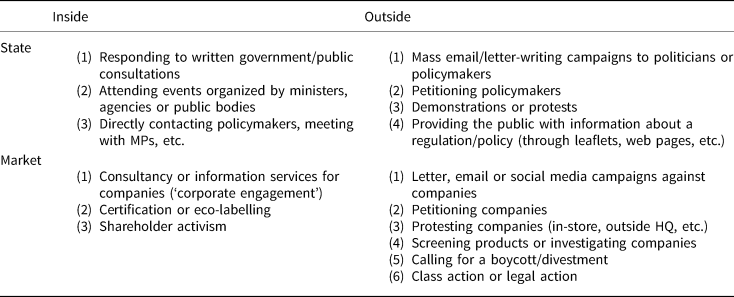
Previous work, however, highlights that market strategies – like state strategies – can be classified as ‘inside’ and ‘outside’ through the ways in which NGOs engage with firms (Colli and Adriaensen, Reference Colli and Adriaensen2018). Direct contacts with firms – including private regulation and corporate engagement (Boström and Klintman, Reference Boström and Klintman2011) and shareholder activism (Hamilton, Reference Hamilton2013) – are the market equivalent of ‘inside’ strategies. Groups can also target corporations by mobilizing public opinion through boycott and divestment campaigns, social media, petitions or protests against company actions (Friedman, Reference Friedman1999; Stolle and Micheletti, Reference Stolle and Micheletti2013). NGOs, therefore, have at least four paths that they can choose to influence policy or companies through the market and the state; however, these have very rarely been examined alongside each other. Table 1 presents an outline of the potential strategies available to NGOs (see also Colli and Adriaensen, Reference Colli and Adriaensen2018; Colli, Reference Colli2020). This framework allows us for the first time to operationalize and comparatively measure NGOs' lobbying strategies in the state and the market.
List of strategies (Colli, Reference Colli2020)

The choice between the state and the market
Initial development of the state/market choice has highlighted some broader reasons why groups may choose to target their action at one or the other. Based on venue-shopping and political opportunity structure (POS) approaches (McAdam, Reference McAdam, Mcadam, McCarthy and Zald1996; Princen and Kerremans, Reference Princen and Kerremans2008), the overarching logic here is that lobbying a particular venue becomes more attractive when that venue is more important in the market governance system (Colli and Adriaensen, Reference Colli and Adriaensen2018: 7). Follow-up work highlighted the role of public mobilization in market strategies, whereby market strategies are used as a technique to increase public awareness around an issue (Colli, Reference Colli2020). This paper aims to identify and test more specific features that may affect groups' choices among and between strategies. These factors essentially affect groups' abilities to mobilize resources (both financial and human) and thereby survive in a competitive strategic environment (see e.g. Hanegraaff et al., Reference Hanegraaff, Beyers and De Bruycker2016; Hanegraaff and Pritoni, Reference Hanegraaff and Pritoni2019).
Due to the lack of research on the choice among strategies within the state and the market, it is difficult to draw clear theoretical expectations about the role of different factors in this choice. Given that market strategies – whether inside or outside – require some level of consumer participation to function (Gulbrandsen, Reference Gulbrandsen2006), they seem to present most similarities to outside strategies, in that they require public participation to work. In the following section, I therefore build on the logic determining the choice between inside and outside strategies to draw theoretical expectations for the choice between state and market strategies.
Structural arguments
A first group of factors focuses on the structures within which they are embedded, embodied in venue-shopping and POS theories. These focus on the structural openness of the political system and its receptivity to the claims of a particular actor (Princen and Kerremans, Reference Princen and Kerremans2008: 1131). Although POS have been criticized for a tendency to become overly broad, a common definition entails four factors: the relative openness or closedness of political institutions; the stability of elite alignments within the political system; the presence or absence of elite allies; and the state's propensity and capacity for repression (McAdam, Reference McAdam, Mcadam, McCarthy and Zald1996). More open structures make organizations more likely to use inside strategies, as they are able to gain access to the political system. POS has recently shifted to focus not only on these objective structures but also on how open groups perceive them to be (Kurzman, Reference Kurzman1996). Of course, these perceptions may be linked to the group-level arguments above, as groups with higher resources or less concerned about survival may be able to concentrate more resources on lobbying, and therefore have a higher estimation of the change they can affect. This interplay between structure and agency highlights the utility of using configurational methods to study groups' strategic choices.
POS have already been somewhat adapted to the market. Factors included in these ‘market’ opportunity structures are generally (loosely) based on those included in the state. Schurman's (Reference Schurman2004) ‘industry opportunity structures’ include specific industry features facilitating mobilization, including market fragmentation and the sensitivity or negativity of the product or service produced. Again, market opportunity structures remain a broad concept: factors included in other versions of the concept include the resources for change in the target industry; the multiplicity of industry stakeholders; possibilities for counter-mobilization of the industry; target vulnerability (including reliance on branding and dependence on consumers); the existence of private regulation; and the type of change demanded (Wahlström and Peterson, Reference Wahlström and Peterson2006; Mena and Waeger, Reference Mena and Waeger2014). To date, however, no side-by-side comparison of opportunity structures in the state and the market has been undertaken. A standardized operationalization of how NGOs choose between the state and the market, allowing for comparison beyond case studies, has not yet been attempted.
Resource arguments
An organization's resources interact with the POS to determine which of the available strategies it chooses. Inside strategies require organizations to have policy- or subject-specific expertise to be considered trustworthy enough for policymakers to rely on the information that they provide. Outside strategies, on the other hand, require organizations to (seem to) legitimately represent the interests of the ‘public’ or a broad constituency (Bouwen, Reference Bouwen2002; Binderkrantz, Reference Binderkrantz2005; Beyers and Kerremans, Reference Beyers and Kerremans2007; Dür and Mateo, Reference Dür and Mateo2016). In contrast, collective action and population ecology theories emphasize groups' preoccupation with their own survival; strategies depend on groups' precarity and reliance on members (Lowery, Reference Lowery2007). Members of specific interest groups (like business organizations) are generally organizations paying membership fees, who want to know that the group is representing their interests towards institutions by providing expertise and policy input. In contrast, members of diffuse groups (such as civil society organizations) generally do not follow the actions of the group as closely; in order to maintain high membership and funding levels, groups must use more public actions to ‘prove’ that they are active (Kollman, Reference Kollman1998; Dür and Mateo, Reference Dür and Mateo2016; Hanegraaff and Pritoni, Reference Hanegraaff and Pritoni2019). It should be noted that both of these explanations are inherently resource-based and lead to similar predictions and findings: civil society groups (with generally lower funding and more diffuse membership) are more likely to use outside strategies, while specific interest groups are more likely to use inside ones. In fact, some scholars have found that the difference between civil society organizations and businesses becomes more marked, rather than disappearing, when groups have more resources (Dür and Mateo, Reference Dür and Mateo2016), implying that the survival logic prevails.
Given the mixed results of higher resources (whether they lead NGOs to use more inside or outside strategies), it is difficult to draw clear expectations for how resources affect the choice between the state or the market. Nonetheless, we may expect higher resources to lead NGOs to combine strategies more often, as has been found previously in the case of NGOs targeting the state (Junk, Reference Junk2016). Resources may also allow groups to use more market strategies as these are likely to be more resource-intensive than state strategies, given that the structures for interest participation are already established in the state.
Issue arguments
The third group of arguments are based on the policy issue itself. Different issue factors have been shown to be important for the choice between inside and outside lobbying: the generality or specific of groups' policy goals (Binderkrantz and Krøyer, Reference Binderkrantz and Krøyer2012), whether groups are lobbying on distributive or regulatory issues (Mahoney, Reference Mahoney2008; Dür and Mateo, Reference Dür and Mateo2013) and whether a public good is at stake (Junk, Reference Junk2016). These issue-level factors all share the same logic: that different topics affect the likelihood that groups will be able to mobilize their members and draw public attention to an issue, summed up as how politicizable an issue is. Politicization has recently begun to be operationalized in a rigorous manner, with three main factors identified as indicators: polarization of opinions or interests, actor expansion and high public salience (de Wilde, Reference De Wilde2011; De Bruycker, Reference De Bruycker2017). Given that the first two of these are difficult or impossible to measure when discussing a policy issue rather than lobbying on a specific proposal or bill (where it is much easier to measure the number and polarization of actors involved by e.g. counting responses to a consultation), this research focuses on public salience as a proxy measure for politicization.
It is important to note that the relationship between politicization and strategies may run two ways: politicization increases the chances of success through outside lobbying as more members of the public get involved and policymakers have no option but to pay attention; however, outside lobbying also increases politicization (and therefore the chance that civil society groups will be listened to) (Culpepper, Reference Culpepper2011). When discussing the choice between the state and the market, it is reasonable to assume that a similar relationship between lobbying and politicization occurs. Previous research has shown that market strategies are particularly useful in simplifying political issues and making them accessible to the public (Friedman, Reference Friedman1999; King, Reference King2008b), as they allow groups to frame strategies in concrete terms of winners and losers (Schurman, Reference Schurman2004). In other words, market strategies help groups to politicize an issue and thereby to create or improve the opportunity structures they are faced with (Colli, Reference Colli2020). This research therefore investigates the politicizability of the issue – how easily it can be politicized – rather than the current politicization. Following the (somewhat circular) logic outlined above, if an issue is easily politicizable, groups are more likely to use market strategies to (successfully) politicize the topic, which in turn increases the likelihood that their campaign will be successful.
Method
Fuzzy-set QCA
The method chosen for this research is fsQCA (Ragin, Reference Ragin1989). QCA was chosen for this research for several reasons. First, the aim of this article is to explain how a particular outcome came about – why NGOs lobby the state, the market or both – rather than explaining the effect of a particular variable, making QCA an appropriate choice. Second, given that the population of cases is unknown – there is no list of all NGO campaigns in a particular country – methods that require the use of a random or representative sampling are not viable. Finally, as highlighted above, the POS approach lends itself well to a configurational method such as QCA, as it is inherently focused on the effect of combinations of agential and structural conditions. In this case, choosing QCA allows us to better grasp how group and issue factors interact with structures and lead to certain strategic choices by groups.
Case selection and data collection
This paper examines 24 NGO campaigns across four issues (cage eggs, antibiotic use in farming, ocean plastics and civil rights and technology) in two western European countries (the UK and Italy). This paper takes a most similar, different outcome approach to selecting cases (Berg-Schlosser and De Meur, Reference Berg-Schlosser, De Meur, Rihoux and Ragin2009); in other words, it sets scope conditions within which the cases must fall (‘most similar’ cases), and then selects cases within this scope to ensure variation along key variables (Jordan et al., Reference Jordan, Gross, Javernick-Will and Garvin2011). The aim was to have a mix of outcomes (i.e. cases where NGOs used market strategies, state strategies and both) but also as much variation among conditions as possible.Footnote 2 In a first step, the four issues were purposively selected based on variation in the sensitivity of the issues – particularly the link to public health and safety, which has been shown to increase the likelihood of market-based activism (Schurman, Reference Schurman2004). Importantly, however, all of the issues chosen could feasibly have campaigns that targeted the market or the state.
The two countries were then selected in a second step to increase this variation. The UK and Italy both fit within the scope conditions (western European countries) and are broadly comparable – both are EU member states (for the period under examination) and have comparable policy agendas from the EU and institutional structures. However, they also represent two different ‘extremes’ of NGOs in western Europe: Italian citizens generally have lower levels of environmental, animal welfare and civil rights issues than those in the UK (European Commission, 2016). Moreover, studies of political consumerism and boycotts have found that Mediterranean countries have among the lowest levels of participation, while the UK has among the highest (Stolle and Micheletti, Reference Stolle and Micheletti2013). These two features mean that it should be easier for UK NGOs to mobilize their (more interested) public through market strategies. The two countries are therefore included not for a direct comparison, but to ensure a wider range of conditions and outcomes are present in the data and to improve the external validity of the results, within the scope conditions (Thomann and Maggetti, Reference Thomann and Maggetti2017). Moreover, the inclusion of Italy also has added value, given the relative lack of studies examining its interest group or NGO population (see e.g. Lizzi and Pritoni, Reference Lizzi and Pritoni2017).
The unit of study of this research is the NGO campaign. Cases are basically all major campaigns in the past 5 years in each country on each issue. A ‘campaign’ is defined here as extended advocacy on one issue by an NGO or coalition of NGOs: this had to include more than one action on the issue. The final set of campaigns ranged from 6 to 18 months in length, with an average timespan of 11 months. Campaigns were found through an initial search of an existing database of GO actions against companies and governments (Koenig, Reference Koenig2017), supplemented with further online searches to find all campaigns on each issue in the two countries.
Data were gathered through a combination of desk research and semi-structured interviews. Online primary sources, including NGO websites and social media pages, provided an overview of the NGO actions. Seventeen semi-structured interviews were subsequently carried out between May and October 2018 by videoconference and in person. Attempts were made to have at least one interview per group, and where this was not possible, cases were dropped unless there was extensive written documentation.Footnote 3 Measures were also taken to minimize the risk of self-reporting bias by ensuring that interviewees had been responsible for the campaign and by triangulating all interview data with written sources.
Operationalization and calibration
The outcomes
This QCA tests three outcomes: using state strategies only, using market strategies only and using combinations of both. These outcomes were derived using a configurational method (see Colli, Reference Colli2020). First, a list of all tactics possible in the state and the market was drawn up based on previous literature and theoretical work (see Table 1). Raw scores were then calculated as a proportion of tactics used within each strategy (inside state, outside state, inside market and outside market) before being calibrated into membership scores. Finally, the combinations of strategies found were logically minimized to ‘cluster’ them into the outcomes. Cases' membership scores in each outcome thus represent the intensity with which they use state strategies, market strategies or both. All raw and calibrated outcome scores are presented in the online Appendix.
Four analyses are conducted below. I first present the results for campaigns exclusively targeting the state (STATE) and exclusively the market (MARKET), before examining campaigns targeting the state or using combinations (STATE&COMB) and the market or using combinations (MARKET&COMB). This approach allows for insight into the similarities and differences between campaigns in which NGOs combine strategies, and those in which they specialize. While I present the results for the four outcomes separately, the results are drawn together in the discussion below, allowing insights to be integrated from all four models and applied to the broader research question.
The conditions
Table 2 presents an overview of all conditions, as introduced in the previous section, and their operationalization. In addition, I present a brief outline of the indicators chosen for each condition below. These indicators were calibrated into set-measurements individually and then aggregated through set-theoretic methods (Goertz, Reference Goertz2006; Ragin, Reference Ragin2008); more details on this process can be found in the online Appendix.
Operationalization of the conditions

Favourable market opportunity structures were operationalized through four dichotomous indicators. The first indicator was whether a consumer-facing company (operationalized as a consumer brand or retailer) was involved in the issue, as this should make it easier to get public attention and run a campaign against the company (Baron, Reference Baron2003; Schurman, Reference Schurman2004). Second was the existence of private regulation, expected to make it easier for campaigning organizations to make a business case for the issue (Mena and Waeger, Reference Mena and Waeger2014). Third was whether the issue was related to the supply chain or not; supply chains may make state regulation of the market more difficult and thus make market strategies more attractive (Mayer and Gereffi, Reference Mayer and Gereffi2010). Finally, high industry concentration (a market dominated by one or a few large firms) means that potential targets are well-known among consumers and provide an obvious target for market strategies. This was measured using statistics on four-firm concentration from EU and OECD statistics, IBIS World and USDA data on export countries.
Unfavourable state opportunity structures were operationalized through three indicators: two that measure the ‘objective’ opportunity structure and one measuring groups' perception. Following McAdam's (Reference McAdam, Mcadam, McCarthy and Zald1996) definition, the first objective indicator was dichotomous: whether there was a legislative proposal prior to the NGO campaign or not. The second was also dichotomous, measuring whether the group had elite allies – policymakers or ministers who champion a group's cause or support their campaign (Wahlström and Peterson, Reference Wahlström and Peterson2006). The subjective indicator was a group's perception of government closedness, collected through interviews as the response to a question on how closed groups perceived policymakers to be on a scale from 1 to 5.
High resources are measured through the financial resources of NGOs in their annual financial reports.Footnote 4
Finally, the most complex condition, high politicizability, is aggregated through three indicators. The first is a high increase in media salience. While previous work has measured public salience as the number of newspaper articles on a topic per day of the campaign (Beyers et al., Reference Beyers, Dür and Wonka2017), this is unsuited for NGO campaigns with a more undefined and long duration. I use a weighted measure of the difference in salience in the 2 years prior to the beginning of the campaign to capture whether salience saw a sharp increase. A Lexis Nexis search was conducted of all broadsheets (UK) and national newspapers (Italy) and the number of articles per issue and year counted. A raw measurement was then created through a simple weighting: the percentage change, multiplied by the number of articles on the topic as a proportion of all articles on the four topics for that year and two ‘control’ topics. The second indicator was expert opinion of politicizability, through a small survey of experts working in policy advising and public affairs on EU level. Thirteen experts were asked to rate the campaign topics from 1 to 5 on how easily they thought they could get people interested to take action on the topic. Finally, the third indicator was the occurrence of a focusing event. These focusing events can draw attention to an issue and create an opportunity for groups to take action against policymakers or firms (Birkland, Reference Birkland1998; King Reference King2008a). Information was collected on whether a larger focusing event (such as national disasters) or smaller ‘anchor events’ (including the release of major international reports) occurred prior to the NGO campaign (Dyussenov, Reference Dyussenov2017).
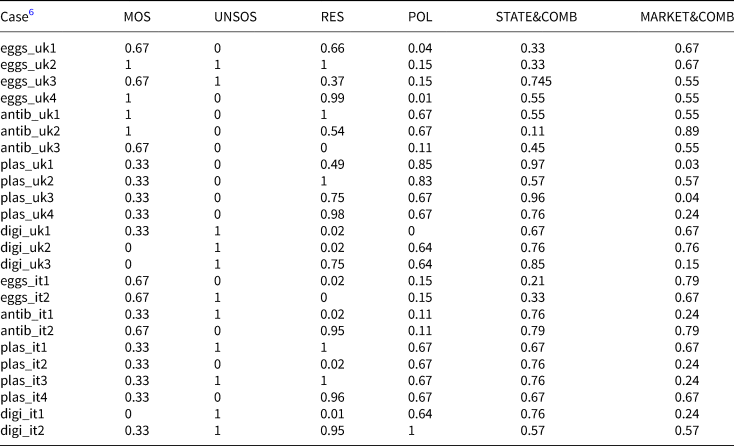
All calibrated conditions and the outcomes are shown in Table 3.
Calibrated measurement of all conditions and outcomes

Results
The results are first presented descriptively for each outcome, before being discussed together in the discussion section, allowing us to draw conclusions based on the results as a whole. All analyses were conducted using the R packages QCA and SetMethods (Oana and Schneider Reference Oana and Schneider2018; Dusa, Reference Dusa2019). Robustness checks were also carried out by including other conditions (membership funding and radicalness); adjusting the calibration thresholds for the outcomes and conditions; and using crisp-set QCA to check the broad application of the results. Enhanced intermediate solutions are presented in this paper as they are parsimonious enough to provide interpretable results, without including rows in the logical minimization that would contradict formal logic (Schneider and Wagemann, Reference Schneider and Wagemann2012). All other solutions, truth tables and XY plots can be found in the online Appendix.
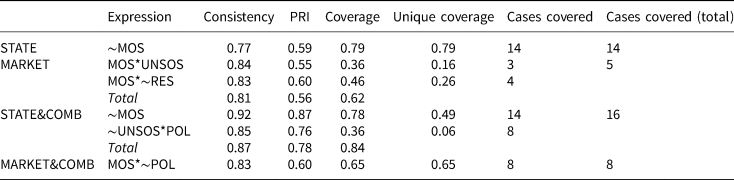
The presentation of all solution terms takes into account the standard measures of fit in QCA (Rihoux and Ragin, Reference Rihoux and Ragin2009; Schneider and Wagemann, Reference Schneider and Wagemann2012). Consistency measures how much the cases depart from a perfect subset relationship, taking into account cases where the solution expression is present but the outcome absent. A higher score is better, with a minimum of 0.75 generally accepted. Coverage measures how much of the outcome the solution expression explains; again, higher scores are better. Proportional reduction in inconsistency (PRI) shows how much the solution belongs to the outcome and not the absence of the outcome. The closer this is to 0.5, the more it explains both – and thus the less useful it is as an explanation (Table 4).
Solutions for all outcomesFootnote 7

The first analysis was conducted for campaigns where NGOs only targeted the state. The results show that NGOs target only the state when market opportunity structures are not open (~MOS→STATE). Thirteen of the 14 cases where this occurred were on the issues of plastic pollution and digital civil rights.
A second analysis was conducted for campaigns that targeted only the market. One condition emerged as a strong necessary condition for NGOs to run a campaign using only market strategies: open market opportunity structures. This was then found to be sufficient in combination either with a closed state opportunity structure or when a group had low resources (MOS*UNSOS + MOS*~RES→MARKET). The effect of resources here is somewhat surprising, as I had anticipated higher resources to potentially help groups to use market strategies; this finding is discussed below.
The third analysis was conducted for all campaigns where NGOs targeted the state, including when they combined state and market strategies. The results echo those above: ~MOS+~UNSOS*POL→STATE&COMB. NGOs use only state strategies when market opportunity structures are not open; they use combinations when the state opportunity structures are open and the issue is politicizable.
The final analysis was conducted for all campaigns where NGOs targeted the market, including combinations of market and state strategies. This again emphasized the importance of market opportunity structures: MOS*POL→MARKET&COMB. There were eight cases where groups combined strategies that were not covered by this solution; however, these were all covered by the solution for STATE&COMB, presented above. The implications of this finding are discussed below.
Discussion
Three key points arise from the analyses conducted here. First, structural factors – particularly in the market – are the main determinants of groups' strategic choices; second, campaigns combining strategies seem to be either market- or state-oriented; and third, other conditions have a minor – but enabling – role in the causal combinations.
Structural factors are predominant as key explanatory conditions for groups' strategic choices. As highlighted, market opportunity structures have a symmetrical relation to the outcome: they are necessary in their presence for groups to use only market strategies, and sufficient in their absence for groups to use only state strategies. Market opportunity structures seem to be more important than state opportunity structures in determining strategic choices (although state opportunity structures also follow theoretical expectations). This implies that the ‘default’ may be for groups to target the state; they only consider (also) targeting the market when there is actually an open market opportunity structure.
Structural factors are therefore both consistent and important in explaining the choice between state and market strategies, an encouraging conclusion for the study of opportunity structures in general, especially given the problems raised with structural approaches (Goodwin and Jasper, Reference Goodwin and Jasper1999). More specifically to this study, it is a positive sign for the elusive operationalization of both state and market opportunity structures (Meyer and Minkoff, Reference Meyer and Minkoff2004). As highlighted previously, while opportunity structures have been used extensively as explanations for groups' behaviour in case studies, the number of methodical, consistent operationalization of the concept for comparative study is limited. The fact that the results here match theoretical expectations from the literature indicates that the operationalization of both is broadly accurate and useful for future studies. However, the low consistency and PRI scores for some of the results (especially e.g. STATE) indicate that certain aspects of the measure could be fine-tuned. One way in which the measure could be improved is to take the specific campaign context into account – for example, by examining whether elite allies were present in the market for this specific campaign (i.e. the dynamic ‘windows of opportunity’ rather than broader institutional structures (Giugni, Reference Giugni2009)). While this would require some challenging data collection and measurement strategies, it would not only improve parameters of fit but also help to further develop and specify the operationalization of opportunity structures in general.
A second significant finding is that there are two distinct types of ‘combination’ campaigns: market-oriented and state-oriented campaigns: those that are covered by the results for STATE&COMB, and those that are covered by the results for MARKET&COMB. The key difference between the two types of campaigns is the openness of market opportunity structures, as highlighted above. The existence of two types of combination campaigns has implications beyond simply understanding strategic selection by interest groups. When combination campaigns are more state-oriented, market strategies are used as a sort of supplement to state strategies – for instance, to garner publicity, draw public attention to an issue or mobilize supporters (King, Reference King2008b; Heldman, Reference Heldman2017). However, NGOs' ‘real’ target remains policymakers. In market-oriented combination campaigns, groups target one or more firms; state strategies are here used to supplement market-oriented strategies. This was particularly salient in interviews, where NGOs in the former group tended to argue that they focused their energies on the state because they considered it more effective: ‘While company change is a good start, legislation is key to getting change across the board’ (interview 3); ‘We look at systems change and large-scale intervention rather than “hearts and minds” stuff’ (interview 13). On the other hand, NGOs in the latter group tended to think the opposite: that targeting companies was ‘most efficient’, it would ‘make the most impact possible in a short amount of time’ and potentially change production practices worldwide (interviews 6, 7, 17).
This implies that in some cases, market strategies are used essentially as outside strategies more generally, while in other cases, they are used as a separate strategy in their own right. Whether or not the latter use should be named ‘lobbying’ is debatable, given that it does not aim to change public policy. Nonetheless, it would be interesting to examine why such a difference appears, in particular the reason(s) why some groups seem to believe inherently in the efficacy of market strategies, while others continue to target the state. This could be an opportunity for studies of institutionalized advocacy to borrow from social movement studies, which has focused more on collective identity as an explanation for strategic choices (Tarrow, Reference Tarrow2011). Path dependency and resource dependence explanations may equally be at play, as NGOs do what they know how to do and what they have always done (Malatesta and Smith, Reference Malatesta and Smith2014).
The final finding from these results points the minor, but somewhat surprising, effect of the other two conditions: resources and politicizability. While initial theoretical expectations were that the presence of high politicizability would lead to market strategies, as NGOs can more easily mobilize the public, the relationship was the other way around. A politicizable issue (in combination with open state structures) led to state-oriented combinations; a non-politicizable issue (in combination with open market opportunity structures) led to market-oriented combinations. This indicates that groups tend to target the market when an issue is not politicizable, and therefore not on the public agenda. There are at least two possible explanations for this. First, groups may be essentially ‘exiting’ the political arena (Hirschman, Reference Hirschman1970) by turning their attention to firms and thereby circumventing the need to draw policymakers' attention to an issue. Alternatively, if groups see politicizability as raising the chances that they will receive public backing on a particular issue, they may prefer to turn to the state when the issue is more easily politicizable. In this case, groups may be making the most of the politicizing nature of market strategies by using these as a first step in a campaign, and thereby aiming to use these strategies to develop a more state-oriented campaign, as previous work has found to be a possibility (Colli, Reference Colli2020).
Resources play a very minor role in the solution terms, only appearing in one solution term. They appear to play an enabling role by allowing groups to combine strategies, as we can see by comparing truth table rows for market strategies only (MARKET) and market strategies with combinations (MARKET&COMB). This links with previous research that has highlighted that as NGOs' resources increase, they become more likely to use all sorts of strategies – and therefore also combinations thereof (Dür and Mateo, Reference Dür and Mateo2016; Junk, Reference Junk2016). Nonetheless, the relatively minor role of resources could be linked to the fact that previous research has drawn contradictory findings about the effect of financial resources on the ways in which groups lobby – particularly within one group type. It may be that groups' lobbying choices are simply more dependent on other factors – structural, issue and group type – than on the financial resources that they control. Another alternative explanation for this finding is the operationalization of resources: due to data constraints, I operationalized resources as purely financial resources, as opposed to the often-used operationalization of resources as staff or membership numbers (e.g. Hanegraaff et al., Reference Hanegraaff, Beyers and De Bruycker2016; Junk, Reference Junk2016). This implies that if operationalized differently, the effect of resources may be slightly stronger (Table 5).
The effect of resources: comparing truth table rows

Conclusions
Research on NGOs and their advocacy strategies has thus far suffered from several blind spots. Despite a recent emphasis on combinations of strategies, these have remained unexamined; moreover, while the social movement literature has paid increasing attention to groups' action towards companies and industries in addition to state-oriented advocacy, the choice among (combinations of) the two has not been examined. In addition to filling these gaps, this article has developed the concrete operationalization of POS to allow for standardized measurement of the structures that groups are surrounded by. These contributions mean that this paper takes a significant step forward in understanding how NGOs choose their strategies in advocacy towards not only the state, but also the market. The openness or closedness of the market is the most important factor determining whether groups lobby the state or the market; resources and politicization play a minor role.
The results of this study do present some limitations. First, the relatively low PRI and consistency scores for some of the solutions suggest that while the indicators are generally good proxies for the conditions, their measurement could be fine-tuned. Second, although the solutions can explain all cases except one when combined, the low coverage for some of the solution terms highlights that adding extra conditions to the QCA – or fine-tuning the existing conditions – may also hone the explanatory power of the analysis. However, as a first attempt to explain the choice between state and market lobbying in a comparative way, the results remain coherent.
In terms of implications for democratic representation, the results indicated here are quite positive. While open market opportunity structures were vital in determining whether NGOs targeted the market with their advocacy strategies, they targeted the state even when state opportunity structures were closed. These groups therefore seem to have significant leeway in when they decide to turn to the market – not simply because the state is closed to their demands, but rather as a specific choice, either focusing on firms' practices or because they use market strategies as an outside, public-mobilization strategy. This has positive implications for the state of citizen representation, indicating that the market acts as an alternative option for NGOs to take political action, but not as a second-best option.
This research also contributes to the commonly-asserted claim that NGOs have started targeting market actors – firms and industries – due to the globalization of production practices and the state's loss of power when compared to these market actors (Soule, Reference Soule2009; Mayer and Gereffi, Reference Mayer and Gereffi2010). The resulting power of market actors is encapsulated in the push for corporate social responsibility: the call for firms to take responsibility for social or environmental issues along their supply or value chain (Barnett et al., Reference Barnett, Cloke, Cark and Malpass2011). This research indicates that while this may be the pattern for some campaigns – those campaigns using only market strategies – many campaigns actually combine targeting the market with ‘regular’ advocacy against the government. This is visible not only in the sheer number of combination campaigns, but also in the interconnectedness of the solution expressions and the cases that are covered by each expression – one cannot be read and interpreted without the others. These domestic campaigns have until now remained unexplained; however, this research indicates that they are another way of making the most of companies' power: by leveraging the brand reputation of well-known companies, NGOs attract public attention to their campaigns and politicize issues that they are lobbying on in the state. Therefore, the claim that the market is increasingly powerful does hold some truth; this research has highlighted the extent to which this power can be used even when the ultimate target of NGOs' lobbying is public regulation.
NGOs increasingly take political action in both the state and the market; this analysis of their lobbying choices in both shows that – at least for the groups in this dataset – access to the state itself was not a problem. These western European NGOs choose to use the market – or combine strategies – for their own reasons, leveraging firms' power and recognition to facilitate public mobilization. This ability to choose can only be positive for the organizational representation of citizens' interests throughout the whole political economy.
Supplementary material
The supplementary material for this article can be found at https://doi.org/10.1017/ipo.2020.18.
Funding
This research received no grants from public, commercial or non-profit funding agencies.
Data
The replication dataset is available at http://thedata.harvard.edu/dvn/dv/ipsr-risp
Acknowledgements
I would like to thank the NGO representatives who gave up their time for interviews. A previous version of this article was presented at the 2019 GovLis Symposium ‘Lobbying for better or worse?’ and I thank the participants for their useful feedback. I am also grateful to Bart Kerremans, Johan Adriaensen and other LINES colleagues for their valuable comments on earlier drafts of the paper, to Andrea Pritoni for his advice on the research design and to two anonymous reviewers for their helpful suggestions.