Introduction
Infertility is defined as the inability to become pregnant (conceive) after 1 year (or longer) of unprotected sex (Duca et al., Reference Duca, Calogero, Cannarella, Condorelli and La Vignera2019). Intracytoplasmic sperm injection (ICSI) is used widely in assisted reproduction technology (ART) clinics for fertility treatment, in particular in the treatment of male factor infertility (Esteves et al., Reference Esteves, Roque, Bedoschi, Haahr and Humaidan2018). The role of hyaluronic acid (HA) as a ‘physiologic selector’ is also well recognized in vitro. Spermatozoa that bind to immobilized HA in vitro have completed plasma membrane remodelling, and cytoplasm and meiotic maturation (Morselli, Reference Morselli2016). Sperm selection using HA is expected to increase the implantation rate in ICSI cycles. Several studies have explored the characteristics of HA binding to spermatozoa in normozoospermia and oligospermia patients. However, limited data are available regarding the effects of the injection of HA-selected sperm on the development of embryos in couples with normozoospermia (Oseguera-López et al., Reference Oseguera-López, Ruiz-Díaz, Ramos-Ibeas and Pérez-Cerezales2019). As SpermSlow™ consists of HA, it is supposed to be a safer alternative to the synthetic plastic polyvinylpyrrolidone (PVP) (Parmegiani et al., Reference Parmegiani, Cognigni, Bernardi, Troilo, Ciampaglia and Filicori2010; Nel, Reference Nel2015).
In nature, human oocytes are surrounded by HA, which is then involved in the mechanism of sperm selection. Only mature spermatozoa that have extruded their specific receptors to bind to and digest HA can reach the oocyte and fertilize it. HA’s role as a ‘physiologic selector’ is now well recognized in vitro. It has been demonstrated that HA forms a three-dimensional net to which mature spermatozoa expressing HA receptors will bind. Therefore, only mature spermatozoa are slowed by SpermSlow, whereas immature spermatozoa or those not expressing HA receptors will move more freely (Wang et al., Reference Wang, Feng, Shu, Zhou, Zhang, Chen, Lin, Gan, Wu and Wei2018). At this stage, a viscous medium containing PVP is routinely used in most IVF centres to reduce sperm motility during the ICSI procedure. Nevertheless, some authors have stated that PVP may be toxic for gametes and developing embryos (Longenecker et al., Reference Longenecker, Cho, Khillan and Kulkarni2021). A study by Nabi et al. (Reference Nabi, Entezari, Miresmaeili, Vahidi, Lorian, Anbari and Motamedzadeh2021) found that sperm samples could be incubated with PVP for less than 10 min; in contrast, prolonged incubation might significantly damage the sperm DNA integrity and viability.
This study aimed to assess an alternative product and a different approach by using hyaluronic acid, which measures sperm motility and slows it, and analyze the fertilization rate, the quality of the embryos, and the pregnancy rate in patients with male factor infertility.
Materials and Methods
Study population
The study population consisted of 200 couples, including 1467 ICSI cycles that were referred for assisted reproduction at the Fertility Clinic in the International Islamic Center for Population Studies and Researches, Al-Azhar University, Cairo, Egypt, between September 2019 and October 2021.
The 200 male subjects were divided into four groups according to semen parameters (each group contained 50 cases):
-
Group 1: Normozoospermia divided into two subgroups (PVP-ICSI and SpermSlow-ICSI).
-
Group 2: Oligozoospermia divided into two subgroups (PVP-ICSI and SpermSlow-ICSI).
-
Group 3: Asthenozoospermia divided into two subgroups (PVP-ICSI and SpermSlow-ICSI).
-
Group 4: Teratozoospermia divided into two subgroups (PVP-ICSI and SpermSlow-ICSI).
Semen analysis
All male partners were subjected to complete semen analysis. Semen samples were collected by masturbation after a 3–7-day period of sexual abstinence. A physical examination, including volume, colour, odour, and liquefaction, was carried out. A microscope examination was performed to evaluate sperm concentration, motility, morphology, and the presence of other cellular elements using a light microscope (Olympus, C 21, Japan). Sperm were classified into progressive motile, non-progressive and immotile.
Sperm preparation
For the first group that was injected, sperm were prepared using a traditional centrifugation method. Sperm samples for ICSI were processed after microscope examination; 1 ml of sperm gradient medium (PureSperm, Nidacon, Sweden) was added to a fresh sample and centrifuged at 1800 rpm for 10 min (Heraeus 300, Osterode, Germany). The supernatant was removed and 2 ml of sperm washing medium (Sage, Denmark) was then added to sperm in the resulting pellet, followed by centrifugation at 1800 rpm for 10 min to reach and isolate the motile and morphologically normal sperm cells needed for assisted reproduction (Longenecker et al., Reference Longenecker, Cho, Khillan and Kulkarni2021).
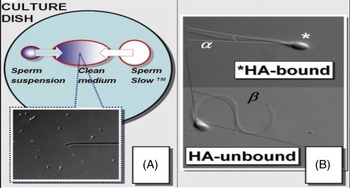
For the second group that was injected, sperm were prepared using SpermSlow. On a plastic culture dish (IVF Petri dishes), a 2-ml droplet of a suspension of treated spermatozoa was touched with a pipette tip to a 5-ml droplet of fresh culture medium. At the same time, a 5-ml droplet of SpermSlow was touched with a pipette tip to a 5-ml droplet of fresh culture medium. The spermatozoa on this culture dish were incubated for 5 min at 37oC under oil (FertiCult Mineral Oil). Spermatozoa bound to HA were slowed at the junction zone of the two droplets (Figure 1). These spermatozoa were selected and collected using an injection pipette (ICSI micropipette) and injected into oocytes.
SpermSlow procedure: preparation

Intracytoplasmic sperm injection (ICSI)
Following semen analysis and sperm preparation as described previously, samples were incubated until the time of injection. Each oocyte was injected with a single gross morphologically normal spermatozoon mechanically immobilized in PVP. Individual sperm for ICSI were examined and evaluated. The injection procedures were carried out in sterilized dishes using a holding pipette and injection needle, and then the best sperm were selected for injection and mechanically immobilized in the PVP droplet. In both procedures (SpermSlow and PVP), after sperm selection sperm, the mature oocyte was put in a 10-µl droplet of global total w/HEPES buffer (LifeGlobal, Europe) at 37ºC in a 90–95% humidity environment, equilibrated, and covered with mineral oil. The oocyte was attached to the holding pipette by slight negative pressure. The injection needle containing the sperm in PVP or SpermSlow was brought into the focal plane and a single sperm was positioned just at the tip of the microinjection needle. The next step was a slow, steady and consistent movement into the cytoplasm of the metaphase 2 (MII) oocytes; the sperm then was released into the cytoplasm with ∼1–3 µl medium. The injected oocyte was then washed and put in global total medium (LifeGlobal, Europe) in a culture dish covered with sterile warm equilibrated global oil (LifeGlobal, Europe) at 37ºC in a 6% CO2 in a 90–95% and 5% O2 atmosphere until fertilization (Cohen, Reference Cohen and Gardner2006; Sciorio and Smith, Reference Sciorio and Smith2019).
PVP procedure
A 10% PVP with human serum albumin (HSA) solution (Irvine Scientific, catalogue no. 90123, 5 × 0.5 ml kits) was obtained and intended for use in assisted reproductive procedures that included human gamete and embryo manipulation, and to immobilize sperm for ICSI procedures. PVP was dissolved in mHTF (an isotonic HEPES-buffered medium) to make a 10% (w/v) solution that contained 5 mg/ml HSA.
Other components were as follows. Salts and ions: sodium chloride, potassium chloride, magnesium sulphate, potassium phosphate, calcium chloride. Buffers: HEPES, sodium bicarbonate. Energy substrates: glucose, sodium pyruvate, sodium lactate. Protein source: HSA. Polymer: povidone. Water: water for injection (WFI) quality.
The 10% PVP solution is recommended for normal and high-motility sperm specimens. An aliquot of sperm was placed into the 10% PVP solution. The ICSI pipette containing the PVP solution then captured a single, immobilized sperm according to standard laboratory protocols. The sperm were now ready for the ICSI procedure.
SpermSlow procedure
The intended use of SpermSlow (product no. 1094) is to slow the movement of sperm to allow for the selection of the most mature, viable sperm for ICSI.
Other components were as follows. Hyaluronate, HSA, recombinant human insulin, glucose and derived metabolites, physiological salts, nucleotides, amino acids, vitamins, sodium bicarbonate, gentamicin sulphate 10 μg/ml.
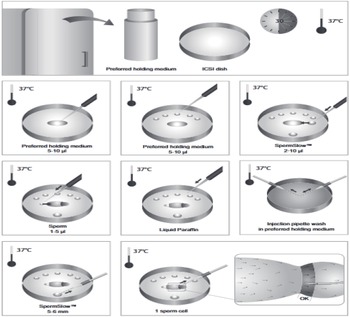
Liquid paraffin was pre-equilibrated according to a standard protocol; the preferred holding medium (e.g. Flushing Medium, QA with HEPES) and an ICSI dish were warmed to 37°C for a minimum of 30 min.
-
1. An elongated (bridging) drop (5–10 μl) of holding medium was dispensed into the ICSI dish. Depending on the number of oocytes used in the ICSI procedure, a corresponding number of 5–10 μl droplets was pipetted into the holding medium.
-
2. Pipette 2 × 10 μl of SpermSlow: a primary drop should be close to one end of the elongated bridging droplet. A secondary droplet can be placed where convenient (for use as a handling drop). The pipette tip was used to create a junction between the primary SpermSlow droplet and the bridging droplet.
-
3. A small amount (1–5 μl) of prepared and washed sperm suspension was introduced close to the opposite end of the bridging drop (for low-quality sperm samples, using a bridging drop can be omitted, and contact can be created directly between the SpermSlow droplet and the sperm suspension droplet). The pipette tip was used to create a junction between the sperm droplet and the bridging droplet.
-
4. The ICSI dish was covered immediately with pre-equilibrated liquid paraffin and either used immediately or incubated at 37°C for 15 min before use. An oocyte was placed in each droplet of the preferred holding medium.
-
5. An injection pipette was pre-loaded with SpermSlow from the handling droplet.
-
6. The primary SpermSlow droplet was located and worked along the edge until the junction zone between the bridging droplet and SpermSlow droplet was reached. This should be evident from the number of sperm trapped in the three-dimensional net of hyaluronate.
-
7. A mature spermatozoon was carefully selected. The mature spermatozoa expressing HA receptors were bound to the hyaluronate in SpermSlow and were easily identifiable by their beating tails but with limited forward motion. Spermatozoa moving freely in the SpermSlow drop are immature spermatozoa and should not be selected (Figure 2).
-
8. Sperm MUST also be selected based on their morphology, as for standard ICSI. It may be easier to select sperm and then reassess morphology in the secondary SpermSlow handling drop before injection.
Figure 2.SpermSlow procedure: selection


Assessment of fertilization and embryo quality
Fertilization was assessed 16–18 h after microinjection. The injected oocytes were observed for any sign of damage and for presence of pronuclei. Oocytes were classified as fertilized if two pronuclei (2PN) were present and the second polar body had been extruded. Approximately 72 h after microinjection, adequate numbers of embryos were transferred to recipient subjects. Embryo grading and transfer were performed ∼72 h after injection, and the cell number and morphology of each embryo were scored according to the indicated grading (Hill et al., Reference Hill, Freeman, Bastias, Rogers, Herbert, Osteen and Wentz1989):
-
Grade A: equally sized blastomeres without fragmentation.
-
Grade B: slightly unequal blastomeres up to 10% cytoplasmic fragments.
-
Grade C: unequally sized blastomeres up to 50% fragments and large granules.
-
Grade D: unequal blastomeres with significant fragmentation and large black granules.
Day 3 embryos were transferred (471 embryos) to recipient subjects according to the guidelines of the American Society of Reproduction. Excess good-quality embryos were cryopreserved. At 14 days after embryo transfer, serum HCG was determined using a chemical pregnancy test (considered positive if the result was 20 IU/L). In addition, a transvaginal ultrasound scan of the uterus was performed after 6–7 weeks of amenorrhea to determine whether a clinical pregnancy had been established (intrauterine gestational sac visible; Parmegiani et al., Reference Parmegiani, Cognigni and Filicori2014).
Statistical analysis
Data were coded and entered using Statistical Package for the Social Sciences (SPSS) version 26 (IBM Corp., Armonk, NY, USA). Data were summarized using mean, standard deviation, median, minimum and maximum in quantitative data, as well as frequency (count) and relative frequency (percentage) for categorical data. Comparisons between quantitative variables were carried out using the non-parametric Mann–Whitney test (Chan, Reference Chan2003a). To compare categorical data, a chi-squared test was performed. The Exact test was used instead when the expected frequency was less than 5 (Chan, Reference Chan2003b). P-values less than 0.05 were considered statistically significant.
Results
The distribution of the mean age of the 200 female patients was 27.21 ± 3.76; the mean age of the male patients was 32.04 ± 4.66. The mean body mass index (BMI) of female patients was 28.11 ± 1.98; the mean duration of infertility was 3.86 ± 1.61. The number of female patients subjected to the antagonist protocol was 42 (21.0%). The number of female patients subjected to the long protocol was 124 (62.0%) and the number of female patients subjected to the short protocol was 34 (17.0%).
Normozoospermia group
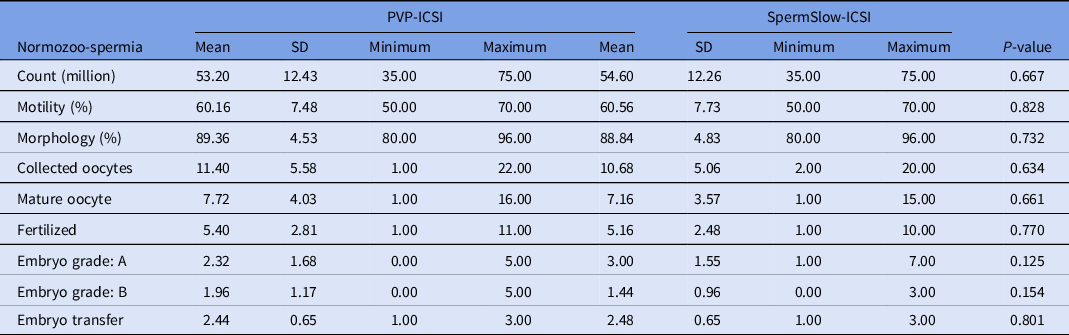
The mean male sperm count in PVP-ICSI was 53.20 ± 12.43 compared with 54.60 ± 12.26 in the SpermSlow-ICSI with a statistically insignificant difference (P > 0.667) (Table 1). The mean male sperm motility in PVP-ICSI was 60.16 ± 7.48 compared with 60.56 ± 7.73 in the SpermSlow-ICSI. These differences were statistically insignificant (P > 0.828). The mean male sperm morphology in PVP-ICSI was 89.36 ± 4.53 compared with 88.84 ± 4.83 in the SpermSlow-ICSI. These differences were statistically insignificant (P > 0.732).
Results of the normozoospermia group

SD, standard deviation.
The number of collected oocytes was higher (11.40 ± 5.58) in the PVP-ICSI group compared with 10.68 ± 5.06 in SpermSlow-ICSI, but these differences were statistically insignificant (P > 0.634). The number of mature oocytes was higher in the PVP-ICSI group (7.72 ± 4.03) compared with 7.16 ± 3.57 in the SpermSlow-ICSI. However, these differences were statistically insignificant (P > 0.661).
The number of fertilized oocytes was higher in the PVP-ICSI group (5.40 ± 2.81) compared with 5.16 ± 2.48 in SpermSlow-ICSI. However these differences were statistically insignificant (P > 0.770). The number of grade A embryos was lower (2.32 ± 1.68) in the PVP-ICSI group compared with 3.00 ± 1.55 in the SpermSlow-ICSI group. However these differences were statistically insignificant (P > 0.125). The number of grade B embryos was higher in the PVP-ICSI group (1.96 ± 1.17) compared with 1.44 ± 0.96 in the SpermSlow-ICSI group. However these differences were statistically insignificant (P > 0.154).
The number of embryo transfers was lower (2.44 ± 0.65) in the PVP-ICSI group compared with 2.48 ± 0.65 in the SpermSlow-ICSI group. However these differences were statistically insignificant (P > 0.801).
Oligozoospermia group
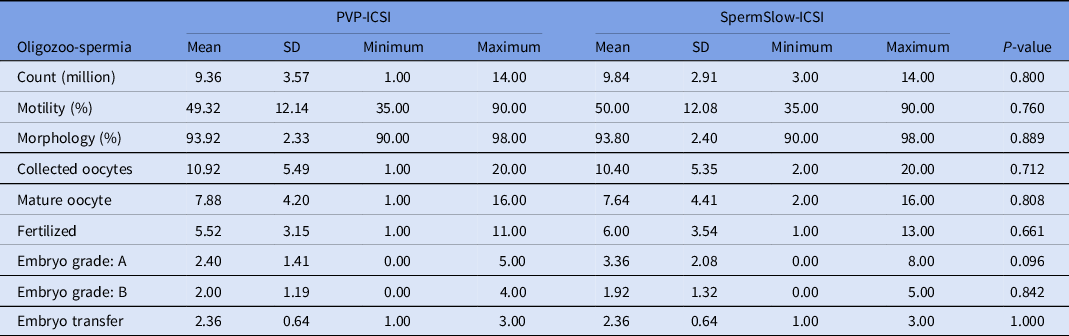
The mean male sperm count in PVP-ICSI was 9.36 ± 3.57 compared with 9.84 ± 2.91 in the SpermSlow-ICSI with statistically insignificant difference (P > 0.800) (Table 2). The mean male sperm motility in PVP-ICSI was 49.32 ± 12.14 compared with 50.00 ± 12.08 in the SpermSlow-ICSI. These differences were statistically insignificant (P > 0.760). The mean male sperm morphology in PVP-ICSI was 93.92 ± 2.33 compared with 93.80 ± 2.40 in the SpermSlow-ICSI. These differences were statistically insignificant (P > 0.889).
Results of the oligozoospermia group

SD, standard deviation.
The number of collected oocytes was higher (10.92 ± 5.49) in the PVP-ICSI group compared with 10.40 ± 5.35 in the SpermSlow-ICSI, but these differences were statistically insignificant (P > 0.712). The number of mature oocytes was higher in the PVP-ICSI group (7.88 ± 4.20) compared with 7.64 ± 4.41 in the SpermSlow-ICSI group. However these differences were statistically insignificant (P > 0.808).
The incidence of fertilized oocytes number was lower in the PVP-ICSI group (5.52 ± 3.15) compared with 6.00 ± 3.54 in the the SpermSlow-ICSI, however these differences were statistically insignificant (P > 0.661). The number of grade A embryos was lower (2.40 ± 1.41) in the PVP-ICSI group compared with 3.36 ± 2.08 in the SpermSlow-ICSI group, however these differences were statistically insignificant (P > 0.096). The number of grade B embryos was higher in the PVP-ICSI group (2.00 ± 1.19) compared with 1.92 ± 1.32 in the SpermSlow-ICSI group, however these differences were statistically insignificant (P > 0.842).
The number of embryo transfer was equal (2.36 ± 0.64) in the PVP-ICSI group compared with 2.36 ± 0.64 in the SpermSlow-ICSI group, however these differences were statistically insignificant (P > 1.000).
Asthenozoospermia group:
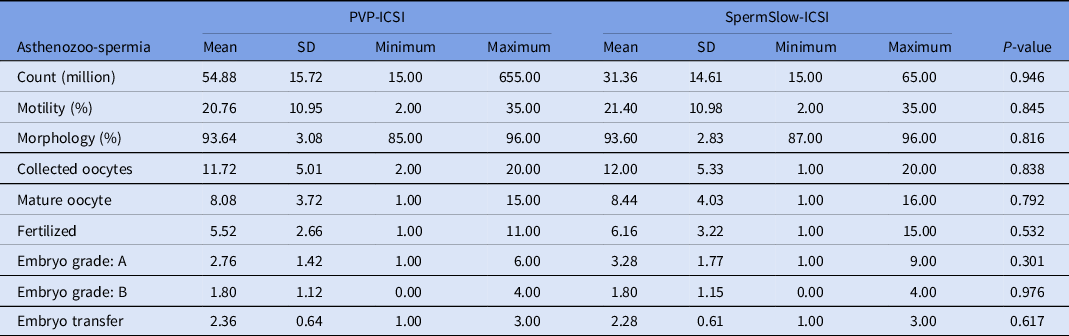
The mean male sperm count in PVP-ICSI was 54.88 ± 15.72 compared with 31.36 ± 14.61 in the SpermSlow-ICSI group (Table 3). With statistically insignificant deference (P > 0.946). The mean male sperm motility in PVP-ICSI was 20.76 ± 10.95 compared with 21.40 ± 10.98 in the SpermSlow-ICSI. These differences were statistically insignificant (P > 0.845). The mean male sperm morphology in PVP-ICSI was 93.64 ± 3.08 compared with 93.60 ± 2.83 in the SpermSlow-ICSI. These differences were statistically insignificant (P > 0.816).
Results of the asthenozoospermia group

SD, standard deviation.
The number of collected oocytes was lower (11.72 ± 5.01) in the PVP-ICSI group compared with 12.00 ± 5.33 in the SpermSlow-ICSI, but these differences were statistically insignificant (P > 0.838). The number of mature oocytes was lower in the PVP-ICSI group (8.08 ± 3.72) compared with 8.44 ± 4.03 in the SpermSlow-ICSI. However these differences were statistically insignificant (P > 0.792).
The incidence of fertilized oocytes number was lower in the PVP-ICSI group (5.52 ± 2.66) compared with 6.16 ± 3.22 in the SpermSlow-ICSI. However these differences were statistically insignificant (P > 0.532). The number of grade (A) embryos was lower (2.76 ± 1.42) in the PVP-ICSI group compared with 3.28 ± 1.77 in the SpermSlow-ICSI group, however these differences were statistically insignificant (P > 0.301). The number of grade (B) embryos was equal in the PVP-ICSI group (1.80 ± 1.12) compared with 1.80 ± 1.15 in the SpermSlow-ICSI group, however these differences were statistically insignificant (P > 0.976).
The number of embryo transfers was higher (2.36 ± 0.64) in the PVP-ICSI group compared with 2.28 ± 0.61 in the SpermSlow-ICSI group, however these differences were statistically insignificant (P > 0.617).
Teratozoospermia group
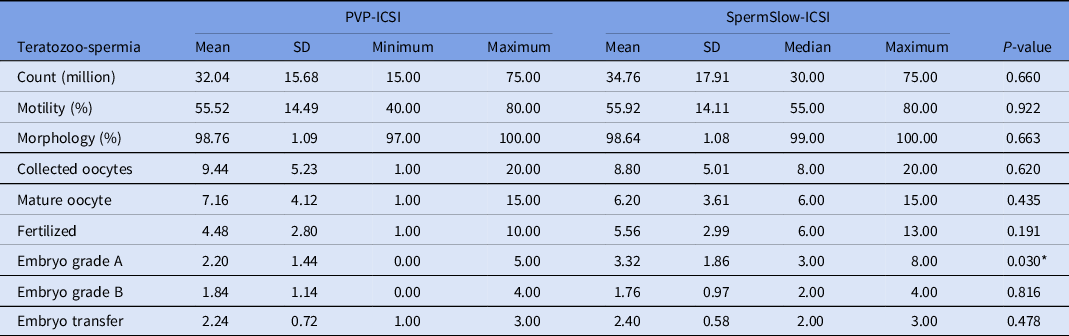
The mean male sperm count in PVP-ICSI was 32.04 ± 15.68 compared with 34.76 ± 17.91 in the SpermSlow-ICSI with statistically insignificant difference (P > 0.660) (Table 4). The mean male sperm motility in PVP-ICSI was 55.52 ± 14.49 compared with 55.92 ± 14.11 in the SpermSlow-ICSI. These differences were statistically insignificant (P > 0.922). The mean male sperm morphology in PVP-ICSI was 98.76 ± 1.09 compared with 98.64 ± 1.08 in the SpermSlow-ICSI. These differences were statistically insignificant (P > 0.663).
Results of the teratozoospermia group

* Differences were statistically significant by standard deviation (SD).
The number of collected oocytes was higher (9.44 ± 5.23) in the PVP-ICSI group compared with 8.80 ± 5.01 in the SpermSlow-ICSI but these differences were statistically insignificant (P > 0.620). The number of mature oocytes was higher in the PVP-ICSI group (7.16 ± 4.12) compared with 6.20 ± 3.61 in the SpermSlow-ICSI. However these differences were statistically insignificant (P > 0.453).
The incidence of fertilized oocyte number was lower in the PVP-ICSI group (4.48 ± 2.80) compared with 5.56 ± 2.99 in the SpermSlow-ICSI group. However these differences were statistically insignificant (P > 0.191). The number of grade A embryos was lower (2.20 ± 1.44 in the PVP-ICSI group compared with 3.32 ± 1.86 in the SpermSlow-ICSI group, however these differences were statistically significant (P > 0.030). The number of grade B embryos was higher in the PVP-ICSI group (1.84 ± 1.14) compared with 1.76 ± 0.97 in the SpermSlow-ICSI group. However these differences were statistically insignificant (P > 0.816).
The number of embryo transfer was lower (2.24 ± 0.72) in the PVP-ICSI group compared with 2.40 ± 0.58 in the SpermSlow-ICSI group, however these differences were statistically insignificant (P > 0.478).
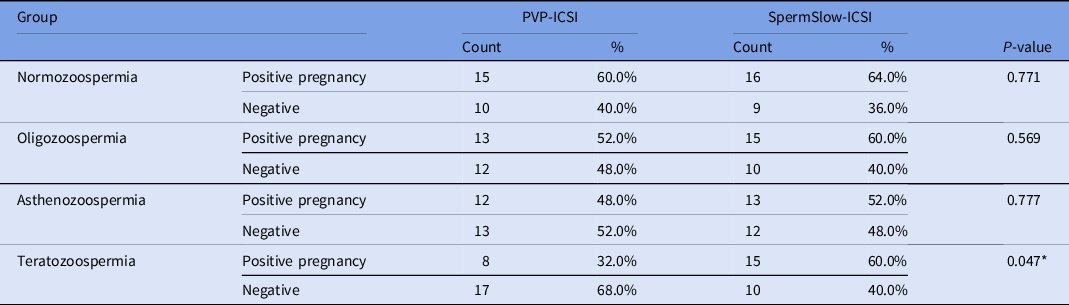
Table 5 shows that the positive pregnancy rate in the normozoospermia group was higher in the SpermSlow-ICSI group (16/64.0%) compared with 15/40.0% in the PVP-ICSI group. However these differences were statistically insignificant (P > 0.771).
Pregnancy outcome among study groups

* Differences were statistically significant.
The positive pregnancy rate in the oligozoospermia group was higher in the SpermSlow-ICSI group (15/60.0%) compared with 13/52.0% in the PVP-ICSI group. However these differences were statistically insignificant (P > 0.569).
The positive pregnancy rate in the asthenozoospermia group was higher in the SpermSlow-ICSI group (13/52.0%) compared with 12/48.0% in the PVP-ICSI group. However these differences were statistically insignificant (P > 0.777).
The positive pregnancy rate in the teratozoospermia group was higher in the SpermSlow-ICSI group (15/60.0%) compared with 8/32.0% in the PVP-ICSI group. However these differences were statistically significant (P > 0.047).
Discussion
The selection of the ideal spermatozoa for ICSI represents an exciting challenge in the modern IVF laboratory. Effective sperm selection becomes critical, especially when limited numbers of oocytes are available for injection (Evans et al., Reference Evans, Scholten, Mzyk, Reyes-San-Martin, Llumbet, Hamoh, Arts, Schirhagl and Cantineau2021). In total, 200 subjects, including 1467 ICSI cycles, were monitored in this study. It seems possible to reduce the risk of fertilization with DNA damaged and chromosomal-disturbed spermatozoa by selecting ICSI sperm using maturation markers such as HA receptors (Parmegiani et al., Reference Parmegiani, Cognigni and Filicori2014). The present study compared a SpermSlow-ICSI group versus a PVP-ICSI group, as PVP-ICSI is the most commonly used technique in IVF centres. This study was the most expansive to date that compared advanced ICSI to conventional ICSI. The study revealed that injection of HA-bound spermatozoa (SpermSlow-ICSI) produced a statistically significant improvement in embryo quality.
The current study found a higher fertilization rate in the study group (SpermSlow-ICSI), but this was statistically insignificant in oligozoospermia, asthenozoospermia, and teratozoospermia compared with PVP-ICSI in the same groups. The present study is in agreement with that of Liu et al. (Reference Liu, Feenan, Chapple, Roberts and Matson2019), who found increased normal fertilization rates (HA-ICSI 73.8% versus PVP-ICSI 62.1%, P = 0.073). The same positive trend when injecting HA-bound spermatozoa was observed by Novoselsky Persky et al. (Reference Novoselsky Persky, Hershko-Klement, Solnica, Bdolah, Hurwitz, Ketzin El Gilad, Nefesh and Esh-Broder2021). The two sperm selection methods tested in this study resulted in different rates of fertilization, as well as the development towards higher normal fertilization rates that was not statistically significant (in the HA-ICSI). In a similar study (Agarwal et al., Reference Agarwal, Majzoub, Baskaran, Panner Selvam, Cho, Henkel, Finelli, Leisegang, SenGupta, Barbarosie, Parekh, Alves, Ko, Arafa, Tadros, Ramasamy, Kavoussi, Ambar and Kuchakulla2020) and a retrospective study on 2772 ICSI cycles HA-ICSI (n = 1387) and PVP-ICSI (n = 1385) (Miller et al., Reference Miller, Pavitt, Sharma, Forbes, Hooper, Bhattacharya, Kirkman-Brown, Coomarasamy, Lewis, Cutting, Brison, Pacey, West, Brian, Griffin and Khalaf2019), the researchers found no difference in fertilization rate between their comparison groups.
The current study found that the comparison between embryo grading in all groups was not statistically significant on day 2. Whereas, on day 3, there was a positive drift in embryo quality in the group (SpermSlow-ICSI) (3.32 ± 1.86) with teratozoospermia compared with PVP-ICSI, (2.20 ± 1.44) in the same group (statistically significant, P ≤ 0.030). In contrast with these results, Avalos-Durán et al. (Reference Avalos-Durán, Cañedo-Del Ángel, Rivero-Murillo, Zambrano-Guerrero, Carballo-Mondragón and Checa-Vizcaíno2018) found no difference in embryo quality between their comparison groups.
These results matched Mishra et al. (Reference Mishra, Jain and Shankar2021), who found that embryo quality was statistically significantly different when injecting sperm with HA. The results agreed with Igawa et al. (Reference Igawa, Yamashita, Inoue, Taguchi, Tujimoto, Kayoko, Yamamoto, Nakamura, Miyazaki, Terai and Ohmichi2019), who concluded that a high-quality embryo rate alone in the HA-ICSI group was significantly higher than in the PVP-ICSI group (P = 0.034). Similar results were reported by Kim et al. (Reference Kim, Kim, Kim, Jeong, Lee and Lyu2020), who revealed that injection of HA-bound spermatozoa HA-ICSI in 77 couples and PVP-ICSI in 75 couples produced a statistically significant improvement in embryo quality.
The current study found that the comparisons between chemical pregnancy also showed no statistically significant difference between the two procedures, SpermSlow-ICSI and PVP-ICSI, in all groups. However, the pregnancy percentage was better in the SpermSlow-ICSI group; the number of transferred embryos was similar in both groups and the result was statistically significant (P > 0.047). In contrast, Miller et al. (Reference Miller, Pavitt, Sharma, Forbes, Hooper, Bhattacharya, Kirkman-Brown, Coomarasamy, Lewis, Cutting, Brison, Pacey, West, Brian, Griffin and Khalaf2019) found that there was no difference between groups in pregnancy rate for HA-ICSI (39.5%, 546/1383) and PVP-ICSI (39.5%, 544/1377).
Our finding was in accordance with that of Erberelli et al. (Reference Erberelli, Salgado, Pereira and Wolff2017) who found the same positive trend in pregnancy rate (when injecting HA-bound spermatozoa) when comparing 19 HA-ICSI versus 37 ICSI-PVP treatments. The present result also confirmed data from the related studies by Novoselsky Persky et al. (Reference Novoselsky Persky, Hershko-Klement, Solnica, Bdolah, Hurwitz, Ketzin El Gilad, Nefesh and Esh-Broder2021), who demonstrated a positive drift in pregnancy rate when injecting HA-bound spermatozoa.
In conclusion, the present study suggested that the HA-ICSI technique in ART is an important technique that improves fertilization rate, embryo quality, and pregnancy rate. The possible reason for this better fertilization was the selection of mature spermatozoa with a low incidence of aneuploidies and DNA damage using SpermSlow-ICSI.
Acknowledgements
I would like to thank the International Islamic Center for Population Studies and Research, Al-Azhar University, Darasssa, Cairo, Egypt for supporting this study and for confirming data collection and analysis.
Conflict of interest
No conflict of interest
Ethical standards
The authors assert that all procedures contributing to this work comply with the ethical standards of the relevant national and institutional committees on human experimentation and with the Helsinki Declaration of 1975, as revised in 2008.