Introduction
Selective serotonin reuptake inhibitors (SSRIs) and serotonin and norepinephrine reuptake inhibitors (SNRIs) are first-line pharmacological treatments for anxiety, obsessive-compulsive, and stress-related disorders (Kendrick & Pilling, Reference Kendrick and Pilling2012), leading causes of disability (Global, Regional, and National Burden of 12 Mental Disorders in 204 Countries and Territories, 1990–2019, Reference Ferrari, Santomauro, Mantilla Herrera, Shadid, Ashbaugh, Erskine and Whiteford2022). While antidepressants are commonly prescribed (Martin, Hales, Gu, & Ogden, Reference Martin, Hales, Gu and Ogden2019), most patients are non-compliant (Sundbom & Bingefors, Reference Sundbom and Bingefors2013), with fear of potential adverse reactions being the second leading cause of non-adherence, after discontinuity due to remission of symptoms, the leading cause (Sundbom & Bingefors, Reference Sundbom and Bingefors2013). Hence, data comparing adverse event rates and tolerability profile of each medication may inform attempts to improve adherence. This is particularly important, given the minor differences between medications concerning efficacy (Gosmann et al., Reference Gosmann, Costa, Jaeger, Motta, Frozi, Spanemberg and Salum2021).
Previous meta-analyses assessed the tolerability of SSRIs and SNRIs in the treatment of non-depressive disorders, but three key questions remain unanswered. First, previous studies restricted their inclusion criteria to specific medications (Li et al., Reference Li, Zhu, Zhou, Liu, Du, Wang and Fang2018, Reference Li, Hou, Su, Liu, Zhang and Fang2020; Li, Zhu, Su, & Fang, Reference Li, Zhu, Su and Fang2017; Liu et al., Reference Liu, Li, Zhang, Sun, Sun, Xu and Tian2018; Zhang et al., Reference Zhang, Wang, Cui, Gao, Wang, Tan and Fang2020), diagnoses (Li et al., Reference Li, Hou, Su, Liu, Zhang and Fang2020, Reference Li, Zhu, Su and Fang2017, Reference Li, Zhu, Zhou, Liu, Du, Wang and Fang2018; Liu et al., Reference Liu, Li, Zhang, Sun, Sun, Xu and Tian2018; Zhang et al., Reference Zhang, Wang, Cui, Gao, Wang, Tan and Fang2020), adverse events (Telang, Walton, Olten, & Bloch, Reference Telang, Walton, Olten and Bloch2018; Wang et al., Reference Wang, Li, Kang, Liu, Shan and Wang2022), or populations (Schwartz, Barican, Yung, Zheng, & Waddell, Reference Schwartz, Barican, Yung, Zheng and Waddell2019). Thus, no large-scale quantitative review or network meta-analysis evaluated the comparative tolerability and rates of most adverse events associated with all SSRIs and SNRIS for the treatment of anxiety, obsessive-compulsive, and stress-related disorders. Second, incidence rates for several key adverse events or medications used during the treatment of anxiety disorders were completely unassessed, and estimates for other adverse events or medications had low statistical power (Li et al., Reference Li, Hou, Su, Liu, Zhang and Fang2020, Reference Li, Zhu, Su and Fang2017, Reference Li, Zhu, Zhou, Liu, Du, Wang and Fang2018; Liu et al., Reference Liu, Li, Zhang, Sun, Sun, Xu and Tian2018; Purgato et al., Reference Purgato, Papola, Gastaldon, Trespidi, Magni, Rizzo and Barbui2014). Third, effects of clinical and methodological moderators were not assessed as they impact comparisons of medications. These limitations create a need to further compare side effect rates and tolerability of these medications in the treatment of non-depressive disorders while exploring potential moderators of these estimates. Such data may inform medication choices.
We estimated the overall incidence rate of adverse events and the incidence rates of specific adverse events associated with SSRIs, SNRIs, and placebo in the treatment of children and adults diagnosed with anxiety, obsessive-compulsive, or stress-related disorders. Our secondary objective was to compare the tolerability of SSRIs, SNRIs, and placebo for the global rate and for the specific adverse events rates in the treatment of individuals diagnosed with these disorders. We used data pooled through network meta-analysis and multiple meta-regression analyses accounting for clinical and methodological differences.
Methods
Search strategy, selection criteria, and data extraction
This study is a three-level network meta-analysis designed to evaluate the efficacy and tolerability of SSRIs, SNRIs, and placebo in the treatment of children and adults diagnosed with anxiety, obsessive-compulsive, or stress-related disorders (Gosmann et al., Reference Gosmann, Costa, Jaeger, Motta, Frozi, Spanemberg and Salum2021). We report this study as recommended by the Preferred Reporting Items for Systematic Reviews and Meta-Analyses (PRISMA) extension statement for network meta-analysis (online Supplementary Table S1) (Hutton et al., Reference Hutton, Salanti, Caldwell, Chaimani, Schmid, Cameron and Moher2015). This study was registered in PROSPERO (CRD42017069090) in 12 June 2017, during data extraction; we updated the protocol in 30 January 2018, to describe the stage of review and to include collaborators. Ethical approval was not required as this study synthesized data from previous studies.
Inclusion criteria
We included randomized controlled trials (RCTs) assessing the efficacy of SSRIs, SNRIs, and placebo in participants with a primary diagnosis of any anxiety disorder, obsessive-compulsive disorder, or stress-related disorder according to standard diagnostic criteria (Feighner criteria, ICD-10, DSM-III, DSM-III-R, DSM-IV, DSM-IV-TR, and DSM-5). No restriction was used regarding comorbidities with any other mental disorder (e.g. depression, bipolar disorder), as well as participants' age and sex, blinding of participants and researchers, date of publication, or study language. Studies had to compare any SSRI or SNRI with each other, with the same medication using distinct doses, or to a placebo group. Although citalopram and desvenlafaxine are not FDA-approved for the treatment of non-depressive disorders, these medications were also included in this review, given these SSRIs/SNRIs are also commonly used as off-label interventions in the treatment of anxiety, obsessive-compulsive, and stress-related disorders. We excluded trials with any kind of previous intervention (e.g. medication after psychotherapy period) or selection based on treatment resistance, and treatment arms with any combined intervention (e.g. medication and psychotherapy), given that the primary objective of this review is to evaluate the efficacy and tolerability of these antidepressants as monotherapy.
Search strategy
We searched MEDLINE, PsycINFO, Embase, and Cochrane from inception to 23 April 2015, and updated the search in 09 September 2022, using keywords related to study design, interventions, and assessed disorders, defined after discussion with experts in this field (online Supplementary Text S1). We supplemented electronic databases searches with manual searches for published and unpublished RCTs registered in ClinicalTrials.gov, ISRCTN registry, European Clinical Trials Database, Pan African Clinical Trial Registry, International Federation of Pharmaceutical Manufacturers & Associations, Australian New Zealand Clinical Trials Registry, Food and Drug Administration database, and pharmaceutical companies' databases. Reference lists of included RCTs and relevant reviews were inspected to detect any relevant study possibly missed with the electronic search, and experts were asked to indicate additional trials. We also contacted study authors to provide data of unpublished studies and to provide additional data related to incomplete reports of original papers, clarify inconsistencies, and report unpublished results.
Data extraction and data synthesis
Four reviewers, all psychiatrists, independently screened abstracts, assessed full-text articles, evaluated risk of bias, and extracted data, and a fifth reviewer double checked all data entries. Disagreements and inconsistencies were resolved by consensus of all review group members.
For trials with multiple publications, we included the most informative and complete study report. Any outcome measure of interest reported in only one of the publications was extracted within the same trial data.
Primary outcome was the proportion of participants experiencing at least one adverse event. Secondary outcomes were the incidence rates of agitation, dizziness, dry mouth, headache, sweating, constipation, diarrhea, dyspepsia, nausea, ejaculation dysfunction, erectile dysfunction, loss of libido, asthenia, tremor, insomnia, somnolence, weight change, and the aggregate measure of these symptoms, as an overall estimate of tolerability. Moreover, the specific symptoms were clustered into five groups: autonomic (i.e. agitation, dizziness, dry mouth, headache, and sweating), gastrointestinal (i.e. constipation, diarrhea, dyspepsia, and nausea), sexual (i.e. ejaculation dysfunction, erectile dysfunction, and loss of libido), motor (i.e. asthenia and tremor), and sleep-related (i.e. insomnia and somnolence) symptoms. We also analyzed the incidence rates of suicidal ideation, suicide attempts, and deaths by suicide. We included all trials with duration between 6 and 26 weeks of follow-up in the analysis and extracted outcomes that were evaluated in the endpoint. Primary and secondary outcomes from each set of aims were defined before data analysis.
We used group-level data, and extracted information included primary and secondary outcomes, publication data, demographic data, inclusion and exclusion criteria of study population, diagnostic system, intervention regime, control regime, sample comorbidities, items related to industry influence, data analysis method, response and remission rates, discontinuation rates, and internalizing symptoms scores.
Statistical analysis
We performed a frequentist network meta-analysis and calculated summary odds ratios (ORs), number needed to harm (NNH), and corresponding 95% confidence intervals (CI) for primary and secondary outcomes. To emphasize continuity, we report together the CIs of NNH and of number needed to treat for non-significant estimates of NNH (i.e. when the CI for the absolute risk reduction includes zero) (Altman, Reference Altman1998). We estimated between-study variance through τ2 estimates and evaluated heterogeneity through I 2 and Q statistic. Heterogeneity was interpreted as significantly high when I 2 was higher than 50% and when p < 0.1 for the Q statistic. We synthesized data as different networks for the primary outcome (i.e. the proportion of participants experiencing at least one adverse event) and for each specific symptom using random-effects models. We analyzed the aggregate measures of all specific symptoms and of the five clusters of symptoms as distinct networks using three-level models with random slopes by study for medication and type of symptom (Konstantopoulos, Reference Konstantopoulos2011). League tables and p scores were used to compare the treatment effects and to estimate treatment rankings, respectively. The p scores are based on the point estimates and standard errors of the network meta-analyses estimates and ranged from 0.00 (worst) to 1.00 (best). We assessed small study effects through comparison-adjusted funnel plots. We present the relative frequencies of adverse events with a circular bar plot, which indicate all specific adverse events rates for each medication. The transitivity assumption underlying network meta-analysis was evaluated by comparing the distribution of clinical and methodological variables across treatment comparisons. We assessed network consistency using the design-by-treatment test and by comparing indirect and direct evidence (Bucher, Guyatt, Griffith, & Walter, Reference Bucher, Guyatt, Griffith and Walter1997).
We performed all head-to-head comparisons of medications for the aggregated measures of adverse events rates using a multiple meta-regression model with clinical and methodological moderators. In these models, we considered the following variables: medication, comparator, equivalent dose (estimated using fluoxetine equivalents based on previous studies) (Hayasaka et al., Reference Hayasaka, Purgato, Magni, Ogawa, Takeshima, Cipriani and Furukawa2015), trial duration, primary diagnosis, sample age, publication year, benzodiazepine use, placebo lead-in, and study funding. We classified study funding as academic, governmental or non-profit, industry, or unclear according to the funding sources statement of the primary studies. We categorized all studies that did not explicitly report academic, governmental or non-profit, or industry funding sources or did not present any funding source statement as having an unclear funding. We also performed head-to-head comparisons of medications in RCTs designed to evaluate the efficacy of SSRIs or SNRIs in children and adolescents using the same multiple meta-regression model with clinical and methodological moderators. We estimated treatment rankings for the overall tolerability accounting for the clinical and methodological moderators using the multiple meta-regression model. We also estimated p scores for efficacy using the multiple meta-regression model of our previous work on this network meta-analysis, which evaluated the improvement of internalizing symptoms accounting for the same moderators (Gosmann et al., Reference Gosmann, Costa, Jaeger, Motta, Frozi, Spanemberg and Salum2021). The correlation between the effect sizes and between the treatment rankings for tolerability and efficacy was estimated with Pearson correlation coefficients. Two-sided p values less than 0.05 were considered statistically significant. All analyses were performed in R (version 4.1.2), using packages ‘netmeta’ and ‘metafor’ (Viechtbauer, Reference Viechtbauer2010).
The risk of bias appraisal was performed using the Cochrane Collaboration's Risk of Bias Tool for RCTs (Higgins et al., Reference Higgins, Altman, Gøtzsche, Jüni, Moher and Oxman2011). We classified studies as having low risk of bias if none of the domains in the instrument was rated as high risk of bias and three or less were rated as unclear risk; moderate if one was rated as high risk of bias or none was rated as high risk of bias but four or more were rated as unclear risk, and all other cases were rated as having high risk of bias (Furukawa et al., Reference Furukawa, Salanti, Atkinson, Leucht, Ruhe, Turner and Cipriani2016). We assessed certainty of evidence using the Confidence in Network Meta-Analysis framework (CINeMA) (Nikolakopoulou et al., Reference Nikolakopoulou, Higgins, Papakonstantinou, Chaimani, Del Giovane, Egger and Salanti2020). We decided to evaluate certainty of evidence after registration of the study protocol in PROSPERO in order to improve results reporting.
Results
We screened 5655 titles and abstracts and evaluated 420 full-text articles for inclusion (online Supplementary Fig. S1). We included 80 studies in the meta-analysis, which reported 799 outcome measures, comprising 21 338 patients. All included studies were classified as double-blind. We did not find any study assessing desvenlafaxine that met the inclusion criteria for this meta-analysis. Generalized anxiety disorder was the main disorder assessed in 21 (26.25%) of 80 trials, whereas social anxiety disorder was studied in 18 (22.50%), panic disorder in 12 (15.00%), obsessive-compulsive disorder in 15 (18.75%), and post-traumatic stress disorder in 14 (17.50%). The mean age of participants in placebo groups was 35.70 years (s.d., 9.05) compared with 36.79 years (s.d., 7.95) in medication groups. Moreover, 69 (86.25%) trials were designed to assess adults and 11 (13.75%) studies evaluated children and adolescents. Mean proportion of women was 55.60 (s.d., 16.46) in the placebo group compared with 56.00 (s.d., 15.05) in medication groups. Of included studies, seven (17.04%) were single center trials. The median number of sites from multicenter trials was 21 (interquartile range, 10–43). Concerning diagnostic criteria, DSM-IV was used in 51 (63.75%) studies, whereas 16 (20.00%) trials utilized DSM III-R, DSM IV-TR was used in five (6.25%), and DSM III in two (2.50%). Diagnostic criteria were not clear in six (7.50%) of included studies (online Supplementary Tables S2–S4).
Overall, 16 (20.00%) trials were rated as high risk of bias, 37 (46.25%) trials as moderate, and 27 (33.75%) as low (online Supplementary Fig. S2 and Table S5). Visual inspection of comparison-adjusted funnel plots did not suggest that small studies gave different results from larger studies in most medication–placebo comparisons, with the exception of the agitation, loss of libido, and ejaculation dysfunction models (online Supplementary Figs S3–S20).
The certainty of the evidence for the primary outcomes as measured with CINeMA varied from moderate to high. The majority of the comparisons involving aggregate measures (115 comparisons) and specific adverse events (396 comparisons) were rated as moderate or high. Full information on CINeMA is described in online Supplementary Tables S6–S30.
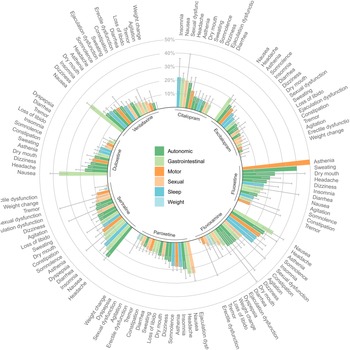
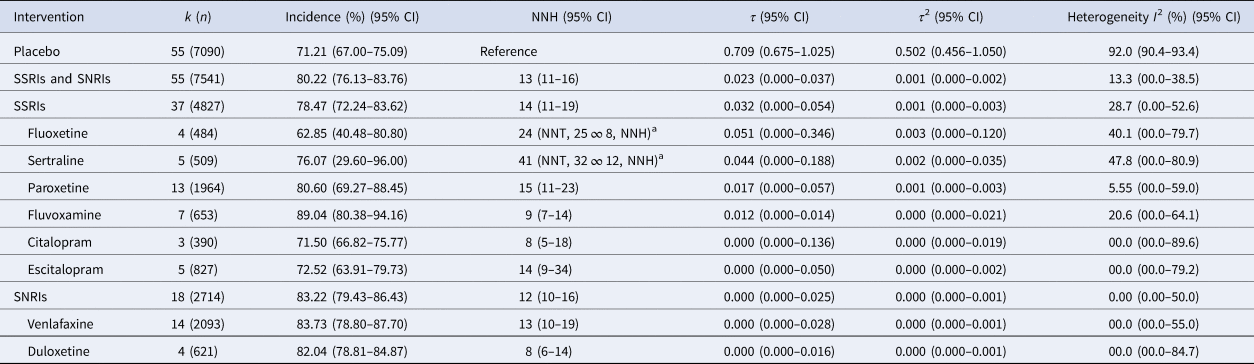
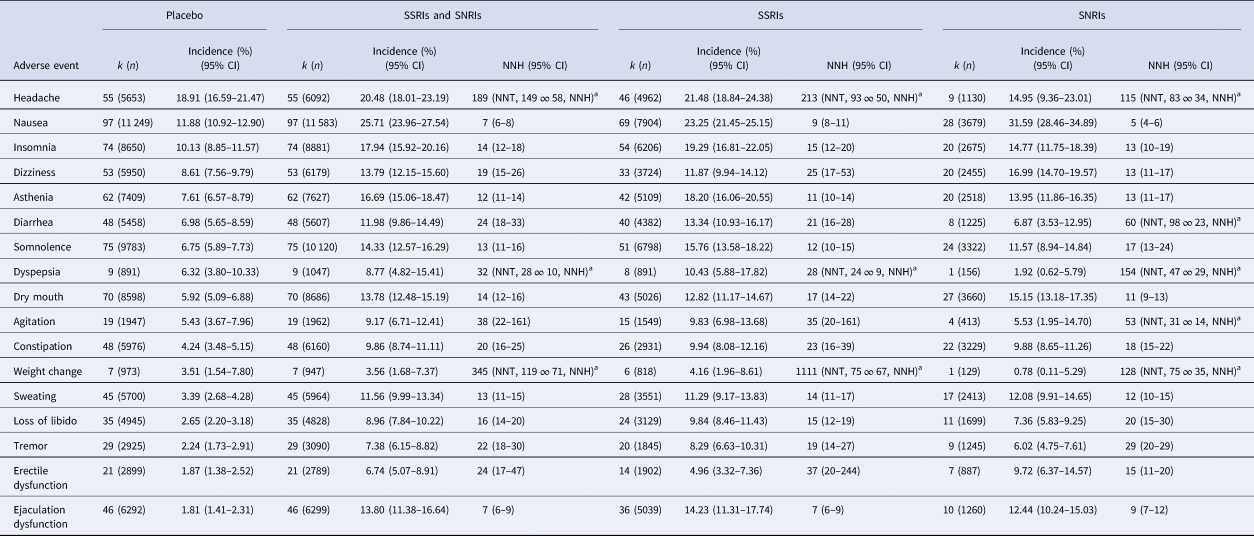
We identified that the proportion of participants experiencing adverse events in medication groups (80.22%, 95% CI 76.13–83.76) was higher than those found in placebo groups (71.21%, 95% CI 67.00–75.09), as expected. Incidence rates of at least one adverse ranged from 62.85% (95% CI 40.48–80.80) for fluoxetine to 89.04% (95% CI 80.38–94.16) for fluvoxamine (Table 1). For the pooled medication group, nausea was the most common adverse event (25.71%, 95% CI 23.96–27.54), while weight change presented the lowest incidence rate (3.56%, 95% CI 1.68–7.37) (Table 2). Figure 1 reports the relative frequencies of specific adverse events by medication.
Relative frequencies of specific adverse events by medication. Effect sizes are presented as odds ratios, and error bars represent estimated standard errors. Specific adverse events are described outside of the circular bar plot and are colored according to the corresponding adverse event domain.

Incidence rates of adverse events of each medication class and each medication within the same class

k, number of studies; n, sample size; CI, confidence interval; NNH, number needed to harm; NNT, number needed to treat; SSRIs, selective serotonin reuptake inhibitors; SNRIs, serotonin and norepinephrine reuptake inhibitors. NNHs were estimated using the placebo group as reference.
a Non-significant differences are presented with the NNT to the left and NNH on the right.
Incidence rates of specific adverse events of placebo and medications' classes

SSRIs, selective serotonin reuptake inhibitors; SNRIs, serotonin and norepinephrine reuptake inhibitors; k, number of studies; n, sample size; CI, confidence interval; NNH, number needed to harm; NNT, number needed to treat. NNHs were estimated using placebo group as reference.
a Non-significant differences are presented with the NNT to the left and NNH on the right.
We found significant ORs indicating higher rates of adverse events for medications over placebo for the pooled medication group (OR 1.65, 95% CI 1.52–1.79) and for most individual medications, with the exception of sertraline and fluoxetine (online Supplementary Fig. S21) (moderate to high certainty of evidence). The network diagram of direct comparisons is presented in online Supplementary Fig. S22.
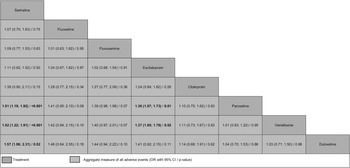
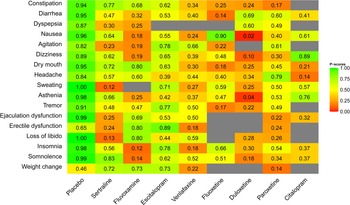
We performed head-to-head comparisons through the multiple meta-regression model, accounting for clinical and methodological moderators. For the aggregate measure of all specific symptoms, when compared to sertraline, paroxetine (OR 1.51, 95% CI 1.19–1.92; very low), venlafaxine (OR 1.52, 95% CI 1.22–1.91; very low), and duloxetine (OR 1.57, 95% CI 1.06–2.31; low) and, when compared to escitalopram, paroxetine (OR 1.36, 95% CI 1.07–1.73; low) and venlafaxine (OR 1.37, 95% CI 1.05–1.78; low) had significantly higher adverse events rates, with no further significant differences between all other medications (Fig. 2). We also found significant differences in head-to-head comparisons of medications concerning the five clusters of symptoms: (a) autonomic: paroxetine was less tolerated than fluvoxamine (OR 1.97, 95% CI 1.14–2.41; low) and escitalopram (OR 1.48, 95% CI 1.04–2.11; low), venlafaxine was less tolerated than fluvoxamine (OR 2.13, 95% CI 1.21–3.74; moderate), escitalopram (OR 1.60, 95% CI 1.09–2.34; moderate), and sertraline (OR 1.47, 95% CI 1.04–2.09; low), and duloxetine was less tolerated than fluvoxamine (OR 2.25, 95% CI 1.14–4.45; moderate) (online Supplementary Fig. S23); (b) gastrointestinal: venlafaxine was less tolerated than fluoxetine (OR 1.97, 95% CI 1.10–3.51; high) and sertraline (OR 1.63, 95% CI 1.21–2.19; moderate), duloxetine was less tolerated than fluoxetine (OR 2.27, 95% CI 1.05–4.91; high) and sertraline (OR 1.88, 95% CI 1.11–3.18; moderate) (online Supplementary Fig. S24); (c) sleep: paroxetine was less tolerated than sertraline (OR 1.49, 95% CI 1.07–2.06; low), and venlafaxine was less tolerated than sertraline (OR 1.62, 95% CI 1.14–2.30; low) (online Supplementary Fig. S25). There were no significant differences between medications concerning motor (low to high) and sexual adverse events (low to high) (online Supplementary Figs S26–S27). We did not find significant differences between medications for the aggregate measure of all specific symptoms in RCTs designed to assess children and adolescents (online Supplementary Fig. S28). In general, medications were less tolerated than placebo for most specific adverse events (very low to high), with the exception of headache, dyspepsia, and weight change (very low to high; forest plots are presented in Supplementary Figs S29–S34). Figure 3 presents treatment rankings concerning specific adverse events. Although treatment rankings for acceptability and efficacy were not significantly correlated (r −0.53, 95% CI −0.90 to 0.27) (online Supplementary Fig. S35), we found a strong positive correlation between the effect sizes of efficacy and incidence rates of adverse events (r 0.71, 95% CI 0.08–0.93) (online Supplementary Fig. S36). The design-by-treatment interaction models did not identify global inconsistency in the networks, we did not find clear evidence of violations of the transitivity assumption when comparing characteristics of studies across comparisons (online Supplementary Figs S37–S40), and we did not find significant heterogeneity estimates for medication–placebo models, with I 2 ranging from 0% to 34.1%.
Comparisons of all SSRIs and SNRIs for the aggregate measure of all adverse events in the multiple meta-regression model. SSRIs, selective serotonin reuptake inhibitors; SNRIs, serotonin and norepinephrine reuptake inhibitors; OR, odds ratio; CI, confidence interval. Medications are ordered from best to worst according to treatment rankings based on p scores estimated using the multiple meta-regression model. Comparisons between treatments should be read from left to right and the estimate is in the cell in common between the column-defining treatment and the row-defining treatment. ORs above 1 indicate better tolerability for the column-defining treatment. Significant results are in bold.

Treatment rankings for each specific adverse event.

We did not find significant ORs suggesting differences of medications over placebo for suicidal ideation (OR 1.61, 95% CI 0.89–2.92; moderate) (online Supplementary Fig. S41). There were a limited number of suicide attempts and deaths by suicide. While there were two suicide attempts in the placebo group, there were two suicide attempts venlafaxine and paroxetine groups (Allgulander et al., Reference Allgulander, Mangano, Zhang, Dahl, Lepola and Sjödin2004; Baldwin, Bobes, Stein, Scharwächter, & Faure, Reference Baldwin, Bobes, Stein, Scharwächter and Faure1999; Rynn, Riddle, Yeung, & Kunz, Reference Rynn, Riddle, Yeung and Kunz2007). The only suicide was related to a participant receiving paroxetine in an RCT designed to evaluate individuals with social anxiety disorder; nevertheless, authors of the primary study considered the suicide probably to be unrelated to study medication (Baldwin et al., Reference Baldwin, Bobes, Stein, Scharwächter and Faure1999).
We performed a multiple three-level meta-regression analysis to investigate potential sources of heterogeneity in medication–placebo comparisons for the aggregate measure of all specific adverse events, as an overall estimate of tolerability. The multiple meta-regression model indicated higher rates of adverse events for four factors: (a) paroxetine relative to sertraline, (b) higher doses of medications relative to low doses, (c) participants diagnosed with generalized anxiety disorder in comparison to patients diagnosed with panic disorder, and (d) studies that used placebo lead-in periods compared to those that did not include these periods in trials (online Supplementary Table S31).
Discussion
This network meta-analysis provides a comprehensive comparison of antidepressants tolerability for anxiety, obsessive-compulsive, and stress-related disorders, based on 80 studies, which reported 799 outcome measures of 17 types of adverse events, comprising 21 338 individuals. Our results revealed high rates of adverse events for both placebo and medication groups; however, most individual medications presented higher rates of adverse events over placebo, except sertraline and fluoxetine. For individuals receiving medications, the most common adverse event (25.71%) was nausea, while weight change was the least common (3.56%). Moreover, estimates of tolerability were moderated by dose, medication, patient diagnosis, and use of placebo lead-in periods. Finally, concerning head-to-head comparisons, we found that paroxetine and venlafaxine were less well tolerated than sertraline and escitalopram, and duloxetine was also less well tolerated than sertraline for the aggregated measure of all adverse events. We also found significant differences between medications for autonomic, gastrointestinal, and sleep-related symptoms. When evaluating outcomes related to suicidality, we did not find significant differences between medications over placebo.
All included SSRIs and SNRIs have shown incidence rates of adverse events comparable to benzodiazepines and antipsychotics, drug classes that present some evidence supporting their efficacy of these medications for anxiety symptoms (Arbanas, Arbanas, & Dujam, Reference Arbanas, Arbanas and Dujam2009; Ketter et al., Reference Ketter, Miller, Dell'Osso, Calabrese, Frye and Citrome2014). Notwithstanding, these pharmacological agents present distinct tolerability profiles. While benzodiazepines and antipsychotics are frequently associated with serious and potentially dangerous adverse events such as physical dependence, extrapyramidal symptoms, and metabolic side effects (Huhn et al., Reference Huhn, Nikolakopoulou, Schneider-Thoma, Krause, Samara, Peter and Leucht2019; Soyka, Reference Soyka2017), we have found less severe adverse events as most commonly associated with SSRIs and SNRIs. Given we have found that nausea, headache, insomnia, asthenia, and somnolence are the most frequent symptoms associated with these medications, clinicians should inform patients not only about the high incidence rate of adverse events, but also about the frequency of these common events.
In line with large estimates of the placebo effect in studies designed to assess the efficacy of antidepressants for anxiety, obsessive-compulsive, and stress-related disorders (Gosmann et al., Reference Gosmann, Costa, Jaeger, Motta, Frozi, Spanemberg and Salum2021), we found that 71.21% of participants present adverse events due to the nocebo effect, considering that these individuals were randomized to placebo arms in RCTs. These estimates are substantially higher than those associated with antidepressants for depression treatment (Mitsikostas, Mantonakis, & Chalarakis, Reference Mitsikostas, Mantonakis and Chalarakis2014), psychotropic medications for other mental disorders (Dodd et al., Reference Dodd, Walker, Brnabic, Hong, Burns and Berk2019; Palermo, Giovannelli, Bartoli, & Amanzio, Reference Palermo, Giovannelli, Bartoli and Amanzio2019), and common interventions for clinical conditions (Luparello, Leist, Lourie, & Sweet, Reference Luparello, Leist, Lourie and Sweet1970; Mondaini et al., Reference Mondaini, Gontero, Giubilei, Lombardi, Cai, Gavazzi and Bartoletti2007; Silvestri et al., Reference Silvestri, Galetta, Cerquetani, Marazzi, Patrizi, Fini and Rosano2003), suggesting individuals' diagnosis as an important moderator of the nocebo effect possibly due to catastrophic beliefs and pessimistic expectations of individuals diagnosed with anxiety disorders. Moreover, headache, the second most frequent event in medication arms, dyspepsia, and weight change were not significantly more common in individuals using SSRIs and SNRIs when compared to placebo and NNH values were considerably high for some specific adverse events, indicating that incidence rates of several common events can be substantially explained by the nocebo effect. Given 77% of individuals diagnosed with anxiety disorders do not properly adhere to pharmacological treatment (Sundbom & Bingefors, Reference Sundbom and Bingefors2013), with fear of potential adverse reactions being the second leading cause of non-adherence (Sundbom & Bingefors, Reference Sundbom and Bingefors2013), and that the interaction between patient and clinician influences the likelihood of the nocebo effect (Blasini, Peiris, Wright, & Colloca, Reference Blasini, Peiris, Wright and Colloca2018), the exploration of patients' expectations and realistic and precise description of potential benefits and harmful events in a positive way may substantially contribute to successful treatments.
Comparative assessments of medications revealed that escitalopram and sertraline are better tolerated than paroxetine, venlafaxine, and duloxetine for the aggregate measure of adverse events. Moreover, based on treatment rankings and head-to-head comparisons accounting for clinical and methodological moderators, we found distinct symptom-specific tolerability profiles for each medication, especially for autonomic, gastrointestinal, and sleep-related adverse events. These findings can substantially contribute for personalized evidence-based practice. Clinicians should be able to integrate the results from this systematic research with individual clinical expertise by considering other factors such as patient's prior experience with medications, physician's own experience, and potential budgetary constraints. Furthermore, shared decision-making for medication choice should be facilitated by thoughtful identification of individual patients' preferences and discussion of what to expect in terms of tolerability profiles of specific adverse events for each medication (Sackett, Rosenberg, Gray, Haynes, & Richardson, Reference Sackett, Rosenberg, Gray, Haynes and Richardson1996). Comparisons of medications did not find significant differences of tolerability in children and adolescents for the aggregate measure of adverse events; nevertheless, future studies may explore potential distinct symptom-specific tolerability profiles of each medication in this population.
In spite of its well-established benefit of SSRIs for improvement of depressive symptoms (Cipriani et al., Reference Cipriani, Furukawa, Salanti, Chaimani, Atkinson, Ogawa and Geddes2018), concerns have been raised about the risk of suicidal behavior associated with these medications (Hayes, Lewis, & Lewis, Reference Hayes, Lewis and Lewis2019). Our findings did not indicate significant differences of SSRIs or SNRIs over placebo for suicidal ideation, suicide attempts, or deaths by suicide, indicating that these agents are not associated with increased risk of suicide in patients with a primary diagnosis of anxiety, obsessive-compulsive, or stress-related disorders. Given so, clinicians and policy makers should be reassured about safety of these effective antidepressants.
This study has some major strengths. To the best of our knowledge, this is the most comprehensive and the largest meta-analysis to date to evaluate the tolerability of antidepressants for the treatment of patients diagnosed with anxiety, obsessive-compulsive, or stress-related disorders, due to the inclusion of multiple autonomic, gastrointestinal, sexual, motor, and sleep-related adverse events, and extensive search for both published and unpublished trials with no restriction regarding participants' age, date of publication, or study language. This approach allows a well-powered comparison of tolerability among these medications, estimating the incidence rates of 17 adverse events through 799 outcome measures. Moreover, we extracted detailed clinical and methodological information of each included study, exploring potential moderators of tolerability estimates. Also, we evaluated suicidality based on incidence rates of suicidal ideation, suicide attempts, and deaths by suicide.
Nevertheless, our study has some limitations. First, the systematic review was planned to include RCTs with efficacy estimates of antidepressants on internalizing symptoms; however, it is unlikely that there are studies primarily designed to evaluate tolerability of these medications without any estimate of efficacy that would lead to study inclusion. Second, we were not able to analyze possible changes in rates of adverse events within the same trial, since these outcomes are usually reported for the endpoint and rarely reported in other timepoints. Third, there were a limited number of outcome measures for some specific adverse events and for outcomes related to suicidality; therefore, we were not able to perform head-to-head comparisons for specific adverse events through the multiple meta-regression model due to lack of statistical power. Nonetheless, these comparisons were made through clusters of these specific symptoms. Fourth, we identified moderate heterogeneity in our data analysis, as expected in meta-analyses with a large numbers of outcome measures (Saad, Yekutieli, Lev-Ran, Gross, & Guyatt, Reference Saad, Yekutieli, Lev-Ran, Gross and Guyatt2019). Accordingly, we explored and identified potential sources of heterogeneity through meta-regression analysis. Last, although most comparisons were rated as moderate or high according to CINeMA, we rated some significant findings as low or very low certainty of evidence, especially for the aggregate measure of autonomic and sleep-related symptoms and for the aggregate measure of all adverse events, indicating that these results should be interpreted cautiously.
There are currently nine SSRIs and SNRIs available for treating anxiety, obsessive-compulsive, and stress-related disorders. Given the lack of major efficacy differences among medications, other factors should play a role in this selection, such as availability (e.g. what is available in the public health system), cost, and, possibly one of the most important factors, the tolerability profile. Here we provided evidence that pharmacological agents vary substantially in their profile of adverse events. Also, we provided evidence on the average number necessary to harm for multiple adverse events. We hope this evidence can help clinicians share the decision-making with patients on what to expect regarding adverse events when starting an SSRI or SNRI. When adverse events are present, this can also help select the medication with the lower chances of having the same side effect and diminish the clinical journey to find an acceptable pharmacological agent according to preferences of each individual.
Supplementary material
The supplementary material for this article can be found at https://doi.org/10.1017/S0033291723001630
Author contributions
N. P. G. and G. A. S. conceived, designed, had full access to all data in the study and take responsibility for the integrity of data and accuracy of data analysis. N. P. G., M. d. A. C., M. d. B. J., and J. F. selected the articles and extracted the data. N. P. G. and G. A. S. analyzed the data. N. P. G., M. d. A. C., M. d. B. J., J. F., L. S., G. G. M., S. C., P. C., D. S. P., and G. A. S. interpreted the data and contributed to the writing of the manuscript. All authors have reviewed and approved the final submitted version of this article. The corresponding author attests that all listed authors meet authorship criteria and that no others meeting the criteria have been omitted.
Financial support
G. A. S. was supported and this study was financed in part by Fundo de Incentivo à Pesquisa/Hospital de Clínicas de Porto Alegre (FIPE/HCPA – 001) – Brazil, Coordenação de Aperfeiçoamento de Pessoal de Nível Superior (CAPES), Finance Code 001, Conselho Nacional de Desenvolvimento Científico e Tecnológico (CNPq – 001), Brazilian federal government agencies, and Child Mind Institute (CMI – 001) – USA. D. S. P. was supported by NIMH Intramural Research Program Project ZIA-MH002781. The funder of the study had no role in study design, data collection, data analysis, data interpretation, or writing of the report. The views expressed are those of the authors and not necessarily those of FIPE/HCPA, CAPES, CNPq, and CMI. We thank FIPE/HCPA, CAPES, CNPq, and CMI for the financial support for this work.
Competing interest
None.