Lactation studies on dairy cows have shown that the conjugated linoleic acid (CLA) isomer trans-10, cis-12 suppresses milk fat synthesis in the mammary gland and lowers milk fat secretion (Gervais et al. Reference Gervais, Spratt, Líonard and Chouinard2005; Kay et al. Reference Kay, Mackle, Bauman, Thomson and Baumgard2007). This isomer acts on de novo synthesis of fatty acids (FA), as well as on the uptake of preformed FA by the mammary gland (Baumgard et al. Reference Baumgard, Sangster and Bauman2001), thus impacting the pool of precursors involved in fat metabolism and the respective gene expressions (Hussein et al. Reference Hussein, Harvatine, Weerasinghe, Sinclair and Bauman2013). Although the dairy cow has sufficient energy stored in adipose tissue to overcome a possible energy shortage around parturition, mobilisation and utilisation of this energy is limited by the size of the metabolic glucose pool. Insulin sensitivity was affected by CLA without corresponding changes in tissue variables (Saremi et al. Reference Saremi, Winand, Friedrichs, Kinoshita, Rehage, Dänicke, Häussler, Breves, Mielenz and Sauerwein2014). Moreover, CLA reduced the endogenous glucose production in early lactation, suggesting a glucose sparing effect (Hötger et al. Reference Hötger, Hammon, Weber, Görs, Tröscher, Bruckmaier and Metges2013). It is not known, however, if the impact of CLA on milk fat precursors like glucose is strong enough to affect other metabolic pathways, e.g., related to sustaining fertility or health, and if so, how the magnitude of this effect will be.
A positive influence of trans-10, cis-12 CLA on the energy balance of early lactation dairy cows was reported recently by Liermann et al. (Reference Liermann, Pfeiffer and Schwarz2008). This effect was due to a reduced energy output as a result of a reduced milk fat production and constant milk yields. Others, however, have reported that CLA supplementation had no significant effects on milk yield, milk energy output (calculated from yields of fat, protein and lactose) and energy balance (Bernal-Santos et al. Reference Bernal-Santos, Perfield, Barbano, Bauman and Overton2003; Moallem et al. Reference Moallem, Lehrer, Zachut, Livshitz and Yacoby2010; Metzger-Petersen, Reference Metzger-Petersen2013). In all these cases there was a tendency (P < 0·13, P < 0·001, and P < 0·08, respectively) for higher milk yield and higher lactose yield (P < 0·16, P < 0·20, and P < 0·14). Although milk fat content was reduced significantly in the study of Bernal-Santos et al. (Reference Bernal-Santos, Perfield, Barbano, Bauman and Overton2003), slight increases in milk yield and thus, protein and lactose yields compensated for the energy savings from CLA supplementation. Only large quantities (18·35 g/d) of trans-10, cis-12 CLA reduced milk energy output significantly (Castañeda-Gutiérrez et al. Reference Castañeda-Gutiérrez, Overton, Butler and Bauman2005). This increase in milk – and lactose – yield is surprising, since transition dairy cows are notoriously limited in glucose supply.
Milk synthesis requires energy in the form of glucose equivalents for lactose, glycerol and NADPH2 syntheses. The latter two are required for fat and FA synthesis. Because, energetically, fat is the most expensive milk component to synthesise (>50% of total milk yield; Bauman & Davis, Reference Bauman, Davis, Larson and Smith1974), reducing its production and altering its composition can improve the energy and glucose status of dairy cows. Alterations in milk fat composition may result in a reduced proportion of de novo synthesised FA in milk triglycerides. Due to a higher percentage of preformed, i.e. long-chain, FA that have higher molecular weights, the same amount of milk fat requires less moles of FA, glycerol and NADPH2 which would result in less energy expenditure for milk fat synthesis. As many authors have reported that CLA supplementation increased milk yield with a concomitantly greater lactose production, it should be quantified whether the energy- and glucose-sparing or consuming effect of CLA supplementation prevails. According to the meta-analysis of De Veth et al. (Reference De Veth, Bauman, Koch, Mann, Pfeiffer and Butler2009) cows on CLA respond with better fertility e.g. reduced days open. This is difficult to explain, however, if CLA would cause an extra challenge to the glucose pool due to the reported higher milk yield.
The overall objective of this study was to evaluate and quantify the modifications of milk and milk component yields in terms of glucose equivalents and in milk fat synthesis based on quantitative dry matter intake (DMI) data that have been found when trans-10, cis-12 CLA were either orally or abomasally administered to dairy cows. For this purpose available literature data was analysed. Variables considered were milk component yields and milk FA pattern, glucose equivalents, DMI, and amount and route of trans-10, cis-12 CLA administration.
Materials and methods
Literature data
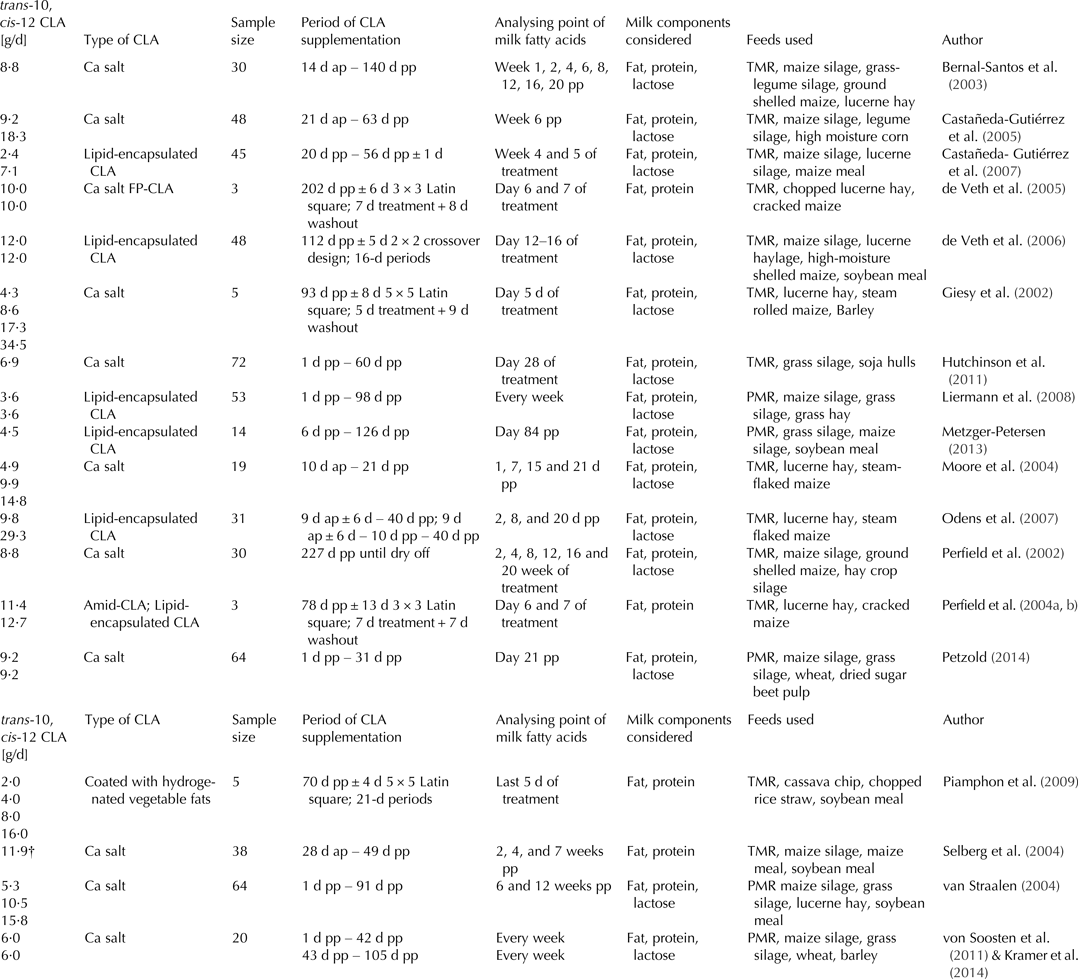
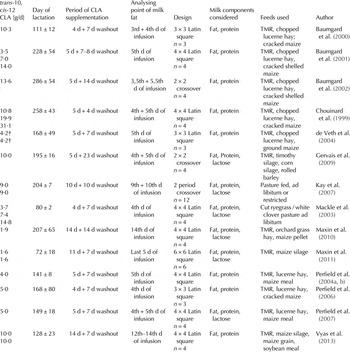
Studies published between 1999 and 2014 (Tables 1 and 2) were considered to evaluate the effects of trans-10, cis-12 CLA supplementation on amount of energy recovered in glucose equivalents and energy required for FA and fat synthesis. The trans-10, cis-12 CLA supplementation ranged from 1·6 to 34·5 g/(d × cow) and CLA was given either by supplementation of the diet, i.e. orally, or by abomasal infusion. Because of presumed differences in transfer efficiency into the mammary gland of trans-10, cis-12 CLA between dietary intake and abomasal infusion, data of studies with oral intake and abomasal infusion were evaluated separately. Calculations of glucose equivalents required that milk lactose concentrations were reported. Although milk lactose content does not vary much, considering its content as being constant would likely have an impact on glucose equivalent estimates given the large amounts of lactose that are synthesised in the mammary gland of lactating dairy cows. The studies varied with respect to duration of supplementation of the CLA isomer, length of period to study the milk (fat) yield and FA composition and stage of lactation of the cows during CLA supplementation.
Literature compilation of trials with oral supplementation of trans-10, cis-12 conjugated linoleic acid (CLA)
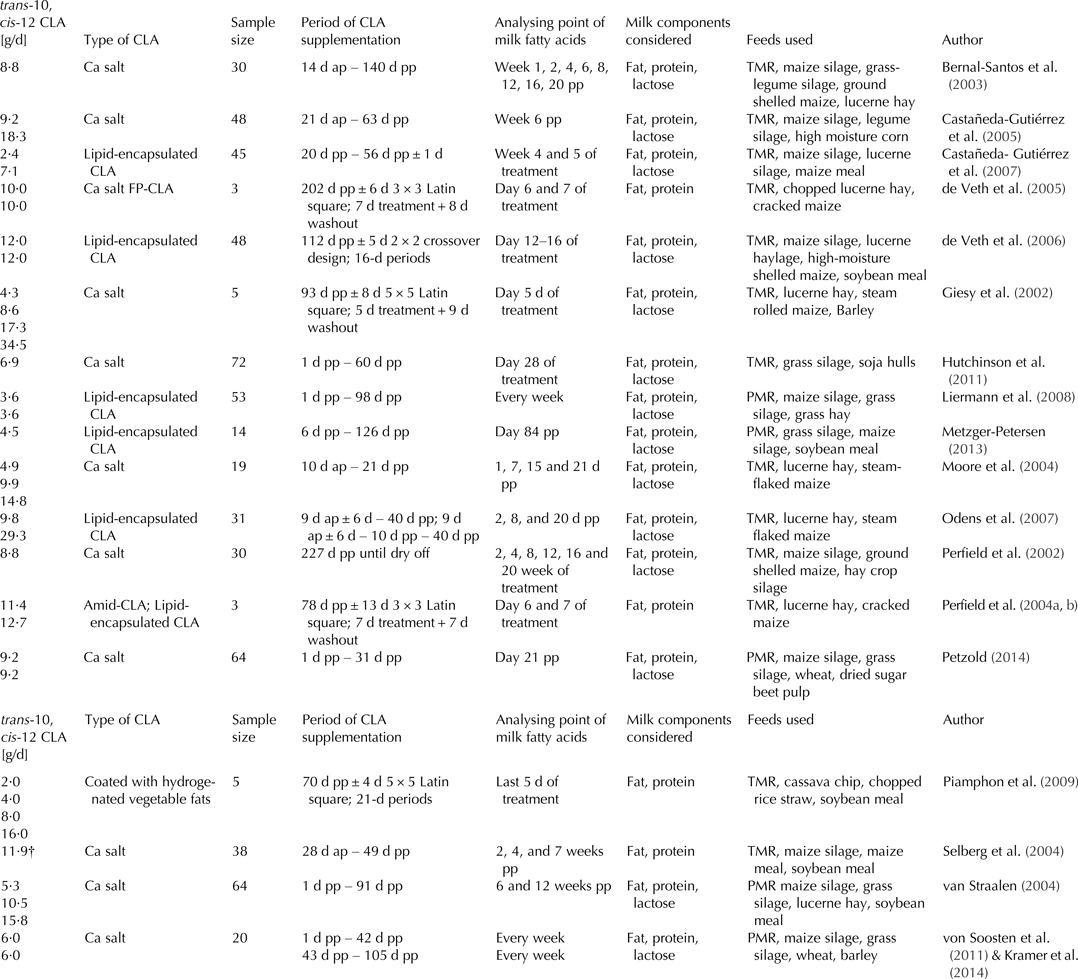
FP-CLA, formaldehyde-protected CLA, intraruminal infusion; ap, ante partum; pp, post partum; TMR, total mixed ration; PMR, partial mixed ration
† Weighted average
Literature compilation of trials with abomasal infusion oral of trans-10, cis-12 conjugated linoleic acid (CLA)

TMR, total mixed ration
† CLA supplemented as free fatty acid and methyl ester, respectively
Other studies were also considered but not included in the evaluation because they did not satisfy one or more of the criteria:
– Bell & Kennelly (Reference Bell and Kennelly2003), Hutchinson et al. (Reference Hutchinson, Hennessy, Dewhurst, Evans, Lonergan and Butler2012), Moallem et al. (Reference Moallem, Lehrer, Zachut, Livshitz and Yacoby2010) and Piperova et al. (Reference Piperova, Moallem, Teter, Sampugna, Yurawecz, Morehouse, Luchini and Erdman2004) reported milk FA concentrations only for FA of between 14 and 18, 12 and 22, 12 and 20, and 14 and 20 carbon atoms, respectively;
– Loor & Herbein (Reference Loor and Herbein2003) only infused CLA for 48 h and collected milk samples directly after infusion had stopped;
– Viswanadha et al. (Reference Viswanadha, Giesy, Hanson and McGuire2003) applied CLA intravenously;
– Moore et al. (Reference Moore, Kay, Collier, VanBaale and Baumgard2005) investigated the effects of CLA on heat-stressed cows;
– Hun et al. (Reference Han, Pang, Li, Zhu, Wang, Wang, Yang and Yang2012) did not report the DMI of the animals and Pappritz et al. (Reference Pappritz, Meyer, Kramer, Weber, Jahreis, Rehage, Flachowsky and Dänicke2011) reported pooled milk FA concentrations and DMI which was not recorded simultaneously with milk samples for FA analyses such that milk FA composition could not be related to DMI.
– Hötger et al. (Reference Hötger, Hammon, Weber, Görs, Tröscher, Bruckmaier and Metges2013) did not report the total milk fat yield of the animals;
– Huang et al. (Reference Huang, Schoonmaker, Bradford and Beitz2008) did not report how much trans-10, cis-12 CLA was administered to the cows; and
– Medeiros et al. (Reference Medeiros, Oliveira, Aroeira, McGuire, Bauman and Lanna2010) used crossbred Holstein x Zebu cows, Shingfield et al. (Reference Shingfield, Saebø, Saebø, Toivonen and Griinari2009) used Finnish Ayrshire cows and Sigl et al. (Reference Sigl, Schlamberger, Kienberger, Wiedemann, Meyer and Kaske2010) used Brown Swiss cows instead of Holstein cows and thus, dietary effects on milk component synthesis might be overlaid or masked by inter-breed differences (Stoop et al. Reference Stoop, van Arendonk, Heck, van Valenberg and Bovenhuis2008).
Calculations
In order to evaluate influences of trans-10, cis-12 CLA supplementation on energy required for supply of glucose equivalents, i.e. lactose, glycerol and NADPH2, and for FA and fat syntheses, a model was constructed that considered the alterations of trans-10, cis-12 CLA on amounts of milk FA (C5–C15 and 60% of C16). Energy requirements for BW changes were not considered, because Gruber et al. (Reference Gruber, Susenbeth, Schwarz, Fischer, Spiekers, Steingass, Meyer, Chassot, Jilg and Obermaier2008) have shown that the energy expenditure for retention and mobilisation of fat and protein cannot be reliably estimated from BW changes. Moreover, the energy supply was based on the respective average group DMI to take account of differences of glucose supply between diets. Subsequently, these values were used for all further calculations related to the oral intake or abomasal infusion of trans-10, cis-12 CLA. Energy requirements for synthesis of milk components were integrated into the model as follows:
Lactose
The required energy input for the synthesis of lactose was calculated according to Bergner & Hoffmann (Reference Bergner and Hoffmann1996, p. 159). The efficiency of conversion of glucose into lactose was assumed to be 97·7%.
Glycerol
The energy requirement for glycerol synthesis was calculated according to Schauff et al. (Reference Schauff, Clark and Drackley1992) based on 3 moles of FA per mol of glycerol. Before calculating the amount of glycerol, the mass of two hydrogen moles and one oxygen mole was subtracted from each single FA in order to adjust for removal of H2O during esterification. Further, the energy required for the esterification with glycerol to yield triacylglycerols (or triglycerides) of the sum of FA was considered. The energy consumption for milk ingredient synthesis was calculated considering ATP yield from glucose and the pathway of converting glucose into glycerol (Bergner & Hoffmann, Reference Bergner and Hoffmann1996, p. 135).
NADPH2
The energy cost of supply of the coenzyme NADPH2 for FA synthesis was assumed to be 3 moles of ATP per mol of NADPH2.
Fatty acids
Energy requirement for FA synthesis was calculated based on milk fat yield and milk FA composition. Since FA of milk triglycerides originate from de novo synthesis as well as from preformed FA, milk FA were separated into two classes, i.e. preformed or synthesised de novo. The FA with a chain length greater than 16 C atoms and 40% of the C16 FA (Waghorn & Baldwin, Reference Waghorn and Baldwin1984) were classified as preformed FA originating from dietary sources or body reserve mobilisation (Bernard et al. Reference Bernard, Leroux, Chilliard, Sejrsen, Hvelplund and Nielsen2006) and FA with a chain length between C5 and C15 and 60% of C16 (Waghorn & Baldwin, Reference Waghorn and Baldwin1984) were assumed to be synthesised de novo. Butyrate was assumed to be available from rumen microbial carbohydrate fermentation and not synthesised de novo. The sources for de novo FA synthesis were acetate (85·4%) and β-hydroxybutyrate (14·6%; Waghorn & Baldwin, Reference Waghorn and Baldwin1984).
Finally, calculations were performed after Bergner & Hoffmann (Reference Bergner and Hoffmann1996, p. 128). The energy required for de novo synthesis of FA was calculated for each FA separately and the result was then translated into the daily FA yield that was calculated from milk fat yield and milk FA composition. Bergner & Hoffmann (Reference Bergner and Hoffmann1996, p. 124) provide details of the energy input of the different steps of the reactions occurring during de novo FA synthesis The assumption was that 3 ATP are generated from one NADH. Energy for glycerol synthesis was calculated as above.
Statistical analysis
Statistical analysis was performed applying a linear non-weighted regression analysis (SAS, 2004):
 $$Y = a + b {\;\rm \times}{\;x}$$
where Y = response variable, a = change in energy amount (MJ net energy for lactation [NEL] from glucose equivalents as outlined above, i.e. corrected for differences in DMI), b = slope of the line to predict Y, and x = amount of CLA supplemented orally or by abomasal infusion.
Results and discussion
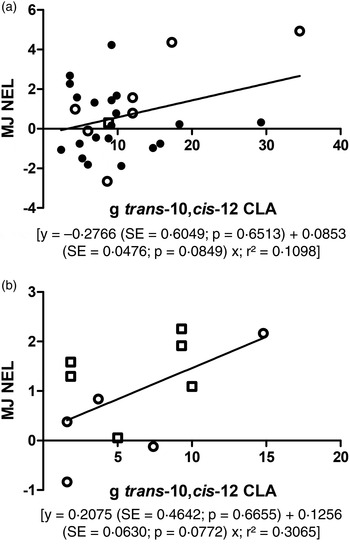
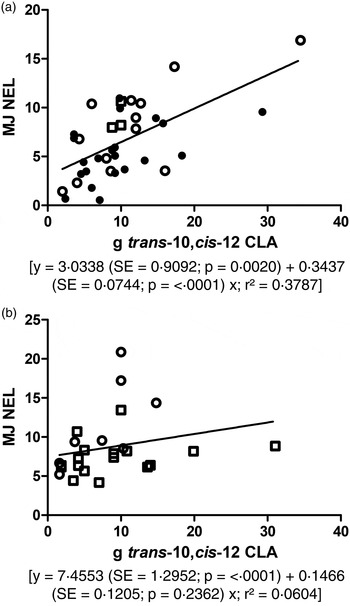
This study evaluated the calculated energy expenditure by dairy cows supplemented with trans-10, cis-12 CLA in a number of studies (Tables 1 and 2). The publications generally provided detailed information about milk ingredient concentrations and yield and – typically based on a much lower number of observations within experiment – an overview of the FA concentrations in milk fat. Although trans-10, cis-12 CLA was supplemented via two different routes, for both routes a dose-dependent effect was observed when amount of supplemented trans-10, cis-12 CLA increased (Figs 1 and 2). Energy savings in the form of glucose equivalents (Fig. 1) responded in a more pronounced way when CLA was abomasally infused than when it was fed to the cows. The opposite observation was made regarding the energy supply for milk fat synthesis (Fig. 2), which had a greater increase following oral supplementation.
Energy supply for milk component synthesis from glucose equivalents (lactose, glycerol, NADPH2 for synthesis of C5 to C15 fatty acids and 60% of C16) taking into account DM intake as the factor governing overall glucose supply. Symbols display the difference (MJ net energy for lactation [NEL]/d) between control and trans-10, cis-12 CLA supplemented groups (g/d); Panel (a) oral CLA supplementation; (b) abomasal CLA infusion. The range of differences (−2·66 to 4·93 MJ NEL) is equivalent to −170 to 314 g of glucose per day. Different symbols indicate time of start of the experiment: filled circles, between 21 d ante partum to 41 d post partum; empty circle, 42–120 d post partum; square, 149–227 d post partum.

Energy supply (MJ net energy for lactation [NEL]/d) for milk fat synthesis (C5 to C15 fatty acids and 60% of C16) taking into account DM intake as related to supplemental trans-10, cis-12 CLA (g/d); (a) oral CLA supplementation; (b) abomasal CLA infusion. Different symbols indicate time of start of the experiment: filled circles, 21 d ante partum to 41 d post partum; empty circle, 42–112 d post partum; square, 141–286 d post partum.

The differences in the strength of the response between oral and abomasal supplementation of the CLA isomer and the greater variability observed with the oral supplementation (Fig. 1) indicate that fed CLA products were affected by ruminal events. Obviously, the protection of CLA products against rumen microbial degradation was less than 100%. Another reason for a more variable response when CLA were fed might be that cows in those studies covered a wider range of lactation stages than abomasally infused cows. Cows in early lactation may undergo severe metabolic stress, and are thus less susceptible to CLA. Bernal-Santos et al. (Reference Bernal-Santos, Perfield, Barbano, Bauman and Overton2003) suggested that, at the onset of lactation, the essential cellular signalling systems are weakened, such that trans-10, cis-12 CLA may be unable to provoke the coordinated reduction in the expression of genes for key lipogenic enzymes. However, Moore et al. (Reference Moore, Haflinger, Mendivil, Sanders, Bauman and Baumgard2004) reported a dose-dependent reduction in milk fat concentration starting already at the onset of lactation when cows were fed trans-10, cis-12 CLA during the transition period until the third week of lactation, which was also the design in the study of Bernal-Santos et al. (Reference Bernal-Santos, Perfield, Barbano, Bauman and Overton2003). It is not known why cows responded so differently in these two experiments.
General differences in the design of the experiments were also related to the length of the CLA supplementation period. Orally supplemented cows were fed the CLA products over several weeks, whereas, the infusion studies never lasted longer than 14 d. In all infusion studies, effects of trans-10, cis-12 CLA were observed on milk fat concentration and milk FA composition. The effect on milk yield, however, was inconsistent. In most studies no effect occurred, yet Mackle et al. (Reference Mackle, Kay, Auldist, McGibbon, Philpott, Baumgard and Bauman2003) found significant milk yield increases at high CLA supplementation levels but Chouinard et al. (Reference Chouinard, Corneau, Barbano, Metzger and Bauman1999) reported lowered milk yields in response to trans-10, cis-12 CLA supplementation. While infused cows generally were in a positive energy balance, cows from most oral supplementation studies were in the transition period or in early lactation and underwent the typical negative energy balance with the deficiency in glucose. Whilst Harvatine et al. (Reference Harvatine, Perfield and Bauman2009) found a decrease in feed intake for mid-lactation cows with CLA, DM intake by cows during transition and early lactation did not respond to CLA supplementation or showed a slight positive responses (Bernal-Santos et al. Reference Bernal-Santos, Perfield, Barbano, Bauman and Overton2003; Castañeda-Gutiérrez et al. Reference Castañeda-Gutiérrez, Overton, Butler and Bauman2005; Odens et al. Reference Odens, Burgos, Innocenti, VanBaale and Baumgard2007; Metzger-Petersen, Reference Metzger-Petersen2013). Milk protein variables were not changed when CLA was supplemented. In most long-term feeding studies the response of milk protein variables was the same as in short-term studies. Only Bernal-Santos et al. (Reference Bernal-Santos, Perfield, Barbano, Bauman and Overton2003) and Metzger-Petersen (Reference Metzger-Petersen2013), who followed the milk and milk component yields far beyond early lactation, observed that average milk yields were elevated by 5·9 and 10·6%, respectively. This would indicate that modified energy expenditure may not be detected during short periods of CLA supplementation and milk energy output and the energy status of the cow may thus be misjudged. This was confirmed in studies of Pappritz et al. (Reference Pappritz, Meyer, Kramer, Weber, Jahreis, Rehage, Flachowsky and Dänicke2011), von Soosten et al. (Reference von Soosten, Meyer, Piechotta, Flachowsky and Dänicke2012) and Hötgers et al. (Reference Hötger, Hammon, Weber, Görs, Tröscher, Bruckmaier and Metges2013). These authors suggest that CLA leads to an improved energy efficiency.
If less energy is directed to the udder when trans-10, cis-12 CLA is supplemented, the question is to what extent can the conserved energy be used for other purposes in other organs? Bernal-Santos et al. (Reference Bernal-Santos, Perfield, Barbano, Bauman and Overton2003) observed a trend towards greater ovulation rates and Castañeda-Gutièrrez et al. (Reference Castañeda-Gutiérrez, Benefield, de Veth, Santos, Gilbert, Butler and Bauman2007) found increases in IGF-1 in cows supplemented with 7·1 g trans-10, cis-12 CLA and a trend was observed for greater values of progesterone during the early luteal phase and of the estradiol to progesterone ratio in follicular fluid. This might affect reproduction through improved ovarian follicular steroidogenesis and increased circulating concentrations of IGF-1. This earlier post partum recovery of IGF-1 with 5 and 10 g/d of trans-10, cis-12 was also reported by Onnen-Lübben (Reference Onnen-Lübben2009). Castañeda-Gutièrrez et al. (Reference Castañeda-Gutiérrez, Benefield, de Veth, Santos, Gilbert, Butler and Bauman2007) suggested that these benefits to reproductive performance seem to be associated with the trans-10, cis-12 isomer itself and are independent from energy balance, however it cannot be excluded that the observed improvements in fertility are based on an energy/glucose effect during the transition period.
With the exception of Odens et al. (Reference Odens, Burgos, Innocenti, VanBaale and Baumgard2007) and Hötgers et al. (Reference Hötger, Hammon, Weber, Görs, Tröscher, Bruckmaier and Metges2013) plasma glucose concentrations did not respond when more glucose was available to extra-mammary syntheses. However, substrate and thus also glucose supply to tissues is not only a function of plasma concentration but also of blood flow, which can vary (Davis & Collier, Reference Davis and Collier1985). So in spite of the lack in glucose concentration response, glucose might flow to sites where fertility and health are concerned.
Conclusion
The literature evaluation revealed a weak to moderate dose-dependent relationship between the amount of CLA administered and the amount of energy in glucose equivalents and energy for the synthesis of milk fat conserved from milk ingredient synthesis. Abomasal infusion of the trans-10, cis-12 CLA more consistently conserved energy in glucose equivalents which indicates an incomplete rumen protection of the fed CLA products. Milk fat synthesis showed an energy saving with a moderate dose-dependent relationship when CLA was supplemented orally.
This study was partly supported by funds allotted to the Institute of Animal Science, University of Bonn.