How much do electoral institutions matter for the rise of right-wing populism? Political scientists continue to debate this question. In this letter, we use a fundamental electoral system change to study the contribution of changes in political institutions to the rise of right-wing populist (RWP) parties in Europe. In 1999, the UK adopted a proportional representation (PR) electoral system for European elections. It replaced the traditional first-past-the-post system in single-member districts. Theories of electoral institutions and strategic coordination by voters and politicians imply that such an institutional change can be conducive to the entry and growth of new parties. With its combination of multi-member districts and a PR electoral formula, a proportional system reduces the prospect that a vote for a new entrant is ‘wasted’ (Duverger Reference Duverger1954). Introducing PR for countrywide elections – for the first time in British history – may have contributed to the spectacular growth of new RWP parties above the European trend. But has it? In this letter, we provide a controlled test.
We analyse a unique institutional change – the introduction of a PR system for European elections in 1999 in the UK – and find that it is an important institutional factor behind the rise of right-wing populists. This electoral system change took place within a Europe-wide assembly. It allows us to model the causal impact of adopting PR at scale in a comparable institutional setting and thus to better account for alternative explanations. Specifically, we use a synthetic control approach (Abadie, Diamond and Hainmueller Reference Abadie, Diamond and Hainmueller2010) to estimate changes in electoral support for RWP parties compared to a ‘synthetic UK’ without such a reform. Compared to the synthetic control case (which shows the same pre-reform levels of electoral RWP support), the introduction of PR increased the average vote share for RWP parties in the UK by about 13 percentage points in the subsequent four elections. Further analyses based on flexible difference-in-difference (DiD) models confirm these results. A major beneficiary of this change was the UK Independence Party (UKIP). In 1994, UKIP won only 1 per cent of the vote and failed to obtain a single seat, while by 2014, it had become the UK's largest party in the European Parliament (EP). Taken together, our best estimates suggest that the electoral reform accounts for roughly one-half of the observed growth in right-wing populism in European elections in the UK.
While our analyses leverage the unique institutional change in the UK, it is important to stress that they are still based on observational data, and estimates depend on particular modelling assumptions. To enhance the plausibility of our results, we: (1) employ two different model set-ups (with different identifying assumptions); (2) enhance model robustness using a large number of time-varying variables whose timing might be confounded with the reform effect (including mainstream party positions, public Euroscepticism, immigration inflows and economic globalization); (3) provide extensive specification and placebo tests in the Online Appendix.
The estimated impact of the reform is substantively important and theoretically plausible. Theories of electoral institutions imply that a switch from first-past-the-post elections in single-member districts to multi-member district PR makes the electoral system more permissive and increases the limit on the viable number of parties (Cox Reference Cox1997).
At the same time, in the empirical populism literature, the relevance of electoral rules ‘continues to be questioned’ (Norris and Inglehart Reference Norris and Inglehart2019, 317). Many studies focus on demand-side factors, such as globalization and cultural anxieties (for reviews, see Golder Reference Golder2016; Norris and Inglehart Reference Norris and Inglehart2019), while a complementary body of research examines the impact of electoral institutions and political opportunity structures. However, assessing the causal impact of electoral system change is fraught with well-known difficulties, and the existing literature finds only mixed and contradictory support for the idea that more proportional electoral systems are a causal driver of RWP votes (Golder Reference Golder2016, 486; Muis and Immerzeel Reference Muis and Immerzeel2017, 913). Moving beyond studies of populism, the literature on the success of new (and niche) parties debates the impact of electoral rules and faces the same empirical challenges (Lago Reference Lago2021; Meguid Reference Meguid2005). As electoral system change is rare, early research on the vote effects of electoral systems is largely cross-sectional. To mitigate endogeneity problems, some comparative studies use election-year panel data and leverage within-country changes in median district magnitude (see, for example, Golder Reference Golder2003). While an important contribution, these studies effectively consider a different research question, namely, the effect of adjustments within existing systems on a single dimension.
Our results have notable implications for research on institutions and the success of populist and new parties more broadly. They indicate that extrapolating evidence from marginal reforms to the effect of electoral system change might underestimate its magnitude. While several studies report null results, the largest point estimate of the impact of median district magnitude on RWP vote shares from Golder (Reference Golder2003, 451, Table 2) implies that an increase in district magnitude, such as the one included in the reform studied here, increases RWP votes by about 6.9 percentage points. We find that the overall impact of the reform might be almost twice as large. This makes sense as electoral system change is a bundle and provides a focal point to strategic actors.
Altogether, our contribution stresses the importance of electoral system change to understanding the ascendancy of RWP parties. To be clear, our analysis should not be interpreted as a horse race between institutional and other explanations. Our period of study is marked by a Europe-wide trend in rising RWP votes, which has been explained by several structural factors, including a backlash against globalization and rising economic insecurity (Colantone and Stanig Reference Colantone and Stanig2018; Muis and Immerzeel Reference Muis and Immerzeel2017). Our aim is not to explain this general trend, but to assess whether electoral system change can help to explain the sudden change in electoral fortunes of populist parties in the UK given underlying demand-side factors.
Institutional Setting
Implementing a Labour manifesto pledge, the government of Tony Blair adopted a reform of the electoral system used to elect the UK's 87 members of the EP. The European Parliamentary Elections Act 1999 replaced plurality voting in single-member districts with closed-list PR in 11 multi-member districts.Footnote 1 Following the reform, the median British Member of the European Parliament is elected in a district with eight seats, compared to one seat before. The new system was first used in 1999, and it marks the first time a proportional electoral system was employed nationally in the UK. This reform was introduced to accommodate a potential coalition partner in Westminster (the Liberal Democrats); it did not result from a groundswell in support for populist alternatives (Farrell and Scully Reference Farrell and Scully2007, ch. 4; Fielding Reference Fielding2003, 50–5). Other European Union (EU) countries have used proportional electoral systems since 1979 and experienced no reform between the 1994 and 1999 EP elections. While some minor institutional adjustments occurred in subsequent elections, the basic rules of the game remained in place until 2014 in the eight other countries that held European elections since 1979 (Belgium, Denmark, France, Germany, Greece, Ireland, Italy and the Netherlands; we refer to them as the EU8). They make up the pool of cases from which we draw to construct a counterfactual synthetic UK.Footnote 2 The fact that European elections across countries are held for the same assembly in the same supranational system of government controls for the structure of legislative and executive institutions. This setting provides a fruitful environment for a comparative case study. We classify RWP parties competing in European elections between 1979 and 2014 following two recent and comprehensive comparative data sets drawing on a large secondary literature and expert surveys. In the UK, this includes both UKIP and the British National Party (BNP). Online Appendix A provides further details.Footnote 3
Empirical Results
The synthetic control method (SCM, see Abadie, Diamond and Hainmueller Reference Abadie, Diamond and Hainmueller2010; see also Online Appendix B.1), enables us to compare the post-reform electoral support for RWP parties in the UK with a synthetic control case. This synthetic UK is constructed to closely resemble the UK prior to the 1999 electoral reform, both in terms of votes for RWP parties and in terms of predictors of RWP votes, from a pool of donor countries. In addition to pre-reform RWP vote shares, our set of pre-reform characteristics includes public Euroscepticism, mainstream party positions on European integration from expert surveys, satisfaction with national democracy, the unemployment rate, the generosity of unemployment insurance, capital openness, Chinese import competition, immigrant inflows and government partisanship (for data details, see Online Appendix A).Footnote 4
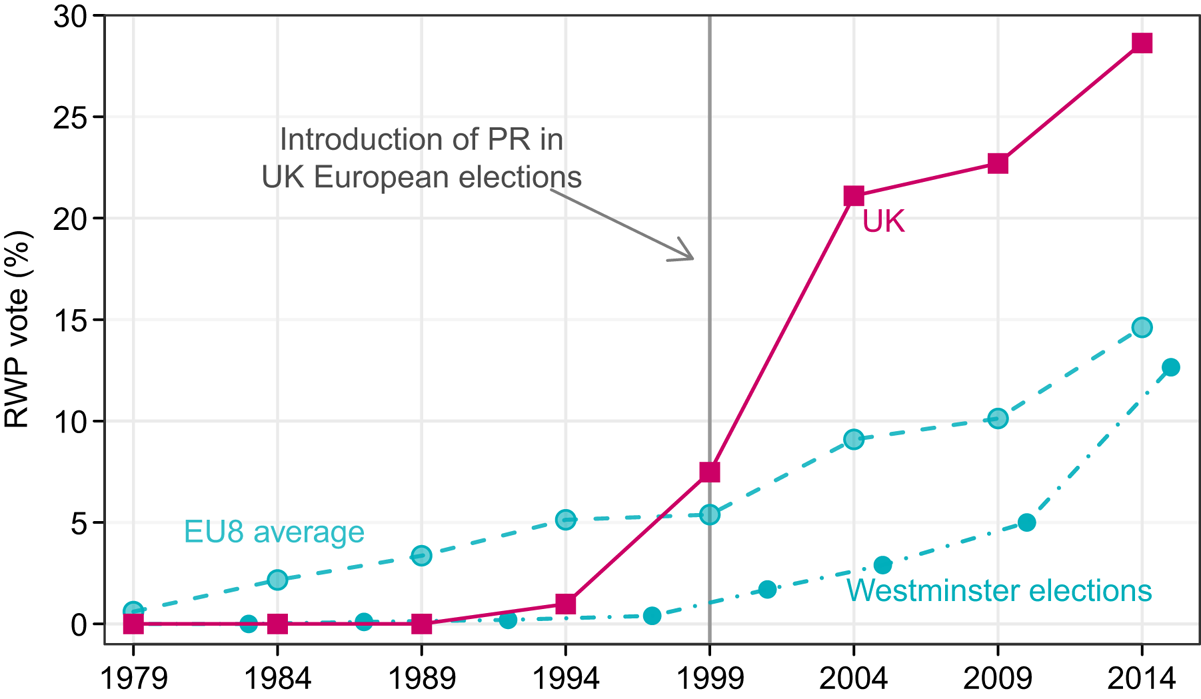
Before turning to the results of the statistical analyses, it is instructive to consider two simpler comparisons. Figure 1 plots the evolution of the combined vote share of RWP parties in the UK in EP elections between 1979 and 2014 compared to an unweighted average of EU8 countries and UK national (that is, Westminster) elections. It shows that electoral support for RWP parties in the UK is virtually zero until 1994, when UKIP first entered the European electoral arena but received only 1 per cent of the vote. With the introduction of PR in the 1999 EP election, the RWP vote in Britain increases more than sevenfold and grows monotonically until the 2014 election. Comparing the UK's four pre-reform and post-reform EP elections reveals an average gap in RWP votes of 19.7 percentage points. This trajectory encompasses the spectacular growth of UKIP and the more modest growth of the BNP, which first entered European elections in 1999. However, assessing how much, if any, of this gap can be attributed to the reform requires a plausible comparison case. The steep rise of RWP in UK European elections after the reform stands in contrast to the evolution in the EU8, as well as in Westminster elections.
Development of RWP vote shares.
Notes: This figure plots RWP vote shares in elections to the EP in the UK and the EU8. Vote shares in UK national (Westminster) elections are displayed for comparison.

The EU8 already experienced a noticeable rise in right-wing populism in EP elections before 1999. In the last election before the reform, the average RWP vote is already five times larger than in the UK. Thus, Figure 1 suggests that a simple EU8 average makes for an inadequate counterfactual comparison case. Westminster elections provide an intuitively appealing comparison case for EP elections in the UK that holds constant country and time-varying factors shaping populist demand. Indeed, pre-reform levels of support for RWP are practically identical in EP and Westminster elections but diverge sharply after the electoral reform (increasing with a relatively steeper slope in the PR elections). Nonetheless, this within-country comparison has limitations. In particular, it does not account for the strategic interdependence of the two electoral arenas. The success of RWP in Europe may spill over into national elections (Dinas and Riera Reference Dinas and Riera2018). Voters may also strategically balance higher support for RWP parties in EP elections with lower support in national ones (Carrubba and Timpone Reference Carrubba and Timpone2005). In the latter case, using Westminster as the comparison group overstates the impact of the electoral reform.
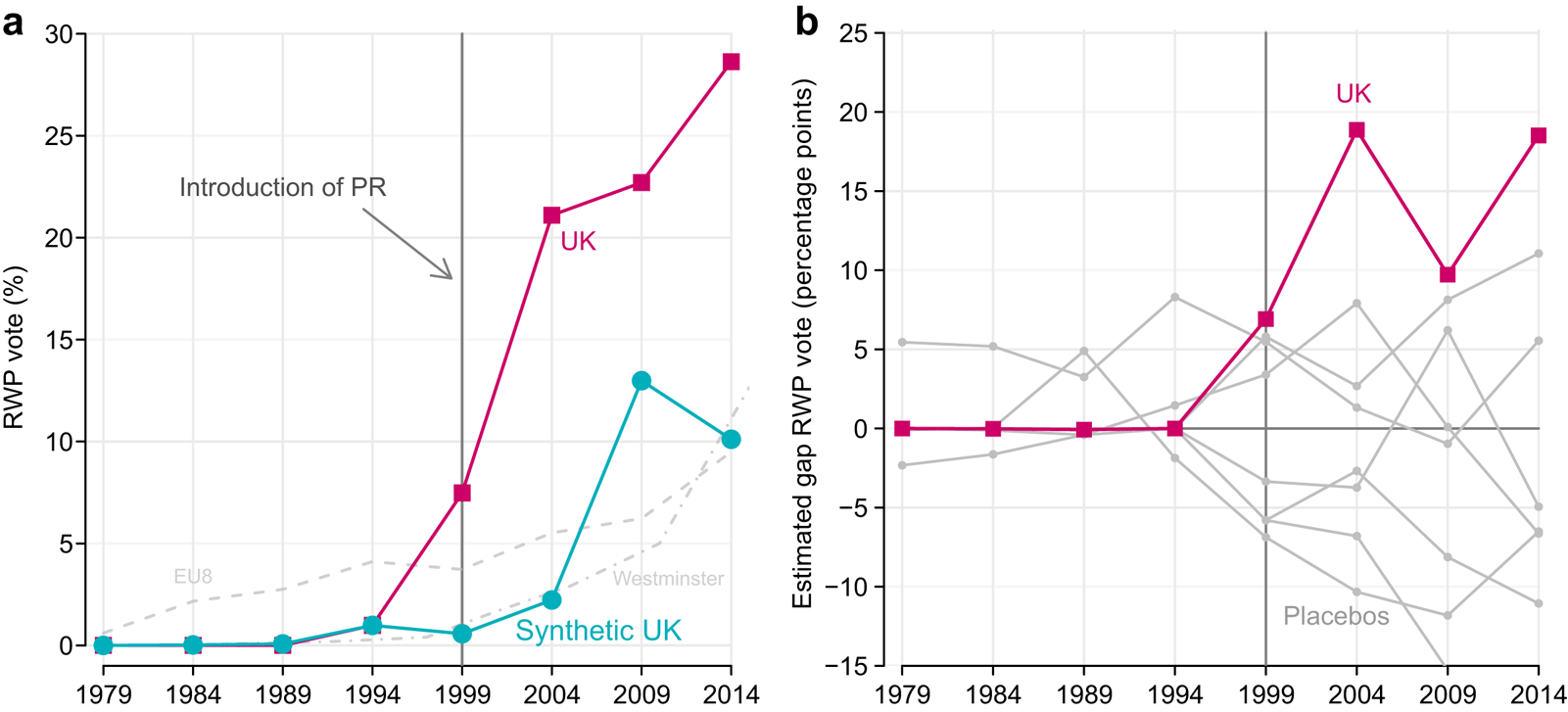
Figure 2 illustrates our main results using a synthetic control case. Panel ‘a’ plots the evolution of the combined vote share of RWP parties in the UK in EP elections between 1979 and 2014 compared to the synthetic UK. It shows that the growth of RWP votes in the UK sharply diverges from the synthetic UK with the introduction of PR in 1999. In contrast to the EU8, the synthetic UK closely approximates pre-reform RWP votes in the UK. It is comprised of a weighted combination of the Netherlands, Ireland and Belgium (see Table B.1 in the Online Appendix). While countries (country weights) are chosen to optimally match synthetic and observed pre-reform trends, the resulting set of countries makes substantive sense as well.Footnote 5 They are highly open economies with strong trade and historical links to the UK. Similar to pre-reform UK, Ireland and Belgium have high effective electoral thresholds, making the entry of new parties difficult (Farrell and Scully Reference Farrell and Scully2007, 75); in the Netherlands, the threshold is lower but not as low as in the national parliament, as the number of available seats is much smaller.Footnote 6
The effect of electoral system change on the RWP vote in Europe.
Notes: Panel ‘a’ plots RWP vote shares in EP elections in the UK (magenta line), which replaced its first-past-the-post system with a PR electoral system in 1999, compared to three control cases: ‘synthetic’ UK, constructed via generalized synthetic control estimation (green line), the EU8 average and Westminster elections (dashed lines). Panel ‘b’ plots the difference in RWP vote shares (percentage points) between treated and synthetic control units. Grey lines plot gaps for placebo-treated units.

With the introduction of PR, a gap of 6.9 percentage points sharply emerges between the UK and its synthetic counterpart, with an even larger gap in the following 2004 election. This gap – shown by the bold line in Panel ‘b’ of Figure 2 – estimates the impact of the electoral reform on the electoral performance of the populist right in the UK. Averaging over all post-reform EP elections, the difference in RWP vote shares between the UK and its synthetic counterpart amounts to 13.5 percentage points. The magnitude of this change is substantively important and theoretically plausible. Our estimate is unlikely to be the result of chance alone. We create in-space placebo estimates by applying the SCM to each of the eight potential donor countries, assuming that 1999 is the placebo election. Placebo estimates are plotted as grey lines in Panel ‘b’ and reveal that no country shows an estimated increase in RWP votes as large as, or larger than, the UK in any of the post-reform elections.Footnote 7 It is noteworthy that the synthetic UK sees a larger average growth in right-wing populism than Westminster elections, leading to a smaller estimate of the reform's impact. This comparatively conservative result illustrates the appeal of the method. Using information on pre-reform outcomes as well as predictors of populist votes, SCM appears to better capture underlying structural changes.
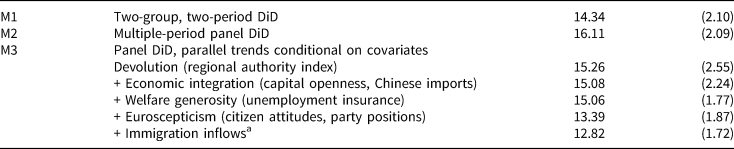
Employing DiD estimators, which make different identification assumptions, confirms the SCM results. Table 1 summarizes the DiD estimates.Footnote 8 Throughout, point estimates are similar to those from the SCM and statistically significant. Model M1 contrasts differences between average RWP vote shares in the UK and EU8 before and after the reform. It accounts for time-invariant unobserved differences between the UK and other countries, as well as common shocks, including treaty changes and factors that increase the demand or supply of populism. Results from a panel DiD estimator with multiple periods are very similar (Model M2). Next, we estimate several model specifications (M3) that relax the parallel trends assumption by conditioning on observed covariates (Callaway and Sant'Anna Reference Callaway and Sant'Anna2021). We sequentially add potentially fast-moving covariates: political decentralization, economic integration, welfare state generosity, Euroscepticism (attitudes and mainstream party positions) and immigration inflows. The most conservative point estimate from this flexible specification suggests that the reform increased the RWP vote by 12.8 percentage points, which is quite close to the average estimate from the SCM. Our results have to be interpreted against a backdrop of rising support for RWP across Europe in general and more plausible comparison cases in particular. In the UK, reduced concerns about wasted votes and lower barriers to entry in EP elections since 1999 allowed this support to manifest itself at the ballot box in a way that was not possible in first-past-the-post elections. Our preferred estimates from SCM and DiD methods imply that the introduction of PR accounted for between one-half and two-thirds of the observed growth in RWP votes in the UK. The substantive impact of the reform is consistent with existing theory (Cox Reference Cox1997) and experimental evidence (Hix, Hortala-Vallve and Riambau-Armet Reference Hix, Hortala-Vallve and Riambau-Armet2017) showing that introducing a PR system substantively relaxes the incentives of voters and elites to coordinate on one of the two previously dominant parties. It is also well aligned with evidence from an electoral reform in Norway showing that the introduction of PR reduced voter coordination against the Labour Party (Fiva and Hix Reference Fiva and Hix2021).
DiD estimates of electoral reform impact on RWP vote

Notes: Estimates with standard errors in parentheses. M1 is a two-period analysis using pre- and post-reform averages. N = 18. Wild bootstrap standard errors (5,000 replicates, Rademacher weights). M2: Average treatment effect on the treated (ATT) from multi-period DiD panel estimator (Callaway and Sant'Anna Reference Callaway and Sant'Anna2021). N = 72. M3 relaxes the parallel trends assumption conditional on covariates. Bootstrapped standard errors using 5,000 replicates. a Covers 1984 to 2014 and excludes France due to missing immigration inflow data.
In additional analyses, we find that the reform increased the effective number of electoral parties by about one (see Table E.1 in the Online Appendix). This increase in the number of effective parties is the flip side of reallocating votes from mainstream parties to the RWP challengers. We believe that the vote impact of the reform is unlikely to stem from the difference between closed-list and open-list PR (Blumenau et al. Reference Blumenau2017). In the EU8, only Ireland and Italy have an open-list PR system, and our results are robust to excluding them (see Figure B.2 in the Online Appendix). The other countries give voters no or limited scope to change candidates' list placement (Farrell and Scully Reference Farrell and Scully2007, 77). We also find no evidence that the reform shaped EU attitudes directly (see Table D.1 in the Online Appendix).
Discussion
This article highlights a relatively neglected institutional factor behind the recent rise of right-wing populism in the European electoral arena: the adoption of a proportional electoral system for European elections in the UK in 1999. We find that this electoral system change entailed a sizeable increase in the vote share of RWP parties. Our findings contrast with the common view in the populism literature that electoral rules play, at best, a modest role. Caution is needed when existing empirical results based on partial reforms are extrapolated to electoral system change.
The reform we studied concerns European elections, which are considered second-order elections to national parliamentary elections. However, this does not mean that they are irrelevant for national politics, which they might affect via spillovers (see, for example, Dinas and Riera Reference Dinas and Riera2018). Relatedly, the decision of Conservative Party leader David Cameron to hold a referendum on a British withdrawal from the EU has been explained by several scholars as ‘an attempt to stem rising support for the Eurosceptic populist UKIP’ (Norris and Inglehart Reference Norris and Inglehart2019, 371).
Our findings do not condemn the use of PR in European elections. Proportional electoral systems can serve an important voice function, and electoral system design usually requires an evaluation of trade-offs. Indeed, there is evidence that the introduction of PR in the UK has increased ideological congruence between voters and legislators, though at the cost of lower legislative effort (Becher and Menéndez González Reference Becher and González2019). Nor do our results imply that first-past-the-post systems are free of populism: it being more difficult for new RWP parties to become successful, political entrepreneurs might try to capture a mainstream party (as some observers have argued happened in the US).
Supplementary Material
Online appendices are available at: https://doi.org/10.1017/S0007123421000703
Data Availability Statement
The data and codebook, as well as R code replicating all tables and figures, can be found at: https://doi.org/10.7910/DVN/ITBVI2
Acknowledgements
For valuable comments, we are especially grateful to Karine Van der Straeten, Bogdan Gabriel Popescu, participants at the annual meeting of the American Political Science Association (2019), French Political Science Association (AFSP 2019) and seminar participants at Institute for Advanced Study in Toulouse (IAST).
Financial Support
Michael Becher acknowledges IAST funding from the French National Research Agency (ANR) under the Investments for the Future (Investissements d'Avenir) program (Grant No. ANR-17-EURE-0010). Daniel Stegmueller acknowledges funding from the National Research Foundation of Korea (Grant No. NRF-2017S1A3A2066657).
Competing Interests
None.