INTRODUCTION
The timing and nature of the dispersal of archaic and modern humans out of Africa and into Asia, and their interactions with local hominin populations, are key questions in human evolution (Bae et al., Reference Bae, Douka and Petraglia2017). The Eastern Hemisphere is especially important for answering these questions because of a long Pleistocene record of multiple hominin species, including Homo erectus, Denisovans, Homo floresiensis, and Homo sapiens, with H. sapiens potentially deriving from several dispersal events (Martinón-Torres et al., Reference Martinón-Torres, Wu, Bermúdez de Castro, Xing and Liu2017). Previous work has claimed the primary event leading to the appearance of modern humans in Asia was a dispersal event out of Africa and into Eurasia around 50–60 ka (Marine Oxygen Isotope Stage [MIS] 3; Stringer and Andrews, Reference Stringer and Andrews1988). Although a dispersal event at this time was a substantial contributor to Pleistocene population structures in Asia (Prüfer et al., Reference Prüfer, Racimo, Patterson, Jay, Sankararaman, Sawyer and Heinze2014), an accumulation of recent evidence from archaeology, hominin paleontology, geochronology, and genetics has complicated this account. Increasingly, evidence points to important dispersals out of Africa beginning during MIS 5 (130–71 ka), with archaeological evidence appearing in inland dispersal corridors (Petraglia et al., Reference Petraglia, Korisettar, Boivin, Clarkson, Ditchfield, Jones and Koshy2007, Reference Petraglia, Haslam, Fuller, Boivin and Clarkson2010; Liu et al., Reference Liu, Wu, Pei, Wu and Norton2010; Demeter et al., Reference Demeter, Shackelford, Bacon, Duringer, Westaway, Sayavongkhamdy and Braga2012; Bae et al., Reference Bae, Wang, Zhao, Huang, Tian and Shen2014; Groucutt et al., Reference Groucutt, Petraglia, Bailey, Scerri, Parton, Clark-Balzan and Jennings2015; Liu et al., Reference Liu, Martinón-Torres, Cai, Xing, Tong, Pei and Sier2015; Westaway et al., Reference Westaway, Louys, Awe, Morwood, Price, Zhao and Aubert2017).
For the major MIS 3 dispersal, two directional models are consistent with the evidence, broadly northerly and southerly paths (Kaifu et al., Reference Kaifu, Izuho, Goebel, Kaifu, Izuho, Goebel, Sato and Ono2015). The paths taken by dispersals during MIS 4 and 5 are less clear, however. A southern coastal route has been suggested by genetic evidence (Macaulay et al. Reference Macaulay, Hill, Achilli, Rengo, Clarke, Meehan, Blackburn, Semino, Scozzari, Cruciani, Taha, Shaari, Raja, Ismail, Zainuddin, Goodwin, Bulbeck, Bandelt, Oppenheimer, Torroni and Richards2005), but most archaeological deposits from this period in India, China, Laos, Sumatra, and Philippines are located away from the coast. In addition, the technological behaviors that enabled the MIS 4 and 5 dispersals, especially into East Asia, remain unclear. Lithic assemblages in East Asia at this time are often described as showing little difference from Mode 1 technologies characterized by simple cores, flakes, and tools that lack standardization (Gao and Norton, Reference Gao and Norton2002; Norton et al., Reference Norton, Gao, Feng, Camps and Chauhan2009; Gao, Reference Gao2013). These assemblages, by their absence of Mode 2 (characterized by bifacial retouched tools such as the hand axe) and Mode 3 (characterized by prepared core technologies such as Levallois concept) technologies, show little influence of dispersal events of hominins from Europe and western Asia. However, recent work on assemblages in southwest China is starting to indicate the presence of traces of technological innovation that might reflect population events such as dispersals or increases in the density and connectivity of MIS 4 and 5 groups in East Asia (Lycett and Norton, Reference Lycett and Norton2010).
Recent reassessment of the chronology and stone artifact technology at Guanyindong Cave in Guizhou Province, China, identified traces of the Levallois strategy dated to approximately 170–80 ka (Hu et al., Reference Hu, Marwick, Zhang, Rui, Hou, Yue, Chen, Huang and Li2019). Similarly, traces of Levallois have been described in the stone artifact assemblage from Lingjing (Henan Province, China), dated to 125–90 ka (Li et al., Reference Li, Li, Gao, Kuman and Sumner2019). The Lingjing artifacts are associated with two archaic human crania demonstrating a mixture of traits from archaic East Asian humans, Neanderthals and early modern humans. Taken together, these two assemblages lend support to recognition of a Chinese Middle Paleolithic, as a regional variant of the Middle Pleistocene technological advances documented at Eurasian and African archaeological sites (Li et al., Reference Li, Li, Gao, Kuman and Sumner2019). What makes the Chinese Middle Paleolithic distinct from the Middle Pleistocene assemblages in the Western Hemisphere is the low frequencies of prepared core technologies and pieces produced using a Levallois strategy. The rarity of Levallois in East Asia, relative to the Old World, may be because of small, low-density populations with weak and/or irregular patterns of social interconnectedness in this region during the Middle Pleistocene. Under these conditions, technological innovation or persistence would have been rarer, compared with the high-population and/or high-density conditions of Middle Pleistocene sub-Saharan Africa, where Levallois is more abundant (Lycett and Norton, Reference Lycett and Norton2010).
With only these two assemblages, the trajectory of technological evolution during MIS 5 and 4 in China is obscure because of the scarcity of Middle Pleistocene sites in this region and lack of reliable chronology. It is not until MIS 3 that another assemblage in China shows signs of Levallois and far to the north at Jinsitai Cave in Inner Mongolia. Levallois cores and points have been recovered from layers dated to ca. 47–42 ka (Li et al., Reference Li, Kuhn, Chen, Wang, Southon, Peng, Shan, Wang, Ge, Wang, Yun and Gao2018). This sparse archaeological record from MIS 5–4 in China makes it challenging to investigate models of hominin dispersals, contractions, extirpations, and extinctions during this important time. One reason for the sparseness of the record in China is that many sites with cultural materials in Pleistocene deposits have only been dated with radiocarbon methods; however, the ages of the dated materials are beyond the limit of radiocarbon dating (~50 ka).
In this article, we report on our dating of a recently discovered Paleolithic site from southwest China, Tianhuadong (THD) Cave, using a newly developed optical dating technique. Optically stimulated luminescence (OSL) dating is suitable for establishing chronologies for sites older than 50 ka, because it can reach ages beyond the range of radiocarbon dating. First proposed in 1980s, optical dating provides an estimate of the time since mineral grains, such as quartz or feldspars, were last exposed to sunlight or heat (temperatures above 300°C) (Huntley et al., Reference Huntley, Godfreysmith and Thewalt1985; Aitken, Reference Aitken1998; Roberts et al., Reference Roberts, Jacobs, Li, Jankowski, Cunningham and Rosenfeld2015). Over the last decade, it has been widely applied to determine the ages of Quaternary sediments all over the world (Preusser et al., Reference Preusser, Degering, Fuchs, Hilgers, Kadereit, Klasen, Krbetschek, Richter and Spencer2008; Wintle, Reference Wintle2008; Rhodes, Reference Rhodes2011; Roberts et al., Reference Roberts, Jacobs, Li, Jankowski, Cunningham and Rosenfeld2015).
Our attempts to date the deposits at Tianhuadong using radiocarbon methods have not been successful because of the old age of the dated materials (>50 ka). Previously, research tentatively allocated the assemblage to MIS 5–4, because its lithic assemblage exhibits some characteristics that are comparable with Middle Paleolithic cultures from Europe and Africa (Ruan et al., Reference Ruan, Liu, Hu, Li, Yang and Luo2017). We dated the artifact-bearing deposits using single-aliquot regenerative-dose (SAR) procedure for individual quartz grains extracted from the sediments. Our results confirm that the age of archaeological deposits at Tianhuadong falls into the MIS 5–4, providing new evidence of human activity during the Middle–Upper Pleistocene in this region.
SITE AND STRATIGRAPHY
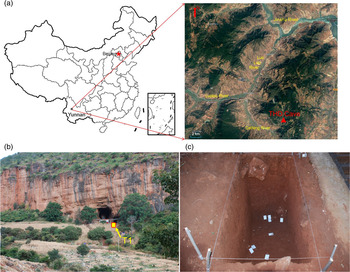
Tianhuadong (26°02.211′N, 100°27.648′E; 1805 m above sea level) is a cave site located on the east side of a limestone valley, Heqing County, Yunnan Province, southwest China (Fig. 1a). The cave, ~200 m long, has a 13-m-wide entrance. It covers an area of ~2400 m2. Sixteen kilometers to the north of the cave is the Jinsha River, and ~100 m to the west is a branch of the Caifeng River. This cave has been used as a temple for many years, so it is difficult to investigate and excavate inside the cave. For this reason, investigations were carried out in 2010, 2013, and 2016 on a gentle slope in front of the cave (Fig. 1b) by the Institute of Cultural Relics and Archaeology of Yunnan Province. A 1 × 2 m trench (T1), extending from west to east, was opened (Fig. 1c). The deposits excavated are mainly red silty clay with a stable and homogeneous sedimentary structure. The sedimentary profile of the trench was divided into five layers (Fig. 2), which are described as follows: (1) Layer 1 (0–25 cm thick) is a disturbed top soil layer. It consists of brown-yellow silty clay. A total of 81 stone artifacts and a small number of animal fossils were recovered from this layer. (2) Layer 2 was divided into two sublayers, layers 2a (15–40 cm thick) and 2b (35–70 cm thick). Layer 2a is a light-brown/red silty clay layer with dense structure and solid texture. Weak carbonate cementation is developed. A total of 100 stone artifacts were recovered from this layer. Layer 2b is a brown-red silty clay layer, with similar structure and texture as layer 2a. Only a few (n = 14) stone artifacts and animal fossil fragments were found from layer 2b. (3) Layer 3 (10–45 cm thick) consists of brown silty clay with carbonate cementation. It bears numerous (n = 56) stone artifacts, animal fossil fragments, and some charcoal fragments. (4) Layer 4 (15–70 cm thick) is red-brown silty clay with carbonate cementation. Numerous animal fossil fragments and a small number (n = 32) of stone artifacts were recovered. (5) Layer 5 (15–30 cm thick) is a brown-red silty clay layer with carbonate cementation. Only a small number of animal fossil fragments and charcoal fragments were recovered.
(color online) (a) Geographic locations of the Tianhuadong site. (b) Photo showing the cave entrance and the excavation area (T1) in front of the cave. (c) Photo showing the excavated trench.

Schematic diagram of the stratigraphy, cultural relics and localities of optically stimulated luminescence (OSL) samples of the north wall of T1. Figure modified from Ruan et al. (Reference Ruan, Liu, Hu, Li, Yang and Luo2017).

Apart from the top layers (1 and 2a), there is no obvious evidence of reworking induced by water flows. According to observations by local farmers, the deposits from the near surface (~ 0.5 m) were removed during previous engineering activities. Therefore, the stone artifacts collected from the surface are expected to originate from the overlying deposits that have been removed and the underlying deposits (mainly layer 1) that have been reworked during engineering activities. More than half of the stone artifacts and fossils recovered from both the surface and lower deposits show signs of weathering on their surface. This is probably because of the acid depositional environment associated with red clay, a typical depositional environment in south China. Most of the stone artifacts recovered from the deposits and collected from the surface show little or no traces of abrasion on their edges, indicating that they were neither exposed for a long period nor transported for a long distance. This suggests that the artifacts were recovered in situ, although more detailed taphonomic work is needed to fully understand the site formation process.
STONE ARTIFACTS
The detailed analysis of the stone artifacts from this site has been reported by Ruan et al. (Reference Ruan, Liu, Hu, Li, Yang and Luo2017), so here we only briefly summarize the key features of the assemblage to give context to the new OSL ages (see the next section). A total of 1121 stone artifacts including 289 from within the stratigraphic layers and 832 from the surface were studied. Table 1 summarizes the number of stone artifacts collected from individual cultural layers and surface. Most of the artifacts (n = 114) came from layer 2, followed by layer 1 and then layer 3. The artifacts collected from the surface and individual layers show similar features in the extent of weathering, raw material, and typology. We could not identify any clear technological changes through different layers. This, however, does not rule out any systematic difference among different layers, because of the relative small number of artifacts excavated from individual layers. Further excavation may be able to provide more statistically significant information for studying the stratigraphic and chronological evolution in the stone technology. At this stage, we believe it is best to treat the stone artifacts from all layers as a whole assemblage. The entire lithic assemblage consists of cores (n = 37), flakes (n = 509), tools (n = 113), and chunks and debris (n = 462). Hard hammer percussion is the dominant technique utilized. The raw materials are dominated by igneous rock (78%), and there appear to have been no major changes in preference in raw material selection over time.
Statistics on the distribution of stone artifacts collected from cultural layers and surface in the Tianhuadong site.

Cores
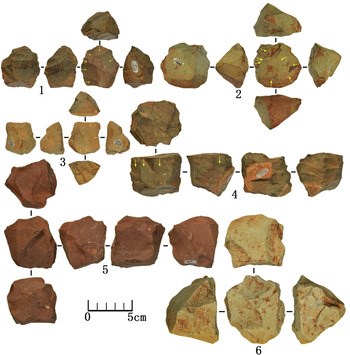
Selected cores from the Tianhuadong site are shown in Figure 3. There are two types of core strategies, simple debitage and complex debitage. Cores that demonstrate no signs of preparation or predetermination were classified as the simple debitage (Fig. 3.1, 3.4–3.6). This type of core includes single platform, double platform, and multiplatform cores. Other cores show traces of preparation and predetermination or have a relatively stable morphology and reduction strategy representing complex debitage (Fig. 3.2–3.3). Most cores are knapped simply, yielding a constricted number of flakes with irregular morphologies. There are two cores that resemble the Levallois reduction (Fig. 3.2–3.3) because of the recurrent centripetal scar pattern shown on the upper surface and other criteria such as hierarchical construction. However, a larger sample is needed to confirm the systematic, long-term use of Levallois strategies at this location. One core displays several parallel scars (Fig. 3.4).
(color online) Photos showing selected cores from the THD site. 1, Discoidal core; 2–3, prepared cores; 4, multiplatform core with elongated flaking scars; 5–6, multiplatform cores. Photos from Ruan et al. (Reference Ruan, Liu, Hu, Li, Yang and Luo2017).

Flakes
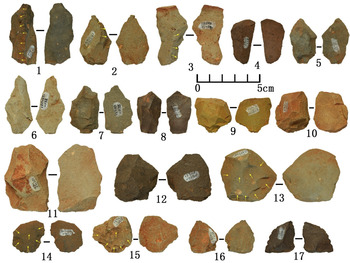
Selected flakes are shown in Figure 4. There are 420 complete flakes, which comprise ordinary flakes, elongated flakes, crest flakes, discoidal flakes, Levallois-like flakes, and triangle flakes. There are 89 flake breaks including proximal, distal, and medial breaks, as well as left and right splits. Elongated flakes are defined as having a length dimension that is two times greater than the width dimension, with regular ridges on the dorsal side (Fig. 4.4–4.8). There are several flakes that have sharp edges and a thick center with centripetal ridges convergent in the middle (Fig. 4.9–4.12), which may have been produced from classic discoidal cores. There are a small number of flakes that demonstrate nearly elliptical shapes, centripetal dorsal scars, and other features that resemble the dorsal scar pattern of products obtained from Levallois reduction (Fig. 4.13–4.15).
(color online) Selected flakes from the THD site. 1–3, Crested long flakes; 4–8, elongated flakes; 9–12, flakes produced from classic discoidal cores; 13–15, flakes with dorsal scar pattern resembling Levallois flakes; 16–17, triangular flakes. Photos from Ruan et al. (Reference Ruan, Liu, Hu, Li, Yang and Luo2017).

Tools
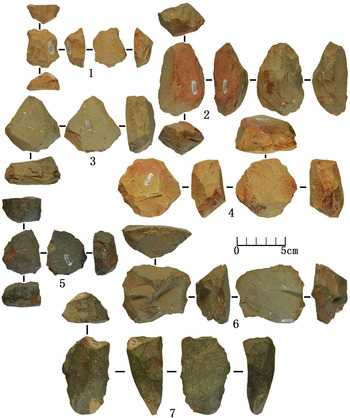
Tools make up 10% of the entire assemblage. They consist of hammers, sidescrapers, denticulates, and notches (see Fig. 5 for selected tools). The blanks of tools are mainly flakes or broken flakes. Most of them are small and with a low intensively of retouch, leading to irregular morphologies and edge shapes, as well as uneven retouching scars. There are only a few tools with extensive small retouching. Notably, there are 38 scrapers, which we term Quina-like scrapers that exhibit similar features with Quina retouch scrapers found in Europe (Fig. 5). However, compared with Quina tools found in Europe, the scrapers are less standardized and show relatively little control over the shape of the cutting edge. Most are denticulate with irregular shapes. The retouch scars are relatively large, and lack a systematic pattern of repetition. Fine retouch is absent. These scrapers are larger than other types of tools and are retouched on thick blanks (most of them are flakes). The retouching scars are stepped and terminate in either step or hinge fractures. Compared with other tools, they have more intensive and invasive retouch and regular morphologies. The retouching scars are evenly distributed, ending up with more normative edge shapes.
(color online) Selected Quina-like scrapers discovered in the THD site. 1–2, Discoidal retouched Quina-like scrapers; 3, multiedged Quina-like scraper; 4–7, semidiscoidal retouched Quina-like scrapers. Photos from Ruan et al. (Reference Ruan, Liu, Hu, Li, Yang and Luo2017).

SAMPLES AND MEASUREMENT FACILITIES
Sample description and preparation
A total of 6 sediment samples were collected for dating from each of the stratigraphic layers and sublayers from the north wall of the test trench (Fig. 2). The samples were collected by hammering opaque steel tubes, each about 5 cm in diameter and ~25 cm long, into the cleaned section face. The tubes were sealed in black plastic bags and transported to the University of Wollongong for analysis. The sample tubes were opened and prepared under dim red light in the OSL dating laboratory at the University of Wollongong. The materials at both ends of each tube were removed and used for determining the environmental dose rate, because they might have been exposed to sunlight at the time of sample collection.
Quartz grains were extracted using standard preparation procedures (Aitken, Reference Aitken1985; Wintle, Reference Wintle1997). First, the samples were dissolved in 10% hydrochloric acid to remove carbonate before they were subsequently treated with 30% hydrogen peroxide solution to remove organic matter. The remaining sample was dried and then sieved to isolate grains of 180–212 µm in diameter. Quartz grains were separated from other minerals by density separation using sodium polytungstate solutions of 2.62 and 2.70 specific gravities, respectively. The separated quartz grains were etched with 48% hydrofluoric acid for ~40 min to remove any feldspar contamination and to remove the outer layer of each quartz grain that was irradiated by alpha particles. The etched grains were then rinsed in hydrochloric acid to remove any precipitated fluorides, before being dried and sieved again to obtain grains of 180–212 µm in diameter.
Measurement facilities
All OSL measurements were made on an automated Risø TL-DA-20 luminescence reader equipped with a focused green laser (532 nm) (Bøtter-Jensen et al., Reference Bøtter-Jensen, Andersen, Duller and Murray2003). Laboratory irradiations were carried out within the luminescence reader using a calibrated 90Sr/90Y beta source. For OSL measurements, individual quartz grains were mounted onto standard Risø single grain discs (gold-plated aluminum discs drilled with 100 holes that are each 300 µm in diameter and 300 µm deep) (Bøtter-Jensen et al., Reference Bøtter-Jensen, Bulur, Duller and Murray2000), where each grain hole contained 1 grain of 180–212 µm in diameter. The spatial variation in the dose rate for individual grain positions was calibrated using gamma-irradiated calibration quartz standards. The ultraviolet OSL emissions were detected by an Electron Tubes Ltd. 9235QA photomultiplier tube fitted with a 7.5-mm Hoya U-340 filter.
OSL DATING
OSL age is determined by dividing the equivalent dose (D e, a measure of the radiation energy absorbed by grains during their period of burial) by the environmental dose rate (the rate of supply of ionizing radiation to the grains over the burial period). Analysis typically focusses on one of two minerals, quartz or K-feldspars. Quartz is commonly used for dating when sediments are younger than ~200 ka, whereas K-feldspar is used to date older samples because the infrared-stimulated luminescence signals from K-feldspar saturate at a much higher radiation dose than does the conventional OSL signal from quartz (Li et al., Reference Li, Jacobs, Roberts and Li2014). Our analysis found that K-feldspars are rare in the deposits at Tianhuadong, and the grains we sampled showed only a dim luminescence signal, which prevented us from applying K-feldspar for dating this site. As a result, we focused our analysis on the quartz minerals to determine the sedimentary ages of our sediment samples.
Dosimetry
The environmental dose rate for etched quartz is attributable mainly to beta and gamma radiation, from the decay of 238U, 235U, and 232Th (and their daughter products) and 40K in the deposits surrounding the dated grains, and cosmic rays. Beta dose rates were measured directly by low-level beta counting of dried, homogenized, and powdered sediment samples from the dosimetry bags, using a GM-25-5 multicounter system (Bøtter-Jensen and Mejdahl, Reference Bøtter-Jensen and Mejdahl1988). Gamma dose rates were measured based on the combination of thick source alpha counting and beta counting. The cosmic-ray dose rates were estimated following Prescott and Hutton (Reference Prescott and Hutton1994), based on the geomagnetic latitude and altitude of the site, as well as the thickness of sediment above each sample. Because our samples were collected immediately in front of a mountain (Fig. 1b), we also allowed for the overhead mountain shielding (i.e., the cosmic-ray dose rates are about 50% of those if there is no mountain shielding). We assigned a relative uncertainty of 10% to account for the systematic uncertainty in the primary cosmic-ray intensity.
The measured water contents of the six samples ranged from 10% to 16% (Table 2). Because these samples were stored for a few months after being taken, we expect that the measured present-day water contents were slightly underestimated. So, instead of using the in situ water content, we used a value of 15 ± 5% as an estimate of the long-term water content for our OSL samples. The measured in situ water contents were within the 1-sigma range of the assumed value. Each of the measured beta and gamma dose rates and the calculated cosmic-ray dose rate were corrected for attenuation by water using the assumed water content.
Dose rate data, equivalent doses (D e) and optically stimulated luminescence (OSL) ages for sediment samples from the THD site.

a Values used for dose rate and age calculations, with measured (field) water contents shown in parentheses.
b Values after correction for the zenith angular distribution of cosmic rays.
c The D e and corresponding ages for THD-OSL1 and THD-OSL2 were based on maximum age model, but they should be considered as minimum ages.
d A systematic error of 2% was added (in quadrature) to the propagated random errors in the final ages to allow for any bias associated with calibration of the laboratory beta sources.
Equivalent dose determination
The D e values were determined using a SAR procedure (Supplementary Table 1) (Galbraith et al., Reference Galbraith, Roberts, Laslett, Yoshida and Olley1999; Murray and Wintle, Reference Murray and Wintle2000). The SAR procedure involved measuring the OSL signals from the natural (burial) dose and from a series of regenerative doses, each of which was preheated at a given temperature (e.g., 240°C) for 10 s prior to optical stimulation by a green laser beam for 1 s at 125°C. A fixed test dose (~10 Gy) was given after each natural and regenerative dose, with the induced test dose OSL signals used to correct for any sensitivity changes during the SAR sequence. A cut-heat temperature (e.g., 180°C) lower than the preheat temperature was applied to the test dose. A duplicate regenerative dose was included in the procedure to check the validity of sensitivity correction, and a “zero dose” measurement was made to monitor the extent of any “recuperation” or “thermal transfer” induced by the preheat. We also applied the OSL infrared depletion-ratio test (Duller, Reference Duller2003) at the end of the SAR sequence, using an infrared bleach of 100 s at 50°C, to check for feldspar contamination.
SAR performance test
In order to find the most suitable experimental conditions (e.g., preheat and cut-heat temperatures), we conducted dose recovery tests using a range of preheat and cut-heat temperatures (280/180°C, 260/180°C, 240/180°C, 220/180°C, 200/160°C, and 180/160°C). Because our samples are dominated by bright grains (about half of the grains emit a detectable OSL signal; Supplementary Table 2), only one single-grain disc (100 grains) was measured for each preheat temperature. In this test, all the grains were bleached for ~30 min using a Dr Hönle solar simulator (model: UVACUBE 400). The bleached grains were then given a dose of ~100 Gy, before being measured using the SAR procedure with different preheat and cut-heat temperatures. To select reliable single-grain D e results, we applied several rejection criteria similar to but slightly different from those proposed by Jacobs et al. (Reference Jacobs, Duller and Wintle2006). Grains were rejected if they exhibited one or more of the following properties: (1) Test-dose signal (T n) was too weak (i.e., the initial intensity was below the instrument detection limit [3σ below the background intensity] and/or the relative standard error on the test dose net-signal was more than 20%). (2) There were high levels of recuperation (i.e., the ratio between the sensitivity-corrected OSL signals for the zero dose and the largest regenerative dose was less than 5% of the natural response). (3) There was a poor dose response curve (DRC) (i.e., the regenerative signals were too scattered to be well fitted with suitable functions). It should be noted that a bad recycling ratio or IR-OSL depletion ratio would also fall into this group, so we did not apply a separate rejection criterion on recycling ratio. To assess the goodness-of-fit of the DRCs, we adopted the figure-of-merit (FOM) and reduced-chi-square (RCS) values (Peng et al., Reference Peng, Pagonis and Li2016; Peng and Li, Reference Peng and Li2017), which are defined as follows:
 $$FOM(\% ) = 100 \times \displaystyle{{\sum\nolimits_{i = 1}^n { \vert y_i^o -y_i^f \vert}} \over {\sum\nolimits_{i = 1}^n {y_i^f}}} $$
and
 $$RCS = \displaystyle{1 \over {N-n}} \times \sum\nolimits_{i = 1}^n {\displaystyle{{{(y_i^o -y_i^f )}^2} \over {\sigma _i^2}}} $$
where yoi and yfi denote the ith observed and fitted values, respectively; N and n denote the number of observations and fitted model parameters, respectively; and σ i is the standard error for the ith observation. We set upper limits of 10% for the FOM and 5 for the RCS criteria as recommended by Peng and Li (Reference Peng and Li2017), which have been shown to be able to select grains with satisfactory DRCs. (4) The sensitivity-corrected natural OSL signal (L n/T n) was statistically (at 2σ) equal to or greater than the saturation level of the corresponding DRC. The implementation of the rejection process was achieved using the built-in functions provided in the R package “numOSL” (Peng and Li, Reference Peng and Li2017).
Between 26 to 46 grains were accepted for each of the preheat temperatures after applying the rejection criteria. The measured to given dose ratios (or dose recovery ratios) were summarized as radial plots (Supplementary Figure 1a–f) for each of the preheat temperatures, respectively. We applied a central age model (CAM) (Galbraith et al., Reference Galbraith, Roberts, Laslett, Yoshida and Olley1999) to calculate the weighted mean recovery ratios for each preheat temperature, and these were shown in each of the radial plots (Galbraith et al., Reference Galbraith, Roberts, Laslett, Yoshida and Olley1999; Galbraith and Roberts, Reference Galbraith and Roberts2012). The distribution of the measured D e values is tightly distributed around a central value, and overdispersion (OD) values are all statistically consistent with zero. The dose recovery results were plotted against the preheat temperature in Figure 6a. It shows a “plateau” region between 200°C and 260°C. The recovery ratios are statistically consistent with unity at 1σ for the preheat temperatures at 220°C and 240°C, although the results from 200°C and 260°C are slightly lower than unity. There is significant overestimation and underestimation for the preheat temperatures of 180°C and 280°C, respectively.
(color online) (a) The weighted mean dose recovery ratio plotted against preheat temperature. (b) Typical natural optically stimulated luminescence (OSL) decay curves of 10 grains of sample THD-OSL6. (c) Distribution of OSL signal intensities from 200 grains of quartz from sample THD-OSL6. Data are plotted as the proportion of the total light sum that originates from the specified percentage of grains. (d) Typical dose response curves from 6 grains of sample THD-6. The sensitivity-corrected (L x/T x) dose response curves were well fitted using a single saturating exponential function of the form I = I 0(1 − exp−D/D0), where I is the L x/T x value at regenerative dose D, I 0 is the saturation value of the exponential curve, and D 0 is the characteristic saturation dose.

SAR De determination
Based on the performance tests shown previously, we have chosen the preheat/cut-heat temperatures of 240°C/180°C for measuring D e values for all of the samples. Figure 6b shows the natural OSL decay curves of 10 grains from THD-OSL6. The OSL intensity varies significantly from grain to grain (e.g., the net initial OSL intensity varies from a few tens of counts per 0.1 s to more than 10,000 counts per 0.1 s). Despite nearly half of the grains yielding a detectable OSL signal, about 20% of the grains contributed ~80% of the total OSL signal (Fig. 6c). Apart from the variation in OSL intensity, the DRCs from different grains also display a wide range of shapes associated with different saturation doses (Fig. 6d).
Between 500 and 800 grains were measured to determine D e values for each of the samples, respectively. The same rejection criteria described previously were applied to select reliable results. The rejected grains number of each criterion is summarized in Supplementary Table 2. About 60% of the grains were rejected because of weak signals (i.e., the initial intensity of T n was less than 3σ above the background intensity and/or its relative standard error was more than 20%). Only a few grains of each sample were rejected because of recuperation larger than 5%. Among the grains with detectable OSL signals, from 23% to 49% of them were rejected because their DRC data were too scattered to be fitted reliably. We found that there was no discernable difference in the brightness (T n) between the grains with satisfactory DRCs and those with poor DRCs. For those grains with satisfactory DRCs, however, there were significant proportions of grains (from 15% up to 57%) that had natural signals saturated. In other words, their L n/T n values were consistent or above the saturation levels of the corresponding DRCs, so that they yielded infinite D e estimates or D e error. After rejection of these grains, from 10% to 36% of the measured grains yielded reliable and finite D e estimates.
The distributions of individual D e values passed through the rejection criteria are shown in radial plots in Figure 7 for all of the samples. It can be seen that all of the samples have a broad range of D e values, including many values close to zero, indicating that all the samples were affected by postdepositional mixture or intrusion of “younger” grains. This is especially apparent in the two uppermost samples (THD-OSL1 and THD-OSL2), which is not surprising because the top layers have been disturbed by recent agricultural and engineering activities that might inevitably result in the mixture of younger and old grains in the upper layers and the intrusion of some young grains into the deeper layers. Fortunately, the intensity of mixing decreases significantly in the lower layers, which is demonstrated by the significant reduction in the number of younger grains in the four lower samples (THD-OSL3, THD-OSL4, THD-OSL5, and THD-OSL6).
SAR D e distribution of samples (a–f). D e distribution for the accepted grains of samples THD-OSL1 to THD-OSL6, respectively. OSL, optically stimulated luminescence; SAR, single-aliquot regenerative-dose.

Standardized growth curve analysis
As shown in Supplementary Table 2, there are considerable proportions of grains (up to ~57%) that have natural signals being saturated, especially for the lower samples. It has been suggested by recent studies that the rejection of a large number of “saturated” grains may cause final D e values to be considerably underestimated because of the truncation of the full D e distribution (Duller, Reference Duller2012; Thomsen et al., Reference Thomsen, Murray, Buylaert, Jain, Hansen and Aubry2016; Guo et al., Reference Guo, Li, Zhang, Yuan, Xie and Roberts2017; Li et al., Reference Li, Jacobs, Roberts, Galbraith and Peng2017). To deal with this problem, a new method of analyzing the L n/T n distribution and establishing standardized growth curves (SGCs) (Roberts and Duller, Reference Roberts and Duller2004; Li et al., Reference Li, Roberts, Jacobs and Li2015) for different grains or aliquots has been proposed by Li et al. (Reference Li, Jacobs, Roberts, Galbraith and Peng2017). When using this method, because grains that are saturated are also accepted, it can obtain a full and untruncated distribution of the L n/T n ratios with a reliable D e estimation beyond the conventional limit of ~2D 0 using the standard SAR procedure. This method has been successfully applied to date the Guanyindong Cave site from southwest China (Hu et al., Reference Hu, Marwick, Zhang, Rui, Hou, Yue, Chen, Huang and Li2019). Given the large number of “saturated” grains in our samples, the same method was applied to estimate D e values of our samples.
First of all, the variability of the DRCs of our samples was investigated. We first identified and rejected poorly behaved grains, so that only well-behaved grains with reliable growth curves were analyzed. This was achieved based on the same rejection criteria mentioned previously, but the DRCs from “saturated” grains were accepted. In Supplementary Figure 2a, we have summarized the DRCs (n = 1464) that passed the rejection criteria for all of the samples. From the figure, we can see that it is impossible to establish a common DRC for all of the grains because these DRCs are greatly variable among different grains, indicating that there are multiple groups of grains with different shapes of DRCs. Li et al. (Reference Li, Jacobs and Roberts2016) found that, according to different saturated dose levels, the single-grain DRCs for their quartz samples could be divided into three groups—namely, “early”, “medium,” and “later”—by analyzing the L x/T x ratios between two regenerative doses. In addition, the grains from the same group are characterized by a similar shape of DRC, so a single SGC can be established for each group. Following their method, we calculated the ratios between the L x/T x values from a large regenerative dose (400 Gy) and a smaller regenerative dose (100 Gy), which can reflect the saturation dose level of the corresponding DRC (e.g., higher ratios means later saturation, and smaller ratios mean early saturation). The ratios for individual grains from all of the samples are shown in Supplementary Figure 2b. A large range of ratios from ~1 to ~2.5 is observed, indicating that the grains have a wide range of saturation doses. For example, the grains with L x/T x ratios close to 1 correspond to early saturated grains (i.e., there was a negligible increase in OSL signal beyond 100 Gy). In contrast, grains with higher L x/T x ratios have a larger saturation dose level.
In order to statistically identify the number of groups of grains that share similar DRC shapes (or L x/T x ratios), as well as estimate the weighted mean ratios for each group, we applied the finite mixture model (Galbraith and Green, Reference Galbraith and Green1990; Roberts et al., Reference Roberts, Galbraith, Yoshida, Laslett and Olley2000; Galbraith and Roberts, Reference Galbraith and Roberts2012) to the L x/T x ratios. We found that, unlike what was observed by Li et al. (Reference Li, Jacobs and Roberts2016), at least seven groups were needed to fully take into account the observed spread in the ratios for our samples (Supplementary Fig. 2b). In order to establish corresponding SGCs for each of the groups (Supplementary Fig. 2c), a least-square normalization (LS-normalization) procedure (Li et al., Reference Li, Jacobs and Roberts2016) was used to analyze the DRCs from each group, which involved the following steps: (1) fitting the L x/T x data from all grains from the same group using a best-fit model (e.g., single saturating exponential function); (2) rescaling the L x/T x data from each grain by multiplying a scaling factor so that the difference between rescaled L x/T x values from that grain and the fitted common growth curve was minimized through an optimization procedure (each grain was treated individually so different scaling factors were determined for different grains); (3) repeating steps 1 and 2 iteratively until there was negligible change in the rescaled regenerative-dose signals and best-fit function. The scaling factors obtained for individual grains were then used to normalize their corresponding natural signals (L n/T n). The general order kinetic function (Guralnik et al., Reference Guralnik, Li, Jain, Chen, Paris, Murray, Li, Pagonis, Valla and Herman2015) was used to fit the dose-response data from the same groups. The grouping of grains and establishment of SGC for each group were achieved using the combination of the two packages “numOSL” (Peng et al., Reference Peng, Dong, Han, Long and Liu2013; Peng and Li, Reference Peng and Li2017) and “Luminescence” (Kreutzer et al., Reference Kreutzer, Schmidt, Fuchs, Dietze, Fischer and Fuchs2012) in R (R Core Team, 2016).
The SGCs for all of the groups are shown in Supplementary Figure 2c. It can be seen that different groups have considerably different saturation dose levels (i.e., group 1 saturated at ~100 Gy, but group 7 showed no sign of saturation up to 600 Gy). To test the validity of grouping and SGC establishment, the ratios between the measured L x/T x and the expected values based on the SGC were calculated. The data show that they are statistically consistent with unity for all of the groups; most of these ratios (~90% or more) are consistent with unity at 2σ (Supplementary Fig. 2d–j), supporting that the SGCs obtained are reliable. The proportions of grains in each DRC group are shown in Supplementary Figure 2k for each sample. It is shown that groups 2, 3, 4, and 5 are dominant in our samples, followed by group 1 and then group 6. Only a small proportion (less than 3%) of grains falls into group 7 for THD-OSL1, THD-OSL2, THD-OSL3, and THD-OSL4, but they are absent in THD-OSL5 and THD-OSL6.
De determination based on SGCs
In order to estimate D e values for individual groups, we followed the method of Li et al. (Reference Li, Jacobs and Roberts2016) by analyzing the L n/T n values for each group. To allow direct comparison of natural signals among grains from the same group, the L n/T n values of each group were renormalized using the same scaling factors obtained during the LS-normalization procedure when the SGCs were established for individual groups. Statistical analysis was then conducted to the LS-normalized L n/T n values for each group to estimate their “weighted mean” value. Such value was then projected onto the corresponding SGC to estimate the final D e for that group. The distribution of LS-normalized L n/T n values for individual groups of our samples is shown in Supplementary Figures 3–8, respectively.
Similar to the SAR D e distribution shown in Figure 7a and b, the L n/T n distributions for the topmost samples THD-OSL1 and THD-OSL2 show a wide range of values, although a large proportion of the data points are clustered in the upper range, indicating that these samples were affected by intrusion of younger grains. So we applied the maximum age model (Olley et al., Reference Olley, Roberts, Yoshida and Bowler2006), adapted from the minimum age model of Gaibraith et al. (Reference Galbraith, Roberts, Laslett, Yoshida and Olley1999), to estimate the maximum component in the distribution. In this model, we used a value of 0.15 for σ b, a parameter representing the expected overdispersion for a well-bleached and nondisturbed sample. This value is based on the OD values of the L n/T n distribution for the lower samples, in which no evidence of postdepositional mixture was observed (e.g., group 5 of THD-OSL5 shown in Supplementary Fig. 7e). For the 4 lower samples, all of the groups appear to have L n/T n values concentrated in a single population, although most of them contain a few grains that have considerably smaller L n/T n values. For this reason, we applied the normalized median absolute deviation (nMAD) method to reject outliers. We used 1.4826 as the appropriate correction factor for a normal distribution and rejected log L n/T n values with nMADs greater than 1.5. This method is effective to reject outliers from the distribution (Supplementary Fig. 5–8). After rejecting the outliers using the nMAD method, we calculated the weighted mean values of the accepted data points based on the CAM.
The best estimates of L n/T n values based on our statistical analysis mentioned previously were then projected onto the corresponding SGCs to calculate D e values for individual groups, which are summarized in Supplementary Table 3. For some groups (e.g., groups 6 and 7), insufficient numbers of grains were accepted, so reliable results could not be obtained. Group 1 (i.e., the early saturated group) of most samples and groups 2 and 3 from some samples yielded infinite D e values because their L n/T n values are statistically consistent with the saturation levels of the corresponding SGCs. For the other groups that had higher saturation doses, finite results were obtained, and their D e values were statistically indistinguishable from each other for the same sample. This further confirmed that the grouping, SGC establishment, and D e estimates based on L n/T n and SGC were reliable. We, therefore, estimated the final D e values for each sample based on the weighted mean of the results of the DRC groups that produced finite D e values (Table 2 and Supplementary Table 3). The dose rates, final D e estimates, and ages for all of the OSL samples are summarized in Table 2.
RESULTS
Based on the single grain analysis of samples from Tianhuadong, the two samples (THD-OSL1 and THD-OSL2) taken from the top layers contain a large number of younger grains, but the number of younger grains decreased progressively with the depth. This result is consistent with the fact that the top of the trench was used as agricultural land and reworked by engineering activities, resulting in numerous younger grains having intruded into the top layers. This suggests that single-grain measurements were able to effectively identify mixture in the deposits for the THD site. Furthermore, it is shown that the postdepositional mixture, as a result of agricultural and engineering activities, mostly affected the two uppermost samples and was insignificant for the lower samples (Supplementary Figs. 5–8).
The ages for our samples from Tianhuadong follow stratigraphic order, indicating good stratigraphic integrity of the deposit and the reliability of the age measurements. There is no obvious evidence of significant sedimentary hiatus, as indicated from stratigraphy and OSL ages. Sample THD-OSL6 from layer 5, which is archaeologically sterile, was dated to 87 ± 9 ka. Sample THD-OSL5 from layer 4, associated with both artifacts and fossils, reveals the earliest human occupation at the THD site at 85 ± 10 ka. The two samples (THD-OSL1 and THD-OSL2) taken from the topmost layers yielded ages of ~40–50 ka, suggesting that that human occupation of the site spans about 40–90 ka, corresponding to MIS 3–5c. Previous studies have suggested that southwest China had experienced cycles of glacial and interglacial periods during late Middle Pleistocene, broadly consistent with MIS stages (Hodell et al., Reference Hodell, Brenner, Kanfoush, Curtis, Stoner, Xueliang, Yuan and Whitmore1999; Wang et al., Reference Wang, Liu, Hou, Si, Huang, Schepartz and Miller-Antonio2004; Karkanas et al., Reference Karkanas, Schepartz, Miller-Antonio, Wang and Huang2008). During this period, global climate records indicate several glacial and interglacial cycles leading to temperature and environmental fluctuations (Lisiecki and Raymo, Reference Lisiecki and Raymo2005). Nonetheless, according to the analysis of stone artifacts from Tianhuadong (Ruan et al., Reference Ruan, Liu, Hu, Li, Yang and Luo2017), there were no major changes in the lithic technology and raw materials during this time span, indicating that the relationship between environmental changes and stone artifact technologies was weak during this time. We suggest that the technological strategies used at Tianhuadong were sufficient to be equally effective under a wide range of environmental conditions.
DISCUSSION
According to our previous study (Ruan et al., Reference Ruan, Liu, Hu, Li, Yang and Luo2017), the technologies of the Tianhuadong assemblage indicate a mix of simple and complex reduction. Generally, the lithic assemblage is similar to other MIS 4 and 5 sites found in southwest China, with simple knapped cores and flake tools, such as Bianbiandong (upper Pleistocene; Cai et al., Reference Cai, Wang and Xu1991), Yanhuidong (113–181 ka; Wu et al., Reference Wu, Wang, Zhang and Zhang1975), and Xiaohuidong (49–55 ka; Cao, Reference Cao1978). Core reduction is generally simple and without preparation in these assemblages. Retouch techniques at Tianhuadong are mainly simple knapping along the edge of flakes, consistent with other sites from the same region, such as Xiangbidong (~50 ka; Dali Bai Autonomous Prefecture Cultural Relics Management Institute, Yunnan Institute of Cultural Relics and Archeology, Jianchuan Institute of Cultural Relics, 2015), Yushuiping (40–20 ka; Gao et al., Reference Gao, Min, Li, Duan, Zhang and Li2012), Laohudong (30–18 ka; Zhu and Ji, Reference Zhu and Ji2010), and Longtanshang locality 2 (~30 ka; Qiu and Zhang, Reference Qiu and Zhang1985).
The Tianhuadong assemblage also exhibits characters that are similar to Middle Paleolithic cultures from Europe, Africa, and west Asia. The discovery of elongated flakes, crested flakes, and core with parallel scars indicates the development of blade technology in this region. The appearance of Levallois-like products at Tianhuadong is consistent with other nearby sites (e.g., Guanyindong and Panxiandadong) in southwest China that contain Levallois elements (Huang et al., Reference Huang, Hou and Si1997; Otte et al., Reference Otte, Weiwen, Hu and Hou2017; Hu et al., Reference Hu, Marwick, Zhang, Rui, Hou, Yue, Chen, Huang and Li2019). Additionally, the Quina-like scrapers, representing a relatively complex retouching technique, are also similar to those from the Middle Paleolithic sites from Europe and Africa. Compared with late Middle Pleistocene sites, Panxiandadong (~300 to 130 ka; Huang et al., Reference Huang, Hou and Si1997; Miller-Antonio et al., Reference Miller-Antonio, Schepartz, Karkanas, Yamei, Weiwen and Bekken2004; Otte et al., Reference Otte, Weiwen, Hu and Hou2017) and Guanyindong (~170 to 80 ka; Li and Wen, Reference Li and Wen1986; Leng, Reference Leng2001; Li et al., Reference Li, Hou and Boëda2009; Hu et al., Reference Hu, Marwick, Zhang, Rui, Hou, Yue, Chen, Huang and Li2019), Tianhuadong shares many similarities in tool making, such as core-flake tools and hard hammer percussion. However, neither raw material procurement nor exploitation, core preparation, invasion, and regularity of retouch at Tianhuadong are as complex and systematically present throughout the assemblage as found at Panxiandadong and Guanyindong.
In addition to the Levallois-like core and Qunia-like retouched tools, the majority of the stone artifacts from Tianhuadong also exhibit various type of scrapers, denticulates, and notches resulting from invasive retouch on some of the tools. However, the small number of stone artifacts recovered from Tianhuadong prevents a comprehensive comparison with other assemblages. Levallois elements have also been reported from a younger site Dahe (44–35 ka; Ji, Reference Ji2008) in the same region, indicating there might be a long-term technological transmission or population interaction in southwest Asia during the late Middle Pleistocene. Based on available information, we could draw a preliminary sketch for the late Pleistocene of semi-isolated human groups learning some technologies from their forebears or neighbors, with small numbers of these Levallois elements persisting through time. One reason why these technologies did not become more dominant in archaeological assemblages may be because of the low availability of raw materials with predictable flaking qualities (e.g., chert is rarely available in this region). Another contributing factor may be the constraints of relatively smaller effective population sizes that limit the propagation and long-term persistence of new technologies (Lycett and Norton, Reference Lycett and Norton2010).
Although the record remains sparse, the results from Tianhuadong highlight the importance of the MIS 5 dispersal out of Africa. One possible implication of the finds at Tianhuadong is that the MIS 5 dispersal potentially resulted in the appearance of Levallois in East Asia. A second implication is that a southern, or lower-latitude, MIS 5 dispersal route may now be more plausible. However, Levallois itself is not sufficient evidence of this dispersal because it can be linked to both archaic and modern humans. Furthermore, Levallois strategies could result from convergent evolution, unrelated to dispersal events. Also, we currently lack fossil evidence to robustly link the appearance of Levallois in southwest China to a dispersal event. Hopefully, future work will lead to skeletal or ancient DNA evidence that can indicate how isolated or connected the human populations were in southwest China.
CONCLUSION
Tianhuadong is important because it provides securely dated new evidence of human activity in southwest China during MIS 4 and 5. There are few Paleolithic sites in southwest China dating back to this period, compared with north China where there are more sites and where many have been intensively studied. Many of the sites in southwest China were dated in the last century, and the quality of dating results is difficult to assess because of the limited information provided in those publications. Ages at many of the sites were based only on stratigraphic correlation, without confirmation from absolute dating methods. This makes it challenging to understand human behavior and technological change during the Middle and Upper Pleistocene in this region.
Our OSL dating on individual quartz grains from sediments suggests that the age of archaeological deposits at Tianhuadong is approximately 40–90 ka. The lithic industry shows a diversity of lithic technologies and knapping strategies that are similar to those found from nearby Paleolithic sites in southwest China. The presence of features similar to Levallois and Quina technologies at Tianhuadong hints at population interactions among modern human groups following their initial appearance in East Asia during this period. Further archaeological and chronological studies in this region are, however, needed to better understand the trajectory of human behavior, evolution, and technology development during MIS 4 and 5 in this region.
ACKNOWLEDGMENTS
This work was supported by the Australian Research Council through Future Fellowships to BL (FT140100384) and postgraduate scholarships from the University of Wollongong to YH. We thank Sam Lin for his constructive advice; Zenobia Jacobs, Yasaman Jafari, and Terry Lachlan for help in the laboratory; and Ashok Singhvi and an anonymous reviewer for their helpful comments.
SUPPLEMENTARY MATERIAL
The supplementary material for this article can be found at https://doi.org/10.1017/qua.2019.67.