Introduction
Malignant spinal cord compression (MSCC) is a serious condition classed as an oncological emergency, and approximately 5–10% of patients with cancer will go on to develop MSCC.1 In MSCC, the cancer has metastasised to the vertebral bodies of the spine and is compressing the nerves causing pain, neurological symptoms such as numbness, loss of mobility and strength in the upper/lower limbs and urinary or faecal incontinence. If left untreated, this can cause irreparable damage to the spinal cord causing hemi- or quadriplegic paralysis and permanent incontinence.Reference Cameron2
By irradiating the involved area, this can alleviate pain, improve mobility, reduce neurological symptoms and avoid paralysis.Reference Cameron3 Typical regimes include 20 Gray (Gy) in five fractions or 8 Gy in a single fraction prescribed to depth (in cm) taking into account the magnetic resonance imaging/computed tomography images. The resultant depth will indicate which energy of photons is required, so a larger depth will require a higher energy, for example, 10 MV and a smaller depth will only require 6 MV.
National Institute for Health and Care Excellence (NICE) guidelines states that MRI should be performed within 24 hours of presentation of neurological symptoms and radiotherapy treatment within 24–48 hours of presentation.4 Patients presenting with MSCC have a poor prognosis with a median survival of 2–3 months and only 17% are still alive at 1 year.5
The Royal College of Radiologists (RCR) published guidelines in 2012, which suggested that less than 20% of patients selected to receive palliative radiotherapy should die within 30 days of treatment.Reference Lees6 It also recommended that there should be appropriate patient selection based on performance status (PS) and life expectancy before delivery of palliative radiotherapy and that an appropriate dose and treatment regime should also be applied. This means that clinicians should consider reducing the standard five fractions to a single fraction when taking into account PS and disease burden when recommending radiotherapy to assist with symptomatic relief of disease. It should also be noted that delivery of palliative radiotherapy near the end of life has been shown to lead to lower pain response rates than are seen with longer survival times with 45% of patients surviving less than 12 weeks experiencing a response as compared to 85% in those surviving over a year.Reference Hoskin, Misra and Hopkins7 The RCR recommendation is to assess the decision-making process in patients who die within 14 days after a single fraction and 30 days after a fractionated regime to learn from these situations and reduce avoidable harm. Results from a randomised phase III trial of single-dose radiotherapy compared to multi-fraction radiotherapy in patients with MSCC demonstrated that reduced treatment regimes are comparable to longer regimes in terms of control of pain, and giving a single dose of 8 Gy in patients with MSCC was as effective as multiple fractions.Reference Meeuse, van der Linden, van Tienhoven, Gans, Leer and Reyners8
There is evidence in the literature which suggests that by monitoring the levels of albumin and C-reactive protein (CRP) biomarkers and using PS, it may be possible to identify in advance a cohort of patients who will die within 30 days of MSCC treatment. The aim of this study was to analyse the 30-day mortality post-palliative radiotherapy for MSCC patients to identify if radiotherapy can be safely omitted or the fractionation reduced in the poor prognosis group as this cancer centre currently treats large numbers of MSCC patients. Routine assessment of biomarkers as part of the patients’ investigations during a cancer diagnosis and throughout the patient journey to assess response or to indicate the presence of progressive disease is recommended.Reference Proctor, Morrison and Talwar9
Biomarkers
CRP is a widely used biomarker for diagnosing acute and chronic inflammation, the normal range for CRP is 0–5 mg/L. Its importance has been extended to the diagnosis of other conditions, specifically malignancies.Reference Wang and Sun10,Reference Lee, Choe, Kim and Sung11 Rising concentrations in the blood can be valuable in monitoring disease activity, and an elevated CRP is associated with progressive disease and decreased survival.Reference Koenig, Khuseyinova, Baumert and Meisinger12
Albumin is a biomarker which is used to assess nutritional status, the normal level is between 36 and 47 g/L. The level can be lowered by cancer and can reach very low levels which indicate advanced cancer or spread throughout the body and can serve as an indicator of cancer prognosis.Reference Gupta and Lis13,Reference McMillan, Watson, O’Gorman, Preston, Scott and McArdle14
Performance status
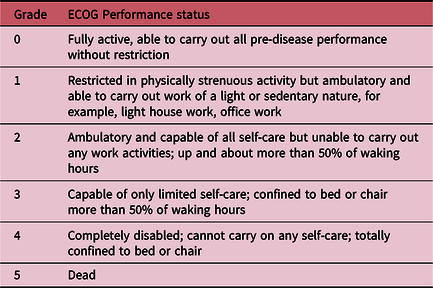
The Eastern Cooperative Oncology Group (ECOG) PS tool describes a patient’s level of functioning in terms of their ability to care for themselves, their daily activity and physical ability and is used to assess deterioration of the patient (Table 1), and this tool was used for this study.Reference Oken, Creech and Tormey15
Developed by the Eastern Cooperative Oncology Group (ECOG)

Methodology
Retrospective data from patients identified as having radiotherapy for MSCC were collected from Aria radiotherapy patient management system for the period of July 2019–December 2019. Data on treatment duration, date of death, biomarkers (CRP and albumin) and PS were collected using two hospital patient management systems. Ethical approval was not required as the project was classed as a service evaluation/audit; however, departmental approval was sought and granted as auditing local practice is recommended by RCR.Reference Spencer, Morris and Dugdale16 The data were analysed using Pearson’s correlation coefficient to identify if there was high or low correlation between biomarkers and PS in the cohort of patients who died within 30 days of initial treatment for MSCC as this could potentially aid decision-making around omission of radiotherapy or reduction in the number of treatments delivered.
Data Analysis
Thirty-day mortality results
The number of patients who received radiotherapy for MSCC (July–December 2019) was 101. There were 32 female patients versus 69 male patients. The age range was 26–92 years with a mean age of 68 years. The number of patients who died within 30 days of radiotherapy was 17 and the 30-day mortality rate was 16·8%. Of the 17 patients who died within 30 days, there were 5 female patients and 11 male patients (1 patient was treated twice in 6 months). The number of patients who died within 14 days of radiotherapy was seven, three had a single fraction and four had five fractions.
Performance status
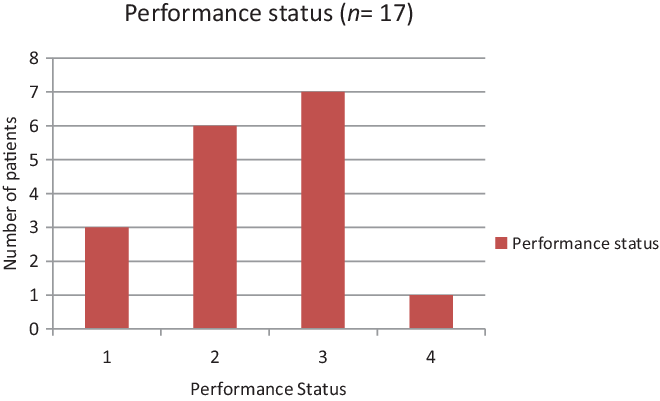
The PS for all patients who died within 30 days was recorded and most of these patients scored a poor performance being restricted in their activities and had ambulatory issues as shown in Figure 1.
Performance status.

Of the 101 patients in the study, 40 patients were still alive 6 months after the treatment for MSCC and it is important to note that 76% of these patients have PS of 0 or 1. A good PS has, therefore, shown to be associated with an improved prognosis and these patients could be considered for one or five fractions of radiotherapy.
PS and CRP levels
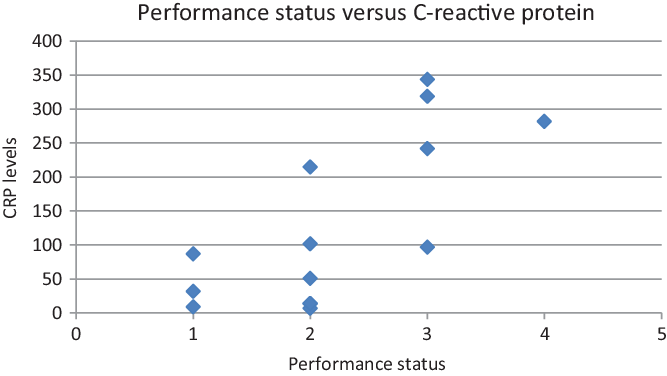
All biomarkers were recorded within 1 week prior to radiotherapy and a few days after the first treatment. Figure 2 shows a positive correlation between worsening PS and rising CRP levels. The correlation coefficient of 0·7 suggests a moderate to high level of correlation in keeping with previous studies within the literature.Reference Koenig, Khuseyinova, Baumert and Meisinger12 Based on these results, a PS of 2–4 plus high CRP levels indicates a poor prognosis and risk of early death (within 30 days). A single fraction of radiotherapy should be offered as standard in this patient group; however, if patient condition is extremely poor, then omitting radiotherapy altogether is recommended.
Performance status versus C-reactive protein.

PS and albumin
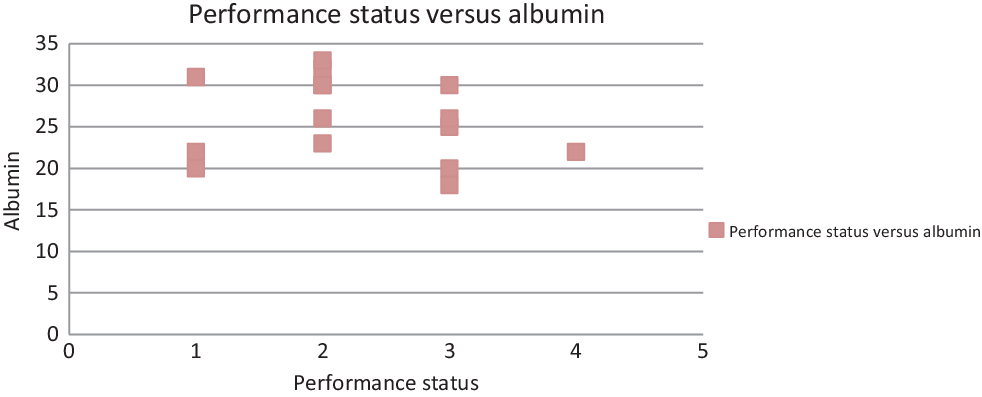
In the data set, there was negligible correlation found between worsening PS and decreasing albumin levels with a correlation coefficient of −0·2 (Figure 3). This is in contrast to the literature which suggests that these variables are closely linkedReference Gupta and Lis13,Reference McMillan, Watson, O’Gorman, Preston, Scott and McArdle14 and it is uncertain why this study recorded such differences; however, the small number of patients sampled in this study may have influenced this.
Performance status versus albumin.

The results demonstrate that there is correlation between PS and CRP, and this information should be used to aid decision-making regarding treatment duration. Clinicians should, therefore, order biomarkers as standard and annotate PS in patient records to determine patient suitability for treatment and fractionation. The education of patients is also essential to ensure early presentation with a better prognostic outlook and to reduce the number of patients who develop worrying neurological symptoms due to late presentation.
Quality improvement
It is important to use performance measurement as a tool for quality improvement as it will highlight quality problems which will determine the areas requiring immediate attention, indicate costs related to poor quality or decision-making which will justify change in resources and provide feedback for driving improvement.Reference Oakland17 This correlates with RCR guidelines which recommends auditing local practice in patients receiving palliative radiotherapy to ensure appropriate decision-making.Reference Spencer, Morris and Dugdale16
Discussion
There were a number of issues with the retrospective primary data collection as some patients did not have biomarkers routinely requested and some patients had none or had them done either before or after the first fraction of radiotherapy. A pragmatic approach was taken in this study and included blood results within 1 week prior to starting radiotherapy and up to 2 days after starting treatment.
PS was also not recorded consistently, which required analysis of annotations within the patient management systems to identify the patient’s level of performance. As a result, the PS could be subject to bias as the investigator interpreted the clinical notes retrospectively. There was also an issue with the robustness of the data with patients being classed as ‘emergency cord compressions’ in the Aria patient management system; however, on closer analysis within the patient records, they did not have MSCC but required treatment for symptomatic relief of pain for bone metastases and were therefore excluded from the study.
The incidence of MSCC is approximately 100 cases per cancer network each year, assuming an average population of 1·2 million per network.5 South East Scotland Cancer Network has a population of 1·4 million and based on current figures had 101 MSCC patients treated in only 6 months which is double the estimated figure. This number does not include patients who went for primary surgery or who presented late and were not offered radiotherapy.
Patient education for early detection of MSCC is key to improving outcomes,5 and good practice should be to offer all patients with bone metastases or patients at high risk of developing MSCC be given written advice on early symptoms of MSCC and advice on contacting health professionals promptly if symptoms appear.1 By educating patients at risk, then earlier presentation of MSCC may occur which would offer a better prognosis for some patients and reduce the burden of intensive in-patient care for patients with permanent paralysis as a result of late presentation.
Conclusion
The current 30-day mortality rate is 16·8% which is in line with other reported treatment centres and below the RCR guidelines of 20%. However, the recommendation is to assess patients who die within 14 days after a single fraction and 30 days after a fractionated regime.Reference Oakland17 There is clearly still work to be done ensuring clinicians consider giving shorter fractionation regimes or omitting radiotherapy (unless indicated for pain) in the poor prognosis group as this recommendation is not currently being met, with under half of the patients in the 30-day cohort group receiving one or five fractions of radiotherapy and dying within 14 days. Monitoring CRP and PS as standard throughout patients’ treatment may also be valuable as the data suggest that this is a useful tool to monitor disease progression. Worsening PS and high CRP is an indicator of poor prognosis and early death, and therefore omission of treatment or a single fraction of radiotherapy is recommended.
Acknowledgements
None.