Introduction
The reproductive success of parasitoids depends on their ability to locate hosts (Bukovinszky et al., Reference Bukovinszky, Poelman, Kamp, Hemerik, Prekatsakis and Dicke2012) and infochemicals provide cues for host location (Dicke & Baldwin, Reference Dicke and Baldwin2010). By detecting infochemicals secreted by host plants or herbivores, natural enemies such as parasitoids can locate and recognize their hosts (Costa & Reeve, Reference Costa and Reeve2011; Lo Giudice et al., Reference Lo Giudice, Riedel, Rostas, Peri and Colazza2011). Many studies have focused on chemical communication within plant–herbivore–natural enemy tritrophic systems (Afsheen et al., Reference Afsheen, Wang, Li, Zhu and Lou2008).
Kairomones, synomones and marking pheromones are among the most extensively studied infochemicals (Gonzalez et al., Reference Gonzalez, Cusumano, Williams, Colazza and Vinson2011; Penaflor et al., Reference Penaflor, Erb, Miranda, Werneburg and Bento2011; Kong et al., Reference Kong, Liu, Wang, Zhang and Zhang2012; Martin & Lopez, Reference Martin and Lopez2012). Parasitoids often use synomones (herbivore-induced plant volatiles (HIPVs)) from the host plant to locate the habitat of their hosts at long distances (Vet & Dicke, Reference Vet and Dicke1992). Kairomones are then used for host location, recognition and acceptance over shorter distances (Vinson, Reference Vinson1991, Reference Vinson1998; Vet & Dicke, Reference Vet and Dicke1992). Kairomones that are directly released from the herbivore body or its secretions can reveal the presence of the herbivore to the parasitoid. Kairomones play a critical role in host finding and acceptance (Hofstetter et al., Reference Hofstetter, Gaylord, Martinson and Wagner2012; Van Tol et al., Reference Van Tol, Bruck, Griepink and De Kogel2012).
Kairomones are usually present in host eggs, larvae and pupal cuticle, frass, silk, cocoons and glandular secretions (Afsheen et al., Reference Afsheen, Wang, Li, Zhu and Lou2008). Kairomones can attract natural enemies by volatile chemicals (Gonzalez et al., Reference Gonzalez, Cusumano, Williams, Colazza and Vinson2011). Compared with pupal parasitoids, egg (Aak & Knudsen, Reference Aak and Knudsen2012) and larval parasitoids (Onagbola & Fadamiro, Reference Onagbola and Fadamiro2011; Seenivasagan & Paul, Reference Seenivasagan and Paul2011) are more studied from the perspective of the host location process. Afsheen et al. (Reference Afsheen, Wang, Li, Zhu and Lou2008) suggested that the lack of research might be due to the rarity of pupal parasitism in nature. In studies of pupal parasitism, compared with synomones (HIPVs) (Rousse et al., Reference Rousse, Chiroleu, Veslot and Quilici2007; Giunti et al., Reference Giunti, Benelli, Conte, Mele, Caruso, Gucci, Flamini and Canale2016), kairomones have received less attention. Kairomones can be released from pupal cuticles (Chiu-Alvarado et al., Reference Chiu-Alvarado, Barrera and Rojas2009), cocoons (Gonzalez et al., Reference Gonzalez, Cusumano, Williams, Colazza and Vinson2011) or mature larvae (Zvereva & Rank, Reference Zvereva and Rank2004.), but the specific components of these kairomones are largely unknown. The parasitoid wasp Chouioia cunea Yang (Hymenoptera: Eulophidae) (Yang, Reference Yang1989), is an endoparasitic chalcid wasp, native to China, that parasitizes the fall webworm, Hyphantria cunea Drury. H. cunea is a worldwide pest. Since it was first introduced into China in 1979, the moth has invaded provinces and cities such as Liaoning, Shandong, Anhui, Shanxi, Hebei, Henan, Shanghai, Tianjin and Beijing, and it continues to spread (Ji et al., Reference Ji, Xie, Li, Gao and Li2007; Gao et al., Reference Gao, Du, Gao and Liu2010). The larvae have more than 600 reported hosts about 100 of which occur in China (Zhang & Wang, Reference Zhang and Wang2009). In addition to H. cunea, C. cunea also parasitizes other Lepidoptera defoliators, including Clostera anachoreta F., Micromilalopha troglodyta (Graeser) (Notodontidae), etc. (Yang, Reference Yang1989).
C. cunea is small, adults are 1.1–1.5 mm long. A total of 145–365 adult wasps from a single H. cunea pupa and the percentage of emerged females were very high (98–99%) (Yang, Reference Yang1990). In China, C. cunea has shown great promise for reducing H. cunea populations, and we selected it for use in a biological control program against H. cunea (Yang, Reference Yang2004; Yang et al., Reference Yang, Wang, Wei, Qu and Qiao2008; Zheng et al., Reference Zheng, Qi, Sun and Yang2012). In many areas in China, such as Shanxi, Liaoning, Hebei, Shandong, Beijing, Tianjin and Shanghai, H. cunea management by C. cunea has been effective (Yang et al., Reference Yang, Wei and Yang2001; Ji et al., Reference Ji, Xie, Li, Gao and Li2007; Yang & Zhang, Reference Yang and Zhang2007). In Japan, Italy, Iran and Turkey, the introduction of C. cunea has also been an effective component of H. cunea biological control (Shamilov, Reference Shamilov2008; Sullivan et al., Reference Sullivan, Karaca, Ozman-Sullivan and Yang2011).
The ecology, behavior, anatomy and mass rearing of C. cunea have been well studied (Yang et al., Reference Yang, Wei and Wang2006). However, little is known about the mechanism used by C. cunea to locate hosts. In this study, we investigated the role of host-related kairomones produced by H. cunea. We evaluated electroantennogram (EAG) and behavioral responses of female C. cunea to a variety of odor stimuli associated with H. cunea and identified chemical(s) that determine the specific attraction of C. cunea. This information will help us understand the host location mechanisms of C. cunea.
Materials and methods
Insect rearing
Parasitoid wasps C. cunea was obtained from the Natural Enemy Breeding Center of Luohe Central South Forestry (Henan, China) in 2012. The tussah, Antheraea pernyi (Lepidoptera: Saturniidae), was the substitute host of C. cunea, and these were obtained from the Benxi Tussah Breeding Base (Liaoning, China). Wasp cultures were kept in an incubator at 25°C and 70% relative humidity (RH) in total darkness. Approximately 20–30 C. cunea wasps were placed with one A. pernyi pupae in an Erlenmeyer flask sealed with cotton wool. After 3 days, they were kept in the incubator at 25°C with 75% RH and a 14:10 light: dark cycle and incubated until the adults emerged (17–20 days). The incubator was checked every day. Once adults of C. cunea emerged, the Erlenmeyer flasks were removed from the incubator. Adults of C. cunea were collected from Erlenmeyer flasks and used for studies within 24 h.
Inside the host pupa, C. cunea develops from the egg to the pre-oviposition adult stage. The adult wasps mate inside the host pupa, and then chew an exit hole in the host pupal shell. The other wasps exit the pupa using this same hole. Thus, the adult females can parasitize new hosts soon after their ‘emergence’ (Yang, Reference Yang1989). In this study, the adult wasps emerged from the host pupa within 24 h and so mating had been completed.
Larvae of H. cunea were collected in May 2013 in Tianjin Normal University, Tianjin, China. Larvae were raised in the laboratory on Chinese ash Fraxinus chinensis leaves. They were maintained in an incubator at 25°C with 75% RH and a 16:8 light: dark cycle. Prepupae, frass and pupae produced by the mature H. cunea larvae were collected and stored in separate Erlenmeyer flasks.
Stimulus preparation procedure
The Y-tube olfactometer bioassays, EAG recordings and solid-phase microextraction (SPME) used different stages and frass of H. cunea. Each employed: (a) 20 prepupae; (b) 5 g dried larval frass; (c) 20 pupae.
For gas chromatography–mass spectrometry (GC–MS) analysis, several chemical standards were used, such as gamma-butyrolactone (99% purity), naphthalene (99% purity), dimethyl phthalate (DMP, 99.5% purity), acenaphthene (98% purity), 1-dodecene (98% purity), n-hexadecane and n-eicosane (98.5% purity) (Lark Technology Co., Ltd, Beijing, China). These chemical standards were also used in the EAG and Y-tube olfactometer bioassays.
Solid-phase microextraction
Volatile compounds released by H. cunea were sampled by SPME.
A total of 20 prepupae or 5 g dried frass or 20 pupae were placed in a 30 ml vial covered with a glass lid (with a small hole in the middle), and volatiles were captured with SPME fiber (100 µm polydimethylsiloxane/carboxen, Supelco, Bellefonte, PA, USA). The SPME fiber was preconditioned for 1 h at 250°C in the injector of a gas chromatograph (GC). For odor collection, the fiber was exposed approximately 2–3 cm above the different stages and by-products of H. cunea through the hole of glass lid for 3 h, providing sufficient time for equilibration of all released volatiles.
Gas chromatography–mass spectrometry
The loaded SPME fiber was desorbed in the injection port of a coupled GC–MS system (HP 7890 GC interfaced to an HP 5975 Mass Selective Detector Agilent Technologies, Inc., Santa Clara, CA, USA). The GC was equipped with a DB-5 column (30 m × 0.25 µm ID, Agilent) with splitless injection (250°C). The oven temperature program started at 50°C for 3 min, increased to 170°C at 5°C min−1, and then increased to 240°C at 15°C min−1. Helium (3 ml min−1) was the carrier gas. Mass spectra were recorded from 30 to 550 amu with electronic impact ionization at 70 eV.
Tentative identifications of Flame Ionization Detector (FID) peaks were made by the comparison of spectra with those of authentic samples in a database (NIST 2001 libraries.). Tentative identifications by GC–MS were confirmed by co-injection of the authentic standards on both HP-1 non-polar and DB-WAX polar columns. The oven temperature for the non-polar column was maintained at 100°C for 2 min, raised to 250°C at a rate of 5°C min−1, and held for 10 min. The polar column was held at 100°C for 2 min, increased to 250°C at a rate of 3°C min−1, and held for 10 min. In both instruments, temperatures of the injector port and detector (FID) were 250°C, and all samples were injected in the splitless mode. A total of three replicates were performed.
EAG recordings
An antenna of a 1-day-old mated C. cunea adult was cut off at the bottom by using a pair of operation scissors under anatomical lens. A glass capillary (0.5 mm inner diameter) filled with 0.1 M KCl solution was used as electrode. The reference electrode was connected to the bottom of an isolated antenna, whereas the recording electrode was connected to the cut tip of the antenna. Chlorinated silver–silver chloride junctions were used to maintain electrical contact between the electrodes and input of the preamplifier. The analog signal detected through a probe (INR-II; Syntech) was processed with a data acquisition controller (IDAC-232; Syntech) and later analyzed using EAG 2000 software (Syntech) on a PC.
To test chemical standards, standards of test compounds were applied to the filter paper (5 × 20 mm2) using 10 µl of 1 µg µl−1 solutions formulated in redistilled hexane (Webster et al., Reference Webster, Bruce, Dufour, Birkemeyer, Birkett, Hardie and Pickett2008). The impregnated paper strip was inserted into a 14-cm-long glass Pasteur pipette, which constituted an odor cartridge. The responses were compared with the hexane control. The control stimulus was a similar pipette containing a filter paper strip impregnated with 10 µl of hexane.
For different stages and by-products of H. cunea testing, 20 prepupae or 5 g dried larval frass or 20 pupae were inserted into a glass tube (8 cm long and 3 cm diameter) directly. The tube is composed of two parts; the two parts can be connected together through the frosted surface. Both ends of the tube is relatively narrow, then were connected with a glass Pasteur pipette by the rubber hose. The responses were compared with the empty control.
The tip of the pipette was placed 3 mm into a small hole in the wall of a glass tube (13 cm long and 8 mm diameter) oriented toward the antennal preparation and kept 1 cm away from the preparation. The odor stimuli were provided as 0.5 s puffs of air into a continuous humidified air stream at 400 ml min−1 generated by an air stimulus controller (CS-55; Syntech). Approximately 2–3 min was allowed between successive stimulations for antennal recovery.
Each antenna was puffed three times, and then it was replaced with a new antenna. At least 15 female C. cunea antennas were exposed to each stimulus treatment and responses recorded. Controls were presented to each EAG preparation before and after the test stimulus. The relative EAGs to a test stimulus (Sr) were calculated as Sr = 2Sc/(R′ + R′′), where Sc is the absolute amplitude of the stimuli, and R′ and R′′ are the mean responses to the reference substances before and after stimulation (Hou & Yan, Reference Hou and Yan1995).
Y-tube olfactometer bioassays
The Y-tube olfactometer consisted of a central tube glass (11.5 cm long and 22 mm diameter) and two lateral arms glass (7.5 cm long and 22 mm diameter). Air (200 ml min−1) was passed from an air pump, activated charcoal and doubly distilled, deionized water. A paper box was placed outside the olfactometer, which was open on the top and the front side. A lamp (25 W, 250 lux) was positioned 55 cm above the olfactometer for illumination.
For different stages and by-products of H. cunea testing, 20 prepupae or 5 g dried larval frass or 20 pupae were inserted into one arm with 70 mesh absorbent cotton gauze in isolation prevent physical stimuli. The other arm is the empty control.
For chemical standards testing, standards of test compounds were delivered as a 10 µl (1 µg µl−1 solutions formulated in redistilled hexane) sample placed on filter paper strips (Webster et al., Reference Webster, Bruce, Dufour, Birkemeyer, Birkett, Hardie and Pickett2008). After allowing 20 s for solvent evaporation, the filter paper was inserted into one arm of the olfactometer. A similar filter paper containing a 10 µl hexane was inserted into the second arm (solvent control).
One-day-old mated female C. cunea were individually released at the base of the central arm of the Y-tube and observed for a maximum of 5 min each. An insect that did not make a choice was not included in the analyses within 5 min. Parasitoids were noted as having made a choice were that walked 1 cm past the Y junction and remained there for at least 10 s. The C. cunea that entered the lateral arm connecting to the odor source and remained there for at least 10 s were recorded to have positive tropism to the odor. Those that entered the lateral arm connecting to the control were recorded to have negative tropism to the testing odor, that is, the odor showed repellent effects on C. cunea. The choices of C. cunea were recorded. The tube was cleaned with soap, hexane, water, and then air-dried, after ten parasitoids had been tested. In each choice test, 40 female C. cunea were tested. Each parasitoid was used only once. Bioassays were conducted at 25°C and 60% RH.
The selection rate were calculated as Sr = the number of positive tropism/(all the tested insects – the insect that did not make a choice) × 100%.
Statistical analysis
We used SPSS version 16.0 (SPSS, Chicago, IL, USA) statistical software for all data analysis. The relative EAG data were analyzed using one-way analysis of variance (ANOVA) followed by post hoc Duncan multiple-range test to compare EAG responses among volatiles with level of significance set to P < 0.05. The results are expressed as the mean ± standard deviation. Response percentages of female C. cunea in the Y-tube olfactometer were analyzed using χ2 test.
Results
Chemical analyses
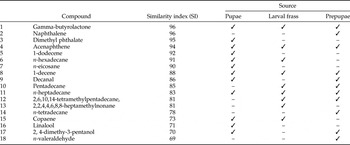
The chemical components of frass, prepupae and pupae of H. cunea were analyzed by GC–MS, and 18 compounds were detected from the major peaks based on the similarity index (SI) with entries of a compound database (table 1). Seven compounds (SI > 90) were selected for the subsequent experiment. These were 1-dodecene (pupae), n-hexadecane (pupae), DMP (pupae), gamma-butyrolactone (pupae, frass and prepupae), n-eicosane (pupae), naphthalene (larval frass) and acenaphthene (prepupae). These compounds are listed in table 1.
Compounds identified from H. cunea.

EAG responses
Different stages and by-products of H. cunea
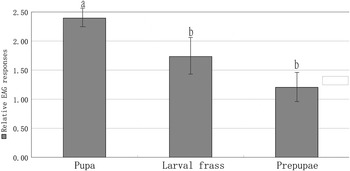
Compared with prepupae and frass, pupae elicited greater EAG responses (F = 64.146, df = 2, 42, P < 0.005). No significant difference was found between prepupae and frass (frass: 1.67 ± 0.27b; prepupae: 1.24 ± 0.21b) (fig. 1).
Relative electroantennogram responses from female C. cunea, when exposed to different by-products. These data are expressed as mean ± SD, n = 15 for each treatment. Means in a row with superscripts without a common letter are significantly different, as determined by a one-way ANOVA followed by Duncan's multiple-range test (P < 0.05).

Chemical standards
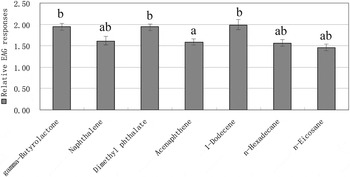
All values of the relative EAG responses were >1. This demonstrated that all the identified compounds elicited greater EAG responses than the controls (fig. 2). Gamma-butyrolactone, naphthalene, DMP, 1-dodecene, n-hexadecane and n-eicosane elicited greater EAG responses than acenaphthene (F = 12.641, df = 6, 98, P < 0.005).
Relative Electroantennographic responses from female antennae C. cunea, when stimulated with different compounds.

Y-tube olfactometer bioassays
Different stages and by-products of H. cunea
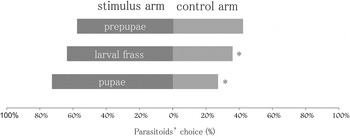
Chi-square analyses showed a significant olfactometer response of mated female C. cunea to the H. cunea pupae (73%; χ2 = 14.53; P < 0.05) and larval frass (65%; χ2 = 5.05; P < 0.05). However, prepupae did not elicit a significant behavioral response in female C. cunea (58%; χ2 = 1.80; P = 0.178 > 0.05) (fig. 3).
The selection rate (mean ± SD) of female C. cunea attracted to different by-products.

Chemical standards
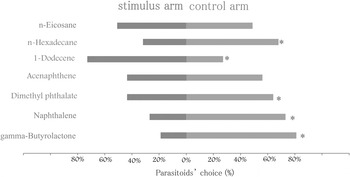
C. cunea exhibited significant movement into the stimulus arm when 1-dodecene was tested (73%, χ2 = 14.53; P < 0.05). C. cunea exhibited significant movement into the control arm when gamma-butyrolactone (19%, χ2 = 26.60; P < 0.05), naphthalene (27%, χ2 = 20.71; P < 0.05), DMP (36%, χ2 = 5.05; P < 0.05) or n-hexadecane (32%, χ2 = 9.825.71; P < 0.05) was offered in the stimulus arm (fig. 4). However, acenaphthene (58%; χ2 = 0.808; P = 0.396 > 0.05) and n-eicosane (51%; χ2 = 0.5; P = 0.823 > 0.05) did not elicit a significant behavioral response in female C. cunea (fig. 4).
The selection rate (mean ± SD) of female C. cunea attracted to different chemicals.

Discussion
In this study, the role of host-related kairomones was investigated. The attraction of H. cunea pupae, frass and prepupae to C. cunea was studied using EAG and Y-tube olfactometer bioassays. Pupae elicited greater EAG responses than the other treatments. C. cunea showed greatest preference for pupae and larval frass in the Y-tube olfactometer bioassays. This indicates that pupae of H. cunea contain volatile kairomones. The cocoons of H. cunea are very light and thin. They are easy to broken by other larvae. The broken cocoons are always mixed together with the leaves and frass. So it is difficult to collect cocoons of H. cunea; therefore cocoons were not included in this study.
GC–MS analysis volatiles from of pupae, frass and prepupae collected by SPME revealed 18 compounds. Seven compounds (SI > 90) were selected for the analysis. 1-dodecene attracted C. cunea. Four chemicals, such as naphthalene, DMP, gamma-butyrolactone, acenaphthene and n-hexadecane were repellent and one chemical, such as n-eicosane produced no obvious reaction. Other chemicals remain to be studied in the future.
Gamma-butyrolactone was present in H. cunea pupae, frass and prepupae. It elicited greater EAG responses than the control and was a repellent in the Y-tube olfactometer bioassay. Gamma-butyrolactone has been identified as a plant volatile in other studies (Selli et al., Reference Selli, Canbas, Varlet, Kelebek, Prost and Serot2008; Moon & Shibamoto, Reference Moon and Shibamoto2009; Kashima & Miyazawa, Reference Kashima and Miyazawa2014). However, there is no research on the effect of gamma-butyrolactone in insects. This study suggests that C. cunea showed an aversion to the gamma-butyrolactone. The n-hexadecane was found in H. cunea pupae and frass. Bioassays demonstrated that C. cunea was repelled by n-hexadecane. In some insect-damaged plants, the levels of n-hexadecane were increased compared with undamaged plants (Zong et al., Reference Zong, Luo, Zhou and Liu2012). The insect repellency of this compound has been confirmed by other studies (Snyder et al., Reference Snyder, Antonious and Thacker2011). Our results suggest that n-hexadecane is repellent to C. cunea.
The n-eicosane was only found in H. cunea pupae. In other study, it was reported as a kairomone that can enhance the parasitization rate of Trichogramma japonicum Ashmead (Rani et al., Reference Rani, Kumari, Sriramakrishna and Sudhakar2007). However, in this study, Y-tube bioassays showed that C. cunea had no obvious reaction to n-eicosane. It is suggested that kairomones display species specificity for each species. 1-dodecene was found to attract C. cunea in this study. It has been reported that plants can release 1-dodecene, which functions as an insect repellent. For example, 1-dodecene can repel the soybean leaf-feeding pests Trichloplusia ni (Hübner) and Epilachna varivestis (Liu et al., Reference Liu, Norris and Lyne1989). Several patents with insect repellent claims include 1-dodecene in their formulations (Norris & Liu, Reference Norris and Liu1991). However, it is unknown whether 1-dodecene can attract natural enemies. We found that 1-dodecene occurs in H. cunea pupae and appears to function as a kairomone. This compound may help repel herbivores and attract parasitoids and predators (Willmer et al., Reference Willmer, Nuttman, Raine, Stone, Pattrick, Henson, Stillman, Mcilroy, Potts and Knudsen2009). GC–MS analysis and comparison with a standard sample indicated that the compound with the highest similarity was 1-dodecene. Validation of the 1-dodecene structure will require comparison with different 1-dodecene isomers. We investigated the biological activity of 1-dodecene in a laboratory setting and activity under natural field conditions remains to be studied.
In the natural environment, insects are attracted to odors, which are frequently blends of chemicals. In these blends, there are compounds that are considered key components and sometimes only by themselves can elicit attraction (Zheng et al., Reference Zheng, Wu and Fu2014; Sacchetti et al., Reference Sacchetti, Rossi, Bellini, Vernieri, Cioni and Flamini2015; Azandeme-Hounmalon et al., Reference Azandeme-Hounmalon, Torto, Fiaboe, Subramanian, Kreiter and Martin2016). However, other studies suggest that only blends of chemicals at certain proportions can elicit any attraction (e.g., Mukherjee et al., Reference Mukherjee, Sarkar and Barik2015; Malik et al., Reference Malik, Karmakar and Barik2016). In this study, one chemical component, 1-dodecene was found to attract C. Cunea; whether this compound is more active or inactive when combined with other compounds remains to be studied.
In this study, compounds were not tested at different concentrations; this is important to keep into account as for the specific compounds, there are minimum threshold concentrations above which an olfactory response is triggered. Above the minimum threshold concentration, any increase of compound concentration up to a certain level leads to an increase in olfactory response (Schoonhoven et al., Reference Schoonhoven, van Loon and Dicke2005). Increasing the concentration of some compounds, such as n-eicosane, perhaps would lead to have different results, but that remains to be studied.
C. cunea is an effective natural enemy and a useful biological control agent for H. cunea. This study demonstrated that C. cunea is attracted to volatile kairomones from H. cunea and provides evidence that volatile host cues are detected by C. cunea. Recently, the antennae transcriptome of C. cunea were reported by Zhao et al. (Reference Zhao, Wang, Zhang, Zhang, Guo, Zhu, Liu and Li2016). Some chemosensory genes were exclusively or primarily expressed in female antennae. These female antennal-specific or dominant expression profiles may assist in locating suitable host and oviposition sites. If the kairomone 1-dodecene found in this study could combine with these OBPs (odorant-binding proteins), it should be studied in the future research.
Acknowledgements
This project was supported by the Natural Science Foundation of China (grant numbers 31401962 and 31201730); Tianjin City High School Science & Technology Fund Planning Project (grant no. 20110602), Talent introduction program in Tianjin Normal University (grant no. 5RL127) and The Doctor Foundation of Tianjin Normal University (grant no. 52XB1003).