Between Jawaharlal Nehru's Reference Nehru1946 portrayal of India as “an ancient palimpsest”Footnote 1 on which layer upon layer of thought and reverie had been inscribed” and Mao Zedong's Reference Tse-tung1958 vision of China as a “blank sheet of paper” on which “the most beautiful pictures can be painted” lie intriguing differences in political historiography (Nehru Reference Nehru1946; Mao [1958] Reference Tse-tung1967). Nehru was writing while India was struggling to break free from colonial rule; by contrast Mao was writing after the success of the communist revolution. Their differing portrayals of their nations’ respective histories serve as a reminder of Benedetto Croce's dictum, “All history is contemporary history.” Yet recognition of this historiographical bias does not mean that we, as scholars, should give up our quest to understand history as it “actually happened” (Ranke [1956] Reference Ranke and Stern1972, 57). However, our understandings of the past are inflected not only by our contemporary contexts, but also by our sources.
The impetus for this essay was a discussion I had with some graduate students in Seoul, Korea, while I was attending the 2017 AAS-in-Asia conference; they wondered if oral histories were legitimate sources of information for historians. As a historical anthropologist who has not only drawn on archival sources but also gathered hundreds of oral histories in the course of my research in Thailand, I was surprised to learn that the legitimacy of oral histories was any more a matter of controversy than the biases in archival sources. Even Leopold von Ranke, considered by many as the father of modern history, encouraged scholars to avail themselves of the “original narratives of eyewitnesses” (Ranke [1956] Reference Ranke and Stern1972, 57). Oral histories have revealed the changing lives of rural women in China, shamans in Korea, female guerrillas in the Philippines, ethnic minorities in Laos, families divided by the partition across South Asia, and many others hitherto hidden from history (e.g., Butalia Reference Butalia2000; Hershatter Reference Hershatter2011; Kendall Reference Kendall1988; Lanzona Reference Lanzona2009; Lee Reference Lee2015). Therefore I had assumed that oral histories were at least widely appreciated for their role in “filling in the gaps” in the archival records (Fogarty Reference Fogarty1983).
The questions from these students prompted me to reflect on oral history usage across Asia. Although a comprehensive review remains to be undertaken, a preliminary overview suggests intriguing differences in the use of oral histories across Asia, including such countries as China, where scholars have long embraced its use; Japan, where scholars were notably skeptical; and India and Thailand, where scholars have been largely indifferent until recent years. The emergence of oral history usage across Asia is embedded in the interplay of available archival sources and shifting historiographical questions. However, oral histories can do more than simply fill in archival gaps; they can also challenge historiographical paradigms.
The tumultuous life of northern Thailand's most famous monk, Kruba Srivichai (1878–1939), provides an opportunity to show how oral histories can challenge paradigms. Although ignored in national textbooks, Srivichai led the most important northern resistance movement of the twentieth century. He was detained under multiple protracted temple arrests in the northern cities of Lamphun and Chiang Mai, and finally sent under police guard to Bangkok for investigations in 1920 and again in 1935. The 1935 detention resulted in the forcible disrobings of over three hundred northern monks and novices. According to the prevailing historiography, the once independent kingdoms of the northern region were peacefully and gradually integrated into the modern nation-state of Thailand at the turn of the twentieth century. A better understanding of the history of Srivichai's life challenges this facile portrayal, laying bare the deep regional cleavages that in fact continue to the present day.
Oral histories face the obvious challenges posed by shifting memories, conflicting accounts, and the interviewers’ own positionalities.Footnote 2 Already Thucydides (n.d.), who explains that he based his account of the Peloponnesian wars on eyewitness accounts, notes, “My conclusions have cost me some labour from the want of coincidence between accounts of the same occurrences by different eye-witnesses, arising sometimes from imperfect memory, sometimes from undue partiality for one side or the other.” Indeed, I often joke with students that if they want to know the truth, they should only interview one person, because once they begin interviewing others, the picture often becomes blurry.
Consequently I have embraced an approach to oral history that I call “pointillism,” deriving from a technique of painting in which small, distinct dots of color are applied in patterns to form an image.Footnote 3 Accordingly, I seek to interview as many people as possible, viewing each interview as a different colored dot. When one finally stands back from tens and even hundreds of interviews, one see an overall picture emerging. Thus my research on the nineteenth century, conducted during the 1980s, is based on over 550 interviews with villagers, most of whom were over the age of 80, living in over 400 different villages in the Chiang Mai Valley of northern Thailand. My research on Srivichai specifically involves at least an additional hundred interviews across the northern region.
This essay is divided into two halves. In the first half, I review the academic engagement with oral history sources across Asia, suggesting that oral histories have differing historiographies. I note its rise in Thailand as a corrective to the disinterest of an earlier generation of Thai historians in village life. In the second half, I divide the palimpsest of Srivichai's life into four periods: his early life, his 1920 arrest, his 1935 arrest, and his afterlife. These periods correspond with four major historical shifts in Thai state-formations and four different paradigms of state-peasant relations. In each section, I will show how oral histories provided important insights that challenged the regnant paradigms. In combination, these insights challenge the overall narrative of Thailand's nation-state formation, revealing the harsher and more dramatic process by which the northern region was incorporated. By exploring the interplay of oral histories, archival sources, and regnant paradigms in the historiography of Thailand, I will conclude by suggesting that oral histories, albeit no magic wand, can have important roles to play in penetrating the palimpsests of history, in Asia as elsewhere.
Asia in the Historiography of Oral Histories
The historiography of oral history usage in Asia remains malleable. Classic oral history readers make virtually no mention of its usage in Asia. Neither David K. Dunaway and Willa K. Baum's ([1984] Reference Dunaway and Baum1996) nor Donald Ritchie's (Reference Ritchie2011) edited volumes include any work on Asia, even though the latter has been translated into Chinese. The latest edition of The Oral History Reader (Reference Perks and Thomson2016), edited by Robert Perks and Alistair Thomson, has only one essay on Asia out of its forty-three essays (i.e., Stoler with Strassler Reference Stoler, Strassler, Perks and Thomson2016). The absence of essays on oral history usage in Asia may reflect the compilers’ biases, but also suggests the possibility, often asserted in the few available historiographies, that it is a relatively new development.Footnote 4 My preliminary overview of oral history usage across Asia suggests differences in its popularity, in response to changing evaluations of archival gaps and shifting historiographical interests.
Shaped by a narrow definition of oral history as tape-recorded interviews, most studies of oral histories suggest that the methodology began in the United States with Allan Nevins, who, in 1948, established the first oral history archives at Columbia University to preserve the reflections of influential elites (Ritchie Reference Ritchie2011, 4). Its usage in the United States grew rapidly during the 1960s; the Oral History Association was founded in 1967 and the journal Oral History Review in 1973 (see Starr [1984] Reference Starr, Dunaway and Baum1996, 46–49). In contrast to this “top down” approach, the British tradition is portrayed as “bottom up,” “more rooted in social and cultural history, and allied with political movements on the Left” (Ritchie Reference Ritchie2011, 4). In 1966, British historians founded the socialist History Workshop, seeking to learn the histories of workers, villagers, women, and other ignored social groups. One of its original members, Paul Thompson, played a major role in founding the British-based Oral History Society and the journal Oral History in 1971. His book, The Voice of the Past: Oral History, first published in 1978 and translated into Chinese in 2000, became highly influential, arguing that oral history allowed history to become more democratic.
According to this Western-based historiography, oral history usage subsequently spread internationally, beginning with the first International Conference on Oral History held in England in 1978 (Grele [1984] Reference Grele, Dunaway and Baum1996, 68). In 1980, the International Journal of Oral History began publication. The International Oral History Association (IOHA) was founded in 1996, during the International Oral History Conference held that year in Sweden. The Oral History Association (n.d.) only lists two Asian affiliates, in Singapore and in Japan. The Oral History Centre of the National Archives of Singapore was set up in 1979 (National Archives of Singapore 2017; see also I. Lim Reference Lim1992). The Japan Oral History Association was founded much later, in 2003 (Japan Oral History Association 2003). The first International Oral History Conference to be held in an Asian country took place in Bengaluru, India, in 2016, shortly after the founding of the Oral History Association of India (OHAI) in 2013. Indira Chowdhury was the first president of the IOHA elected from an Asian country (2014–16).Footnote 5 This overview suggests that oral history usage is relatively recent in Asia.
However, an alternative history can also be written, both for the West and for Asia. As Paul Thompson (Reference Thompson1978, 19) argues, “In fact, oral history is as old as history itself. It was the first kind of history.” Instead of viewing oral history usage as a new phenomenon, Thompson argues that its usage only declined over the course of the nineteenth century, such that its modern usage is not “a discovery but a recovery” (64). Countering the portrayal of the American rise of oral history as “top down,” we should recall the early importance of Hubert Howe Bancroft (1832–1918), who sought to compile a history of California through wide-ranging interviews; the pioneering work of Franz Boas among native Americans; the role of the Chicago school of urban sociology in the 1920s and 1930s; and the Federal Writers Project of the 1930s, which included over 2,300 first-person accounts of slavery.
Within Asia, China appears to have the strongest tradition of oral history usage, both embedded in and complementing its archival records (Kwong Reference Kwong1992; Stave Reference Stave1985; Yang Reference Liwen1999; Zuo Reference Zuo2015). In his very interesting article, Luke S. K. Kwong (Reference Kwong1992, 27) suggests that the first written records indicating the use of oral histories date back to Sima Qian (c. 145–90 BC), and even earlier. However, he suggests that the first Chinese scholar to use oral history in the modern era was Liang Qichao (1873–1929; see figure 1). Already in 1921, Liang argued for the systematic collection of oral testimonies of those who had taken part in or witnessed important recent events in China. Influenced by socialist ideologies, Chinese scholars and political activists became increasingly open to fieldwork and interview methods. Mao Zedong conducted such fieldwork in Hunan Province in 1927 to learn about peasant grievances, leading to his prescription “to inquire by mouth and take notes by hand,” which was pursued by other cadres (Kwong Reference Kwong1992, 31). After the founding of the People's Republic in 1949, oral history collection intensified (see esp. Kwong Reference Kwong1992). In 1959, Premier Zhou Enlai provided encouragement, noting the huge changes in Chinese society and saying, “It is our duty to preserve all manner of historical documents from this period” (Yang Reference Liwen1999, 137). Focusing initially on the period from 1898 to 1949, branches of the Chinese People's Political Consultative Conference began coordinating the collection of the “four histories,” namely the histories of families, villages, communes, and factories (Zuo Reference Zuo2015, 261), involving a staff of some 3,000 people. As many as 300,000 people contributed eyewitness accounts, resulting in the publication of over 11,600 volumes and some 1.6 billion characters of writing by the mid-1990s (Yang Reference Liwen1999, 138). In 2004, the Chinese Association of Oral History Studies was established to provide a national structure to coordinate these vast troves of materials (Zuo Reference Zuo2015, 262).
Liang Qichao as a teenager (Wikimedia Commons 2016).

If, rather than a nation-oriented analysis, we consider the global flows of ideas, we can see connections across continents in ways that include Asia. In the case of China, Liang himself was influenced by Hubert Howe Bancroft (Kwong Reference Kwong1992, 29). It can also be argued that Chinese traditions of oral history influenced Western scholars. The American journalist Edgar Snow's Red Star over China (Reference Snow1937) is an oral history work in its own right, providing insight into the early phase of the Chinese communist movement. Andre Schifrin, an editor at Pantheon Books, worked with Jan Myrdal on Report from a Chinese Village (Reference Myrdal1965), a book that made use of oral histories to tell a cross-generational story of the impact of the Communist Revolution. Schifrin wondered if a similar kind of book could be written about an American city and asked Studs Terkel to write it. The result was Division Street, America (Reference Terkel1967), a book that began to establish Terkel's reputation as one of America's foremost oral historians (Kwong Reference Kwong1992, 41; Terkel Reference Terkel1967, xvii).Footnote 6
In contrast to its embrace in China, Sheila Hones (Reference Hones1992, 15) writes that “there was very little tradition of academic oral history in Japan.” Hiroko Tomida and Keith Snell (Reference Tomida and Snell1996, 88) similarly observe that “even now the method is still hardly considered a serious academic pursuit in the writing of Japanese history.” In explaining why Japanese historians have felt “considerable suspicion or hesitation over oral history methods,” Tomida and Snell suggest additional factors beyond simply concern over the reliability of memory, namely “complicated attitudes to authority, towards those who are poorer or less privileged in society”; they write, “Lesser people were thought an irrelevance in historical analysis and narrative, and there was little interest in methods appropriate to their study” (89).Footnote 7 Frustrated by the lack of archival materials and inspired by the pioneering work of folklorist Kunio Yanagita (1875–1962) and Shigemi Yamamoto's research on female silk-factory workers, feminists turned to oral history. Consequently, the 1980s saw a rise in the “relatively new field of Japanese women's history,” and the “very novel nature of this subject permitted it greater flexibility” (Tomida and Snell Reference Tomida and Snell1996, 88; see also Hones Reference Hones1992, 16; Yamamoto Reference Yamamoto2000).Footnote 8
If Japanese historians have been slow to include oral histories due to active skepticism regarding the methodology, Indian scholars have been similarly slow to include oral histories. However, unlike in Japan where scholars have suggested a lack of interest in the lives of “lesser people,” India saw the rise of subaltern studies in South Asia over the course of the 1980s. Many of the leading figures in this movement had spent time in England, and their work has had a transnational impact. Nonetheless, despite their focus on the subaltern, these scholars drew remarkably little on oral histories. We might speculate that Indian historians had no need of oral histories to reconstruct the lives of India's subalterns due to the strength of its colonial records (e.g., Cohn Reference Cohn1990; Guha Reference Guha2009).Footnote 9 As in Japan, feminist scholars of South Asia have contributed to a surge of historical work that draws heavily on oral histories; however, unlike in Japan where the focus centered on female workers, in South Asia the focus has largely centered on the aftermath of the 1947 partition and other violent conflicts (e.g., Butalia Reference Butalia2000; Das Reference Das2007; Menon and Bhasin Reference Menon and Bhasin1998; Saikia Reference Saikia2011; Virdee Reference Virdee2013). Further contributing to the increasing use of oral history beyond partition studies is what Vinayak Chaturvedi refers to as an “archival crisis,” in which the state is failing to document communal riots, farmer suicides, and other forms of everyday violence or is otherwise unwilling to release its records even when documents should have been declassified after the prescribed thirty-year period has passed.Footnote 10
Unlike in Japan, Thai historians have not evidenced any particular skepticism towards the validity of oral history usage. However, like Japan but unlike India, Thailand is a country whose royalist archives and correlated historiographical paradigms long excluded curiosity about the lives of ordinary people.Footnote 11 Phya Anuman Rajadhon, who served as Director-General of the Ministry of Fine Arts, wrote one of the earliest accounts of the Thai peasantry. First published in 1948, his essay is entitled “The Life of the Farmer” (Anuman Reference Anuman Rajadhon and Gedney1961). The account is not based upon first-hand fieldwork, but, quaintly, upon “the verbal accounts of many other friends who have seen farming and have been kind enough to explain farming to me” (3). So odd was the topic at the time that Phya Anuman remarks, “When we say that the country people constitute the largest part of the population of the country, or, as they say, the backbone of the country, this is usually an end of the matter. No one is interested in knowing about country people” (8).
The radical historian Thadeus Flood (Reference Flood1975, 55) frames the result, writing, “For the past century much Western imperialist scholarship and Thai royalist scholarship has sought to perpetuate the image of benign Thai royalty ruling over a happy, carefree and subservient populace dwelling in a land of sunshine and smiles.” Thongchai Winichakul has noted how this paradigm of benign rule has in turn contributed to Thai historiography of nation-state formation. Lauding the court for its role in warding off the threats of colonization, historical studies became “a collection of stories by and for the national elite celebrating their successful mission of building and protecting the country.” This paradigm of historical discourse has made history “an ideological weapon and a source of legitimation of the state” (Thongchai Reference Winichakul1995, 99).
The study of history underwent a major change in the 1970s, in the wake of the 1973 overthrow of the military regime. As peasant protests intensified, there was a growing interest in changing rural conditions. As Rujaya Abhakorn (Reference Rujaya Abhakorn1999, 2) explains the rise of oral histories, “there were demands for ‘the people's history’ to replace history of the state and the ruling class.” Chatthip Nartsupha's The Thai Village Economy in the Past ([1984] Reference Nartsupha, Baker and Phongpaichit1999) is typically considered to mark the first use of oral history to gain insight into peasant political history.Footnote 12 Since then, more Thai scholars have been making use of oral histories.
This cursory overview reveals the differing interplay of archival sources and oral histories.Footnote 13 In China, oral histories were deployed to record a wide range of the populace's experiences. In Japan, oral histories grew primarily as a means to retrieve women's histories. In South Asia, they were a means to learn about the aftermath of the partition and other violent events. In Thailand, they have grown as an avenue to learn about the everyday lives of villagers. Nonetheless, in each of these countries, scholars have turned to oral histories to fill in the gaps in the archival records.
Challenging Paradigms
However, oral histories can do more than simply “fill in the gaps.” As the following analysis of the historiography of northern Thailand's most famous monk, Kruba Srivichai, demonstrates, oral histories can also provide the evidence needed to challenge and change regnant historiographical paradigms.
Archival sources provide the basic framework of Srivichai's life. He was born in a remote mountain village in Lii District in Lamphun Province in 1878. By 1920, he was supported by “80 per cent of the people” in the northern region, with many viewing him as tonbun or saint, and others viewing him as a “traitor to his religion and his King” (Bangkok Times Weekly Mail 1920a). He was detained under multiple protracted temple arrests in Lamphun and Chiang Mai, and finally sent under police guard to Bangkok for investigation. Upon his release from Bangkok, he then restored or built over one hundred temples throughout the north, efforts involving thousands of villagers. In November 1935, while he was completing the most massive project of his life, namely constructing a nearly 12-kilometer road up the mountain to the revered temple of Chiang Mai's Wat Phrathat Doi Suthep, Srivichai was sent a second time to Bangkok for investigation in 1935. By this point, conflicts in the north had become so intense that “the independent monks of the north had openly severed connections with their ecclesiastical superiors and declared Phra Sri Vijaya to be their leader” (V. Thompson [1941] Reference Thompson1967, 642). Srivichai was not allowed to return to the north until May 1936, when he finally signed an agreement “to abide by the laws of the church” (643). In the process, over three hundred monks and novices residing in some sixty northern temples were forced to disrobe. He died shortly thereafter, in 1939.
Interest in Srivichai has grown in the past few years, with new oral histories and archival materials coming to light. The prevailing paradigms of Srivichai's life combine to portray a narrative of a benign state that gradually expanded its control of the sangha (monastic order) and thereby integrated the population into the modern nation-state. By contrast, oral histories reveal Srivichai's life to have been embedded in more violent and secular processes, involving both military and police force. Accordingly, the next four sections of this essay explore the palimpsest of Srivichai's life, revealing the interplay of oral histories, archival sources, and regnant paradigms in the historiography of Thailand.
Absolute Monarchies: Early Life: Dharmarajas vs. Maitreyan Saints
By the time of his first investigation in Bangkok in 1920, Srivichai was already widely heralded as a tonbun, or incarnation of the future savior, the Buddha Maitreya. Just when Srivichai began to be identified as a tonbun is not clear. However, by 1920, his mytho-biography, as told by villagers and recorded in palm leaf manuscripts, already redounded with the classic cosmological portends of Maitreya across the Theravada Buddhist world of Southeast Asia. Srivichai was said to be able to walk in the air, not get wet in the rain or hot in the sun, see and hear long distances, and read minds. These messianic rumors reached their climax in stories that the god Indra had given Srivichai the Srikanchai sword, a magical sword that creates storms and wields social justice.Footnote 14 Villagers’ quest for a Maitreyan savior conflicts with the prevailing historiographical narrative of a benign political economy.
In these early years of his life, the various kingdoms of mainland Southeast Asia were ruled by absolute monarchs. In the regnant paradigm, these kings are typically portrayed as dharmarajas, or kings ruling in accord with Buddhist moral principles. Drawing upon Clifford Geertz's notion of a “theatre-state,” Stanley Tambiah (Reference Tambiah1976, 125) characterizes traditional Thai kingdoms as “galactic polities,” states held together “not so much by the real exercise of power and control as by devices and mechanisms of a ritual kind.”Footnote 15 Although the existence of slavery is recognized, it is described in the most benevolent terms, with an emphasis on debt slavery. Drawing on Bishop Pallegoix's remarks, Sir John Bowring ([1857] Reference Bowring1969, 1:193–94) writes that “the slaves are treated like the children of the masters; they are consulted in all matters, and each man feels that as his master is prosperous, so is he.” Kukrit and Seni Pramoj, themselves members of the Thai aristocracy, summarize the resultant historiographical paradigm, writing that “in King Mongkut's time slavery was not a system whereby one or more human being were subjugated by another. It was, strangely enough, the right of free men to sell themselves into bondage” (in Ingram Reference Ingram1971, 61).Footnote 16
The prevailing theatre-state paradigm also assumes that villagers lived in a subsistence economy. Thus Norwegian naturalist Carl Bock ([1884] Reference Bock1986, 316) describes northern villagers as “naturally lazy, and, with a fertile soil which provides them with all the necessities of life without any appreciable effort on their part, their indolence is encouraged.” Similarly, Phya Anuman (Reference Anuman Rajadhon1988, 47) writes of villagers whose “requirements for subsistence in the old days were simple and easily obtained.”Footnote 17
The paradigm of the subsistence economy was so deeply instilled in me that in the course of my interviews in 1984–86, even though villagers repeatedly told me of their families’ hardships, I dismissed them as typical village complaints. Interview number sixty-one was the one when a lightbulb finally went off. I was interviewing a woman who was sorting tobacco leaves with a group of women along the banks of the Ping River. She described the earlier days when royal boats laden with rice floated past the village. Local villagers worked unloading and reloading the royal boats so they could get past the nearby dam. As in previous interviews, she remarked that her family and others in the village were poor and everyone fell short of rice. When I asked how villagers made it through the months they fell short of rice, I was shocked when she told me that local villagers walked to Mae Chaem, a district in the mountains, a trip that took four days. The image of villagers short of rice, sitting next to the banks of the river as royal boats laden with rice floated by, stuck with me.
Thereafter I began routinely asking elderly villagers throughout the Chiang Mai Valley if people in their villages had fallen short of rice in the past, and if so, for how many months out of the year. Of a total of 273 villages about which I have information, 96.7 percent of villages had at least some households that fell short of rice for at least two or three months each year. In nearly half (48.7 percent) of the villages, the majority of households fell short of rice at least two or three months each year. In many areas, the lush fields around their villages belonged to the ruling lords.
Repeated in numerous interviews was a sense of relentless poverty forcing villagers to unceasing industry. Far from a subsistence economy, villagers made pottery and other handicrafts, collected honey and other forest products, or traveled long distances in search of work or food. Several men I interviewed had worked as porters, carrying goods through the mountains on long shoulder poles; one man described the callouses on his shoulders as thick as a monkey's ass. Much to the horror of his family who was listening to our interview, one man bragged of his superior magical powers that enabled him to steal rice from the magically protected mountain fields that belonged to hill tribes.Footnote 18 Other villagers described travelling long distances to beg for rice (Bowie Reference Bowie1998).
These oral histories enabled me to flesh out the scant references to village life made in the archival sources. The missionary Hugh Taylor provides a moving account of a famine in the northern region in 1892, writing of going into villages and “finding dead bodies in deserted houses” and “village wells filled with starved bodies that the neighbors were too weak to bury” (Taylor, Reference Taylorn.d., 114). Newspaper and missionary accounts for the early decades of the twentieth century provide similar reports of droughts, floods, and poverty, conditions made worse by hookworm, malaria, and outbreaks of cholera and smallpox.Footnote 19
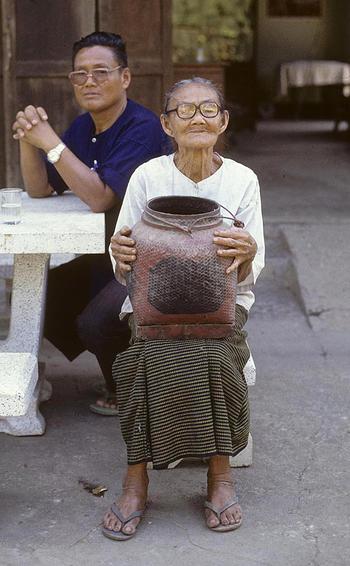
Far from voluntary debt-slaves, I learned over the course of routinely asking villagers how their village was founded that their forebearers had originally been settled by war captives. During one particularly memorable interview, a woman showed me the lacquer basket that her own grandmother had used to carry her clothes during the journey to Chiang Mai (see figure 2). While I was at the National Archives in England, I came across an account of a British official from 1876 describing the trauma of over 1,000 war captives being force-marched from Laos to Thailand, with hundreds dying en route (Bowie Reference Bowie and Durrenberger1996). Subsequent reading revealed a remarkable consensus among nineteenth-century observers that at least half and as many as three-quarters of the northern population were war captives.Footnote 20 Thus enslavement had been largely involuntary.
Meh Luang Kaew (age ninety-six) with basket used by her grandmother to carry belongings when captured as a war slave. Baan Thaa Khii Naak, Tambon Nong Tong, Hang Dong, Chiang Mai, Thailand. December 4, 1984. Photo by author.

In contrast with the portrayal of dharmaraja kings of theater states, villagers’ attitudes toward their rulers were overwhelmingly negative. In the over five hundred interviews I conducted during the 1980s, I did not encounter a single informant who spoke positively of the nineteenth-century ruling northern lords. Instead villagers described how they hid their daughters so they would not be taken as concubines, their sons so they would not be conscripted as soldiers, and their water buffaloes so they would not be slaughtered for royal feasts.Footnote 21 I was particularly moved by the account of a man who described the funeral preparations of his grandmother's body; she was a former slave. As they were changing her clothes, he was stunned to see the scars of whip marks across his grandmother's back.
The understanding of the nineteenth-century political economy grounded on enslaved and impoverished villagers helps to explain the widespread belief in the Maitreya Buddha I encountered in the course of conducting oral histories, but which is only fleetingly recorded in archival accounts. Villagers spoke to me in secretive, hushed tones about messianic texts describing such signs of the apocalypse as floods, droughts, diseases, famines, exploitation, and other forms of suffering. Belief in the Maitreya Buddha in turn helps to explain why villagers would turn to a monk such as Srivichai to lead them in their struggles against social injustices.
The regnant benign paradigm of the theater state ruled by dharmarajas and its embedded myth of the subsistence economy fails to explain why villagers were in search of a Maitreyan savior. Supplemented by the scattered archival materials, oral histories reveal the apocalyptic character of the political economy of the late nineteenth and early twentieth centuries, the context in which Srivichai's reputation as a millenarian saint began to emerge.
Transitional Period: The First Arrest Series: Ordination vs. Military Conscription
The second layer in Srivichai's life coincides with the expansion of the Bangkok court into the once quasi-independent northern kingdoms. In explaining the first series of arrests, which culminated in 1920, scholars have asserted that Srivichai violated the 1902 Sangha Act by ordaining novices and monks without authorization. However, this explanation sidesteps three major complications. First, the Sangha Act was not enforced in Monthon Phayab—as these northern provinces were then called—until 1924. Secondly, this act contained no provisions regarding ordination or any of the other charges he faced. Thirdly, the central Thai sangha initially took a very moderate and even supportive position of Srivichai's responses to the charges against him.
In Bangkok, Srivichai faced eight charges, namely: (1) ordaining monks and novices without permission, (2) not obeying his senior district-level monk, (3) refusing to attend a district-level monastic meeting, (4) failing to light candles and beat gongs in honor of the royal coronation anniversary, (5) inciting other temples to resist the senior district monk, (6) refusing to assist officials with their household register, (7) inciting other temples to refuse to attend district monastic meetings, and (8) possessing a magical sword with a golden scabbard (the last charge indirectly insinuating leading a political rebellion) (Bangkok Times Weekly Mail 1920b).Footnote 22 Srivichai was declared guilty only of the first charge and innocent of the last five charges; the committee concluded there was insufficient evidence to make a determination on the second and third charges given the ambiguity of whether secular or monastic authorities had issued the summons to Srivichai. The Bangkok ecclesiastical committee sought no further punishment, noting that Srivichai had already endured temple arrest in the north. To conclude the matter, they paid for Srivichai's train ride back to the north and gave him a gift of 60 baht.
So what was going on? If we look closely at the newspaper account, we can see the conflict was not triggered by the monastic hierarchy, but by secular officials: “About five years ago he [Srivichai] proposed to ordain a new priest, and he sent the Kamnan [sub-district head] and head-man of the village to ask for a licence from the Kromakarn [secular official of Religious Affairs Department] and Nai Amphur [secular district level officer of the Ministry of Interior]” (Bangkok Times Weekly Mail 1920a). For reasons that are not obvious, the secular officials did not issue the requested permissions.
The lightbulb only turned on when I integrated archival sources with what I had learned through oral histories. Newspaper accounts announced the implementation of two new interlocked regulations in the north, the Ordination Act of 1913 and the Military Conscription Act, which went into effect in the north in April 1914. The Ordination Act increased state supervision of not only who could conduct ordinations but also who could be ordained. The Military Conscription Act exempted monks and novices who both “knew the dharma (ruu tham)” and whose ordination was verified by relevant secular authorities. Central Thai officials considered northerners who were not literate in the central Thai language and script as ignorant of the dharma and therefore draftable.Footnote 23 These new regulations reflected growing secular control over the Buddhist sangha and the population at large, thus marking a dramatic shift in the former balance between state, sangha, and laity in northern Thailand.Footnote 24
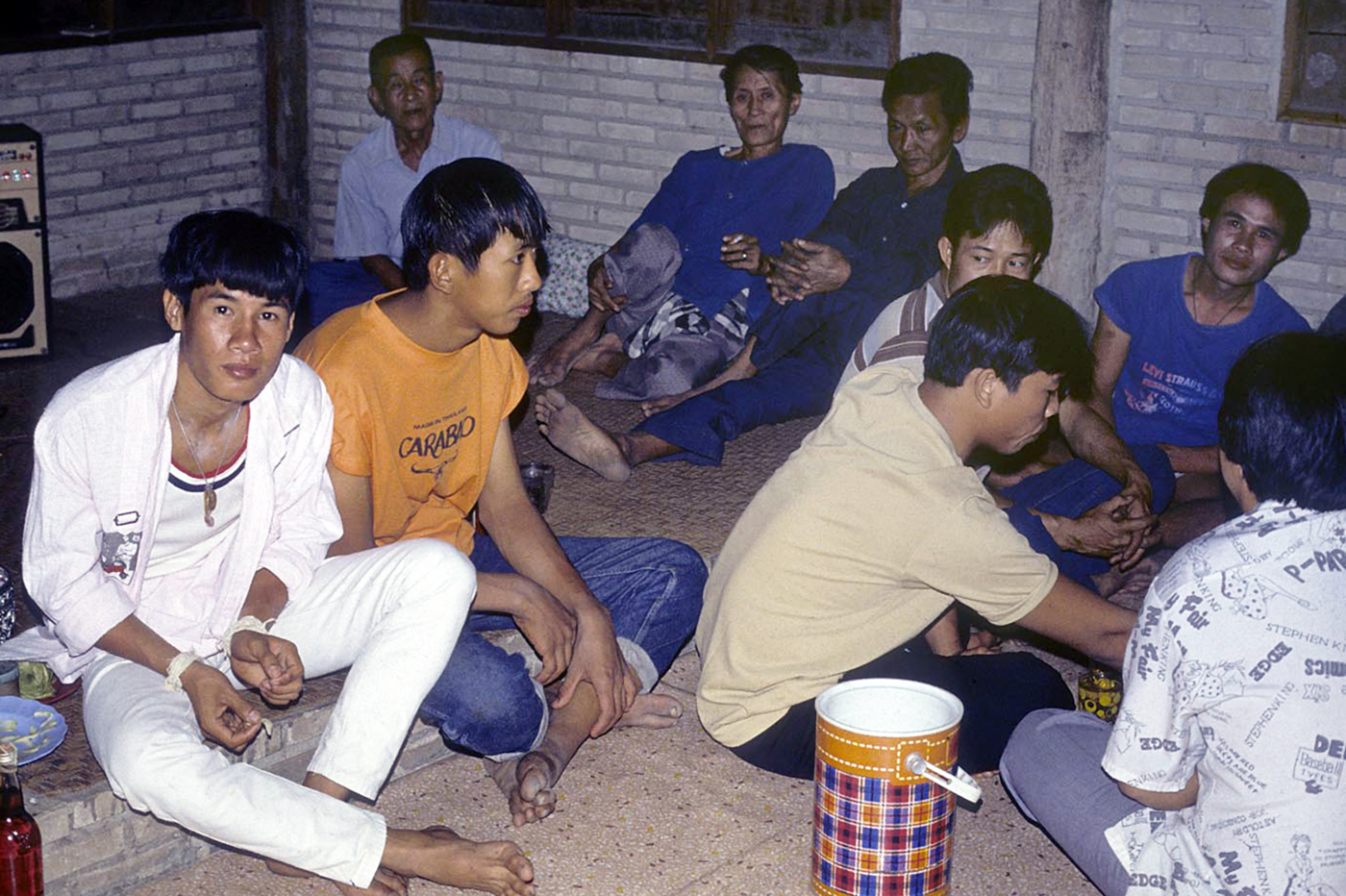
Oral histories gave me the insight necessary to understand the significance of these changes in military conscription. Having attended village “draft parties” in the 1970s, I knew that villagers dreaded the draft (see figure 3). Villagers spent considerable sums with both spirit mediums and well-placed bureaucrats to ensure that their sons would not be selected. Villagers repeatedly commented that villagers in the past ordained as novices and monks in order to escape the draft; one abbot recalled as many as twenty to forty novices ordaining during conscription. The British Consul-General, W. A. R. Woods, provides contemporary confirmation, noting that the government was issuing increasing regulations “to prevent the temples from becoming refuges for taxdodgers and evaders of military service,” and adding that “when a village Headman was called upon to compile a list of the young fellows in his village who were liable for conscription, he was fain to report that there were none at all, but that the local temple had had to put up several temporary buildings to accommodate the abnormal number of young priests and novices” (Woods Reference Woods1935, 151).
Villagers at a draft party, with the wrists of the potential recruits bound with sacred strings to protect them from being drafted into the military. Baan Huarin, Tambon Tungsatok, Amphur Sanpatong, Chiang Mai, Thailand. April 1985. Photo by author.

My confidence in the importance of military conscription as the key issue underlying Srivichai's first series of arrests was further enhanced by a famous vignette describing the fiery reaction of Chiang Mai's supreme patriarch, Kruba Sophaa, widely known among a generation of villagers for his anti-Bangkok, anti-draft stance. According to one colorful account, when Sophaa learned that novices and monks were being forced into the draft, his blood boiled. Carried by litter, he went straight to the residence of the Siamese commissioner and bellowed angrily in northern Thai, “Are wars and tigers now besetting us on all directions? Is that why you are now taking novices and monks off to be soldiers?” It seems that as a result of this angry outburst, the commissioner decided that monks and novices would be exempted from the draft (Pranii [1964] Reference na Pathalung1995, 187). This detente appears to have ended with Sophaa's death in 1915 and the commissioner's departure about the same time, both events corresponding to the time when Srivichai's problems began.
Oral histories allow us to reread the archival sources and challenge the prevailing explanation. Srivichai was not arrested because of an internal monastic dispute over ordination, but a conflict with secular authorities over military conscription.
Constitutional Monarchy: The Second Bangkok Arrest: Minimal Impact vs. Major Reforms
Srivichai's 1935 detention occurred after Thailand's coup established a constitutional monarchy. After Srivichai's return to the north in 1920, he built or restored over one hundred temples throughout the northern provinces, each involving hundreds of villagers and townspeople who flocked to help. The building of the mountain road up Doi Suthep involved literally thousands of villagers.Footnote 25 Despite his widespread popularity, Srivichai was detained in Bangkok in November 1935 and only allowed to return to the north after he signed a document acceding to the authority of the central Thai sangha; he finally signed on April 21, 1936.Footnote 26
The prevailing paradigm minimizes the importance of the 1935 arrest, collapsing it into the first arrest as a benign misunderstanding over ordination and ignoring its impact. Despite recognizing that many northern monks “had openly severed connections with their ecclesiastical superiors” and that “some of these leaders were arrested,” Virginia Thompson, the primary source of subsequent scholars, writes:
The year 1935 found him once again in Bangkok, and this time he was even more tactfully treated. He had been sent for because he apparently did not understand the rules of the Buddhist church. The charges against him were virtually the same…. After a sojourn of several months in the capital, Phra Sri Vijaya saw the light, signed an agreement to abide by the laws of the church, and returned to his home, to be welcomed back by more than eight thousand people. (V. Thompson [1941] Reference Thompson1967, 642–43)
Stanley Tambiah (Reference Tambiah1976, 246) echoes this mild view, noting in passing the arrests of monks, but writing that “[o]nce again Phra Siwichai was treated with tolerance.” Charles Keyes (Reference Keyes1971, 558) adds that “a tacit agreement to permit the northern clergy to follow Yuan [northern] customs also was apparent, for there have been no efforts since that time to suppress Yuan practices.”
In contrast to this prevailing paradigm, oral histories reveal the intensity of the conflict. By 1935, the 1902 Sangha Act was in effect. Srivichai was certainly aware of its provisions, but continued to ordain hundreds and indeed thousands of monks and novices throughout the northern region in willful violation. Furthermore, monks were not merely arrested; hundreds were physically disrobed and many others fled to Burma.
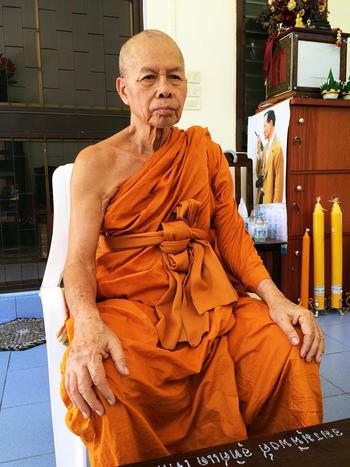
I first learned about this mass disrobing in an oral history with one of the disrobed monks, who was eighty-six when I interviewed him in 1985. He recounted that over 340 monks, a large number of whom were abbots, were forced to disrobe. I found an interview with the nephew of Phra Panyaa, the disrobed abbot of Wat Phrabat Yangwit, to be particularly moving; the nephew is himself an abbot in his eighties (see figure 4).Footnote 27 After Phra Panyaa twice refused orders to disrobe, he and his fellow monks and novices were escorted by police to the temple of the provincial head (chawkhana cangwat) in Chiang Mai and forcibly disrobed. His relatives and fellow villagers, who had accompanied the procession into town, asked to be allowed to keep his robe (jiworn), but the provincial head refused. Instead he had his secretary take the robe and write on it, “the robe of Phra Panyaa, Wat Phrabat Yangwit.” The robe was then hung over the temple walls so everyone would see it. As the nephew concluded, “They walked in lines of yellow into town, monks and novices, and came out wearing white. The villagers were in tears. They went as monks and came back in white.”
Phrakhruu Dharmabhirom (age eighty-one), nephew of disrobed abbot Phra Panyaa and abbot of Wat Nam Boh Luang, Tambon Baan Mae, Amphur Sanpatong, Chiang Mai, Thailand. August 9, 2015. Photo by author.

Oral histories enrich our understanding of the archival sources and enable us to reconstruct the dramatic impact of this mass disrobing in both religious and secular realms. The mass disrobings left many temples without abbots; Bangkok was able to replace them with monks who had been trained in Bangkok. These Bangkok-trained monks helped to change the practice of Buddhism in the north. By emphasizing the life of the historical Buddha Gautama, they suppressed beliefs about Maitreya. The jataka stories of the Buddha's previous lives, often orated as bawdy comedy, had been a popular part of northern Buddhism; the Bangkok-trained monks viewed the jatakas as mere myths and found bawdy comedy inappropriate (e.g., Bowie Reference Bowie2017b). Oral histories and surviving archival sources reveal numerous other disputes over changing religious practices (e.g., Pii Reference Pii1951). The conflicts continued long after Srivichai's return, becoming so intense in the 1950s that followers of Srivichai and Bangkok respectively refused to sleep in the same buildings in village temples.
However, oral histories reveal that the impact of the 1935–36 arrest went beyond monastic issues. The agreement included a provision that Srivichai was “to assist in the work of building schools for the benefit of the children of the land according to the Primary Education Act, and to assist in convincing the people of the benefits to be derived from education” (Bangkok Times Weekly Mail 1936). I did not understand the importance of the education issue until I interviewed a villager whose father had been detained in jail for three nights as a way to force him to attend the secular government school instead of temple school. This and subsequent interviews led me to engage the development of the national education system and the enforced instruction in central Thai script and dialect, both of which undermined the traditional northern monastic educational structure. Although the Primary Education Act was issued in 1921, serious efforts to enforce it occurred only after 1932 (Vachara Reference Sindhuprama1988, 255). Northern reaction against this imposition of central Thai secular education was strong. A report from Monthon Phayab in August 1935, just before Srivichai's arrest, remarks that as many as 80 percent of the population in some districts were refusing to attend secular schools and that some schools had been set on fire (Phuusinsachai and Phuthinantha Reference Bongkasaphongamphai and Phonchaiarun2015, 109–10).
Contrary to the portrayals of Srivichai's 1935 arrest as having had no impact, oral histories reveal that the mass disrobings and the enforcement of compulsory education brought about far-reaching changes in the fabric of northern Thai society.
The Present Day: Afterlife: National Saint vs. Resistance Hero
Srivichai died in 1939, a few years after his return to the north. His memory is being kept alive not only by northerners, but increasingly by Bangkokians and Thais across the country. At present, the new paradigm that is forming is that Srivichai was a saint, not in the Maitreyan tonbun tradition but in the kejiajarn tradition of central Thailand, namely a monk with mystical, supranormal powers. As a northern kejiajarn, Srivichai can be seen as a symbol of northern pride, linking the north to the nation-state. Tourists from across the country worship his shrine at the foot of the Doi Suthep mountain road. Enormous statues of Srivichai are being built throughout the north, many with monies from central Thais. Images of Srivichai are increasingly appearing at temples elsewhere in Thailand. He is often grouped together with monks with such auspicious-sounding names as Money, Happiness, and Fortune; or in a national pantheon with famous monks representing different regions of Thailand, such as Luang Buu Thuat from the south, Somdet To from the central region, and Luang Buu Man from the northeast. In addition, there are monks who claim to be Srivichai reborn, many of whom are patronized by central Thais (e.g., Cohen Reference Cohen2017). Most of these non-northern Thais have no knowledge of Srivichai's tumultuous life history.
However for many northerners, Srivichai resonates as a symbol of political resistance. Following the military coup in September 2006, Thai politics became divided into a struggle between the “Red Shirts,” strong in the northern and northeastern regions, and the “Yellow Shirts,” strong in the central and southern regions. Prime ministers Taksin Shinawatra and his sister Yingluck both received support from the Red Shirts; they and other northern politicians drew upon Srivichai in their political campaigns. Taksin was rumored to have made merit with Srivichai in a previous life; Yingluck and other members of the Pheu Thai political party began their electoral campaign at his statue on Doi Suthep. I became aware of the contemporary political resonances in the course of an interview with a well-known member of parliament who was widely known as an expert on Srivichai. His years spent talking with villagers about Srivichai struck me as an important element in his popularity among his constituency. Thereafter I began to trace the links between the Red Shirt movement and the Pheu Thai party, noting various political gatherings at Srivichai's shrine in the months leading up to and following the military coup of May 22, 2014.Footnote 28 Oral histories led me not just to contemporary links with the Red Shirt movement, but also to connections between Srivichai and the growth of the communist guerrilla movement in the 1940s–1960s and the Farmer Federation of Thailand in the 1970s.
The prevailing paradigm of the national discourse about Srivichai is that he is a saint, understood in an apolitical sense of a kejiajarn who can assist with lottery numbers and other utilitarian requests. Many northerners are complicit, pleased to see their saint receiving national respect. However, oral histories have helped me to see the continuing political connections of Srivichai with the roots of the communist insurgency, the farmer movement, and the Red Shirt movement. For northerners, viewing Srivichai as an incarnation of Maitreya has become anachronistic; instead he is a heroic symbol of northern resistance to the central state.
Pointillist Conclusions
In this essay, I have described four layers in the palimpsest of Kruba Srivichai's life, showing how a pointillist approach to oral histories has resulted in challenges to the prevailing historiography. Far from a theatre state and happy peasants living in a subsistence economy, the state was based in military power, war captives, and poverty. The political economy of the nineteenth and early twentieth centuries helps to explain the vision of Srivichai as a tonbun, or millenarian incarnation of the coming Maitreya Buddha. The conflict during the first series of arrests culminating in 1920 was not a simple misunderstanding within the monastic hierarchy, but a fundamental shift of power such that secular concerns over military conscription then took precedence. The second arrest in 1935–36 was also not a simple misunderstanding within the monastic hierarchy, since Srivichai was willfully ordaining hundreds and thousands of monks and novices. The subsequent arrests across the north were not minor, but entailed the widespread disrobings of hundreds of monks, leading to a massive change in the fabric of northern Thai society that we still see in the present day. With the enforcement of the compulsory education act, northern Thais lost their ability to read northern texts; few children today ordain, but instead attend secular schools taught in central Thai. Lastly, although the national portrayal of Srivichai today is as an apolitical saint with supranormal powers, his reputation as a rebel resistance leader echoes among northerners, underlying the growth of the Communist Party of Thailand in the 1940s–1960s, the peasant movement in the 1970s, and the Red Shirt movement of the past decade.
My argument is not that oral histories are a magic wand. Emotions shape memories in complex ways. Indeed, many of the villagers gave incomplete explanations for Srivichai's arrests, in part because they did not want to have to portray Srivichai as a defeated hero.Footnote 29 Northerners were not making the connections between the nineteenth-century political economy, the imposition of military conscription, and the enforcement of compulsory education as factors behind Srivichai's arrests. But that is where the pointillist art of using oral histories comes in. Northerners in fact described these elements in their interviews, leaving it to me to stand back and see the broader picture their oral histories had created. Revising our understanding of four layers of the palimpsest of Srivichai's life provides an even broader historiographical challenge to the prevailing narrative of Thai nation-state formation. In contrast to the view that the north was integrated into the Thai nation-state at the turn of the twentieth century, the date 1936 marks the north's involuntary integration and reveals tensions that echo into the present.
Far more reflection needs to go into how scholars across Asia have or have not been making use of oral histories in their research. The usage of oral histories is no less fraught than those of archival materials.Footnote 30 However, oral histories, in a dialectic with archival sources, can provide valuable insights by which to reach deeper understandings of both what transpired in the past and the process of historiography itself. As I hope this essay has shown, oral histories can do more than “fill in the gaps.” By bringing in new voices, they can bring us closer to history as it actually happened. They also have the power to challenge prevailing historical paradigms, thereby making history that much more accurate and more democratic.
Acknowledgments
I would like to thank Alfred McCoy, Mike Cullinane, Anne Hansen, Mary McCoy, Laurel Kendall, Krisna Uk, Matthew Bowie-Wilson, James Bowie-Wilson, Anthony Irwin, the Southeast Asia Research Group of graduate students at the University of Wisconsin–Madison, the graduate students who came to see me in Seoul who prompted me to write this essay, Pensupa Sukkata, Naren Panyaphuu, Pisith Nasee, Paul Cohen, Manat Chajkaew, Narintip (Piak) Virabanditkul, Amornwat (Aod) and Phunnaphat (Ning) Watcharawichaisri, Narong and Kongchan Mahakhom, Sanguan Phongmanii, Phrakruu Dharmabhirom, and all the hundreds of villagers in Thailand who spent time answering my questions.