Introduction
Malnutrition and intestinal parasitic infections (IPIs) are common public health problems of children in developing countries, causing thousands of avoidable deaths each year (Garba & Mbofung, Reference Garba and Mbofung2010). IPIs are globally endemic and have been described as constituting the greatest single worldwide cause of illness and disease (Steketee, Reference Steketee2003). For reasons not well understood, compared with any other age group, preschool and school-aged children (including adolescents) tend to harbour the greatest numbers of intestinal worms and, as a result, experience growth stunting, diminished physical fitness as well as impaired memory and cognition (Crompton & Nesheim, Reference Crompton and Nesheim2002). These adverse health consequences combine to impair childhood educational performance, reduce school attendance and account for the observation that hookworms, and presumably other diseases caused by parasitic worms, reduce future wage-earning capacity (Bleakley, Reference Bleakley2007). Even mild to moderate-intensity helminth infections during childhood have been associated with undernutrition and reduced physical fitness.
Observational data suggest an inverse relation between intestinal helminthiasis and haemoglobin concentrations. While the aetiology of anaemia is complex and multifactorial, iron deficiency due to parasitic diseases has long been recognized as a major contributor in endemic countries. Hookworms have for a long time been recognized as an important source of blood loss leading to iron deficiency anaemia (Hotez et al., Reference Hotez, Bathony, Bottazzi, Brooker and Buss2005).
Cameroon launched the National Programme for the Control of Schistosomiasis and Intestinal Helminthiasis (PNLSHI) (MINSANTE, 2004) in 2003. As priority projects, PNLSHI ensures that anthelmintic drugs are always available in all health centres, educates communities about worms and the risks of infection, and promotes hygiene, good water and sanitation systems in communities. However, intestinal helminth infections still remain a major heath burden with no up-to-date epidemiological data available for intestinal helminth infections in many parts of the country. This is a serious handicap to the attempt to control the disease. This study therefore aimed at investigating the impact of intestinal helminth infections on the nutritional status of school-aged children living in Dibanda. It established the prevalence of soil-transmitted helminth (STH) infections and malnutrition in school-aged children and assessed the extent to which their coexistence influences each other.
The major factor that favours intestinal helminth transmission in Dibanda is poor environmental sanitation, with many households lacking basic toilet facilities. Most of the inhabitants are subsistence farmers with limited financial resources. Although grains, tubers, fruits and vegetables are abundantly grown in this locality, most of them are sold to traders from the nearby economic capital of Douala rather than consumed locally, thereby contributing to poor diets. These factors made Dibanda an important site for this investigation of the interrelation between intestinal helminth infections and nutritional status.
Materials and methods
Study site and population
Dibanda is located some 22 km from the Atlantic Ocean at the Golf of Guinea, and on the eastern flank of the active volcanic Mt Cameroon. It is a semi-rural setting with a heterogeneous and multi-ethnic population of approximately 5000 inhabitants, with about 1500 of these being children ≤ 14 years of age. Poor environmental and hygiene practices place inhabitants at higher risk of STH infections. As a result of poverty, most fruits and vegetables, although grown abundantly, are sold rather than consumed locally, thus exaggerating the poor nutritional status of these children. This study included 265 primary schoolchildren (119 boys and 146 girls) between the ages of 4 and 14 years. Ethical and administrative clearance for the study was obtained from the South West Regional Delegation of Public Health and Basic Education, respectively. The objectives and advantages of the study were explained to teachers and pupils. Only pupils who presented consent forms signed by their parents or guardians were recruited in this survey. All pupils diagnosed positive for intestinal STHs were treated free of charge using single-dose mebendazole (500 mg). This study was carried out between January and August 2010.
Collection and analysis of faecal samples
Pupils were given clean stool collection bottles and faecal samples were collected on the same day. The consistency of each faecal sample was noted as hard, soft, diarrhoeic or watery. Labelled samples were transported on ice in a cool box to the University of Buea Life Science laboratory, preserved with 10% formalin, and subsequently examined for the presence of intestinal helminth species.
The formol-ether sedimentation concentration procedure is recommended as being the easiest to perform, allowing recovery of the broadest range of organisms, and being the least subject to technical error (Lynnes & Bruckner, Reference Lynnes and Bruckner1997). This procedure leads to the recovery of all eggs and larvae present. The protocol developed by Ritchie (Reference Ritchie1948) and described by Ash & Orihel (Reference Ash and Orihel1991) was followed using 1 g of stool; all of the sediment was examined. The mean number of eggs/gram (epg) of stool was used as the quantitative measure of infection status, based on the average egg count for each specimen. World Health Organization (WHO) criteria were used to classify each infected sample as being of low, moderate or high-intensity infection. For A. lumbricoides infection, light = 1–4999 epg, moderate = 5000–9999 epg, and severe ≥ 10 000 epg. For hookworm infection, light = 1–1999 epg, moderate = 2000–3999 epg, and severe ≥ 4000 epg. For Trichuris trichiura, 1–1999 epg represented light, 2000–3999 epg moderate and ≥ 4000 epg severe worm burden (World Health Organization, 2002).
Anthropometric measurements for nutritional status assessment
Nutritional status was determined using age and anthropometric parameters of weight and height. Ages of children were obtained from school records with the permission of the head teacher. Weights were measured using a Tarraillon weighing scale (Terraillon, Paris) and heights using a height measuring board. Heights, weights and ages were then related to references as standard deviation (SD) scores or Z scores. The Z score values of height-for-age (HAZ), which is an indicator of chronic malnutrition and is used to identify stunted children, weight-for-age (WAZ), which is an indicator of both acute and chronic malnutrition, and weight-for-height (WHZ), which is an indicator of acute malnutrition, were calculated. These Z scores were computed based on the WHO 2006 growth reference curves (World Health Organization, Multicentre Growth Reference Study Group, 2006). For the purposes of descriptive analyses, individuals were classified as stunted, underweight and/or wasted if the HAZ, WAZ and WHZ scores were respectively more than 2SD below the WHO mean international growth reference standard values.
Packed cell volume
Packed cell volume (PCV) was used to screen for anaemia. Blood samples were collected from study participants by a finger prick, and used for the determination of PCV. Each heparinized PCV tube was filled to about three-quarters its length, sealed at one end with plasticine, labelled with the subject's ID number and spun in a microhaematocrit centrifuge (Hettich, Zentrifugen, Germany) at 12,800 rpm for 5 min to obtain constant packing of red cells. PCV values were then read from the spiral scale of the microhaematocrit reader and results expressed as percentages (Cheesbrough, Reference Cheesbrough2005).
Statistical analysis
Statistical analysis was conducted using the Statistical Package for Social Sciences, SPSSTM version 17.0 for Windows (SPSS Inc., Chicago, Illinois, USA). Chi-square (χ2) tests were used to test for differences in nutritional status and prevalence of helminth infections and anaemia among the sexes and age groups. Anthropometric indicators were calculated using an SPSS macro designed and made available by WHO. This macro uses the WHO 2006 international growth reference standard. The anthropometric indices: HAZ, WAZ and WHZ were expressed as mean and SD to describe the patterns of nutrition in the different age groups. One-way ANOVA and two-tailed t-test, where necessary, were used to compare means, and also to examine the relationship between anthropometry (or nutritional status) and the presence of polyparasitic infections and anaemia. Correlation analysis was used to predict the relationship between anthropometric indices and intestinal helminthiasis, and also the relationship between PCV < 31% and helminth infections. All results were considered to be significant at the 95% probability level (P< 0.05).
Results
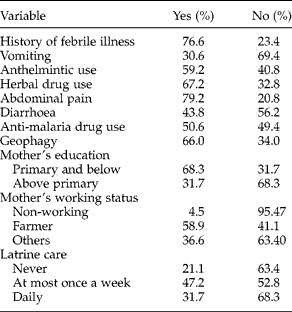
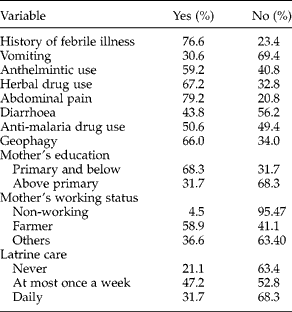
A total of 265 schoolchildren (119 males and 146 females) were selected for the survey. The children were placed in the following three age groups: ≤ 5 years (46), 5.1–9 years (100) and 9.1–14 years (119). Data gathered from the questionnaire are summarized in table 1.
Questionnaire responses (%) in relation to a number of variables ranging from the history of febrile illness to latrine care.
Prevalence of intestinal helminth infections
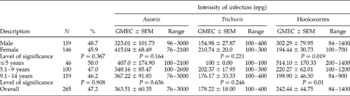
Of the 265 children who provided stool samples for examination, 47.2% (125) were infected with at least one of the soil-transmitted helminth species. Male and female prevalences were respectively 48.7% (58/119) and 45.9% (67/146). Gender did not significantly influence the prevalence of helminth infections (table 2). The highest prevalence of helminth infection, 50.0% (23/46), was recorded in the ≤ 5 years age group. Egg load ranged from 76 to 3000 epg for Ascaris and 100–400 for Trichuris. Ascaris recorded the highest geometric mean egg count (GMEC) ± SEM of 363.51 ± 60.35 (table 2). There was a significant difference (P< 0.05) in the distribution of hookworm egg load in the different age groups and gender. No child was heavily infected with any of the helminth species.
The prevalence (%) and intensity of infection with soil-transmitted helminths as affected by sex and age groups of pupils.

N, Number of children examined; GMEC, geometric mean egg count; SEM, standard error of mean; epg, eggs per gram.
Helminth infection and packed cell volume
Of the 125 children who were infected with intestinal helminths, 47.2% had PCV values < 31%. The mean PCV in each case was lower for helminth-infected than for non-infected children, and this difference was significant for hookworm infection. A significant negative correlation was observed between hookworm egg load and PCV (r= − 0.382).
Prevalence of malnutrition
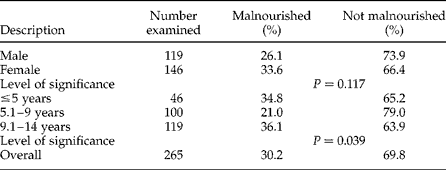
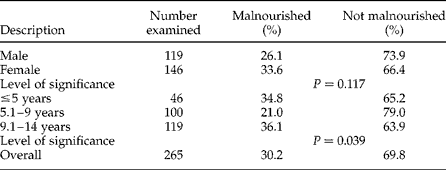
The prevalence (table 3) of malnutrition in schoolchildren in Dibanda stood at 30.2%, with females recording a higher (33.6%), though not significant, prevalence than males (26.1%). Prevalence ranged from 21% in the 5.1–9-year-old age group to 36.1% in the 9.1–14-year-old age group. Age significantly influenced the prevalence of malnutrition in the study population (P< 0.05).
The prevalence (%) of malnutrition relative to the sex and age of children.
Helminth infections and anthropometric indices
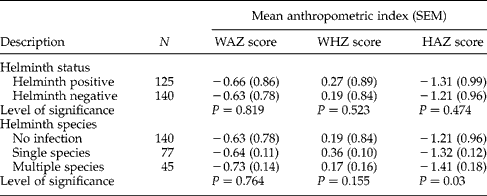
In the entire sample, children who were positive for at least a single helminth infection had lower mean values of HAZ, WAZ and HAZ scores than children who were not infected with helminths. These differences were, however, not significant (table 4). There was a significant difference in the mean HAZ between those who were helminth negative and those who harboured single or multiple helminth infections. Children who were positive for two or more species had lower mean values of WAZ and HAZ than those with single, or no helminth infections. The differences, however, were not statistically significant.
A comparison of measures of growth and nutritional status between helminth-infected and uninfected children.
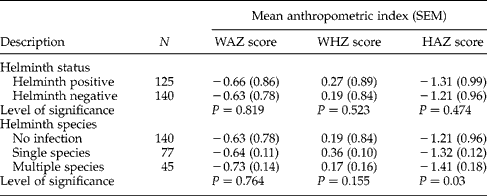
Figures in brackets represent standard error of mean values; N, number of children examined; WAZ, weight-for-age Z score; WHZ, weight-for-height Z score; HAZ, height-for-age Z score.
Malnutrition, helminth infection and packed cell volume
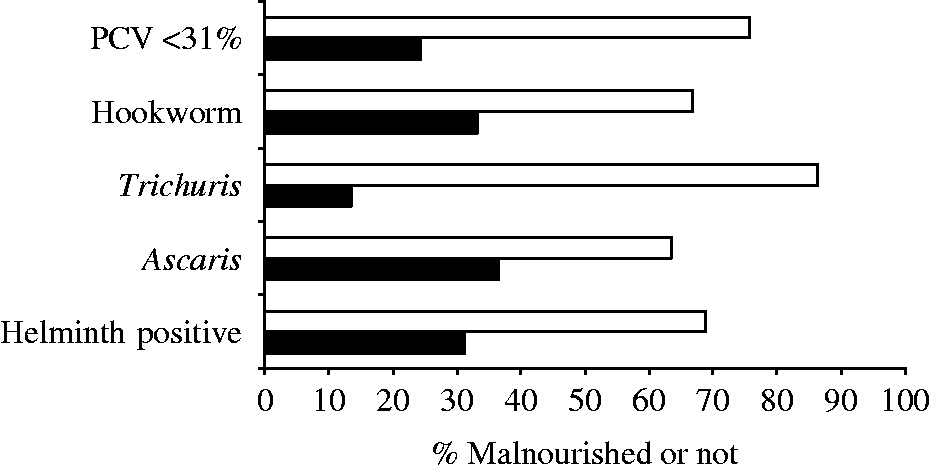
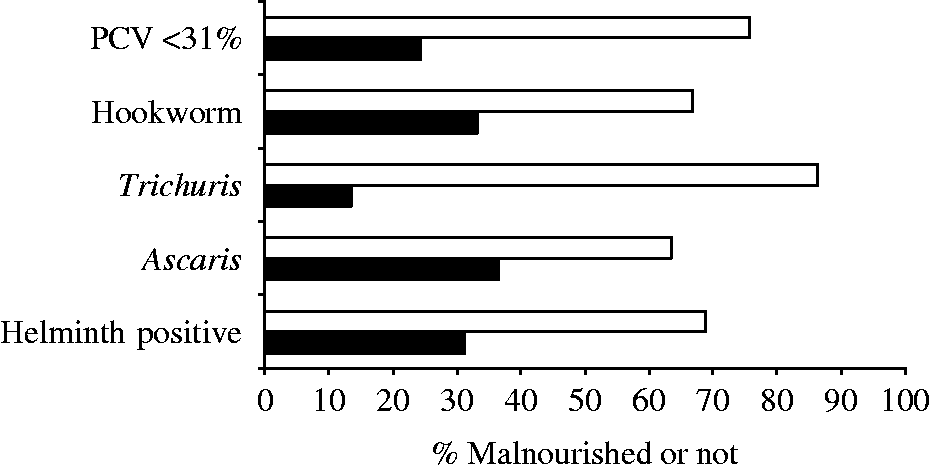
Out of 125 children diagnosed positive for intestinal helminths, 31.2% (39) were malnourished. Most of those malnourished also had PCV < 31% (fig. 1). Mean anthropometric indices were lower in all cases of infection. Although there was no significant difference in the prevalence of malnutrition between helminth-infected and non-helminth-infected children, there was a significant association between the most common parasitic infection, Ascaris, and malnutrition.
Comparison of % malnourished (black) and % not malnourished (white) with respect to PCV < 31%, helminth species and overall helminth status.
Discussion
In this study, 265 schoolchildren in Dibanda were successfully studied. The prevalence of intestinal helminth infections stood at 47.2%. This high prevalence of intestinal parasites is consistent with reports from many indigenous populations in the rural tropics (Hurtado et al., Reference Hurtado, Lambourne, James, Hill, Cheman and Baca2005), including those of Ndamukong et al. (Reference Ndamukong, Ayuk, Dinga, Akenji, Ndiforchu and Titanji2000) and Mbuh et al. (Reference Mbuh, Ntonifor and Ojong2010) in Cameroon. In Dibanda, poor socio-economic status, poor hygienic practices and lack of proper sanitation propagate intestinal helminth infections. Most of the toilets in the schools were poorly sanitized, not equipped with lavatories, and the number of users far outnumbered the available facilities. As a result, some children were forced to defecate in nearby bushes, and failed to wash their hands because of overcrowding around taps or, in some cases, taps with interrupted water supply. These do not only propagate infection but also help children to develop attitudes of poor hygiene which are practised later on in life. Most children (66%) accepted that they will eat or drink soil-contaminated materials. Also, 47.2% reported that their latrines are never washed, while 21.1% have their latrines washed at most once a week.
All helminth infections were of light intensity. All the head teachers reported that their schools are beneficiaries of the free donations of mebendazole by PNLSHI in Cameroon. This occasional deworming could possibly be responsible for the low worm burden. Analysis of questionnaire data revealed that 59.2% of the pupils were occasionally administered anthelmintics. As reported by Hall, hosts tend to be infected for long periods of time with slowly fluctuating numbers of worms and, even if all children in a community are infected, the majority are usually lightly infected (Hall, Reference Hall1993).
Overall, 42.3% of children had PCV values < 31%. There was a significant association (P< 0.05) between hookworm infection and PCV < 31%. Hookworms have a high propensity to feed on blood because of their ability to produce intestinal haemorrhage. Although there was no significant association between low PCV values and the prevalence of Ascaris and Trichuris infections, mean PCV values were lower in helminth-positive than in helminth-negative individuals.
This study revealed that 48.8% of all those infected with intestinal helminths were also malnourished. Helminth infections have been reported to reduce the body's ability to use proteins and absorb fats, thus worsening protein–energy malnutrition. Similar results have been reported in previous studies (Stephenson, Reference Stephenson1991). There was no significant association between intestinal helminth infection and anthropometric indices of short- and long-term nutritional status. These results were similar for multiple species infections and remained when controlling for age and sex. However, there was a statistically significant association between the most common parasitic infection, Ascaris, and malnutrition. There are several possible explanations for these negative consequences of helminths on nutritional status. First, it is quite plausible that all school-aged children living in Dibanda are faced with nearly unavoidable exposure to the infectious stages of intestinal helminth parasites throughout their childhood. In addition, Ascaris, the most commonly encountered parasite in this sample, is often associated with malnutrition. Ascaris infection can lead to nutritional impairment and growth retardation in children because the worm interferes with the absorption of proteins, fats, carbohydrates, vitamin A and possibly other nutrients. Previous research in Cameroon (Ratard et al., 1991) found that Ascaris and other STH infections appear to be endemic all year round, suggesting that children would be continually infected and re-infected throughout childhood. Maternal education has previously been found to be an important risk factor for childhood malnutrition (Sakisaka et al., Reference Sakisaka, Wakai, Kuroiwa, Cuadra, Kai, Mercedes and Hanada2006). In this study, mother's educational level could be an important risk factor for children's growth and development. Most malnourished children (71.3%) had mothers who had not been educated above primary school level. If mothers have a better education and knowledge on health care, they may better understand and implement proper health and nutrition behaviours for their families.
In conclusion, this study established that low-burden helminth infections and malnutrition prevail in school-aged children in Dibanda. Mean PCV values were lower in helminth-infected children and this difference was significant in hookworm infection. Although this cross-sectional study did not find any significant association between helminth infections and malnutrition, suggesting that other factors important in the aetiology of malnutrition also coexist in this locality, mean anthropometric indices were, however, lower in helminth-infected individuals. In consequence, helminth infection is an important factor to consider in the aetiology of malnutrition in helminth-endemic environments.