Introduction
The combination of activities, services and organisations that make up health systems is constantly evolving and changing. As new practices take root older ones will either be actively phased out or be followed by reducing numbers of practitioners. However, there is a marked imbalance between ebb and flow, with new investments outweighing those replaced. In response, calls for greater disinvestment have moved from the periphery to the centre ground of health care design and delivery in recent years, and are now embedded in many prescriptions for evidence-based health care across the OECD (Day et al., Reference Day, Norman and Robinson2016).
A variety of tools and approaches have been developed to support the selection of candidate interventions for removal or replacement (Mayer and Nachtnebel, Reference Mayer and Nachtnebel2015). However, the experience to date suggests that attention is also required to the human elements of disinvestment, and in particular the potential for opposition from stakeholders and wider society (Robert et al., Reference Robert, Harlock and Williams2014; Niven et al., Reference Niven, Mrklas, Holodinsky, Straus, Hemmelgarn, Jeffs and Stelfox2015). Engaging the public, in particular, is often depicted as a necessary step towards major service change of this kind (Dalton et al., Reference Dalton, Chambers, Harden, Street, Parker and Eastwood2015). In practice however, communities have tended to play a peripheral role or else have mobilised in contestatory ways such as through protests or campaigns (Hunter et al., Reference Hunter, Kieslich, Littlejohns, Staniszewska, Tumilty, Weale and Williams2016). Either way, health systems have seemingly been reluctant to genuinely open up decision making to influence from ‘outside’ despite formal requirements to do so. The experience of public engagement has therefore been marked by accusations of both tokenism and manipulation (Harrison and Mort, Reference Harrison and Mort1998). The inherent contentiousness of decisions in which by definition loss is incurred, combined with the availability of strategies for opposition, arguably suggest the need for special attention to engagement and participation.
This study addresses the following questions: do health professionals believe citizens should be involved in decisions to remove or replace health care interventions, and if so why? It reports from an empirical investigation using Q Methodology and in-depth interviews with health professionals working in front line clinical or middle-management roles within the National Health Service (NHS) of England. We adopt Florin and Dixon’s (Reference Florin and Dixon2004: 159) definition of public participation as “the involvement of members of the public in strategic decisions about health services and policy at local or national level”. This broad definition is used so as to reflect the range of potential phenomena referred to by respondents, and therefore encompasses notions of participation, consultation and engagement (Wait and Nolte, Reference Wait and Nolte2006).
The study highlights some apparent contradictions in expressions of support for public involvement, and some tensions in the positions of professionals with regards to participation in disinvestment decision making. Implications for future research and practice in this area are explored.
Involving the public in disinvestment decisions
Disinvestment refers to the act of removing funding from services, treatments and/or technologies, affecting their accessibility to patients. In this respect it overlaps significantly with terms such as: decommissioning (Robert et al., Reference Robert, Harlock and Williams2014), de-adoption and de-implementation (Prasad et al., Reference Prasad, Cifu and Ioannidis2012), as well as more common-sense terminology such as termination, closure or discontinuation. There are a range of possible drivers for disinvestment including: optimising service outcomes; releasing resources for reinvestment, and; balancing budgets. Disinvestment activity can take place at multiple decision making levels including: the macro or health system level; the meso or programme level where funding is prioritised between different specialties or treatments, and the micro or patient level where funding is prioritised between individual patients (Litva et al., Reference Litva, Coast, Donovan, Eyles, Shepherd, Tacchi, Abelson and Morgan2002). In practice, disinvestment can take a number of forms ranging from substitution of services through to full withdrawal (Daniels et al., Reference Daniels, Williams, Robinson and Spence2013).
Developments in the disinvestment field in many ways echo those previously rehearsed in the broader priority setting literature in which implicit (or non-criteria-based) approaches to resource allocation have been rejected in favour of technocratic models driven by assessments of clinical and cost-effectiveness (Goddard et al., Reference Goddard, Hauck and Smith2005). These in turn have been attenuated by increased appreciation of the pluralistic and deliberative requirements of successful decision making. In a similar way, the development of approaches to disinvestment has been accompanied in recent times by calls for engagement with those implicated in and affected by decisions (Mitton et al., Reference Mitton, Dionne, Damji, Campbell and Bryan2011; Robert et al., Reference Robert, Harlock and Williams2014).
The normative case for public involvement in decision making suggests that it can serve a range of functions including: improving decision outcomes and credibility (instrumental benefits); supporting democratic engagement (democratic benefits); and raising awareness of the complexities of decision making (educative benefits) (Williams et al., Reference Williams, Robinson and Dickinson2012). However, operationalising these aims, and realising their associated benefits is rarely straightforward in practice (Wait and Nolte, Reference Wait and Nolte2006). For example, Litva et al. (Reference Litva, Coast, Donovan, Eyles, Shepherd, Tacchi, Abelson and Morgan2002) find that the public wish to be involved in decision making at the system (macro) and programme (meso) levels but are less willing to be involved at an individual level in which treatment access for particular patients is determined. Furthermore, the range of views held by the public can mean that involving them in decision making leads to a protracted process (Lenaghan, Reference Lenaghan1999). Others have argued that the public are either insufficiently informed (Knox and McAlister, Reference Knox and McAlister1995) or excessively self-interested (Bruni et al., Reference Bruni, Laupacis and Martin2008) to contribute constructively to disinvestment decision making.
This combination of challenges, risks and apparent drawbacks may go some way towards explaining the reluctance of system actors to engage their communities in decision making (Stewart and Aitken, Reference Stewart and Aitken2015). For some commentators, engagement has become primarily a ‘technology of legitimation’ serving to consolidate managerial power (Harrison and Mort, Reference Harrison and Mort1998), whilst others suggest a more complex picture in which power and legitimacy are negotiated according to context (Martin, Reference Martin2008). Overall, although public involvement is often seen to be a crucial component of decision making, there are arguments against it (Bruni et al., Reference Bruni, Laupacis and Martin2008), and questions have been raised as to how it has been carried out in practice (Anderson and Florin, Reference Anderson and Florin2000). This study seeks to improve understanding by focussing on the perspectives of health system actors at the meso level in relation involvement of the public in disinvestment decision making.
Setting
Like most publicly funded systems, the English NHS has sought to respond to the challenges posed by an ageing population, new treatments and technologies, and limited funding (Amalberti et al., Reference Amalberti, Nicklin and Braithwaite2016). Financial pressures in particular have intensified in recent years with, for example, 95% of provider organisations reporting a deficit in 2016 (Dunn et al., Reference Dunn, McKenna and Murray2016). This has led to the drawing up of regional transformation programmes involving accelerated processes of change across multiple organisations, with substantial disinvestment planned. However the scale of change proposed combined with a lack of public engagement has prompted senior NHS figures to warn that local communities might ‘sink plans they don’t support’ (Bodkin, Reference Bodkin2016). According to government policy, local communities have a right to be involved in major system change and statutory authorities have a legal duty to consult them (Department of Health, 2012; NHS England, 2015). What’s more, a public poll found that only 17% were happy for such changes to be implemented without them having a say (Ipsos-Mori, 2017). However, the specific requirements of engaging the public in decisions to disinvest in services are not well understood and it is not clear that this responsibility has been fully grasped by the relevant health system actors (Health Foundation, 2016; Taylor, Reference Taylor2017).
Against this backdrop, this paper reports from a study of the key constituencies influencing such processes at local levels of the NHS in England. These include clinical and managerial professionals (or both) in both service provider and commissioner roles. In an English context the term ‘commissioning’ refers to the process of identifying and procuring health care services for a given population. Although Clinical Commissioning Groups (CCGs) are formally responsible for allocating NHS budgets at the local level, in reality they do so in partnership with larger NHS provider organisations and, to a lesser extent, Local Government commissioners of public health and social care. The main sample group for the study is therefore clinicians and managers involved at decision making levels within NHS commissioning and provider organisations will a sub-sample of Local Government commissioners.
Methods
The population for this study was health professionals in front line middle to senior clinical and management roles in health provider or commissioning organisations at the meso level in the English NHS. This group was targeted because it was found that their views were under-represented in the literature (Daniels, Reference Daniels2016) and because it has been suggested that health care leaders have, at times, put in place ineffective and/or tokenistic public involvement processes (Charles and DeMaio, Reference Charles and DeMaio1993; Church et al., Reference Church, Saunders, Wanke, Pong, Spooner and Dorgan2002).
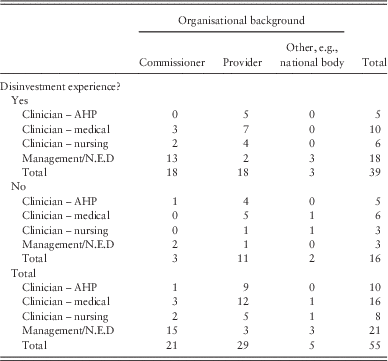
No requirement was set for prior involvement in disinvestment, and recruitment to the study was facilitated by a variety of means including written invitations to senior teams in NHS organisations and to named individuals registered on leadership programmes in the NHS, and snowball sampling based on responses to these invitations (Steelman and Maguire, Reference Steelman and Maguire1999). A total of 219 invitations were made to named individuals, with 55 participants agreeing to take part in the Q study using online Q Methodology software (Jeffares et al., Reference Jeffares, Dickinson and Hughes2012). Details of the organisational and professional backgrounds of the Q study participants are shown in Table 1. All clinicians that took part in the research were practicing at the time of their participation, including those in management positions.
Q study participants

Q Methodology and in-depth interviews were applied in sequence, with the interviews designed to add in-depth exploration of themes and questions arising from the Q study. A sub-sample of participants, selected following analysis of data from the Q study, was invited to participate in a follow-up interview. Recruitment to this second stage ceased when no new substantive themes were being generated (data saturation). This enabled us to explore each of the perspectives identified in the prior Q study. In both stages the focus of data collection was on attitudes towards the involvement of the public in decision making.
Stage one: Q study of health care professionals
Q Methodology uses a standard set of stimuli to assess the views of participants, and, by focussing on the ways that the participants prioritise these stimuli, identifies “patterns of subjective perspectives across individuals” (Steelman and Maguire, Reference Steelman and Maguire1999: 363). There are two main components which make up a Q study: the Q sort and the correlation and factor analysis (Stenner et al., Reference Stenner, Cooper and Skevington2003). A Q sample formed of 42 stimuli (statements) representing the breadth of views and opinions (Webler et al., Reference Webler, Tuler and Krueger2001) related to public involvement in disinvestment decision making was identified. This was compiled based on focus groups of doctoral researchers at the University of Birmingham with an interest in health and social policy research, and unstructured scoping reviews of the academic and popular literature (Daniels, Reference Daniels2016). The final selection was designed to encapsulate perspectives relating to the various benefits and drawbacks of involvement as well as other reasons for and against. The statements used are shown in Annex 1.
The process of Q sorting is defined by Brown (Reference Brown1980: 195) as “a modified rank ordering procedure in which stimuli (the statements) are placed in an order that is significant from the standpoint of a person operating under specified conditions”. In this case participants ranked the stimuli in order of their level of agreement (the specified condition). Based on these rankings, the software placed them into a pre-defined sorting grid (Stenner et al., Reference Stenner, Dancey and Watts2000).
Following factor analysis (Bryant et al., Reference Bryant, Green and Hewison2006), participants were asked to elaborate in open text form on their reasons for ranking the statements at either extreme (Brown, Reference Brown1993). In this way it was intended that the participants would reveal the rationale behind their choices and the considerations which influenced their decision making (Gallagher and Porock, Reference Gallagher and Porock2010; Woods, Reference Woods2011). Factor analysis followed the centroid method employing bi-variate analysis to calculate correlations between Q sorts and to establish where there were areas of strong agreement and/or disagreement between pairs of Q sorts. The level at which bi-variate correlation was considered to be substantial was determined using a standard error calculation (Brown, Reference Brown1993). The calculation was as follows (N=size of Q sample):
 $${\rm Substantial\,/\,significant}\,{\rm correlation}\, {\equals}\, 2.58{\times}\left( {{1 \mathord{\left/ {\vphantom {1 {\sqrt N }}} \right. \kern-\nulldelimiterspace} {\sqrt N }}} \right)\, {\equals}\, 2.58{\times}\left( {{1 \mathord{\left/ {\vphantom {1 {\sqrt {42} }}} \right. \kern-\nulldelimiterspace} {\sqrt {42} }}} \right)\, {\equals}\, 0.398.$$
Groups of Q sorts that are correlated and resemble each other (i.e. ‘factors’) are taken to represent shared perspectives (McKeown and Thomas, Reference McKeown and Thomas1988). Factor analysis therefore reveals the number of factors and how strongly each participant (via their Q sort) correlates with (or ‘loads’ on to) these.
The decision on when to stop extracting factors from the data, and how many factors to extract, was taken on the basis of the Kaiser–Guttman criterion (Guttman, Reference Guttman1954; Kaiser, Reference Kaiser1960), the Total Variance criterion (Kline, Reference Kline1994) and the Two Exemplar criterion (Brown, Reference Brown1980). The solution with the maximum statistically significant and mutually distinct factors was sought. In order to be considered an exemplar, a Q sort should correlate with the factor at a level of >0.398 and only load significantly on to that factor.
A varimax rotation was carried out to reduce confounded participants and increase participant loading on to single factors (Webler et al., Reference Webler, Danielson and Tuler2009). This approach enabled the data to speak for itself (VanExel and DeGraaf, Reference VanExel, Baker, Mason, Donaldson and Brouwer2005), whilst maintaining the integrity of the inductive approach and ensuring that the mathematical variance of the factors was maximised (Watts and Stenner, Reference Watts and Stenner2005; Baker et al., Reference Baker, Thompson and Mannion2006).
Following rotation, a series of factor arrays were produced, showing the ‘ideal Q sort’ for each of the factors and demonstrating how the statements would have been sorted under each factor. The emerging factors were then interpreted following Watts and Stenner’s (Reference Watts and Stenner2012) ‘crib sheet’ approach to ensure consistency.
Stage two: follow-up interviews with a sub-sample of respondents
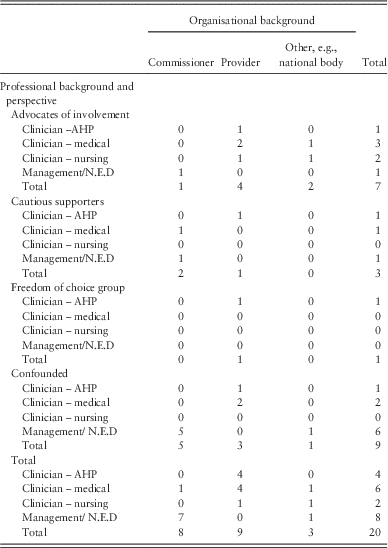
Follow-up interviews were carried out to further explore the Q study findings and their implications for public involvement in health disinvestment decision making. The follow-up interviews sought to explore the perspectives identified in more depth and with additional probing in relation to: extent to which the public should be involved, when within the decision making process and what types of decision require what level of involvement. Participants were provided with three scenarios which described different disinvestment decisions to aid discussion (see Annex 2 for further details). In total, 20 individuals who had previously taken part in the Q study and consented to further involvement were interviewed for the second phase of the research. Details of interview participants’ professional and organisational background, as well as their affiliation with any of the viewpoints identified in the Q study, are included in Table 2.
follow-up interviewees

Interviews lasted between 25 and 80 min and were conducted via telephone at the preference of the respondents. Following transcription, the research team used NVivo10 to code the data and to inductively derive themes structured against the overall study research questions (Robson, Reference Robson2011). The first author led on qualitative data analysis and co-authors I.W. and S.R. reviewed coding of a subset of data. A final coding structure was developed incorporating all qualitative data and results were compared with those from the Q study in order to combine quantitative and qualitative insights into the research questions. This triangulation was employed as means of developing depth and nuance in the overall data analysis.
Research findings
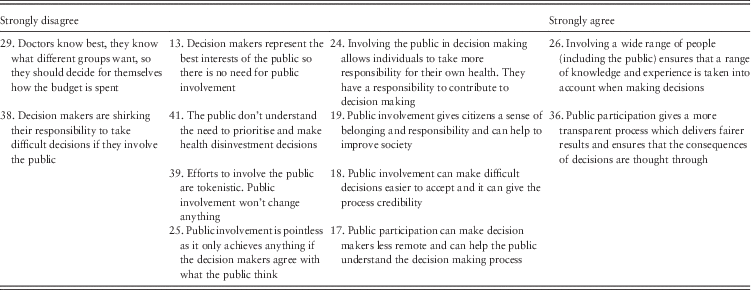
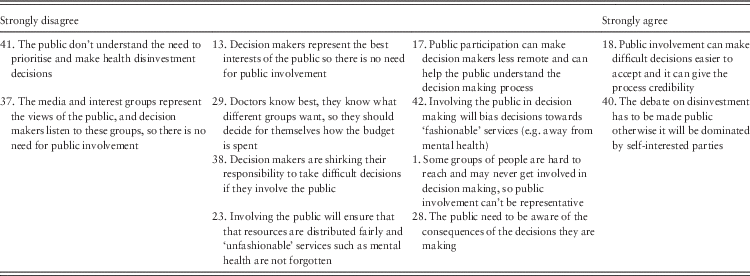
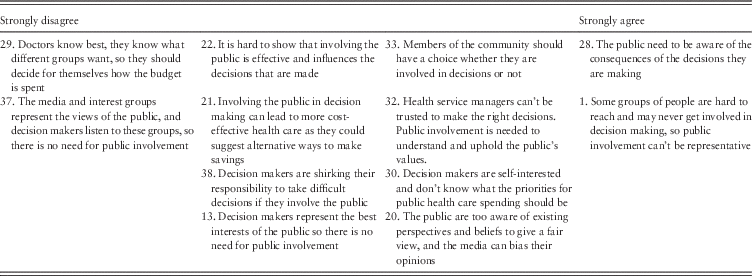
This section presents findings from the two data collection activities in turn. Tables 3–5 shows the statements that were placed at extremes for each of the three unique and distinct factors identified in the Q study. The three perspectives identified from within the sample of Q participants are then described, followed by findings from the semi-structured interviews.
Factor one – ‘advocates of involvement’

Factor two – ‘cautious supporters’

Factor three – ‘freedom of choice group’

In the factor interpretations below, supporting evidence is provided in the form of illustrative, direct quotations from exemplar participants and from the positions at which statements appear in the factor arrays. Statement positions are shown in brackets (statement number, statement position).
Stage one: findings from the Q study
Advocates of involvement
In total, 20 of the 55 participants loaded strongly on to factor one – ‘advocates of involvement’. These included 12 from provider organisations (seven doctors/surgeons, three allied health professionals, one manager and one nurse) and six commissioners (four managers and two general practitioners). The remaining two participants were employed in health and social care commissioning roles in local government. Each of the managers and commissioners cited personal experience of disinvestment ranging from making disinvestment proposals through to delivering associated service changes. Five of the provider-based clinicians reported no direct experience of disinvestment, with six having had experiences in an advisory capacity.
The advocates of involvement viewed public participation in disinvestment decision making very positively, suggesting that it can deliver instrumental benefits. For example, they believed that public involvement would improve decision making because the public “know more what the man in the street wants, they are more in touch with the community” (Participant 34) (5, +1), and because the public could enable fair distribution of resources, even to ‘unfashionable’ services which were not promoted by the media or interest groups (23, +1). This marked the advocates out from the ‘cautious supporters’ (5, −2/23, −3) and the ‘freedom of choice’ group (5, −2/23, −2) who were both notably more sceptical in relation to these benefits. Advocates of involvement had a strong belief that the public had the skills, abilities and knowledge to contribute to decisions that were being taken and were “just as clever and wise as health managers” (Participant 32) (41, −3). In addition to this, advocates of involvement believed that decision makers had a genuine interest in what the public had to say (39, −3) and that “strong public opinion can affect changes in decision makers” (Participant 8) and sway their thinking (25, −3).
Advocates of involvement argued that “the more people are involved the fairer the decisions and the more transparent the process is” (Participant 48) (36, +4), and that a fair process would likely lead to a fair outcome. This was based on further instrumental benefits to the credibility of the disinvestment enterprise, for example by making it “easier for people to accept decisions that have been made in an open and transparent process” (Participant 19) (18, +3).
To these were added educative and democratic benefits as illustrated by comments such as: “the more an individual is involved the more literate they will be” (Participant 18) (17, +3) and building “a sense of shared ownership and responsibility and a sense of empowerment and being part of a whole” (Participant 20) (19, +3). The perspective suggests that these stakeholder groups could add a wealth of knowledge and experience which neither decision makers (13, −3), who “operate in a centrally controlled system which is not democratically accountable” (Participant 2), nor doctors (29, −4), could offer in isolation. Advocates of involvement strongly disagreed that, by involving the public, decision makers would be hiding from their responsibilities to take decisions (38, −4). Indeed, they suggested that decision making was “a shared responsibility” (Participant 20) and that “decision makers are taking responsibility for good governance by involving the public” (Participant 32).
Advocates of involvement agreed that the public could overlook self-interest and “can be trusted to make sensible decisions and choices” (Participant 9) (9, 2) and that this was not hampered by being too aware of existing perspectives (20, −1). This viewpoint was in contrast to both the cautious supporters (9, −1/20, 1) and the freedom of choice group (9, −2/20, 3) who were more sceptical of the public’s ability to be impartial.
Cautious supporters
In total, 11 non-confounded Q sorts loaded strongly on to factor two – cautious supporters. Six of these worked as managers including four from commissioner organisations and two from provider organisations. All of the commissioners, and one of the provider managers who worked in a secondary care organisation, had some experience of disinvestment. This ranged from acting in an advisory capacity, to leading disinvestment and service changes. The remaining five exemplars were clinicians in provider organisations (three medics, one AHP and one nurse). Each of these, bar one, had experience of disinvestment including as part of pathway re-development.
In contrast to the idealism of the advocates of involvement, cautious supporters took something of a tactical approach. For example, they recognised that it was necessary to open the debate up to the public because otherwise, other interested parties would have disproportionate influence. Cautious supporters were broadly supportive of public involvement in disinvestment decision making because of the benefits that it could deliver in making the public more accepting of decisions; “informed consent creates an environment for logical, fair changes” (Participant 12) (18, +4). Cautious supporters believed that the public were not in a better position than doctors or managers to decide how money should be spent; the public “do not have the wider view of public interest, most, but not all, will be guided by what’s important to them” (Participant 14) (4, −4). Despite this, doctors and managers were not considered to be in a position to take decisions on their own (13, −3/29, −3). For example, one noted: “doctors are experts in their own areas, but are not disinterested in the funding for their own services or special areas of interest” (Participant 50). In light of this, the perspective suggested that decision makers had a responsibility to involve the public and, by doing so, were “ensuring that everyone’s views are listened to” (Participant 25) (38, −3). They believed that the likelihood of public acceptance of decisions would increase if they knew and understood the process (17, +3).
Whilst cautious supporters acknowledged these benefits, they also highlighted perceived limits to representation, citing “the usual suspects with the usual agenda that get involved whilst others (particularly in deprived areas) simply do not have a loud enough voice” (Participant 7) (1, +3). They also warned that the public could be swayed towards a preference for ‘fashionable’ and high profile services, “the public focus of questions is predominantly on acute hospital services” (Participant 37) (42, +3), and that involving the public might compound inequities between service areas (23, −3).
One of the statements that distinguished cautious supporters from the other two factors related to the importance of economic evidence. This foregrounding of cost-effectiveness implies that cautious supporters would take a more utilitarian view of disinvestment, believing that “value for money is the way to select the most appropriate service” (Participant 14) (34, +1). By contrast the freedom of choice group (34, −2) and the advocates of involvement (34, −2) both felt that public opinion should take precedence over cost-effectiveness analysis.
Despite their overall support for involvement, the cautious supporters were sceptical as to whether the public were well enough informed to make health disinvestment decisions (31, +2), again in contrast to the advocates of involvement. The freedom of choice group were neutral about whether the public were sufficiently well informed to contribute (31, 0) but, their distrust of health service managers (32, +3) suggested that, from their perspective, the only way to ensure that public values were understood and upheld was to involve them.
Freedom of choice group
Two Q sorts loaded onto factor three – freedom of choice group. Both were working as allied health professionals in provider organisations and both had experience as clinical leads for their services of being required to identify options for disinvestment.
Similarly to the cautious supporters, the freedom of choice group were broadly supportive of involving the public, who, they said, could “act as a critical friend” (Participant 47) in disinvestment decision making. The freedom of choice group were, however, champions of informed choice and felt that the public should be able to decide for themselves whether or not they became involved (28, +4/33, +3).
The freedom of choice group felt that “it is impossible to engage with the whole community” (Participant 55) (1, +4), thus questioning whether public involvement could be representative. Despite this they suggested that involvement should still be sought as health service managers and decision makers were self-interested (30, +3) and did not “always have the (needs of the community) at the centre of their decision making processes” (Participant 55) (32, +3/13, −3).
The freedom of choice group suggested that involving the public could have “both a knowledge building and influencing impact” (Participant 47) (22, −3), but they did not agree that public involvement could deliver innovation or more cost-effective outcomes (21, −3). It could therefore be suggested that the freedom of choice group viewed public involvement as an end in itself and that they were less concerned with the instrumental benefits it may offer.
Similarly to the other factors, the freedom of choice group demonstrated a distrust of the media and interest groups (37, −4) and questioned the public’s ability to take all arguments and evidence into account when involved in disinvestment decision making (20, +3). Despite this mistrust, the freedom of choice group suggested that ‘doctors do not know best’ and that managers’ decision making was “based around money and wholly money” (Participant 55) (29, −4/32, +3). The freedom of choice group suggested that decisions should be taken by a “number of health care professionals” (Participant 55) and that decision makers would not be shirking their responsibilities if they involved the public (38, −3).
Whilst advocating for public involvement, the freedom of choice group suggested that political will would influence decisions and that even with involvement, decisions would depend on what politicians wanted (16, +2). Both the advocates of involvement (16, −2) and the cautious supporters (16, −1) disagreed with this, suggesting that they were more confident that involvement could have an impact even if the public and politicians were in disagreement.
Whilst the advocates of involvement (18, +3) and the cautious supporters (18, +4) agreed that involving the public could make difficult decisions easier to accept and could give the process credibility, the freedom of choice group remained neutral (18, 0). The freedom of choice group (36, −1) also disagreed with the advocates of involvement (36, +4) and the cautious supporters (36, +1) as to whether public involvement added transparency to the process. The freedom of choice group maintained that involving the public did not necessarily make the decision making process transparent; potentially explaining why they did not agree that a process with public involvement was always more credible.
Stage two: findings from follow-up interviews
Follow-up interviews enabled us to probe more deeply into the views of each of the factors. Advocates, cautious supporters and freedom of choice groups were all given the opportunity to elaborate on their views and to apply these to concrete examples either from their own experience or as prompted by the three example decisions (Annex 2). This section presents findings from the interviews focussing on the benefits identified and how these related to the views expressed in the Q study.
Instrumental motivations
When asked to elaborate on the instrumental benefits of involvement, advocates pointed to specific impacts that could be had. For example, one participant suggested that public involvement can “help shape and deliver services that respond better to customers’ needs” (Participant 39 – Management/N.E.D, Commissioner). Participants believed that the public could be a useful source of information, offering new perspectives on disinvestment problems and the allocation of limited funds. Interviewees felt that meeting the challenge of disinvestment required service integration and the establishment of new care pathways and felt that involving the public and enabling them to influence disinvestment decisions may support this integration.
I think that [by involving the public] you might get a challenge to rather deeply-embedded clinical silo thinking (Participant 16, Management/N.E.D, Commissioner).
Participants also suggested that this may, in turn, help to improve organisational efficiency, improve quality and deliver efficiency.
More commonly, interviewees described benefits in terms of in the credibility of both decision makers and decision making organisations in the eyes of the public, and that involving citizens could give them confidence that decisions were being made in their best interests:
At the minute it all happens behind closed doors I suppose. So by being more involved with it they might be more confident in it and the fact that they’ve been part of the process (Participant 27, Clinician – AHP, Provider).
If you get better understanding you may get better co-operation with the final decision (Participant 4, Management/N.E.D, Commissioner).
I think that if you don’t get people on board with that decision, involve them with that decision, then you are going to lose out (Participant 43, Clinician – Medical, Other).
Interviewees suggested that public involvement would increase the chances of successfully implementing disinvestment decisions because the public (and those working within the service) would be more likely to abide by the decision that had been taken.
The format for the interviews – involving scenario decisions and probing of answers – uncovered doubts over the supposed instrumental benefits of public involvement as well as concerns regarding tokenism. For example, where expectations were artificially raised, it was felt that this could risk eroding public trust in decision making organisations.
minimal involvement and almost tokenistic attempts are worse than doing nothing at all. The trouble is that you have that knock-on effect (Participant 38, Management/N.E.D, Commissioner).
Others felt that the public often held strong views about disinvestment based solely on a service’s reputation, and that as a result public involvement could allow unfounded views to unduly influence the outcome of a decision making process:
If something has a very strong reputation or if there is a very strong community group influence then sometimes their voice can be so strong that it can go against whether or not a service is really good. So, for example, if something is not proven to be effective but a group very strongly wants to keep it open, it’s almost impossible in some ways to decommission it (Participant 17, Clinician – Nursing, Provider).
These comments – coming equally from the advocates as from the cautious supporters – suggest a more nuanced and ambivalent appreciation of the instrumental benefits than was communicated in the Q study.
Educative motivations
Interviewees again identified ways in which involvement may serve to educate the public on appropriate use of services: it was suggested by one participant, for instance, that public involvement can:
lead to better environments for patients and also a better understanding of what services can be used for – ED, primary care, pharmacy, they [patients] are still not using them to the fullest extent or some in the right ways (Participant 31, Management/N.E.D, Other).
By extension it was suggested that involvement could engender greater public understanding of why disinvestment was required, as well as educating them on how to most effectively influence decision making.
I think there is a need to slowly manoeuvre the public into that territory of understanding that, unless you are prepared to pay a lot more tax, or make some stark choices around less public spending in other areas of public services there are choices to be made (Participant 39, Management/N.E.D, Commissioner).
Whilst knowledge levels amongst most of the public were thought by interviewees to be conducive to involvement, some participants identified potential bias towards popular or high profile services. The educative benefits of public involvement were thought to be particularly important and relevant in managing these views. Others felt that the risks to less popular services were too great to warrant public involvement:
You can pretty much guess who [public involvement] would affect – Sexually Transmitted Disease clinics, patients that were IV drug users and alcohol abusers, smokers, obese people. All the things that people perceive ‘oh they’ve brought it on themselves’, they would start losing their services … all the sorts of things that are in the media that are perceived to be something that they have brought upon themselves would be the services that you would see decline and that really worries me (Participant 24, Clinician – AHP, Provider).
It was also suggested that the public should not be involved in disinvestment decision making because they did not place enough importance on safety:
If it’s the general population, sometimes their perception of the service is different to if you are actually involved in it or receiving it and then you understand the complexity more. We have had publics championing keeping services open when, in actual fact, that is advocating for unsafe provision (Participant 9, Clinician – Nursing, Other).
By contrast some interviewees suggested that the public were able to offer a measured and balanced perspective:
I do think that people have the ability to be objective. People are always affected by their own personal circumstances or what is affecting their family but they are grown up and I think that they are aware of things on a slightly more complicated level (Participant 43, Clinician – Medical, Other).
If we can put things in plain language then most people can get their heads round the issues and that’s my personal reflection on interactions with the public when I’ve been information giving (Participant 39, Management/N.E.D, Commissioner).
Overall the interviews suggest a greater emphasis on educative benefits – vis-à-vis instrumental benefits – than was apparent in the Q study, albeit some respondents felt no amount of ‘education’ would render the public amenable to disinvestment proposals.
Democratic motivations
In interview, some respondents re-asserted the democratic right of the public – as funders of health care – to have a say:
The taxpayer’s money is being used for the benefit of the public. It’s a finite amount, and I think that there should be ways of getting greater public influence over how that money is spent, as a principle (Participant 16, Management/N.E.D, Commissioner).
However, this perspective was voiced relatively infrequently and was countered by concerns over representativeness:
We don’t have any representation from… actually if I twist it round and tell you the ones that we do have: we have retired, middle-class, white females (Participant 30, Management/N.E.D, Commissioner).
Public consultations always seem to me to involve white, middle class people who have the means to participate in the NHS by providing themselves with a taxi or providing themselves with a relative who’s got a car or whatever (Participant 24, Clinician – AHP, Provider).
The focus afforded by the interviews on respondents’ own experiences uncovered some difficult and sometimes distressing experiences of the public involvement process. These ranged from verbal attacks from angry participants to aggression between protagonists that had on one occasion required police intervention. This was an important check on the sometimes benign picture of ‘democracy’ implied in prescriptions for public engagement. Others highlighted conflict in their own experiences of discussing disinvestment with members of the public. One participant described…
…a call to arms to say ‘they’re shutting our service,’ (Participant 23, Clinician – Medical, Provider).
Another recalled an instance where, following a disinvestment in a neighbouring service, they…
…had a patient come into clinic the other week who was literally shouting at me (Participant 27, Clinician – AHP, Provider).
Both of these instances indicate a more equivocal position than portrayed in the first round of data collection.
Modified advocacy of involvement
Overall the interviews were notable for introducing a softening or qualification of the advocates of involvement perspective that featured prominently in the Q study. Data from interviewees that had previously loaded onto this factor revealed greater levels of ambivalence and it is likely that this was in some part due to their reflecting both on the scenarios and on their own experiences as recounted above. This engendered a more ambivalent strain to their responses. One advocate of involvement, for example, still supported public involvement but cited an additional requirement to represent their organisational interests:
If I went to a meeting I am speaking not as myself, but as an employee of an organisation and I’ve got their mission statement and anything I say I can only say with their authority (Participant 17, Clinician –Nursing, Provider).
Advocates were also more inclined to note practical constraints, citing for example the burden of time and resource required for engagement. The responses of the advocates of involvement would suggest that they viewed public involvement in somewhat abstract terms in the Q study but took a more realist perspective in the interviews. The change of focus from the ‘whether’ to the ‘how’ of engagement appeared to undermine some of the ideals previously expressed. One participant, for instance, was supportive of involvement but stated that…
…you shy away from doing it because you don’t feel confident and it’s difficult (Participant 43, Clinician – Medical, Other).
Discussion
The study was designed to investigate the perspectives of health system actors at the local level – including clinical and managerial leaders and decision makers – in relation to the participation of the public (citizens) in decisions to disinvest in medicines, services and organisations. The study took place against a backdrop of increased rates of planned disinvestment in the English NHS and the statutory requirement for such activities to involve citizens and communities. With public involvement previously seen as being weak or tokenistic in studies of health care, it is clear that a better understanding was required of the attitudes, experiences and motivations of those in key health system roles. Through an initial Q study we were able to identify three broad perspectives (‘factors’) on the topic and to explore each of these in more depth using follow-up interviews.
The Q study showed that the positive case for public involvement in disinvestment decision making was understood and shared by the majority of participants irrespective of their specific role within the system. Respondents articulated a range of potential drivers and benefits of involvement ranging from improvements to decision making through to gains in democratic accountability and acceptability of decision outcomes. Whereas advocates of involvement adopted an aspirational and highly normative view of public involvement (Hands, Reference Hands2012), cautious supporters and the freedom of choice group felt there to be drawbacks. Cautious supporters were apparently more inclined to think about the practical implementation of engagement and to emphasise the potential gains to the system (and to themselves) of a supportive and acquiescent public.
The potential drawbacks and negative effects of public involvement came to the fore to a much greater extent in the follow-up interviews. Many of those in the advocates of involvement group in the Q study reverted to a cautious supporter position when asked to consider specific examples of disinvestment (either hypothetical or from their own experience). The focus shifted almost entirely to the strategic or pragmatic value of public engagement – for example in reducing the rates of subsequent challenge and opposition to disinvestment – and interviewees were more inclined to emphasise the risks, limitations and costs (rather than the benefits) of involving citizens in decision making.
These findings help to unpick the apparent disjuncture observed between bold statements of purpose that often emanate from the system – for example in relation to plans for consultation and shared decision making – and the realities of engagement strategies that are often highly bounded, peripheral and under-resourced. To the extent that our results provide a possible insight into wider practices, they suggest a gap between an abstracted aspiration to engage, and a reality in which risk aversion, competing priorities and system constraints often crowd out these ideals. The study supports claims that approaches to public engagement in health care are often simplistic and fail to take into account the inherent heterogeneity of communities and the need for multiple approaches at different stages of decision making.
More importantly in the context of disinvestment decision making, the study suggests that greater thought and planning is required as to the specific forms of engagement required when decisions are likely to be contentious and/or opposed. The responses of our participants appear to be predicated on a conception of engagement in which the public are intended to support and inform – rather than challenge – decision making (referred to by Greer et al. (Reference Greer, Stewart, Wilson and Donnelly2014) as ‘volunteerism’). The levels of ambivalence expressed, especially during follow-up interviews, reflect, in part, respondent fears that public input might take an adversarial form. Rather than treating this as a legitimate and even predictable response, it was treated as something to be avoided. That the subsequent retreat from an advocacy position appears in our study to represent a combination of naivety and ‘volunteerism’ (rather than conscious manipulation) does little to protect against the accusation of tokenism (Harrison and Mort, Reference Harrison and Mort1998). Given the importance of establishing trust in public engagement, this in turn threatens future attempts to engage citizens in ‘constructive conversations’ (Gilson, Reference Gilson2003; Marinker, Reference Marinker2006).
The implications of these deficits are that, assuming public engagement in disinvestment decision making cannot be avoided, new approaches are required. Clearly, public attitudes to disinvestment in health care services are unlikely to be improved by rhetoric extolling the many benefits of public engagement when the reality is marked by competing pressures, volunteerism and risk aversion. Participation is required that allows for the expression of discord and emotion alongside consensus-building and rational argument. In this, insights may be drawn from approaches implemented in other settings. These include, for example, social care where longer-term public engagement programmes have seen the gradual reframing of current care models as being outdated and superseded. This has been shown to help increase acceptance of closure of care homes by local authority social services departments (Robinson et al., Reference Robinson, Glasby and Allen2013). In areas such as transport and renewable energy, where public opposition is often mobilised against the introduction of new schemes, it has been shown that engaging with communities who disagree can lead to more stable and supported policy outcomes (Stewart and Aitken, Reference Stewart and Aitken2015). This suggests the need for approaches to engagement that seek to work with conflict and disagreement, rather than avoiding oppositional views or dismissing them as either partial or unrepresentative.
The study also has implications for the research methods employed to explore such issues. As noted, respondents in interviews appeared more inclined to voice complexity, doubt and ambivalence, and this had the effect of uncovering higher rates of negativity with regard to the effects of involvement. This points to the need for research which enables ambivalence and contradiction to be expressed and explored. In our study, a two-stage study design and the use of example scenarios were crucial in facilitating this. The Q study addressed the research question – should the public be involved and why – in something of a vacuum, which may have encouraged somewhat aspirational or idealised responses. By contrast, interview discussions were anchored in the scenarios and prior experience. This, and the opportunity afforded for reflection between the two stages of the study, appears to have led participants to contextualise the questions and to consider practical implementation issues in more detail. This has implications for the selection of future study design between options stripped of immediate context and those embedded in the lived experience of participants.
This is the latest of a growing number of studies that have employed Q Methodology to investigate attitudes towards resource allocation decisions in health care (Baker et al., Reference Baker, Wildman, Mason and Donaldson2014; VanExel et al., Reference VanExel and DeGraaf2015). Our application of the method appears to have generated a somewhat ‘surface’ account of participants’ perspectives, which were then reflected upon and challenged in the follow-up interviews. We do not view this as an indication of an inherent flaw in Q Methodology when applied to this sort of question. It does however underline the importance of gathering as wide a Q sample as possible. Participants in Q studies are restricted by the stimuli available for them to sort (Cross, Reference Cross2004), and therefore if the Q sample does not fully reflect their views, or capture their preferred response to the questions posed, then the follow-up interviews may be functioning as a corrective to these limitations.
The study suggests additional learning for future application of the Q Methodology technique. Our application only afforded participants the opportunity to explain their positioning of the two statements that they agreed and disagreed with most strongly; there was no opportunity to comment on or explore the rationale for how any of the other statements were positioned. As the study took place online with no researcher present, there was no opportunity to ask participants to go into further depth at the time when they gave their reasoning (apart from in open text boxes), and no opportunity for participants to clarify the meaning of the statements. This lack of proximity is one of the reasons why some practitioners suggest that Q Methodology is better carried out face to face (Previte et al., Reference Previte, Pini and Haslam-McKenzie2007). It is also possible that without a researcher present, participants rushed the final section of the Q study and failed to offer as much detail as they would in a face-to-face session, seen by many researchers as being the best way to ensure ‘authentic’ research outcomes (Seymour, Reference Seymour2001).
The study has some other notable limitations. One of these relates to participants being required to define public involvement for themselves (although there was an opportunity to clarify understanding in the interviews); this may have meant that there was some difference in the understanding of public involvement between the participants. Another limitation relates to the freedom of choice group in the Q study analysis which had just two exemplars. As a result we have granted this aspect of the study findings only marginal attention within this paper, and we recommend future research explores this perspective in greater detail.
Our overall approach to sampling was informed by our primary concern to investigate the perspectives of clinical and managerial system actors in positions of relative seniority in the English NHS. This meant that the study does not address questions including to what extent and in what ways the public and other stakeholders would wish to be involved, if at all. The study encompasses decisions made at macro, meso and micro levels, but did not distinguish between those led by commissioners and providers. We again offer these as a candidate topic for future empirical inquiry, building on cognate studies already published (e.g. Litva et al., Reference Litva, Coast, Donovan, Eyles, Shepherd, Tacchi, Abelson and Morgan2002).
Conclusions
Although the health care leaders and decision makers in this study supported public involvement in disinvestment decision making, the rationale for this appeared to shift from advocacy of shared decision making to an approach aimed primarily at increasing the credibility of the decision making process and softening public opposition. This would appear to reflect a characterisation of involvement as legitimation, and suggests that the normative case for public involvement is sometimes over-ridden by considerations of risk aversion, volunteerism, self-interest and practical constraint. In the context of disinvestment decision making where scrutiny of the probity and processes of decision making is often extremely high, this is likely to increase rather than alleviate the challenges. Future research should seek to further explore the role that the public should play in disinvestment decision making as well as exploring their perceptions of disinvestment and future practice should embrace the full range of engagement modes and forms, including those compatible with decisions for which opposition is likely to be encountered.
Acknowledgement
Tom Daniels received a Universitas 21 Studentship in order to carry out this research.
Annex 1: Q sample statements

Annex 2: Disinvestment scenarios
Participants were presented with the following scenarios and were asked to consider the role that public involvement in each of them:
-
(i) a national decision by NICE to decrease the number of IVF cycles funded for couples by the NHS (e.g. reducing the limit from three cycles to one)
-
(ii) downgrading a local A&E department to an urgent care centre which would not be able to accept the most serious cases, e.g., major trauma
-
(iii) a decision to replace consultant led outpatient Dermatology clinics delivered in a hospital setting with community based Clinical Nurse Specialist Clinics
For each of these scenarios:
-
1. What role should the public have?
-
2. How should we involve the public and at what stage?
-
3. How much influence should the public have over the final decision?