


1. Introduction
During the last two decades we have witnessed tremendous advances in computing power and data collection capabilities accelerating and transforming how science and technology progresses with astrophysics being significanlty impacted by this progress. The operation of new scientific instruments such as the JWST pose new challenges to our ability to extract knowledge from unprecedented vast volumes of collected data. The Astroinformatics discipline, which employs Deep Learning (DL), big data management and distributed computing for serving astronomy’s goals, has emerged as a result of this wave of scientific evolution. In particular, the ability of deep learning algorithms, which are based on neural networks, to extract knowledge directly from raw data, without sophisticated preprocessing, along with their performance behaviour, which gets significant improvements with larger and larger datasets, make them ideal for being deployed in astroinformatics. Thus, neural networks have been extensively applied for gravitational wave detection Nousi et al. (Reference Nousi, Koloniari, Passalis, Iosif, Stergioulas and Tefas2023), for light curve classification using the transformer-based Large Language Models Li et al. (Reference Li, Bai, Wang, Qu, Lu, Soria and Liu2025), and even for detecting possible signs of technological activities from nearby stars Ma et al. (Reference Ma, Ng, Rizk, Croft, Siemion, Brzycki, Czech, Drew, Gajjar, Hoang, Isaacson, Lebofsky, MacMahon, de Pater, Price, Sheikh and Worden2023).
In cosmology, the creation of galaxy catalogs is a significant goal related to questions concerning the origin, age and evolution of the Cosmos. Morphological classification of galaxies is maybe the most basic information when creating these catalogs and comprises an important steps to study the formation, structure and evolution of galaxies. Starting from the famous Hubble classification system Hubble (Reference Hubble1936) to more detailed classification systems e.g., de Vaucouleurs, the aim of these efforts is to classify galaxies into one of (sub)categories, usually in a probabilistic manner. Various methods have been applied/devised for achieving this goal; photometric-based, pure image-based, and so on. We focus here on computerized learning-based techniques; for instance Mukundan et al. (Reference Mukundan, Nair, Bailin and Li2024) uses a machine (but not deep) learning-based method for performing the classification, namely k-nearest neighbors. Barchi et al. (Reference Barchi, de Carvalho, Rosa, Sautter, Soares-Santos, Marques, Clua, Goncalves, de Sa-Freitas and Moura2020) investigated the performance of two somewhat outdated neural architectures, namely ResNet and GoogleNet Goodfellow et al. (Reference Goodfellow, Bengio and Courville1916) along with a decision tree and Support Vector Machine; Cao et al. (Reference Cao, Xu, Deng, Deng, Yang, Liu and Zhou2024) used a vision transformer, but they worked on a five-class classification task, which apparently is a less challenging relatively, since the complexity of the task increases with the increase of the number of classes. Variawa et al. (Reference Variawa, van Zyl and Woolway2022) investigated transfer learning but for the purposes of comparing and combining crowd-sourcing to more traditional methods in galaxy classification.
In this article, we focus exclusively on deep learning algorithms, namely convolutional neural networks, transformer-based neural networks and transfer learning for performing morphological classification of galaxies, while deploying minimal image preprocessing. We wish to investigate a) whether these methods can reap significant performance gains with a few training rounds and b) also the impact of techniques such as early stopping, which further accelerates the training on the performance.
The rest of this paper is organized as follows: section 2 describes the deep learning neural architectures we have implemented and evaluated and section 3 describes the datasets used to evaluate these methods. Section 4 presents and explains the results obtained and finally, section 5 summarizes our findings and concludes the article.
2. Deep learning algorithms
We implemented and evaluated several convolutional neural networks (CNNs); some baseline ones, namely the AlexNet Goodfellow et al. (Reference Goodfellow, Bengio and Courville1916), more advanced ones, namely a VGG family member, some pretrained models and a transformer. AlexNet is comprised by eight layers: the first five are convolutional layers, some of them followed by max-pooling layers, and the last three are fully connected layers. Our VGG variant has a total of four convolutional layers with  $3 \times 3$ kernel filters, two 2D pooling layers with
 $2 \times 2$ kernel filters, and two fully connected layers. The activation function throughout the hidden layer is ReLU, in the first fully connected layer, the activation function is ReLU while in the second layer the activation function is SoftMax. The pretrained models include EfficientNetB3 and a pretrained VGG-16 model. EfficientNetB3 is a CNN that employs Mobile Inverted Bottleneck Convolution blocks, including depthwise separable convolutions with varying kernel sizes (
 $3 \times 3$ and
 $5 \times 5$), and Squeeze-and-Excitation (SE) blocks for feature extraction; it has a
 $300 \times 300 \times 3$ input shape, a depth of 210 layers. VGG16 has thirteen convolutional layers, five Max Pooling layers, and three Dense layers, which sum up to 21 layers, but it has only sixteen weight layers, i.e., learnable parameters layers. Our pretrained models were trained on the ImageNet dataset. Our deployed Vision Transformer (ViT) is the classic one reported in Dosovitskiy et al. (Reference Dosovitskiy, Beyer, Kolesnikov, Weissenborn, Zhai, Unterthiner, Dehghani, Minderer, Heigold, Gelly, Uszkoreit and Houlsby2022).
3. Dataset and evaluation setting
The Galaxy Zoo (GZ) project invited volunteers to classify galaxies from the Sloan Digital Sky Survey based on the morphology of the given color images Lintott et al. (Reference Lintott, Schawinski, Slosar, Land, Bamford, Thomas, Raddick, Nichol, Szalay, Andreescu, Murray and Vandenberg2008). Subsequently, a Kaggle competition centered around the GZ was developed. This paper uses the dataset from the GZ project available on the Kaggle platform, which has been used by other studies as well, e.g., Cao et al. (Reference Cao, Xu, Deng, Deng, Yang, Liu and Zhou2024); Variawa et al. (Reference Variawa, van Zyl and Woolway2022). In particular, our dataset contains 61578 images of JPG format for training, and 79975 images of JPG format for testing purposes. There is a solution file of training images that shows the probability distribution for each image. We performed minimal preprocessing, simply to reduce the size of each image. The original shape of each image is ( $424 \times 424$) while taking advantage of the fact that the point of interest is at the center, we just crop and downsampled the images. The final shape of each image became (
 $60 \times 60$).
We used as loss function the Binary Cross Entropy and the Adam optimizer with learning rate equal to  $0.001$.
4. Classification results
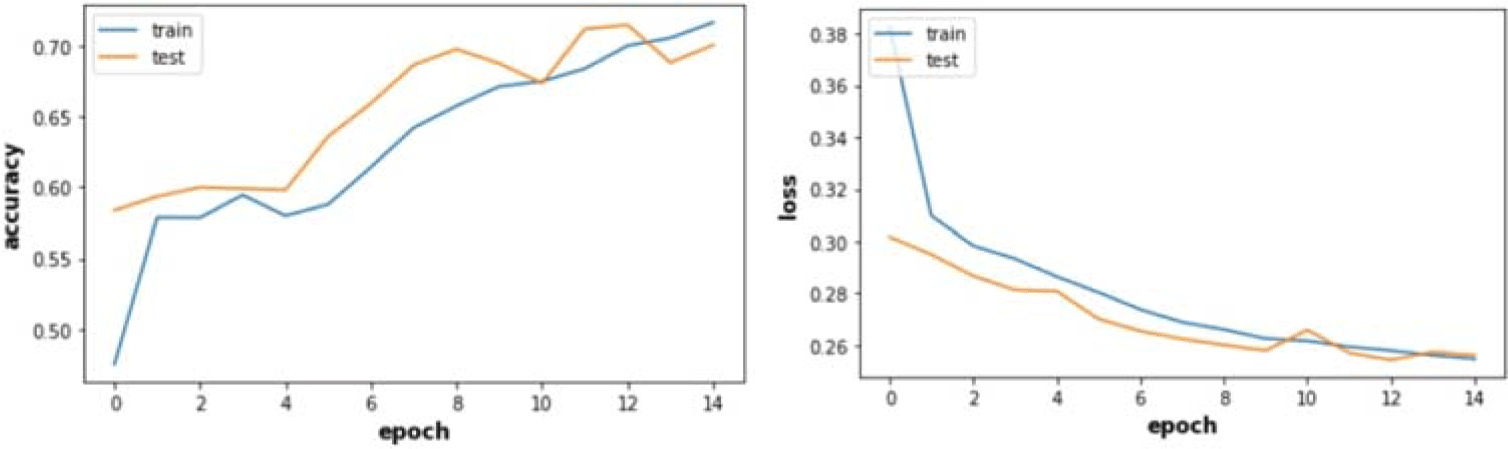
Our first observation is that the loss for all our architectures reduces exponentially fast (neither linearly, nor step-wise). We show it only for AlexNet (right plot of Figure 1). This is an encouraging fact, since it implies that we can get very good performance in the first few rounds of training.
AlexNets’ performance: (left) accuracy (right) loss.

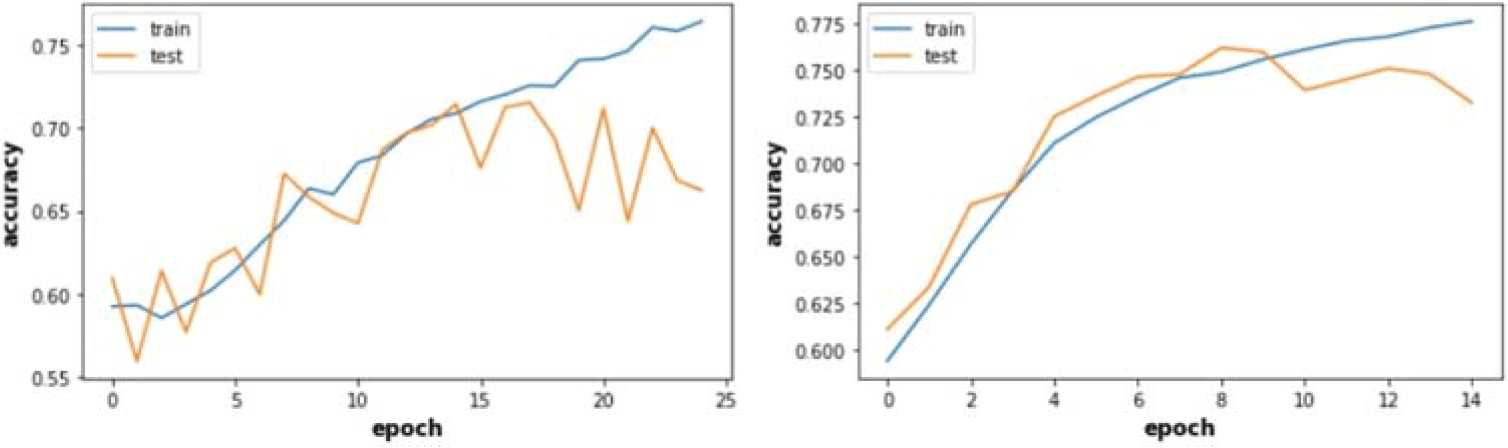
Our second observation concerns issues of overfitting. As it can be seen in Figure 2, the technique of early stopping is very beneficial by improving the test accuracy and on the other hand improving convergence.
VGG’s accuracy (left) without early stopping, (right) with early stopping.

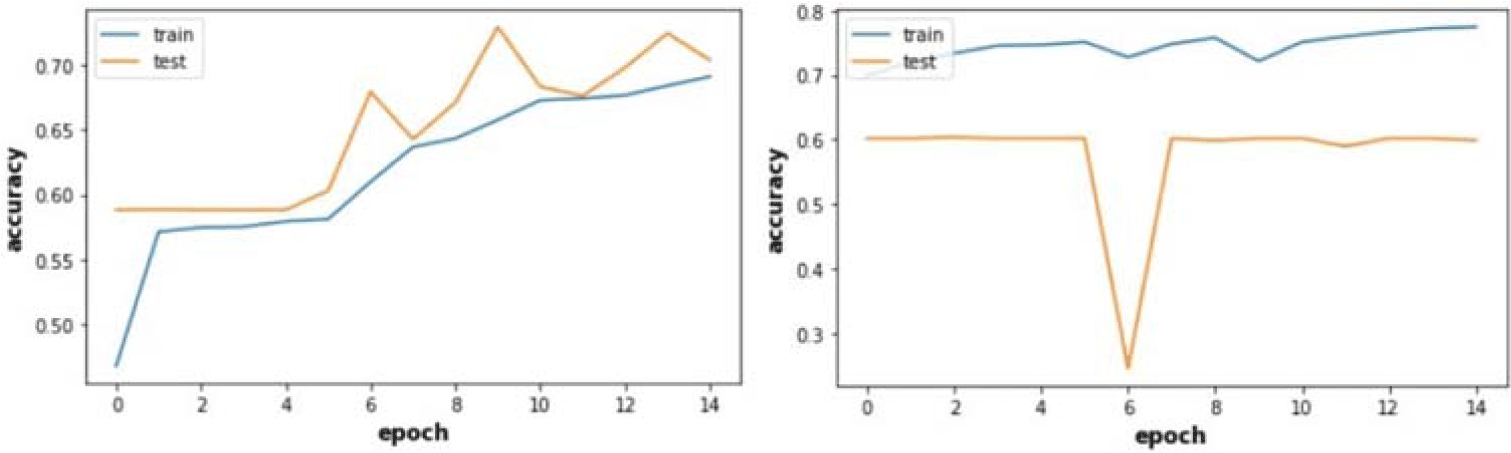
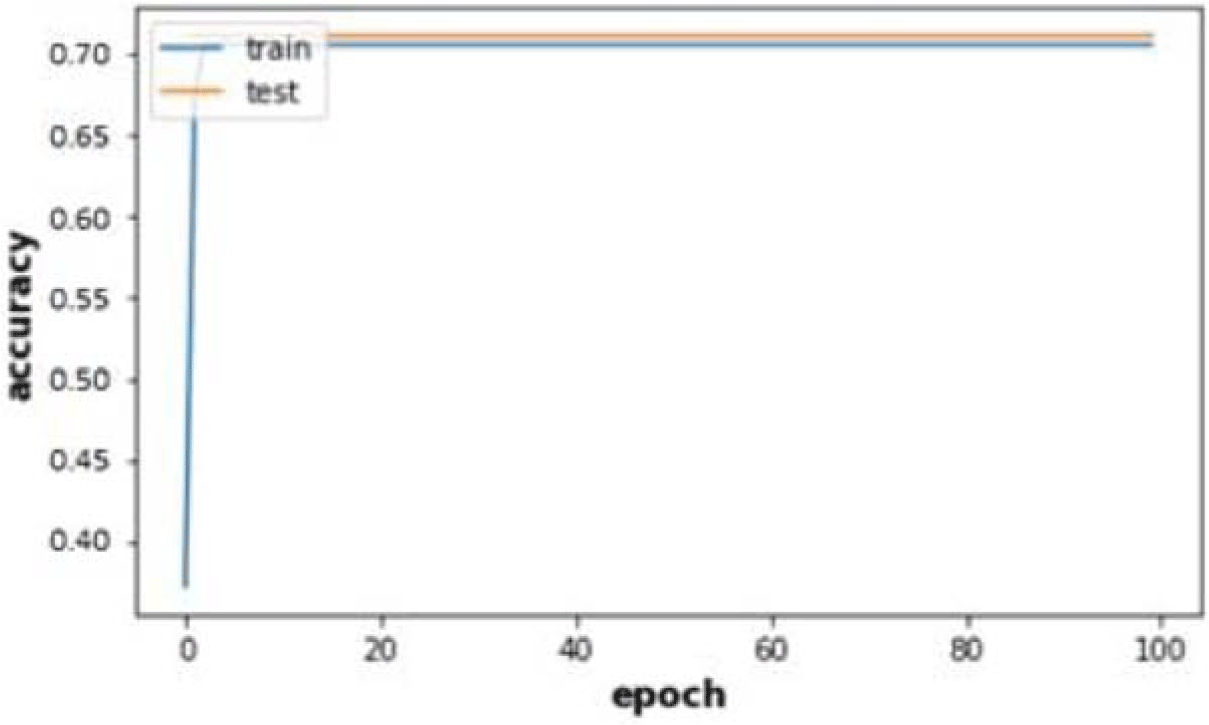
As far as the accuracy is concerned, we observe in Figure 1(left), and Figures 2–Figure 4 that with only a dozen training rounds, the examined methods are able to achieve around 75% accuracy, and the percentage keeps growing for some methods in subsequent rounds. Among the competitors, the Vision Transformer, achieves this performance from the very first few rounds.
Pretrained models accuracy: (left) VGG16 (right) EfficientNet-B3.

Vision Transformer’s accuracy.

5. Discussion
Neural networks are very effective mechanisms for addressing important problems in astronomy and astrophysics. It is known however that neural networks need huge amounts of data in order to achieve significant performance. Here we investigated the question whether their deployment can reap performance gains with minimal training in the context of morphological galaxy classification. Our results strongly suggest that this is feasible.
The surprising and unexpected result is the performance of the pretrained VGG architecture, which – even though it has been trained on a dataset of different nature – showed almost identical performance to that of the top performers. This maybe implies that transfer learning, which can alleviate the burden of tremendous dataset sizes in astronomy/astrophysics, needs to be thoroughly investigated. We plan to extend our investigation along the lines of federated learning, so as to allow for training using geographically dispersed dataset repositories.