Mumbai is a prosperous symbol of modern India and the most densely populated city in the world (29 650 people per square kilometer),1 which makes it a highly visible target for terrorists. Terrorist acts of violence induce a disproportionate state of fear in the public when compared to the number of people killed by other methods.Reference Cocks2
The November 26-29, 2008, terrorist attacks in Mumbai have been referred to as “India's 9/11,” although these were not the worst terrorist attacks that Mumbai has experienced and no unconventional weapons were used, as in the September 11, 2001, attacks on the United States.Reference Rabasa, Blackwill and Chalk3 This 60-hour-long event was unique in the international media attention it received, the multiple attack strategies used, and the fear it triggered nationwide. Everyone was a target—random members of the general population, iconic targets, and foreigners alike were under attack from the terrorists. Terrorist-instigated mass-casualty incidents are new to Mumbai and are in keeping with the increase in terrorist events around the world. The trend toward using heavy-duty firepower such as automatic assault rifles, machine guns, hand grenades, and improvised explosive devices is increasing.Reference Peleg, Aharonson-Daniel, Michael and Shapira4 The present study is an attempt to describe the nature of the 2008 attacks and to evaluate the adequacy of the medical/emergency medical systems (EMS) response.
METHODS
A retrospective, descriptive study of the terrorist event was conducted, using multiple sources of information. Information about the nature and site of the attacks was collected from newspaper reports, police press releases, legal reports, and other publicly available resources, and these were analyzed for medical events of rescue, injuries and deaths. There was no centralized source of data on the fatalities. The police had gathered data on the dead-on-scene victims by sex, nationality, and occupation. Hospitals' casualty departments compiled information about people who died on the way to or after reaching the hospitals. The list of people who were injured was collected from the various hospitals that received patients. Interhospital transfer, follow-up details about injuries, and patient outcomes were obtained through key-informant interviews of hospital staff members. One administrator or physician, 1 nurse or resident, and 1 technician/paramedic from each receiving hospital were the key informants interviewed. Details about the nature of the injuries, specialized medical interventions, and in-hospital mortality were collected from these interviews. The distribution of terror victims among various city hospitals, interhospital transfers, critical radius, and surge capacity was calculated based on the interview data, police data, and published lists of victims. The conflicting data from these different sources were resolved by including only information for which consensus was reached by 2 independent sources (triangulation). Besides overall mortality and the case-fatality ratio (CFR), the critical mortality rate was calculated based on the death rates among patients from the hospital injured list and the interviews. Next, these rates were compared with published rates of similar events in Mumbai and the rest of the world. The publications were searched in PubMed (National Library of Medicine) using the key words “critical mortality,” “hospitalized,” and “terrorism.” The damage in terms of financial losses at each attack site was estimated using police reports.
RESULTS
Description of the Event
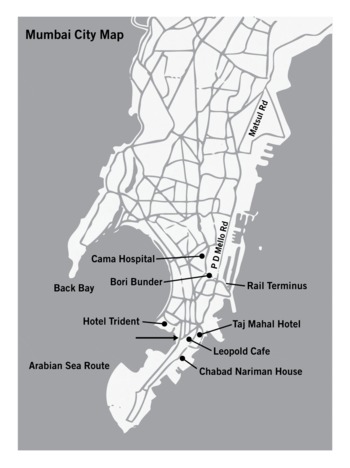
After hijacking a local fishing boat on the high seas, 10 people in their early 20s arrived at the Mumbai shoreline. They divided themselves into 4 attack teams. One team opened fire inside Mumbai's main train station, the Chhatrapati Shivaji rail terminus, and at the Cama & Albless Hospital, killing numerous commuters and 2 hospital staff members. The heavily populated train station was a scene of extreme carnage, and this act of terrorism caused the most disruption to the lives of ordinary citizens. News of the killing of the hospital staff members spread by word of mouth; Cama & Albless and GT hospitals turned off their lights and asked patients to remain silent to discourage terrorists from entering the hospital buildings. The second team invaded Nariman House, a commercial-residential complex run by the Jewish Chabad Lubavich movement. A third 2-person team moved from the landing site to the Trident-Oberoi Hotel and opened fire, taking hotel guests as hostages and negotiating for the release of political prisoners. The fourth team entered the Leopold Café and used automatic weapons to shoot random diners, and then moved to the Taj Mahal Palace hotel, entering through the back and engaged in arson, set off explosives, and took hostages (Figure 1).
Terror spot map.

The terrorists used Type 56 automatic assault rifles (a Chinese version of the Kalashnikov AK-47), each having 7 magazines of ammunition (30 rounds each); Heckler & Koch MP5 machine guns; 9-mm pistols, each with 2 clips of ammunition; hand grenades; and improvised explosive devices that contained RDX and ball bearings to create shrapnel. They also placed a bomb in a taxi, which later exploded in the suburb of Vile Parle.Reference Rabasa, Blackwill and Chalk3
The terrorist attacks played out in various parts of downtown Mumbai for 60 hours. The shootings came in bursts, with long pauses in the violence, so the rate of casualties was staggered. These pauses enabled the hospitals' medical response teams to effectively treat patients. Another factor in the effective response was the rapid pace of prehospital transport, which was quicker than usual. Mumbai’s roads are almost always densely populated with slow-moving traffic; however, the access roads had been cordoned off by police and no traffic obstructed ambulance paths.
Fatalities
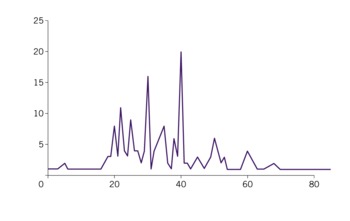
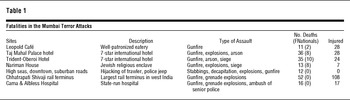
Men constituted 137 (80%) of the 172 people who were killed. The age group of the terror victims was concentrated in the 20- to 40-year-old range (Figure 2) and the average age was 33.4 years. The unusually high numbers of foreign, as compared with Indian, nationals among the fatalities are shown in Table 1. Foreign nationals were killed in places that are well patronized by tourists. In Nariman House, 5 Israelis were killled and 2 Germans died in the Leopold Café shootings. Those killed at the Taj Mahal Palace hotel were from the United Kingdom (1), Israel (1), Germany (1), Australia (1), Mauritius (1), Belgium (1), Malaysia (1), and Canada (2). Those killed at the Trident-Oberoi Hotel were from Japan (1), France (1), Singapore (1), Thailand (1), Italy (1), Australia (1), and the United States (3). Foreign nationals who were injured at Leopold Café were from Oman (3), the United Kingdom (3), Australia (2), and Germany (1); the injured at the Taj Majal Palace hotel were from Germany (1), Spain (1), the Philippines (1); and the United Kingdom (2); and the injured at the Trident-Oberoi Hotel were from Poland (1), Jordan (1), Japan (1), the United States (2), and Canada (2).
Age group of victims.

Fatalities in the Mumbai Terror Attacks

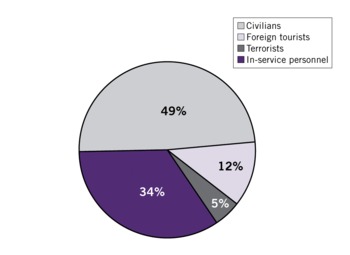
The CFR in this attack was 2.75:1. The ratio was calculated by dividing the number of injured by the number of dead, based on police and hospital sources. The profile of the dead is graphically represented by Figure 3, which shows that 34% were in-service personnel, including police (16), commandos (2), boat crew (5), taxicab drivers (2), hospital employees (4), hotel employees (27), and railroad employees (4).
Profile of victims.

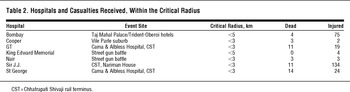
The various hospitals in the critical radius of the attacks received the distribution of victims outlined in Table 2, which also shows the victims who were pronounced dead on arrival. Because prehospital field triage was not available, bystander rescuers were not able to differentiate readily between individuals who were seriously injured or dead.
Hospitals and Casualties Received, Within the Critical Radius

Injuries and Surgical Interventions
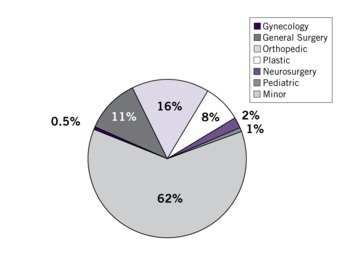
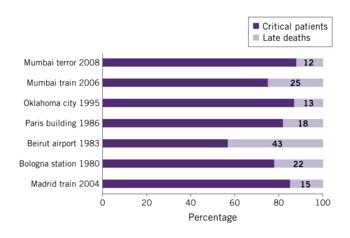
Of the 304 people who were injured in the attacks, 79% were men and boys and 21% were women and girls. The average age was 33.21 years (range, 3 months-85 years; Figure 2). A total of 38.5% of patients arriving at the hospitals required major surgical intervention. The breakdown of specialist intervention services required is shown in Figure 4. The majority of surgeries were for wound debridement, sutures, or splints and the rest were orthopedic (external fixation for compound fractures) and general surgies (abdominal explorations for penetrating bullet/shrapnel injuries). The mortality rate among critically injured people (critical mortality) was 12% (Figure 5). Data on long-term patient outcomes about deaths among seriously injured individuals admitted to the hospitals were used for this calculation.
Surgery requirements: Treatment breakdown of hospitalized victims.

Critical mortality rates of various terrorist events.

Damage and Financial Losses
The loss of government and private property was valued at approximately 84 crores and 76 lakh rupees 84 76 12 971, equivalent to US $18 547 329 million.
COMMENT
Transnational terrorism has been on the rise in the last decade5 and is reflected in attacks on India's neighbors such as Malaysia.Reference Abul Aziz6 Although few of these terrorists were based locally, the majority were linked to international groups or organizations. Terrorists are increasingly using more sophisticated technologies, such as satellite telephones (eg, Skype) and Internet search engines, and both technologies were used in the 2008 Mumbai attacks.Reference Duraphe7
Damage to Mumbai extended beyond the physical damage of property to psychological damage, work-related losses, and increased security requirements. Terror attacks are known to place a great deal of stress on a city's resilience, but further research is needed to quantify the changes in resilience.Reference de Ceballos, Turégano-Fuentes, Perez-Diaz, Sanz-Sanchez, Martin-Llorente and Guerrero-Sanz8 Using multiple strategies of attack (eg, carjack, arson, explosive, hostage negotiation-exchange, at-random shooting) on iconic targets in multiple locations, the terrorists created and sustained chaos; however, the main lesson learned from this attack has been that although mass-casualty bombings are commonly used terrorist tactics, the intermitting firing of automatic weapons in an urban setting is as effective in terrorizing the public. The use of automatic weapons prompted the media to suggest that Mumbai was under siege, increasing the level of fear. Attacking soft targets such as foreigners generated international media attention and suggested a proxy war against other nations.Reference Rabasa, Blackwill and Chalk3Reference Roy9 It is not clear whether the shootings at the Cama & Albless Hospital were planned as part of the overall Mumbai terror attack; regardless, being a violation of Article 14 of the Geneva Convention, the shootings exacted a larger psychological impact on society because they made unsafe a space that was considered to be safe.Reference Madhiwalla and Roy10
On-scene preparedness during the acute and rescue phases of terror attacks can save lives.Reference Kirschenbaum, Keene, O’Neill, Westfal and Astiz11 The main type of protection against injury used by Mumbai police personnel was bulletproof vests. The type of bullet-induced injuries received by Mumbai police officers revealed that their vests stopped bullets that were fired from 9-mm carbine guns and 0.38 revolvers but not from AK-47s and SLR 7.62 mm assault rifles. Because of the weight of and discomfort caused by bulletproof vests in the tropical climate of Mumbai, the necks, shoulders, and backs (many did not wear the additional reinforcing rear plate) of police officers were vulnerable to injury. For civilians, the pattern of bullet wounds, primarily on individuals' upper torsos, in the 2008 Mumbai event reveals that the terrorists were trained to fire from a standing position. Instructing civilians to lie flat on the ground during terror attacks and other shooting incidents (eg, bank robbery), may save lives.
As in other mass-casualty events in Mumbai, dead and severely injured people were first picked up in handcarts and then rushed to hospitals in ambulances or other transport vehicles. These individuals would have been “black tagged” (dead/survival unlikely) in countries with a formal EMS system of field triage, but India does not have such a system. Thus, the dead and people who were severely injured in the Mumbai attacks were declared dead on arrival at the hospitals, which added to the chaos in their casualty departments. Because each death is a medicolegal event, all of the terror attack–related deaths would mandatorily be registered with the police by victims' next of kin. Compensation and other legal issues require police certification.
Death-related data were accurately compiled from police records and hospitals' injury lists, and we calculated the CFR as 2.75:1. The CFR in terrorist-related events usually is 2.5 to 3.0:1, except in the case of small explosions in closed spaces, where the CFR is higher.Reference Frykberg12 The cause of death of people who died at the scene could not be evaluated for the present study because postmortem and forensic reports were not available. Frykberg showed that in similar terrorist attacks, immediate death was caused by primary blast lung injury (47%), abdominal injuries (34%), and chest injuries (25%).Reference Frykberg12 The overall mortality rate, which forms the denominator of the CFR, is skewed, however, by the large number of survivors with minor injuries. The critical mortality rate (death rate among critically injured survivors) is perhaps a more significant rate than the CFR in terrorist attacks.Reference Frykberg12 This outcome measure reflects the efficiency of prehospital transport, aggressive resuscitation, and medical intervention in the critically injured hospitalized patient. The critical mortality rate in terrorist attack survivors is doubled, when compared to similarly injured victims of traffic crashes.Reference Peleg, Aharonson-Daniel and Stein13
In the 2006 peak-hour serial suburban train bombings in Mumbai, the critical mortality rate was 25%.Reference Deshpande, Mehta and Kshirsagar14 The critical mortality rate of various terrorist attacksReference Peleg, Aharonson-Daniel, Michael and Shapira4Reference Frykberg12Reference Rignault and Deligny15Reference Kluger, Peleg, Daniel-Aharonson and Mayo16 is compared in Figure 5. The critical mortality rate was 12% in the 2008 Mumbai terror attack. This lower rate may be the result of the mixed mechanism of injury—shooting and explosions—not primarily by bombing in closed spaces.
The US Centers for Disease Control and Prevention reported that terrorist bombings produce a pattern of one-third of patients with injuries requiring major surgical intervention, whereas two-thirds require minimal intervention.17 This number is consistent with other studies of terrorist bombing and shootings.Reference de Ceballos, Turégano-Fuentes, Perez-Diaz, Sanz-Sanchez, Martin-Llorente and Guerrero-Sanz8 The number was similar in the 2008 Mumbai terrorist attacks: only 38.5% of patients arriving at hospitals required major surgical intervention. The specialty services required in hospital operating rooms, as shown in Figure 4, reflects a pattern found in other studies from MadridReference de Ceballos, Turégano-Fuentes, Perez-Diaz, Sanz-Sanchez, Martin-Llorente and Guerrero-Sanz8 and Israel.Reference Frykberg12 In the 2006 Mumbai train bombings, King Edward Memorial Hospital received 40% (31/76) of the patients triaged as critical, and 22% (17/76) required immediate surgery.
Fewer neurosurgeries were performed as a result of the Mumbai attacks than as a result of other attacks worldwide. This lower number may be attributed to a higher number of deaths caused by delays in transporting people with head injuries to hospitals.
The orthopedic service in Mumbai hospitals received the highest number of calls for both major and minor surgeries. Debridement and dressing of wounds after shrapnel injury or falls were common, followed by treatment of compound fractures of the foot or ankle. The high incidence of compound fractures necessitated early wound exploration and debridement.Reference Shenoy, Pai, Dalvie and Bapat18 Among the victims of the 2008 Mumbai attacks who reached a hospital, injuries to the extremities were the most common, similar to other terrorist events.Reference de Ceballos, Turégano-Fuentes, Perez-Diaz, Sanz-Sanchez, Martin-Llorente and Guerrero-Sanz8Reference Frykberg12 Debridement and closed reductions are surgeries that can be staggered and scheduled after emergency surgeries during the first 2 days of a terrorist attack to maintain operating room availability.Reference Kirschenbaum, Keene, O’Neill, Westfal and Astiz11
In-hospital mortality was more likely in patients with multiple-trauma, who, besides limb injuries, sustained injuries to the chest, abdomen or head. Among the major surgeries required after the 2008 terrorist attacks, abdominal and chest trauma surgeries kept general surgery services busy. In addition, abdominal exploratory laparotomy is commonly indicated for penetrating injuries (eg, bullets, shrapnel).Reference Kashuk, Halperin, Caspi, Colwell and Moore19 No laparotomies were required for blast victims received at King Edward Memorial Hospital after the 2006 Mumbai bomb blasts, but some of the shooting victims of the 2008 attacks required laparotomies. The in-hospital mortality rate was 22% in this subgroup, which is notably different from that for those with orthopedic injuries. A liberal approach to abdominal, head, and thoracic surgeries has been advocated because of the high specific mortality in this subgroup.Reference de Ceballos, Turégano-Fuentes, Perez-Diaz, Sanz-Sanchez, Martin-Llorente and Guerrero-Sanz8
There was no field triage, only “scoop and run,” at all venues of the 2008 Mumbai terror attacks. Ambulances attached to 6 public hospitals and 1 private hospital transported the victims. Because of the lack of a formal EMS service,Reference Roy, Murlidhar and Chowdhury20 bystandersReference Lerner, O’Connor and Schwartz21 were the “first responders” to the public shootouts (eg, the Chhatrapati Shivaji rail terminus station). As seen in other mass-casualty events, underfunded public hospitals take the brunt of the casualties of terror attacks.Reference Abul Aziz6Reference Roy9 The experiences at the King Edward Memorial Hospital after the 2006 serial bomb blastsReference Kluger, Peleg, Daniel-Aharonson and Mayo16Reference Goenka and Jethwani22 and the 1993 Mumbai riotsReference Shenoy, Pai, Dalvie and Bapat18 or at hospitals after the terrorist explosions in Istanbul in 2003Reference Rodoplu, Arnold, Tokyay, Ersoy, Cetiner and Yücel23 and Madrid in 2004Reference de Ceballos, Turégano-Fuentes, Perez-Diaz, Sanz-Sanchez, Martin-Llorente and Guerrero-Sanz8 are similar. Public hospitals provide free health care and are supported by health ministries/governments. Medical countermeasures planning for terrorist events requires building capacity with free public hospital systems, and we recommend this for future events.Reference Abul Aziz6Reference Roy9
Only 20% of arriving casualties require immediate medical treatment.Reference Kosashvili, Daniel, Peleg, Horowitz, Laor and Blumenfeld24 Because no field triage was available during the 2008 Mumbai attacks, the arrival of a particular victim at a particular hospital was determined by the proximity of the hospital to the site at which the injury was received, by the type of prehospital transport (police van or hospital-owned/private ambulance), or at the request of the patient. Ideally, transport would have been based on field triage and injury severity to avoid overwhelming any single facility.Reference Frykberg12 Because hospitals are not coordinated through a control center, surge capacity coordination is not possible in Mumbai. Despite this, no facility reported being overwhelmed.Reference Roy9 The number of casualties generated per hour was small compared with past riot and civil disorder events. Furthermore, the terrorist attacks occurred in various parts of downtown Mumbai, so a geographical distribution of casualties to medical facilities was possible. In the case of the Chhatrapati Shivaji rail terminus station victims, the inpatient capacity of the large public hospitals in Mumbai was expanded by opening nonstandard spaces in the hospitals for new beds, although they did report delays in emergency operations. Enhancing surge capacity in resource-limited environments includes temporarily lowering the standards of care and, usually, making sure manpower resources are adequate, as in the 2008 Mumbai attacks. In India, physician residents and nurses-in-training usually reside on hospital campuses and thus are able to converge on short notice during mass-casualty events.
Agency ambulances were mobilized for response, although there is no central EMS in Mumbai.Reference Roy, Murlidhar and Chowdhury20 Ambulances transported seriously injured victims, which was not the case in previous events in Mumbai. Where there is well-established EMS, the “walking wounded” bypass triage (and decontamination) measures and present to the nearest hospital, with the potential to cumulatively overwhelm it.Reference Caldicott, Edwards, Tingey and Bonnin25 For example, in the 1995 sarin gas attack in the Tokyo subway, only 15% of the victims arrived at hospitals in EMS vehicles.
A limitation of our study was that because India lacks a national trauma registry, any analysis of specific terrorism-related injuries requires data compilation from discrete police, forensic, and hospital databases. Therefore, we were forced to compile data regarding injury and death from multiple databases. Another limitation of this study was that postmortem reports were not available to determine causes of death. Because of the lack of a standardized trauma system in Mumbai, the inpatient trauma charting and public health trauma/injury reporting mechanisms were variable at best, which made our ability to obtain and analyze detailed hospital inpatient records untenable. Also untenable was describing injury burden by Injury Severity Score for individual patients by chart review. Furthermore, injured people who died after they left hospitals to seek treatment elsewhere may have skewed calculation of the critical mortality rate. The 2008 attacks have provided the Mumbai health system with a strong impetus to move toward a more standardized trauma system, which would include standardized charting and injury reporting to improve preparedness for future mass-casualty events.
CONCLUSIONS
Similar Mumbai-style attacks can be expected. The international media coverage of terrorism, with a focus on foreign victims, who are easy targets in a proxy war on nations other than the one under attack, is intense. The lives of vulnerable uniformed staff must be safeguarded during such attacks by providing appropriate protective gear. In Mumbai and elsewhere in India, terrorists using heavy-duty automatic weapons and explosives present new challenges for medical counterterrorism response. Surgical outcome measures, the critical mortality rate, and the specialty services required in hospitals were comparable to previous terrorist attacks in other urban settings. Strengthening public hospitals, establishing a central control locale for coordinated response, and creating a national trauma registry to allow analysis of specific terror-related injuries are important, effective measures in the response to future terrorist attacks. In terms of increased security checks, alerts, and fears of similar Mumbai-style attacks, the 2008 attacks had not just a local impact but also global consequences. The resilience of the citizens of Mumbai is a critical measure of the long-term effects of terror attacks and is a potential area of further research in India.
Disclaimer: The findings, conclusions, and recommendations in this article are those of the authors and do not represent the official position of the Centers for Disease Control and Prevention.
Author Disclosures: The authors report no conflicts of interest.