INTRODUCTION
The nutrient cycle is a vital component of ecosystem functioning and decomposition is an important step (Aber & Melillo Reference ABER and MELILLO1991), contributing to the formation and fertility of soils and forming the base of various food webs in tropical forests (Fittkau & Klinge Reference FITTKAU and KLINGE1973). The transformation of the organic matter is especially important in tropical forests with infertile soils, where a large proportion of the nutrients are locked up in leaves (Aber & Melillo Reference ABER and MELILLO1991). These nutrients are quickly mineralized and absorbed by the roots, especially in the rainy season (Sanderman & Amundson Reference SANDERMAN, AMUNDSON and Schlesinger2005).
Decomposition is known to be influenced by five intercorrelated factors: climate, soil fertility, organic matter quality, and the abundance and composition of invertebrates and micro-organisms (Coûteaux et al. Reference COÛTEAUX, BOTTNER and BERG1995, Lavelle et al. Reference LAVELLE, BLANCHART, MARTIN, MARTIN and SPAIN1993). All of these can be affected by disturbance, yet relatively few studies have examined the effects of forest disturbance on decomposition in the humid tropics. The existing studies suggest that heavily impacted areas, such as sites with no vegetation, pasture and small fragments, show slower decomposition rates compared to a primary forest (Kumar & Deepu Reference KUMAR and DEEPU1992, Mesquita et al. Reference MESQUITA, WORKMAN and NEELY1998). However, secondary forests in advanced stages of succession show similar decomposition rates to primary forests (Barlow et al. Reference BARLOW, GARDNER, FERREIRA and PERES2007, Xuluc-Tolosa et al. Reference XULUC-TOLOSA, VESTER, RAMÍREZ-MARCIAL, CASTELLANOS-ALBORES and LAURANCE2003). These studies also reveal a marked geographic bias. For example, studies within the Brazilian Amazon are concentrated in forest fragments near Manaus, Amazonas (Didham Reference DIDHAM1998, Mesquita et al. Reference MESQUITA, WORKMAN and NEELY1998, Rubinstein & Vasconcelos Reference RUBINSTEIN and VASCONCELOS2005, Vasconcelos & Laurance Reference VASCONCELOS and LAURANCE2005).
Accidental fires have become increasingly frequent in Amazonian forest over the past two decades, especially at agricultural frontiers and in severe dry seasons influenced by global climate changes (Alencar et al. Reference ALENCAR, NEPSTAD and DIAZ2006). Burning can have an impact on post-fire decomposition by changing forest structure, leading to higher temperatures, lower humidity (Cochrane & Schulze Reference COCHRANE and SCHULZE1999, Nepstad et al. Reference NEPSTAD, VERÍSSIMO, ALENCAR, NOBRE, LIMA, LEFEBVRE, SCHLESINGER, POTTER, MOUTINHO, MENDOZA, COCHRANE and BROOKS1999, Uhl & Kauffman Reference UHL and KAUFFMAN1990) and changes in soil proprieties (Schlesinger Reference SCHLESINGER and Schlesinger1997), all of which act directly on organisms involved in decomposition (Sanderman & Amundson Reference SANDERMAN, AMUNDSON and Schlesinger2005). Furthermore, even low-intensity fires destroy the leaf-litter and soil fauna that live within it (Silveira Reference SILVEIRA2008). Because the soil fauna actively contributes towards decomposition (Coûteaux et al. Reference COÛTEAUX, BOTTNER and BERG1995, Dickinson & Pugh Reference DICKINSON and PUGH1974) it seems likely that fire could also alter decomposition rates by changing faunal populations. However, just one study has examined the impact of wildfires on decomposition in tropical forests, and this was carried out a long (and unspecified) time after the fires occurred, and did not explicitly consider the role of soil fauna in decomposition (Chacón & Dezzeo Reference CHACÓN and DEZZEO2007).
Soil fauna can be classified on the basis of body size, with mesofauna being organisms with a body width of < 2 mm, and macrofauna being organisms with a body width > 2 mm. Mesofauna affect decomposition rates by grazing on bacteria, fungi and soil animals, and consuming litter and excreting pellets. Macrofauna transform litter in a similar way, but also physically mix soil organic matter with the mineral horizon (Coûteaux et al. Reference COÛTEAUX, BOTTNER and BERG1995, Dickinson & Pugh Reference DICKINSON and PUGH1974, Wardle Reference WARDLE2002). The interaction between both groups can further affect decomposition rates (Bradford et al. Reference BRADFORD, TODORFF, EGGERS, JONES and NEWINGTON2002, Heneghan et al. Reference HENEGHAN, COLEMAN, ZOU, CROSSLEY and HAINES1999, Setälä et al. Reference SETÄLÄ, MARSHALL and TROFYMOW1996, Sulkava & Huhta Reference SULKAVA and HUHTA1998).
This study aims to provide data on decomposition rates (% mass loss) and the importance of the leaf-litter fauna in two different experimental fire regimes in a seasonally dry forest in the south of the Brazilian Amazon. Treatments included unburned forest (UF), once-burned (BF1) and forest burned annually for three years (BF3). We test the hypotheses that (1) decomposition is slower in burned forests and (2) decomposition is slower when macrofauna are excluded from the litterbags.
MATERIALS AND METHODS
Study site
The study was carried out at Fazenda Tanguro (13°4′35.39″S; 52°23′8.85″W) in 150-ha of Amazonian forest in the municipality of Querencia in the state of Mato Grosso, Brazil, 30 km north of the forest-cerrado (Brazilian savanna) boundaries. The vegetation in the study site consists of a closed-canopy forest, with tree height reaching 18–20 m, with a few taller emergents (Balch et al. Reference BALCH, NEPSTAD, BRANDO, CURAN, PORTELA, CARVALHO and LEFEBVRE2008, Ivanauskas et al. Reference IVANAUSKAS, MONTEIRO and RODRIGUES2003). Vegetation in these forests is lower in diversity than more humid tropical forests (Balch et al. Reference BALCH, NEPSTAD, BRANDO, CURAN, PORTELA, CARVALHO and LEFEBVRE2008). Oxisols are predominant, with high Al content and low fertility (Radam Brasil Reference RADAM1974). Climate is humid tropical, type Aw according to Köeppen's classification (Radam Brasil Reference RADAM1974). Average annual rainfall is c. 1500 mm. There is a marked dry season from May to September, where rainfall often falls below 10 mm mo−1 (Balch et al. Reference BALCH, NEPSTAD, BRANDO, CURAN, PORTELA, CARVALHO and LEFEBVRE2008).
The 150-ha site was divided into three 50-ha plots in 2004, composed of unburned forest (UF), once-burned (BF1), and forest burned annually for 3 y (BF3). Trails were cut every 50 m in N–S directions, and marked every 50 m in E–W directions in the three plots, creating a grid that was used for data collection. All experimental burns took place at the end of the dry season (August–September). During all years, fires were set using kerosene drip torches along the N–S trails. A total of 10 km of fire-lines were set per plot during 3–4 consecutive days from 9h00 to 16h00. These fires often smouldered or went out during the humid nights, and were therefore relit the following day. Fires typically burned leaf litter and fallen twigs and branches, but not the standing trees (see Balch et al. Reference BALCH, NEPSTAD, BRANDO, CURAN, PORTELA, CARVALHO and LEFEBVRE2008 for more details).
This study was conducted from December 2006 to August 2007 (before the 2007 burning); therefore the two burnt treatments had either been burnt once in 2004 and were measured 28 mo after the last fire (BF1), or had been burnt once per year for the last 3 y, with measurements taken 4 mo after the last fire (BF3). The site was surrounded by a large expanse of native forest on three sides, and one side was adjacent to pasture (Balch et al. Reference BALCH, NEPSTAD, BRANDO, CURAN, PORTELA, CARVALHO and LEFEBVRE2008). We avoided edge effects by placing litterbags at least 100 m from the pasture and adjacent treatments.
Environmental variables
We recorded three forest structural variables that indirectly affect decomposition: litter depth, understorey vegetation density and canopy openness. Those variables were recorded in 3 × 3-m quadrats at each grid point (n = 162 for each plot). Litter depth was measured with a ruler at the four corners of each quadrat. Understorey density was indexed by counting how many times live vegetation touched a pole that was 2.5 m in height and 3.5 cm in diameter, placed upright at the four corners of each quadrat. Canopy openness was calculated using digital hemispherical photographs taken in the centre of each quadrat. For each of these measurements, the average score was used to characterize each 3 × 3-m quadrat, and the average across all representative quadrats was used to characterize the environmental conditions in each forest plot. All data were collected in March (rainy season) and August (dry season). Temperature and relative humidity were recorded at 15 randomly located points within each treatment, using T-RH sensors (Onset Computer Corporation, Pocasset, MA, USA) that took readings at midday throughout the experiment.
Litterbags
Two litter bags (representing one coarse and one fine mesh size) were placed in 120 randomly selected grid points in each plot (n = 240 per plot and 720 in total). Litterbags (25 × 25 cm) were made of 2-mm nylon mesh, preventing the entrance of macrofauna but allowing mesofauna to enter. In half of the litterbags we made three 1-cm2 perforations on each side to facilitate the colonization of macrofauna (cf. Didham Reference DIDHAM1998). Litterbags were filled with approximately 10 g of naturally abscised leaves collected randomly in primary forest and oven dried for 4 d at 60°C. Litterbags were placed in the forest in early December 2006, during the rainy season. At 2-mo intervals we collected the coarse- and fine-mesh litterbags from 30 randomly selected grid points from within the three plots. Litterbags were oven dried for 4 d at 60°C and reweighed to the nearest 0.1 g after removing fine roots, invertebrates and mud. Due to damage (mostly by leaf cutter ants) only 531 litter bags were analysed, but the sample design remained balanced across factors: sampling period (n = 134, 143, 116, 138 for periods 1–4), fire treatment (n = 180, 170, 181 for unburned, once and thrice-burned forest, respectively) and mesh types (n = 255 and 276 for fine and coarse mesh types, respectively).
Data analyses
The difference between forest structural variables, temperature and relative humidity in the three treatments was examined using one-way ANOVA after checking data for normality. Although the variance in relative humidity was lower in the control plots than the burned treatments, we continue to use ANOVA as the results were the same using non-parametric tests (e.g. Kruskal–Wallis) and it allows Tukey's post hoc comparison between treatments. Decomposition rates were expressed as remaining dry weight in the litterbags after 2, 4, 6 and 8 mo in the field. We converted litter dry weights to the proportion of litter weight remaining in the litterbags. The effects of fire treatment (UF, BF1 and BF3), mesh size (large and small), and time period (four measurements) on the proportion of litter weight remaining were examined using Analysis of Deviance with the ‘glm’ and ‘anova’ functions in the R statistical environment (R Development Core Team 2008). We used a quasi-binomial error structure appropriate for the analysis of proportion data, and used the F-test to examine significance (Crawley Reference CRAWLEY2007), where F is the ratio of the between-group variation divided by the within-group variation.
RESULTS
Environmental variables
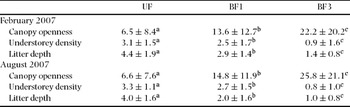
All forest structural variables used were significantly different across plots (P < 0.001). BF1 showed intermediate values for all of them (Table 1). BF3 forest had the highest degree of canopy openness, the lower understorey density and the smallest litter depth, indicating that three successive fire events had drastically affected forest structure. Temperature in UF and BF1 was similar overall, while BF3 was significantly hotter than both other treatments in almost all months (Figure 1). Relative humidity was similar in UF and BF1 and higher than BF3 in all months except August (Figure 1).
Mean (± SD) canopy openness (%), understorey density (frequency) and litter depth (cm) in unburned forest (UF), once-burned forest (BF1) and thrice-burned forest (BF3). Letters represent results from Tukey's post hoc test, where groups with the same letter were not significantly different from each other at P < 0.05.

Mean (±SE) temperature (a) and relative humidity (b) in unburned forest, once-burned forest and thrice-burned forest. Tukey's post-hoc tests revealed the following significant differences: thrice-burned was different from the unburned treatment in all months for temperature and relative humidity; for temperature, once-burned was significantly different from thrice-burned in December, March, April and June, and was significantly different from unburned in all months except December and April. For relative humidity, once-burned was significantly different from thrice-burned in all months except August, and was significantly different from unburned in February, May, June and August.

Litter decomposition
Litter decomposition was strongly affected by sampling period (F3,520 = 192; P < 0.001), fire treatment (F2,523 = 24.3; P < 0.001), and mesh size (F1,525 = 24.1; P < 0.001) (Figure 2). There were significant interactions for fire treatment × mesh size (F2,522 = 7.8; P < 0.001), and fire treatment × sampling period (F6,513 = 2.7; P = 0.012). Interactions between sampling period × mesh size and treatment × sampling period × mesh size were not significant (P > 0.05). The differences of mass loss between UF and BF1 were not significant (P > 0.05), but BF3 was significantly different from both (P < 0.001) based on the GLM summary statistics. All comparisons of mass loss between sampling periods were significantly different from the first sample (P < 0.001).
Mean remaining litter weight (% ± SE) in unburned (open bars), once-burned (diagonal hatching) and thrice-burned (cross-hatched) forest, over four sampling periods. Within each sample period and fire treatment, coarse-mesh litter bags are represented by the bar on the left, and fine-meshed litter bags by the bar on the right.

Because of the significant interactions between fire treatment × sampling period, we conducted separate tests for each of the four sampling periods. Fire treatment was highly significant in the first (F2,130 = 8.9, P < 0.001), third (F2,112 = 10.5, P < 0.001) and fourth (F2,134 = 24.1, P < 0.001) sample period, and narrowly insignificant in the second sample period (F2,139 = 2.7, P = 0.07). Mesh size was significant (P < 0.05) in all sampling periods. The fire treatment × mesh size interaction was only significant in the second sample (F2,137 = 4.5, P = 0.01).
DISCUSSION
This experiment examined whether fire can affect decomposition rates in seasonally dry tropical forests. We do not attempt to compare between fire regimes, as our comparisons are limited by the different time since the last fire in the burned plots (28 mo in BF1 and 4 mo in BF3). However, our results do highlight some important patterns, and show that 28 mo after a single low-intensity fire some aspects of forest functioning that are necessary for nutrient cycling are restored. This was not the case 4–12 mo after the last fire in forest that was experimentally burned three times in as many years.
Environmental variables
Fire had a clear effect on canopy openness, understorey and litter depth, with greater effects seen in BF3 than in BF1. This may reflect either the time since the last fire, or that burning multiple times has a more severe effect on forest structure. By increasing the sunlight reaching the floor, canopy gaps favour the rapid growing up of shrubs, lianas and large herbs (Denslow & Hartshorn Reference DENSLOW, HARTSHORN, McDade, Bawa, Hespenheide and Hartshorn1994), leading to an increase in understorey density (Barlow & Peres Reference BARLOW and PERES2004). However, our measurements did not detect any increase in understorey density 1 y (BF3) or even 3 y (BF1) after the last fire. These results suggest that seasonally dry Amazonian forests that are located close to cerrado (Brazilian savanna) may have a different dynamic of regeneration after disturbance from humid forests further from the forest–cerrado transition zone. Litter depth also was higher in UF, intermediary in BF1 and lower in BF3, and these results can be linked to the time since the most recent fire, as BF1 had more time to accumulate leaf-litter while BF3 did not. Temperature and humidity in our surveyed plots appeared strongly linked to changes in the forest structure; UF generally had the lowest temperatures and highest relative humidity, BF1 showed intermediate values, and BF3 showed the highest temperatures and lowest relative humidity. Temperatures are generally 3–4°C hotter in canopy gaps (Holdsworth & Uhl Reference HOLDSWORTH and UHL1997), also increasing the temperature of the forest in general (Barlow et al. Reference BARLOW, GARDNER, FERREIRA and PERES2007, Nepstad et al. Reference NEPSTAD, VERÍSSIMO, ALENCAR, NOBRE, LIMA, LEFEBVRE, SCHLESINGER, POTTER, MOUTINHO, MENDOZA, COCHRANE and BROOKS1999, Uhl & Kauffman Reference UHL and KAUFFMAN1990).
Litter decomposition
There is no evidence that fire affected decomposition 28 mo after a single fire, and these forests appeared to function in a similar way to unburned forest. The fact that there were significant differences in forest structure but no difference in decomposition between UF and BF1 plots suggests that below-ground leaf-litter decomposition processes may not be strongly coupled with above-ground forest structure. These results are comparable to those from Chacón & Dezzeo (Reference CHACÓN and DEZZEO2007), in which forests showed similar mass loss a long time after the last fire. Our results also demonstrate that recurrent fires can result in a system with reduced litter decomposition rates. This effect may partly be due to the higher temperatures and lower relative humidity seen in BF3 (Figure 1), which may have resulted in decomposition being more limited by water. There are no comparable studies on litter decomposition in tropical forests that have succumbed to recurrent fires.
Litter biota provides a second potential explanation for differences in decomposition rates between the fire treatments. Macrofauna appeared to play a much greater role in decomposition in BF3 than in either BF1 or UF, as macrofaunal exclusion appeared to result in lower decomposition rates in BF3, but had no effect in BF1 or UF (Figure 2). However, the role of macrofauna does not explain all of the reduction in decomposition in BF3, as the decomposition rate in the fine-mesh bags (excluding macrofauna) were still lower in BF3 than other fire treatments across most of the seasonal samples. This result suggests that annual burning may reduce the biomass or alter the composition of soil microbes, and/or mesofauna, all of which could have an effect on decomposition rates (Bradford et al. Reference BRADFORD, TODORFF, EGGERS, JONES and NEWINGTON2002, Waldrop et al. Reference WALDROP, BALSER and FIRESTONE2000). Other studies that have examined the effect of soil fauna on decomposition in the tropics have also found varying results. For example, litter mass loss was not found to be related to the population of litter-feeding invertebrates in two studies based in Malaysia (Anderson et al. Reference ANDERSON, PROCTOR and VALLACK1983) and the central Brazilian Amazon (Didham Reference DIDHAM1998), but was found to be related to mesh size in Nigeria (Swift et al. Reference SWIFT, RUSSELL-SMITH and PERFECT1981), Pará, Brazil (Nepstad et al. Reference NEPSTAD, MOUTINHO, DIAS-FILHO, DAVIDSON, CARDINOT, MARKEWITZ, FIGUEIREDO, VIANNA, CHAMBERS, RAI, GUERREIROS, LEFEBVRE, STERNBERG, MOREIRA, BARROS, ISHIDA, TOHLVER, BELK, KALIF and SCHALBE2002) and Amazonas, Brazil (Vasconcelos & Laurance Reference VASCONCELOS and LAURANCE2005).
The similar decomposition rates in BF1 and UF suggest that one single fire may represent a disturbance of relatively low impact to nutrient cycling, reflecting results from old secondary forests (Barlow et al. Reference BARLOW, GARDNER, FERREIRA and PERES2007, Ewel Reference EWEL1976, Loranger et al. Reference LORANGER, PONGE, IMBERT and LAVELLE2002, Swift et al. Reference SWIFT, RUSSELL-SMITH and PERFECT1981, Xuluc-Tolosa et al. Reference XULUC-TOLOSA, VESTER, RAMÍREZ-MARCIAL, CASTELLANOS-ALBORES and LAURANCE2003), selective logging (Anderson et al. Reference ANDERSON, PROCTOR and VALLACK1983, Burghouts et al. Reference BURGHOUTS, EARNSTING, KORTHLS and DE VRIES1992), large forest fragments (Didham Reference DIDHAM1998, Mesquita et al. Reference MESQUITA, WORKMAN and NEELY1998, Rubinstein & Vasconcelos Reference RUBINSTEIN and VASCONCELOS2005, Vasconcelos & Laurance Reference VASCONCELOS and LAURANCE2005), severe dry seasons (Nepstad et al. Reference NEPSTAD, MOUTINHO, DIAS-FILHO, DAVIDSON, CARDINOT, MARKEWITZ, FIGUEIREDO, VIANNA, CHAMBERS, RAI, GUERREIROS, LEFEBVRE, STERNBERG, MOREIRA, BARROS, ISHIDA, TOHLVER, BELK, KALIF and SCHALBE2002), and old burned forest (Chacón & Dezzeo Reference CHACÓN and DEZZEO2007). However, decomposition rates were considerably lower in the recurrently burned plot (BF3), suggesting that the impact of these fires on leaf-litter decomposition is comparable to those found following the most severe forms of forest disturbance, including deforestation (Ewel Reference EWEL1976), conversion to pasture (Kumar & Deepu Reference KUMAR and DEEPU1992) or plantations (Barlow et al. Reference BARLOW, GARDNER, FERREIRA and PERES2007), and the creation of very small fragments (Didham Reference DIDHAM1998, Rubinstein & Vasconcelos Reference RUBINSTEIN and VASCONCELOS2005).
CONCLUSIONS
Annually burned, seasonally dry Amazon forests apparently present a negative fire feedback, as low litter production acts to reduce fuel input (Balch et al. Reference BALCH, NEPSTAD, BRANDO, CURAN, PORTELA, CARVALHO and LEFEBVRE2008). However, this study shows that important ecosystem functions such as decomposition are not recovered within 1 y of the most recent recurrent fire. This change in function appeared to be related to changes in both the microclimate and forest structure, although the role of mesh size indicates that changes in the litter and soil biota caused by the fire treatment may also be important. The similarity of decomposition in once-burned forests 28 mo after the most recent fire compared with unburned forest suggests that one single fire does not have long-term negative effects on at least some ecological processes. However, we would caution against extrapolating these results from experimental fires in very seasonal forests to other situations in Amazonia, and suggest that more work is required to fully understand the scale of effects of fire on ecosystem functioning in these fire-sensitive ecosystems.
ACKNOWLEDGEMENTS
J. M. Silveira gratefully acknowledges the Conselho Nacional de Pesquisa Científica (CNPq) which supported her Ph.D. research, and the IPAM field staff who helped collect the data. Grupo Amaggi provided logistical support. Funding for the experimental fires was provided by the David and Lucile Packard Foundation, NASA LBA-ECO program, and NSF Biocomplexity in the Environment and Ecosystems programs. An anonymous reviewer provided comments that improved the manuscript.