Introduction
Aging populations lead to rapid demographic transitions and pose major challenges to the health and welfare systems around the globe. Older people in low and middle-income countries (LMIC) currently contribute to 6–9% of the total population (World Bank, 2009; WHO, 2010a) with annual growth rates of 2.1% in low and 1.3% in lower to middle income countries. With an increase in the older population, their health service utilization, health expenditure, health budgets, and the per capita health expenditure have also increased (Casey et al., Reference Casey, Oxley, Whitehouse, Antolín, Duval and Leibfritz2003).
The total health expenditure in high-income countries is around 11.2% of their GDP. While the total health expenditure in India is only 4.2% of its GDP, much of that expenditure (67.2%) is paid directly by patients and their families as out-of-pocket expenses (WHO, 2010b). Studies from other LMIC have also documented that out-of-pocket health expenditures are more than their government expenditure on health and that advancing age is positively correlated with high out-of-pocket expenditure (Somkotra and Lagrada, Reference Somkotra and Lagrada2009; You and Kobayashi, Reference You and Kobayashi2011). A recent cross-national study has reported that health service utilization by older people in LMIC declines, when the proportion of health visits requiring out-of-pocket expenditures increases (Albanese et al., Reference Albanese2011). However, there is a dearth of information on the determinants of out-of-pocket health expenditure.
The high prevalence of chronic illnesses and consequent disability increase the need for health services among older people in LMIC (Somkotra and Lagrada, Reference Somkotra and Lagrada2009; Albanese et al., Reference Albanese2011). Older people with high needs and meager financial resources are at risk for catastrophic health expenditures (Kawabata et al., Reference Kawabata, Xu and Carrin2002), defined as more than 40% of the household income being spent on health (WHO, 2011a). The optimal threshold to define catastrophic health expenditure has been debated and various health economic studies have employed thresholds ranging between 5% and 60% (Wyszewianski, Reference Wyszewianski1986; Wagstaff and van Doorslaer, Reference Wagstaff and van Doorslaer2003; Xu et al., Reference Xu, Evans, Kawabata, Zeramdini, Klavus and Murray2003; Su et al., Reference Su, Kouyate and Flessa2006; Limwattananon et al., Reference Limwattananon, Tangcharoensathien and Prakongsai2007). Unlike high-income countries, in LMIC, health expenditures accounting for as little as 10% of the income or consumption expenditure of the households may lead to impoverishment and financial debts (Bonu et al., Reference Bonu, Bhushan and Peters2007; Reference Bonu, Bhushan, Rani and Anderson2009; Limwattananon et al., Reference Limwattananon, Tangcharoensathien and Prakongsai2007).
Determinants of health expenditure are heterogeneous and vary across different countries (Xu et al., Reference Xu, Evans, Kawabata, Zeramdini, Klavus and Murray2003). The different context in LMIC, with the lack of social security net and inequitable access to health services (Albanese et al., Reference Albanese2011), nutrition, education, and sanitation demand specific evaluation (WHO, 2011b). Catastrophic health expenditures are common, yet underresearched, in LMIC undergoing transition (Xu et al., Reference Xu, Evans, Kawabata, Zeramdini, Klavus and Murray2003), hence a detailed study of their determinants and probable consequences is indicated. We aimed to investigate various socioeconomic and health determinants of out-of-pocket and catastrophic health expenditures among rural older people in south India.
Materials and methods
Study design
We employed a cross-sectional study to investigate these objectives. This study was part of the 10/66 Dementia Research Group population-based studies (Prince et al., Reference Prince, Acosta, Chiu, Scazufca and Varghese2003). The methodology employed in this study is briefly mentioned here and has been reported elsewhere in detail (Jacob et al., Reference Jacob, Kumar, Gayathri, Abraham and Prince2007).
Setting
We recruited the participants from Kaniyambadi block of Vellore district, situated in the southern Indian state of Tamil Nadu, between February 2004 and June 2005. Kaniyambadi is spread over 127.4 square kilometers and has a total population of about 110,000. In India, older people seek healthcare from government health services and from the private sector. Helpseeking from alternative medicine (Siddha, Ayurveda, Homeopathy, and Unani) and from other traditional (faith) healers is common. Despite government health services providing medical consultations and essential medications free of cost, their limited services mean that many older people need to seek private medical healthcare and spend out of their pockets (Albanese et al., Reference Albanese2011).
The Kaniyambadi block is served by a government primary health center (PHC) and by many private physicians. The department of community medicine, Christian Medical College (CMC), Vellore, has provided a comprehensive community health program in this block for the past five decades. It has a four-tier monitoring and computerized surveillance system, which is updated every month. The health statistics are provided by community health workers (Joseph et al., Reference Joseph, Joseph and Kamaraj1991), who live within the village communities and are supervised by public health nurses and physicians.
Study sample
We identified those, aged above 60 years, using a computerized list and door-to-door survey. We conducted individual interviews to ascertain their age. Whenever participants did not know their age accurately, we estimated that by a historical calendar method (Jacob et al., Reference Jacob, Kumar, Gayathri, Abraham and Prince2007). All consecutive older people above 65 years, who consented, were recruited for the study. We have reported the factors associated with dementia (Jacob et al., Reference Jacob, Kumar, Gayathri, Abraham and Prince2007), depression (Rajkumar et al., Reference Rajkumar, Thangadurai, Senthilkumar, Gayathri, Prince and Jacob2009), and disability (Duba et al., Reference Duba, Rajkumar, Prince and Jacob2011) among these participants elsewhere. Our data have also been analyzed as part of the 10/66 cross-national investigation of inequities in the delivery of community healthcare to older people in LMIC (Albanese et al., Reference Albanese2011).
Data collection
We employed a structured questionnaire to assess sociodemographic characteristics, medical history, and anthropometrics. We determined the self-reported health service utilization and out-of-pocket health expenditures over the previous three months by Client Socio-demographic and Service Receipt Inventory (CSSRI) (Chisholm et al., Reference Chisholm, Knapp, Knudsen, Amaddeo, Gaite and van Wijngaarden2000a), adapted for use in LMIC (Chisholm et al., Reference Chisholm, Knapp, Knudsen, Amaddeo, Gaite and van Wijngaarden2000b). We assessed all visits to primary, secondary, or tertiary care health services, private physicians, dentists, alternative medicine, and to the traditional healers. We included all out-of-pocket expenditures on outpatient clinics, and on transportation, medications, and hospitalization costs. We also employed the following standard instruments: (i) World Health Organization Disability Assessment Scale II (WHODAS II) (WHO, 2001b) to measure the disability status of the participants, (ii) Geriatric Mental State (GMS) (Copeland et al., Reference Copeland, Dewey and Griffiths-Jones1986) to assess psychopathology, (iii) Community Screening Instrument for Dementia (CSID) (Hall et al., Reference Hall, Gao, Emsley, Ogunniyi, Morgan and Hendrie2000), (iv) Consortium to Establish a Registry of Alzheimer's Disease (CERAD) ten-word-list learning task (Ganguli et al., Reference Ganguli1996), (v) History and Aetiology Schedule – Dementia Diagnosis and subtype (HAS-DDS) (Dewey and Copeland, Reference Dewey and Copeland2001), and (vi) Neuro Psychiatric Inventory Questionnaire (NPI-Q) (Cummings et al., Reference Cummings, Mega, Gray, Rosenberg-Thompson, Carusi and Gornbein1994). We derived DSM-IV psychiatric diagnoses based on the 10/66 computerized algorithms (Prince et al., Reference Prince2007). The training of research staff involved procedures for data collection and quality control, which were in accordance with the norms for 10/66 Dementia Research Group population studies (Prince et al., Reference Prince, Acosta, Chiu, Scazufca and Varghese2003; Reference Prince2007; Jacob et al., Reference Jacob, Kumar, Gayathri, Abraham and Prince2007). The Institutional Review Board of Christian Medical College, Vellore, India, approved this study.
Statistical analyses
We initially analyzed the study variables using descriptive statistics. We checked whether all continuous variables were normally distributed by one sample Kolmogorov–Smirnov tests. As the principal outcome variable, out-of-pocket health expenditure, did not follow Gaussian distribution and had multiple influential outliers, regression diagnostics proved that linear regression models, employing Ordinary Least Squares (OLS) regression, are not valid. Hence, we studied the association between out-of-pocket health expenditure and various hypothesized explanatory variables with robust regression models, using STATA rreg command. Robust regression models are valid, despite the presence of influential outliers and the non-normality of residuals. They initially perform OLS regression to compute absolute residuals, which are scaled by the median residual value. After estimating Huber weights and Tukey biweights, iteratively reweighted least squares regression is performed to estimate the regression coefficients. We assessed the coefficients of determination (R 2) of our robust regression models by STATA rregfit command.
We calculated the fractions between out-of-pocket health expenditure and total family income. We defined catastrophic health expenditure, as expenditures above 10% threshold value of these fractions. Catastrophic health expenditure can only be observed in a restricted non-random sample of participants (n = 681), who made at least one visit to any health services during the previous three months. Logistic regression models assume that all participants have equal probability of experiencing the outcome event. The participants, who selected themselves to visit health services, differ from others, regarding their probability to experience catastrophic health expenditure. Such sample selection problem reduced the validity of logistic regression models. Hence, we evaluated the potential determinants of catastrophic health expenditure by maximum likelihood probit regression models with Heckman sample selection, using STATA heckprob command. Heckman probit regression equations initially estimate the likelihood of visiting any health services for all participants, and then fit the full probit models including the independent variables (Maddala, Reference Maddala1983). We assessed the relative risks with 95% confidence intervals for potential consequences of catastrophic health expenditure, by generalized linear models for the binomial family with log link function. We performed all analyses using statistical software STATA 12.0.
Results
Participant characteristics
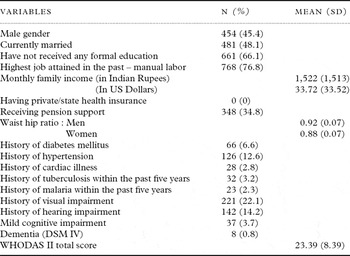
We identified 2,116 people, aged above 60 years, using the database and door-to-door survey. We conducted individual interviews and ascertained that 1,023 people were above 65 years of age. We present the sociodemographic and health profiles of the participants (n = 1,000) in Table 1. The majority of the participants were women, widowed, and lacked formal education. Their mean age was 72.53 (SD 5.87) years. The participants did not differ significantly from those who refused consent to participate (N = 23), either on their gender (χ2 = 1.02; df = 1; p = 0.31) or age (t = −0.51; df = 1021; p = 0.61).
Sociodemographic and health profiles of the participants (n = 1,000)

Note: DSM-IV = Diagnostic and Statistical Manual of Mental Disorders, 4th edn; WHODAS II = World Health Organization Disability Assessment Scale 12-item total score on 1–5 Likert scale.
Health service utilization
The proportion of participants who utilized health services within the previous three months was 68.1% (95% CI 65.2–71.0%) and they made a total of 2,011 visits to health services. The number of visits to private physicians was the highest (772; 38%). The number of visits to PHC, secondary or tertiary care hospitals, alternative medicine, dentists, and traditional healers were 241 (12%), 496 (25%), 307 (15%), 89 (4%), and 106 (5%), respectively.
Nature of out-of-pocket health expenditures
The mean total out-of-pocket health expenditure during the previous three months was US Dollars (US$) 4.83 (SD 75.43). The mean expenditure on traditional healers was the highest with US$ 1.74 (SD 46.46), followed by the expenditure on private physicians, US$ 1.34 (SD 14.59). Mean expenditures for government PHC, secondary or tertiary care hospitals, alternative medicine, and dentists were US$ 0.04 (SD 0.15), US$ 0.26 (SD 3.91), US$ 0.02 (SD 0.33), and US$ 0.04 (SD 0.40), respectively. Mean travel expenditure to health services was US$ 0.33 (SD 0.69). The following were the mean out-of-pocket expenditures per health service visit, limited to those participants, who visited a particular health service at least once: traditional healers US$ 3.75 (SD 21.28), private physicians US$ 1.54 (SD 10.53), Government PHC US$ 0.13 (SD 0.18), secondary or tertiary care hospitals US$ 0.66 (SD 6.92), alternative medicine US$ 0.02 (SD 0.11), and dentists US$ 0.53 (SD 1.10).
Determinants of out-of-pocket health expenditure
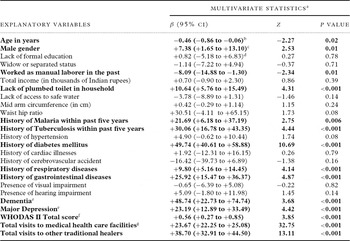
During bivariate analyses, male gender (p = 0.003), widow or separated status (p = 0.007), higher waist hip ratio (p = 0.02), lack of plumbed toilet in households (p < 0.001), malaria (p = 0.006), tuberculosis (p < 0.001), diabetes (p < 0.001), respiratory and digestive diseases (p < 0.001), dementia (p < 0.001), major depression (p < 0.001), and disability (p = 0.02) were significantly associated with higher out-of-pocket health expenditures. Advancing age and having previously worked as manual laborers were inversely associated with out-of-pocket expenditure. We present the multivariate analyses for the determinants of out-of-pocket health expenditure in Table 2. Sociodemographic factors, male gender, lack of plumbed toilets, medical illnesses, and disability, significantly increased out-of-pocket expenditure, after adjusting for the effects of age, gender, and literacy. Visits to medical health services, alternative medicine (β = +18.67; 95% CI + 17.14–20.19; p<0.001), and to other traditional healers significantly increased the out-of-pocket expenditure during multivariate analyses. A parsimonious model, including all bivariate significant variables, could explain 22% of the variability observed in out-of-pocket health expenditure (R 2 = 0.22). In such a model, visits to medical health services (p < 0.001), disability (p = 0.001), diabetes (p < 0.001), and dementia (p < 0.001) were significantly associated with higher out-of-pocket health expenditure.
Factors associated with total out-of-pocket health expenditure among rural older people in south India (n = 1,000)

a Multivariate robust regression models with total out-of-pocket health expenditure (in Indian Rupees) as the dependent variable, adjusted for effects of age, gender, and literacy as covariates, with total out-of-pocket health expenditure as the dependent variable.
b Adjusted for the effects of gender and literacy.
c Adjusted for effects of age and literacy.
d Adjusted for the effects of age and gender.
e Diagnosis based on the DSM IV diagnostic criteria.
f WHO Disability Assessment Scale II 12-item total score.
g Total number of visits to medical healthcare facilities such as primary health care centers, secondary or tertiary care hospitals, private physicians, and dentists.
Probable consequences of high out-of-pocket health expenditure
Participants who spent more than 10% of their total family income on health, during the past three months, had significantly higher risk to experience hunger (Adjusted Relative Risk (ARR) 2.38; 95% CI 1.53–3.70; p < 0.001), suicidal ideation (ARR 1.09; 95% CI 1.17–7.66; p = 0.02), and depressive ideas (ARR 3.59; 95% CI 1.96–6.58; p < 0.001) at the time of this study, after adjusting for the effects of age, gender, and education. Although causal relationship could not be ascertained with this cross-sectional design, the consequences of out-of-pocket health expenditure, above 10% of their total income, could seem catastrophic for our older participants.
Determinants of catastrophic health expenditure
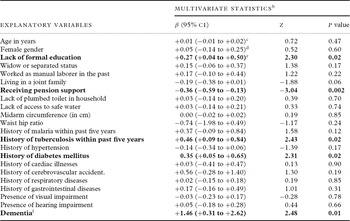
The prevalence of catastrophic health expenditure, as defined by out-of-pocket health expenditure above 10% or 40% of the total family income, was 13.3% (95% CI 10.9%–15.1%) and 7.5% (95% CI 6.4%–9.6%), respectively. During bivariate analyses, female gender (p = 0.04), widow or separated status (p = 0.009), lack of formal education (p = 0.004), past occupation as manual laborer (p = 0.02), tuberculosis (p = 0.02), diabetes mellitus (p = 0.04), and dementia (p = 0.01) increased the risk for catastrophic health expenditures. Pension support (p = 0.009) and living in a joint family (p = 0.02) reduced the risk of catastrophic health expenditures. After adjusting for the effects of literacy alone, the associations between catastrophic health expenditure and many bivariate significant determinants, including female gender (β = +0.04; 95% CI −0.15 to +0.23; p = 0.69), widowhood (β = +0.14; 95% CI −0.04 to +0.32; p = 0.13), and past occupation as manual laborer (β = +0.17; 95% CI −0.09 to +0.43; p = 0.20) were not statistically significant. We present the multivariate analyses for the determinants of catastrophic health expenditure in Table 3. Lack of formal education, tuberculosis, diabetes, and dementia continued to increase the risk for catastrophic health expenditure, during further multivariate analyses, adjusting for the effects of age, gender, and literacy. When we analyzed a parsimonious model, including all bivariate significant variables, Widow or separated status (p = 0.02), tuberculosis (p = 0.02), diabetes (p = 0.04), and dementia (p = 0.01) significantly increased the risk of catastrophic health expenditure, while Government pension schemes (p < 0.001) were protective against it.
Factors associated with catastrophic health expenditure a among rural older people in south India (n = 1,000)

a Total out-of-pocket health expenditure is more than 10% of the total family income.
b Maximum likelihood probit regression model with Heckman sample selection, employing catastrophic health expenditure using 10% as threshold value is the dependent variable, adjusted for effects of age, gender, and literacy as covariates. Health services visits were included as the selection variable (total visits ≥ 1 is coded as selected) and disability levels of the participants (WHODAS II 12-item total scores) were included in the selection equation.
c Adjusted for effect of gender and literacy as covariates with catastrophic health expenditure of 10% as the dependent variable and visiting health services as the selection variable.
d Adjusted for the effects of age and literacy.
e Adjusted for effects of age and gender.
f Diagnosis based on the DSM IV diagnostic criteria.
When we defined catastrophic health expenditure by out-of-pocket health expenditure above 40% of the total family income, the following variables were significantly associated with it, after adjusting for the effects of age, gender, and literacy: lack of formal education (β = +0.31; 95% CI +0.05 to +0.57; p = 0.02), past occupation as manual laborer (β = +0.50; 95% CI +0.06 to +0.94; p = 0.03), and malaria (β = +0.60; 95% CI +0.14 to +1.05; p = 0.01). Government pension schemes (β = −0.48; 95% CI −0.76 to −0.20; p = 0.001) were again protective.
Correlates of economic inequality
Women (Mann–Whitney U = 86,800; p < 0.001) and those who lacked formal education (p < 0.001) had significantly lower incomes. Participants, who worked as unskilled manual laborers in the past, and who lacked pension support also had less income than others (p < 0.001). Older people who had access to safe water (p < 0.001), plumbed toilets (p < 0.001) and better nutrition (p < 0.001), were significantly richer than those, who lacked access to such fundamental needs. Those with tuberculosis (p = 0.003), visual impairment (p = 0.01), and depression (p < 0.001) had significantly less income, while those with hypertension (p = 0.04) were significantly richer. Total income was significantly inversely related with WHODAS II disability scores (β = −16.18; 95% CI −25.59 to −6.77; p = 0.001), implying that poverty was associated with higher disability. However, the relationship between income and out-of-pocket health expenditure was not linear (β = +0.05; 95%CI −0.10 to +0.19; p = 0.52).
Discussion
Our study evaluated the determinants of out-of-pocket and catastrophic health expenditures among Indian rural older people. This is the largest available study from LMIC, to investigate these objectives, by exclusively recruiting older participants. Its strengths include studying a combined model of social and medical determinants and employing standard assessment instruments. The possibility of selection bias was avoided by recruiting all eligible older people in a geographically defined rural community. Recall bias was minimized by collaborating with local community health workers and by verifying the medical history with available medical records. Its limitation was its cross-sectional design and consequent temporal ambiguity. Employing multiple models of regression analyses might have inflated the likelihood of type I errors.
Factors associated with out-of-pocket health expenditure
Non-communicable diseases, such as diabetes, are considered as the major determinants of geriatric health expenditure (McIntyre et al., Reference McIntyre, Thiede, Dahlgren and Whitehead2006; WHO, 2011c). Our findings support the fact that communicable diseases and related socioeconomic factors also determine out-of-pocket health expenditures among the older people in LMIC. Lack of plumbed toilets increased the out-of-pocket expenditure significantly. Investing in sanitation and improving living conditions may prevent infectious diseases such as malaria, tuberculosis, and gastrointestinal diseases. In turn, they may reduce the number of health visits and the overall burden of out-of-pocket health expenditure.
Many poor older people in LMIC, who lack secure regular income and health insurance, avoid utilizing health services, or risk experiencing catastrophic out-of-pocket expenditure. Inequities in the healthcare delivery still exist, due to the prevailing economic inequality in many LMIC (Albanese et al., Reference Albanese2011). Our results showed that women, and those, who worked as unskilled manual workers and lacked pension support, spent significantly less out of their pockets. Older women were significantly more disabled in our population (Duba et al., Reference Duba, Rajkumar, Prince and Jacob2011). Hence, less out-of-pocket health expenditures in such vulnerable older people are better explained by poor financial resources than by reduced need for health services. Existing public health services should strive to minimize out-of-pocket expenditures to ensure equitable access to health services for all older people (Ahmed et al., Reference Ahmed, Adams, Chowdhury and Bhuiya2000; van Doorslaer et al., Reference van Doorslaer2007; Balarajan et al., Reference Balarajan, Selvaraj and Subramanian2011).
Many rural older people rely on the services of traditional healers in LMIC (Stekelenburg et al., Reference Stekelenburg, Jager, Kolk, Westen, van der Kwaak and Wolffers2005; WHO, 2008). Visits to traditional healers significantly increased the out-of-pocket health expenditure. A study from Nigeria has also reported similar findings (Uwakwe et al., Reference Uwakwe2009). As many older people in LMIC simultaneously hold multiple medical and non-medical explanatory models for chronic diseases (Charles et al., Reference Charles, Manoranjitham and Jacob2007), their culturally rooted belief systems make them seek help from traditional healers, despite a clear economic disadvantage. Primary care health professionals need to be more sensitive to these culturally ingrained non-medical beliefs. Their cultural competence in addressing these belief systems during their health education sessions may reduce helpseeking from multiple facilities and may bring down the cost of care.
Need to reconsider the definition of catastrophic health expenditure in LMIC
Distinguishing between high out-of-pocket health expenditure and catastrophic health expenditure is essential. Many older people in LMIC, who have meager financial resources and lack the support of social security net and health insurance schemes, suffer catastrophic consequences, although their actual out-of-pocket expenditures are modest. Hence, the burden of out-of-pocket health expenditure should be weighed within the local socioeconomic context. The threshold for exploring catastrophic health expenditure varies among different countries (Wyszewianski, Reference Wyszewianski1986; Wagstaff and van Doorslaer, Reference Wagstaff and van Doorslaer2003; Xu et al., Reference Xu, Evans, Kawabata, Zeramdini, Klavus and Murray2003; Su et al., Reference Su, Kouyate and Flessa2006; Limwattananon et al., Reference Limwattananon, Tangcharoensathien and Prakongsai2007) and the need to lower the threshold from 40% to 10% of total family income in LMIC has been suggested (Bonu et al., Reference Bonu, Bhushan and Peters2007). In our population, older people who spent more than 10% of their income on health were more prone to suffer from food scarcity, depressive ideas, and suicidal ideas. These findings add evidence and highlight the need to reconsider the definition of catastrophic health expenditure in India. Locally appropriate definitions for catastrophic health expenditure will aid in identifying individuals and households at much greater risk. This will help in targeting health financing policies in LMIC. Relevant definitions are also essential for research to investigate the causal pathways and to evaluate likely interventions.
Factors associated with catastrophic heath expenditure
Our findings confirm alarming prevalence of catastrophic health expenditure in LMIC (Xu et al., Reference Xu, Evans, Kawabata, Zeramdini, Klavus and Murray2003). Those who lacked formal education, were at higher risk for catastrophic health expenditure. Our analyses documented that the association between catastrophic health expenditure and many bivariate significant determinants, such as female gender and widowhood, dissipates, when controlled for the effects of literacy alone. These findings highlight the importance of education to curtail the catastrophic consequences of out-of-pocket health expenditure. Education is positively associated with judicious health service utilization, especially of prevention and promotion services, and with better adherence to treatment protocols by older people in LMIC (Albanese et al., Reference Albanese2011). It opens the doors for better employment, higher income, better living conditions, and access to pension schemes. Improving the literacy of a population may reduce the incidence of catastrophic health expenditure. Both communicable and non-communicable diseases increased the risk for catastrophic health expenditure. Primary prevention strategies for tuberculosis and diabetes may prevent catastrophic health expenditure. Our results have confirmed that existing pension schemes were protective factors. Current government-funded pension schemes should be sustained at any rate, if they cannot be expanded.
Need for equitable health services
Utilization of health services, requiring out-of-pocket expenditure, depends on the resources and the needs of an individual. Economic inequality has complex interactions with the needs for out-of-pocket health expenditure. The rich have better living conditions and education, and generally better health, reducing their needs for out-of-pocket health expenditure. However, as they are better educated and have more economic resources, their awareness of the need for healthcare can be higher, and the thresholds at which they access services correspondingly lower. The opposite applies to the poorer and less educated who are much less likely to use health services (Albanese et al., Reference Albanese2011), especially prevention services, leading to worse health standards thus increasing the risk of catastrophic out-of-pocket expenditure. Although our cross-sectional study design could not disentangle these intricate interactive pathways, we documented that there were significant differences in the prevalence of various diseases between the rich and the poor and that poverty was associated with higher disability among older people (Duba et al., Reference Duba, Rajkumar, Prince and Jacob2011). The need for out-of-pocket health expenditure is an important link between the economic inequality and the inequities in the delivery of healthcare to older people in LMIC. Inequity in the delivery of healthcare to older people is a violation of universal declaration of human rights (UN, 1948). Minimizing out-of-pocket health expenditure is a priority to ensure equitable healthcare delivery to all older people in LMIC.
Hence, our results suggest the following:
-
1. Both social and medical determinants contribute toward out-of-pocket health expenditure. Policies to curtail out-of-pocket expenditure should extend beyond curative medical approaches, to encompass preventive social aspects (Jacob, Reference Jacob2007). Future research should investigate combined social and medical models.
-
2. Infectious diseases still add to the out-of-pocket health expenditure for older people in LMIC. Ensuring the basic human rights, such as access to clean water, adequate nutrition, and sanitation, may reduce the likelihood of spending of limited resources in LMIC, on modern diagnostic aids and on expensive drugs (Jacob, Reference Jacob2007).
-
3. Lack of education is associated with poor health standards and poses disproportionate burden on health and economy (WHO, 2011c). Health programs in LMIC should work in cooperation with the social welfare programs, which improve literacy and social equity.
-
4. Many rural older people seek help from traditional healers. Improving the cultural competence of the primary care health professionals and integrating traditional healers with the existing health services may reduce their out-of-pocket health expenditure (WHO, 2001a). Despite the concerns regarding such integration, appropriately trained traditional healers are helpful to promote health among the rural communities in LMIC (Freeman and Motsei, Reference Freeman and Motsei1992; Miller et al., Reference Miller, Rashida, Tasneem and Haque2012).
-
5. High reliance on private physicians indicates the shortcomings of the current public health services and the need to strengthen prepayment mechanisms in LMIC (Xu et al., Reference Xu, Evans, Carrin, Aguilar-Rivera, Musgrove and Evans2007). Future studies should explore the pitfalls of existing government primary health services and their referral centers.
-
6. The presence of influential outliers among any health expenditure data is a rule rather than an exception in LMIC with high economic inequality. Hence, future studies should employ appropriate robust regression models, and not parametric analyses (Ruger and Kim, Reference Ruger and Kim2007), to investigate such data.
It is time to guarantee basic human rights, including equitable access to health services, to all older people in LMIC.
Conflict of interest
None.
Description of authors' roles
MP conceived and designed the project. KSJ supervised and implemented the study. EMB, APR, UE, MP and KSJ analyzed the data and wrote the paper. All authors reviewed the manuscript, read, and approved the final draft.
Acknowledgments
This work should be attributed to the Department of Psychiatry, Christian Medical College, Vellore 632002, India. This study is part of the population-based investigations of the 10/66 Dementia Research Group of Alzheimer's Disease International. It was supported by grants from the World Health Organization and from the Institute of Psychiatry, London. We thank all the study participants as well as their families for their cooperation and the research fellows Mr. Senthil Kumar, Ms. Gayathri, Ms. Kanagathara, and Ms. Symon for data collection. We also thank Mr. Antonio Rodriguez Andres, Aarhus University, Denmark, for his valuable feedback regarding the statistical models.