Introduction
The role of public administration in Central and Eastern Europe (CEE) countries is changing rapidly, due to post-socialist developments and the globalization of society and the economy, and because it is directed at the Europeanization of the region, which is striving to become an active part of the EU (Kovač and Jukić Reference Kovač and Jukić2017). The single European market, with its free movement of goods, puts product safety and quality at the top of the agenda (Koszewska Reference Koszewska2003). A strong driver for change in Serbian legislation comes from its political decision to apply for EU membership. Many of the requirements laid down in international standards, directives and other legislative measures must be met by the Serbian economy so that Serbia can join the market mechanisms. Unfortunately, governments usually become aware of their role as a control organ only when the whole consignment of export goods is rejected because they do not comply with international legislation (Physikalisch Technische Bundesanstalt (PTB 2007). Therefore, establishing a good national quality infrastructure is a key step towards good governance, which creates a favourable trade climate in the (CEE) region (PTB 2007). However, globalization, uncritical model-taking from the EU, and a lack of awareness of the importance of national quality infrastructure (NQI) issues often lead to ‘shallow Europeanization’ (Czernielewska et al. Reference Czernielewska, Paraskevopoulos and Szlachta2004). During the accession period, uncritical and mechanical law adoption with a fast-track procedure and lack of knowledge, experience or expertise on the part of policy-makers are usually identified as causes of ‘Euroscepticism’. Although the common problems of the transposition of EU legislation in CEE countries are widely studied, our knowledge is still limited about how public policy-makers perceive QI (quality infrastructure) issues in the specific case of Serbia during the EU pre-accession process.
Quality infrastructure refers to all aspects of metrology, standardization, testing, quality management, certification and accreditation that have a bearing on conformity assessment (Pejović et al. Reference Pejović, Filipović and Tasić2011). As such, an adequate NQI is an important precondition for developing countries to have access to international markets and it is an integral part of the economy. The growing importance of quality in daily life, business activities and governance prompts the need to consider its role in policy-making more explicitly. Hence, our article addresses the NQI issue of the adaptation of Serbian administrative systems to new legislation in the process of Europeanization. In order to deal with this subject, we employ qualitative and quantitative methods: (1) content analysis of speeches; (2) a literature review (comparative analysis); and (3) a questionnaire. The article contributes to the understanding of (1) CEE region policy-making capabilities and procedures in EU law transposition; and (2) the in-depth particularities of Serbia.
Literature Review
The recent enlargement rounds of the European Union with the inclusion of new member states, mostly from the CEE and the Balkan regions, have attracted remarkable attention in the academic literature and in policy debates (Koutalakis Reference Koutalakis2010). Actually, there is a strong body of literature shedding light on common problems the CEE pre-accession countries face, such as ‘shallow Europeanization’ (Musa and Petak Reference Musa and Petak2015), ‘Potemkin harmonization’ (Bugarič Reference Bugarič2015) ‘rubber stamp’ effects (Mikulova Reference Mikulova2013), ‘empty shells’ (Dimitrova Reference Dimitrova2010) or ‘world of dead letter’ (Falkner Reference Falkner2010). Before accession to the European Union, the negotiations start with a preparatory phase or a screening of the acquis, which is conducted by the Commission and is followed by the adoption of basic EU legislation. Crucially, Přibáň (Reference Přibáň2007: 99) claims that ‘national parliaments which favoured a smooth integrative process without adequate political debate, mechanically enacted most of the proposals harmonizing national laws with the EU legal framework’ in the form of ‘well-oiled machines’. Furthermore, Berry and Baybeck (Reference Berry and Baybeck2005) notice that states may be more likely to adopt bills that their politically, demographically and economically similar neighbours adopt. As a consequence, without the development of a perception of domestic needs and without mobilizing domestic actors of policy development, enforcement will be seriously threatened (Tews Reference Tews2009). On the flipside, the time pressure and a number of required reforms sometimes lead to the mechanical and fast filling of gaps without prior impact evaluation and a clear strategy for reform (Nikolova Reference Nikolova2006). In Haughton’s (Reference Haughton2007: 236) opinion, the fast-track mechanisms can avoid the normal procedures of a democratic process, since candidate countries are forced to accept lots of new laws in a short period of time.
In order to build a common platform for studying policy-making in some particular fields in the EU pre- and post-accession CEE countries, we developed a framework for a comparative analysis of policy-making. The framework is based on the results of extensive literature research and creates generalized knowledge and experience in some particular areas, such as quality infrastructure. In the context of the EU–CEEC transmission belt of legislation in pre- and post-accession periods, we point to the common problems of ten states (Table 1): (a) legislative approximation without modification; (b) lack of experience, knowledge and expertise; (c) adoption of the EU laws in a fast-track procedure. We focus on young and post-transition CEE countries on the assumption that due to the EU accession process they went or are going through a similar administrative change process.
The common problems of EU law harmonization in CEECs.

Candidate countries have not yet faced the effects of Potemkin harmonization or shallow Europeanization, because it is largely a phenomenon that only later becomes apparent in post-accession countries. Therefore, in many respects, EU policies in the CEE neighbourhood have not necessarily been closely suited to partner countries’ needs, capabilities and priorities.
Quality Infrastructure Policy-making – The Case of Serbia
The process of Europeanization begins at an earlier stage in the Balkans than it did in CEE countries. Integration of Serbia into the EU is seen as a national priority. The Stabilization and Association Agreement and the Interim Agreement on Trade between Serbia and the EU were signed in 2008, when Serbia committed to harmonize its legislation with the EU acquis communautaire (Smigic et al. Reference Smigic, Rajkovic, Djekic and Tomic2015). In formal terms, enlargement has meant the alignment of the institutional and legislative system of candidate states with the acquis of EU legislative material (Krizsan and Popa Reference Krizsan and Popa2009) including ‘free movement of goods’ (standardization, conformity assessment, accreditation, metrology and market surveillance). Harmonizing national legislation with regional and international trade partners is a key step in supporting global NQI integration (Tippmann Reference Tippmann2013). According to Pejović et al. (Reference Pejović, Filipović and Tasić2011: 254), ‘quality infrastructure relates to all fields of metrology, standardization and testing, of quality management and conformity assessment, including certification and accreditation’. It provides acceptable evidence that products and services meet defined requirements, be it demanded by authorities or the marketplace. In the NQI system, ‘accreditation’ plays a vital role because ‘it is an accepted process by which a third party gives formal recognition that an organization is competent to carry out specific tasks’ (Castanheira et al. Reference Castanheira, Robb, Owen, den Boer, Schmit, Ent and Calhau2007: 726) related to certification of products, management systems and personnel. No less important are ‘metrology’, which ensures that measurements are made with appropriate accuracy, reliability (Choi et al. Reference Choi, Hyun, Hong and Kang2014), and ‘standardization/standards’ as a significant quality assurance tool in free trade. Quality infrastructure management issues significantly influence productivity, economic growth and quality of life in every country. They play a leading role in productive, economic and social development concepts and policies (Gonçalves et al. Reference Gonçalves, Göthner and Rovira2015). Actually, NQI is an integral part of the economy and the foundation of world trade.
In today’s business environment, a functioning NQI is a prerequisite for entrance to the EU single market. However, certain differences may be observed among CEE countries’ NQIs. Some of them are EU members (such as Romania, Bulgaria, Hungary or Croatia) while others are still candidate members (Serbia, Montenegro or Macedonia). Some, such as Poland, Romania, Slovakia, the Czech Republic and Hungary are in the group of the fastest growing economies (CEE Investment Report 2016). As Racine (Reference Racine2011: 7) states ‘countries in transition had some type of NQI before the transition, but the systems were designed on the basis of the logic of a planned economy’. Serbian QI institutions operate in accordance with the regulations governing the legal status of the public services, founded by the Government under the coordination of the Ministry of Economy. On the contrary, in the US and Australia, for instance, some QI institutions are private/non-governmental.
Research Problem and Hypotheses
The situation indicated by the generic problems (Table 1) leads to the question: ‘How does Serbia as a transition pre-accession state deal with harmonization of legislation’? By extending our field of analyses to ten countries, we expect to obtain a sufficiently large basis for the following hypotheses.
H1: The NQI laws are largely the result of a mechanical transfer of solutions from existing global models.
H1a: During the QI law harmonization, policy-makers do not consider national particularities.
Legislators use speeches as a tool for criticizing existing policies and appealing to potential voters (Akirav Reference Akirav2014). Numerous scholars identified the widely used keywords/concepts in political speeches with regard to different topics (Kratochvíl and Tichý Reference Kratochvíl and Tichý2013; Neiman et al. Reference Neiman, Gonzalez, Wilkinson, Smith and Hibbing2015; Schwartz et al. Reference Schwartz, Caprara and Vecchione2010; Pitman Reference Pitman2012). Hence, we hypothesize the following.
H2: Policy-makers are not fully familiar with the meaning of quality infrastructure concepts and they often use QI terminology for marketing purposes.
The disconnection between policy-makers and experts is common to many sectors and academic disciplines (Brown et al. Reference Brown, Mitchell, Holden, Folkard, Wright, Beharry-Borg, Berry, Brierley, Chapman, Clarke, Cotton, Dobson, Dollar, Fletcher, Foster, Hanlon, Hildon, Hiley, Hillis, Hoseason, Johnston, Kay, McDonald, Parrott, Powell, Slack, Sleigh, Spray, Tapley, Underhill and Woulds2010). There exists a strong body of literature on how policy-makers attempt to identify and make use of external expertise (Newman et al. Reference Newman, Cherney and Head2016; Head Reference Head2015; Spruijt et al. Reference Spruijt, Knol, Vasileiadou, Devilee, Lebret and Petersen2014). However, whether policy-makers really consider experts’ opinion remains a question for further research. This leads to our next hypothesis.
H3: The experts are not significantly involved in NQI policy-making processes.
Methodology
In order to explore the extent to which policy-makers perceive NQI we employ the ‘triangulation’ method used in qualitative social science (Fosco and Bray Reference Fosco and Bray2016; Koc and Boz Reference Koc and Boz2014) to arrive at the same point on the basis of multiple measures and diverse analytic perspectives (Archibald Reference Archibald2015). An empirical focus on the CEE region (comparative analysis), a questionnaire, and a content analysis of speeches help us to prove our hypotheses and strengthen the accuracy of our results (Figure 1).
Triangulation and hypotheses.

Developing the Questionnaire
The questionnaire was issued in electronic form to quality management experts. It comprises 89 closed questions. Acting under the advice of Dolnicar and Grün (Reference Dolnicar and Grün2014) we used a four-point Likert-type answer format (1 – Disagree strongly; 4 – Agree strongly), because midpoints on the scale do not add much value and have the potential to induce evasion such that, as a consequence, researchers will lose information. Furthermore, following Perona-2010;Garcelán et al. (Reference Perona-Garcelán, Úbeda-Gómez, León-Palacios, Barros-Albarrán, Escudero-Pérez, López-Jiménez, Vallina-Fernández, Jiménez-García-Bóveda, Diez-Alegría, Rodríguez-Testal, Ruiz-Veguilla, García-Montes, Pérez-Álvarez and Hayward2016), we use Cronbach’s alpha for the assessment of the inter-consistency.
Sample
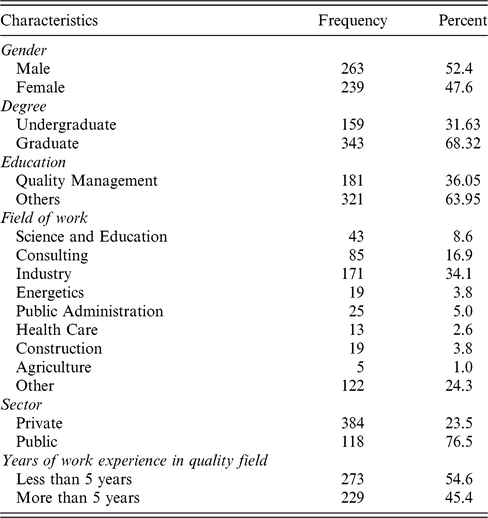
A survey was conducted among Serbian quality management experts (scientists, engineers, researchers and other practitioners who possess professional and specialized knowledge in quality management and related fields). The questionnaire was distributed to 2885 experts and a total of 502 experts completed the questionnaire. Similar to Carter (Reference Carter2017), the effective response rate of 17.4% gave the authors confidence that the survey had reached a representative sample of the target audience. The basic elements of the statistics group that are used for research purposes in this study were defined by descriptive statistics (Table 2). As for the statistical analysis of the data, we used the Chi-Square Contingency Table and Mann-Whitney test, with the p-value of less than 0.05 being considered statistically significant.
Demographic profiles and descriptive statistics of respondents.

Content Analysis
As part of our triangulation we employed a qualitative method that involved content analysis of speeches related to the NQI issue in Serbia. This method has been widely used to assess the extent to which emotions are present in policy speeches (De Castella et al. Reference De Castella, McGarty and Musgrove2009) or to analyse policy-makers’ visions, beliefs, aspirations (Pitman Reference Pitman2012) or views (Coffey Reference Coffey2005). The data were collected from stenographic notes of debates in the National Assembly of Serbia on a set of NQI bills from 2009 to 2010 (226 speeches). We undertook a detailed analysis of 35 speeches about NQI bills, including those of proponents of the law, and ministerial and MPs’ speeches. The source of the data was the website of a project called Open Parliament (2017), supported by the US Agency for International Development.
Discussion of the Results
NQI Legislative
The Serbian NQI laws, based on the principles of the New Legislative Framework, constitute the legal foundation for the adoption and application of technical legislation consisting of the following: (a) the Law on Accreditation; (b) the Law on Metrology; (c) the Law on Technical Requirements for Products and Conformity Assessment; and (d) the Law on Standardization. Going back to the years 2009 and 2010, we analysed the agendas and stenographic notes of parliamentary debates on QI bills in Serbia. The first QI laws were adopted in 2009, including the Law on Technical Requirements for Products and Conformity Assessment followed by the Law on Standardization. Generally, the greatest number of bills was adopted in 2009 and 2010 (Smigic et al. Reference Smigic, Rajkovic, Djekic and Tomic2015) when the agenda of the National Assembly most frequently contained bills from the so-called ‘European Agenda’. Analysing the 2009 agenda we notice that the discussion on the Law on Technical Requirements for Products and Conformity Assessment and the Law on Standardization was the least well-attended (85 present from a total of 250). An equally important observation that supports H1 is that government representatives and representatives of the ruling parties tended to emphasize the importance of adopting QI bills as a condition for entry into the World Trade Organization (WTO) and the EU, and only then explained why it was important for the country and economy. It is a kind of mantra that has been repeated over and over again and in this way law proposers (un)consciously influence members of Parliament and put pressure on them to adopt bills as soon as possible and vote positively. The government expects them to behave like ‘pupils who adopt the norms of the teachers’ (Mikulova Reference Mikulova2013).
There is also a strong conviction with the experts that the NQI laws in Serbia were simply downloaded from the EU (85%). Experts with more than five years of work experience in quality management asserted that NQI laws in Serbia were transferred from the European Union (2.93±0.623 versus 3.04±0.494, p<0.05). When it comes to NQI policy-making, 75.9% of the respondents believe that the requirements for joining the WTO and EU affect policy-makers’ initiatives. Furthermore, within the process of mechanical EU law harmonization, the experts think that Serbian policy-makers do not take into consideration specifics such as national culture (76%), the national economy (69.3%), language barriers (67.9%), tradition (63.1%), administrative overload (53.5%) and state economic policy (49.6%). These findings bring us to H1a. Consequently, without the development of a perception of domestic needs, enforcement will be seriously threatened (Tews Reference Tews2009).
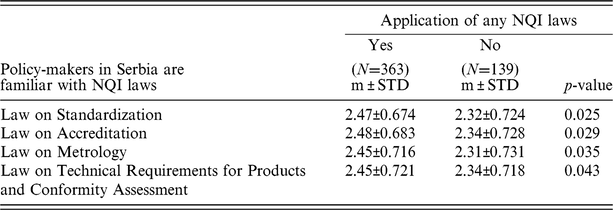
In favour of H1, the authors find that there is a statistically significant difference of opinion among respondents who apply and who do not apply any NQI laws at the workplace. Those who apply the laws believe that policy-makers in Serbia are familiar with the NQI laws (Table 3) and they also think that policy-makers understand the role and significance of QI elements such as ‘metrology’ (2.38±0.713 versus 2.23±0.695, p<0.05) and ‘conformity assessment’ (2.35±0.744 versus 2.19±0.731, p<0.05). From one point of view, this finding might be partially explained by the fact that the policy-makers develop the solutions through legislation, so experts suppose that they are familiar with the laws they make and develop. Incorrect measurement results or nonconformity of products with certain standards and laws could have fatal implications for customers’ health, the environment, and safety and quality assurance. The respondents who apply any of the QI laws are more aware of the consequences of policy-makers’ ignorance of the topic, so their rule of thumb is that policy-makers must be familiar with these laws and concepts.
Application of any NQI laws in the workplace* Policy-makers in Serbia are familiar with the NQI laws.

From the second point of view, this finding might indicate that the MPs perceive the QI bills as good EU practice and that they adopt them automatically without debate. The exception is the Law on Accreditation, which was the subject of heated and lengthy debates. Similarly, the results of a comparative analysis of CEECs indicate phenomena of ‘flow through boiler’ and ‘fast-track’ procedures. Faced with a need to accept voluminous new legislation in a short period of time, countries apply fast-track mechanisms to circumvent the normal procedures of a democratic process (Haughton Reference Haughton2007: 236). Moreover, the problem of the dissimilarity of bills treated in joint discussions also arises. According to the Rules of Procedure of the National Assembly of Serbia (2009/10), ‘joint discussions on related bills are possible if they are interdependent or their solutions are related’. However, the analysis of the stenographic notes reveals that, within the same agenda, the bills treated were not interdependent (for example, the Law on Metrology was part of a joint discussion with the Law on the Right to Free Shares, the Law on Privatization and the Law on Regional Development). In such a mixture, NQI bills were perceived as ‘intruders’. As a consequence of fast-track procedure (lack of time) and unrelated laws bundled on the same agenda, the number of speeches/debates related to NQI bills was significantly smaller (35 of total 226 speeches).
These findings also support H1 and point to H1a. Drawing on Grabbe’s (Reference Grabbe2001) statement, we can say that the lack of debate in most CEE legislatures could reflect a consensus on accession (‘well-oiled machine'), and it could point to a lack of awareness of the details of the legislation being passed, or it could mean that policy-makers do not feel that they can change anything over here, resulting in a kind of apathy.
Policy Speeches and Terminology
Orlović (Reference Orlović2012: 238) believes that in Serbia ‘there are MPs who are entirely ignorant about the issue … when you ask a question you see that that the person does not understand the subject matter entirely or that they simply do not even know what you are talking about’. As we assumed in H2, in the stenographic analysis the same problem is identified. Actually, some MPs suggested changing the name of the Law on Accreditation to the Law of Quality Inspection of Products and Services. In this case, we can notice that policy-makers do not distinguish QI concepts. Prompted by our previous findings, we asked quality management experts in Serbia to express an opinion about the most frequently used QI concepts in political speeches. In favour of H2, the survey reveals that some of the QI concepts are (ab)used in political rhetoric and their utilization increases during an election campaign. The most employed concepts are ‘quality’ (CC= 40.258, p<0.001), ‘standard’ (CC=44.830, p<0.001), ‘quality of life’ (CC=29.671, p<0.001, ‘product/service/food safety’ (CC=12.300, p<0.001), ‘accreditation’ (CC=9.608, p<0.001), ‘quality inspection’ (CC=7.683, p<0.01) and ‘ISO’ (CC=3.862, p<0.05). Generally, 85.85% of experts think that policy-makers insufficiently cover QI terminology in the media and do so with an inadequate meaning or in an incorrect context (CC=13.229, p<0.001). The experts with more than five years of work experience in the field agree that the items mentioned are not used adequately and in the right context (1.80±0.600 versus 1.91±0.571, p<0.05). Briefly, we can say that Serbian policy-makers usually provide their own interpretation of QI terminology: it has become an attractive ‘suitcase’ of words that assume a variety of meanings depending on the context in which they are used. The survey shows that ‘accreditation’ and ‘quality inspection’ are least used in policy speeches. The findings from the stenographic notes also indicate that policy-makers are not familiar with these two concepts. The explanation Williams (Reference Williams2001: 31) proffers is that ‘policy-makers could be less familiar with the technical language or they just lack information and specialized knowledge’.
When it comes to management system standards, it must be emphasized that they are generally based on the principle of voluntariness. Of the total number of quality manager experts consulted, 63.5% think that policy-makers in Serbia are not familiar with the role of management system standards and the majority believe that policy-makers do not know that the application of ISO management system standards is voluntary (CC=55.272, p<0.001). Exceptionally, standards may be rendered compulsory in the form of technical regulations or by legislation. Furthermore, the experts who agree with the assertion that policy-makers in Serbia are not familiar with the role of these standards also concur that policy-makers do not take into consideration the requirements of stakeholders interested in different management systems such as quality (CC=59.700, p<0.001), social responsibility (CC=56.971, p<0.001), food safety (CC=45.385, p<0.001), risk (CC=43.051, p<0.001), information security (CC=30.836, p<0.001) and energy efficiency (CC=29.067, p<0.001).
The Relationship between Policy-makers and Experts
An important issue that deserves closer study is the flow of knowledge and influence between governmental decision-makers and non-governmental experts who produce rigorous knowledge (Head et al. Reference Head, Ferguson, Cherney and Boreham2014). As Max Weber (Reference Weber1922) has already noted, expertise is a major type of authority in addition to the formal authority vested in political and administrative systems. Zhu (Reference Zhu2013: 281) defines experts as ‘special policy-making participants who use their expertise to influence the decision-making process’. According to Tamtik and Sá (Reference Tamtik and Sá2012), experts come from a variety of occupations, including not only scientists and researchers but also a broader range of societal actors, government officials or professionals from different fields. Sometimes, policy debate can be dominated by instrumental and centralized information constructed and controlled by functional and managerial experts (Head Reference Head2013).
By testing hypothesis H3, we found that the quality management experts think that during the NQI policy-making process they can affect policy initiatives and decisions, but they are not sufficiently involved (CC=44.937, p<0.001). The same problem is recognized in Portfolio Committees of the National Assembly in Serbia which may engage research or professional institutions or persons in order to study specific issues. The respondents who think that the Portfolio Committees significantly affect policy decisions also agree with the statement that experts are not suitably involved (CC=24.396, p<0.001). Afterwards, we focused on the question of whether any of the respondents had been invited to participate in the Serbian QI policy-making. It is interesting that 87.6% of them were never invited, 5.6% were invited but did not participate, and only 6.8% experts were invited and took part. However, this pretty much fits with the conclusion of Newman et al. (Reference Newman, Cherney and Head2016) that academics and policy-makers are perceived as occupying separate communities. During the implementation of new EU food safety systems in Serbia, Smigic et al. (Reference Smigic, Rajkovic, Djekic and Tomic2015) noticed that the Ministry of Agriculture faced the following problems: (a) poor infrastructure; (b) inadequate personnel policies; and (c) an insufficient number of experts. The same problem of ‘limited expert knowledge’ we also recognize in the comparative analysis of CEECs policy-making (Table 1). According to Halffman and Hoppe (Reference Halffman, Hoppe, Maasse and Weingart2004), in times of difficult political bargaining, policy-makers may prefer to rely rather on their own knowledge, skills and ability, because the last thing they want is to be criticized by the experts. Consequently, evaluation of the likely consequences of each policy option can be easily overlooked.
Conclusion
A strong driver for change in Serbian legislation comes from the country’s political decision to apply for EU membership. In order to build a common platform for studying policy-making in some particular fields in the EU pre- and post-accession CEE countries, we developed a framework for a comparative analysis of policy-making in these countries. This framework, based on the results of an extensive literature research, has served as a valuable tool for the application of generalized knowledge and experience in some particular areas, such as quality infrastructure. The framework rests on three key propositions concerning policy-making in the EU pre- and post-accession CEE countries. These are that policy-making in these countries is strongly influenced by existing EU policies and legislation; that these processes require a specific level of dedication, experience, knowledge and expertise of the policy-makers, and that time pressure is a constraint to successful policy-making projects.
Next to a comparative analysis, an analysis of policy speeches and the results from a questionnaire lead to the following conclusions. First, policy-makers in the Republic of Serbia are not fully familiar with the NQI terminology but they utilize it for marketing purposes. Second, policy-makers adopt QI laws mechanically and without adjustment to the national culture, economy, language and tradition. Finally, regardless of their own lack of specialized knowledge and expertise, policy-makers do not involve experts in NQI policy-making. Negative implications for the economy, health, safety, consumer protection and environmental issues in the common market may result. In addition, such an approach to NQI stifles innovation, may create impediments to trade, and does not guarantee the safety of import and export products.
Different NQI schemes offer an opportunity to establish a hybrid model that would blend their most suitable elements. Certainly, this would lead to the circumvention of a mechanical transfer of solutions from existing global models, as well as open the possibility for serious considerations of national particularities. Moreover, this would certainly prevent the policy-makers from using QI terminology as buzzwords for their political campaigns. The model by Hubo and Krott (Reference Hubo and Krott2013), which combines specialized and integrated public administration systems, would nicely corroborate the hybrid model, opening the possibility for the inclusion of both sector-specific and integral expertise. It would allow making visible, recognizing and communicating the problems policy-makers face in adapting to new EU regulations.
The conclusions of this study should serve as an important marker for all EU pre-accession countries. Besides being a contribution to public administration and management literature, this article may be of use as input for policy-makers to anticipate problems relevant to NQI and other issues. As a result, an appropriate policy can be easily analysed and effectively implemented. Finally, the findings should raise awareness in Serbia and the CEE region of the importance of NQI as well as of the relevance of involving quality management experts in the NQI policy-making process.
About the Authors
Jelena Ruso, MSc, is a PhD student at the Faculty of Organizational Sciences, University of Belgrade – Department of Quality Management and Standardization, with a focus on quality management aspects of public administration. She is also a teaching assistant at her department.
Jovan Filipovic is a Quality Management Professor and Head of the Quality Management and Standardization Department at Belgrade University, Faculty of Organizational Sciences. He earned his PhD and MSME from Purdue University (USA), School of Mechanical Engineering, and BSME from the Belgrade University School of Mechanical Engineering. He earned his second PhD from the University of Ljubljana (Slovenia), Faculty of Public Administration.