Introduction
Childhood antisocial behavior is a public health concern. Antisocial children are at greater risk for mental health problems such as internalizing psychopathology and substance abuse (van der Molen et al., Reference van der Molen, Blokland, Hipwell, Vermeiren, Doreleijers and Loeber2015), and poorer well-being (Von Stumm et al., Reference Von Stumm, Deary, Kivimäki, Jokela, Clark and Batty2011). Individuals who experience social adversity early in life are at an elevated risk for antisocial behavior (Piotrowska, Stride, Croft, & Rowe, Reference Piotrowska, Stride, Croft and Rowe2015). This may be due to the chronic strain from early social adversity that can exert a biological burden on the body (McEwen, Reference McEwen1998). In particular, exposure to social disadvantage has been shown to affect neurodevelopment by altering myelin growth (Ziegler et al., Reference Ziegler, Moutoussis, Hauser, Fearon, Bullmore, Goodyer and Dolan2020). The literature on allostatic load documents that the most consistent neurobiological findings in children with adverse psychosocial experiences are linked to impaired prefrontal cortical functioning (Danese & McEwen, Reference Danese and McEwen2012). Given that prefrontal brain impairment is a risk factor for antisocial behavior (Yang & Raine, Reference Yang and Raine2009), social adversity may affect behavior through its effects on children's developing brains.
Despite the deleterious impact of early psychosocial risk, some children may develop resilience to the effects of such adversity. For instance, good child-rearing (Farrington & Ttofi, Reference Farrington, Ttofi, Bliesener, Beelman and Stemmler2011), high non-verbal intelligence (Ttofi et al., Reference Ttofi, Farrington, Piquero, Lösel, DeLisi and Murray2016), positive peer relationships (Lansford, Criss, Pettit, Dodge, & Bates, Reference Lansford, Criss, Pettit, Dodge and Bates2003), higher heart rate (Farrington, Reference Farrington, Raine, Brennan, Farrington and Mednick1997), and a high activity monoamine oxidase-A genotype (Kim-Cohen et al., Reference Kim-Cohen, Caspi, Taylor, Williams, Newcombe, Craig and Moffitt2006) constitute buffering protective factors that moderate the association between psychosocial risk factors and antisocial behavior. Despite the need to identify protective factors that may support resilience, the scientific foundation for the notion that youth in high-risk environments can be protected from engaging in antisocial behavior remains limited (Hall et al., Reference Hall, Simon, Mercy, Loeber, Farrington and Lee2012). This is especially salient as the estimated cost of saving a high-risk youth at age 10 years is $3.2–5.5 million (Cohen & Piquero, Reference Cohen and Piquero2009). Moreover, prevention and intervention efforts that seek to reduce antisocial behavior are least costly and most effective if they are implemented in childhood (Dodge et al., Reference Dodge, Bierman, Coie, Greenberg, Lochman, McMahon and Group2014).
One candidate protective factor is vitamin D. Vitamin D serves as a vitamin and prohormone as it can be ingested orally and produced endogenously in the skin by ultraviolet B conversion. In pediatric populations, insufficient vitamin D is associated with an increased risk of physical illnesses (Esposito & Lelii, Reference Esposito and Lelii2015), as well as neurodevelopmental disorders such as autism (Mazahery et al., Reference Mazahery, Camargo, Conlon, Beck, Kruger and von Hurst2016), schizophrenia (McGrath, Burne, Féron, Mackay-Sim, & Eyles, Reference McGrath, Burne, Féron, Mackay-Sim and Eyles2010), and attention deficit hyperactivity disorder (ADHD) (Kamal, Bener, & Ehlayel, Reference Kamal, Bener and Ehlayel2014). Low vitamin D status is thus acknowledged as a worldwide health problem (Hossein-nezhad & Holick, Reference Hossein-nezhad and Holick2013; Palacios & Gonzalez, Reference Palacios and Gonzalez2014).
Notably, vitamin D is a regulator of brain development and functions through its role in calcium signaling, neurotrophic actions, and neuronal differentiation, maturation, and growth (Groves, McGrath, & Burne, Reference Groves, McGrath and Burne2014; Kalueff & Tuohimaa, Reference Kalueff and Tuohimaa2007). As early deprivation and social adversity can disrupt brain development and neuronal functioning that are relevant for the regulation of behavior, having an optimal level of vitamin D may help to counter these effects. This can protect children who grow up in relatively disadvantaged environments against the damaging neurobiological effects of stress. Besides a neuroprotective effect, a mechanism by which vitamin D may protect children with social risk against antisocial behavior is through the regulation of serotonin levels. Lower serotonin levels are associated with greater antisocial behavior (Moul, Dobson-Stone, Brennan, Hawes, & Dadds, Reference Moul, Dobson-Stone, Brennan, Hawes and Dadds2013). Vitamin D has been suggested to play a role in brain serotonin synthesis by activating the transcription of tryptophan hydroxylase 2 (Patrick & Ames, Reference Patrick and Ames2015). Thus, vitamin D may contribute to the adaptation of stress by regulating the production of serotonin.
Despite general agreement about the importance of vitamin D, vitamin D insufficiency is common (Holick, Reference Holick2017). Reviews of studies globally show that the majority of samples drawn from the general population have mean 25-hydroxyvitamin D [25(OH)D] levels below 30 ng/mL (Hilger et al., Reference Hilger, Friedel, Herr, Rausch, Roos, Wahl and Hoffmann2014; Wahl et al., Reference Wahl, Cooper, Ebeling, Eggersdorfer, Hilger, Hoffmann and Dawson-Hughes2012), a threshold for vitamin D sufficiency that has been proposed in both national and international contexts (Holick, Reference Holick2017; Holick et al., Reference Holick, Binkley, Bischoff-Ferrari, Gordon, Hanley, Heaney and Weaver2011). Mean values in samples of children and adolescents are predominantly in the 10–19.6 ng/mL range (Wahl et al., Reference Wahl, Cooper, Ebeling, Eggersdorfer, Hilger, Hoffmann and Dawson-Hughes2012). Although a higher mean 25(OH)D level of 26.4 ng/mL has been documented in children in the USA (Mansbach, Ginde, & Camargo, Reference Mansbach, Ginde and Camargo2009), studies on nationally representative samples report that 73% of children aged 6–11 years (Mansbach et al., Reference Mansbach, Ginde and Camargo2009) and 70% of individuals aged 1–21 years (Kumar, Muntner, Kaskel, Hailpern, & Melamed, Reference Kumar, Muntner, Kaskel, Hailpern and Melamed2009) have vitamin D levels below 30 ng/mL. Differences in vitamin D levels also exist across races. National estimates have revealed mean 25(OH)D levels of 28.8 and 19.6 ng/mL in Caucasian and African American children, respectively, and higher prevalence of vitamin D insufficiency among African American children (92%) compared with Caucasians (59%) (Mansbach et al., Reference Mansbach, Ginde and Camargo2009). This pattern of findings has been replicated in other nationally representative samples of US children (Kumar et al., Reference Kumar, Muntner, Kaskel, Hailpern and Melamed2009).
Evidence has accumulated for the role of nutrition and psychosocial deprivation on long-term development (Sonuga-Barke et al., Reference Sonuga-Barke, Beckett, Kreppner, Castle, Colvert, Stevens and Rutter2008). Although multivitamin and mineral supplementations have been found to reduce antisocial behavior among children (Benton, Reference Benton2007) and low vitamin D intake levels have been observed among prisoners (Eves & Gesch, Reference Eves and Gesch2003), it is unknown whether vitamin D has protective effects on antisocial behavior in children. This study sought to contribute to the literature on resilience to child antisocial behavior among individuals with psychosocial risk, as well as on outcomes related to vitamin D insufficiency by evaluating whether increased vitamin D intake can lower a child's vulnerability to social adversity. To investigate the potential buffering protective role of vitamin D, this study tests the hypothesis that vitamin D moderates the association between early social adversity and child antisocial behavior.
Methods
Participants
The Healthy Brains and Behavior Study recruited 454 children aged 11 and 12 years from the city of Philadelphia and contiguous suburbs between 2009 and 2012. Recruitment involved targeted mailings to parents of 11–12-year-old children residing within the geographic sampling area, flyers in the community, advertisements, personal referrals, and enrollment through health care providers. The use of multiple recruitment strategies was adopted to aid the recruitment of community-residing youth. Children were excluded if they had a psychotic disorder, mental retardation, or pervasive developmental disorder diagnosis, a seafood allergy, or medication that may modify lipid metabolism. Eighteen participants were found to be ineligible or withdrew from the study. Additional information about participant recruitment and exclusionary criteria has been reported (Liu et al., Reference Liu, Richmond, Raine, Cheney, Brodkin, Gur and Gur2013; Richmond, Cheney, Soyfer, Kimmel, & Raine, Reference Richmond, Cheney, Soyfer, Kimmel and Raine2013).
A total of 300 children (151 females, 149 males) who had complete data on the key study variables, namely vitamin D, social adversity, and antisocial behavior, were included in the analysis. The sample was predominantly African American (80.0%). In total, 11.3% were Caucasian and 8.3% were of other ethnicities (Asian American, Native American, Hispanic, or multiracial). One participant declined to respond regarding their race. The mean age of the sample was 11.44 (s.d. = 0.50) years. No significant differences in demographic characteristics, antisocial behavior, social adversity, or vitamin D levels were observed between individuals who were included in the analysis and those who were not (p > 0.05; online Supplementary Table S1). The caregiver of each child also participated in the study as an informant for the child's behavior. Caregiver participation primarily involved the biological mothers (90.7%). Written informed consent and assent were obtained from parents and children, and the study protocols were approved by the Institutional Review Board of the University of Pennsylvania and the Philadelphia Department of Health.
Measures
Social adversity
Following recommendations for the assessment of adverse childhood experiences, a social adversity index that encompassed a range of psychosocial factors was used to accommodate the breadth of adversity experienced by children (Wade, Shea, Rubin, & Wood, Reference Wade, Shea, Rubin and Wood2014). The scale reflected early childhood adversity that is associated with long-term stress. Based on responses to demographic items obtained from an interview with caregivers, a total social adversity score was calculated by adding 1 point for each of the following 18 indicators: mother's low education, father's low education, parent unemployment, teenage pregnancy (mother aged 20 years or younger at child's birth), problems with living accommodation, five or more siblings, not living with both biological parents, early maternal separation between age 6 months and 2.5 years, absence of child supervision at home, living in government housing, more than one person per room, moved four or more times in the past 12 years, mother's physical illness, father's physical illness, mother's mental illness, father's mental illness, father had been detained or imprisoned, and mother had been arrested. Higher scores reflected greater social adversity. Any missing responses were dealt with by a simple imputation procedure. Full details of this procedure and about the scale have been reported (Choy et al., Reference Choy, Raine, Portnoy, Rudo-Hutt, Gao and Soyfer2015).
Vitamin D
25(OH)D (in ng/mL) was measured from blood samples collected from the participants. Serum 25(OH)D concentration is widely-acknowledged to be the best indicator of vitamin D status (Holick et al., Reference Holick, Binkley, Bischoff-Ferrari, Gordon, Hanley, Heaney and Weaver2011). Based on the distribution of vitamin D levels, three outliers greater than 3 standard deviations above the mean were identified and rescaled by assigning them to the nearest value lying within the valid, non-outlying distribution. This Winsorization approach has been recommended as effective at maximizing power and the accuracy of standard errors (Erceg-Hurn & Mirosevich, Reference Erceg-Hurn and Mirosevich2008).
Vitamin D sufficiency was defined as 25(OH)D ⩾ 30 ng/mL (75 nmol/L). Children with 25(OH)D levels below 30 ng/mL were considered vitamin D-insufficient. This definition of an optimal level of vitamin D is consistent with recommendations provided for pediatric populations (Godel et al., Reference Godel, Irvine, Onyett, Saylor, Schroter and Young2007; Thorisdottir et al., Reference Thorisdottir, Gunnarsdottir, Steingrimsdottir, Palsson, Birgisdottir and Thorsdottir2016).
Child antisocial behavior
Antisocial behavior was reported by participants and their caregivers. To provide more robust indices of child antisocial behavior and to help reduce type I error, all child and parent report scales were separately factor analyzed to produce overarching measures of antisocial behavior using principal component analysis (Raine et al., Reference Raine, Cheney, Ho, Portnoy, Liu, Soyfer and Richmond2016). Each scale was z-transformed and then summated to provide four antisocial behavior scores used in the analyses. Analyses were conducted separately for parent and child reports of antisocial behavior. Full details for the factor analyses have been documented (Raine et al., Reference Raine, Cheney, Ho, Portnoy, Liu, Soyfer and Richmond2016). Additionally, details about the individual scales, including internal reliabilities based on data from this sample, which range from Cronbach's α = 0.80–0.83, have been reported (Choy et al., Reference Choy, Raine, Portnoy, Rudo-Hutt, Gao and Soyfer2015).
Child reports. Children completed five questionnaires that yielded 14 subscores. The Buss–Perry Aggression Questionnaire produced scores for physical aggression, verbal aggression, anger, hostility, and indirect aggression (Buss & Perry, Reference Buss and Perry1992). The Reactive–Proactive Aggression Questionnaire yielded scores for reactive and proactive aggression (Raine et al., Reference Raine, Dodge, Loeber, Gatzke-Kopp, Lynam, Reynolds and Liu2006). The Youth Self-Report (YSR) was used to assess the rule-breaking and aggressive behavior syndromes (Achenbach & Rescorla, Reference Achenbach and Rescorla2001). The Antisocial Process Screening Device (APSD) evaluated three dimensions of child psychopathy: callous-unemotional traits, narcissism, and impulsivity (Frick & Hare, Reference Frick and Hare2001). The Conduct and Oppositional Defiant Disorder Scale (CODDS), modeled on the Diagnostic and Statistical Manual of Mental Disorders (DSM-5) symptoms, assessed conduct disorder and oppositional defiant disorder (Raine, Reference Raine2008).
An overall child report antisocial behavior score was calculated from all 14 subscores. Based on the factor analyses, two subfactors, aggressive-reactive and callous-proactive, were also analyzed (Raine et al., Reference Raine, Cheney, Ho, Portnoy, Liu, Soyfer and Richmond2016). The callous-proactive score was created from the conduct disorder, proactive aggression, callous-unemotional traits, and rule-breaking subscores. The aggressive-reactive factor was assessed based on the other 10 subscales.
Parent reports. Caregivers completed four assessments about their child's behavior, comprising nine subscales. Parents responded to the supplement of the YSR, the Child Behavior Checklist (Achenbach & Rescorla, Reference Achenbach and Rescorla2001), as well as the APSD and CODDS (Frick & Hare, Reference Frick and Hare2001; Raine, Reference Raine2008). In addition to the questionnaires, parents were interviewed by trained research assistants using the National Institute of Mental Health Diagnostic Interview Schedule for Children Version IV (NIMH DISC-IV), to assess symptoms of conduct disorder and oppositional defiant disorder (Shaffer, Fisher, Lucas, Dulcan, & Schwab-Stone, Reference Shaffer, Fisher, Lucas, Dulcan and Schwab-Stone2000). An overall parent report antisocial behavior score was obtained based on all nine parent report scales.
Covariates
Demographic characteristics, sex (1 = male, 0 = female) and race (1 = African American, 0 = non-African American), were included in all analyses. Body mass index (BMI), intelligence, ADHD, and calcium levels were examined as possible confounders. Season of serum collection and skin pigmentation were also considered as sources of potential confounding as they may affect antisocial behavior through pathways independent of vitamin D (Ross et al., Reference Ross, Manson, Abrams, Aloia, Brannon, Clinton and Jones2011).
BMI (in kg/m2) was calculated from the average of two height and weight measurements conducted at a hospital and by a research assistant at the testing site. Intelligence was assessed based on raw scores for the digit span, coding, vocabulary, and matrix reasoning tasks in the Wechsler Intelligence Scale for Children (Wechsler, Reference Wechsler2003). Diagnoses of ADHD in the past year were made using the NIMH DISC-IV (Shaffer et al., Reference Shaffer, Fisher, Lucas, Dulcan and Schwab-Stone2000). As low calcium intake may be associated with vitamin D insufficiency (Steingrimsdottir, Gunnarsson, Indridason, Franzson, & Sigurdsson, Reference Steingrimsdottir, Gunnarsson, Indridason, Franzson and Sigurdsson2005), the average daily consumption of calcium (in mg) was assessed via three interviews using the dietary recall procedure of the National Health and Nutrition Examination Survey. Consistent with other studies, season of serum collection was defined as winter (December to February), spring (March to May), summer (June to August), and fall (September to November) (Dong et al., Reference Dong, Pollock, Stallmann-Jorgensen, Gutin, Lan, Chen and Zhu2010). Skin color was rated by separate researchers based on an 11-point scale (Massey & Martin, Reference Massey and Martin2003). Ratings were highly correlated (r = 0.92). Higher ratings denoted darker skin color.
Statistical analysis
Bivariate associations were assessed using Pearson correlations, independent t tests, chi-square tests, and one-way analysis of variance as appropriate to the nature and distribution of the variables. Variables were included in subsequent analyses as covariates if they were significantly associated with an antisocial outcome and one of the main predictors (social adversity or vitamin D insufficiency).
To assess whether vitamin D moderated the social adversity–antisocial behavior relationship, a regression-based model including the interaction term, social adversity × vitamin D insufficiency, was tested using the PROCESS macro on SPSS (Hayes, Reference Hayes2013). Regressions were also conducted without the interaction term in order to shed light on the extent of the moderating effect. In sensitivity analysis, interaction effects were assessed using vitamin D as a continuous variable. The continuous variables were centered prior to all moderation analyses. The Johnson–Neyman technique was used to identify the level of vitamin D at which social adversity no longer significantly affects antisocial behavior (Johnson & Fay, Reference Johnson and Fay1950). Furthermore, due to the large proportion of African Americans in the sample, a subanalysis was performed to examine moderation effects among African Americans (n = 204) specifically. Statistical analyses were conducted using SPSS, version 24.0 (IBM Corp).
Results
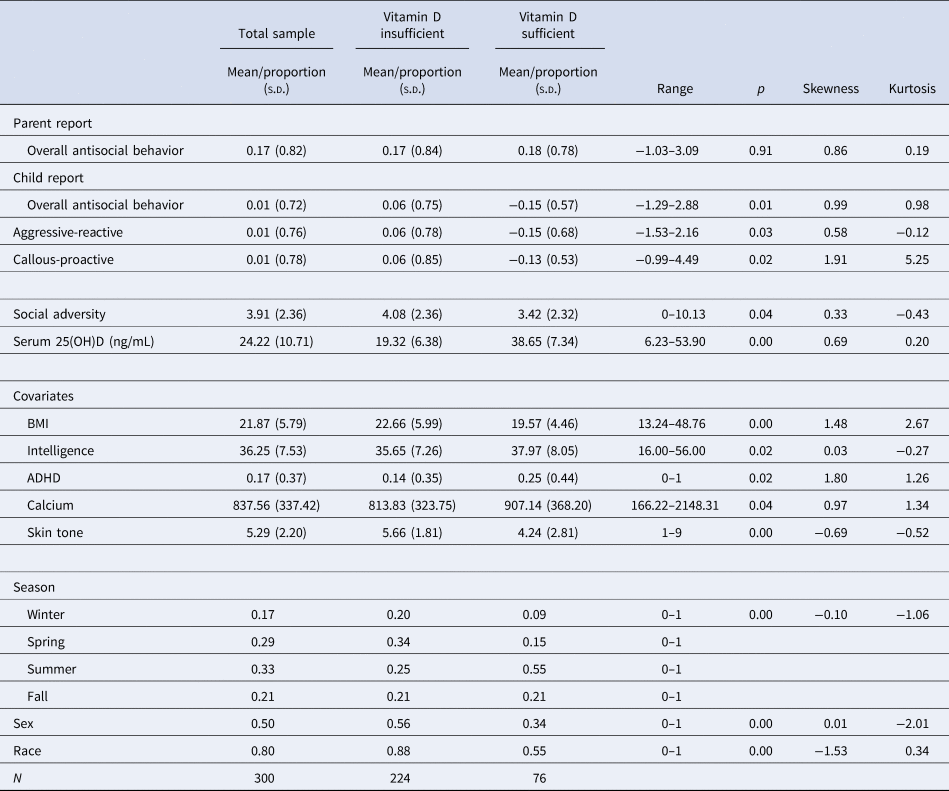
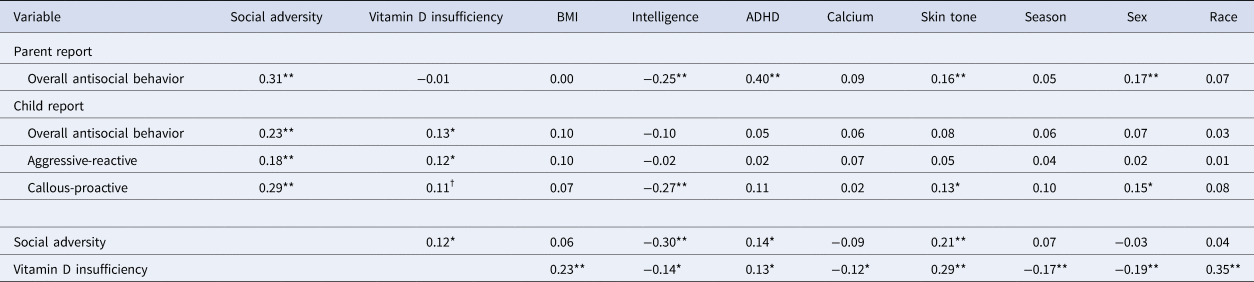
The mean serum vitamin D concentration was 24.22 ng/mL (Table 1). Consistent with prevalence rates from nationally representative samples of US children (Kumar et al., Reference Kumar, Muntner, Kaskel, Hailpern and Melamed2009; Mansbach et al., Reference Mansbach, Ginde and Camargo2009), 74.7% of the sample had 25(OH)D levels lower than 30 ng/mL. The descriptive statistics for all of the study variables are presented in Table 1. As intelligence, ADHD diagnosis, and skin tone were the only hypothesized confounders to be significantly associated with antisocial behavior and one of the main predictors (Table 2), they were included as covariates in the moderation analyses.
Descriptive statistics and differences between vitamin D sufficient and insufficient groups

BMI = body mass index; season = season of serum collection; sex = 1 if male; race = 1 if African American; N for BMI = 296; N for intelligence = 294; N for ADHD = 295; N for calcium = 291; N for skin tone = 267.
Bivariate correlations between key study variables and covariates

N = 267–300. BMI = body mass index; ADHD = 1 if ADHD is present; season = season of serum collection; sex = 1 if male; race = 1 if African American; vitamin D insufficiency = 1 if 25(OH)D < 30 ng/mL.
†p < 0.10; *p < 0.05; **p < 0.01.
Moderating effect of vitamin D on antisocial behavior
Parent reports
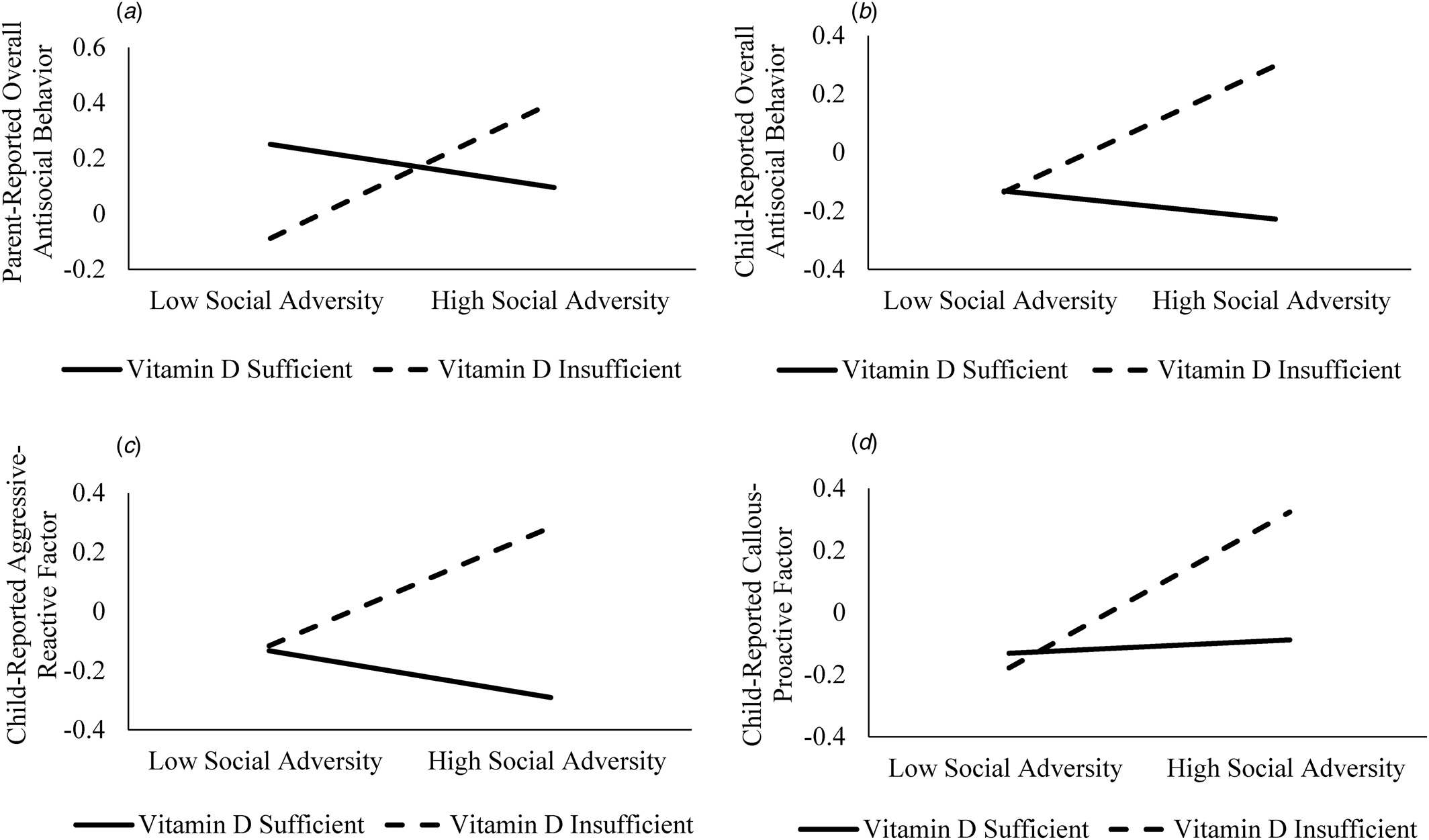
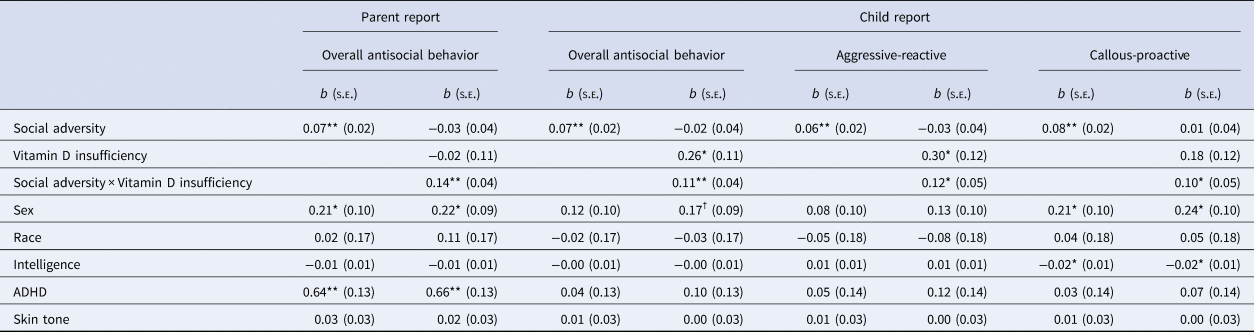
A significant interaction effect of social adversity × vitamin D insufficiency (b = 0.14, s.e. = 0.04, t = 3.17, p = 0.002) was observed for parent-reported overall antisocial behavior (Table 3). Among children with vitamin D insufficiency, greater social adversity was associated with higher levels of parent-reported antisocial behavior (b = 0.07, s.e. = 0.02, t = 4.16, p < 0.001; Fig. 1). However, social adversity was not associated with antisocial behavior for children who met the threshold for vitamin D sufficiency (b = −0.03, s.e. = 0.04, t = −0.75, p = 0.46). The results suggest that having sufficient vitamin D is associated with nullification of the effect of social adversity on antisocial behavior.
Effect of social adversity and vitamin D insufficiency on (a) parent-reported antisocial behavior, (b) child-reported overall antisocial behavior, (c) child-reported aggressive-reactive behavior, and (d) child-reported callous-proactive behavior scores. Note. Social adversity groups are 1 s.d. above and below the mean. Models were adjusted for sex, race, intelligence, ADHD, and skin tone. Vitamin D insufficiency = 1 if 25(OH)D < 30 ng/mL.

Regression coefficients for the effects of social adversity, vitamin D insufficiency, and their interaction on antisocial behavior outcomes

N = 257 as the PROCESS macro uses listwise deletion based on all variables in the model. Models were adjusted for sex, race, intelligence, ADHD, and skin tone. Sex was coded as 0 for female and 1 for male. Race was coded as 0 for non-African Americans and 1 for African Americans. b = unstandardized coefficient; s.e. = standard error. Vitamin D insufficiency = 1 if 25(OH)D < 30 ng/mL.
†p < 0.10; *p < 0.05; **p < 0.01.
Child reports
Significant interactions between social adversity and vitamin D insufficiency were also detected in predicting self-reported overall antisocial behavior (b = 0.11, s.e. = 0.04, t = 2.63, p = 0.01) and the aggressive-reactive (b = 0.12, s.e. = 0.05, t = 2.60, p = 0.01) and callous-proactive factors (b = 0.10, s.e. = 0.05, t = 2.13, p = 0.03). Children with insufficient vitamin D exhibited increases in self-reported antisocial behavior when they experienced social adversity early in life, while vitamin D-sufficient children displayed non-significant changes in antisocial behavior as a function of social adversity (Fig. 1).
Sensitivity analyses
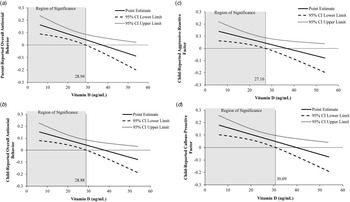
When vitamin D was assessed as a continuous variable, results did not substantively change. The interaction effects were significant in predicting parent-reported antisocial behavior (b = −0.01, s.e. = 0.002, t = −2.99, p < 0.01), child-reported overall antisocial behavior (b = −0.01, s.e. = 0.002, t = −2.78, p < 0.01), aggressive-reactive scores (b = −0.005, s.e. = 0.002, t = −2.46, p = 0.01), and callous-proactive scores (b = −0.01, s.e. = 0.002, t = −2.89, p < 0.01). The Johnson–Neyman technique showed that when children have vitamin D concentrations above 28.94 ng/mL, social adversity is no longer significantly related to parent-reported antisocial behavior (Fig. 2). As vitamin D levels decrease, the relationship between social adversity and antisocial behavior becomes more positive. The effect of social adversity on child-reported overall antisocial behavior, aggressive-reactive behavior, and the callous-proactive factor transitions to non-significance at vitamin D levels of 28.88, 27.16, and 30.69 ng/mL respectively.
Johnson–Neyman plot of the region of significance for the conditional effect of social adversity on (a) parent-reported antisocial behavior, (b) child-reported overall antisocial behavior, (c) child-reported aggressive-reactive behavior, and (d) child-reported callous-proactive behavior scores across the range of vitamin D levels. Note. Dashed lines represent the upper and lower limits of the 95% confidence interval. The horizontal line denotes a conditional effect of 0. The vertical line represents the boundary of the region of significance (p < 0.05), which is delineated by the shaded area.

In analyses restricted to African Americans as a robustness check, the pattern of findings from the main analyses persisted (online Supplementary Fig. S1). The influence of early social adversity on antisocial behavior was observed among vitamin D-insufficient children, but not among those meeting vitamin D sufficiency. However, although the interaction effect of social adversity × vitamin D insufficiency remained significant for parent-reported antisocial behavior (b = 0.16, s.e. = 0.06, t = 2.78, p < 0.01), child-reported overall antisocial behavior (b = 0.14, s.e. = 0.06, t = 2.35, p = 0.02), and the aggressive-reactive factor (b = 0.15, s.e. = 0.06, t = 2.35, p = 0.02), it was attenuated for the callous-proactive factor in the African American subsample (b = 0.12, s.e. = 0.06, t = 1.87, p = 0.06; online Supplementary Table S2).
Discussion
This study tested the hypothesis that vitamin D sufficiency confers resilience to child antisocial behavior. Our results show a protective-stabilizing effect of vitamin D as having sufficient vitamin D helped to neutralize the association between early social adversity and antisocial behavior. Children with high adversity and vitamin D sufficiency had similar levels of antisocial behavior as individuals without social risk. Specifically, the effect of social adversity on child antisocial behavior outcomes became non-significant when vitamin D concentrations were from 27.16 to 30.69 ng/mL. The examination of the vitamin D levels required for optimum protective effects can have public health implications. Although the threshold reflecting vitamin D sufficiency has been debated, our findings are consistent with the evidence that the most advantageous serum vitamin D concentrations begin at 30 ng/mL and support guidelines for vitamin D sufficiency to be defined as 25(OH)D ⩾ 30 ng/mL (Holick et al., Reference Holick, Binkley, Bischoff-Ferrari, Gordon, Hanley, Heaney and Weaver2011).
The consistent pattern of results found across multiple informants and for different antisocial outcomes adds credence to our findings. Prior studies have found low to moderate levels of agreement between caregiver and children reports (Shakoor et al., Reference Shakoor, Jaffee, Andreou, Bowes, Ambler, Caspi and Arseneault2011). This is exhibited in the current study as the correlation between parent and child reports of overall antisocial behavior was r = 0.41. Nevertheless, the protective function of vitamin D against overall antisocial behavior is observed despite variations between informants' reports, supporting robustness of the findings.
Additionally, there has been little research on whether protective effects operate in the same way across races (Jolliffe, Farrington, Loeber, & Pardini, Reference Jolliffe, Farrington, Loeber and Pardini2016). Sensitivity analyses provided evidence that the buffering protective effect of vitamin D sufficiency persisted in a subsample of African Americans. Although the interaction effect in this subsample was found to be marginally significant for the callous-proactive factor, the pattern of findings remained consistent, showing that for African American children who meet the threshold for vitamin D sufficiency, social adversity is no longer significantly associated with the callous-proactive form of antisocial behavior.
A possible explanation for the discrepancy in findings for the callous-proactive factor between the total sample and subsample of African Americans is that there are unique mechanisms that underlie different subtypes of antisocial behavior (Yang, Joshi, Jahanshad, Thompson, & Baker, Reference Yang, Joshi, Jahanshad, Thompson and Baker2017). Although definitive conclusions remain to be drawn, some initial evidence suggests that as opposed to proactive aggression, reactive aggression, which is more related to prefrontal dysfunction, may be more amenable to remediation using nutritional approaches (Choy & Raine, Reference Choy and Raine2018). Furthermore, antisocial behavior in children with callous-unemotional traits has been found to be under stronger genetic influence compared with antisocial behavior in the absence of elevated levels of these traits (Viding, Jones, Paul, Moffitt, & Plomin, Reference Viding, Jones, Paul, Moffitt and Plomin2008). The high heritability of callous-unemotional behavior in children is supported by estimates that up to 78% of the variation in callous-unemotional traits is attributable to genetic influences (Viding & McCrory, Reference Viding and McCrory2012). These findings suggest that the callous-unemotional factor may be driven less by social environmental factors, which may help account for the attenuated interaction effect observed.
Findings from this study can be considered in the context of the growing body of literature on the relevance of vitamin D to psychiatric conditions. Due to its role in brain structure and function, vitamin D has been particularly linked to disorders with a developmental basis, such as schizophrenia, ADHD, and autism spectrum disorder (Eyles, Burne, & McGrath, Reference Eyles, Burne and McGrath2013; Khoshbakht, Bidaki, & Salehi-Abargouei, Reference Khoshbakht, Bidaki and Salehi-Abargouei2018). Notably, violence has been argued to have neurodevelopmental origins (Raine, Reference Raine2019). Relatively much less research has been conducted on vitamin D status in relation to antisocial and aggressive behavior. Although the exact mechanisms underlying the protective effect of vitamin D on antisocial behavior remain to be determined, the results from the current study show that the association between low vitamin D and behavioral conditions with a neurodevelopmental basis, may also apply to violence.
The optimal vitamin D concentration for these brain-related outcomes, however, remains a topic of debate. Vitamin D sufficiency has been defined at different levels in prior research (Holick, Reference Holick2017; Khoshbakht et al., Reference Khoshbakht, Bidaki and Salehi-Abargouei2018). Interestingly, our results are in line with other research findings on the level of vitamin D defined to be sufficient for maximum musculoskeletal health, which is 30 ng/mL (Holick et al., Reference Holick, Binkley, Bischoff-Ferrari, Gordon, Hanley, Heaney and Weaver2011). What also remains unknown is whether the protective effect of vitamin D on antisocial behavior in children with social risk persists over the life course. It has been suggested that the timing of vitamin D insufficiency affects the severity of cognitive and behavioral dysfunction (Patrick & Ames, Reference Patrick and Ames2015). Evidence that lower levels of vitamin D early in life may accelerate the risk of brain morphology defects and impairments in social cognition and decision-making suggests that a protective role of vitamin D may be particularly important during early developmental stages.
There are several limitations to this study. The cross-sectional analysis limited our ability to determine the temporal relationship between vitamin D and antisocial behavior and to investigate longer-lasting protective effects of vitamin D on behavior. Conclusive recommendations based on these findings await the outcome of randomized controlled trials (RCTs) among individuals predisposed to antisocial behavior as well as in antisocial populations. Additionally, although we attempted to include many covariates related to social adversity, vitamin D, and antisocial behavior, our effect estimates may have been influenced by other unmeasured or unknown confounders. For example, genetic factors, which play a role in antisocial behavior with and without callous-unemotional traits (Tuvblad, Grann, & Lichtenstein, Reference Tuvblad, Grann and Lichtenstein2006; Viding et al., Reference Viding, Jones, Paul, Moffitt and Plomin2008), can influence vitamin D levels. Genome-wide association analyses have identified common single nucleotide polymorphisms in genes that are linked to the regulation of 25(OH)D concentrations (Wang et al., Reference Wang, Zhang, Richards, Kestenbaum, Van Meurs, Berry and Spector2010). Medications can also upregulate enzymes involved in vitamin D metabolite inactivation (Taylor, Reference Taylor2020). Although this study aimed to provide a more comprehensive measure of social risk that included variables regarding family structure, poverty, and living conditions, our broad approach limited the ability to make conclusions about precise social processes. Other factors such as social norms and social networks, and other indicators of parental health, such as their nutritional levels, can also be linked to child antisocial behavior. Nevertheless, as a first investigation of the protective function of vitamin D on antisocial behavior, the findings here are hypothesis-generating and can be used to develop protocols for RCTs. They provide support for the notion that nutritional factors play a role in behavior (Sonuga-Barke, Reference Sonuga-Barke2015) and suggest that there is a public health case to be made for undertaking exploratory trials involving an easily modifiable, safe, and publicly accessible resource.
Conclusions
Vitamin D insufficiency is surprisingly common. The mean vitamin D level and prevalence of vitamin D insufficiency observed in this study are in line with that found in nationally representative samples in the USA (Kumar et al., Reference Kumar, Muntner, Kaskel, Hailpern and Melamed2009; Mansbach et al., Reference Mansbach, Ginde and Camargo2009). However, it is apt to note that although this study recruited participants broadly from the community, this sample cannot be claimed to be representative of the general population. Although mindful of the limitations that the reporting and expression of antisocial behavior can be affected by many factors and that this study does not experimentally manipulate vitamin D levels to examine effects on behavior, the consistent findings of a buffering protective effect of vitamin D across multiple antisocial outcomes and from different reporters of behavior suggest the role of this nutritional factor in antisocial behavior, particularly in children with social risk. Moreover, given that aggression is a diagnostic feature of some mental disorders, including antisocial personality disorder, intermittent explosive disorder, conduct disorder, and borderline personality disorder (American Psychiatric Association, 2013), in line with the symptom-based research approach in psychiatry (Schmidt, Reference Schmidt2015), these findings may prompt further research on vitamin D in order to shed light on potential cost-effective ways to reduce this symptom among at-risk individuals.
Supplementary material
The supplementary material for this article can be found at https://doi.org/10.1017/S0033291721001069.
Financial support
This project was funded, in part, under a grant from the Pennsylvania Department of Health (SAP# 4100043366) and the Clinical and Translational Research Center, Perelman School of Medicine, University of Pennsylvania (grant number UL1-RR-024134).
Conflict of interest
None.