INTRODUCTION
One major international restaurant company does not allow its European beef burger suppliers to source meat from cattle sold through auction markets. This trading embargo was introduced because of concerns about tracing an animal or its meat back to the farm of origin. Now that cattle passports have been introduced in the European Union (EU), the concern has disappeared. Instead, the reason for the trade barrier now focuses on the welfare image of markets. There is a perception that the welfare of finished cattle sold through livestock markets is poorer compared with cattle sold directly to abattoirs (Murray et al. Reference Murray, Davies, Cullinane, Eddison and Kirk2000).
The welfare concerns include fatigue, fear and distress, fasting, dehydration, and injuries in finished cattle and, in store cattle, there is an additional concern about acquiring disease (Horder et al. Reference Horder, Strachan, Ramsay and Burns1982; Corrier et al. Reference Corrier, Purdy and DeLoach1990; Edwards Reference Edwards1996). It is well recognized that the prevalence of bruising in carcasses from finished cattle sold through markets is higher than for cattle sold directly to abattoirs, and this is cited as evidence that auction marketing is less appropriate than direct sale to an abattoir (Weeks et al. Reference Weeks, McNally and Warriss2002).
An alternative approach to placing an embargo on market sold cattle would be to address the welfare concerns by identifying the key issues that exist at markets and then manage those issues in the most appropriate way. From this background, the UK Department of Environment, Food and Rural affairs (Defra) initiated the current study that examined the facilities, cattle and calf behaviour at 18 UK cattle markets.
MATERIALS AND METHODS
The markets selected for the current study were the same as those reported by Gregory et al. (Reference Gregory, Benson, Smith and Masonin press). Eighteen of the 24 markets sold cattle on at least one of the days of the visit, and there were 18 markets selling finished cattle, 14 selling stores and 12 selling calves. It had been intended to compare the handling of store and finished cattle within markets, but since finished and store cattle were graded, sold and sometimes loaded in different facilities within the same market, a within-market comparison was invalid. Instead, the data for each class of cattle were grouped across all the markets at which they were seen.
Interview with the market manager
The interview with the market manager was the same as that described in Gregory et al. (Reference Gregory, Benson, Smith and Masonin press). The main findings are reported in that paper.
Facilities
The following facilities were inspected at every market: vehicle reception area, unloading/loading bays, unloading/loading pens, grading station, corridors, gateways, holding pens, isolation pen and sale ring. Stocks held overnight in the pens before the sale were examined where this occurred.
The approach that was used was to start with the assumption that the facilities were good. Anything that was seen that deviated from that expectation was recorded. Particular attention was given to adequacy of the capacity of the facility, adequacy for the species, location of the facilities, protection from inclement weather, escape-proof features, visibility of exits for stock in sale rings, non-slip properties of floor surfaces, surface drainage, features that could cause balking including shadows or visual contrasts, bruising or impact points, protection from jumping injuries, interlocking double entry/exit gates, maintenance of gate hinges and latches, noise control with baffles, bedding, and access to water. The floor surfaces were evaluated for non-slip properties by simple visual and physical inspection without animals passing over them.
In the grading and selling facilities, ‘gates’ refers to all gates within the system apart from exit gates, and they included entry and internal gates. In the categories used for vehicles, ‘pick-ups’ did not have a tailboard.
The classes used for describing the animals were

Calf management through the sale ring was monitored at five of the 12 calf markets with a total of 185, 186 and 181 calves assessed before, in and after the ring, respectively.
Handling procedures
The cattle and calves were examined as they came off (unloading) or onto (loading) vehicles at the markets. In each of those situations the behavioural features were mutually exclusive and they were not counted more than once in the same animal. For example, if a steer jumped, slid and then fell over as it came off a truck, the worst outcome only was recorded, which in this case would be the fall. During grading the cattle were sorted according to size or breed, checked that the ear tag number corresponded to the passport number and lot-tagged with a paper tag on the back. The exact procedure varied according to the type of animal and the custom of the market.
Animals were assessed for the following behaviours during grading and selling, which included the time they were put up to the sale ring, while in the sale ring and as they came back from the sale ring to a post-sale holding pen.
Refusal to move – refusal to move in the required direction while subjected to repeated attempts to get them to move. This included refusal to step onto the tailboard when trying to load the animals into a vehicle, refusal to load and instead the animals milled round the pen, refusal to move up the vehicle when attempting to close the tailboard side gates or a vehicle pen gate, and refusal to enter or leave a pen, weighbridge or sale ring.
Balking – an unwanted arrested flow due to an apparent distraction or intimidation.
Slips – foot slide or stumbling that did not result in a fall but nearly did so.
Fall – animal went down on its side or both knees, or is off both its hind feet.
Impact – a hard strike by another animal or with a physical feature such as a gate or a vehicle.
Jumping – leaping with all four feet simultaneously off the ground in a manner or situation that could be hazardous for the animal.
Inappropriate handling – included restraining or pulling a calf by its tail or ears, throwing a calf, excessive tail twisting or turning in cattle, and inappropriately directed or excessive use of a stick, pipe or electric goad. ‘Inappropriately directed’ means directed at the wrong animal or an inappropriate part of an animal.
Isolation leading to distress – isolation with physical arousal indicated by emotional disturbance including pacing or circling, vocalizing, attempts at joining other animals, gate charging, or excessive measures taken in avoiding a person.
Confusion – failure to manage the flow of animals in the required direction or speed due to either an interference or an encumbrance, or an inattention in managing the animals resulting in the stock moving in a way or direction that was unwanted, or they failed to move when movement was required. This included animals that were unloaded or loaded twice, animals that came off the vehicle backwards in a manner that created chaos, and animals that escaped from the pen or facility and ran about in an inappropriate area (e.g. vehicle parking area).
Holding after the sale
A total of 1034 cattle were examined in 220 holding pens after the sale at 18 markets. The prevalence of ruminating was assessed while observing undisturbed cattle in a pen for a period of up to 2 min. The number of animals that were horned was recorded (excluding animals with scurs) along with the number of pens that held horned and hornless cattle mixed together.
Statistics
Data were analysed with Fisher's exact and Chi square tests.
RESULTS
Facilities
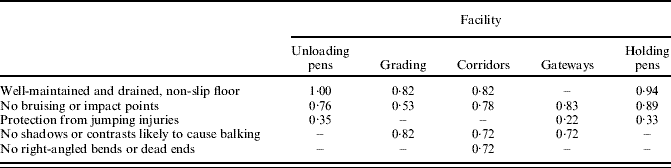
The features that could help minimize handling difficulties and injuries are shown in Table 1. In general, the floor surfaces were considered to be non-slip. Of the markets, 0·39 were completely free from easily identifiable potential bruising or impact points and 0·06 of the markets had no obvious potential leg traps if or when an animal jumped at or over a gate or pen wall. Those markets had leg excluders that stopped a leg sliding down between the gatepost and a gate. Most of the markets managed to minimize right angled bends in corridors that presented visual dead ends, as well as shadows that could cause balking.
Frequency of good features in the facilities at 18 markets that should help minimize handling difficulties and injuries in cattle

Values are the frequencies expressed as proportions of 1·00.
Vehicle queuing at the cattle unloading bays was a problem at 0·28 of the markets. This was often due to delays in emptying the unloading pens because of slow progress in checking passport numbers at the grading station. Long vehicle queues were seen at busy calf markets that were in dairy farming regions.
At 0·33 of the markets the unloading bays were protected from inclement weather. The unloading bays were escape proof when properly used at all the markets, and the vehicle reception area was escape proof at 0·78 of the markets.
None of the markets provided free access to water in all the holding pens occupied by cattle. Of the markets, 0·18 provided water in the unloading/loading pens.
At 0·39 of the markets the size of the holding pens could be altered using internal gates and 0·67 of the markets had pen gates that allowed entry or exit from opposite directions in the corridor.
The isolation pen was located within 20 m of the unloading bay at 0·88 of the markets. In 0·76 of cases the pen was totally enclosed by solid walls and gates, and it was ready for immediate use in 0·76 of cases.
Unloading
Cattle and calf unloading was observed for a total of 671 and 140 vehicles, respectively. Of the cattle vehicles, 0·97 were single deck, 0·03 held cattle on more than one deck, 0·89 of the calf vehicles were single deck, 0·10 were pick-ups and 0·01 were multi-deck trailers with calves on the upper deck.
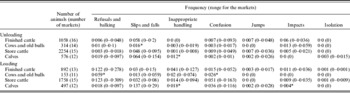
In general, the prevalence of problems in cattle and calves during unloading was low (Table 2). The main problem was with slips and falls (overall prevalence >0·05). In total there were 160 slips and 51 falls in cattle, but over half (0·57) occurred at five markets. This included one market where there was an open-top drainage channel in the corridor receiving stock from the unloading pens. This feature was responsible for about 0·40 of all falls. Over half the cattle slips and falls (0·52) were on dry concrete. In calves, the majority of the slips and falls (0·69) occurred either on or as they were coming off the tailboard.
Frequency (range for markets) of problems during unloading and loading at cattle markets in the UK

* Number of animals too small to provide a reliable range in prevalence.
Values are the frequencies expressed as proportions of 1·00.
Grading
Cattle were usually graded in a race, but some animals were held in a crush or were standing in the holding pens. At some markets the race had a series of sliding gates allowing confinement of the individual animals. After grading, bulls were penned individually in stalls or pens depending on their size, and at some markets it would have been possible to grade them in the stalls, but this was not common.
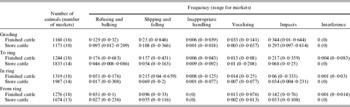
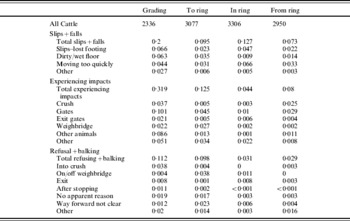
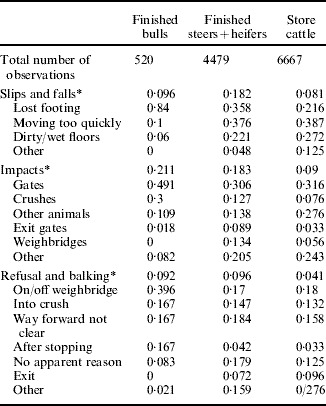
Difficulties seen during grading, according to their prevalence, were impacts (0·31 of all cattle), slipping and falling (0·20), and refusing plus balking (0·11). Finished cattle were more prone to these problems than stores and they were also more vocal (Table 3). Impacts were mainly with gates and other animals, and refusal to enter the crushes was the single most common reason for hindered movement (Table 4). Slippery floors and lost footing were the main contributors to slips and falls.
Frequency (range for markets) of handling problems and vocalizing at cattle markets in the UK

Values are the frequencies expressed as proportions of 1·00.
Frequency of cattle handling problems at different stages in livestock markets in the UK

Values are the frequencies expressed as proportions of 1·00.
Selling and holding after the sale
All cattle were sold while passing through a sale ring. This involved removing them from the holding pen, taking them to a weighbridge, putting them through the sale ring and returning them to a holding pen, which was either a buyer's pen where they were mixed with cattle from another group or a pen with animals of the original group.
Impacts with gates, getting them on and off the weighbridge and slips on dirty or wet floors were the most common incidents when cattle were put up to the ring (Table 4). Store cattle were more likely to be put up as groups, whereas finished cattle were often sold individually. Associated with this, stores were less prone to arrested movement when put up to the ring (Table 3).
The prevalence of problems in the ring was low, except for slips and falls among finished cattle. This was often linked to moving too fast (Table 4). When impacts occurred, they were mainly with gateways.
Returning from the ring to a holding pen involved some impacts and slipping in finished cattle (Table 3). The impacts were mainly with gateways, and with crushes at those markets where crushes were situated near the exit to the ring (Table 4). Rapid movement led to some slipping.
Some of the cattle (0·12) were ruminating during holding after the sale (range 0–0·36). Overall, 0·23 of the cattle were horned, and 0·48 of the post-sale holding pens contained horned cattle mixed with hornless cattle.
Calves were sorted into sale lots while they were in the holding pen area. The prevalence of slips plus falls and impacts during selling (when the calves passed to, through and away from the sale ring) were 0·092 and 0·087, respectively. The prevalence of slips plus falls was highest while the calves were in the ring (0·188 compared with 0·038 and 0·050 before and after the ring, respectively, P<0·001). The vocalizing rate during selling was 0·054. The prevalence of refusing to move and balking during selling was low (0·034).
Loading
When selling ended, cattle were drafted from their holding pens into a corridor, and then to a loading pen at the docking bay. Cattle loading was examined for 293 vehicles of which 0·12 were multi-decks. Calf loading was examined for 75 vehicles, of which 0·05 were pick-ups, and none were multi-decks.
There were more problems during loading compared with unloading (Table 2). For example, in cattle the prevalence of refusal plus balking was higher and this contributed to the higher prevalence of inappropriate handling. There were also more cases of confusion during loading.
Refusal and balking during loading were more common in finished and store cattle than in cows and breeding bulls (P<0·05). Of all the cases, 0·86 were cattle that refused to either step onto the tailboard or enter the vehicle. In 0·07 of the cattle there was a problem with closing the tailboard sidegates because the cattle did not move up the vehicle, for example when the vehicle had a full load.
In cattle the main reasons for slips and falls were missed footing on the tailboard or internal ramp (0·56) and wet or dirty concrete (0·26). Slips and falls were common in calves; 0·88 were either on the tailboard or when the calf came off its edge. In most cases the calf failed to lift its feet when moving onto the tailboard and instead its legs folded at the knees and so it went down. Falls also occurred when attempting to load calves into pick-up vehicles (0·06).
There were 65 incidents in cattle that were classed as inappropriate handling. They were more common in finished cattle than store cattle, and they usually involved excessive or inappropriately directed use of a stick (0·81). The second most common cause was inappropriate placement or use of an electric goad (0·15). There were very few cases of inappropriate handling in calves (n=9), but reasons included restraint by holding onto a tail, throwing or dropping them into a vehicle, pulling by the ears and mishandling an escapee.
In cattle, confusion usually occurred when animals went onto a vehicle and came off again spontaneously (0·74). The remainder were escapees or animals that were suddenly deterred from loading, for example by a swinging gate. In 0·24 of the cases the cattle were removed from the vehicle to re-sort them or remove their lot tags.
Cattle type
Finished bulls were more prone to impacts with gates and crushes, compared with other finished cattle and store cattle (Table 5). They were less prone to slipping or falling because they were slower and thus less susceptible to slippery floors. They were prone to refusing to move or balking, and among other causes this occurred when they passed through the weighbridge and when they were required to start after a pause in movement.
Reasons for handling problems during grading and selling in finished and store cattle at markets

* Proportion of total number of animals in the respective class.
Values are the frequencies expressed as proportions of 1·00.
Stores were managed in large groups and were prone to impacts between each other. Finished heifers and steers were prone to slipping while moving too quickly.
Market size
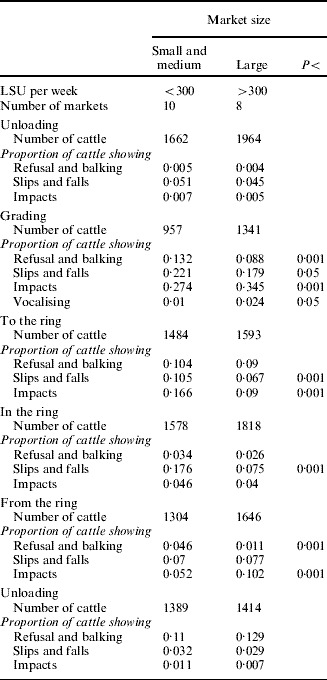
In the UK there are not many markets selling less than 100 LSU every week that deal regularly in cattle. Small markets rely more on sales of sheep. In view of this, the data for small and medium cattle markets were grouped together for comparison with large markets. The focus here is on significant differences between those groups.
In general, there were fewer problems at large markets compared with small- and medium-sized markets (Table 6). For example, there was less refusal to move, balking, slips and falls during grading, fewer impacts and slips when the cattle were put up to the ring, and fewer slips while in the ring. Set against this, there were more impacts at large markets during grading and when the cattle were taken back to their pens after passing through the ring. There was no effect of market size on problems during unloading or loading.
Handling problems in cattle at markets according to size of their throughput

DISCUSSION
The discussion focuses on the handling difficulties that were identified during the study and on some potential solutions to those problems. Finding solutions is important if livestock market operators wish to regain some of their lost market share.
Facilities
Slipping was identified as a major difficulty in the current study. The floor in the grading area can become slippery through wear from heavy use. One market recognized this, and laid a resin plus grit screed over the concrete to improve grip. It proved successful, and the prevalence of slips and falls was 0·09, compared with 0·20 as the mean for all markets. Metal weighbridge platforms become very slippery when wet or soiled with manure. This was managed at some markets with a resin plus grit screed that had been laid on the metal surface.
An interesting outcome from the current study was that subjective judgements made about the non-slip features of floor surfaces did not correspond with behavioural observations where the prevalence of cattle slips and falls was monitored independently. The person making the floor assessment was experienced in handling stock, and had spent many years training Animal Welfare Officers for markets and abattoirs. This indicates that it can be difficult to make reliable judgements about floors from visual inspection. It is more helpful to watch stock passing over them, or make objective skid resistance value measurements.
A difficulty at several markets was the poor location of the store cattle grading race. It was situated some distance from the sale ring, and more importantly the animals had to turn through 180° at the end of the race to move in the required direction after grading. This posed a risk for falls at the turn.
Many markets had two-way gates for the holding pens. These had a centre gatepost at the entrance supporting two gates that opened at opposing ends allowing cattle to enter and leave the pen in both directions along the corridor. The disadvantage of these pens is that the entrance can be narrow, and this presents bruising points at the centre and corner posts. The prevalence of impacts from this and other causes when putting cattle up to the sale ring was 0·125. Impacts were also frequent during grading, and this is a common feature with any work on cattle in crushes, races or other systems involving close confinement. One way of reducing movement and the likelihood of severe impacts is to temporarily section the raceway into a series of individual pens using sliding gates. This stops the cattle shunting up and down the raceway, and it stops horned cattle trying to burrow under an animal in front. Not all markets had raceways with a sliding gate system.
British markets and abattoirs do not have adjustable unloading and loading ramps. Instead, they have two types of bay; one for farm trailers that is level with the docking area, and a stepped or sloping bay for larger vehicles. Neither type of bay suits the needs of vehicles that are not fitted with tailboard ramps. During the current study, vehicles that did not have a fitted unloading ramp and were used for transporting calves included pick-ups, four-wheel drives, vans and in one case the cab of a lorry. The overall prevalence of this class of vehicle used for calves was low (0·08), but at one market where turning space for long vehicles was limited, it was 0·24. It is likely that vehicles without a fitted unloading ramp will be phased out in future, as they do not comply with European Council Regulations (European Council 2005).
Unloading and loading
Loading and unloading are two of the most stressful stages during cattle transport (Jacobson & Cook Reference Jacobson and Cook1998). In most respects, loading is more difficult than unloading, but unloading has some hazards. The overall prevalence of falls during unloading was 0·01 and 0·03 for cattle and calves, respectively. According to criteria developed by Grandin (Reference Grandin1998), a prevalence of 0·01 falls is not acceptable as a welfare standard, and in the present study, five cattle markets had more than 0·01 falls during unloading. Of the cattle falls, 0·79 were on concrete and 0·15 were on tailboards. This suggests that there are some high risk situations in the unloading area where special attention is needed for slippery concrete floors. The solution may lie in applying screeds that reduce concrete floor slipperiness. Two markets had recognized the risk and used resin screeds containing grit at dangerous sites, and another market had used an epoxy paint containing sand sharps.
In the present study it was noted that unloading cattle backwards was hazardous if the animal slipped as it turned or if it was pushed by other cattle coming off the truck at the same time. This hazard is likely to be greatest where the animals are large relative to the width of the vehicle entrance and with vehicles that are heavily stocked.
One market had half gates in the unloading/loading pen and they were a bruising hazard from impacts. Stock often pass quickly through the unloading pen and they are prone to impacts especially when bunched at a narrow gateway. A full width gate helps reduce impacts with the gateway.
Farmers consider certain breeds of cattle that are nervous and difficult to handle present particular difficulties during loading (Villarroel et al. Reference Villarroel, Mariá, Sierra, Sañudo, Garćia-Belenguer and Gebresenbet2001). This applies even for experienced farmers and drivers. It helps if they assist each other in getting cattle on-board, and if market staff stay on after the sale to give assistance. This, however, has cost implications for the market companies. The Farm Animal Welfare Council (FAWC) (1986) recommended that unloading and loading must be regularly supervised by the market operator, and an inspector should be present in the market at both unloading and loading. During the current study, loading was usually unsupervised as well as unassisted.
At some markets loading cattle was difficult because the loading pen was too wide. Milling or circling occurred when the pens were more than 4 m wide. The height of the loading platform above the vehicle docking point influenced ease of loading. Where it was too high, the cattle had a clear view downwards into the vehicle and they sometimes refused to load. This was a particular problem at one market where the height difference was 930 mm, which was higher than usual. Several market staff claimed that placing straw on the tailboard can overcome refusal to load. However, markets did not usually provide straw. Some farmers and drivers brought straw with them and laid it on the tailboard before loading but this was not common. Placing straw on dry concrete can make the floor more slippery and so it is not recommended for the unloading/loading pens.
Inappropriate handling
The current study showed that the prevalence of inappropriate handling methods at cattle markets was low. It occurred mainly when loading finished cattle, and included inappropriate use of a stick or electric goad and occasional cases of excessive tail twisting. The main reason was refusal to load onto the vehicle. Sticks and goads were sometimes applied to the animals nearest the person managing the loading, while animals nearer the vehicle were responsible for the hold up. It is an offence to inflict injury or unnecessary suffering when using sticks on cattle at markets (Welfare of Animals at Market Order (WAMO) 1990).
Grading
Impacts are an inevitable risk when grading cattle in a raceway or crush, and these insults are a common hazard with other procedures involving confined cattle, such as tuberculosis testing or vaccination. Slips, falls and impacts in a raceway might be reduced by using sliding gates that divide it into stalls. Sliding gates are prone to misuse when they are closed in front of an advancing animal or forced against an animal's legs or hindquarters, and so some authorities recommend forward opening gates instead (Weeks et al. Reference Weeks, McNally and Warriss2002). Market operators need to ensure that there are no protrusions in the raceway or crush when minimizing bruising hazards (WAMO 1990).
In principle it may help to put cattle through the same corridors during grading as used later when they are put up to the sale ring. The cattle can become familiar with the facilities, and this should make it progressively easier to manage their movement.
Impacts could be avoided altogether by eliminating grading in a raceway or crush. At some markets, cattle were lot-tagged in their holding pens instead of a grading race. Where cattle were graded in raceways, they were more inclined to raise their heads in raceways that had panelled sides, and this made ear tag reading easier. Ensuring that cattle are ear-tagged or fitted with a transponder before they are sent to market, and reading transponders in cattle while they are in their pens, could go some way towards avoiding the stress and injuries associated with grading in a raceway or crush.
Selling and holding
In the UK, cattle are sold through a ring rather than in their holding pens. In Australia, selling in pens has been associated with less bruising compared with selling through a ring and so there are quality as well as welfare advantages to pen selling (Wythes & Shorthose Reference Wythes and Shorthose1984).
After selling through the ring, the cattle were transferred to holding pens. It has been recommended that markets should use ‘buyers pens’ where finished cattle leaving the sale ring are placed in a pen dedicated to the appropriate cattle buyer (FAWC 1986). This reduces the amount of sorting that has to be done once selling has ended. The disadvantage is that buyers do not usually distinguish between horned and hornless cattle, and so the two are likely to be mixed at an earlier stage than if they were returned to their original groups. The current study showed that the prevalence of pens containing horned cattle mixed with hornless cattle after selling was 0·48, and the overall prevalence of horned cattle was 0·23. It is thought that the number of horned cattle has been increasing in recent years, because of the declining farm labour force. In 1986, 0·60 of markets in the UK did not segregate horned from unhorned cattle, before or after sale (FAWC 1986). In the present study all of the markets had some pens with horned and unhorned cattle mixed together. This suggests that there is widespread disregard of current legislation (European Council 2005).
During the holding period, bulls were in individual stalls arranged as herringbone cubicles with rump chains, and this helped avoid mounting behaviour, butting and impacts. Managing bulls in this way is labour intensive but in principle it should reduce the prevalence of bruising and dark cutting beef.
Cattle type
Bulls were less prone to slips and falls than clean finished cattle (steers and heifers) because they did not move so fast. A substantial number of bulls in the UK are Belgian Blue×Holsteins and have poor mobility compared with non-double muscled cattle. This makes them easier to handle and they have a low risk of injury.
Vocalizing can be a sign of distress, hunger or social calling (Grandin Reference Grandin2001). In the current study it was more common in finished heifers and steers than store cattle or finished bulls, and it occurred most during grading. This was partly due to social calling, and it occurred just after the cattle arrived at the market.
Calves
At most markets the calf unloading area operated on a drive-through principle. Typically, a farm vehicle with trailer drove alongside an entrance to the calf shed where there was a double or treble-hinged lightweight gate. The gate was extended around the far side of the tailboard to reduce the risk of escape, and the calves were walked off the trailer. In general this system worked well, but there were difficulties in moving the calves along the tailboard. Of all the falls, 0·69 during calf unloading occurred at this stage.
Some calves were delivered to the markets in pick-ups. The use of vans and tractor boxes has been approved for transporting limited numbers of calves (FAWC 1986). However, some of the potential difficulties associated with vans (and other fixed-height pick-up vehicles not fitted with tailboards) are as follows. Firstly, there is the difficulty of catching the animal and lifting it onto or off the vehicle. There is a risk of losing control of the animal if it struggles when lifted. In addition, calves can escape under the tail gate of the vehicle or the loading bay side gate, especially where the loading platform slopes downwards towards the vehicle. In addition, these vehicles do not always lend themselves to power hosing and disinfection, and so they can present problems with cleanliness. Falls occurred when unloading calves from 0·21 of the pick-up vehicles. This usually occurred as the calves were lowered onto the ground and failed to stand properly. Most of those cases were not considered serious falls.
During loading, 0·11 of calves fell. This usually happened when they failed to raise their feet adequately while moving onto the tailboard. Instead, the leading fore leg folded at the knee and was followed by the second fore leg. At this stage, if the person loading the calves pushed a kneeling calf by hand from behind, it was prone to going over on its side. Less commonly a calf fell off the side of the tailboard, and became lodged between the tailboard and loading pen side gate.
Calf kneeling on the tailboard could, in principle, be avoided by ensuring that calves are never required to step up onto tailboards. This would be achieved either by lifting the forequarters onto the tailboard, or by modifying the loading area so that the tailboard edge is level with or slightly lower than the edge of the loading platform. Neither approach is completely satisfactory as both have some practical difficulties.
Conclusion
The overall impression from the current study was that there were some common difficulties in managing cattle and calves at livestock markets. In cattle they were refusal to move and balking during grading and while put up to the ring; slipping during grading, selling and when taken to the ring; impacts during grading, while put up to the ring and taken away from the ring; and refusal to load onto vehicles. In calves they were falls during loading and unloading. These issues will need to be addressed if the intention is to upgrade the image of cattle markets and ensure market access to all sectors of the retail meat and restaurant trades. One of the markets was outstanding in terms of the prevalence of few problems, and so in principle it should be feasible to improve the general situation by upgrading individual markets. In addition, changing from selling cattle in a ring to in-pen or in-stall (for bulls) selling could help pre-empt some problems, as would identifying animals from transponders instead of ear tag numbers and installing non-slip resin floors in areas where there is a raised risk of slips and falls.
This project was funded by Defra and supported with advice from the Livestock Auctioneers' Association.