Significant outcomes
• Direct comparisons of cognitive performance in acute schizophrenia and depression are scarce in literature. This study provides a direct comparison between the two patient groups, including a healthy control (HC) sample, while minimising confounding effects of motivation and concentration.
• Both patient groups show clear cognitive impairment compared with HCs.
• Schizophrenic patients differ from patients with unipolar depression in only two of the administered tests (verbal fluency and visual memory). Results suggest a certain overlap of cognitive impairment in schizophrenia group (SG) and depression group (DG), contradicting assumptions that schizophrenic patients are generally heavier impaired than depressive patients.
Limitations
• Medication status was not included in the analyses.
• Explored collectives differed with regard to demographic characteristics, and the subtype paranoid schizophrenia is over-represented in the SG sample.
Introduction
Cognitive dysfunction represents a common and clinically relevant characteristic in schizophrenia and depression (Reference Zakzanis, Leach and Kaplan1–Reference Palmer, Dawes and Heaton5). Schizophrenic patients frequently show deficits in verbal memory, attention, working memory and processing speed (Reference Nuechterlein, Barch, Gold, Goldberg, Green and Heaton6,Reference Krabbendam, Arts, van Os and Aleman7), which have also been reported for depression (Reference Porter, Bourke and Gallagher2,Reference Burt, Zembar and Niederehe8,Reference Gualtieri, Johnson and Benedict9). It is assumed that cognitive impairment in schizophrenia is more profound than in depression (Reference Buchanan, Davis and Goff10). Buchanan et al. state that ‘schizophrenia and schizoaffective disorder share a similar pattern of cognitive impairments, which is distinct from patterns in major depression, bipolar disorder, and Alzheimer's dementia’ (Reference Buchanan, Davis and Goff10). Schizophrenic patients seem to show a distinctive pattern with maximal impairment in memory, attention, reasoning and problem solving, whereas the characteristic profile of depressed patients shows maximal impairment in episodic, declarative memory function (Reference Zakzanis, Leach and Kaplan1,Reference Buchanan, Davis and Goff10). Statements, though, are based on studies focussing on only one psychiatric disease. However, studies that directly compare neuropsychological performance between patients with schizophrenia and unipolar depressive disorder are scarce in literature. The overlap of cognitive deficits between schizophrenia and depression raises the question of specificity.
Available studies comparing cognitive dysfunction in both collectives either use heterogeneous samples, including various affective disorders (Reference Gilvarry, Barber, van Os and Murray11), or depressive patients with psychotic features (Reference Hill, Reilly and Harris12–Reference Reichenberg, Harvey and Bowie14). Results of the latter cannot be generalised to unipolar major depression, as the presence of psychotic features may be associated with exacerbated impairments in cognitive functioning. Furthermore, major depression with psychotic features has shown to be qualitatively different from depression without psychotic features (Reference Hill, Keshavan, Thase and Sweeney15,Reference Fleming, Blasey and Schatzberg16). In addition, it seems that the presence of psychotic symptoms in depressive patients is associated with exacerbated impairment compared with non-psychotic depression (Reference Fleming, Blasey and Schatzberg16–Reference Jeste, Heaton, Paulsen, Ercoli, Harris and Heaton18). Those studies available, focussing on direct comparisons between depression and schizophrenia, are characterized by either different focus and small sample size (Reference Albus, Hubmann, Wahlheim, Sobizack, Franz and Mohr17) or do not include baseline assessment of HCs (Reference Jeste, Heaton, Paulsen, Ercoli, Harris and Heaton18,Reference Sostaric and Zalar19).
The aim of this study was to assess and compare the cognitive functioning of patients with schizophrenia and patients with unipolar major depression without psychotic features and compare their performance with HCs. We hypothesised that both patient groups show cognitive impairment compared with HCs, and that schizophrenic patients are more profoundly impaired than depressive patients with regard to all explored domains.
Materials and methods
Subjects
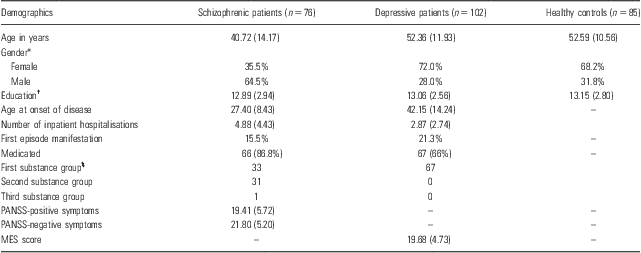
The study was approved by the local ethical committee. All patients were older than 18 years and gave informed consent. The demographical and statistical characteristics of the sample are displayed in Table 1. Patients were consecutively recruited out of acutely admitted inpatients at the Department of Psychiatry and Psychotherapy, University Hospital Charité Campus Benjamin Franklin. Clinical diagnoses were given by the treating psychiatrists according to DSM-IV criteria and confirmed by a senior consultant. Because schizophrenia diagnosis is often unclear during acute episodes, patients were followed clinically for 2 weeks to confirm the diagnosis. If patients were discharged from the hospital before this period of time, only patients with the discharge diagnosis of schizophrenia were included. Two patients were excluded from the analysis because of non-matching diagnosis. All included patients met DSM-IV criteria for schizophrenia and unipolar major depression, respectively. Exclusion criteria consisted of: current or recent psychoactive substance abuse, delirium, acute intoxication, dementia, mental retardation, history of central nervous system disease and all medical illness that might interfere with the assessment of cognitive performance, treatment with electro-convulsive therapy in the last 6 months and other than German as native language (because of the use of verbal tests).
Demographic and clinical characteristics of patients and healthy controls
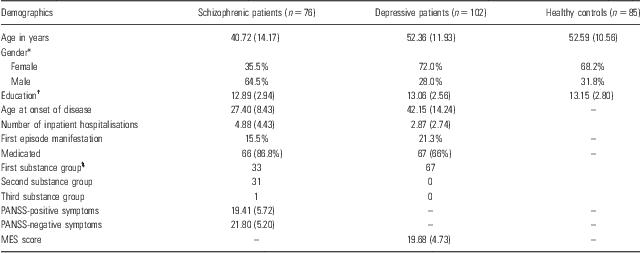
MES, Bech–Rafaelsen Melancholia Scale; PANSS, Positive and Negative Syndrome Scale.
Values given are means with standard deviation in parentheses.
*% given are valid per cent.
†Years of education: sum of school and professional education in years.
‡Patients were medicated with drugs from first, second or third substance groups (antipsychotics, antidepressants and benzodiazepines).
Out of 199 patients asked to participate, eight depressive patients and 11 schizophrenic patients refused. Two schizophrenic patients were not able to conclude the assessment.
A total of 178 patients (patients with schizophrenia n = 76; patients with unipolar major depression n = 102) were included in the study.
Of the schizophrenic patients, 90.8% met criteria for the paranoid subtype (one patient met the criteria for the catatonic, three for the undifferentiated and three for the residual type). None met the criteria for an affective disorder and none of the depressive subjects showed psychotic features.
If medicated, patients received drugs from one, two or three different substance groups (antipsychotics, antidepressants and benzodiazepines) (see Table 1). The following substances were administered – antipsychotics: aripiprazole 10–30 mg, clozapine 100–500 mg, risperidone 4–6 mg, quetiapine 200–600 mg, olanzapine 10–15 mg, amisulpride 100–1000 mg; benzodiazepines: lorazepam 1–2 mg; antidepressants: mirtazapine 30–60 mg, nortryptiline 100–150 mg, fluoxetine 20–60 mg, tranylcypromine 20–60 mg, lithium carbonate 450–1350 mg, valproate 800–1400 mg, duloxetine 60 mg.
Control group
Of the HC subjects, 85 volunteered to participate in this study and were recruited among non-medical and medical staff at the university clinics. Subjects had no history of psychiatric disease nor met criteria for a psychiatric disorder at the time of assessment. None of them received psychopharmacological medication. Exclusion criteria were the same as for the inpatients. None of the control subjects was familiar with any of the tests administered, nor was aware of the study hypotheses.
Procedures
All patients were tested within 10 days after admission to the clinic and completed the test battery in fixed order. Examination was conducted by experienced psychologists and took ∼20 min. The administered tests allowed a brief assessment not exceeding patients’ abilities with regard to concentration and motivation while covering fundamental cognitive domains. A brief assessment was chosen as both schizophrenia and depression generally are accompanied by reduced motivation. Poor test outcome in lengthy batteries may be wrongly attributed to reduced cognitive abilities when in fact it results from a decrease in motivation.
Clinical evaluation
Symptom severity of clinical symptoms was assessed with the Positive and Negative Syndrome Scale (PANSS) in the SG (Reference Kay, Fiszbein and Opler20). Patients in the DG were evaluated with the Bech–Rafaelsen Melancholia Scale (MES) (Reference Bech21). The MES is a depression scale derived from the Hamilton Depression Rating Scale (HAM-D), measuring the quantitative aspects of depression. The scale is a valid and reliable measure of depressive symptoms with high sensitivity and internal construct validity (Reference Bech21,Reference Maier, Philipp, Heuser, Schlegel, Buller and Wetzel22). Its superiority over the HAM-D in the assessment of depressive symptoms has been shown (Reference Licht, Qvitzau, Allerup and Bech23), even though the latter is being used in the large majority of studies.
Both ratings, PANSS and MES, are observer ratings and were carried out by the treating psychiatrist within the week of the neuropsychological assessment.
Neuropsychological assessment
Rey Auditory Verbal Learning Test (RAVLT)
The RAVLT is a widely used measure to assess short-term auditory verbal learning and verbal memory (Reference Rey24). In order to reduce testing time as much as possible, we shortened the original version from five down to two learning trials (RAVLT1 and RAVLT2) and one recall trial (delayed recall; RAVLT delayed).
Trail Making Test (TMT): part A
This well-known test assesses visuo-motor processing speed (Reference Reitan and Wolfson25,Reference Reitan26). The test is sensitive to neuropsychological deficits, as have been reported for schizophrenia (Reference Bowie and Harvey27) and depression (Reference Story, Potter, Attix, Welsh-Bohmer and Steffens28).
Verbal fluency
This test evaluates speech abilities and semantic memory (Reference Spreen and Benton29). We used the semantic group animals as its outcome is less influenced by education than phonemic fluency (Reference Ratcliff, Ganguli and Chandra30).
Wechsler Memory Scale-Revised (WMS-R, sub-scale visual memory)
A well-known scale providing aspects of visual memory (Reference Wechsler31).
Statistical tests
Baseline characteristics of the three groups were compared by univariate analysis of variance (ANOVA) with Tukey's post-hoc tests and χ2-tests. A multivariate general linear model (MANOVA) was used to compare performance on the neuropsychological test battery across the three groups. We included the variables age, sex and education as covariates in the model (MANCOVA) to control for potentially confounding influences. Because of the unequal sample sizes, Pillai's trace was used to compare groups. The applied model allows detection of possible group differences while controlling for the influence of age, education and sex by delivering estimators. Between-group differences in the test outcomes were analysed by interpreting the regression coefficients of the multivariate model. To control for influences of the covariates, estimated means of the adjusted model were calculated on the basis of mean age, mean education and sex ratio. The model coefficients B quantify the size of the effect and are reported together with 95% confidence intervals (CI). A p-value of <0.05 was considered significant. All analyses were performed with the predictive analysis software (version 18).
Results
Demographic and clinical characteristics
The demographic and clinical characteristics of the three study groups are presented in Table 1. Groups differed significantly in terms of age [F(2, 260) = 24.97, p < 0.001] and male/female ratio (sex ratio) (χ2 = 30.48, df = 2, p < 0.001).
Schizophrenic patients were significantly younger than depressive patients and the controls and the schizophrenic group consisted of significantly more male patients than did the depressive and the control group. The latter two did not differ in age and sex ratio.
As the effects of age, education and sex reached significance in the multivariate model, we performed a MANCOVA to control for their possible influence. MANCOVA showed a significant difference among the groups in their performance on neuropsychological tests [F(12, 596) = 10.60, p < 0.001], while controlling for age, gender and education.
Neuropsychological performance
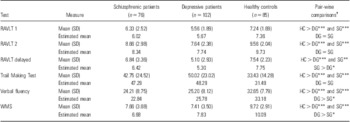
Results of the neuropsychological tests are presented in Table 2.
Means, estimated means of the adjusted model and pair-wise comparisons for schizophrenic patients, depressive patients and healthy controls ADDIN

RAVLT, Rey Auditory Verbal Learning Test; WMS, Wechsler Memory Scale-Revised.
†Interpretation of the regression coefficients (B) of the adjusted model.
*p < 0.05; **p < 0.005; ***p < 0.001.
With regard to the potential influences of the covariates, we calculated estimated means of the adjusted model for each of the tests applied. Those means are estimations on the test outcome when the influence of the covariates is being controlled. Group differences were further analysed by interpreting the regression coefficients (B) of the model. These indicate the following (all results given are estimations, while controlling for the influence of age, education and sex).
RAVLT1
DG did not differ significantly from SG in the amount of words remembered in the first trial (B = −0.36, 95% CI: [−0.97; 1.99], p = 0.252). HCs though remembered 1.36 words more than SG (95% CI: [0.73; 0.25], p < 0.001) and 1.72 words more than DG (95% CI: [1.18; 2.25], p < 0.001).
RAVLT2
SG and DG did not differ in the number of words memorised (B = −0.60, 95% CI: [−1.36; 0.15], p = 0.118), but HCs remembered significantly more words than SG (B = 1.38, 95% CI: [0.61; 2.16], p < 0.001) and DG (B = 1.99, 95% CI: [1.33; 2.64], p < 0.001).
RAVLT delayed
In the delayed recall, SG remembered 1.18 words more than DG, a difference that reaches significance when applying a 0.05 level (95% CI: [−2.05; 0.31], p < 0.05). The HCs performed significantly better than SG (B = 1.33, 95% CI: [0.44; 2.23], p < 0.005) remembering 1.33 words more and better than the DG by remembering 2.51 words more (B = 2.51, 95% CI: [1.76; 3.27], p < 0.001).
TMT
We found no significant differences in the performance of the patient groups SG and DG (B = 0.97, 95% CI: [−5.53; 7.47], p = 0.769). However, HCs were almost 16 s faster than both patient groups (SG: B = 15.80, 95% CI: [−22.45; −9.14], p < 0.001; DG: B = 16.77, 95% CI: [−22.39; −11.15], p < 0.001).
Verbal fluency
The DG (B = 2.94, 95% CI: [0.39; 5.50], p = 0.024) as well as the HCs (B = 10.34, 95% CI: [7.73; 12.96], p < 0.001) produced significantly more words than the SG. When comparing the performance of DG with that of the HCs, the latter produced significantly more words – the estimate B being 7.40 (95% CI: [5.19; 9.61], p < 0.001).
WMS
HCs (B = 3.41, 95% CI: [2.42; 4.30], p < 0.001) as well as DG (B = 1.15, 95% CI: [0.19; 2.12], p < 0.05) performed significantly better than SG. Compared with HCs, depressive patients performed significantly worse on the task (B = 2.25, 95% CI: [1.41; 3.09], p < 0.001).
Discussion
Main results
As expected, both patient groups showed impaired performance compared with HCs in all explored neurocognitive domains.
Schizophrenic patients did not differ from depressive patients in the direct recall RAVLT performance (RAVLT1 and RAVLT2) and the TMT. Performance in the delayed recall trial of the RAVLT (RAVLT delayed) was significantly better in the SG than the DG. Schizophrenic patients performed significantly worse than depressive patients in the verbal fluency test and the WMS.
The findings that both patient groups show generalised neurocognitive dysfunction relative to controls are consistent with literature (Reference Gualtieri, Johnson and Benedict9,Reference Reichenberg, Harvey and Bowie14,Reference Gur, Ragland and Moberg32,Reference Tuulio-Henriksson, Perala and Saarni33). Our results stress the fact that both the disorders, schizophrenia and depression, are accompanied by cognitive dysfunction in the phase of acute illness.
When comparing the performance of depressive and schizophrenic patients, SG performed significantly worse than DG with regard to two of the tests conducted. In the delayed recall trial of the RAVLT, SG performed even better than DG. The data do not confirm our hypothesis of a more profound impairment of SG in all explored neurocognitive domains. Instead, they suggest a certain overlap of cognitive impairment in SG and DG, contradicting assumptions that schizophrenic patients are generally heavier impaired than depressive patients (Reference Buchanan, Davis and Goff10).
Discussion in context with previous studies
We used a brief assessment covering fundamental cognitive domains and did not aim to evaluate cognitive abilities thoroughly. Although we chose widely used tests conducted in comparable studies (Reference Albus, Hubmann, Wahlheim, Sobizack, Franz and Mohr17,Reference Midin, Razali and Zamzam34,Reference Green, Kern, Braff and Mintz35), other authors include much broader diagnostics resulting in very long testing periods (Reference Hill, Reilly and Harris12,Reference Fossati, Amar, Raoux, Ergis and Allilaire36). As schizophrenia and depression are both characterised by reduced motivation, long testing periods may produce misleading results. Poor test outcome may wrongly be attributed to cognitive deficits, although it may only be a result of a motivational decrease. It is the strength of our study that results are relatively void of motivational deficits and distortions caused by exhaustion.
When placing our results in the context of available data from studies using the same or similar neuropsychological tests, results are inconsistent. Jeste and colleagues compared neuropsychological performance of subjects with unipolar depression, psychotic depression and schizophrenia and report better performance of the unipolar depressed subjects on verbal learning tasks and TMT, although we find comparable performance (Reference Jeste, Heaton, Paulsen, Ercoli, Harris and Heaton18). As sample means of the TMT are easily distorted by outliers, we performed the analysis after an exclusion of outliers. Yet results remained unaltered. Other authors support our results. Sostaric et al. (Reference Sostaric and Zalar19) also did not find any difference in psychomotor speed assessed with the TMT between schizophrenic and depressive patient samples.
Fossati et al. (Reference Fossati, Amar, Raoux, Ergis and Allilaire36) found no difference between young schizophrenic and depressive patients in semantic verbal fluency but significantly poorer performance of the schizophrenic in letter fluency – a result in line with our findings. As the verbal fluency test measures speed of the verbal thought process as well as verbal executive functions (Reference Ozgurdal, Littmann and Hauser37), a heavy impairment in SG as we found it, is congruent with general findings stating that executive functions are generally affected in schizophrenia.
Schizophrenic patients performed partly worse, partly as bad as depressed patients, in visual and declarative memory tasks (as measured with the WMS-R and the RAVLT1) – domains generally considered as maximally impaired in depression (Reference Zakzanis, Leach and Kaplan1,Reference Buchanan, Davis and Goff10). The result of the WMS-R implies that, in this domain, schizophrenic patients seem to be even more profoundly impaired than depressive patients.
The fact that DG and SG did not differ in the first two verbal learning trials of the RAVLT supports reports of Palmer et al. (Reference Palmer, Dawes and Heaton5) that patients with schizophrenia do not typically show rapid forgetting of information actually learned. SG patients performed significantly better than DG on the delayed recall trial. This result is remarkable because a meta-analysis, as well as other studies on the topic, reports some of the strongest impairments in schizophrenic patients in verbal memory tasks (Reference Fioravanti, Carlone, Vitale, Cinti and Clare38). Another general population study contradicts our results too, as the authors find verbal learning being the most severely impaired domain in schizophrenia and report a better performance in these tasks in unipolar depressed patients (Reference Tuulio-Henriksson, Perala and Saarni33). A possible explanation may lie in the substantial inter-patient heterogeneity and remarkable within-patient stability of cognitive function over the long-term course of illness as outlined by Palmer et al. (Reference Palmer, Dawes and Heaton5). In their review, they report that, although schizophrenic patients generally show clear cognitive impairments, 20–25% have neuropsychological profiles in the normal range. Yet when cognitive deficits are demonstrated after illness onset, they seem to be quite stable over time. Possibly, our sample consists of a large number of high performers with regard to verbal memory. This may be owing to the fact that the paranoid subtype was over-represented in our SG sample, as some authors report better performance of the paranoid versus the residual/undifferentiated subtype (Reference Dillon, Taragano and Sarasola39,Reference Seltzer, Conrad and Cassens40). Schizophrenic subjects were also significantly younger than subjects in the DG sample, which may represent another explanation. A longitudinal study on verbal memory performance of the same sample would be able to detect such particularities and therefore be an interesting investigation for future research. Whether the found differences in visual memory and verbal memory could be used to distinguish between the two disorders has to be investigated in future research.
Differences in the baseline characteristics of the patient samples with regard to sex ratio and age may present another explanation. But because symptom severity of our SG and DG was comparable to samples used in other studies (Reference Hill, Reilly and Harris12,Reference Knubben, Reischies, Adli, Schlattmann, Bauer and Dimeo41), if not higher (Reference Dickerson, Boronow, Stallings, Origoni, Cole and Yolken42–Reference Hughes, Kumari and Das44), it seems unlikely that we did not find associations because of a lack of symptoms.
Looking at recent research in neuroscience allows a look at the results from a broader perspective. Green et al. (Reference Green, Grozeva and Jones45) have, for example, found a genetic focus that seems to contribute a relatively general increase of risk across the clinical spectrum of mood and psychosis. The authors herewith deliver evidence of an overlap in the biological underpinnings of mental illnesses across the clinical spectrum of mood and psychotic disorders. As depicted by some authors (Reference Meyer-Lindenberg and Weinberger46–Reference Tost, Bilek and Meyer-Lindenberg48), different neuropsychological domains are impaired, in different proportions, in various psychiatric diseases owing to multiple genetic risk variants and their interaction with each other and the environment. This results in an observable overlap of impairment across different disorders – an expression of which may possibly be seen in this study. So far, clinical categories have served as tools to organise the observable expressions of the disease but may have fetched too short. Conceptions of psychiatric disorders as distinct entities with separate underlying disease processes seem to fade because of new evidence and give way to new models. In these, cognitive deficits may be considered as an unspecific expression of different disorders. Its future relevance as a differentiating variable between different diagnostic categories may therefore be questioned.
Limitations of the study/methodological considerations
We documented medication status of the subjects but did not include it in our analysis, as medication-status has been shown to be unassociated with neuropsychological performance in studies with a similar approach as ours (Reference Mojtabai, Bromet, Harvey, Carlson, Craig and Fennig13,Reference Fossati, Amar, Raoux, Ergis and Allilaire36). Nevertheless, the fact represents a shortcoming of the study, as medication is a possible confounder.
It is possible that deficits of the SG were not revealed because of the short testing period and the acute state of symptoms and will disclose only in longer periods of concentration. It would be interesting to assess performance longitudinally, as it seems possible that the reported heavy impairment in schizophrenic patients becomes much more obvious over time.
Furthermore, the paranoid subtype is over-represented in our SG sample. We included all patients admitted consecutively if they met our criteria. Therefore, the high proportion of paranoid schizophrenia in the SG sample is likely to reflect clinical reality but results may not be representative for all schizophrenia subtypes. An explanation for this high proportion of paranoid schizophrenia could be that patients with this subtype are admitted more frequently into a ward for acute care than patients with other subtypes.
Our samples differed with regard to sex ratio and age and may therefore not be representative. Even though these differences may well reflect natural differences within the two psychiatric disorders [recent studies show that schizophrenia is more frequent in men than in women (Reference Aleman, Kahn and Selten49,Reference McGrath, Saha, Welham, El Saadi, MacCauley and Chant50), whereas it is the opposite for depression and the age of onset of schizophrenia is generally younger than for depression (Reference Aleman, Kahn and Selten49,Reference Kessler and Bromet51)] and may be typical for patients admitted into an acute care hospital, as possible influence on the data cannot be fully ruled out. Effects were minimised by using regression-based adjustments for demographic factors, which allow for the prediction of test scores on the basis of the individual's demographic characteristics. This approach obviates the need to match groups with regard to demographic variables, as it statistically removes the influence of those variables on the test scores (Reference Schretlen, Cascella and Meyer52).
The study presents data on neurocognitive performance of patients with schizophrenia, unipolar depression and HC subjects. To the best of our knowledge, it is the first study focussing on the direct comparison between these groups. Results show clear cognitive impairment in both patient groups. Schizophrenic patients performed worse than DG in some but not in all neuropsychological tests.
During the acute phase of illness, a diagnostic classification on the grounds of the patients’ neurocognitive performance has to be done with great caution. Schizophrenic patients differ not as clearly from patients with unipolar depression with regard to cognitive functioning as often assumed.
Acknowledgements
The authors thank all participants and declare that they have no conflict of interest.